Course Articles
Developing Staff Through All Stages of a Career
Carrie Coffman, RRT
Editor's note: This text-based course is an edited transcript of the webinar Developing Staff Through All Stages of a Career, presented by Carrie Coffman, RRT.
It is recommended that you download the course handout to supplement this text format.
Learning Outcomes
After this course, participants will be able to:
- Recognize the different stages of a respiratory therapist career
- Identify various strategies for development opportunities
- Identify issues facing respiratory leaders regarding staffing
First Stage - New Graduate
I am delighted to be here today to discuss the vital topic of staff development. If I were to ask everyone on this webinar—or even walk into any respiratory therapy department across the country—what the top three challenges are, I am confident I would hear the same things. The issues of staff retention, recruitment, and burnout would undoubtedly be on everyone's list, if not at the top.
Speaking from my own experience as a respiratory therapist for over 26 years, with 20 of those years in leadership, I have never seen the staffing crisis reach the level it is at now. While there are no easy solutions to these complex problems, I firmly believe that one essential part of the solution is developing your staff throughout all stages of their careers.
Let's start with the first stage: the new graduate. This group is typically full of energy and enthusiasm, eager to dive into the field and put their newly acquired skills into practice. Their excitement for learning and growth is palpable, as they are ready to tackle challenges, take on new tasks, and immerse themselves in patient care. For leaders, this is a rewarding stage to witness, as these fresh graduates bring a sense of renewal and vitality to the team.
One of the biggest hurdles with new graduates is helping them channel their enthusiasm into focused learning. They are often so eager to excel that they can become overwhelmed by trying to master too many things simultaneously. As a leader, we are responsible for guiding them through this initial phase by helping them focus on one task at a time, allowing them to build a solid foundation of skills before moving on to the next challenge. While this can be a challenge, it is certainly a good one to have—managing enthusiasm and eagerness rather than apathy.
For example, take Antonio—a new graduate on our team. After completing his NICU training, He is already making significant strides and delivering exceptional care. His eagerness to learn and grow has made him a standout, and it is gratifying to see how much potential he has. This phase of development is exciting not only for the new hires but also for the entire team. Their enthusiasm is contagious and can even reignite passion in more experienced team members, including leaders. Working alongside new grads reminds us of why we entered the profession in the first place—seeing their fresh perspective and genuine excitement brings back the drive and inspiration that sometimes fades after years in the field.
It is essential to provide new graduates with structured guidance and mentorship during this stage. They need clear expectations and consistent feedback to build their confidence and competence. Early successes—like mastering key procedures or navigating challenging patient cases—serve as important milestones that keep them motivated and engaged. As they start to find their footing, they gain technical skills and a deeper sense of responsibility and connection to their patients and the team.
However, while new graduates are full of potential, they face steep learning curves. This can lead to self-doubt or frustration as they encounter situations they have not mastered yet. That is where leadership plays a crucial role—being present, offering encouragement, and fostering a safe learning environment where mistakes are treated as growth opportunities rather than setbacks. It is important to remind them that perfection is not expected at this stage and that every challenge they overcome is a step toward becoming a more competent and confident clinician.
What makes this phase so fulfilling for leaders is witnessing the rapid growth and transformation of these individuals. New graduates tend to develop quickly, and with the right support, they can move from nervous beginners to competent professionals in a relatively short time. It is a phase of development where every effort invested in their growth pays off, both for the individual and the department.
Overall, the new graduate phase is a period of high energy, potential, and growth. These new hires are the future of the profession, and by nurturing their development, we are not only helping them thrive but also strengthening the team and enhancing patient care. This stage is about laying the foundation for a long and successful career, and for leaders, it is an opportunity to inspire, guide, and shape the next generation of healthcare professionals.
Second Stage - The Proficient Stage
- The stage our team is going to spend the majority of their career in.
- This proficiency can lead to stagnation.
- Stagnation can lead to disengagement.
The second stage could be called the "proficient stage," where most of our staff will spend the majority of their careers. In this phase, employees have fully mastered their core job skills and can execute their responsibilities with confidence and precision. They are no longer learning the basics but have instead become experts in their day-to-day tasks. Whether delivering patient care, managing complex equipment, or making critical decisions in fast-paced environments, they do it with ease and expertise.
While those in the proficient stage have a firm grasp of their duties, healthcare is an ever-evolving field. They may still need to occasionally learn new equipment, adapt to updated best practices, or master a new charting system. But even when faced with these changes, they are able to incorporate new information without losing the high level of competence they've developed. Their ability to adapt and apply new knowledge to their existing skill set is a hallmark of this stage.
These are the professionals who form the backbone of our departments. They reliably handle the demands of the job, having honed their skills over time through hands-on experience and consistent practice. Because they have moved beyond the learning curve of a new graduate, they are efficient and can manage their workload without constant supervision or direction.
However, it is important to recognize that while this group is highly competent, they may face the risk of becoming stagnant over time. Without opportunities for further growth or development, even the most skilled professionals can lose motivation. That is why, as leaders, it is essential to continue providing new challenges, learning opportunities, and ways for them to remain engaged—whether it is through mentorship roles, leadership training, or specialty certifications. By doing so, we ensure they stay at the top of their game and avoid the disengagement that can come with being in the same role for a prolonged period.
This stage is critical not only for maintaining the quality of care within a department but also for fostering a culture of reliability, consistency, and excellence. These proficient staff members are the ones you can count on during busy shifts or in high-pressure situations. Their experience and knowledge often serve as a resource for newer staff members, and their contributions are vital to the overall success of the team.
Stagnation and Disengagement
- "U.S. employee engagement took another step backward during the second quarter of 2022, with the proportion of engaged workers remaining at 32% but the proportion of actively disengaged increasing to 18%. The ratio of engaged to actively disengaged employees is now 1.8 to 1, the lowest in almost a decade."
- And that proficiency can lead to stagnation. And that stagnation can lead to disengagement. Now, as mentioned, I am located here in beautiful southern Oregon, and we have this beautiful creek here in southern Oregon. And as I was working on this presentation, what it really reminded me of sort of was a metaphor for me of how we get to this second stage, this proficient stage, and what can happen (Harter, 2022).
Imagine a beautiful creek, its water flowing swiftly along, full of energy and movement. Suddenly, it opens up into a wide area where small pools of stagnation begin to form. This image mirrors the progression of our careers. In the beginning, we are fast-moving—not necessarily in a physical sense, though that can be part of it. We are quickly learning, growing, and developing, navigating new skills and responsibilities with excitement and momentum.
Then, like the creek, our career path can widen. In these wider areas, pools of stagnation can appear. Without realizing it, we may slow down, fall into routines, and stop seeking out new challenges. What we need at this stage is something to pull us out of that stagnation—some force that pushes us back into the fast-moving current—back into the center of the stream where we can continue rolling forward, learning, growing, and developing, and most importantly, avoiding stagnation.
We all know that stagnation leads to disengagement, which can be dangerous for our personal growth and the quality of care we provide. For years, as leaders, we have discussed disengagement—what many have referred to as stagnation. Disengagement was the buzzword for quite a while. However, in recent years, we have seen a new term emerge: "quiet quitting." This refers to employees who show up, do the bare minimum required to keep their jobs, and then check out mentally and emotionally. Unfortunately, this is not limited to respiratory therapy. It is a growing phenomenon across the entire workforce.
A September 2022 Gallup article highlighted this trend. In their poll, 32% of the workforce reported being engaged, which does not sound too bad at first glance. However, 18% admitted to being actively disengaged—a number that has been steadily rising across industries and is now nearing the highest level in over a decade. This trend is expected to continue.
As leaders, both in respiratory care and across other fields, we must pay attention to this growing problem of disengagement, stagnation, and quiet quitting. Combating these issues will clearly require focused time, energy, and effort. This brings us back to the second stage—the proficient stage. It is in this stage that disengagement can creep in, and if we are not careful, it can lead to stagnation.
Third Stage - The Late Part of a Career
The final stage, often referred to as the "late-career stage," presents its own set of unique challenges and opportunities. By this point, respiratory therapists have accumulated a vast amount of knowledge and experience, having witnessed and managed countless situations throughout their careers. These professionals are invaluable assets to any department, as they have likely encountered almost every scenario the field has to offer. Their deep understanding of the profession, combined with their practical know-how, makes them an essential resource for both patient care and the ongoing development of the team.
At this stage, one of our primary goals as leaders is to tap into that reservoir of wisdom and ensure it is passed down to the next generation of practitioners. Late-career professionals often possess insights that cannot be learned in a classroom or found in textbooks—they know the nuances of patient care, how to navigate complex cases, and how to handle the pressures that come with high-stakes environments. Their wealth of experience can help guide newer staff members through situations that may seem overwhelming at first.
However, the challenge lies in finding ways to effectively harness this expertise. We must ask ourselves: How do we engage these seasoned professionals and encourage them to share their knowledge with those at the beginning of their careers? One solution is creating formal or informal mentorship programs that provide late-career therapists with the opportunity to serve as mentors or preceptors. Through these programs, they can pass on their hard-earned wisdom, guiding younger staff members in areas like critical thinking, advanced procedures, and even the softer skills of patient communication and teamwork.
Yet, while it is crucial to tap into their expertise, we also need to be mindful of the physical realities that come with the later stages of a career. Respiratory therapy is physically demanding work, and over time, some may find it harder to keep up with the physical demands of bedside care. It becomes a delicate balancing act—how do we honor their desire to continue contributing while ensuring they are not overexerted?
This requires thoughtful and personalized leadership. We must have open conversations with late-career staff members about what they still want to contribute and where they feel most effective. Some may wish to step back from the physically demanding aspects of the job, such as high-intensity critical care or emergency response, but still want to remain involved in teaching, training, or administrative roles. Others may want to focus on areas where they feel they can make the most impact, such as complex patient cases or new hire orientation.
Finding ways to offer flexible roles for late-career professionals is key. This might mean transitioning them into roles that involve more teaching, quality improvement projects, or protocol development, where they can apply their knowledge without being on the front lines 24/7. By giving them ownership over projects that allow them to use their expertise in meaningful ways, we can help them continue to feel valued and fulfilled, even as their physical role evolves.
Engaging late-career therapists in this way benefits them and strengthens the entire team. When newer staff members see that experienced colleagues are still learning, growing, and contributing in different ways, it sets a powerful example of lifelong learning and adaptability. It also helps bridge the generational gap that can sometimes arise between more seasoned and younger staff members. By fostering intergenerational communication and collaboration, we create a more cohesive and well-rounded department.
Additionally, retaining late-career professionals in mentoring or advisory roles can have a profound impact on department culture. Their leadership—whether formal or informal—instills a sense of continuity, tradition, and pride in the profession. It can be deeply motivating for younger therapists to have the opportunity to learn from someone who has dedicated decades to the field, reinforcing the importance of commitment, perseverance, and excellence in patient care.
Ultimately, managing the late-career stage requires flexibility, empathy, and creativity. It is about acknowledging the incredible contributions these therapists have made throughout their careers and finding ways to continue benefiting from their experience, even as their roles evolve. The goal is to keep them engaged and appreciated while allowing them to shift their focus in a way that suits both their physical needs and professional desires. By doing so, we not only honor their legacy but also ensure that the next generation of respiratory therapists can learn from the best, contributing to a stronger, more resilient profession as a whole.
Career Ladder
As we consider our employees at each stage, we must ask: What is the gold standard for developing our teams? The answer is a career ladder. And regardless of its structure, any effective career ladder must have two essential components.
First, the career ladder must be fluid. Second, we as leaders must be fluid in our approach. Our staff members will move through different stages at their own pace, and we need to recognize and support that. This flexibility is key to fostering continuous growth, no matter what the career ladder looks like.
I would like to share a snapshot of our current career ladder, which is currently under review as we work on making improvements. Essentially, it looks like this: our first level, RCP I, is our "floor care" role. This is typically where new graduates begin their journey. At this stage, we want our therapists to focus on honing their assessment skills—especially the critical "sick or not sick" judgments. We also expect them to utilize our therapist-driven protocols to the fullest extent.
Once they have mastered these skills, they can move up. Here is where that fluidity comes into play—there is no set timeline. For one therapist, this transition might happen in two months; for another, it could take six months. It all depends on their individual growth and development.
Once our therapists have mastered the RCP I level, they advance to RCP II. At this stage, we train them to work in our adult critical care units, including the emergency department. This is where the mandatory portion of our career ladder ends. Our expectation for every new hire is that they at least reach the RCP II level.
As mentioned, I am with Asante Health System in southern Oregon, a three-hospital system. At our regional center, we offer an RCP III level, which branches into specialized areas. Staff can apply to either the Adult Critical Care Specialist (ACC) team or the Neonatal Pediatric Specialist (NPS) team. However, this specialization is available primarily at the regional center. At our two smaller sister hospitals, RCP III might be a leadership role, but those opportunities are limited, making it more challenging for staff at those facilities to reach RCP III.
Recently, we added another level to the ladder for transport therapists, offering further advancement beyond RCP III. Each level—RCP I, II, III, and Transport—comes with its own pay scale. While there is some overlap between them, they remain distinct, which provides a financial incentive for staff to reach the next level. Currently, we have a NICU transport team in place, and we are actively working on developing an adult critical care transport team.
As I mentioned earlier, flexibility is crucial when it comes to career development. Throughout each stage of a career and within each level of the career ladder, our staff members are navigating their personal lives. They may be getting married or divorced, welcoming children, caring for elderly parents, or dealing with health issues of their own. Any of these life events can significantly impact their ability to focus on their own professional development or contribute additional time and energy to the department.
That is why it is important for us as leaders to meet our staff where they are. Understanding their personal circumstances and adjusting our expectations accordingly is key to helping them succeed. I would like to share some examples to illustrate what I mean by "meeting them where they are."
Let me start with my first example. We had a team member on our RCP III NPS transport team who was incredibly passionate about neonatal care, as many neonatal therapists are. Unfortunately, he experienced a partial loss of vision in his left eye, which significantly impacted his depth perception. This loss affected his ability to consistently and successfully intubate neonates—an essential skill for our NPS team.
As heartbreaking as it was for him—and for us as his leaders—we had to make the difficult decision to move him from RCP III back to RCP II since intubation was a critical requirement at the higher level. The challenge for us as leaders was not just addressing the technical aspect but also finding a way to keep him engaged and motivated in his new role. We had to ask, "Now what? What can we do to help you stay passionate and fulfilled as an RCP II?"
It would have been easy—almost understandable—for him to fall into disengagement and stagnation after such a setback. However, through persistent encouragement and support, we worked with him to find new areas where he could contribute. He took ownership of several key projects and gradually re-engaged in his role at the RCP II level. I am proud to say that, despite the challenges, he found renewed purpose in his work and remained engaged until his retirement.
That first example was challenging, but this second example highlights a different kind of situation. We had a new graduate passionate about respiratory therapy and floor care. She was a real go-getter, and we were confident she would quickly rise up the career ladder. She had all the signs of someone destined for success.
However, just as she was transitioning into the RCP II role, life threw her a curveball. She went through a divorce, and the change in her personal circumstances drastically affected her childcare situation. Unfortunately, this meant she could no longer work the bedside hours required in our department. Despite our best efforts to accommodate her schedule with different shifts, none fit her new reality. Ultimately, she had to leave bedside care and step away from the inpatient respiratory therapy department altogether.
We found her a position in our outpatient setting, where the 9-to-5 hours worked much better for her childcare needs. She thrived in that role for the next seven years. Fast-forward to the present—her childcare situation was no longer a pressing concern, and she came to us excited about returning to bedside care. She was ready to return to the work she loved: bedside floor care.
We started her back at the RCP I level, despite her seven years of experience in respiratory therapy, because that time did not directly translate to the career ladder. However, she quickly moved to RCP II, took on a charge therapist role, and eventually expressed interest in joining the Adult Critical Care Specialist (ACCS) team. She applied, was accepted, and is now excelling in that position.
I am thrilled that we brought her back into bedside care, where her passion lies. These two examples highlight how a career ladder must remain fluid, adapting to both the stages of a therapist's career and the life events that happen along the way. This is what makes it a gold standard for developing your team. However, as leaders, we know there are countless approaches and tactics for fostering growth and development in our teams. Here, I would like to share a small snippet of strategies we use to help our staff grow and succeed.
Other Approaches
- A level: Our solution to allowing a staff member to contribute regardless of level
- Obtaining credentials
- Mentorship with leadership
- Teaching opportunities
- Jobs within the system
- Unit councils leading to project/team leadership
- Journal Club
- Leadership training
- Conferences
- Outside education
- Professional development funds
Let me take a moment to explain what we mean by an "A level" because I know it may sound a bit confusing. An "A level" is our solution for enabling any staff member, regardless of their position on the career ladder, to contribute meaningfully to the department. Whether an RCP I or higher, you can take on a leadership role in a project or initiative that benefits the team.
The key is that the contribution must be both meaningful and measurable. it is not enough to say, "I am going to be the best therapist I can be." While That is important, it is not considered an A level contribution. An A level requires taking charge of a project, leading a team, or driving an initiative that has a tangible impact on the department.
The A level also comes with a financial reward. It adds an extra dollar per hour to the staff member's base wage—not just when they are actively working on a project but across the board. This financial incentive, combined with the personal fulfillment of contributing to the department meaningfully, makes the A level especially rewarding for those at the RCP I level and beyond.
In addition to leading projects, obtaining new credentials and taking on teaching opportunities are excellent ways to keep staff engaged and help them avoid falling into that stagnant pool. Offering leadership training, hosting educational conferences, and encouraging outside education are strategies I strongly advocate for. I have seen firsthand how attending conferences can reignite passion and spark creativity in our team members. These events allow them to come back with fresh ideas, eager to share what they've learned with the department and other teams. it is a fantastic way to get those creative juices flowing and keep staff energized and engaged.
Professional development funds are something I want to highlight because I have seen how impactful they can be. Leadership training, obtaining new credentials, or pursuing outside education can sometimes present financial barriers for our staff. Even though these tools are essential for growth, the cost can prevent team members from taking advantage of them.
If your facility offers professional development funds, it can significantly reduce—or even eliminate—those financial barriers. By providing access to these resources, we empower our teams to take full advantage of leadership training, conferences, and educational opportunities. These tools are invaluable in helping our staff continue to grow, develop, and remain engaged in their roles.
Nursing Career Ladder Pathway to Excellence
The career ladder I shared with you, along with these other strategies, is not only relevant to respiratory therapy. As we have already discussed, the issue of quiet quitting is not unique to our field—it affects many departments within the hospital setting, including nursing. These challenges are widespread, and it is important to apply these development approaches across the board to keep our teams engaged and motivated.
Now, let me give you an example of our nursing career ladder, part of a program called Pathway to Excellence. This program operates on a point-based system and is built around six key standards: shared decision-making, leadership, safety, quality, a culture of well-being, and professional development.
The program is structured annually, and nurses are responsible for accumulating and tracking their points, with proof, across at least three of these six standards. Over the course of the year, they must meet a certain point threshold by engaging in activities that fall under these selected standards. This ensures that they stay on track with their professional growth while contributing to the hospital's goals for excellence.
Nurses gather all their points and supporting documentation throughout the year and submit them annually, qualifying for a bonus based on their total number of points. I like this approach for many reasons. In fact, when we were designing our respiratory therapy career ladder, we seriously considered using a point system before ultimately deciding on levels instead.
One aspect I particularly admire about the nursing program is the inclusion of well-being activities. I would love to find a way to incorporate similar well-being components into our respiratory therapy career ladder. I truly believe that prioritizing well-being activities could be a powerful tool in addressing staff burnout. If we could help our respiratory therapists find ways to better care for themselves, it would have a tremendous impact on both their personal and professional well-being.
Guiding the Process
- Quarterly rounding
- Yearly evaluations
- Performance feedback
We have established the stages, the approaches, and the strategies for developing our teams. But how do we guide our staff through these processes? This is where gathering feedback becomes crucial.
One effective method is through quarterly rounding. As leaders, we sit down with our staff members every few months to have a candid discussion about what is working well and what is not. When they bring up issues, we encourage them to also come up with possible solutions. This not only engages them in problem-solving but also fosters a sense of ownership and accountability. What better way to motivate and empower them than by having them contribute directly to the solutions they have identified?
Encouraging staff to take ownership of an issue—whether a minor pet peeve or a significant challenge—is one of the best ways to engage them in meaningful solutions. When they are involved in fixing what bothers them, they feel more invested in the outcome.
Of course, we have the yearly evaluations, where we sit down with staff and ask those often dreaded words: "What are your goals for the upcoming year?" For new graduates, the list is endless—they are bursting with excitement and have 1,000 goals. In those cases, our task is to help them focus on just the top three.
However, this conversation can be much more challenging for the proficient group or those in the later stages of their careers. They may not have as many clear goals, or they might feel less certain about what is next for them professionally.
Often, as leaders, we need to think outside the box when guiding staff through goal-setting, especially for those in the proficient or later stages of their careers. This is where performance feedback becomes essential. Let's break down the two types of performance feedback and how we can apply them effectively, starting with the more challenging one: constructive feedback.
Imagine we are preparing for yearly evaluations, or perhaps we have received consistent, credible feedback about a staff member—let's say, Bob. The feedback indicates that Bob is struggling with his communication skills, something you yourself may have noticed or even experienced firsthand.
So, we sit down with Bob and say, "Based on the feedback we have received, it seems communication is an area where you face some challenges. What do you think? What steps do you think we can take to help you improve in this area?"
My recommendation to Bob might be a specific class, a book, a course, or even a leadership program—because leadership courses often include valuable communication training. There are a variety of tactics we can use, depending on the situation and the person. Ultimately, as leaders, our goal is to inspire Bob to actively work on improving his communication skills. In an ideal scenario, Bob returns excited about his learning. He is eager to share his newfound knowledge with his team, coworkers, and you, creating a win-win situation for everyone involved.
Now, That is constructive feedback, which can be challenging. But when done right, it can lead to real growth. On the other hand, positive feedback is something I love to give. it is a win on so many levels. When I sit down with someone and say, "Paul, I have heard nothing but great things about your knowledge of Nitric Oxide in the NICU," it is an easy, rewarding conversation.
"You have become everyone's go-to person for Nitric in the NICU. How would you feel about taking on a bigger role—maybe providing education on Nitric, handling the supply orders, or even becoming the lead for Nitric in the NICU?" By offering this, not only are you acknowledging Paul's expertise and showing your appreciation, but you're also rewarding him with ownership—something he can truly take pride in, especially in an area where he already excels.
This idea of ownership is key, particularly when discussing creating opportunities for late-career professionals to share their extensive knowledge with younger colleagues. Sometimes, there is a significant generational gap in communication, and you're absolutely right—it can be a challenge. In my experience, bridging that gap often requires leadership guidance on how to facilitate these knowledge transfers effectively.
Absolutely—creating mentorship opportunities is key. Take Deb McFarland, the RT who's been with us for 42 years. She faced challenges with the generational communication gap, but at her core, her heart was always in the right place. She wanted to help others become the best they could be in the critical care units. Once my co-leaders and I encouraged her, we coined the phrase, "Take them under your wing." We empowered her to mentor younger colleagues by teaching them everything she knew.
When Deb had concerns or faced challenges, I would guide her on how to approach the situation—offering suggestions on how to communicate feedback effectively or share constructive input. We also shared examples of how others had successfully navigated similar communication barriers.
I think sometimes it really comes down to offering clear examples and providing guidance rather than taking a completely hands-off approach. It is about finding that balance between generations and helping them communicate effectively with one another. This generational gap can go both ways. Take a new grad, for example—someone who has no patience for anything written on paper because they are used to everything being electronic. It is important to help them understand that while we may not expect them to adopt the paper methods of their mentor, they should still recognize the value of learning from someone who relies on those systems because that person may not trust computers as much.
As their leader, I do not expect them to carry on those practices forever, but I do ask them to absorb as much as they can while being precepted. Utilize the paper method to the best of their ability, and once they are on their own, they can adapt their approach—whether that means going fully digital or leaving the paper behind. it is about helping them see the value in both perspectives and how they can use that to move forward. When we talk about the stages of a career, all our tactics, approaches, and strategies for development ultimately come down to guiding our team in a way that fosters engagement and growth.
Development Is Not a Magic Solution
Imagine we all now have a magic wand at our disposal. Suddenly, no more staffing issues—our staffing crisis, retention challenges, recruitment difficulties, and burnout problems are all solved. Magic wand, the problem is completely resolved? If only it were that simple. Unfortunately, development alone is not the magic solution, as much as I wish it were.
Let me give you a snapshot of where we are right now. Despite all our efforts, approaches, tactics, processes, and policies, our current vacancy rate is 14.8%, and our turnover rate is 6.7%. Development cannot solve everything. It is not the magic answer we wish it could be.
We all know that COVID certainly did not help our staffing situation. In 2020, our vacancy rate was 6.2%. So, while things have worsened, I cannot imagine where we would be today if we had not implemented all these strategies. It makes me even more determined to keep asking: What is next? What else can we learn, improve, and develop to keep moving forward?
Forbes published an article in July 2023 titled Why Personal Development is the Solution to Quiet Quitting—there is that catchphrase again. In the article, they emphasized that to retain top talent, boost productivity, and drive innovation, it is crucial to offer more professional development opportunities for employees. This applies across all industries, not just ours. We are not facing these challenges alone—we are in good company. What is becoming clear is that many industries recognize that developing their teams is key to retaining top talent and attracting new talent. Professional development is an essential part of the solution.
What Are Your Areas of Opportunity?
As we have been discussing, what are your areas of opportunity? Do you have a career ladder in place? If not, what could it look like for your team? It could take the form of a point system, a level-based approach, or other career ladder models. There are multiple versions out there, and if you do not currently have one, I strongly encourage you to do your research.
Explore what is available and consider what might work best for your organization. A well-structured career ladder can make all the difference in developing your team, retaining talent, and fostering growth.
As a leader—often pulled in a million different directions—do you have projects that could be handed off as an A-level project or whatever version you might use? Think about what that could look like for your team. Would it involve a bonus or an increase in wages? What form of recognition or reward would make sense for your facility?
I am sure there is something you could delegate. We all have tasks we could pass on. But the key question is: How would that reward your employee? Would it provide personal recognition, increase engagement, or give them a sense of ownership? Or could it be all of those things plus a financial incentive?
Do you also offer professional development funds? I know that, especially during a financial crisis, like many facilities are facing right now—it can be tempting to cut those funds when trimming the budget. But if at all possible, I urge you not to. The benefits of keeping your staff engaged, learning, growing, and developing far outweigh the short-term savings.
What opportunities exist within your system? Do you have relationships with schools or mentorship programs in place? It is important not to overlook those opportunities. For example, we had a traveler come to our system.
She was a wealth of knowledge, having been a traveler and a respiratory therapist for many years. When she came to our facility, she found that she really enjoyed our therapist-driven protocols and the way we operated. As a result, she decided to join us as a full-time employee. We brought her on as an RCP II, given her level of experience.
Shortly after, she applied for the ACCS team and was quickly successful in securing that role. She thrived in it for some time, but then, as life and career stages shifted, she decided it was time to slow down. She came to us and said she wanted to step back from ACCS and return to an RCP II role. We fully supported her decision.
At that very moment, a job opportunity opened at one of our smaller sister hospitals. It was an RCP II position that included PFT (pulmonary function test) responsibilities, and she expressed a strong interest in it. She wanted more time to connect with her patients and felt this role would allow her to do that.
I am incredibly proud of her because she not only took on the role but quickly developed a passion for PFTs. She helped us further develop our cardiopulmonary program and even launched her own Better Breathers Club as part of that program.
This is a perfect example of how meeting your staff where they are—personally and professionally—can help you retain them, even if it means supporting them in a different role or at a different facility. By staying flexible and listening to their needs, they continue to contribute meaningfully to your system as a whole.
Summary
- Better clinicians
- Recruitment
- Retention
- Ongoing development of your staff is an important part of the solutions to the current issues facing our profession
We can all agree that when you invest in developing your staff, you will see better clinicians every time. By preventing stagnation, disengagement, and quiet quitting—where someone only does the bare minimum—you're setting your team up to deliver the high-quality care we all strive for. Engaged therapists provide excellent patient care, and That is something each and every one of us on this webinar is committed to. Not only does development improve patient care, but it also helps with recruitment. For example, we serve as a clinical site for a school in northern California, even though we are in southern Oregon.
The school sends its students to us for their NICU rotation, and every time we welcome a new group into our NICU, we introduce them to our career ladder. We show them exactly what we are willing to do to help them become the best respiratory therapist they can be. We always aim to support their growth and development, and we want them to reach their full potential.
Often, the NICU captivates them during their clinical rotation, though we do have a few who gravitate toward ACCS as well. Do they stay with us forever? Sometimes not. Some are only with us for a handful of years. But I take immense pride in knowing that I have played a part in helping them become the best RTs they could be, even if it means they take those skills to another facility—perhaps even one of yours.
I truly believe that when we focus on developing quality therapists, it makes us stronger as a profession. When we have only the best therapists, it benefits all of us. It also plays a critical role in retention. When your staff sees you as a leader, going out of your way to support them—no matter what stage of their career or the career ladder they are on—builds trust and loyalty. By finding ways to utilize each person's skills to their fullest potential, you create an environment where they can be proud of their work every shift.
This is why I am so passionate about the ongoing development of our staff. It is a key part of the solution to the challenges we face in our profession today, from retention to engagement to overall quality of care.
Questions and Answers
What metrics do you use to measure the success of your onboarding process, such as new hire retention and performance?
While I do not have the hard data in front of me, I can share that we closely monitor several key metrics. For new hire retention, we track how long a staff member stays with us and analyze the reasons for their departure when they leave. In terms of performance, we assess where each employee stands during their yearly evaluations, including the goals they set, and evaluate whether we were able to help them achieve those goals in the following year.How do you account for differences in new hires' backgrounds, such as those from bachelor's programs versus shorter respiratory therapy programs?
We do see clear, measurable differences between new hires from bachelor's programs and those from shorter 14-month programs. In general, bachelor's degree graduates tend to progress more quickly through our career ladder compared to those from shorter programs. The discrepancy is often due to the type of clinical experience they have been exposed to. For example, some graduates from 14-month programs have not performed tasks like arterial blood gas analysis, which can result in a steeper learning curve compared to bachelor's graduates who come in with more hands-on experience.How do you handle onboarding challenges for new hires who are not familiar with your therapist-driven protocols?
There can be a significant learning curve for new hires who have not worked under therapist-driven protocols, where therapists are responsible for decisions like bronchial hygiene treatments or bronchodilator dosages. Our goal is to get them up to speed with these protocols. However, we recognize that it is not always possible to achieve this with every new hire.How does having a union affect your ability to move staff through the career ladder?
Having a union can significantly impact how fluidly we can move staff up or down the career ladder. Before our department unionized, we had more flexibility to make those decisions as respiratory leaders. Now, those decisions are more constrained by union agreements.References
Harter, J. (2022, September 6). Is quiet quitting real? Gallup. https://www.gallup.com
Arruda, W. (2023, July 5). Why personal development is the solution to quiet quitting. Forbes. https://www.forbes.com
Citation
Coffman, C. (2024). Developing staff through all stages of a career. Continued.com - Respiratory Therapy, Article 249. Available at www.continued.com/respiratory-therapy
Oct 23, 2024
1 CE HourMultiple Generations In The Workplace: Effective Communication To Enhance Diversity
Ingrid Provident, EdD, OTR/L, FAOTA
Editor's Note: This text-based course is a transcript of the webinar, Multiple Generations In The Workplace: Effective Communication To Enhance Diversity, presented by Ingrid Provident, EdD, OTR/L, FAOTA.
It is recommended that you download the course handout to supplement this text format.
Learning Outcomes
- After this course, participants will be able to recognize the common characteristics of the different generations in the workforce.
- After this course, participants will be able to identify the best ways to manage the various generations to promote satisfaction and harmony.
- After this course, participants will be able to list different communication styles and the strengths/preferences of each.
Introduction
I want to welcome everyone and thank you for being here today. I hope you find the information helpful.
Generational Makeup of the Workforce
- Traditionalists
- (born 1928-1945)
- Baby boomers
- (born 1946-1964)
- Gen Xers
- (born 1965-1980)
- Millennials/Gen Ys
- (born 1981-1996)
- Gen Zs /Gen 2020
- (born 1997-2012)
I think we would all agree there is a multi-generational workforce currently in most workplaces, with people from all different generations working together across many industries. It is very commonplace to have a mix of Baby Boomers, Generation X, Millennials, and Generation Z coming together.
There are currently 5 generations in the workplace, although Traditionalists are the smallest group.
Traditionalists
Traditionalists were born between 1928 and 1945, so they are often over 70 years old. However, some in this group still work out of financial necessity because their retirement savings took a hit or simply because they want to remain active.
Traditionalists have been influenced most directly by past workplace environments. They have also been the most vulnerable generation to the physical and mental effects of COVID, so you may have noticed older workers struggling to continue working during the pandemic. Traditionalists have been among the most loyal and dedicated yet risk-averse workers. Their values were shaped by the Great Depression, World War II, and the post-war economic boom. This generation possesses a very strong commitment to teamwork and has a high regard for developing interpersonal communication skills.
They are among the most financially stable elderly population in United States history, largely due to their willingness to conserve and save after the economic impacts of the postwar period.
Baby Boomers
Let's shift to discussing the Baby Boomers. This generation was born between 1946 and 1964. Half came of age during the Vietnam War in the 1960s, while the other half grew up during the political change of the 1970s. As a group, Baby Boomers tend to be distrustful of government authorities, given the political climate when they were growing up.
Generation X
Generation X was born between 1965 and 1980. They are a much more progressive and educated generation compared to previous ones. Gen Xers are typically very independent people. They were among the first to embrace technology for both educational and entertainment purposes.
Generation Y
Looking at the next generation, Millennials, or Gen Y, born between 1981 and 1996, have been considered one of the most misunderstood generations. They are highly technology-oriented and favor a team-driven environment. Millennials are often considered the generation of multitaskers.
Generation Z
Generation Z, born between 1997 and 2012, is the youngest generation currently in the workforce. They often cannot go a day without technology access on their devices. Their smartphones have as much computing power as the bulky desktop computers older generations first embraced. Gen Z is considered highly interconnected, with social circles encircling the globe. They think nothing of having friends in different countries and constantly communicating via various online platforms.
Generational Workforce Statistics
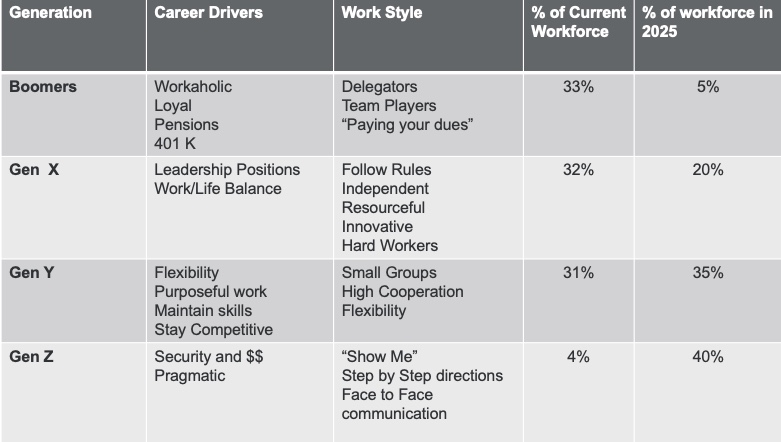
Let's examine some statistics on the generational makeup of the workforce as shown in Figure 1.
Figure 1. Generational makeup of the workforce.
This chart shows the career drivers, work styles, and percentage of each generation currently in the workforce as of 2020. It also projects the percentages for 2025, which show some shifts occurring mostly with the oldest and youngest generations.
Baby Boomers
Baby Boomers are the first generation to actively prioritize work over personal life. They distrust authority and large organizations. Their values were shaped by the rise of civil rights and the Vietnam War era. Boomers are optimistic yet responsible for the “Me Generation” moniker.
As parents of Gen X, their career drivers are a strong work ethic and company loyalty, hoping for financial stability through pensions and 401Ks. Their work style tends towards delegating and teamwork, believing you should pay your dues and work up the ladder.
In 2020, Boomers comprised 33% of the workforce, but are projected to shrink to just 5% by 2025 due to retirements.
Generation X
Generation X has been called the “slacker” generation but also the “sandwich” generation. They question authority but initiated the concept of work-life balance, unlike their career-driven Boomer parents.
Born into declining population growth, Gen Xers possess strong technical skills and more independence than previous generations. They prioritize work less, leading older Boomer managers to sometimes question their dedication. However, Gen Xers follow rules and are resourceful, innovative, and driven to develop niche skills that allow them to take on challenges. They are perceived as adaptable and less concerned with long-term job stability, changing jobs readily.
In 2020, Gen X was about 32% of workers, remaining steady at around 20% by 2025.
Millennials/Gen Y
Millennials or Gen Y are the first truly global generation, coming of age during rapid internet growth and rising international terrorism. They adapt well to change and deeply value diversity and inclusion. Their educational opportunities expanded significantly due to tech advances during their upbringing.
Millennials are considered the most teamwork-oriented generation today. They grew up heavily programmed by parents with structured activities, while Boomer parents intensely focused on careers. Millennials are our most optimistic generation.
Their percentage in the workplace has remained relatively stable at around 30-35%.
Gen Z
Generation Z is gradually replacing the retiring Veteran Generation. They are our youngest employees, comprising about 5% of the workforce in 2020 but estimated to rise to over 20% by 2025. Gen Z is highly concerned about financial security. They are more pragmatic than Millennials and thrive when given clear direction through step-by-step coaching and frequent face-to-face communication with leadership. Since Gen Z will make up the largest percentage of the 2025 workforce, paying attention to their needs can greatly benefit companies looking to expand.
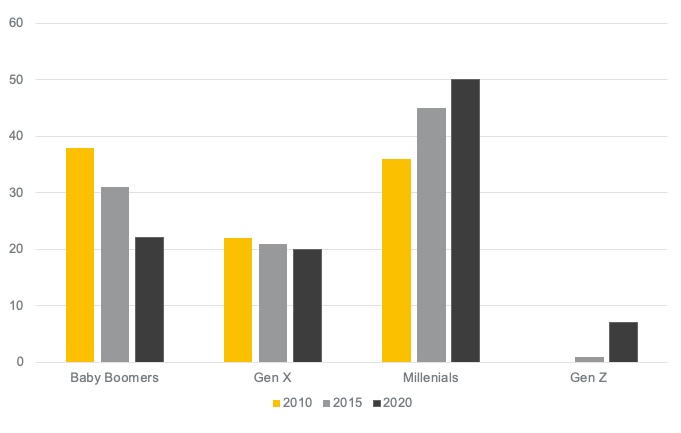
This chart shows the generation workforce shifts (Figure 2).
Figure 2. Generation workforce shifts.
This chart illustrates the population shifts in the United States over the years 2010, 2015, and 2020. The graphs use different colors to represent each respective year: yellow for 2010, gray for 2015, and darker gray, almost shading towards black, for 2020.
The data indicates that the Baby Boomer generation (born between 1946 and 1964) is experiencing a decline in population percentage due to natural aging. Gen Xers (born between 1965 and 1980) have remained relatively steady but occupy a lower portion of the percentage. Meanwhile, Millennials (born between 1981 and 1996) are gradually increasing in population share, reflecting their growing presence in the US population. Additionally, Generation Z (born between 1997 and 2012) is also witnessing a rise in population percentage.
Please note that this data is specific to the year 2020 and does not project beyond that year. To obtain the latest and most comprehensive population information, it is advisable to refer to up-to-date sources from reputable organizations.
Generational Events
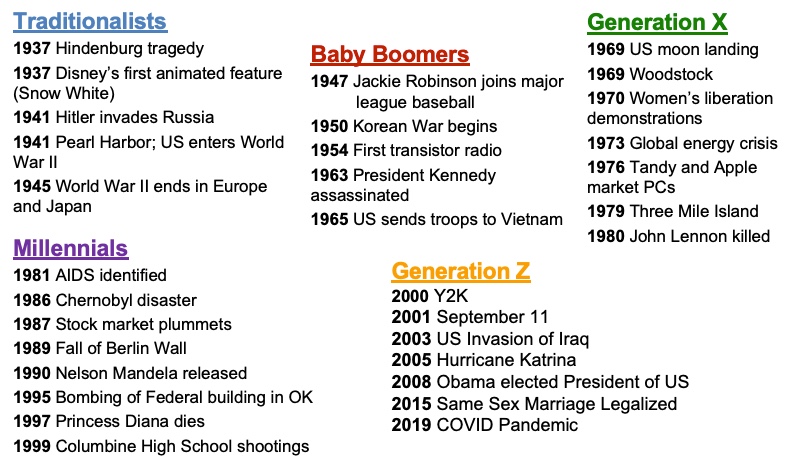
Let's explore some major historical events occurring during each generation's formative years, which helped shape their perspectives (Figure 3).
Figure 3. Major events for each generation.
- Traditionalists - The 1937 Hindenburg explosion, WWII beginning in 1941, and WWII ending in 1945. Overall, many wars and tragedies.
- Baby Boomers - Jackie Robinson breaking baseball's color barrier in 1947, the Korean War in 1950, JFK's assassination in 1963, and the Vietnam War ramping up in 1965.
- Gen X - The 1969 moon landing, 1969 Woodstock festival, 1970s women's liberation movements, the 1973 global energy crisis, and the 1979 Three Mile Island nuclear accident.
- Millennials - The HIV/AIDS crisis, 1986 Chernobyl disaster, 1987 stock market crash, fall of the Berlin Wall in 1989, Columbine High School shooting in 1999.
- Gen Z - 2000 Y2K scare, 9/11 attacks in 2001, Iraq War starting in 2003, Hurricane Katrina in 2005, Obama elected president in 2008, legalized same-sex marriage in 2015, COVID-19 pandemic beginning in 2019.
You can see how major historical events during these formative years likely shaped societal perspectives to some degree for each generation.
Compelling Generational Messages
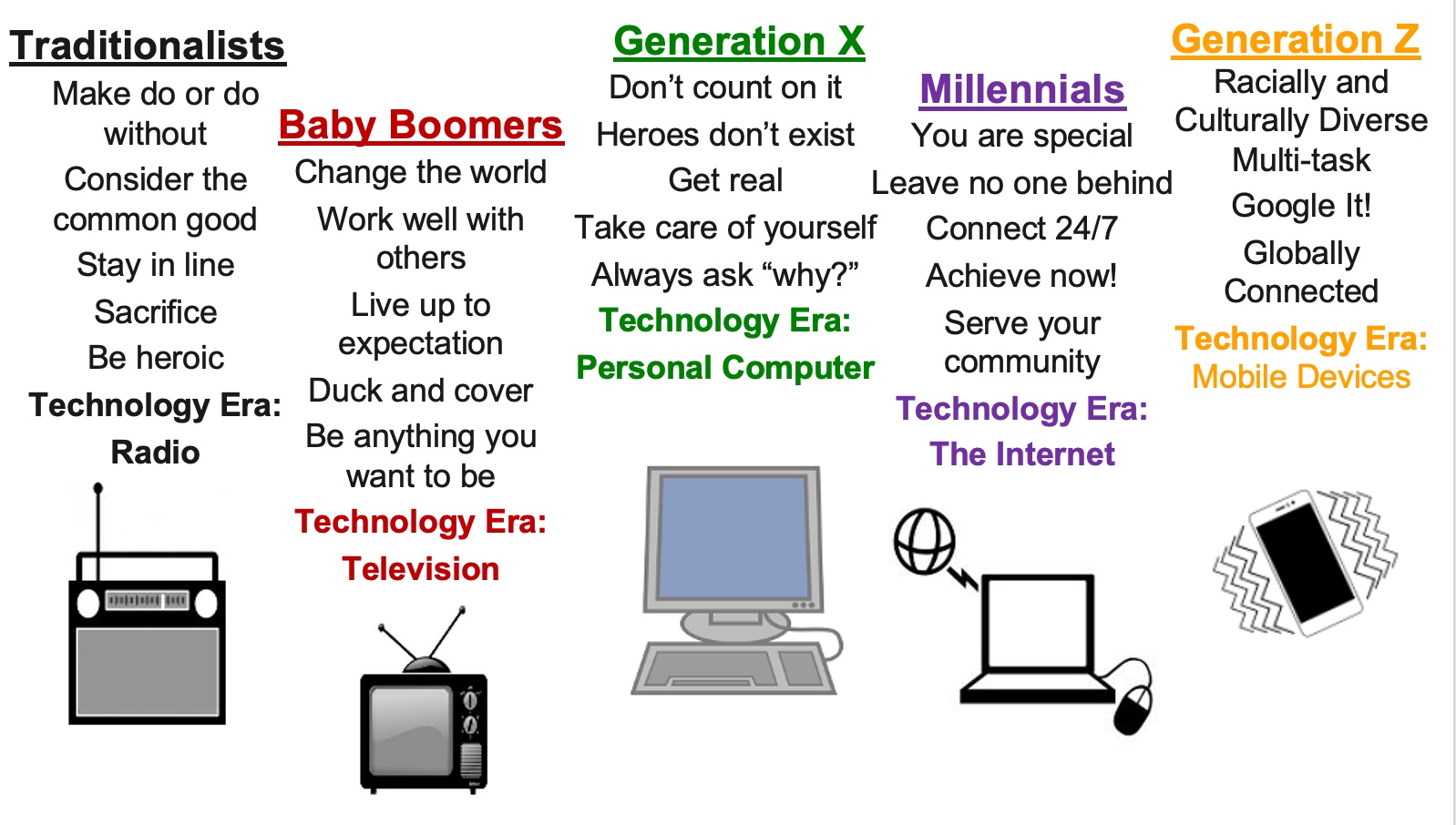
What were some of the compelling societal messages dominating during these generations’ upbringings? Figure 4 shows an overview.
Figure 4. Overview of compelling generational messages.
During the formative years of each generation, they experienced significant historical events that shaped their perspectives and beliefs.
Traditionalists
The traditionalists, born before 1946, witnessed events like the Hindenburg tragedy and World War II, which emphasized sacrifice and unity for the common good. They were told to "make do or do without" and to be heroic during challenging times. Their technology was limited to the transistor radio, which provided them with news and information.
Baby Boomers
Baby boomers, born between 1946 and 1964, saw the desegregation shift in major sports like baseball when Jackie Robinson joined the Major leagues. They lived through significant events like the Korean War and the assassination of President Kennedy. They were encouraged with messages that they could change the world and work together for a better future. The introduction of the first transistor radio allowed them to access real-time information.
Generation X
Gen Xers, born between 1965 and 1980, witnessed the moon landing and Woodstock, events that influenced their sense of exploration and questioning authority. They experienced the energy crisis and the advent of personal computers. They were encouraged to be independent, question authority, and were told that heroes don't exist. The introduction of personal computers provided them with a new way to explore information.
Millennials
Millennials, born between 1981 and 1996, lived through events like the fall of the Berlin Wall and the 9/11 terrorist attacks. They received messages that they were special, should achieve now, and be good citizens. The education system became more inclusive, and they were connected 24/7 through the internet. The expansion of technology, particularly the internet, provided them with access to vast information.
Generation Z
Gen Z, born after 1997, grew up in a culturally diverse and globally connected world. They became adept at multitasking and had instant access to information through smartphones and the internet. They received messages of empowerment and inclusivity. Technology, especially smartphones and portable devices, became an integral part of their lives. Each generation's experiences and the messages they received during their formative years contributed to shaping their unique characteristics, perspectives, and attitudes toward the world around them.
These events and messages played a crucial role in molding each generation's values, beliefs, and understanding of the society they grew up in.
Challenges Vs. Opportunities
- Baby boomers or Traditionalists can see younger employees as children and act parental.
- Gen X or Gen Y in management may treat older employees as parents/grandparents.
- Managers not holding them accountable.
- Identifying and addressing these differences can reap the benefit of multi-generational strengths.
These generational differences understandably can pose significant workplace challenges. For example, there is a tendency for older employees to view younger workers almost as their own children, acting in a parental rather than professional manner of accountability.
Conversely, when younger employees step into leadership roles overseeing older staff, they may feel as if they are managing their parents or grandparents. It takes substantial emotional intelligence and communication skills to navigate these multi-generational dynamics.
For managers and HR professionals especially, it is crucial to understand and appreciate generational differences, along with the influences shaping various age groups. Subtle similarities exist across generations, and healthcare workplaces can benefit greatly when generational diversity is managed effectively, drawing out the unique skills and talents of each age group more fully than a homogenous workforce could. Understanding how to lead different generations and tailor to their needs can foster greater harmony and satisfaction.
Strategies to Effectively Lead and Manage the Various Generations in the Workplace
Understanding the different generations' values and preferences in the workforce can lead to more effective and harmonious interactions.
For Gen Z, active listening and valuing their input are crucial, as they often think outside the box and have unique perspectives. Offering creative work environments can attract them to an organization, especially as they are projected to make up a significant portion of the future workforce.
Veteran/Traditionalists
- Value their experience
- Spend adequate time in orientation and training activities
- Extra time w/ technology
- Respect common norms of courtesy
For veterans or traditionalists, it's crucial to recognize the value of their experience and provide adequate training to adapt to technological changes. Respecting their preferences for face-to-face interactions and common norms of courtesy fosters a positive work environment for them.
Baby Boomers
- Show them how they can be an organizational star
- Provide them with developmental opportunities
- Involve them in operational matters.
- Phased Retirement
- Health / Wellness Programs
Baby boomers appreciate recognition and involvement in operational matters, and offering flexible work options and health and wellness programs can help retain them.
Generation X
- Partner them with mentors that they respect
- Promote work/life balance
- Refrain from giving them too much extended hands-on supervision.
- Reward for productivity
Gen Xers thrive when partnered with respected older colleagues and prefer a work-life balance. Providing clear instructions and allowing them autonomy in their tasks enhances their productivity.
Generation Y/Millennials
- Provide them with structure
- Be generous with training and orientation activities
- Partner them with boomers as mentors
For millennials, structured training and orientation activities are essential, and pairing them with boomer mentors can be beneficial. Listening to their ideas, encouraging creativity, and providing spaces for them to be innovative cater to their preferences.
Generation Z
- Channel their creativity/Listen to their ideas
- Encourage them to communicate outside of technology
- Provide pleasant working environments
- Projected to make up the largest % of the workforce by 2025
For Gen Z, active listening and valuing their input are crucial, as they often think outside the box and have unique perspectives. Offering creative work environments can attract them to an organization, especially as they are projected to make up a significant portion of the future workforce.
The Generations At Work
- Not everybody in the workplace is motivated by the same things anymore.
- Getting the most out of each generation requires flexibility.
- When companies get it, both the company and the employees win.
It is important to recognize that not all employees are motivated by the same factors. This allows organizations to be flexible and cater to the needs of each generation. When companies understand and meet these needs, it leads to a win-win situation, reducing turnover and fostering a positive and productive work environment. By acknowledging and adapting to the preferences of different generations, organizations can create a more cohesive and successful workforce.
Evidence of Conflicts
- “They have no work ethic. They’re a bunch of slackers.”
- “So I told my boss, if you’re looking for loyalty, buy a dog.”
- “If I hear, ‘We tried that in ‘87 one more time, I’ll hurl.’”
- "I have a new rule. I will not attend meetings that start after 5 PM - I have a life.”
- “Lighten up! Work should be fun.”
- “Many of the interviewers did not understand my windy path through employment, which is, of course, a characteristic of my generation. They didn’t understand I wasn’t looking for one job for the rest of my life and that I wasn’t looking for money and status.”
When encountering statements or attitudes like "they have no work ethic" or "they're a bunch of slackers," especially if they are attributed to specific generational groups, it may indicate a lack of understanding and communication between different generations in the workplace. These perceptions can stem from stereotypes and generalizations that may not accurately represent individuals within those groups. Such sentiments suggest a need for better intergenerational understanding and collaboration.
The expression "if you're looking for loyalty, buy a dog" reflects a desire for a more meaningful and purpose-driven work experience, where employees seek reasons behind tasks and may challenge traditional hierarchical structures. This kind of attitude might arise from the perspective of a younger generation seeking more fulfillment and growth in their careers.
Furthermore, individuals from different generations may have diverse career paths and expectations. Some may prefer stability and loyalty to one employer, while others seek varied experiences and opportunities for personal and professional development. Understanding these differences is essential for organizations to attract and retain the right talent.
It is crucial for employers to be mindful of the language used during interviews and the questions asked to attract individuals who align with the organization's long-term goals and values. Recognizing and valuing diverse career paths and motivations can lead to a more inclusive and harmonious work environment where employees from all generations can thrive. Building bridges of understanding and open communication between generations can foster a culture of respect and collaboration, ultimately benefiting the organization as a whole.
Generational Perspectives: A Quiz
Let’s explore our own generational perspectives a bit. I will ask some simple poll questions where you can select the choice that best fits you (Poll generated during the live event).
1. Which of the following is your preferred communication style in the office?
A. In person
B. Phone/e-mail
C. E-mail/texting
D. Texting
The majority of respondents prefer in-person communication, followed by phone/email. Only a small percentage favors just texting. This indicates a preference for personal interaction over digital-only contact.
2. How do you define your work-life balance?
A. I don’t have one: long hours to maintain job security
B. I don’t have one: long hours = identity/sense of contribution
C. I have a balance
D. I’m working on it
Most respondents are working on achieving better balance, implying a desire for greater equilibrium. Very few view work as fully defining their identity. Over a third believe they have attained a good work-life blend, which provides hope it is possible.
3. What is your idea of a reward for a job well done?
A. Pat on the back
B. Money, title, recognition
C. Freedom – day off
D. More meaningful work/projects
The top choice was monetary or title/recognition rewards – extrinsic, tangible forms of appreciation. Almost equal numbers favor more freedom/time off or simply verbal praise. A smaller but meaningful segment finds meaningful work itself the biggest reward.
4. Why would you change jobs or companies?
A. Wouldn’t - company loyalty
B. To do something different
C. It’s necessary
D. Routine
No one would change jobs routinely as part of strategic career planning. The reasons were evenly split between required moves for more money or different opportunities and loyalty to a current workplace. This conveys both pragmatic and idealistic motivations for leaving a position.
Overall these informal polling questions can provide insights into multigenerational preferences that may inform management approaches for optimal satisfaction. Hearing directly from employees is ideal.
Challenges for Managers
What do members of each generation seek that managers can address?
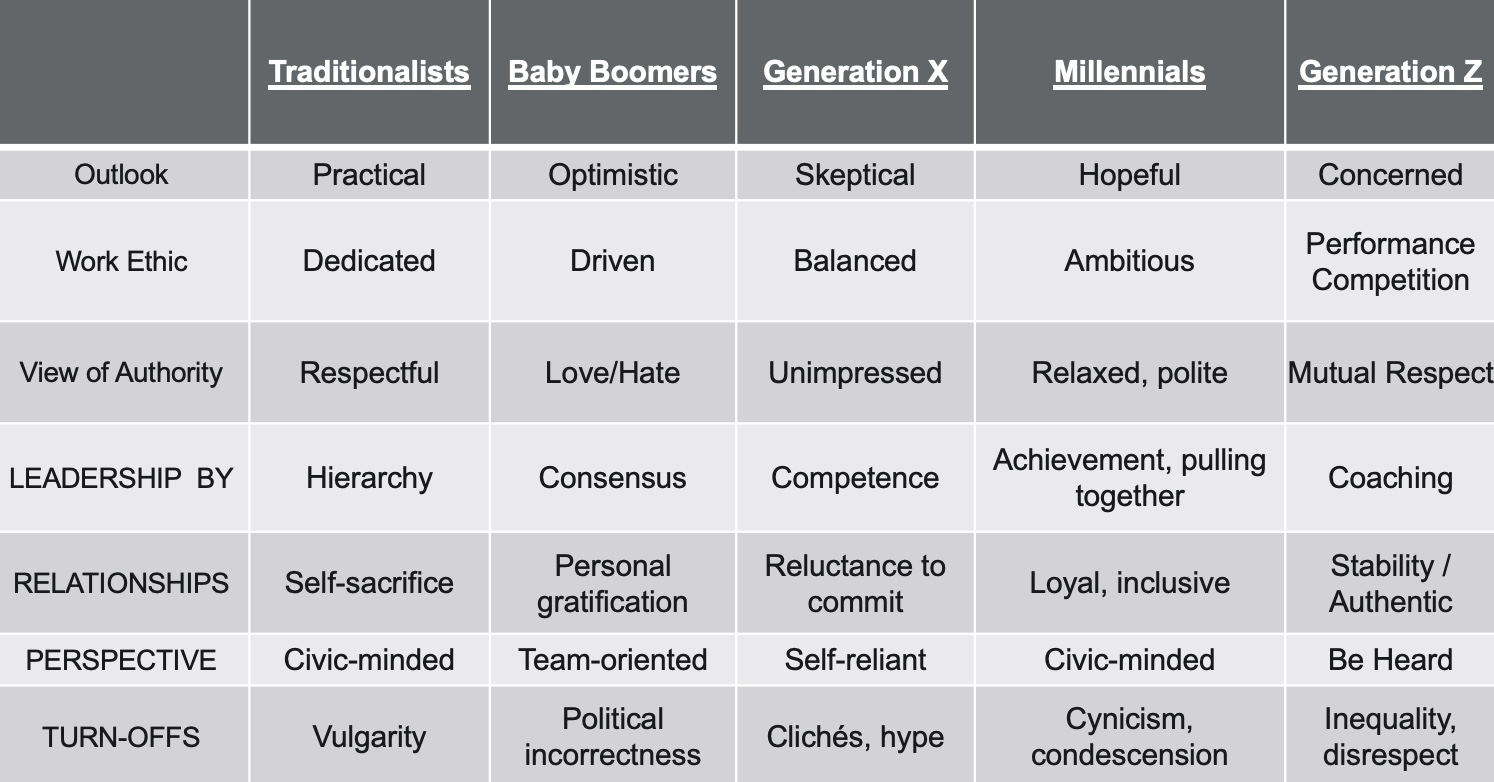
Figure 5. Challenges for managers for each generation.
Each generation presents unique challenges for managers and supervisors in the workplace. Understanding the different outlooks and characteristics of each generation can help managers tailor their leadership approach and create a harmonious work environment.
Traditionalists
For traditionalists, managers should recognize their dedication to work and value their experience. Providing adequate training and orientation, especially in the face of changing technology, will ensure their success in the evolving workplace.
Baby Boomers
Baby boomers, driven and ambitious, thrive when given opportunities to showcase their skills and be involved in operational matters. Offering phased retirement or flexible work options can help retain their expertise while respecting their desire for work-life balance.
Generation X
Gen Xers appreciate competent leaders and desire a balanced work-life approach. Managers should give them space to excel and avoid excessive supervision, acknowledging their competence and providing clear expectations.
Millennials
Millennials prefer collaborative leadership and a sense of equality within the team. Managers should focus on building strong teams and recognizing individual contributions. Offering flexible work arrangements, wellness programs, and opportunities for personal growth can boost their loyalty and engagement.
Generation Z
Gen Zs seek respect and authenticity in relationships with authority figures. Coaching and mentoring programs, with experienced colleagues rather than direct supervisors, can help them navigate the workplace and develop their potential.
Managers should be mindful of factors that may turn off each generation, such as vulgarity for traditionalists, political incorrectness for baby boomers, cliques for Gen Xers, cynicism for millennials, and inequality for Gen Zs. Being sensitive to these preferences can foster a more inclusive and supportive work environment.
Recruiting and Retaining Talent
- Time off as opposed to increased compensation
- Wellness Programs
- Mentoring
- Opportunities for remote work
To recruit and retain talent, offering time off, wellness programs, and mentoring opportunities can be effective strategies. Providing opportunities for remote work, where feasible, can also cater to the increasing desire for flexibility among different generations.
By understanding and adapting to the diverse needs and perspectives of each generation, managers can create a cohesive and productive workforce, leading to greater job satisfaction and reduced turnover.
To recruit and retain our Gen Xers, millennials, and Gen Zs, there are some specific strategies.
Generation X at Work: Recruit and Retain
- Show them lots of options for their workplace schedule.
- Allow them to work autonomously.
- Tap into their adaptability. Generation Xers are typically flexible, and many are independent operators. Give them an important task that needs to get done; they’ll likely get it handled!
- Give FAST (Frequent, Accurate, Specific, Timely) feedback in order for them to build their skills and improve their resumes.
Gen Xers highly value workplace schedule options and flexibility, allowing them to work autonomously and adapt to different situations effectively. When assigning them important tasks, it's essential to give them the necessary time to accomplish them.
In terms of feedback, the FAST acronym is ideal—providing frequent, accurate, specific, and timely feedback helps them develop their skills and seize greater opportunities for growth.
Millennials / Gen Z at Work: Recruit and Retain
- Tap an outstanding employee from the Millennial or Gen Z Generation to talk to the candidate about the company.
- Provide flexibility to allow them to pursue their many outside interests.
- Get them involved in meaningful volunteer efforts. These workers are community-oriented and are graduates of required community service hours.
- Count them in on benefits like 401(k) plans. Millennials and Gen Z are financially savvy.
- Use their capability to access and share information quickly. This is the most technologically and globally aware generation.
- Pair them up with older mentors.
- Help them learn interpersonal skills for the workplace. They may need to be rescued from difficult situations while they develop these skills.
For millennials and Gen Zs, certain factors can encourage them to stay in the workplace. Ensuring diverse representation during the talent attraction process is crucial; they appreciate having someone from their generation who can relate to them during interviews. Flexibility remains a significant appeal, and incorporating volunteer efforts aligns with their civic-mindedness. Providing opportunities for one paid day to engage in community-oriented projects resonates well with them.
These generations are financially savvy, so discussing 401K plans and other benefits is important, especially since many may have student loans to manage. Utilizing technology for information sharing is essential, given their tech-savviness. Mentoring programs can assist in nurturing their interpersonal skills, as they might excel with technology but require guidance in social situations.
What is in Common?
- Flexibility is important regarding work-life balance.
- The highest indicator of satisfaction is to feel valued on the job.
- Career development is a high priority.
- A supportive work environment where they are recognized and appreciated with rewards for results.
- And, most importantly, all generations value trust and want respect.
All of our groups share common desires and priorities. They value flexibility and work-life balance, seeking job satisfaction and feeling valued in their roles. Understanding the rewards that motivate each individual is essential for effective management. Career development is particularly significant for the younger generations, as they aspire to progress and achieve their goals within the organization. A supportive work environment, where recognition and rewards align with their values, is crucial. They also appreciate being trusted and respected, and in turn, they reciprocate that trust and respect to their colleagues. Building a workplace that caters to these common needs can enhance employee satisfaction and retention across all generations.
General Strategies
- Provide structure
- Provide leadership/guidance/coaching
- Create Opportunity for “Can do Attitude” – Set up Success
- Reward Team Work
- Provide Work/Life Balance
- Seek Feedback/Listen
- Employee Centered Workplace
General strategies for managing and guiding these generations include providing a structured environment with clear expectations. Adopting a coaching approach to leadership rather than a rigid directive style is beneficial. When giving feedback, it's essential to recognize and highlight their strengths. Creating a culture that allows for learning from mistakes and turning them into valuable lessons is crucial. Rewarding teamwork and recognizing the contributions of the entire team, rather than solely focusing on individuals, aligns well with the collaborative nature of younger generations. By implementing these strategies, managers can foster a positive and productive work environment for Gen Xers, millennials, and Gen Zs.
Professional Communication
- Essential for Working Relationships
- Correlated with Positive Patient Outcomes
- Healthcare Workers Satisfaction or Stress
- Patient Safety
- Public Satisfaction
Effective communication has been linked to positive patient outcomes, increased worker satisfaction, improved safety, and a positive perception of our organizations in the public domain. Various communication style inventories are available to assess and enhance communication skills.
Self Assessment of Personal Communication Style
- When is the last time you took the time to assess your own communication style?
- What color is your brain?
- Based on the work of Sheila Glazov
- Brief assessment with no right or wrong answers
- The outcome provides you with your dominant brain color
- https://www.sheilaglazov.com/brain-quizzes/
You may be familiar with popular communication style assessments like Myers-Briggs, but I would recommend exploring a different one based on the work of Sheila Glaszov. This brief assessment is easy to take, and there are no right or wrong answers. By participating in these free brain quizzes or color brain quizzes, you can discover your dominant communication style outcome.
Four Distinct Brain Colors
- Yellow Brainers are responsible, organized, stressed w/ disorganization, and direct communicators; 30-40% of people
- Blue Brainers are communicative, helpful, tend to over-extend themselves, yet are inspirational; 30-40% of people
- Green Brainers are logical, independent, stressed when they do not have adequate resources and value efficiency; 10-15% of people
- Orange Brainers are dynamic, fun-loving, more informal communication style, and do not like monotony; 10-15% of people
According to this inventory, there are four distinct brain colors, with yellow and blue brains being the most predominant, making up around 30 to 40% of the population each. Yellow brain individuals are known for their responsibility and organizational skills. They prefer direct communication and appreciate receiving factual information.
On the other hand, blue brain individuals are communicative, helpful, and often inspirational. They have a tendency to overextend themselves in their efforts to assist others.
Green brain individuals, comprising about 10 to 15% of the population, are described as logical, independent, and efficient. They value having adequate resources and can experience stress when faced with insufficient support.
The remaining 10 to 15% of the population are orange brains. They are dynamic, fun-loving, and prefer an informal communication style. Orange brains are often creative individuals who enjoy storytelling when sharing information, and they thrive in environments that offer variety and avoid monotony.
It's worth noting that individuals may possess a specific brain color regardless of their generational affiliation, as brain color and work style can differ even within the same generation.
Ideal Conditions in the Workplace
- Once you determine your dominance and the dominance of those on the team, you can create work conditions that play to the strengths of the team members
- Remember People Thrive when their attributes and abilities are acknowledged
Acknowledging and embracing the diversity of communication styles in the workplace can have a significant impact on both effective communication and potential miscommunication. When individuals are aware of their dominant communication style and recognize the dominant styles of their colleagues, leaders, managers, and team members, this can create a work environment that capitalizes on the strengths of each individual.
By understanding and appreciating the unique attributes and abilities of each team member, leaders can tailor work conditions to allow employees to thrive in their roles. This recognition fosters a positive work culture that values and encourages individual styles, leading to improved communication, collaboration, and overall team performance.
When individuals feel acknowledged and supported in their particular communication style, they are more likely to feel engaged and motivated in their work, leading to increased productivity and job satisfaction. Embracing diversity in communication styles can create a cohesive and harmonious workplace that maximizes the potential of all team members.
When Communicating To:
- Yellow Brainers
- Be Polite and punctual
- Respect their personal values of organization and rules
- Stay on track
- Tell them all the details
- Encourage them to talk about their achievements
- Blue Brainers
- Show you are actively Listening
- Respect their emotions
- Use stories to explain your point of view
- Connect with them personally
- Encourage them to talk about their family
- Green Brainers
- Do not make small talk
- Respect their privacy
- Be brief, but informative
- Give them lots of data and statistics
- Encourage them to talk about their knowledge and offer solutions
- Orange Brainers
- Be direct
- Respect their spontaneity
- Make your point quickly
- Give them the results, not facts and figures
- Encourage them to talk about their personal lives (hobbies or vacations)
Tailoring communication to the different dominant brain styles can greatly enhance understanding and collaboration in the workplace. When communicating with yellow-brained individuals, it's essential to be polite, punctual, and organized, as they value structure and adherence to rules. Staying on track and providing details while encouraging discussions about their achievements can be effective strategies to engage them.
For those with a dominant blue brain, active listening is crucial, as they often express emotions and appreciate stories. Connecting with them personally and showing interest in their lives outside of work fosters a positive rapport.
Conversely, green-brained individuals prefer brief and informative communication, focusing on data and statistics. Encouraging discussions about their knowledge and proposed solutions aligns well with their style.
Orange-brained individuals prefer direct communication and tend to be spontaneous. Providing quick, results-focused messages without delving into extensive facts and figures is more effective when interacting with them. Engaging in conversations about hobbies, vacations, and personal lives can help build rapport with orange-brained individuals.
By understanding and adapting communication approaches to these dominant brain styles, leaders, managers, and team members can promote a more harmonious and productive work environment where each individual feels acknowledged and valued for their unique attributes and preferences.
How to Stay Motivated
- Yellow Brainers
- Keeping a positive attitude
- Scheduling time off to re-charge
- Taking on a new task: "I know I can do it”
- Blue Brainers:
- Performing tasks they enjoy doing
- Developing friendships with other team members
- Tapping into their creativity
- Green Brainers
- Taking continuing education classes
- Being able to research new ideas
- Scheduling time to read books and articles
- Orange Brainers
- Doing something new each day
- Scheduling time for fun and exercise
- Enjoying social activities with team members outside of work
To effectively motivate individuals with specific dominant brain mindsets, it is essential to understand their preferences and tailor the motivational approach accordingly.
For yellow-brained individuals, creating a positive work environment, acknowledging their organizational skills and adherence to rules, and providing time off for rejuvenation are key factors. Assigning tasks that align with their optimistic outlook and validating their confidence in their abilities will also boost their motivation.
For blue-brained individuals, encouraging them to focus on tasks they enjoy and excel at, fostering positive social interactions within the team, and tapping into their creativity are important strategies. Offering projects that inspire them and allow them to showcase their inspirational abilities will further motivate them.
Green-brained individuals thrive on learning and logical thinking. Providing opportunities for continuing education, encouraging exploration of new ideas, and offering tasks involving data analysis and critical thinking will keep them motivated. Allowing time for them to engage in learning activities that promote growth is equally essential.
For orange-brained individuals, incorporating novelty and new experiences into their daily tasks, scheduling fun and social activities, and involving them in planning and organizing social events are effective ways to keep them motivated. Providing opportunities for them to take on exciting challenges regularly will further fuel their enthusiasm.
By recognizing and catering to the unique preferences and strengths of each dominant brain style, leaders and managers can create a motivational work environment where team members feel valued and engaged, leading to increased job satisfaction and overall performance improvement.
Motivating Others- Often The Way You Are Wired
- Yellow Brain
- Praise/acknowledge achievements
- Demonstrate excellence
- Expect the best from the team
- Green Brain
- Set reasonable goals
- Offer incentive or education
- Fair feedback
- Blue Brain
- Good job gifts
- Share inspirational stories
- Showing interest in life outside work
- Orange Brain
- Team celebrations
- Contests w/in department
- Giving pep talks
Understanding how to motivate others is crucial because people's preferences for motivation can differ significantly. It's a common mistake to assume that what motivates us will work for others. Tailoring motivational approaches to individual brain styles can yield better results.
For yellow-brained individuals, praise and recognition for their achievements are powerful motivators. They appreciate when their excellence is acknowledged and expect the best from their team.
Blue-brained individuals value tangible rewards and gifts as symbols of appreciation. Sharing inspirational stories, both personal and from others, can boost their motivation. Showing interest in their life outside of work also fosters a positive connection.
Green-brained individuals thrive when goals are reasonable and attainable, with incentives to work towards. They value fair and balanced feedback, encompassing both positive recognition and constructive criticism.
Orange-brained individuals excel when team celebrations and fun contests are organized within the department. Pep talks and encouragement make them excellent cheerleaders within the workforce.
By recognizing and catering to these unique preferences, leaders can create a motivating work environment where individuals feel valued, leading to increased engagement and overall productivity.
Takeaways
- Strive to develop empathy and understanding of generational characteristics – ultimately, the organization will be more effective and profitable
- Team diversity can breed great success – this variety of experience provides essential tools to handle challenges faced by an organization
- We do not all communicate the same nor do we see situations from the same point of view.
- Becoming knowledgeable of the differences can allow us to enjoy the rainbow of generational cohorts and brain colors in today’s workplace.
In conclusion, the key takeaways from this presentation emphasize the importance of developing empathy and understanding for the different generations within our organizations. Respecting and embracing the diversity of communication styles and experiences in the workplace can lead to enhanced effectiveness and profitability. By fostering diverse teams with people of different ages and brain colors, we gain valuable tools to overcome various challenges.
Recognizing that we all have unique ways of communicating and perceiving the world, shaped by our experiences and upbringing, enables us to respect and appreciate one another. Becoming knowledgeable about our differences allows us to build stronger connections based on generational and brain dominance attributes, ultimately bringing out the best in our workplace.
For further reference, the sources used in creating this presentation are listed. If you have any questions or concerns, please feel free to email me at the provided address. Thank you for your time and attention.
References
Arrington, G., & Dwyer, R. (2018). Can four generations create harmony within a public-sector environment? International Journal of Applied Management and Technology, 17:1, 1-21.
Baik, D., Blakeney, E. A-R., Willgerodt, M., Woodard, N., Vogel, M., & Zierler, B. (2018). Examining interprofessional team interventions designed to improve nursing and team outcomes in practice: A descriptive and methodological review. Journal of Interprofessional Care, 32, 719-727. https://doi.org/10.1080.13561820.2018.1505714
Christensen, S. S., Wilson, B. L., & Edelman, L. S. (2018). Can I relate? A review and guide for nurse managers in leading generations. J Nurs Manag, 00:1–7. https://doi.org/10.1111/jonm.12601
Clark, K. R. (2017) Managing multiple generations in the workplace. Radiol Technol, 88(4):379-396. PMID: 28298496.
Glazov, S., & Knoblauch, D. (Eds.). (2015). What color Is your brain? When caring for patients: An easy approach for understanding your personality type and your patient’s perspective. SLACK Incorporated.
Hisel, M.E. (2020) Measuring work engagement in a multigenerational nursing workforce. Journal of Nursing Management, 28(2), 294-305.
Lewis, L. F., & Wescott, H. D. (2017). Multi-generational workforce: Four generations united in lean. Journal of Business Studies Quarterly, 8(3), 1.
Citation
Provident, I. (2023). Multiple generations in the workplace: Effective communication to enhance diversity. OccupationalTherapy.com, Article 5627. Available at https://OccupationalTherapy.com
Oct 23, 2023
1 CE HourStaying Grounded Through Workplace Trauma
Ten'Niquwa "Nikki" Bryan, B.A.S, M.S.
Editor’s note: This text-based course is an edited transcript of the webinar, Staying Grounded Through Workplace Trauma, presented by Ten'Niquwa "Nikki" Bryan, M.S in I/O Psychology.
It is recommended that you download the course handout to supplement this text format.
Learning Outcomes
After this course, participants will be able to:
- List strategies to identify workplace trauma, individually and as a team
- Identify the effects of workplace traumas on RTs
- Discuss how to optimize work-life balance during and post workplace trauma
I am an Industrial Organizational Psychologist, commonly known as an I/O Psychology Practitioner. I specialize in various areas within I/O Psychology, but my primary focus lies in partnering with companies and organizations to prioritize their workforce's well-being by fostering a healthy work-life balance and equality.
My expertise extends to leadership development, organizational enhancement, optimizing workplace efficiency, and enhancing employee contentment. Through my company, I am committed to collaborating with leaders across sectors such as healthcare to bridge the gap between management and employees. I achieve this through intuitive coaching and evidence-based consulting practices.
Through extensive research, I have concluded that mindset and emotions play integral roles in our daily endeavors. Moreover, I have observed a reluctance to address workplace trauma despite its prevalent occurrence. It is crucial to acknowledge and tackle these issues to ensure organizational vitality.
Over recent years, there has been a notable shift towards recognizing the significance of human capital within organizations. The maxim, "The organization's most valuable resource is its human resource," has gained widespread acceptance. It is encouraging to witness management increasingly prioritize the human element.
Acknowledging and addressing loss, grief, and trauma in the workplace contributes to overall employee well-being. Failure to do so can impede organizational efficacy. Before delving further, I extend my gratitude to you for joining us and investing in your personal development. Whether you have attended my presentations in the past or not, I commend all frontline workers, particularly those in healthcare, for their resilience during the unprecedented challenges posed by the COVID-19 pandemic.
The Triggers
Allow me to express collective gratitude for your service. As we proceed with today's presentation, I encourage everyone to take notes actively. Alongside the information I will be imparting, I urge you to also introspect on your feelings, thoughts, emotions, and any triggers you may identify. While being trauma-informed is crucial, understanding how to respond when confronted with trauma is paramount. In the event that you find yourself profoundly affected or triggered for any reason, rest assured that professional support is readily accessible. I strongly advise you to seek assistance if such a situation arises. Your well-being is of utmost importance.
What is Workplace Trauma?
Before delving into the intricacies of workplace trauma, let's first establish a clear understanding of what trauma entails. Trauma is a component of a trilogy: loss, grief, and trauma. Loss refers to events such as the loss of life or a sense of security, while grief encapsulates the emotional response to such losses. Trauma, on the other hand, manifests as psychological or physical wounds inflicted by these losses. Psychological trauma can affect anyone, regardless of background or circumstance; no individual is immune to its impact.
In the workplace, the inevitability of trauma looms. Workplace trauma, also known as career trauma or workplace PTSD, manifests as an emotional reaction to adverse events encountered in a professional setting. These events encompass accidents, natural disasters, and exposure to toxic work environments. It is not uncommon for individuals to experience some form of workplace trauma during their careers. Whether enduring a hostile work environment, suffering from bullying or harassment, or witnessing violent acts, the toll on one's mental health can be significant. If any of these scenarios resonate with you, gaining clarity on the concept of workplace trauma is paramount.
Workplace trauma can be defined as the physical or psychological harm inflicted upon employees while on the job. It spans from witnessing traumatic incidents to experiencing violence or abuse firsthand. Its impact should not be underestimated, as it can severely impair job performance and even result in job loss. Now, let's explore the root causes of workplace trauma.
Firstly, it is important to acknowledge that trauma can affect entire communities. For instance, disasters like global pandemics, such as COVID-19, or natural calamities like hurricanes or floods can have widespread traumatic repercussions. Allow me to share a personal experience: I hail from the U.S. Virgin Islands, and in 2019, Hurricanes Irma and Maria wreaked havoc across the Caribbean. On Saint Thomas, one of the Virgin Islands, the local hospital faced dire circumstances. Operating solely on generators, half of the facility lay in ruins with no roof, and the entire structure was condemned. Nurses and doctors turned to social media, desperately pleading for aid. Their anguish was palpable, evident in their heartfelt pleas and the agonizing choices they faced regarding patient care amidst scarce supplies, electricity, and staffing shortages.
The aftermath of such disasters extends beyond the hospital's confines. With homes condemned and transportation hindered by fuel shortages, the entire island community bore the brunt of the catastrophe. Spanning a mere 3,200 square miles, options were limited, with only one hospital serving the entire area. Its condemnation marked a traumatic event for all involved.
Furthermore, trauma encompasses a spectrum of experiences, including technological breakdowns or deliberate acts of violence like mass shootings or perceived threats. It is crucial to recognize that trauma can be induced by threats alone, without the occurrence of an actual event.
Moreover, it is not just the breadth of loss factors that warrants attention; the depth of loss is equally significant. Loss experiences can profoundly impact individuals, groups, or organizations, potentially resulting in life-altering consequences or irreversible turning points. While addressing death-related issues in the workplace is crucial, it is equally vital to acknowledge a wide array of significant losses unrelated to death. These may include divorce, disability, chronic illness, victimization, or layoffs, each capable of shattering confidence and sense of security, plunging individuals into states of trauma.
Causes of Workplace Trauma
- Hostile work environment
- Being the victim of bullying or harassment
- Witnessing a violent act
- Being the victim of violence or abuse
- Non-life-threatening injuries
- Emotional abuse
- Workplace relationships/breakups
- Intimidation
- The experience of being fired
- Microaggressions and misogyny
Facing workplace trauma or any other form of trauma can be deeply distressing. The range of experiences listed—from hostile work environments to emotional abuse and beyond—underscore the multifaceted nature of trauma in professional settings. You may say, "Nikki, I have experienced workplace trauma and other traumas. I do not like it. I do not like how it makes me feel. Why is this even important?' Well, I am glad that you asked, and this is why we are here to talk about the effects of workplace trauma.
Now, let's address why understanding and addressing workplace trauma is paramount. By delving into the effects of workplace trauma, we shed light on its significance. Through this dialogue, we aim to foster awareness and provide strategies for coping and healing. Your willingness to engage in this conversation is commendable, and together, we'll explore the profound impact of workplace trauma and avenues for resilience and recovery.
Importance of Identifying Workplace Trauma
Identifying workplace trauma serves a dual purpose: it acknowledges that something has impacted you as an employee or clinician while reassuring you that you are not alone in facing these challenges. Establishing a trauma-informed workplace culture equips employees like yourself with the tools to comprehend their trauma and encourages them to seek treatment or support confidently. Furthermore, it enlightens managers on how to support their team members better, fostering a culture capable of navigating crises effectively—inevitable challenges we'll all encounter at some point. It is crucial to cultivate a culture that stands by its clinicians during trying times, both present and future. Preparing to address trauma before it occurs is key; being trauma-informed means having a plan of action in place for when challenges arise.
Reflecting on your workplace, are you aware if It is trauma-informed? Has this topic been broached in team meetings or training sessions? In my discussions with various healthcare professionals, it seems that trauma-informed practices are not widely implemented in settings such as doctor's offices, hospitals, or clinics. This highlights the need for broader awareness and adoption of trauma-informed approaches across all sectors of healthcare.
Case Study
- Ashley, Black Female
- Cardiologist office
- Racism
- Fear of being fired/Fired for whistle-blowing
Ashley, a Black female employed as a Certified Medical Assistant (CMA) at a cardiologist's office, endured distressing experiences of racism and feared reprisal for speaking out against injustice. She revealed that the doctor she worked for harbored animosity towards Black and Brown individuals, particularly his own employees. Ashley recounted instances where the doctor blatantly avoided interacting with anyone of Black or Brown descent.
In the workplace, it was customary for employees to inform the doctor of patients awaiting consultation. Shockingly, Ashley observed that her Black and Brown colleagues were consistently ignored by the doctor, who only acknowledged communications from white or Hispanic employees. In one egregious incident, a patient was left waiting for nearly three hours as a result of this discriminatory behavior. Despite repeated notifications from Black and Brown employees, the doctor neglected to attend to the patient promptly.
Furthermore, Ashley detailed a toxic environment where nurses exhibited disdain toward CMAs and Certified Nursing Assistants (CNAs), treating them as inferior. Disturbingly, she revealed instances of negligence, such as administering water instead of insulin to patients, highlighting the grave consequences of such mistreatment.
When Ashley raised her concerns to a Hispanic director within the hospital administration, she faced retaliation and was subsequently terminated for whistleblowing. This unjust dismissal forced her to exit the healthcare field altogether. The trauma inflicted by her experiences was profound, compounded by the realization that such discriminatory practices not only affected her but also impacted vulnerable elderly patients seeking care at the cardiologist's office. Ashley's narrative underscores the urgent need for accountability and systemic change within healthcare institutions to eradicate racism and ensure equitable treatment for all employees and patients.
It is heartbreaking to confront the reality of workplace trauma, but it is a necessary reckoning. Statistics paint a stark picture: 3 in 10 women experience gender-based discrimination, while 1 in 2 Black employees face race-based discrimination in the workplace. Racial trauma, a form of mental and emotional injury resulting from encounters with racial bias and discrimination, further compounds these challenges.
Strategies On How To Identify
- Flashbacks
- Insomnia
- Anxiety
- Depression
- Irritability
- Difficulty concentrating
- Lack of presence of mind
- Ongoing mental health issues
- Ongoing physical health issues
- Increased absenteeism
- Increased reactivity
- Decreased work performance
- Increase in burnout
- Self-isolation
- Substance abuse issues
Considering these statistics, it is evident that the modern workplace harbors potential traumatic situations that often go unrecognized. Yet, the impact of workplace trauma can be profound and wide-ranging, manifesting in various signs and symptoms. Individuals may experience flashbacks, insomnia, anxiety, depression, irritability, difficulty concentrating, and a lack of presence of mind. Ashley's experience, particularly her anxiety surrounding the fear of retaliation after whistleblowing, illustrates the detrimental effects of workplace trauma on mental health.
Moreover, the repercussions of workplace trauma extend beyond mental health, encompassing physical health issues, increased absenteeism, heightened reactivity, decreased work performance, burnout, self-isolation, and substance abuse. Substance abuse, in particular, is a significant concern, often overlooked or difficult to address within the workplace. Colleagues may notice signs of substance abuse in their coworkers, but the private nature of these struggles makes it challenging to intervene effectively.
However, recognizing these signs can provide an opportunity to initiate conversations and offer support to those in need. Building relationships with coworkers outside of work settings enables individuals to pick up on subtle cues and signals of distress. While addressing substance abuse is complex, it is essential to create spaces where colleagues can feel comfortable reaching out for help and support one another through difficult times. Paying attention to these signs and signals can serve as a gateway to offering compassionate support and fostering a culture of care and empathy within the workplace.
Poll Question
I want to hear from you all. Have you experienced workplace trauma?
A. Yes, I have experienced traumatic events or situations in the workplace
B. No, I have not experienced any workplace trauma
C. I am not sure, as I may have encountered challenging situations, but I am unsure if they qualify as workplace trauma
It is incredibly powerful to see such candid participation in the poll. With 75% of respondents indicating that they have experienced workplace trauma, it is evident that these challenges are unfortunately prevalent in many professional settings. Your willingness to share your experiences highlights the importance of acknowledging and addressing workplace trauma.
To those who have experienced workplace trauma, please know that you are not alone, and your experiences are valid. It is essential to seek support and resources to navigate through these difficult situations. For those who have not experienced workplace trauma or are unsure, it is crucial to continue fostering a supportive and empathetic workplace culture where everyone feels safe and valued. Thank you all for your participation and for contributing to this important conversation. Your insights and experiences are invaluable in our collective journey toward creating healthier and more inclusive work environments.
The Effects of Workplace Trauma
Exploring the ramifications of workplace trauma reveals a spectrum of adverse effects on individuals. Unresolved emotional trauma stemming from the workplace can manifest in various detrimental mental health symptoms, such as depression and anxiety, and may ultimately prompt individuals to resign. This was notably observed in the case of Ashley, who opted to depart the industry entirely. Beyond the trauma of racism, there exist additional cultural symptoms, including pervasive gossip and a leadership ethos that neglects to heed employee feedback. Such manifestations serve as telltale signs of a workplace environment fertile for emotional trauma. Consequently, this fosters a cycle of high employee turnover, tarnishes the organization's reputation, and inflicts emotional wounds upon its workforce, thereby engendering a ripple effect.
This impact extends beyond the employees themselves, reaching into the realms of patient care, employee families, friends, and the wider community. Moreover, the repercussions are not limited to social spheres; they also significantly impede productivity. When individuals suffer from these symptoms, it inevitably results in decreased efficiency and an elevated propensity for errors. Within the healthcare sector, where precision is paramount, errors can have dire consequences, potentially costing lives. Such outcomes are unequivocally undesirable.
The recent pandemic exacerbated the trauma experienced by many employees, particularly those on the front lines. This demographic notably includes respiratory therapists, doctors, and nurses. As healthcare professionals, exposure to traumatic incidents is an inherent aspect of daily duties, especially when caring for COVID-19 patients. Notably, the enduring effects associated with workplace trauma encompass sustained mental health challenges.
This is the impact of workplace trauma. It can lead to ongoing mental health issues, depending on the person and the situation. This may include heightened anxiety, both work-related and generalized, increased depression, panic attacks, and challenges with emotional regulation. Furthermore, there are ongoing physical health concerns, such as exhaustion, sleep disturbances, difficulty unwinding, decreased energy, and physical pain.
Additionally, individuals who have experienced traumatic events may suffer from flashbacks. These episodes involve feeling as if they are reliving the trauma, with their nervous system reacting as though the trauma is occurring in the present moment, even if the event has long since passed. This can be particularly distressing, especially in the midst of work responsibilities.
Moreover, workplace trauma can lead to increased absenteeism and diminished employee engagement. For instance, employees experiencing mental and/or physical symptoms may need to take time off to prioritize their health. Similarly, if they encounter triggers at work—such as interactions with a toxic boss—they may feel compelled to avoid the workplace altogether to evade potential distress. Furthermore, trauma responses vary from person to person. Increased reactivity is a common reaction, but it is important to recognize that trauma affects individuals differently.
Employees who experience heightened trauma at work may exhibit hyper-reactivity. This means they are more prone to anger and irritability, often reacting in ways that are disproportionate to the situation at hand. Many of you may be familiar with or have experienced this phenomenon firsthand, as it is quite common. Indeed, hyper-reactivity often arises when individuals' trauma is triggered. For instance, following an interaction with an emotionally abusive boss, they may become more irritable, leading to outbursts such as yelling at a colleague seeking assistance with a project. However, increased reactivity can also persist as an ongoing symptom.
In such instances, individuals may be perceived as having a short fuse. Moreover, trauma-related side effects can significantly impede work performance. The mental, emotional, and physical toll of trauma can result in diminished focus and productivity. Employees may struggle to advance their tasks and projects, causing their performance to decline, even if they have previously excelled in their roles.
Furthermore, increased burnout is a common consequence for many individuals grappling with trauma. They may exhibit avoidant behaviors, seeking to evade thoughts or feelings associated with the trauma's impact. For some employees, immersing themselves in work becomes a coping mechanism—a way to avoid confronting their trauma directly. Many of us have likely experienced throwing ourselves into work as a way to cope, believing that focusing on tasks can help improve our performance. However, this tendency puts us at a heightened risk of burnout. Personally, I have often found myself pouring all my energy into work until my body simply says, "Enough."
Moreover, trauma at work can lead to self-isolation. Individuals may withdraw from both work and personal relationships, spending more time alone. This isolation can exacerbate existing mental health issues, which we'll delve into further shortly. Substance abuse is another coping mechanism for some individuals dealing with trauma. Whether it is alcohol or other drugs, turning to substances to numb the pain can be tempting. This can pose serious risks, whether the substance use occurs at work, outside of work, or both.
While organizations cannot entirely eradicate workplace trauma, there are steps they can take to lessen its impact and provide better support for employees. One crucial aspect is removing the stigma surrounding trauma and related issues. We still encounter some reluctance to discuss these matters openly, but addressing trauma requires acknowledging its presence and fostering an environment where employees feel comfortable seeking help and support.
Absolutely, communicating openly with your employees about workplace trauma is crucial. Letting them know that as an organization, you are committed to supporting them is paramount. Make yourself available to listen to their challenges and address any questions they may have. By fostering an environment where trauma is discussed openly and regularly, you create a sense of psychological safety. This encourages employees to feel comfortable reporting workplace trauma and seeking help when needed.
When a traumatic event occurs in the workplace, it is essential to acknowledge it promptly. Discuss the incident with your employees and outline the steps you plan to take to address it. For example, if there's been a workplace accident, acknowledge the event and then outline the measures you are implementing to enhance workplace safety. it is crucial to reassure employees and let them know how you are working to prevent similar incidents in the future. Similarly, if an employee reports abusive behavior from a supervisor, take action swiftly. Inform the supervisor's direct reports about the situation and any disciplinary actions being taken. Additionally, offer support to employees who may be experiencing trauma as a result of the incident, especially those involved in the specific relationship.
Furthermore, providing workplace trauma training is vital for effectively managing trauma in the workplace. Equipping your team with the necessary knowledge and tools helps create a trauma-informed workplace environment. This ensures that employees are better equipped to recognize and respond to trauma-related issues sensitively and effectively. Prioritizing this aspect underscores your commitment to creating a supportive and understanding workplace culture.
How Leaders Can Handle It
Certainly, workplace trauma training is invaluable for equipping managers with the knowledge and tools needed to support employees effectively. Moreover, it empowers employees to understand their own trauma and feel empowered to seek treatment or support. Offering various trauma-informed training modules can significantly benefit your team. Here are some key areas to consider:
- Understanding the common causes of workplace trauma and strategies for dealing with them.
- Recognizing signs of specific traumas, identifying triggers, and learning how to offer support.
- Facilitating discussions about individual and collective traumatic events sensitively and constructively.
- Identifying and addressing abusive behavior in the workplace, and fostering a supportive work environment.
- Providing guidance on how to report trauma in the workplace and effectively manage and support employees in crisis.
By investing in comprehensive training, you ensure that your team is well-informed and equipped to mitigate trauma's impact. Additionally, it is crucial to offer additional resources to traumatized employees. While key team members like leadership, managers, and HR professionals can offer support and understanding, they are not health professionals. Traumatized individuals often require professional help to manage and heal from trauma. Therefore, it is essential to have additional resources available to provide the necessary support and care for employees dealing with trauma. This ensures that employees have access to the resources and assistance they need to navigate their healing journey effectively.
Providing referrals to trauma specialists and information about available support resources is essential. This may include directing employees to social workers, mental health professionals, or trauma support groups. Additionally, offering a mental health or employee wellness stipend can be highly beneficial. By providing financial resources, employees have the means to access the necessary treatment and support when dealing with trauma.
Furthermore, adopting a zero-tolerance policy toward common drivers of workplace trauma is crucial. While it is impossible to anticipate every event or behavior that may cause trauma, addressing common triggers is feasible and necessary. A zero-tolerance approach sends a clear message that the organization prioritizes employee well-being and is committed to creating a safe and supportive workplace environment.
Key elements to include in this policy are:
- Physical violence: No tolerance for any form of physical aggression or harm towards employees.
- Emotional violence: This includes behaviors such as gaslighting, bullying, and harassment, which can cause emotional harm.
- Emotionally abusive management practices: Leaders must refrain from practices that undermine employees' well-being, such as manipulation or coercion.
It is imperative to document this policy in the employee handbook and ensure that all employees receive and acknowledge it. Having employees sign the document confirms their understanding of the policy and reduces potential issues if disciplinary action is required for policy violations. This proactive approach promotes a culture of accountability and fosters a safer and healthier workplace environment for all.
It is important to recognize that a zero-tolerance approach is not feasible for every situation that may induce workplace trauma. For instance, while excessive gossiping can be distressing for some employees, it is not practical to terminate every employee who engages in such behavior. Instead, it is more effective to discourage it and promote healthier communication practices.
In cases where toxic behaviors persist, employing a "gray rocking" approach can be helpful. This involves refusing to engage with or acknowledge employees who exhibit disruptive behaviors. Over time, this approach can help diminish problematic behaviors. If the behavior persists and disrupts the work environment, it may need to be escalated to HR or the individual's supervisor.
Furthermore, prioritizing employees' health and well-being is paramount for any organization. Taking proactive steps to mitigate workplace trauma and supporting traumatized employees should be ingrained in the organizational culture. When employees feel valued and supported, they are more likely to be less stressed, more engaged with their work, and have stronger relationships with their colleagues and managers. Knowing that the company takes their well-being seriously instills confidence in employees that they will be supported in times of need, fostering resilience and better management of trauma when it occurs.
This proactive approach not only supports individual employees but can also help reduce overall trauma in the workplace. For example, a company that prioritizes employee well-being is less likely to foster a toxic work culture, thus reducing the risk of burnout and associated trauma. Additionally, by cultivating a culture that values well-being, it becomes easier to identify and address behaviors that are not aligned with this culture, such as managers who engage in abusive behaviors. Taking decisive action to address such behaviors, including termination if necessary, sends a clear message that the organization is committed to creating a healthy and supportive work environment for all employees.
Trauma-informed Workplace
Six guiding principles for a trauma-informed approach:
- Safety
- Trustworthiness and transparency
- Peer support
- Collaboration and mutuality
- Empowerment, voice, and choice
- Cultural, historical, and gender issues
Simplification of these three overarching concepts:
- Acknowledgment (“I will be heard”)
- Support (“I can get the help I need”)
- Trust (“I will be treated fairly”)
Incorporating the CDC's six guiding principles for a trauma-informed approach is crucial for creating a supportive workplace environment. Simplifying these principles, acknowledgment stands out as a foundational element. A trauma-informed workplace acknowledges the prevalence and impact of trauma on individuals and strives to create an environment that fosters healing and resilience.
A trauma-informed approach recognizes that trauma can manifest in various forms across different industries. For example, in healthcare settings, trauma may result from high-stress environments, exposure to traumatic events, or abusive behavior from patients or colleagues. In educational institutions, trauma may stem from bullying, academic pressure, or adverse home environments. Similarly, in corporate settings, trauma can arise from workplace harassment, discrimination, or high-pressure workloads.
By acknowledging the diverse forms of workplace trauma across different industries, organizations can tailor their approach to effectively support employees' well-being. This may include implementing trauma-informed policies and practices, providing resources for trauma support and intervention, and fostering a culture of empathy and understanding. Ultimately, a trauma-informed workplace recognizes the importance of acknowledging and addressing trauma to create a safe and supportive environment for all employees.
Case Studies
Marly, Black Female
- SchoolTeacher
- Elementary School
- Sexism
Tabby, Female
- RT
- Hospital
- Sexism, Harassment
Meet Marly, a dedicated Black female educator with seven years of experience teaching elementary school. During a recent job interview at a new school, she encountered an unsettling experience. The assistant principal greeted her with flirtatious behavior, setting an uncomfortable tone from the start.
Marly could not help but notice a gender disparity among the administrative staff, with the majority being male. Her discomfort only escalated when she met the principal, who exuded what she described as "creepy vibes." Despite her reservations, Marly proceeded with the interview process diligently. When offered the position, she requested time to consider it. However, upon declining the offer, the principal crossed a line by texting her with a message that left her feeling deeply unsettled: "I always fight for what I want."
This experience has left Marly apprehensive about working under any male superior. She now actively seeks positions at schools where the administrative staff, including the principal, are predominantly women. The incident has left her feeling traumatized and has eroded her sense of security in the workplace, especially considering the potential for one-on-one interactions with male colleagues in meetings and other professional settings.
In addition to Marly's story, it is important to recognize that such experiences can occur in any industry, including healthcare. Allow me to introduce Tabby, another woman whose experience left a profound impact on me. Tabby is a respiratory therapist who worked at a hospital, and her story truly shook me to the core.
Tabby found herself working alongside another respiratory therapist during the night shift, whom she believed she supervised. However, her colleague's behavior became increasingly concerning as he would inexplicably disappear during their shifts. Despite attempts to reach him on their work phones, Tabby received no response. In a desperate attempt to communicate, she called his personal cell phone.
Days later, Tabby was blindsided when her colleague went to HR and accused her of making sexual advances toward him. He presented text messages and fabricated claims of a sexual relationship outside of work. This false accusation of sexual harassment is a serious matter that requires immediate attention and resolution in any workplace. When summoned to the HR office, Tabby was completely unaware of the allegations made against her.
This disturbing incident highlights the devastating consequences of false accusations and the importance of addressing sexual harassment promptly and effectively. Tabby's experience serves as a stark reminder of the potential risks and trauma that can arise in the workplace, underscoring the need for proactive measures to ensure the safety and well-being of all employees.
However, the HR representative astutely sensed discrepancies in his narrative and took note of the phone number associated with the alleged text messages. Upon scrutiny, it was evident that this number did not match Tabby's. This revelation unequivocally refuted the fabricated accusations. Yet, even in such a scenario, the experience was deeply traumatizing.
Consider the irony: the sole occasion Tabby called him from her personal cell phone, prompted by his neglect of duty, became ammunition for his false claims. This betrayal of trust and misuse of a genuine interaction to construct a false narrative is profoundly distressing. It underscores the vulnerability of individuals in the face of baseless accusations, casting a shadow of doubt and fear over future interactions in the workplace.
Such a situation is undeniably frightening and deeply traumatizing. To diligently perform one's job responsibilities, especially in a position of leadership, only to have a colleague fabricate a malicious scenario of sexual harassment is unimaginable. The emotional toll of such betrayal is profound, leaving scars that may never fully heal.
Following this ordeal, Tabby understandably harbored apprehensions about working with male colleagues. The fear of potential repercussions and the need for added precautions, such as having someone else present during phone calls, highlight the lasting impact of this traumatic experience. Unfortunately, in some instances, the response to such reports hinges on the integrity and discernment of those in positions of authority. Depending on their ethical standards or lack thereof, individuals may face unjust consequences, such as immediate termination, due to false accusations fabricated by others.
This stark reality underscores the importance of fostering environments where integrity, empathy, and fairness prevail, ensuring that all employees feel safe, supported, and heard. Such incidents serve as poignant reminders of the imperative to cultivate workplaces built on trust, accountability, and genuine concern for the well-being of every individual.
I highlighted these two distinct instances as illustrations of how workplace trauma can manifest in diverse ways. By showcasing these narratives, I sought to emphasize that trauma experiences are unique to each individual and may vary widely in their nature and impact. Despite these differences, it is crucial to recognize that the existence of varying experiences does not negate the reality of trauma. Whether overt or subtle, visible or hidden, workplace trauma leaves a lasting imprint on those affected. Acknowledging this diversity underscores the importance of creating supportive and inclusive environments that prioritize the well-being of all employees.
Emotional Intelligence
Emotional intelligence is a recurring theme in my webinars, as it holds significant importance in navigating various aspects of life. Research indicates that over 70% of adults have encountered psychological trauma, with a considerable portion of you having shared similar experiences. Moreover, studies reveal that psychological trauma can impair the brain functions essential for emotional intelligence.
Such trauma induces neural changes that impede individuals' emotional intelligence capabilities. Recognizing and understanding emotions is integral to the recovery process, facilitating the management of emotions and fostering healthy relationships. Emotions wield substantial influence over decision-making processes.
Case Study
- My preterm labor/infant loss story
- 18-year-old
- 22 weeks pregnant
- Law Firm File Clerk
Now, I want to share my personal experience with trauma, the quality of work life, and the importance of work-life balance. I will structure my story around the degrees I have obtained, as each significant trauma coincided with my educational milestones. Unfortunately, each degree I pursued was accompanied by a traumatic event. The lack of support and poor work-life balance led me to quit my jobs during these difficult times. For example, while I was in my second-to-last semester of pursuing an associate's degree, I miscarried my daughter at 21 weeks. This tragic event occurred on Thanksgiving Day. By the following week, after the holiday break, my employer was unsupportive, adding to my distress.
The employer's HR representative contacted me, asking when I planned to return to work. It took me about 24 hours to respond because I was upset and trying to process how she could ask such a question after what I had just experienced. I had been very clear about what had happened to me. One of my friends, who had connected me with the job and still worked there, had experienced something similar just four or five months earlier. The HR person was fully aware of the situation, but it seemed like she did not care. All I could think about was how I had just given birth and watched my daughter take her last breath, and this was how I was being treated.
When I explained everything to the HR person again, her response was, "I am sorry to hear that. I am sorry that this happened to you. You are in my prayers. But please let me know if you are going to be returning to work or if you are going to be putting in your resignation." Of course, I quit. Her response felt incredibly insensitive. While I understand that companies have their due diligence, it was too much for me. I was still trying to process my emotions, and on top of that, I had gotten sick from the job. I worked with older women who had the flu and a stomach virus, which is how I got sick and went into preterm labor. In my mind, I thought, "I am here because of you."
I was only 18 or 19 at the time, and I thought, "I am here because of you." I needed time to process everything, so I quit my job and focused on school. Although I had to repeat some classes, I realized that the best thing for me was to focus on getting my degree so I would not have to work for such people anymore. I needed to keep moving forward.
While pursuing my bachelor's degree, about a year or a year and a half later, I had my son prematurely at 28 weeks. A premature birth was not part of the plan. At the time, my employer told me, "If you do not return, you will be accumulating points, and when you get to a certain amount, it means termination." I had one week to return to work, or I would lose my job. Given that my son was born at 28 weeks and was in the NICU, I knew he would be there for six to eight weeks. So, I decided to return to work. I went back a week after giving birth, but I soon quit.
As soon as I found another job, I left. The insensitivity of those workplaces deeply bothered me. This experience sparked my passion for employee wellness. When you prioritize your employees and what they are going through, it makes a significant difference. We spend the majority of our time at work, and if I don’t feel safe with my managers or colleagues, I won't be productive or want to stay.
But my challenges did not end there. Ten years after my first traumatic experience, while I was obtaining my master’s degree in 2021, I faced another devastating event. With only six weeks left before graduation, I lost a very good friend and business partner. Not only did I lose her, but I also had to administer CPR and watched her take her last breath. She had COVID-19 and suffered complications from it. Although this was not my first loss of 2021, it was overwhelming. This experience gave me a deep understanding of what healthcare professionals went through during the pandemic. Hats off to them because I could not do that every day. One would think I would take time off to work on myself, but I had to finish school. I thought, "If I don’t finish school now, I won’t have the emotional capacity to repeat a semester."
I had to push through, but thankfully, at the time, I was working for myself. I was not clocking into anyone else's job, which made things a bit easier, though still challenging. Managing my own business meant dealing with people daily and overseeing my employees. It was not easy at all. However, I was able to step back and focus on school. I had built my company to the point where it could essentially run itself, thanks to having the right employees in place. I gave everyone time to grieve, but I took a significant step back to concentrate on finishing school and getting my master’s degree.
During those six weeks, I completed a dissertation and an eight-day coaching intensive. Without my support system—my classmates, professors, community members, and industry peers who stepped in to help with my company—I would not have made it through that traumatic experience.
it is crucial to build companies and organizations that empower others to step up when leaders need to step back. Employees should seek out such organizations because we spend the majority of our day at work, and we need to be in safe, supportive spaces. We need to be in organizational cultures that foster employee wellness and well-being because our work lives inevitably bleed into our personal lives. After experiencing these traumas, I reflected on how I managed the loss thanks to the organization I built for myself. But what about the average working individual? How much time do they get to truly process traumatic events and experiences?
People around me were going through their own traumatic experiences. My friend was not the only person who passed away that year; I experienced six losses back to back. Two of those losses were my friend's spouse and brother. Her job, by the time her brother passed, simply said, "You have time for the funeral, and that's it. You need to get back to work." While I understand that work needs to resume and production must continue, what about the everyday working individual? How are they processing this? What support are their jobs providing to help them navigate such trauma? Or do they end up quitting, as I did 10 years ago? I will quit any job if I am going through something traumatic and not given the space to deal with it properly.
I advocate for this concept every single time because if your mental health is not at its best, it leads to numerous triggers, which we'll discuss in the upcoming slides. As an I/O Psychologist, my goal is to help companies and organizations prioritize their people by fostering a healthy quality of life and work-life balance. When you prioritize people over profit as a team, you increase productivity and, of course, profitability—after all, that is why we are in business
What Is Work-Life Balance?
Some argue that there is no such thing as work-life balance—you cannot acquire it, you cannot obtain it. But, as you might expect, I beg to differ. Before I delve into my philosophy of work-life balance, let's explore a few definitions of what it entails. Typically, work-life balance is defined as the proportion of time spent on your job compared to the time spent with loved ones or pursuing personal interests and hobbies. Healthy work-life balance refers to maintaining a harmonious relationship between your work and personal life. It involves consciously managing your time and energy to meet both professional and personal commitments while prioritizing self-care and well-being.
Naysayers argue that work-life balance is unattainable because there will always be a part of your life—work or home—that requires more attention than the other. Instead of chasing work-life balance, they suggest letting it go altogether. In short, they are saying you cannot really achieve work-life balance because one aspect will always take priority over the other. They advise against pursuing it at all. However, I disagree. I believe we need to shift our perspective or understanding of work-life balance, but we should not dismiss it altogether. I love the perspective that "Work-Life Balance Is a Cycle, Not an Achievement." Creating work-life balance involves finding harmony between your work life and your home life. There will be times when one demands more of your time and attention, but that does not diminish the importance of the other.
If we spend more time understanding and respecting where we are within the cycle, that creates balance. It is also important to recognize that work-life balance will look different for everyone, depending on their roles or where they are in their life journey.
Poll Question
Do you have a healthy work-life balance?
A. Yes, I consistently make time for both work and personal life, maintaining a balanced approach.
B. No, I often find myself overwhelmed with work, leaving little time for personal activities and relaxation.
C. Sometimes, I manage to strike a balance, but there are periods when work takes precedence over personal life.
D. I'm not sure, as I haven't really assessed or thought about my work-life balance.
Let's see where everyone stands on their work-life balance. Sometimes, or you are not sure, as you have recently assessed or thought about your work-life balance, go ahead and answer the poll. Let us know where you are. For me, achieving work-life balance took a while because, as I mentioned earlier, I would throw myself into work, especially during traumatic events. I would avoid dealing with issues and just immerse myself in work, pushing myself until my body eventually shut down. In my last corporate job, my body completely gave out—hardwired, it was like, "Nope, nope, nope." This forced me to quit that job. It is great to see that 88% of you feel you have a healthy work-life balance, with only 12% saying no. That's amazing! I'd love to hear how you maintain your work-life balance. Feel free to share in the chat.
Optimizing work-life balance during a traumatic experience is crucial. If you are struggling with workplace trauma, know that you are not alone. We all go through it in different ways, and many people experience exposure to traumatic events at some point in their careers. Fortunately, there are helpful resources available to help you cope with your experiences and move forward. Workplace trauma can be debilitating, but with proper support, you can begin to heal.
Optimizing Work-Life Balance (During)
Now that we have discussed what work-life balance is let's focus on how to optimize it during a traumatic experience. As I mentioned earlier, part of work-life balance involves understanding and respecting where you are in the cycle. When a traumatic experience occurs, it is essential to acknowledge what has happened, how you feel, and what you need before making any effective moves. Taking the time to take inventory of your emotional and mental state is crucial for understanding where you are and where you need to go. This self-awareness lays the foundation for effectively managing your work-life balance during difficult times.
Once you have taken this inventory, you can prioritize your to-do list accordingly. For instance, if you are in a state of emergency like during the COVID-19 pandemic, the first item on your list might be to check in with your clinical supervisors to see if you are needed to report to duty that day.
Next, it is crucial to alert your support system about your trauma so they are aware. My favorite quote to share is, "You do not have to do life alone, and you should not do life alone." If you have already identified your support system, let them know exactly what you need. This emphasizes the importance of the first step I mentioned earlier: acknowledging what happened, how you are feeling, and what you may need. By completing this inventory first, when you alert your support system, you'll already have a clear idea of what you are asking for. For example, "I might need someone to pick up my kids" or "I cannot drive." For me, after experiencing the situation with my friend, I'm thankful I did not read the text message from her sister because they had already taken her to the hospital, even though I already knew what had happened.
When you are in shock, your brain still holds onto hope. After making it home and taking a shower to sanitize due to COVID-19 concerns, I finally read the message and felt unable to walk. My son was at school, and I had to assess what I needed at that moment as my brain processed the trauma. It was still a traumatic experience because I was in the midst of it all, with a lot happening. My mom had to drive to my house to pick me up, and I had to ask my son's other godmother to pick him up from school. Eating was the last thing on my mind, but he still needed to eat. I had to start delegating tasks to my support system in order to make it through.
Responding to the question about work-life balance, switching from being a floor RT for 21 years to becoming an RT educator has been a significant change. This switch has allowed for a better work-life balance, as it enables more flexibility to be there for her five kids with weekend and evening schedules, compared to the demanding 12-hour shifts for four days, four times a week as a floor therapist.
it is truly amazing that the change in roles has allowed her to spend more quality time with her kids on weekends. Working while the kids are home can indeed be challenging. Melissa's approach to maintaining work-life balance by prioritizing "me-time" when stressed and ensuring to spend time with family and friends is crucial. Leaving work at work is vital, regardless of whether you are self-employed or not. Establishing separate boundaries, such as having a dedicated phone for work and setting specific business hours, helps maintain a healthy balance. Respecting these boundaries is key to preventing work from encroaching on personal time.
Absolutely, maintaining strict boundaries around work hours is crucial for preserving work-life balance. Not responding to emails or clients outside of designated hours is a great practice to ensure that work stays at work and does not intrude on personal time. Blurring the lines between work and personal life can lead to burnout and decreased well-being, so it is essential to establish clear boundaries and stick to them.
In addition to setting boundaries around work communication, regulating your schedule is also important. This might involve reducing your workload or adjusting your working hours to accommodate a traumatic experience or event. Understanding and respecting where you are in the cycle of life and work allows you to make necessary adjustments to prioritize your well-being. If you are going through a difficult time, it is crucial to recognize that you may not be able to maintain the same level of work intensity as usual, and that's okay. Taking the time to care for yourself and address your needs is essential for long-term well-being.
Respecting your body and acknowledging everything happening holistically is crucial. it is also important to minimize exposure to triggers, especially if you haven't had the opportunity to address your psychological state in depth. Actively subjecting yourself to triggers can have unforeseen consequences, so it is essential to be mindful of that. However, isolation should be avoided if possible. Surrounding yourself with others who are not triggering can help keep you grounded and focused. In my experience, the support of classmates and peers made a significant difference in my journey, even though I attended school online. Their connection and emotional support played a crucial role in my mental well-being.
As much as I felt the urge to shut down, I knew I could not afford to do so. Otherwise, I risked slipping into depression. Isolation has a way of exacerbating emotional struggles because you are left alone with your thoughts. Being connected to others was crucial for me; it allowed me to release my emotions. However, I made sure not to overwhelm my support system with everything I was going through. Instead, I actively sought out therapy. By the fourth week after my friend's passing, I had already started therapy. It was a critical step because it took our family quite some time to bury her. She passed away on October 4th, and her funeral was not until Halloween, October 31st. That gap of almost a month was where the traumatic experience unfolded.
The delay in the funeral prolonged the feeling of being trapped in the trauma. Despite the ongoing turmoil, I found myself blocking out my emotions so I could focus on finishing school. However, as the week of her funeral approached, I started experiencing anxiety and panic attacks. The memories of that day kept replaying in my head relentlessly. Realizing I needed help, I made the decision to seek therapy. It was not easy—I struggled to find the words to explain what I was going through, and I did not want to burden someone else with my trauma. In fact, I did not even want to confront it myself. But I knew I could not continue to suffer in silence, so I reached out for professional support.
it is understandable to feel hesitant about burdening someone else with your own trauma. Seeking therapy and journaling were essential tools for me during that time. I have always found solace in journaling—it is a way to release pent-up emotions and thoughts. While journaling does not make the emotions disappear entirely, it loosens their grip on you. Releasing your emotions, especially when you are in the midst of trauma, is crucial. It allows you to identify and understand those emotions and where they are coming from. Eventually, you reach a point where you can let them go, freeing yourself from their hold. I highly recommend journaling to anyone going through a challenging time—it's a powerful tool for emotional release and self-reflection.
Optimizing Work-Life Balance (Post)
Optimizing work-life balance post-trauma can be challenging, as your work environment might be one of the most difficult places for interactions. This is essentially where PTSD can originate. For example, if you work in a loud environment and have experienced PTSD from your time in the military, you are likely to encounter triggers frequently. On the other hand, your anxiety may be heightened by being alone in a room with another individual, such as a toxic supervisor. Regardless of your specific triggers, it may not be feasible to completely change career paths to reduce your hypersensitivity to your surroundings. Instead, you can make adjustments to your workload to lessen your stress. Maintaining a clean work area and avoiding clutter, as well as reducing time spent in crowded break rooms or cramped meetings, can help manage your stress levels.
In addition to adjusting to your workplace, you may find social events challenging due to increased anxiety. However, avoiding triggers by drastically reducing time with friends, family, and loved ones can be very detrimental to your mental health. Instead, take the initiative by implementing preventative measures and improving your environment. Spend time in places that bring you peace, such as the beach, on walks, or hiking. Engage in activities that ground you and surround yourself with supportive, non-toxic people who uplift you.
Furthermore, counseling and therapy can help improve your reactions to triggers and reduce your stress. These strategies can collectively enhance your overall well-being and help you manage post-trauma challenges more effectively. I am pro-counseling and therapy. A mental health care provider can provide you with coping skills and tips to gradually grant you closure from traumatic events. It does not happen instantly or on your desired timeline, but they guide you there. This support can also help you navigate social situations more effectively.
Focus on what you can control: the places you visit and the number of people you are around. Stick to safe zones, like familiar shops, restaurants, and hangout spots where you feel comfortable. Depending on the type of trauma you have experienced, you might also consider traveling and exploring new places. Just be sure to do your research to avoid putting yourself in potentially triggering situations.
I love the idea of creating a stress plan. It does not mean that when the time comes, we will stick to that plan exactly or that it will play out the way we want. However, it gives you an idea of what to do if something traumatic happens. Even when you carefully adjust your surroundings at home or work, there may be moments when you cannot anticipate stress or triggers to your PTSD. In these cases, having a stress plan can help you navigate through those difficult moments. Find a quiet place, or try stepping away if you begin to feel overwhelmed. This could be as simple as closing the office door, taking a trip to the restroom, or taking a quick walk around the hallways or stairwell when you experience heightened anxiety. The presence of other people may sometimes make you feel trapped or closed off, but remember, this is only for a brief moment. We are not isolating ourselves; we are stepping away temporarily to regain our composure and ground ourselves. Everyone's triggers are different depending on the root of their PTSD, so personalize your plan to what works best for you.
Someone who has PTSD from the military will have different triggers than I do, as I have never been in the military but have experienced my own forms of trauma. For some people, being alone may worsen their triggers, increasing the risk of a panic attack. In this case, try to find a comfortable environment with a bit of background noise and enough people around so you don't feel isolated. Practice anxiety-reducing exercises to manage your stress.
Unfortunately, there may be times when finding a quiet spot to be alone is difficult, such as during a meeting. Several exercises can help reduce stress and bring your breathing and heart rate under control to lessen the effects of a panic attack. Breathing exercises are some of the most common and simple methods to reduce rising anxiety. By controlling your breathing, you can regulate your heart rate and ease the feeling of panic. You can also try muscle relaxation techniques, depending on your environment, to relieve any tension in your body. Each technique works differently for everyone, so it is important to try various methods to find what makes you feel comfortable. Additionally, remember to alert your support system when needed.
It is important, both during and after trauma, to let your support system know where you are. Contact them if you need assistance during a panic attack caused by PTSD. By definition, a support system is a group of trusted individuals with whom you feel comfortable expressing yourself without fear of judgment or ridicule. Ensure these are solid people who understand trauma, know your situation, and can provide the support you need. Remember, your support system may change over time, with different people helping you during various stages of the process.
Having the right people in your support system is crucial because the wrong individuals can be triggering and counterproductive. Be patient with yourself; the healing process takes time, and there will be good days and bad days. Remember that you are strong and will get through it.
It is also important to recognize the telltale signs that you may need to seek professional help. These signs include experiencing flashbacks, nightmares, or intrusive thoughts about the event; avoiding people or places that remind you of the trauma; feeling hopeless, helpless, or worthless; and struggling with substance abuse or other destructive behaviors. There is nothing wrong with seeking professional help. Mental health professionals are there to support you and provide resources to heal from your experience, helping you get back on track with your goals and everyday life.
Learning in Different Ways: Books, Movies, Shows
l always like to include books and shows because people learn in different ways. I love to read, so if you are a reader, I recommend "The Empathetic Workplace" by Katherine Manning. This book is crucial for every manager and HR representative. It does not just prepare them to face reports of traumatic experiences at work; it helps them plan for it. Manning includes a five-step method that helps managers make survivors feel supported and understood.
"The Empathetic Workplace" guides supervisors of any level in understanding how stories of trauma impact the brains of both the survivor and the listener. It provides tools to handle these interactions appropriately, benefiting the listener, the organization, and, most importantly, the survivor. Another great book is "Rising Above a Toxic Workplace" by Gary Chapman. This book discusses how to cope with and overcome toxic work environments.
Additionally, "Surrounded by Idiots" is an insightful book that teaches you how people function and why we struggle to connect with certain individuals. It offers methods for assessing the personalities of those we communicate with and provides insights on how we can adjust our interactions. These books offer valuable perspectives and strategies for navigating and improving workplace environments, making them essential reads for anyone looking to enhance their understanding and management of workplace dynamics.
In "The Empathetic Workplace," Katherine Manning shares authentic stories from today's workers who explain how they cope, change, or quit. They candidly discuss what they learned, what they wish they had done, and how to gain resilience. As for movies and shows, here are some great options that many people have probably watched, such as "Criminal Minds." This is one of my favorite shows. It follows FBI profilers in the Behavioral Analysis Unit (BAU) who capture criminals. The show delves into the minds of serial killers, annihilators, bombers, and more. Including these books and shows provides a variety of resources for different learning preferences, helping individuals understand and navigate trauma and workplace challenges.
In addition to each case they take on, "Criminal Minds" also shows how the job affects the personal lives of the FBI profilers and traumatizes them. For example, Unit Chief Hotchner's wife becomes a casualty of his job. One of the serial killers they were hunting warned Hotchner to stop pursuing him, threatening that he would "pay" if he did not. The payment turned out to be the killer targeting Hotchner's wife. The entire team, including Hotch, was subjected to the trauma of hearing this event unfold, leaving a lasting impact on them. You can only imagine the profound effect this had on their mental and emotional well-being.
These elements in "Criminal Minds" provide a stark illustration of how high-stress jobs can bleed into and disrupt personal lives, underscoring the importance of addressing and managing trauma effectively. I think every single one of the BAU profilers in "Criminal Minds" had something traumatic happen to them because of the job. Watching that show gives you a visual understanding of how workplace trauma takes place. Though these events are traumatic, it is not intentionally their fault—they're simply doing their job.
Similarly, workplace trauma is a constant theme in healthcare shows like House and Grey's Anatomy. We watch characters lose patience, go through various transitions, and face daily challenges. These shows illustrate the realities of working in the healthcare industry. In "How to Get Away with Murder," we see the impact of traumatic events such as sexual harassment, miscarriages, and loss of babies due to the stress of the cases they handle. These traumatic events stay with the main characters as they try to navigate their work lives. Some handle it better than others, while some simply avoid dealing with it.
I recommend these shows because they provide a glimpse into the pros and cons of the choices you make in response to trauma. If you choose not to properly deal with your trauma, you can see the potential decline in your life, highlighting the importance of addressing and managing traumatic experiences effectively.
Summary
I always like to give real-life scenarios of what can happen in different ways because we relate to things differently. For example, in "Criminal Minds," one of the seasons shows Morgan dating a doctor, and her life becomes traumatized by his work. Trauma does not always have to take place at work, but it can still affect your work.
To summarize, workplace trauma is an emotional response to negative events at work. It can be defined as the physical or psychological harm caused to employees when they are at work. This can include hostile work environments, microaggressions, and other detrimental factors. It is important to identify workplace trauma to give employees the space to recognize that they are not at their best and that their job is there to assist them in understanding the trauma and finding tools and resources to deal with it. Managers also need to be aware of the traumas taking place and provide support along with a culture that can help employees through these traumas.
As someone who may be experiencing traumatic events at work or elsewhere, pay attention to your body and mind for changes that affect your work performance. These are often the first signs of workplace trauma. If you are a manager, the best tool or resource you can provide is workplace trauma training.
Becoming a trauma-informed workplace makes a significant difference for everyone involved. Remember, work-life balance is a cycle, not an achievement. We may all be in different parts of that cycle, but each part is equally important. A healthy work-life balance means maintaining a harmonious relationship between your professional and personal life.
When experiencing trauma, the most important step is acknowledging that something is happening. Don’t do life alone. Alerting your support system and releasing your emotions can greatly impact how trauma affects your life. Stress and trauma are inevitable, but creating a stress plan for the future can make a difference in how trauma affects you. That’s all I have for you today. Thank you for tuning in, and I hope you found this webinar beneficial.
References
Chapman, G., & White, P. (2014). Rising above a toxic workplace: Taking Care of Yourself in an Unhealthy Environment. Moody Publishers.
Erikson, T. (2019). Surrounded by idiots: The Four Types of Human Behaviour (or, How to Understand Those Who Cannot Be Understood). Random House.
Manning, K. (2021, February 16). The Empathetic Workplace: 5 Steps to a Compassionate, Calm, and Confident Response to Trauma On the Job.
Thompson, Neil, and Dale A. Lund. Loss, Grief, and Trauma in the Workplace, Taylor & Francis Group, 2009. ProQuest Ebook Central, http://ebookcentral.proquest.com/lib/waldenu/detail.action?docID=3117896.
Citation
Bryan, T. (2023). Staying grounded through workplace trauma. Continued.com - Respiratory Therapy, Article 224. Available at www.continued.com/respiratory-therapy
Sep 19, 2023
1.5 CE HoursRespiratory Therapy Conflict Resolution and Application in the Workplace
Mira Rollins, OTR/L, BA
Editor’s note: This text-based course is an edited transcript of the webinar, Respiratory Therapy Conflict Resolution Application in the Workplace, presented by Mira Rollins, OTR/L.
It is recommended that you download the course handout to supplement this text format.
Learning Outcomes
- Discuss how to apply a conflict resolution matrix to clinical operations conflicts.
- Identify their personal communication style the best conflict resolution techniques for that identified style.
- Identify three personal specific areas of opportunity to improve their current conflict resolution style.
Conflict is...
Conflict is not necessarily a severe disagreement or clash. I wanted to start the first nugget of information, with that often, conflicts do not get resolved at all, or we inherently feel that conflict is negative. However, it does not have to be. That is the number one thing you should start thinking about mulling over as we review the rest of the content. Number two, conflict is not necessarily, serious discord or strife. When I looked up the definition of conflict, this was one of the definitions, I do not want to disagree with Webster, but I do not believe that conflict necessarily, has to be severe discord or strife. It can be, but it does not have to be. A better working definition of conflict is when two people or two parties sharing the same space, resources, or concerns have different opinions, perspectives, or preferences. With that definition, it can radically change how you approach, deal with solve conflicts. Conflict can be natural. It is necessary.
Mindset Matters
I honestly believe that if you have a wrong, incorrect, negative mindset about a matter, it will affect any strategy that you implement. We see this with our patients. We have seen two patients with the same diagnosis, similar situations, with different outcomes. What is the difference? What has been unlocked for one, not the other? Often, we see a different mindset, positive over negative, the thinking that I can versus I cannot, or I am doomed. Mindset matters in everything, even in conflict resolution. The first mindset shift I want some of you to adopt is that there is no unsolvable problem. Frequently, when I go over conflict resolution strategies in a specific situation, I converse with someone who, no matter what strategy or technique, pounces on it and say, "It is not going to work." You are right. If you take that mindset into conflict, it will not work.
The first thing is that there is no unsolvable problem. The worst boss you have ever had, the most horrible coworker, the rudest patient, it is not unsolvable in your dealings with them. Secondly, you cannot wait to feel comfortable before you navigate or handle conflict resolution. If you are waiting for this perfect situation, set of scenarios, perfect ending, perfect feeling that "Okay, now is the right time," it will never come. You cannot wait to feel comfortable addressing your boss about your raise because discomfort will always exist. You cannot wait to feel completely comfortable before you talk to this abrasive coworker because you will never feel comfortable.
The mindset of knowing that I will have to push past the discomfort and still handles the conflict is the mindset that you must adapt.There will not be one solution that gives every character in the story precisely what they want, even you. There is no perfect solution. Take your time figuring out that one perfect situation before you engage in conflict resolution. Number two, you are not helpless. You have options. Those options might be including having a conversation with human resources. It may even lead to changing departments or leaving a particular job, but you are not helpless. You have options. Also, you have a choice on how you respond. My 13-year-old is dealing with anger management issues and, as a teen, is having a problem accepting this too. He feels that people make him mad. I am telling him, as I also am for you, that the window may be small, but there is always a window of opportunity you have between the catalyst, the thing that is causing the conflict, and your response. With practice, that window can grow larger because you will be able to implement these strategies in any situation, no matter how great or small.
Conflict Resolution Requires...
A recent survey found that 61% of employees delay or avoid initiating a conversation they should have with a coworker or supervisor. That is, six out of ten people at your office right now are delaying or avoiding a conversation they know they need to have with a coworker or supervisor. At any given moment, on any given day, six out of ten people are stuffing, suppressing something they need addressing. They have unmet needs and unmet expectations. Suppose 60% of everyone walking around offices interacting today feels they need to be heard or have unmet needs and expectations. In that case, it creates a negative workplace culture. We want to be part of the solution rather than this 60%. We want to be part of this 40% that lets maturity rise to the top as we effectively handle communication.
In speaking with these conversations, conversations should be planned. This is not a prerequisite course, but they are, I would say, partnering in like good supplemental courses. There is another course that I taught on this platform about basic conflict resolution. I think we went into a little bit more conversation strategies and things of that nature. If you would like, after this course, go back and revisit that particular one (Effective Conflict Management Between Multidisciplinary Teams).
Conversations Should Be…
In speaking about how to handle conversations, conversations should be planned. I will not stop the doctor in the hallway to tell him how he spoke with me earlier. That is not planned. He is not ready for it. I gave him no warning, and then I may not have vetted through all that I wanted to say. Whenever possible, ensure that the conversation with the person you are in conflict with is planned, not spur of the moment. It increases your potential for success. Conversations need to be practiced. Yes, practice. We are the culture that takes one selfie a hundred different ways because we want to get it right. If we can invest that much time in a selfie that we will post to the gram, then in that case, we can invest a small amount of time getting in front of the mirror, riding in our car, vetting through the things that you want to say, the conversations you want to have, anticipating what the other person might say—having this dialogue practicing conversations. Conversations need to be concise. Sometimes we want to have vent space with everything we feel with the person we conflict with. Sometimes what gets lost is what you need.
There needs to be a balance of feelings and facts. I am almost at an 80/20 percentage now that I think about my most effective conversations. I want to tell the person the impact of their interaction or what they said or did to make me feel, but I spend 80% of my time telling them the facts of the situation and what I would need afterward. It is much more effective. I have learned because I am a "feelings" kind of person that, I have had to practice being more concise in my communication. Making sure that we are balanced of facts and feelings, and having a "we" versus "me" approach saying that this is what the department would benefit from. Also, this could benefit the patient and be something the caregiver could use. When conversing about a conflict, make sure you are not the only character in the story but how it would benefit other key people.
This is a huge one, ensuring that whenever you are having a conversation, you only initiate it within a level five, on a scale of one to ten, with ten being the peak of anger and one being a baseline. As with our vitals, with our O2 Stats, like as a therapist, I take those vitals I see where they currently are because before I start standing exercising with the client, I want to feel confident that when that oxygen saturation drops, I have somewhere to go safely. It will be okay when that heart rate rises because I started within a safe parameter—the same thing in handling conflict.
When you are upset with your boss, it is not the time to have a closed-door meeting because if you sit in that chair at an anger level of seven, you will rise. You do not want to be that close to a ten. When you have some safe calculated parameters, you only want to handle conflict so that if you get more emotional, upset, and charged, it will not be into the unprofessional territory. That is safe communication whenever you are at that one, two, or three. You make him push it to an emotional level of four or five, but make sure that your emotions are regulated, not above that anger or frustration level of five, because it could end badly if not checked. Then you want to sift. By sifting, I mean mentally or even out loud, saying everything you want. However, picking out the critical, key, and professional things you want to say leaves all the others out. Once you sift it, which makes it very important to practice, you can sift your energy and emotions. When you sift out the most important things, the professional things, the condensed things, it will also help you shift your energy from anger to maybe now through the sifting process. I am frustrated, whereas I am red hot mad. These are simple strategies that, as we build, get into specific scenarios we will implement into those cases.
Say This, Not That
- Head UP: That’s not my job
- Head ON: I would like to help but I don’t have the availability
The first thing, instead of saying, that is not my job when you say something like that, that is a head up, that is going right in at the person, negative energy going head up, that often will make the conflict rise. We want to hit the issue head-on, meaning very directly, calculatedly, and professionally. The head-on way to address this conflict is not to say that it is not my job, which it may not be. We are going to say instead that I would like to help you, but I do not have the availability. Now this sends out a message that it is not that I do not want to help, I am not being a team player, but I have limited resources on my time availability. It will end in the same result. I will not do your job, but it sends a different message.
- Head UP: You’re rude
- Head ON: I appreciate your directness, but it sometimes comes across as abrasive
Let's try another one. You are rude. How many people, doctors, nurses, families, and patients do you want to say flat-out you are rude, but we are not doing that. Our successful conflict management is going to go head-on. We will say, I appreciate your directness, but it sometimes comes across as abrasive. Frequently when someone is rude, what they do not have, is a very good method of sifting. We talked about it. They sometimes tell the truth, but not in a very timed or professional way. Oftentimes a problem is not exactly what someone says, but it is how they say it. In those instances, one example is to say, I appreciate how direct you are, but it sometimes comes across as abrasive starting the conversation from there.
- Head UP: I don’t like you.
- Head ON: We seem to have competing personality styles. I would like to discuss how we can work to complement one another better.
How about this one? I do not like you. How many people, doctors, nurses, therapists, patients, and family members, do you want to say that to? However, we are not. We are going to allow maturity to rule. We are going to say we seem to have competing personalities. I would like to discuss how we can work to complement one another better. That opens up the floor to say, you can also tell me some things that compete with your personality. Let's talk about that. Now, it also gives you the leverage to say, here are a few things that compete with my personality. What would work better for me would be. Now this goes back to that mindset where some of you say it will not work. If I came to that coworker or that boss, even with this head-on approach, it would not work. However, mindset matters. Instead of not having the conversation, I challenge you to practice the conversation and implement some of these head-on strategies
- Head UP: Dude, do your job!
- Head ON: There are a few incomplete tasks that are assigned to you. Can we go over those because they are causing delays in other areas?
Next is, dude, do your job. Earlier, we talked about people wanting to pass things on to you, and you have to tell them that that is not your area of responsibility. What about when a coworker is not holding up their end of the responsibilities? It is saying, do your job. Instead of saying do your job, we are going to say, there are a few incomplete tasks that are assigned to you. Can you go over those? Can we go over those because they are causing delays in other areas. Now you can word this how you want, but the spirit of your communication should be in this head-on way versus the head-up. What we are doing in this head-on approach is we are clarifying expectations of the system of accountability.
- Head UP: You don’t know what you’re doing.
- Head ON: When you get the opportunity, can we discuss an observation and a small concern I have regarding one of your treatment methods?
How about this one? You do not know what you are doing. Have you ever felt that someone needs to be more competent or totally in an area where they are not practicing in their expertise or skillset? What do you say? We are not going to say you are not competent, but what we are going to say is, when you get the opportunity, can we discuss an observation that I made? Let's have a short conversation so that we can discuss one of your treatment methods. Again, you might not say it the way I organized it here, but what you are going to be communicating is number one, giving them a chance to have the conversation with you, not in real-time, not in front of the patient, not in front of other people, but when it is convenient for them. Then also, give them a heads up on what you will be discussing and then allow them the time to think that when you do come together to talk about it, it will not be in front of people. It will not be embarrassing. They will know what you are talking about.
- Head UP: I don’t like that patient. I don’t want to work with him.
- Head ON: I’ve tried various techniques of treatment style with this patient, but none have been effective. I believe another therapist may get a better response and participation from him.
Here is another one. I do not like that patient I do not want to work with them again. I know ten patients have probably come to your mind. What we want to communicate is something more along these lines, I have tried various treatment style techniques with this patient, but none of them have been effective. I believe another therapist may get a better response and greater participation from them. Now what we have communicated is not your lack of tolerance, not your personality, I do not like this person, but you are saying I have tried, it shows effort, but now you are saying that it is impeding this patient's progress because we are not getting the results, that I think he can get because of a personality clash. This keeps it patient-centric.
- Head UP: My shift is over. I can’t do that right now.
- Head ON: My shift ended at 6 pm. It’s now 6:15 pm. I’m unable to stay late today, but if you still need it done tomorrow, I can help then.
My shift is over. I cannot do that right now. I know I have been caught with my purse on my shoulder and my keys in my hand. What do we say? My shift ended at 6:00, and it is now 6:15. I am unable to stay late, but if you still need it done tomorrow, I can help then. This is one example of how you can communicate that you are willing to help, but sometimes boundaries need to be respected. You may not say this exact verbiage, but how do you communicate a willingness to help but a way to respect your boundaries? Both can be done.
- Head UP: Why are you worried about my patient?
- Head ON: Thanks for the advice. I will consider it. However, for right now, I feel confident to proceed with my current treatment.
Or how about this? Why are you worried about my patient? You have a coworker that has their nose all in your business and your files when they should not be. What are we going to say? Thanks for your advice. I will consider it. What does that communicate? It communicates your openness being humble, to receive from your coworkers and your teammates, but it also articulates your competence, that you got this how can you communicate openness to receive but also your confidence in what is currently going on, your competence, your skillset, both can occur.
Words That We Fear Saying
- “NO”
- I appreciate the offer, but I can’t right now.
- I don’t have the availability or capacity right now.
- I don’t believe I’m the best person to complete that.
- Unfortunately, I won’t be able to do that.
Here are some other things that cause conflict. When we are afraid or hesitant to say certain words, The first is "No." Many of us need better boundaries. We feel taken advantage of by our team. We get more of the work, the more challenging patients. We find ourselves taking on responsibilities and committees because we do not feel confident to say no. Saying no allows you to give your best yes to other tasks and responsibilities. Or you can say, "Unfortunately, I will not be able to do that." That is a clear no because I heard somewhere that no is a full sentence. It is not incumbent upon me to always validate my no. Sometimes saying, I am sorry, I will not be able to do that is having the confidence and the courage to say no when appropriate.
- “I DON’T KNOW”
- I am not certain but I can find out by …..
- That’s outside of my specific expertise, but I know who has that information.
- I will look into it and get back with you by …….
- Here’s what I know about that situation.
Or how about this? I do not know. We feel that in our current position, especially as supervisors or team leads, we should know everything, but we do not. We will talk about some things you can confidently say when you do not know. How about this? I do not have the availability or the capacity right now. To be honest that it is not that I do not want to help you. I do not have the resource or time right now to do it. I do not believe I am the person to complete that. That is not where I excel, or that is not an area that I feel confident in. Like I believe that someone else in the department, you may know that specific person, is better at that. It is important that we say no to some things so that we can say yes to the best things for us. When it is an "I do not know the situation," saying I am not certain, but I can find out gives me some time between your question and answer. Sometimes you do not give accurate information when you feel compelled to answer on the spot. It would be better to say, right now, I do not know, but give me a day or two I will get you the resources. Alternatively, that is outside of my specific expertise, but I know who has that information. I will look into it and get back to you by this time. Alternatively, here is what I do know about the situation. All of these communicate a willingness to assist the person in getting the information, even if you do not have it at that moment.
- “I NEED HELP”
- I would appreciate your expertise on this subject.
- Despite several schedule adjustments, I still could use extra support on this project.
- Do you have availability to assist me with …
Then there is, "I need help." Much conflict happens when someone attempts to do something without having the proper resources or out of their scope because they are afraid to say, help me. What can we do in the spirit of conflict resolution when it comes to saying no, telling people that we appreciate the offer, and thanking them for believing you can do this, "Thank you for acknowledging my skillset." Thank you for thinking of me. I appreciate it, but I cannot right now. Literally saying thanks but no thanks. Regarding saying, "I need help," I would appreciate your expertise on this subject. Despite several schedule adjustments, I could still use extra support on this project.
As a manager, it was always great for me when my employees would tell me what they had already done because I was more willing to help. Even think about the last time you had a student. Maybe that student was like, "Hey, I have tried these situations, these techniques, these strategies, but I still want to pick your brain on this." When someone says, I do not know, versus, this is what I do know about it. Can I get your help because I have already tried these things? We are more open to giving that leverage of assistance. The same thing happens when you need help, being able to articulate what you have already done. People are more willing to help in those situations.
Categories of Healthcare Conflict
- TERRITORY
- Perception of infringing on one's job, schedule or workspace
- TONE
- Perception of inappropriate communication of needs
- TECHNIQUE
- Perception of lack of competency, efficiency, or compassion
We are going to review some things that were in the previous presentation that conflict in healthcare. This is bridging all up to about six or seven specific scenarios that we are going to get into in a few minutes. Most conflicts in healthcare occur because of territory, technique, or tone. It is when there is a perception, it is very important that we understand, that conflict occurs not because of your intent but because of the impact of your words or your actions and how they impacted a person. Unless we understand that it is not what your intent was that we have to deal with, but what the impact what that person perceived it. When we are talking about territory conflicts, this is the perception of infringing on one's job schedule or workplace.
An example is the RT who is taking over shared space, the office area with their things, or if you have a person that is PRN who comes on weekends every time you come back on a Monday, they have changed some things or told the patient's family something different, then what was communicated, it is a territory infringement. Alternatively, it could be a technique. This is the perception of a lack of competency, efficiency, or compassion. This is when someone does not like what you are doing or how you are doing it or when you do not like how someone is doing something or how they are doing it or the specific thing that they are doing or not doing. The last one is a perception of inappropriate communication or needs. Any healthcare conflicts or any conflicts can fall under one or more of these specific categories. However, typically one of these three is the predominant one. We will go into some scenarios, see which of these categories we would place it in, then discuss some very practical techniques and strategies to address them.
Territory
Scenario 1
- There are work culture and treatment method differences causing major disagreements.
- “We did it this way at my last hospital.”
- “We do it this way here” mentality.
- Lots of resistance from travelers to assimilate and adopt the culture of the new hospital.
In scenario one, there are work culture treatment and method differences, causing significant disagreements. Let me give you some examples of what we mean. This is when someone has the attitude of, we did it like this at my last hospital, or I will do it like that here.
Alternatively, someone else is coming in doing something different, but someone else is saying, this is the way we do it here mentality. There may be much resistance from travelers or new people to assimilate or adopt the culture of the new hospital that they are working in.
Territory Resolution Strategies
- Clearly establish roles and responsibilities
- Be aware of schedules
- Be aware of systems
- Be an active member of the team
Of the three, it might be a bit of technique, but more than technique, and it is a territory issue. Whenever there is a territory conflict, we want to establish the roles and responsibilities clearly. Who is supposed to do what? If we had to check a nice neat box, what department, what person, what coworker, what supervisor, whose responsibility is this? When there is ambiguity in roles and responsibilities, we see lots of conflicts. That might be one of those practical takeaways for you. If you are a director or supervisor somewhere, do you have clearly outlined roles and responsibilities for your department, or are you being proactive? If you are an employee, you notice that many conflicts happen because there is much ambiguity along the lines of roles and responsibilities. That might be a conversation you plan with one of your supervisors. That is a very proactive strategy. We need to be aware of schedules like, what is the therapy schedule for this person? When do they get their meds? When is there a swallow study? When is lunch? When is checking to see if you know the residents by the CNAs? Are they clean, dry? Knowing these schedules, we know that in healthcare, one domino being pushed affects every other one.
We can prevent or decrease conflict in the territory when we know the schedules of a specific patient or how the hospital or the skilled nursing facility, whatever the schedules are in place. Then we need to be aware of systems. Often systems are as, if not more important, than schedules. How are things done here, ensuring that we respect those systems in place? Next is being an active team member. This says that if I am involved in what goes on here day to day, I will not feel like I am on an island. When you feel like you work in a silo on an island, you will feel deserted. Even if you are an RT that comes to different floors and you do not have a home base, you still need to find out how to integrate yourself to that when you come on that floor, they do not necessarily see you as a visitor, but are part of their team. When that happens, it is going to decrease the territorial conflicts that you have. Now let's go back to the scenario and get some specific strategies.
- As a Traveler/Contractor:
- Considerate yet Confident Contributor
- Move from Orientation into Discovery Period
- Don’t make yourself known but make your presence felt
- As a Full Time/Permanent Employee:
- Be Welcoming
- Tell the Why with the What
- Prioritize Policy over Preferences
If you are a traveler, a contractor, or a new employee, you want to be considerate yet a confident contributor. That means I will be considerate of the system and how things work here. I will not come in ignoring or trying to change everything in this environment because if I do, I will create unnecessary territory battles. I am also going to convey that I am a confident contributor. Yes, I am new to this hospital, but I am not new to RT. I know what I am doing. I will not shrink or try to bottle up my confidence and skill set, but I will be a confident contributor, not here as a warm body, but as helping the environment to keep things going. How can you balance that by considering the systems in place and showing that you are confident in your skillset that you want to move from an orientation checklist to a discovery period? Orientation shows you where the closet is and the code to the closet. It might show you how to get down to the dining hall, all that is important.
What if you are a full-time or permanent employee in the situation? You want to be welcoming. That is very simple. I have worked in many different buildings where new people are not welcome and need assistance. They are not made to feel like they are wanted. When that environment is set up, the contractor or the traveler often goes into defense mode. They start doing their own thing, their way, because of the environment that was initially projected on them.
How can you be welcoming? Also, tell the why, not the what. Understanding why something is that way and why a system is in place will increase their compliance. I am not suggesting that you have to explain the entire workings of your department, but whenever you sense that someone is not in agreement or has a question, be humble and mature enough to give a background on the why and then prioritize policy over preference. If it is a policy, we are supposed to do it this way, whether legally or because it is what the boss said or whatever. That is policy, but then there is a preference. People want their preferences honored. As long as it gets done, you will see a radical shift in territory battles wherever you can uphold someone's preference. However, when it is policy, of course, we need to manage that. If it is a preference, let's go ahead and let it be.
Equally as important is your time, which you invest in discovering the culture. You want to watch how people work, watch how things play out. You want to get into the already established rhythm. If the rhythm is this, you want to avoid coming in at this rhythm, or if the rhythm is that, you want to get in at that rhythm, almost a Double Dutch. You watch what is going on. Once you watch it, that is the rhythm you want to come in at. If you need to change some things, it is only after you have established yourself as a part of the team who respects what was already in place.
Next, do not make yourself known, but make your presence felt. This means you are going to avoid coming in with this foolish mentality of "this is what I know. I am here to get you all back on track and to show you some things" because you will not be integrated or accepted well. Instead, you will create territory battles. You want to make your presence felt that is very different. By your presence felt, that means going back to that confident contributor, where people can look around and say, since Mira joined the team, she has only been here three weeks, but she is made this improvement. She is helped us in this way. We are getting many more patients seen. You are establishing that you are a confident contributor. Rather than someone coming saying, I will put all my preferences on how I do things on an already established system.
Tone
Scenario 2
- A new RT approaches a physician to double-check an order for COPD medication before administering the medication to its intended patient. The physician interprets the question as a sign of distrust in his expertise & publicly lashes out at the RT, and reports his dissatisfaction with the RT to the RT manager on duty.
A small amount of territory is working here, but the main one, the most significant percentage, of the one at work here is tone. In this situation, I want you to consider the frequency. How often does this happen? If you have worked with the doctor before, he or she has never done this before, which is a weird one-off. It may not be a big deal to address it. You can tell the supervisor, "Hey, this is what happened. He overreacted. I will, you know, make sure not to do this or that next time." However, if this is a trend, we need to implement more specific strategies.
- Consider:
- Frequency
- Factors Conflict
- Chain of Command:
- Lowest Level Possible
- Understanding the Formal and Informal Chains
Also, consider the factors. What is going on? Was there a medication error with another patient that was not yours? Since then, the doctor has been very, very distrusting of your whole department. That is a factor that you need to consider. Or was it with you that you disagreed before on a recommendation or something you made? What is the history surrounding this? If we only deal with conflicts, at the level of the conflict, without understanding the iceberg effect, then conflict resolution will not be successful. What are the factors? We also need to know the conflict chain of command. Whenever possible, how can we handle conflict at the lowest level possible? In this situation, it is having a conversation with the doctor, yes, having a conversation, making sure that we are at that level, 1, 2, 3. In this situation, we need to go further down from where we have thought about it, planned it, and emotionally regulated it before having a conversation.
Alternatively, we can understand the formal and informal chains of command. By formal, I mean nothing has happened if you talk to your supervisor, but he continues to take this approach, disrespecting and embarrassing you.
What is the formal chain of command? We are hesitant to go up this chain of command, but I want to encourage all of you that there are policies and HR procedures for a reason. If you have attempted to handle it at the lowest levels, you went to the doctor, you talked to your supervisor no one is doing anything, then here is one of those options that makes you not this helpless victim, but you may want to look into the system, of what is the HR chain of commands, in situations like this. However, look at the informal. What if this doctor has a nurse that has worked with him for 20 years? Everyone knows he or she has his or her ear. Go to the nurse and say, "I have been working with Dr. G., who is chewing me out. It is getting more frequent. What do you think I can do? What are some strategies? Would you mind talking to her?" Things of that nature are those informal chains of command. That discovery you looked at the place's culture might be helpful for you.Scenario 3
- RT is trying to pacify an aggressive family member whose loved one is on the ventilator with a poor prognosis. The family complains to the nurse manager.
- Avoiding Aggression
- Practice crucial conversations
- Consider timing, technique, tone
- Listen. Wait. Restate. Validate.
- Provide appropriate outlets
- Don’t push back but lean in
- Define and display directness
- Create opportunities to coach
We have all had this where you have an aggressive family member, and their loved one is on a mechanical ventilator with a poor prognosis. The family complains to the nurse manager about some of your treatments and how you are doing something that is tone. We want to look at ways to avoid aggression. Here are some ways to practice your crucial conversations and provide appropriate outlets. We want to listen to the family member, wait, restate, and validate. Even though she is level 10 sounding off, how can you hear through how she is saying something to what he or she is saying? How can you listen, wait, restate?
Territory
Scenario 4
- Physicians change ventilator settings without notifying the RT or writing orders, which may/may not make a difference in patient care. RT finds out from routine Q4 vent checks.
- Possible Solutions:
- Respectfully ask to be notified
- Increase communication cadence
- Increase your interaction with the MD to increase confidence
- Investigate to determine if its “procedure” vs “personal”
- Determine if its “negligence” or “nuisance”
Scenario three is some technique, but it is more territory. I have changed these settings, and this is my patient. What are you doing messing with them? Here are some possible solutions. Respectfully asked to be notified about the changes. Again, having the professional maturity and courage to go to the physician has a fact, little feelings conversation. You should tell them why you need to know due to what it could cause using calculated facts over feelings conversation with the doctor. Increase your communication cadence. Here is a significant point that I am getting ready to tell you. Conflict resolution is not how you directly handle conflict or the words you say, but more the environment you set that can decrease the likelihood of conflict. That is a huge takeaway.
What strategies or systems do you need to put in place that change the environment, so things of this nature will not happen as much? A possible situation here is increasing your communication cadence with this doctor, letting them know this is an update on the person.
If you are sending him notes, communicating through a specific app you all use for internal communication, or seeing the doctor in the hallway, give him an update. How can you most effectively increase your communication with this doctor? Not on this one patient but with all their patients? Now you are creating an environment of trust with this doctor that may not have been there before. You are painting a picture of collaboration competence. When he or she sees competent collaboration, they will be less likely, to go tinkering with your settings.
Increase your interaction with the MD to increase confidence. A similar thing also investigates to determine if it is procedure versus personal. By procedure, I mean this doctor's procedure. If she does this to everyone, then you would implement a different set of strategies, versus she is only doing it to you, because if she does it with everyone, then the issue is with her that would implement a certain way to approach it. If she only does it to you, then you need to find out what it is about you, your skillset, or previous interaction that has her interacting with you that way, and find out not just the situation but looking at those iceberg things underneath. Next, determine if it is negligence or a nuisance. If this doctor did something wrong because the scenario said it may or may not cause problems with patient care. Suppose it is negligence that needs to be handled properly, and the proper way depends on the level of the situation and on the policies in place at that particular hospital, clinic, or skilled nursing facility. However, if it is a nuisance, sometimes conflict resolution says, I will let this one go. Now that is not avoiding conflict. That is not what I am suggesting. I want you to pick your battles. Sometimes you have to say, is this important enough to address? Depending on the frequency and level of harm it would cause, it would be up to you to choose if this is something you need to address.
Technique
Scenario 5
- New RT tapes an endotracheal tube using a different technique than the seasoned RTs. The seasoned RTs are negatively discussing this technique in private conversations that ultimately get shared with the new RT.
They're over there gossiping about you. You find out about it. This is a technique. Let's talk about some strategies to mitigate technique conflicts.
- Technique Resolution Strategies
- Be proficient and efficient at what you do
- Be able to articulate the why of what you do
- Seek an understanding of other roles and responsibilities
The first one is to be proficient and efficient at what you do. The more you show confidence and competence, the less people are likely to question what you do. Number two is to articulate the why of what you do. Now, this is only sometimes you do something new. You should be forced to prove that this is right. If there is a conflict, be humble enough to say, "Hey, this is why I am doing it this way." Seek an understanding of other people's roles and responsibilities, looking at their technique and why they feel theirs is better.
Here are some more strategies and ways to think about this scenario. Number one, the evidence speaks. if you want to say, "Hey, this is a journal article, it is a new procedure, it is working." Be confident enough to know where to go to get information backing up your technique. Results speak. Say, "I have tried this technique for the last five of my patients. It is more comfortable, and I have seen better quicker results" Instead of saying, "I can do it the way I want to," say instead, "Here is the evidence and results to support it. I am creating an environment of collaboration, not competition. Being able to say, "Hey, I heard there were some concerns. Here is why I am using this. What are your concerns about it?" being able to, even though they were gossiping about you, you be the mature voice of reason, creating an environment of collaboration. Then consider if it is preference, practical, or principle. Sometimes we fight battles because that is the energy, then how can we change that? Alternatively, sometimes it is practical, yes, you can do it this way, or I can do it this way. Both are correct, but there is one that is quicker, faster, and more cost-efficient. If you say, "Yeah, even though I like this way, I see how this is more practical." Be willing to grow and be lifelong learners, but also humbly show why I do it this way—again, being able to get that ebb and flow of standing your ground when you know something you are doing is right to show other people why, but also to adjust and learn if there is an opportunity to do so.
Identifying Caregiver “Types”
When our caregivers manage many emotions, they are often not at their best. We want to hear how they are saying it and what they are saying. I typically put caregivers in three different buckets.
The “Squirrel”
- Weaknesses
- Visibly Overwhelmed
- No Systems
- Start but only Partially Completes Many Tasks
- Emotional, Often Teary
- Strengths
- Admits Being Overwhelmed, Thus Easy to Identify and more Receptive to Ideas and Suggestions
- Small Changes and Strategies Make Big Changes
- Have Basic familiarity with Most Necessities
- Expressive and willing to Process through emotions
The first one is the squirrels. They are visibly overwhelmed, back and forth, all out of sorts. You have seen them like they physically look frazzled sometimes. The good thing about these caregivers is that they admit to being overwhelmed. They are easy to identify and are receptive to ideas. One weakness is that they do not have systems. They are all over the place. However, the positive thing is that because they have no systems, any small change or suggestion you can make will create huge benefits. They are very receptive because of small changes in ideas, and they are like, I never thought about that, thank you. A weakness is that they start but only partially finish things, and they are very emotional. It is another weakness. However, you get to hear and understand their issues because they are expressive.
How to Help the Squirrel
- Fix the Low Hanging fruit first
- Operate well with Check Lists
- Need Assistance Prioritizing (tasks and feelings) • Support Groups
- Scheduled Weekly Meeting or Phone calls
- Needs to hear, “Can you work on this task first?”
How can we help a squirrel? Fix the low-hanging fruit, the easy things we can fix for them. They operate with checklists. They are all over the place. They do not have systems. If you can give them a checklist of things that they can do, it eases their anxiety. They need assistance prioritizing what is most important. It is good to have suggested support groups because they will often catch you as an RT and give you all their concerns which do not even concern you. In a support group, they get to vent. That is the appropriate place for it to air out everything. Schedule weekly meetings because they need frequent touchpoints. They need to hear, "Can you work on this one task right now/first?"
The “Deer"
Weaknesses
- Visibly Overwhelmed (but may appear apathetic or “lazy”)
- Paralysis Analysis
- Slow to Make Decisions
- Reserved. Decrease Conversations
- Strengths
- Admits Being Overwhelmed, Thus Easy to Identify and more Receptive to Ideas and Suggestions
- Familiar with Multiple Options
- Increased Comfort when Decision is “Finally” Made
The deer is the opposite of the squirrel. They are not moving at all because they are overwhelmed. They are visibly overwhelmed. They have what I call "paralysis analysis," and they do not want to make decisions because they are like, "If I make the wrong decision, I will make the wrong decision." One good thing is that they research and research. They are familiar with options they are very reserved. However, they listen.
How to Help the Deer
- Pros and Cons Discussion Format
- “No Perfect Suggestion”
- Needs Dates and “Deadlines”
- Needs Streamlined Options, Not all the Options
- Testimonials
- Needs to hear, “I support that Decision.”
How we help the deer is that we give the pros and cons. We tell them there is no perfect suggestion, do not wait on the best, on the optimal, the number one, a hundred percent correct, but go on the best suggestion they need to hear, "I support the decision."
The “Lion”
- Weaknesses
- Appears “on top of things” but may be concealing burn out
- Needs to be “in control”
- Can make decisions in Haste
- Appears angry, rude, or inpatient
- Strengths
- Slightly less “emotional” than other types
- Involved. Present. Timely.
- Decisive
- Communicates their emotions and feedback
Now to the lion, the lion is the one that is going to chew you out because you did not do something for their mom or their husband. The lion does this, not necessarily because they are rude, but because they feel this is their way of protecting their loved one. When I am not here, even when I am nowhere to be found, they will ensure that Mom is taken care of because the staff knows who I am and how I am. A lot of the anger the frustration you see is because of them trying to protect their mom or their husband.
How to Help the Lion
- Meeting with those “in charge”
- Frequent Communication
- Seek their option, even on smaller matters
- Give resources and ask to circle back after reviewing
- Needs to hear, “We appreciate your input. That was helpful.”
How can we help the lion? Lions often want to meet with those in charge. They want to feel that the top people know what is happening. Sometimes they meet with you as one of the staff RTs, but when can they meet with the Director of RT from time to time? It may seem unnecessary for you, but lions like to meet with, for example, the Rehab Director. It is okay, and it is not personal—provide frequent communication. Give them information, information, communication, communication. Let them know that their opinion matters. Give them resources, and tell them you appreciate and welcome the input. Those are a few ways to mitigate those over-the-top responses from the lion.
Summary
- Conflict resolution is not just the words you say but the environment you set and the “energy” you bring.
- Conflict is not avoidable, but volatility is.
- Conflict resolution is not “stuffing” or “stifling”
- Successful conflict resolution requires level appropriate intentional steps.
- Conflict resolution is a skill that must be refined and a muscle that must be strengthened.
- You can not determine someone’s response, but you can increase the odds of creating a response you can live with.
Remember that conflict resolution is not your words but the environment you set and the energy you bring. Conflict is not avoidable, but volatility is. How can you set systems in the environment to decrease the likelihood of volatility? Conflict resolution is not stuffing or stifling like I will not say anything, but finding a method, when, and how to say it. Successful conflict resolution requires level-appropriate intentional steps. It is also a skill that must be refined and muscle that must be strengthened. Lastly, you cannot determine someone's response, but you can increase the odds of creating a response you can live with.
References
Doyle, A. (2021) “Top Soft Skills Employers Value with Examples”. The Balance Careers. July 22, 2021. https://www.thebalancecareers.com/list-of-soft-skills- 2063770
Goleman, D. (2008) Working with Emotional Intelligence. Bantam Doubleday Dell Publishing Group.
Maxwell, J. (1997) Becoming a Person of Influence. HarperCollins Leadership.
Citation
Rollins, M. (2023). Respiratory therapy conflict resolution and application in the workplace. Continued.com - Respiratory Therapy, Article 182. Available at www.continued.com/respiratory-therapy
May 26, 2023
1 CE HourCybersecurity for Telehealth
Josiah Dykstra, PhD
Editor’s note: This text-based course is an edited transcript of the webinar, Cybersecurity for Telehealth, presented by Josiah Dykstra, Ph.D.
Learning Outcomes
After this course, participants will be able to:- Describe three potential security vulnerabilities in telehealth delivery
- Explain three mitigations for delivering improved security for telehealth
- List sources for further information on implementing secure telehealth
Medicine is Immersed in Technology
It is a pleasure to talk about cybersecurity today. This is my area of expertise. I am delighted to apply it to telehealth today. Whether you are offering telehealth services already, considering them in the future, or have some role in deciding how your health setting will use them. Today, I want to ensure that you have actionable steps that your practice can do to ensure that it is as secure and safe as possible. We owe that to our patients because it is the right thing to do, and the law also demands it. HIPAA requires that.
Now telehealth offers a lot of things for the community, whether the assessment in education, remote monitoring, or management of patient care. There are many ways we use telehealth. We will talk about a few of those today. As I said, my goal is to ensure you have practical steps. I have spent the last 18 years studying cybersecurity. My Ph.D. is in computer science. I learned from my wife, an audiologist and a private practice owner, how many needs there are in the healthcare community. I now apply my expertise in this area because I think it is important, and I look forward to sharing my experiences with you.
There is a couple of things I want to say upfront that we will not cover in this course that is still important. One is that we are not going to talk about the mechanics of how to do a telehealth appointment other than the security aspects. There are many courses and individual nuances of whatever software you might use. This is not how to do a telehealth course specifically.
We are also not going to talk about the legality of licensure, a very important aspect of telehealth that you must be familiar with. For example, if your state requires the patient to be in the same physical state where you are located because your licensure demands that, that is an awfully important consideration. I do not know the state licensure for every state. We could not even delve into it in a security talk anyway. Please make sure you put that on your list of things to know about. I think many of us in the past 24 months since COVID have become very familiar with video conferencing. Whether or not you do telehealth, I would be surprised if anybody has not become very familiar with things like Zoom.
Even the fact that you are reading this presentation today shows this is a technology you are familiar with. Your patients who are kids, many of the people you interact with, are also getting more familiar. There are tremendous benefits to that. It allows us to offer services in ways that were impossible before or physical distance limited before. Many good things about telehealth cybersecurity are never intended to get in your way. Do not let any cyber person tell you that. Cybersecurity is intended to make sure that you can do your job and that you can do what you want to do need to do in a compliant, safe, private manner. I am at the forefront of the cybersecurity group that says cybersecurity is not the goal.
The goal is health care for you. Cybersecurity should be enabling you. If you ever find that it is getting in your way, make sure you have a conversation with someone about that. Now, as you know even more than me, I think medicine, and health care, in general, are immersed in technology. I bet no day goes by that you could do your job without some technology. That is not just limited to telehealth, the equipment you use to schedule appointments and communicate with people, all of that enabled by different kinds of technology. It is an opportunity for the attackers and us to do all those things safely.
By one count, the adoption of telehealth has skyrocketed as well. I found one article, for example, that says that physicians' use of telehealth jumped from 18 to 48% in the two years, from 2018 to 2020. Now, that adoption has remained very high. There has been a little drop-off as people return to seeing face-to-face, in-person encounters. Telehealth is not going away. There are no indications that we will go back to 100% in-person or that people prefer that. There are many more advantages to having a flexible schedule, a safe encounter, maybe a previously impossible encounter with somebody physically distant far away. Technology is here to stay. That is why it is never too late to start doing good security, protecting your liability, and ensuring you are as compliant as possible.
The Technologies Behind Telehealth
We all desire the patient's privacy to be protected. We are all also patients. I think we all understand the value of protecting the security and privacy of our information. It is never too late. If you are not doing it today, today is a great time to start. I want to give you a high-level sketch of the basic technologies. To sort of highlight how this technology works behind the scenes without diving into the technical minutiae, that you know when and how to secure them. This section will also discuss the special precautions still in effect because of COVID.
These are things that might change. I want to give you a heads-up about that. Telehealth goes by many names. Sometimes called telemedicine, remote physical, or respiratory therapy. For the most part, they are interchangeable words. It essentially means what this picture shows: it is not two people physically sitting next to each other. Tele, as a prefix, is used for all kinds of technology. From telephone to telephony to telehealth. It is any situation where the two people are not sitting in chairs next to each other. Now this includes a lot more than live video. Live video is one kind of telehealth. We use technology to communicate remotely, even by email, text messages, mobile phones, remote monitoring of equipment, and all of those things.
Telehealth as a concept is also not new. I cannot find references as far back as 1897, more than 125 years ago, when this kind of health care offering was first emerging. That gives great credit to people being creative for 100 years—lots of innovation in this space. It was considered an alternative way to avoid unnecessary office visits. It was about convenience and a new kind of delivery for patients.
Telehealth, Telemedicine, Remote Respiratory Therapy
Telehealth
- The Health Resources Services Administration (HRSA) of the U.S. Department of Health Human Services (HHS) defines telehealth as the use of electronic information telecommunications technologies to support promote long-distance clinical health care, patient professional health-related education, public health health administration. Technologies include videoconferencing, the internet, store- and-forward imaging, streaming media, landline wireless communications. (www.hhs.gov)
There is more than one kind of telehealth. Synchronous live video, essentially a face-to-face appointment through a camera and a screen. This is very common. It is the thing that most of us think of first, even though we are not in the same physical location—certainly, a very popular way to offer telehealth.
Another is what is called asynchronous or store-forward telehealth. This is where the information and the data are collected without the health care professional present at the time of collection or interpretation. If the patient has a health device, an electronic device, that collects information, that information goes, for example, to a website or a portal, and it sits there for you or any other health provider to look at that data. That is not a real-time video conversation. It is still telehealth because you are offering a service to them. Not in real-time, but it still has value.
A third kind is remote patient monitoring. This can be synchronous or asynchronous. For example, if a patient has a chronic illness or chronic disease, they have a sensor that communicates that information remotely to a health provider, which would be remote patient monitoring. For example, you might see this kind of example in an assisted living facility where there is a nurse, for example, in another room or another building, who monitors the patient's health in some way.
The fourth way that telehealth exists is in mobile health. Mobile health, or mHealth, uses smart devices and other apps that support continued health care. There are many implementations of this. It is more likely to be the store-forward asynchronous version where the data is collected all the time and sent back to a place where the health provider can look at it and interpret that, as opposed to real-time video. Telehealth has been around for a long time, much before COVID. That is a great thing. The demand is higher than ever. Patients, I think, like to see you face to face. Certain kinds of health care do not lend themselves well to the remoteness of telehealth. Diagnosis is different remotely. For example, managing the ongoing care of someone with a disease or an illness can be more conducive.
It is up to you to determine if it is the right approach for a particular patient or situation. When I talk to physicians to other health providers, they tell me they find enormous benefits in this adoption. That the benefits outweigh the risks is the start of the conversation I normally have about the risks and how those risks can be mitigated. That it continues to provide outsized value to it. The words we use, like telehealth and telemedicine, are interchangeable. If you are looking for one official definition, HHS offers this one, which is consistent with what we have discussed.
In that, using digital or electronic communication information supports long-distance health care. Again, it is not two chairs sitting in front of each other. It is a broad definition. I will come back later to this. There are no special security rules specific to telehealth. The HIPAA laws are written in such a way that they apply no matter where protected health information exists, whether it is on paper or digital, whether you are physically sitting with a patient or remote, the same requirements apply. we are going to come back to that a couple of times. as I said, at a very high level, the core components of telehealth can be boiled down to three buckets.
Basic Infrastructure
On one side of the screen, one side of the situation is you, the remote therapist, at a digital device, whether that is a real-time video call or the interpretation of digital data. Your device is in one location. On the opposite side of the screen is the remote patient, the person receiving the care. Again, it might be the patient live video chatting with you, uploading data, or any other situation. They are in another environment, usually with equipment in their control. Even if they have medical equipment that you might have some control over, they might also use a personal tablet or computer to communicate. They exist in different locations.
The two sides here, the two sides of the screen, are connected by internet services. This is a big broad topic. In general, there are physical wires that connect you. There are servers in the middle. There are service providers that enable this kind of communication, whether it is data or video, or anything else. We will talk a little about where in this picture, problems can pop up where we have control to ensure that security is as good as it can be. Before we move on, many of you have very compliant systems, compliant in the HIPAA sense. that might be a HIPAA-compliant computer, a HIPAA-compliant service.
I sometimes find that those services are they do not work 100%. What is your backup plan if your webcam does not work five minutes before the appointment? Is it to use another computer? Is it to use a personal device that might be less compliant? The reality of technology not being 100% is we need contingency plans just for the functionality. I worry a little bit that the use of personal devices could be a potential threat to security privacy just because the device is not at the same level of protection as the otherwise compliant device might be.
COVID-19 Relaxations
Notification of Enforcement Discretion for Telehealth Remote Communications During the COVID-19 Nationwide Public Health Emergency
- A covered health care provider that wants to use audio or video communication technology to provide telehealth to patients during the COVID-19 nationwide public health emergency can use any non-public facing remote communication product that is available to communicate with patients…
- Under this Notice, covered health care providers may use popular applications that allow for video chats, including Apple FaceTime, Facebook Messenger video chat, Google Hangouts video, Zoom, or Skype, to provide telehealth without risk that OCR might seek to impose a penalty for noncompliance with the HIPAA Rules related to the good faith provision of telehealth during the COVID-19 nationwide public health emergency. Providers are encouraged to notify patients that these third-party applications potentially introduce privacy risks, providers should enable all available encryption privacy modes when using such applications.
- Under this Notice, however, Facebook Live, Twitch, TikTok, similar video communication applications are public facing, should not be used in the provision of telehealth by covered health care providers.
As I mentioned, there were relaxations to the telehealth rules because of COVID-19. HHS, which administers HIPAA and puts out health guidance for you, did say, you can still find these documents on their website, that they were going to relax the enforcement of some of the rules of HIPAA.
Now they did not relax them all. The relaxations were temporary. It was in the interest of patient health care. When it was perceived as unsafe for patients to come to see you in person, the government said people still needed to talk to their health providers. As a result, they said the health providers are allowed to use technology that might otherwise be considered not compliant, and the government might fine or enforce its rules for using those technologies. For example, on the screen, you can see that they opened up the aperture to say you are allowed to use any non-public-facing remote communications even if they would otherwise not be HIPAA compliant.
- The list below includes some vendors that represent that they provide HIPAA-compliant video communication products that they will enter into a HIPAA BAA.
- Skype for Business / Microsoft Teams
- Updox
- VSee
- Zoom for Healthcare
- Doxy.me
- Google G Suite Hangouts Meet
- Cisco Webex Meetings / Webex Teams
- Amazon Chime
- GoToMeeting
- Spruce Health Care Messenger
Now, non-public facing means things where somebody cannot just go to a website and watch the video of you talking to your patient. That is true of things like Apple FaceTime. If you FaceTime with a patient, that video session is not broadcast on a website for the general public to see. It is a one-to-one communication, and you would have to invite somebody to join that conversation. That is true for Skype, Zoom, and a handful of others. This was not a wide-open invitation to use any technology. Public-facing services were very explicitly prohibited. Those include things like Facebook Live or TikTok, which broadcast to the public that other people who were not you, the patient, could just casually view.
Those things were never permitted. As I said, some of these technologies specifically allowed things like Apple FaceTime. Whether you use those or not, it is helpful to understand the general context of what the government was okay with and which ones they were not. Whether you are looking at a commercial service, that is something to keep in the back of your mind. My advice is if you doubt whether it is public-facing, assume it is public and avoid it. Unless you know for certain that, yes, it is a strictly controlled non-public choice, then that is okay. I think we should err on the side of caution in this case.
The other important thing is for any entity you share data with outside your clinic or service provider. You are required to get a business associate agreement (BAA). That BAA helps ensure that the company you have hired protects health information as you do. HIPAA is not limited only to health providers. Anybody who sees PHI-protected health information. That includes your attorney, cleaning crew, and email service provider. If those people could see PHI, you should have them sign your BAA. In their HIPAA relaxation, the government says you should pick a service provider who will sign that. What was a little confusing is that some commercial providers offer both HIPAA compliant non-HIPAA-compliant versions of their software, and Zoom is one of those.
There is a public version of Zoom that you might use to talk to family members. There is a HIPAA compliance called Zoom for Healthcare. If you signed up for Zoom for Healthcare, they would design the BAA. They will not sign the BAA if you use the free version for the public. People had to be cautious about picking the version that would sign up BAA. Many commercial services now are very open to the public about that. If you ever get stuck you are not sure how do I get them to sign my BAA, that is something that you can ask your IT staff, or I can help you with that as well.
As I said before, the relaxations are not permanent. We do not know if Congress or HHS will make some of the provisions permanent. as I have said, telehealth will not go away. We are in a situation now where HHS is giving a sort of fixed times of how long they will extend the public health emergency. The public health emergency is the linchpin for when these temporary restrictions will go away. We are under an extension that goes through October 13, 2022. If the government does nothing, on October 13, the rules will revert to what they were before the relaxations will disappear. Or the government could give another extension, say the health emergency is not over, and the rules remain temporarily changed for another 60 days until those expire. You need to know where we are in that timeframe or a technology provider who can keep you updated about that. Keep that date penciled in on your calendar for October 13. Things could change. Of course, things can change all the time. These particular rules, they said, will not just disappear on a moment's notice. They will always give a heads-up before they change.
History of Telehealth in Respiratory Therapy
Telehealth is also not new to respiratory therapy. Remote consultations have been around for quite a long time. Looking through medical literature as far back as the late 19th century, we saw reports about the very innovative uses of the recently invented telephone. For example, that respiratory therapists could listen to a child's breath to determine if there is a breathing problem over the telephone. That is probably as far back as I can definitively say that sounds very much like telehealth. In those 125 years, things have advanced relatively quickly. We had video technology, probably in the '50s, not over the internet. Video camera displays were sort of not quite as far apart. We have had email for quite a while, quite some time, 20 or more years. Some people were using that for telehealth. Certainly, we are in the realm now of video kinds of technologies. This is not certainly the end.
This evolution will probably continue, whether it is the metaverse, virtual reality, or anything else. I see no reason that it will not. One thing that I thought was a little bit interesting was in the early days of the telephone, when people were listening to audio sounds of the child's breath, the scare back then was that somebody might contract an infection from using a public telephone that was unhygienic. Not everybody had a telephone in their home. If they called the doctor from a public telephone, was their health worse off than not having that opportunity? It seems a little crazy now. You can imagine there is fear in every version of this. Is the email safe and secure? Is the video safe and secure? Whatever the evolution of technology happens, we will always have contemporary challenges to consider.
Potential Security Vulnerabilities in Telehealth Delivery
Now I want to talk a little bit about the potential vulnerabilities in telehealth delivery. This is not meant to make you afraid. It is not about fearmongering. It is very much to help you understand where the risks are and how you can help focus and prioritize your mitigations appropriately. There is such a thing as too much security. As a security person, I am hesitant to say that. I want you to know how to lower your risks appropriately and make good decisions. Most of us understand and appreciate that hackers and computer attackers go after computers.
That is not a surprise at all. That is where the data is. There is an old quote about a bank robber. Somebody asked him, "Why do you rob banks?" The bank robber said, "Because that is where the money is." Attackers go after computers because that is where the valuable data is. They are not always trying to get you, they are not always targeting you, and they might not even be targeting health care. You might just become a victim because they are broadly spraying across the internet you happen to get caught in that. We all get bad emails. That is not because we are specifically targeted. The attackers are trying to get anybody they can. The attackers, what we most often think about in computer hackers, is the idea of remote exploitation.
Somebody sitting across the planet, in their basement, trying to attack our computer over the internet. I will be honest. That is very unlikely. Today's technology makes that a very difficult task for the attacker, your computer. By its very nature, your computer is defended against that kind of remote exploitation. Even though home routers have good firewalls, the operating systems on our computers are quite robust against remote exploitation. That is not the primary way hackers get onto our computers. What is much, much more common, much more likely, is this umbrella we call social engineering. Phishing emails fall under this. It is anytime that the attacker is trying to exploit our human weaknesses.
They send an email that appeals to our sense of urgency. They might say, "Your bank account has been closed. Please click this button to make sure that all your money is safely transferred." It is our sense of fear. It is our human sense of trying to be helpful. All of those are because we are helping busy people, and we do things accidentally that can cause our computers to become infected. Malicious emails, malicious attachments like Word documents, or visiting websites that compromise our computer happen a lot every day to a lot of people, even by accident. They do not know if they are doing anything wrong. You can do a lot about that to make careful, slower decisions.
If you are very busy, that might not be a good time to check your email because the attackers are counting on that busyness to help trick you into doing something. Now, of course, the attackers are not just sending you emails. They are also sending them to everybody on the internet, including your patient. We generally have little or no control over the security of those personal devices. If our patients open every attachment, their computer is very infected, threatening telehealth. That is a bit outside of your control. When patients sign up for telehealth, you can tell them about the risks. I strongly encourage you to get the patient's consent to do telehealth.
That document can say there are risks to this. The risks are A, B, and C. If you consent as a patient, please sign this document saying that you understand you agree to do it anyway. At least that covers you a little bit to say, well, I told the patient, here were the risks they accepted anyway. If the patient has an infected computer, that infected computer could listen to your conversation with the patient because it is out of your control. Then, of course, all the computers on the internet also get the same kinds of attacks that your patient gets. We again have very little control over that.
The BAA, the business associate agreement, is one way to lower your risk in at least the services that you sign up for that you pay for. If your email provider says, "Yes, I will sign the BAA. I will protect your email," for instance. That is your sort of insurance, in a sense. Even if something goes wrong, they are liable to protect the information. Again, lots of opportunities for those attackers. Some things are in our control some things are not. What happens if an attacker accesses your computer or your patient's computer? What could happen? I am not saying these are guaranteed to happen. In cybersecurity, we do not know the likelihood of these very well.
Computer Security
- A compromised computer might enable a hacker to:
- Commit medical billing fraud
- Illegally access live videos between patients doctors
- Gain unauthorized entry into other computers
- Access cloud-based EHR/EMR systems where patient data is stored
I want you to be aware that they are technologically possible. If an attacker had access to your computer where you do telehealth appointments, it is possible that they could commit medical billing fraud. They could get the patient's information. They could use your computer to submit fraudulent billing. I have not seen many public instances of this, but it is possible. I think it is relatively low risk, something to be aware of. Another thing that they could do would be to illegally access the audio or video between you and your patient. This is, by its nature, illegal. It is the kind of thing I think many of us are frightened about that an attacker could turn on the video camera or listen to our conversations.
We will talk a little bit later in the presentation about one way to help prevent this. It is all the more reason to make sure our computers do not get infected in the first place. Let's prevent that from even happening. One thing that is quite common is the third bullet here. When an attacker gets access to one computer, they might install malicious software, might steal information. They often use your computer to attack other computers on the same network. That could be in other computers if you are working from home. It could mean other hospitals or other computers in the hospital. Anything that the attackers, the computer that is compromised, can see online.
The attacker wants to spread. They want to spread their infection to other computers. by getting access to one, which is a foothold into the network for them to do more damage. Another reason we want to stop infections as soon as possible is that, over time is how the attackers do that spreading. It is not instantaneous. It might take them a day or a month, or a week. The sooner we clean up the infection, the less likely it is to spread. The last thing is that because you are using the computer or the tablet to do the telehealth appointment, by the nature of that interaction, you are accessing health information, whether it is stored locally on the device or in a cloud-based EHR or some other online service.
If the attacker has access to your computer, they could also access those cloud-based services. This is another thing that is a really bad outcome. Because of data breaches, this is how a data breach happens. The attacker gets access to one computer, downloads or compiles all the information on that device, steals it, and maybe sells it online. We want to limit the availability of those attackers on our computers to access any of that information. Remember, the goal here is not just to protect the single patient you are talking to in a live telehealth appointment. HIPAA says that our goal is to protect all the patient information for all patients over which we have control.
Basic Infrastructure
Furthermore, this is not only about the computer. Digital information can be compromised because we are human. It can happen because we speak loudly to a patient over that telehealth appointment. It is your responsibility to protect what is said out loud the same way you protect the digital information on the computer. As I said before, the rules apply no matter how that PHI exists. It can exist by speaking out loud, in video form, on paper, or anywhere. The people in this diagram matter just as much as the computers, even in a digital sense. Again, you have a lot of control over your environment. We'll talk even more about the fact that you should make sure the door is closed so that people cannot casually listen to the conversation.
You can encourage your patients to be in a secure environment as well. They can make whatever choice they are going to make. It is helpful. I think to help the patient understand where the risks are, how can they help protect the situation of the health setting that they are in at that moment. Now, there are humans all along that internet services path. Some people work for your cable company if that is how you get internet. Some people work for the email provider or the video conferencing provider. All of those people could pose a problem. We want to ensure all of them are educated and well-trained even though they understand they have human risks. They also can make risky decisions if they are tired or if they are distracted busy.
The last thing that I will mention here is it is really helpful, I think, sometimes to think like a criminal. I presume that everyone here is a law-abiding citizen and that you are all doing the right thing and trying your best. Imagine you wanted to attack this system. How would you go after it? How would you try break steal information? As you think about that, I think it will help illuminate where you can do better security. If, for example, your office hypothetically did not have a lock on the door, you can imagine if I were a criminal, maybe I would walk into the room, steal the computer, plug in a USB device, and install some malicious software. Thinking like a criminal can help us do better security. I am not, of course, advocating that you do anything criminal.
Selecting Telehealth Services
- HIPAA contain NO any special section devoted to telehealth!
- Same HIPAA requirements as in-person appointment
- Only authorized users should have access to ePHI
- Secure communication to protect the integrity of ePHI
- System of monitoring communications containing ePHI to prevent accidental or malicious breaches
- Features to consider when selecting a telehealth provider/solution:
- Business Associate Agreement
- Strong end-to-end encryption (NIST recommends 256-bit AES)
- A virtual waiting room
- Technical support (doesn’t add any security)
Let's briefly discuss selecting telehealth services from a cybersecurity privacy perspective. If you already have a service, these are things to maybe review in your mind. If you have the opportunity to help influence the choice of software, these are things that should be on your mind. Let me reiterate. There are no special considerations in HIPAA for telehealth. All of the same HIPAA rules apply to any PHI, whether it is digital or not, electronic or not. That should always be on your mind. It is one reason, for example, that you should always ask the provider to sign your business associate agreement.
Business associate agreements are one-directional agreements. if the provider says, "I want you to sign my BAA." My understanding, I am not a lawyer is that you should also ask them to sign your BAA. You can ask your attorney about that. My general advice is always to ask the other person to sign yours. Number two is that you should always be on the lookout for strong encryption. Encryption is one of those kinds of abstract concepts. It provides the protection of information as it moves around the internet. Because you can talk to the patient, we want it to be more secure, for example, than a postcard through the mail.
We want that communication, whether text or video, to be scrambled or encrypted. That anybody who looks at the postcard as it moves around the proverbial postal system looks garbled on the postcard. They cannot read the information. That is your case, would be health information. When you look for a provider, look for strong end-to-end encryption. You will often see numbers and letters that speak to the kind of encryption they use. For example, 256-bit AES. This is a particular encryption algorithm. It is the one that the government NIST recommends. You can look for numbers that are bigger than 256. You might see those. That should be the minimum recommendation that you are looking for.
That ensures that information is quite well protected. Nothing is impossible. It should give you a lot of comfort that the information you are exchanging is well protected. Another thing that I advise people to look for their solution is a virtual waiting room. If you do not have a virtual waiting room, if the solution you use automatically connects and turns on your camera, you have less control over the person on the other end of the line. We expect that it is the actual patient, not some random person, that you are ready for the appointment. We will talk about three steps to do it to execute a telehealth appointment. The virtual waiting room gives you more control time to say, "I am sitting at my device."
I am ready to do this appointment. My environment is protected. Now I can see that this patient is the one I expected at 3:30. I will let them into the appointment." It is essentially what you would do in a physical setting too. People do not just come in the door and waltz into the exam room. We will do some checks in the meantime. We should do digital checks as well. Something that often seems helpful but provides not much cybersecurity is technical support. It is great to have somebody who can help. Technology can be unreliable sometimes. It can be confusing sometimes. A virtual service will often say, "Oh, you get customer service 24 hours a day, seven days a week." That might be very helpful. You might be highly desired. I will say it does not necessarily make the service any more secure. Just be careful you understand which side of the benefits column. Things like that are on.
Security Mitigations for Telehealth Before, During, and After Appointments
With those potential vulnerabilities in mind, what can you do? What should you do? Let's discuss what to do now, today, and this afternoon. What to do after appointments as well. I want to highlight first that there are security best practices that you should do, regardless of telehealth. Especially because telehealth is something that you are considering, you can do four things that will greatly lower your computer's risk of infection, which supports good secure telehealth.
Follow Security Best Practices
- Keep software updated
- Install turn on antivirus software
- Keep data encrypted
- Use two-factor authentication
Number one, ensure that the software on your computer is up to date. That it has all the patches installed that it can have. This is becoming a little bit easier in some cases. For example, on Windows iPhone, you can turn on automatic updates. This means the device will check for you to see if there is an update and install it automatically. You do not necessarily have to look for updates all the time. It is free. It is a load cost it requires very little expertise. That is often something I hear from health providers I do not have time, I do not have money, I do not have expertise. Software updates all four things on the screen are low cost, low time, and low expertise required.
Check the software on your computer. Make sure it is updated. This is not only about the operating system, Windows, and Zoom. Is your Zoom client up to date? Whatever software you use is a potential way an attacker could take advantage of unsecured software. Attackers love software that is not patched. If we use old, outdated software that is a very common mechanism for attackers to try to access our devices, the highly patched well, secured software is much more difficult for them. It is very easy for you, very difficult for them. That is an excellent combo in your favor.
Number two, ensure you have installed, enabled turned on the antivirus software on your computer. Antivirus these days is very effective at helping mitigate problems if they happen. If we accidentally visit a website that tries to attack our computer, the antivirus is one way to detect and block that kind of attempt automatically. We have to make sure it is installed. We have to make sure it is turned on. There are some free antivirus options. Windows has a built-in firewall called Windows Defender. Windows Defender is free again. As long as it is turned on, it will provide you with a level of protection. If you work for a company, ensure they have also considered the paid services. In some sense, you get the protection you pay for. Any antivirus is better than no antivirus. Make sure that that is turned on.
Number three is another HIPAA requirement, which is to keep data encrypted. We discussed picking end-to-end encryption for your telehealth software a few slides ago. We also want to ensure that the files and the data that live on our devices or in our cloud storage are encrypted. If heaven forbid, somebody should steal our information. We want to help limit the availability of the attacker to read the information. Making sure that it is encrypted helps that goal. You can turn on BitLocker encryption in Windows with just a few clicks. You can probably Google this and figure out how to do it on your own. It is transparent to you. The hard drive where the files stored locally on your device exist is automatically encrypted. You never have to do anything. If the device is lost or stolen, the person who steals that data cannot read it. It is all scrambled. Turning on data encryption is a HIPAA requirement. Relatively easy to do and certainly supports good telehealth.
The last thing I want to advocate here is using two-factor authentication, sometimes called multi-factor authentication. By Microsoft's estimate, multi-factor authentication could block 99.9% of account compromises. If the attacker steals your password or guesses it, they do not have the code that goes to your phone or another second factor. Then they still cannot get into your account. Our accounts are the lock that goes to much-protected information, whether email, social media, cloud storage, EHRs, or anything. It is worth the extra 30 seconds it takes to use two-factor to ensure that that is turned on everywhere possible for your accounts, particularly those like banking, email, and EHRs. That provides excellent protection for you in general. It is good cyber hygiene. It also helps protect telehealth.
Install Use Webcam Covers
Many of us use video cameras for telehealth. I want to make one important announcement that there is a possibility attackers can turn on our cameras without our knowledge if they have access to our computers. They cannot just magically do this without ever touching your computer. If there happens to be a compromise, we do not even want to offer the possibility that somebody could look through our camera. One way to help protect this is with a hard plastic cover over the video camera, whether on your laptop or tablet or if you have an external webcam. A physical cover over that camera, even if somebody were to turn on the video, would not be able to see you. That is good protection at a very low cost. You can buy these for $10 or less online. they provide quite a good amount of security. Many people take a different approach: putting a piece of tape over the camera, a post-it note, or a sticker.
This is not my recommendation. None of those is 100% as beneficial as the hard plastic cover is. You can see in this picture that even through a piece of tape, it is possible to make out some fuzzy image of the person that might be you on the other side. Invest, go for the hard plastic cover. Let me talk about the one minute that happens for you before you start an appointment. Wherever you are, whether you are in a clinic, a hospital, or your home, prepare the environment before you start the appointment. Make sure you remove any sensitive information on the table, the desk, or the bookshelf behind you. The camera can see anything that might expose another patient's health information.
We do not want that to show up visibly on the camera. Maybe you have to turn off some screens. Maybe you have to close the file folder, whatever it might be. Make sure that that will not be visible when you start the video session. Number two, close the door. If you are even in your home, try to be in a space where other people cannot see or overhear you. I certainly would never recommend you do a telehealth appointment in a public space. Do not do it in a coffee shop. Do not do it at the library. All of those are horrible opportunities for other people to hear the conversation for there to be a HIPAA violation.
We want to avoid that at all costs. Once the environment is prepared, log in to the telehealth system connect. I appreciate that we sometimes have staff trying to be helpful who might want to log us in automatically so we can walk into the room and have our session. While that could be convenient, it is not helpful in the security sense because you have outsourced control. Maybe the camera turns on even before you are ready the room is prepared. I would say if at all possible, you should log in and connect. Then the last thing is, because we all bought our plastic cover, turn on the camera, turn on the microphone, unmute enjoy the appointment.
Immediately Before the Appointment
Checklist for Today
- Purchase install a webcam cover
- Review/Update your Employee Handbook
- Review/Update your Notice of Privacy Practices
- Create a Telehealth Consent Form for patients
- Confirm/Obtain a BAA with telehealth providers
- Install the latest updates for all software devices
- Update run an antivirus scan
- https://DesignerSecurity.com/TelehealthChecklist
That is a really helpful way to ensure that you are in a situation you are ready for the appointment in a secure, compliant way. These kinds of steps might be something to consider for an employee handbook. Make this the policy. Do not just rely on every provider doing it because they remember. Help people with a checklist and have a policy that says, "This is the way we are all going to do this." That is a good way to make sure that it is constantly enforced. We have talked about a lot of things today. If you go to my website, you can download this telehealth checklist because some of these will take a little while.
Some I think, like installing a webcam cover, you can do that very easily. if you have the opportunity to update your employee handbook, make sure you put that on your to-do list. Make sure you have a good consent form for your patients. That consent form that says, here are the risks allows the patient to review them to sign off with a wet signature that they agree. That is also on the list if you need to check about BAAs. Then the cyber hygiene things that we talked about. Making sure your software is updated. These are good things to review on a routine basis, not just a one-time checklist. Technology changes very quickly. Not just in the adoption of telehealth during COVID but the tech itself. The emergence of video conferencing.
Maintaining Awareness of New Emerging Threats
When are we going to have things like augmented reality? What about the emerging threats that happen seemingly overnight? A new bit of ransomware, a new bit of cyber attack. How can you know what you need to know without worrying about being overwhelmed by being a technological cyber expert? There is a couple of ways that you can do due diligence without having to spend all day every day worrying about just security.
Review Your Security Posture
- Every 30 days, check the security of your telehealth services:
- Is your software up to date?
- Are user accounts accurate authorized?
- Is ePHI backed up encrypted?
- Any unusual or anomalous activity in system logs?
I highly recommend you put on your calendar once a month, every 30 days, to remind yourself about the security of telehealth mentally. Are you still doing things as routinely as you want to? Is your software still up to date? Are you still careful about ensuring the room and the environment you are in are safe before you start appointments? Also, is your information backed up? If you have control over that, as opposed to your provider, make sure that the backups exist. Go online and make sure that those files are there. You can do this kind of review in just a couple of minutes. It is a good use of your time before anything goes wrong to make sure that, yes, I am confident that the security is still functioning in the way that I expected. one way that you can help prevent catastrophe, even if something goes wrong, is to do this mental or physical checklist once a month.
Advice Breaking News
- Cybersecurity Infrastructure Security Agency (CISA)
- Reuters
- Kim Komando
There are a lot of places to get information online these days. It seems like there is no end to this. The internet is a big place. There is a lot of information that I do not trust. Sources where I would not recommend that you get information. We are not going to talk about the bad sources. I do want to give you some good ones. The first is a government agency called CISA, the Cybersecurity Infrastructure Security Agency. They exist under DHS, under Homeland Security. They publish a lot of really digestible information online. You can go to their website. You can subscribe to their Twitter page or their Facebook page. They put out information almost every day.
That is easy to read and understand. Because they write it for normal people, they are not writing for a tech audience. They want to ensure that even people at home understand what ransomware is. How can I make sure that I am safe? What is this new emerging thing that I saw on the news that might have happened a couple of days ago or a week ago? CISA is a reputable place for cyber information. Reuters news, which has a website here, is another place to go for all of their cybersecurity news to be reputable, timely, and very factual. Kim Komando airs on the radio if you like a casual conversation or want to listen to an easy-to-listen podcast.
You can subscribe to those podcasts or go to her website. Another place where I find there to be timely, relevant, actionable advice for all of us, everyday people. As we start to summarize, I hope your questions are coming to the forefront because we will also have time for those. There are many everyday things we can do to help ensure and secure private telehealth. Telehealth is here to stay. If anything, we will see new opportunities and innovations for remote care that are great for our patients. Health providers need to understand where are the potential vulnerabilities. What are the everyday things we can do to ensure that technology works as we expect?
Part of that is thinking about cyber hygiene. We should do this whether or not it is in the telehealth setting. Then there are very specific telehealth countermeasures that we can do as well. Things like monitoring the physical environment, ensuring our cameras are protected, and all those things. We are then making sure that our passwords are secure. We cannot control everything. We cannot control our patients via our mental 100%. We cannot control the internet 100%. I think it is important that you do the things within your control.
If you are interested in some references for cybersecurity in the field, here are a couple that you might want to read about. As I dug into this before the presentation, I found that the uptick in cybersecurity in respiratory therapy has increased, not surprisingly. Many people are studying the problem in academia, proposing new opportunities to do telehealth. These are things that kind of academic reading that might interest you as well. For things that are not technical, there are other options for information, like the AMA and the government's websites, that offer this intersection of healthcare cybersecurity. They, for example, offer a BAA template. If you want a free BAA, you can go to hhs.gov to get one they offer. If you need to adopt one, that is a fine place to start. I am here if you need other information or feel like you are getting stuck or hitting a wall.
I am always happy to answer your questions. We'll open it up here in a second for your questions. I do not want you ever to feel confused. I do not want you to feel like security is impossible. The things that I have given you off are just the start. There are lots of other opportunities. Cybersecurity for mobile devices, for example. We could do a whole conversation about that. Thank you for paying attention to privacy security in your health delivery. You can do it. It does not have to be overwhelming. It does not have to be expensive. There are everyday things that we can all do to make sure that our patients that our practices are as secure as possible.
Questions Answers
How does the VPN work? Does my patient need also to have it?
Excellent question. There is a lot of confusion over VPNs. A VPN is particularly helpful when you are in an environment where you do not trust the network. When I go to a coffee shop, for example, I do not trust the wireless network in the coffee shop. I do not know who runs it. I do not know the other people in the coffee shop who are using it. I use a VPN to ensure a trustworthy connection between my computer and the VPN provider. This is slightly different from a VPN, like between physical locations. If you have two hospital settings, for example, they might have a private VPN between those settings. It can be helpful. It is not always essential. If you are in your home, for example, the VPN probably does not help you that much. This is equally parallel for your patient. If they are in their home or another trustworthy controlled setting, the patient probably does not need the VPN. There is not never harm in it. There are very low-cost, easy-to-use VPNs. Hopefully, that has put you in the right direction anyway.
Can you explain how Google Authenticator works? Is it the same as two-factor authentication?
Google Authenticator is an app that runs, I think, on every platform. Even though it is a Google app, it runs on iPhones, on Android phones. Google Authenticator provides codes. When you sign up for two-factor authentication for email, most email providers say, would you like a code text message to your phone? Or would you like to use an app like Google Authenticator? There is a strong preference from me in the security community not to do text messages. The text messages are just less secure and less in your control. The apps are better. There are lots of them. Google Authenticator is one, and LastPass has one. Much other software allows you to get a code that is the second factor for your login. You would put in your username your password.
The site you are using would say, now, please enter the code that currently appears in Google Authenticator. Every 30 seconds or every 60 seconds, the code changes. The security it provides is that even if somebody has your password, they do not know the code because it is always changing. I use an application like this. I have 20 or 30 different websites. I use it for my bank. I use it for my email, everything, and even my social media because it is worth that extra effort. Not every site supports something like Google Authenticator. Some banks, for example, might require a different piece of software. It is really helpful. It provides a really strong level of security. Thanks for asking that.
What about password managers? Are they beneficial for us to have?
I love password managers. I think they provide a tremendous amount of security, in part because I am a human. As a human, I am horrible at picking a good password. I care a lot about not using the same password on every website that I go to. Because if something should happen to that password, I do not want the attackers to be able to get into my email, my bank, my computer, and everything. Because I have that special software, the password manager, which you can get for free or very low cost, things like LastPass 1Password that allow me to pick a powerful password for every site I visit.
My social media passwords are all different. I do not even know what the passwords are. Because the software fills them in for me automatically, it helps my human brain. I very much encourage everybody to at least consider it. If not, go sign up for that today.
If I was using my hotspot while reviewing patient records in a public place, does that compromise cybersecurity the same as using public WiFi?
The personal hotspot is better than public WiFi. I would certainly pick that over the public. Now, if you are in your home, I would say your home WiFi is probably equally secure to the hotspot. It does not provide you any benefit there. Of course, there are other considerations in a public place, like can people in the public place see your screen. I am glad you are thinking about the network part. It is one component.
References Further Reading
Munafo, D., Hevener, W., Crocker, M., Willes, L., Sridasome, S., & Muhsin, M. A. (2016). A telehealth program for CPAP adherence reduces labor yields similar adherence efficacy when compared to standard of care. Sleep Breathing, 20(2), 777-785.
Pierce, M., Gudowski, S. W., Roberts, K. J., Scott, M. J., & Laudanski, K. (2021). Establishing a telemedicine respiratory therapy service (eRT) in the COVID-19 pandemic. Journal of Cardiothoracic Vascular Anesthesia, 35(4), 1268-1269.
Pierce, M., Gudowski, S. W., Roberts, K. J., Jackominic, A., Zumstein, K. K., Shuttleworth, A., ... & Laudanski, K. (2022). The Rapid Implementation of Ad Hoc Tele-Critical Care Respiratory Therapy (eRT) Service in the Wake of the COVID-19 Surge. Journal of Clinical Medicine, 11(3), 718.
Sawadkar, M. M., & Nayak, V. R. (2021). Telehealth: The role of respiratory therapists during the COVID-19 emergency. Canadian Journal of Respiratory Therapy: CJRT= Revue Canadienne de la Thérapie Respiratoire: RCTR, 57, 119.
Sculley, J. A., Musick, H., & Krishnan, J. A. (2022). Telehealth in chronic obstructive pulmonary disease: before, during, after the coronavirus disease 2019 pandemic. Current Opinion in Pulmonary Medicine, 28(2), 93.
Telemedicine, privacy, information security in the age of COVID-19, M. Jalali, A. Landman, W. Gordon , JAMIA, https://academic.oup.com/jamia/advance- article/doi/10.1093/jamia/ocaa310/6039104
Cybersecurity in Medical Private Practice: Results of a Survey in Audiology, J. Dykstra, R. Mathur, A Spoor. 2020 IEEE 6th International Conference on Collaboration Internet Computing, https://designersecurity.com/SurveyPaper2020
American Medical Association https://www.ama-assn.org/topics/telehealth
Health Human Services https://www.hhs.gov/hipaa/for-professionals/faq/telehealth/
Health IT Security https://healthitsecurity.com/tag/telehealth
Citation
Dykstra, J. (2023). Cybersecurity for telehealth. Continued.com - Respiratory Therapy, Article 169. Available at www.continued.com/respiratory-therapy.
Jan 20, 2023
1 CE HourEffective Conflict Management Between Multidisciplinary Teams
Mira Rollins, OTR/L, BA
Editor's note: This text-based course is an edited transcript of the webinar, Successful Conflict Management Within Multidisciplinary Teams, presented by Mira Rollins, OTR/L.
Learning Outcomes
After this course, participants will be able to:
- Identify management personality styles of self others implement the most effective strategies for interaction based on the identified style
- Express effective strategies for handling crucial confrontational conversations
- Identify the main sources of conflicts in healthcare implement specific conflict resolution strategies for each source
Categories of Healthcare Conflict
View Full Size Image Figure 1. Categories of Healthcare Conflict.
I want to tell you a story that happened yesterday. I went into a gas station for what I thought was be a quick convenience store run. I went to grab myself a Sprite and what I believe was a pack of peanut butter crackers. I am at the counter in front of the person who works at the store behind the register. Then there is a customer I am witnessing a conflict with. The customer is upset because the attendant carded her son. she felt she did not need to continuously card her son because he comes to that store regularly. It was this back-forth interaction, "You carded him twice." She said, "I will card him five times. Oh, are you being rude? I am not being rude, it was you." It was climaxing in front of me. I slid my crackers on the counter and asked, "Can I get these real quick leave?" I quickly take my exit. After I got into the safety of my car immediately, all of these things started to pop into my head, she could have said this differently, or if she had interjected this particular phrase in this particular conflict resolution style, that could have been handled differently, it would have ended it would not have escalated. I go through life looking at situations of, "Ooh, if she would have said this or that could have been different." What I want you to be able to do after we end this particular session is to be able to look at your daily interactions with your coworkers and say in real-time, what can I interject into this situation to make it successful in this conflict that we are having right now?
When I think about the conflicts the drama that we experience as healthcare professionals, I put them into three categories. The first category is territory, next is technique, then tone. Every conflict we encounter as healthcare professionals can be safely put into one or multiple of these three categories. The territory is the perception, and I will stop at that word perception. I do not know if you have heard the expression "perception is reality." Often, what hinders us from successfully managing conflict is that we only look at the situation from what our intent was. It was not my intent to offend them, or I did not say it like that. That is how they interpret it. What happens is we stop there because that was not my intent. I choose not to look into it deeper. I choose not to look at it from their perspective, but if you want to be successful in managing conflict, you have to be willing to say, I will deal with not necessarily with what happened, but what this person's perception of what happened. That takes a lot of maturity and humility, but I promise you that it is one of the critical factors in successful conflict resolution. How did this person perceive my interaction with them? We can handle it from there. That does not mean yielding to what they say or necessarily giving in, but it does mean being aware of where they are coming from and their frame of mind as you navigate that situation. Perception is reality.
Territory conflicts arise when there is a perception of infringing on one's job, schedule, or workplace. The next category is technique. The technique category is a lack of competency, efficiency, or compassion. The last one is tone, the perception of inappropriate communication of needs. As we go through each of these, please think about some recent conflicts that you have had and what category they would fall into. Several times, I will ask you to chime in the chat for some quick examples of territory, technique, or tone conflicts. Then, in the end, we may go back to those situations and see how we could use the strategies we discussed today in our personal conflicts.
Now let's go to each one individually. Territory is when you feel someone infringed on your role, job, or time. Let me give you several examples. Let's say I am an occupational therapist, and everyone knows that I do activities of daily living (ADLs) in the morning with my clients. I have five patients. Everyone knows or should know that Mira gets these patients between 8 to 10 o'clock. I have been doing this for two weeks consistently. As usual, I was ready for Ms. Johnson, and when I came down, I saw that the physical therapist had Ms. Johnson on the arm bike. I think you are infringing on my time. Alternatively, let's say I have a schedule that I gave everyone. The schedule says that at 10 o'clock, Mira sees Ms. Johnson, but then the respiratory therapist needs to take the patient from occupational therapy services to do some of their services with them. However, I am like, no, this is my designated time.
The respiratory therapist says this is the time that this treatment needs to happen. Now we have a territory battle, or another example would often be in speech therapy. In occupational therapy, we both can work on cognition cognitive goals, but we cannot both do them at the same time because, frequently, insurance will not reimburse one of us if we both are working on cognition goals. Then I walk into the clinic and start working with my patient. The speech therapist sees that I am doing some cognitive retraining. She feels that I should yield to that goal as the occupational therapist because she has an active plan of care as the speech-language pathologist. These are some examples of territorial conflicts. What I would love for you to do right now is to tell me some examples of a territory conflict, a perception of infringing on one's job, schedule, or workplace. Take a few seconds. I would love to see some examples of territory conflict you have experienced. Please do not go into a long story, but maybe like my coworker continues to put her belongings in my cubby territory.
Territory Resolution Strategies
Figure 2. Territory Resolution Strategies.
One effective strategy to avoid handling territory battles is establishing roles and responsibilities. This may sound simple, but I have seen many issues amongst coworkers because we do not know whose job it is to do. For example, the hydrocollator is something we put hot pads in moist heat to apply to our clients. It is supposed to be checked and cleaned once a week or daily. No one was doing it. Everyone was bickering over it. I did it last week, yesterday, or two weeks ago until the manager said we would have a rotating schedule.That specific nuance of clearly established roles and responsibilities completely alleviated anyone arguing or bickering. Referring to the example of the occupational therapist and the speech-language pathologist. Both have in their scope of practice cognition training. What I did as a manager is that anytime speech therapy had an active plan of care, if the occupational therapist wanted to address cognition before she wrote the goal, she would have to speak with the speech therapist to ensure there was no overlap. If there were overlaps, the occupational therapist would yield to the speech therapist to address that goal. That was something that established roles.
I want you to think about these strategies. How could I, in my perspective department or job, what is a way that I can establish a role or responsibility that would bring forth less drama in my current work environment? that is the first step in territory resolution. The second is to be aware respect schedules. As we navigate our day-to-day, we all know that the med nurse needs to give the medicine, and physical therapy needs to get them on a piece of particular equipment at a specific time. The doctor makes his rounds at this time. We need to honor and respect each of our coworkers' schedules. Even more, to put the responsibility on ourselves, how can we communicate our schedules? If you, as a respiratory therapist, come to a particular unit at a specific time, pretty much the same time every day, make sure that people know that. Communicate that to the nurses, to new staff, and as you see them, introduce yourself, "Hey, I am the respiratory therapist. I see you are a new nurse on the unit. I typically come between 8 or 10 o'clock." Make sure that everyone knows that if there is a particular procedure, you have to have them in a specific time window. Do you email that? Do you post it? Is there some internal communication that you have between the units? How can you most effectively consistently communicate your schedule and then ask for schedules from other people, so there will not be territory conflict? Then the third thing is being aware of systems. If schedules tell you when and systems, say how.
Systems are like something as simple as the meal schedule at 8, 12, and 5 o'clock. The system may be that the CNAs complete cleaning checks of the patients, ensuring they are clean and dry after each meal. That is not an exact time, but that is a system that everyone knows. As a respiratory therapist, immediately after meal times come, you may not try to take someone from the unit to do any interventions because on this particular unit all patients get back to bed for a check to make sure that they are clean, dry, so it is not a good time. That is a system that you should be aware of. Alternatively, any day a client has an appointment outside the facility, these things are completed before each client leaves the facility. This may not be the best time to come to try to work with them right before an appointment in the community. Knowing the workings of your department in your facility and honoring those systems can prevent many territory battles. Then there is a big one, be an active team member. I know that as respiratory therapists, frequently, you are assigned to many different units or facilities. Whereas other respiratory therapists are housed at one particular department, those who have a home and do not float can integrate themselves a lot easier into a department and a facility. However, for those who maneuver around multiple areas, it is important to integrate yourself into each of those units. Make sure that you are not seen as a visitor or an outsider, that you get to know people, and even lend your assistance to things that may not necessarily be part of your job. Even if it is simple, I am headed in that direction and will drop that off for you. Small things like that begin to allow people to see you as a part of the team. When you need something or want something, or there is a minor conflict, they will be more inclined to assist or yield because you are seen as one of them, not an external person coming into the department, demanding things. These are four simple, practical territory resolution strategies. I would love to go to the chat right now. Did anyone chime in on a territory resolution or battle they have seen before?
[Audience question]: My coworker often interrupts my lunch to have me help her with her work.
[Mira]: Oh, that is a great one. You are infringing on my self-care. I am a respecter of self-care time. I think an excellent way for you to handle this is number one, not at that exact moment. Let's say her name is Katie. I would say to her, maybe as you guys are packing up to leave home, or as you are at the refrigerator, getting your food out, you can say, "Hey, Katie, I enjoy talking to you. You have some great conversations, but I am one of those people that, at lunch, I need to unplug completely. It helps me to get through the day if I can take 30 minutes to not talk about work or talk about anything I like to put on my headphones. That might be another cue you can use to put on your headphones because it sends this soft message, he is doing something and does not want to be disturbed. Even if you do not have anything playing, tell her I need those 30 minutes to unplug. If you would not mind asking me anything work-related during lunch, not that I will not help you at any other time, but I need those 30 minutes of self-care. It may be a little bit awkward for that quick 30-second or two-minute conversation, but it will allow you that boundary that you need going forward. That is a great example.
[Audience question]: The morning meeting is at 8:45, in the middle of the morning treatments and first rounds. They keep adding items to the meeting, taking up more time and throwing off our scheduled treatment times.
[Mira]: There is something that I call how to manage up. That means that where you are on the hierarchy, you either have employees under you or supervisors over you. We often do a decent job managing down people under us but have difficulty managing up. In this particular situation, it is going to take managing up. That means asking for a meeting with the supervisor who schedules this meeting. The reason why I am saying asking for the meeting is that you do not want to do it in passing. You do not want to do it during the meeting when you are frustrated, but you want to carve out some time that they will not be rushed and that you will have the time that you need to discuss. Then you want to present to them the problem, give them some examples, actual patient examples of when this meeting runs long. Last week, I could not get to Ms. Johnson; I had to rush. Give them the problem with specific examples, then come up with some of your suggestions. Can we limit it to 30 minutes? Anything that goes over 30 minutes, maybe we can table it for the next day. Can it be sent in an email? Can we have someone that moderates the meeting that keeps us on time? Your suggestions can now be part of a solution. Those would be some of my suggestions, a great example of territory. I also want to throw out this mindset shift. Sometimes people will say this is an unsolvable problem. The person asking that question might say, " You do not know my boss." They will not listen. We convince ourselves that I will have to deal with it. You have this mindset that this is an unsolvable problem. It prevents you from attempting the four steps I have on the screen. Change your mindset. It might not be perfect. It might not be swift, but implementing these practical strategies can change incrementally or over time.
[Audience comment]: Offer help before lunch and let them know you will eat. Can I do anything for you before I eat?
[Mira]: That is great. Before I go into my zone, I tell my kids that when I come into my office and close my door, that means do not disturb mom. I ask them, does anybody in this house need anything before this door is closed? I think that the person who posted that comment said it much more gracefully than I talk to my kids, but the heart of it was the same thing, hey, can I do anything for you? I am getting ready to, even calling it fun names like, I am going into my zone. Then your coworkers know that when Mira says her "zone," she does not want to be disturbed. You can say I am getting ready to go into my matrix zone. Small signals communicate a message without awkwardness, great solution, or strategy. I appreciate that comment.
Technique Resolution Strategies
- Be proficient and efficient at what you do
- Be able to articulate the why of what you do
- Seek understanding of other roles and responsibilities
Rember that technique is someone's perception that you are not efficient at something that you are doing, or you are doing it incorrectly, or maybe too abrasive. They have a perception that you are not doing something the best way. How do we combat that? The first one is to be proficient and efficient at what you do. It is straightforward. Do your job and do it well. Often in the medical field, we get territorial about our patients. Because we love them, we have the heart of caregivers. As a respiratory therapist, if you come into the physical therapy clinic and see a physical therapist being what you think is rough with Mr. Johnson, then that is a technique battle that will make you infuriated. Alternatively, you may see a physician you do not believe is providing this client the best strategy or intervention. That is a technique conflict.
If you put that on yourself, what strategies are you using? Are those the most recent current effective strategies? This takes on the responsibility of, am I keeping up with my continuing education? If there is anything that I lack efficiency in, what am I doing to increase that skill set? When people see you as proficient and efficient, it will decrease your interactions that circle around technique resolution. Be able to articulate the why of what you do. Again, this takes humility because it rises up in us. When I get upset, my ears get hot because I feel that I have to explain myself to people after being a therapist for 20 years. I know what I am doing. Why is this doctor asking me about this? Why is this nurse micromanaging this? I know what I am doing. Oftentimes that pride prevents me from having a conversation where I say, "Hey, Doctor or Nurse Jessica, the strategy that I am using with Mr. Johnson is because I have seen in the past that it works better because of this. I will update you on how it is going so that you can feel more comfortable—being okay with having those conversations and not seeing it as if I am answering to someone.
It is that I am preventing technique conflicts by increasing understanding. When you increase understanding, you also simultaneously increase compliance. Increasing understanding increases compliance. Those are the first two strategies and suggestions, then also seek understanding of others' roles and responsibilities. Occupational therapists often use pegs for fine motor coordination and cognition retraining. We can do a thousand things with pegs. If someone comes into a clinic saying, I need Mr. Johnson right now, he has to go for a swallow study, or he has to go for some other major procedure. They see Mr. Johnson sitting at my table playing with pegs. They are like, that is not important. You are here playing games. Well, if you took the time to understand what I am doing with those pegs, she is working on sequencing because Mr. Johnson has major difficulties sequencing, affecting his ADLs. This is one technique that they are using to help with that goal. Okay, now it makes sense, now I do not see it as pegs, but I see it as a strategy to improve his deficit of sequencing his global cognition. Now that you have taken the time to understand what I am doing, it allows you a little bit more patience when we have a technique conflict. Did anyone comment on a technique resolution they have used before?
[Audience comment]: Explain your actions in the spirit of education, not validation.
[Mira]: Absolutely. I love that. I am not trying to justify what I am doing to you, but what I am doing is trying to educate. It will not be in the way of talking down to you or not talking at you. It will give you a little more knowledge of this procedure for your own good. It is not defensiveness. It is not being, , no one is talking at one another, we are two clinicians, two medical professionals exchanging information, wonderful.
Tone Resolution Strategies
Figure 3. Types. of resolution styles.
If I had to stack the categories, I think many of our issues come from tone and knowing how to talk to somebody. I am sure you can think about four to five people about how they talk to you. They talk loud, and they talk at you in front of people. The words they use are almost combative. If you could learn how to say that better, it would make people respond much better. I think that you have heard the whole statistics about how much communication is nonverbal versus verbal. Your tone can be in your words, but also in the posturing of your body, in your position. Are you blocking doors when you are talking to another professional? We must be aware of things we do not think about in real-time. Frequently tone reflects itself in our resolution styles.
Some people are passive, others are aggressive, but what we want to achieve and strive for is being assertive. A passive resolution style is when you are avoiding or delaying necessary actions. This person thinks all conflict is bad. It makes you sweat thinking about it. You begin to stuff the things happening to you instead of trying to come up with solutions because you do not want to deal with them. Are you an avoider of conflict? Your tone is almost non-existent because you do not talk about it or discuss it. In the passive style, we see people handle conflict covertly because they do not want to deal with it. It is not that I never deal with it, but I deal with it in almost secretive ways that I will figure out myself. For example, instead of going to your supervisor asking, "Hey, can you not have this meeting this long because it is interfering," what you begin to do is, "Oh, I will sit at the back then quietly leave, thinking she will not notice." Then you end up having a conflict because she will write you up for leaving the meeting, but it is because you are avoiding conflict. The passive resolution style often handles conflict at the height of the behavior or consequence. That means that you avoid, avoid, until you cannot avoid anymore, and you explode. It is incumbent upon you if you see that you are this passive personality to say, "Okay, I either go from zero, I am not handling it all, but then I will go to 10 because I have stuffed considerably." If you are this passive personality, you hold it in your brain. We will discuss what assertive looks like and how we can move you to assertive.
The aggressive resolution style handles conflict, anything, and everything. Aggressive people feel it is incumbent upon them to ensure that the world is always on their "p's" and "q's." They feel they are being helpful but are breeding a negative work environment because they are aggressive in handling all conflicts immediately. They handle conflict overtly, hard, fast, in public, all the time. Alternatively, they address the conflict regardless of the magnitude or the frequency, often with the same technique. I think I will get this saying wrong, "If you think everything is a nail, you'll use a hammer." Aggressive people will come at it with the same energy, no matter how small or large the conflict is. They get labeled as aggressive because no matter the situation, they bring the same high energy to every conflict. We want to be assertive, not passive or aggressive. This is when we carefully consider conflict to decide how and when to address it. Do I even need to address this? Yes, it is an issue, but how small is it? Is it important enough for me to handle this now? If so, when will I do it? The assertive person questions that before acting. They handle conflict appropriately.
The resolution strategies match the level of the conflict. This is huge. Depending on the level of your conflict, what is your energy, and what is your conversation? How much time and energy effort are we devoting to discussing this conflict? We are measuring that based on the actual incident itself. Passive people believe that they are non-confrontational. They wear this badge as I am the easy one in the office, the easy one in my family when the truth is that they are being passive. They often feel that they are in control of their emotions. Everyone else around me gets riled up, but I stay calm. Are you staying calm, or are you not articulating how you feel? There is a difference. I typically go with the flow. Are you going with the flow, or are you burning up inside and not wanting to discuss it? I am an introvert. That is different from being passive. Now here is aggressive, I am overly confrontational, or I confront things head on. They wear that badge proudly. Are you that person that has convinced yourself that I tackle problems, but are you being overly confrontational? This one takes some self-awareness. Because of the conflicts that we see with our coworkers, we always believe that it is them, but even if it is 25% or even 10%, if you are acting in passiveness or aggressiveness, what if you could change the dynamic of your work environment 10%, would it be helpful? Absolutely. Aggressive people feel that they openly express their emotions. , I am in tune with my emotions. I do not mind articulating those. That is a great quality, but you may be a little too aggressive if you do it often. They regularly challenge other people's opinions. That is a huge word, opinions. If it is a perspective or an opinion, it is often okay to allow someone to have that opinion that is separate from yours if it does not negatively affect the department's operations, but aggressive people cannot let it go.
Avoiding Aggression
- Practice crucial conversations
- Consider timing, technique, tone
- Listen. Wait. Restate. Validate.
- Provide appropriate outlets
- Don't push back but lean in
- Define and display directness
- Create opportunities to coach
We will talk about how we do not want to be either of these things. We want to be assertive. If you find yourself in the passive category or working with a coworker or a passive supervisor, these are some strategies you can use to help with that. Practice crucial conversations. If you are passive, you find yourself always avoiding those confrontations. You are constantly letting Katie talk to you at lunch, it is driving you bananas, but you do not want to say, "Can you talk to me in about 15 minutes? I am all yours in 20 minutes." Even that little phrase makes you tense and anxious. Practicing these conversations in the car on your drive home would be best. I am having this problem with Katie. I am having this problem with my boss. This is what I am going to say. This is how I will start the conversation, and she will probably say this in return. If she says that, this is a good response. For those of us who do not have problems with conversations, this may seem like overkill, but trust me, many people struggle with having these conversations. Five minutes of practicing this in your head help you push past being passive.
Consider your timing, technique, and tone. When am I going to address this with this person? I do not want people around because that will make me more nervous. Maybe I should get her in the morning because that is when she is more accessible. Practice, think of how I will say this and my technique. Having this forethought planning helps the passive person have these conversations. Then you want to ask or allow questions. Let people know what you need. Also, get the information from them in those crucial conversations, and do not be afraid to ask for clarification. Passive people will try something two, three four times because they do not want to ask for clarification, but be okay with coming to someone saying, "Hey, I tried it once. I used this strategy, which did not work, but now I need further clarification, okay?" Practice proficiency, and give or provide feedback. When there is something they do not like or agree with or are not benefiting from, the passive person will not want to tell the person, "Hey, this is not working for me because of this." They do not like to give feedback, or when they receive feedback, it pushes them further back into their passiveness. The person constantly acting from a place of passiveness needs to be comfortable practicing a cadence of giving and providing feedback. If you authentically want better conflict resolution within your coworkers or at home, you will say, " what, that is one nugget for me, or this is a second nugget that I want to practice."
You may not remember all the slides, but someone is reading this right now thinking, that is me head on. I do not like to give feedback on things in my department. I allow everyone else to give their opinions. When things change or are added, it is not with my perspective in mind. I need to practice giving feedback, but I also get deflated when I get feedback. It pushes me further away from the team. It pushes me further back from what I need. I will be conscious of being better at receiving critical constructive feedback. Then we need to manage our personal or environmental stress. It does not take much to push a passive person deeper into their passive tendencies. One of the ways that you prevent yourself from falling deeper into that hole, or if you are a manager who has a passive employee, know that the stress level increases automatically and assume that person is retreating, they are going to have fewer conversations and are going to give less feedback. It is going to be more challenging to receive your feedback. How can you manage or reduce the stress level of the department if you are the manager or, specifically, yourself- how can I reduce my stress? I see myself falling into these patterns. If you are aggressive, you should also practice crucial conversations. Not because you have difficulty having them, but because you have difficulty successfully navigating them.
The aggressive person is unaware that the conversation did not go well because they often come away feeling heard because they are the more aggressive person. If you have done a little self-evaluation and have identified yourself as, Yeah, I can be a little aggressive. It will take you understanding that because you came away feeling heard and understood. How did the other person in that conversation feel? If you only give one-way communications in a department, things will not change. You can create an unhealthy work environment. The passive person has to practice it to give it, but the aggressive person has to practice it to ensure that they are not overpowering everyone else in the department.
Listen, wait, restate, validate. If you are more aggressive, you need to practice this strategy in this order. Many of you say I am not an aggressive person, and it is my boss or my coworker. Then you would have to take that strategy of practicing a crucial conversation in your car asking for what you need. You would need to ask your boss about a conversation like this, "When we communicate. I do not feel you fully understand what I am trying to say. It would be better for me or help me if you would allow me time to vet my point entirely. Before you immediately respond, I would like a little time in between for you to think about it and consider it." We must be aware of that crucial conversation as healthcare providers and professionals. That was a perfect example of how you can use a passive person's strategies and know what the aggressive person needs. That is how these all kind of overlap.
People feel that they cannot talk to you if you are an aggressive person. Permitting people to state their points or to talk to you, asking people, "Hey, is there an issue? I see that you did not say anything in the meeting. Is there anything you want to share?" The aggressive person should give people the opportunity, "the safe zone," to express their issues. Do not push back but lean in. A person who operates mainly from aggression will quickly return with a retort, have something to say, or be defensive. If you are noticing that is your inclination, what you want to do is not push back but lean in. That means asking the person in conversation, "Oh, that is how you felt. Tell me more. Can you explain that a little bit? I did not get that from our conversation. Can you tell me how you perceived it?" The aggressive person needs to be willing to lean into someone else's perspective of the situation.
Defining and displaying directness is a great one. The aggressive person often feels that I am not being aggressive. I am being direct. We have to check that. What does being direct look like? What is okay when it is being direct? What does it look like to move from being direct to being aggressive? If you are on the receiving end of aggressive behavior, you have to be willing to explain to the person that is being aggressive, "Hey, I do not mind you being direct. We are all adults here, and I respect that about you. However, when you do these things (you name them), I feel it moves from directness to aggression.
Again, someone taking this course could benefit from saying there is a nurse in hall three that thinks she is direct in handling business. I have let her talk to me crazy long enough, but what I am not going to do is go head to head with her. I will tell her, "I appreciate you being direct, but these specific behaviors make me feel like you are being more aggressive than direct. Having the conversation is going to be awkward. It will not feel good, but it will yield positive results. Also, being willing to be more of a coach, not always trying to operate from the "I am the leader, I am the boss," but being willing to give coaching strategies.
The Soft Skills Gap
- Consistent studies show companies reporting a soft skills gap
- 59% of hiring managers and 89% of executives report difficulty recruiting candidates with an adequate demonstration of communication, teamwork, and leadership
Conflict occurs because we do not know how to speak to someone or we are not being efficient. We can be great clinicians, the best doctor, and the best respiratory therapist in the world, but we can have all this drama around us because we have not worked on our soft skills. Consistent studies show that companies report a soft skills gap, 59% of hiring managers and 89% of executives say they have difficulty recruiting candidates with an adequate demonstration of communication, teamwork, and leadership. We have all these people with doctorate degrees and master's degrees. We go on to get certifications in a particular new strategy. We are becoming some of the most efficient, intelligent respiratory and occupational therapists. Still, we have this vast cataclysmic gap in soft skills. As we build up our skill set, we need to ensure that we are not leaving behind these soft skills that make working in departments either great or awful.
Figure 4. Soft skills.
Examples of soft skills include communication, problem-solving, leadership, teamwork, adaptability, creativity, time management, emotional intelligence, empathy, and flexibility. These are things that you should ask, "Why are we even talking about this?" You look into these boxes, and you could probably put a coworker's name in each box with a gap in one of these soft skills. To be honest, we could probably write our names in some of these boxes. We must commit to working on these skills ourselves to know how to navigate other people who have these gaps.
Why the Gap Is Growing
- Increase in Virtual and Remote Positions
- Less touch points
- Less in services
- In services are replacing trainings
- Less organic learning through observation and modeling
- The “should” trap (develop)
- Fireplace vs. Fire mentality (monitor)
- Generational Workforce Issues (Gen Z, Millennials, Gen Z, G.I. Generation, Silent Generation, Baby Boomers)
The gap is growing because we see an increase in virtual remote positions. Our opportunities to interact are decreasing because of how the world is moving. If I am in my car, I do not have to display or work that muscle of teamwork often in this one-on-one environment. If I already have a gap, it is widening if I work in virtual remote environments. We have fewer touchpoints and in-services as much is on the computer now. We do these modules online. Half the time, we may be drinking coffee, multitasking, and not listening. We are going away from these in-person training services, or even virtual engagements, where we are asking people for response real-time feedback. The efficiency of the training is not being monitored as much. Sometimes the things we educate people on are not penetrating as much because of how we structure our learning modules. In-services are replacing training. Say, "We will work on training together. I am going to see how you practice this skill. I am going to give you feedback on the skill. I am going to going to give you adaptations real-time feedback for you." We have less organic learning through observation modeling.
As leaders and coworkers, an example of the "should" trap is she should know by now not to do that. She should know because she is an adult, is grown, and should know how to talk to someone or keep her schedule. I will not give her resources or feedback on that because I do not feel I should have to waste my time discussing this because she should know. That prevents us from having very crucial conversations. Then we must look at the fireplace versus the fire mentality. That means handling something before it gets out of hand. These soft skills grow because if we had handled it with our coworker or our supervisor or our employee even when we first saw the behavior, we could have given her feedback when the behavior was at a level two, but now that we have let it grow to a level seven, this gap has widened and is creating havoc within our department. Then we also look at generational workforce issues. The technology use or lack of technology and different things that are part of the culture was once important to a generation that now may not be so important. We see clashes there because we do not understand the generational culture gaps, and we need to take the time to dive into them.
Bridging the Gap
- Include soft skills into your professional development strategy
- Make it part of the culture by examples, expectations and emphasis
- Be intentional about increasing interaction with employees
- Less in services and more training (role play, discussion, dissection of videos simulation, etc)
- Change “should” mentality. Make it priority. Have a plan. Be patient.
- Increase check points to avoid “the fire”
- Generational Workforce Issues (Gen Z, Millennials, Gen Z, G.I. Generation, Silent Generation, Baby Boomers)
How do we bridge the gap? Including soft skill strategies in your professional development is the most important thing. Yes, we need to learn about this new cutting-edge equipment that we are using, yes, we need to learn about new strategies, but we also need to have periodic in-service training with our departments on verbal communication. We need to talk about time management strategies, even if everyone rolls their eyes and says, I do not need this. Research is showing that we do okay. Make it a part of the culture through examples and expectations, not a periodic in-service. We infuse our soft skills training healthy work environment into everything we do.
What does that look like for your particular department? Be intentional about increasing interaction with your employees. No avoiding. No, I will stay in my corner, you stay in yours. We are going to increase our interactions. It forces us to practice and build those muscles. As I discussed earlier, moving back into training where we are role-playing, discussing, and dissecting videos, not doing point-click modules. Change the "should mentality." We have to make it a priority. If a negative behavior exists, how do we address it? Having the "should mentality" does not fix it. It makes the behavior worse because it is allowed to grow and fester. Increase your checkpoints. If you have a problem with your boss, and you feel they have a communication soft skills gap, for example, he tends to never talk to me, but when he does, he explodes because I did not do something he wanted. Well, what I am going to ask for with my particular supervisor is, can we have a one-on-one every Wednesday for 15 minutes? If there is anything I am not doing correctly, or you want to counsel or give me some feedback, let's do it weekly, so it does not build up and explode. That is exercising professional maturity. If you have someone in your department with a time management issue, for example, they will have a patient for an hour, but their sessions always run long, how can you have a conversation with them to express that there is an issue with their time management? Do it in a friendly, professional way. Work together to come up with solutions, not allowing them to fester and then understanding the generational workforce issues, knowing things that are prevalent in some age ranges that are not as prevalent in some, and being respectful of those differences.
- Be strategic when employees on projects and task forces
- Switch collaboration teams when necessary
- Growth plans over performance improvement plans
- Provide opportunities for employee implementation of skills
- Provide resources, articles, books, etc based off your observation of employee
To bridge the gap, be strategic when you put them on project task forces, like who needs to be on this committee. Maybe not even committees. Sometimes departments have work teams where there is team one, and they see these patients. Do these employees need to be on the same team? They do not play well together. Is my strategy, I am going to put them on the teams they can hash out their issues and figure them out, or I am going to put people who work better on specific teams, certain committees, certain projects, or knowing yourself, I do not work well with this person. Instead of saying, I do not like her. She gets on my nerves, be able to say to your supervisor using terms from this particular session to say, "Susie is a little bit more aggressive. That does not gel well with my personality. I work better with Mary because Mary does this." You are giving your supervisor tangible, specific things to point back to say, "It is not that she does not want to play nice in the sandbox. She has assessed herself and her coworkers to make some accurate assessments. I agree. Let me shift the teams."
You can have those discussions on awareness and switch the collaboration teams when necessary. Performance improvement plans are saying you are not performing. I have you on paper. If you do not meet these goals by this time, you will be demoted, fired, or transitioned. Performance improvement plans are the fire out of the fireplace mentality. However, growth plans happen before that. They say, "I am noticing that you are not doing this or that." Alternatively, I am noticing that you have a problem with my performance. Can we talk about what your expectations are? Let me give you my expectations. Let's have a conversation. This is what I would like to see, or what do you need from me? What do you want to see? Growth plans are the fire in the fireplace; if you are a manager or even an employee, you can ask your supervisor. I am noticing some tension. Let's talk about it so we can clearly expect what is needed. This conversation often prevents a person from being put on a performance improvement plan.
There is less anxiety around it. It is not fear-based, but it is growth based provides opportunities for employees to implement the skill. If you see someone struggling with the time management issue, or if you are struggling with time management, how do you put yourself on your own growth plan? It comes down to professional awareness. I am a great occupational therapist, but I am not good at communicating with my coworkers. What is my plan to implement soft skills? I do not play well on teams. I am an independent worker. I work much more efficiently in my mind by myself, but I am noticing that it creates an issue with my team. How will I put myself on a growth plan to practice working better within teams? Provide resources, articles books that will help that person with that particular soft skill. Get online and Google on how to have better verbal communication. That might be your issue. Will you devote 15 or 20 minutes to work on that? Whether you are the boss or yourself in seeing this gap. If you say, It is not me. It is my coworker. Then no, I do not expect you to walk up to your coworker and say, "Here is a pamphlet on better time management." Maybe you talk to your boss and say, "Hey, I know we have in-services that are all great. However, do you think we can spend five minutes talking about soft skills in every team meeting?" Just pick one. Some of you are like, I do not want to be the teacher's pet, but I promise you the small things we bake into our culture can cataclysmically change a department.
Conflict Resolution
- Resolving a disagreement by communicating conflicting opinions or strategies and engaging in collective compromise
- One of the most essential soft skills
- Can instantly and intensely improve most of the others
- Assists with self-awareness
- Fosters collaboration
More conflict resolution, resolving a disagreement by communicating conflicting opinions or strategies engaging in collective compromise, is the definition of conflict resolution. It resolves a disagreement by communicating conflicting opinions or strategies and engaging in collective compromise. It is one of the essential soft skills because it incorporates almost all the others. It can instantly intensely improve most of the other soft skills. It assists with self-awareness it fosters collaboration, which is crucial as we work in multidisciplinary teams.
What is Conflict?
What is conflict? We think of conflict as battle, strife, disagreement, screaming unsettled. An example was the people at the gas station from my earlier story arguing and angry. You may immediately get this adverse reaction when I say the word burp like it is gross. However, as a respiratory therapy team, what is burping? It expels the extra gas we need to get out of our bodies. If we did not, it would have many adverse reactions. Burping, even though at first, it is like, ugh, but when we think about it, it is natural and necessary. If I said sweat, we might think sweat is gross, but we know it is how our body cools and regulates our body temperature. If we think of passing gas, we may think it is gross. Again, we know that we are expelling gas from our bodies. As adverse and gross as it sounds, it is natural and necessary. Like conflict, we often think of it as adverse I do not want to deal with it, but as we navigate relationships, conflicts are naturally necessary. They can be positive, mature, healthy, communicate, productive, and helpful. It is necessary. It is good. One of the main ways we can successfully navigate conflict is by first changing our mindset that all conflict does not have to be awful. Implementing strategies effectively could be natural, necessary, mature, and productive.
Successful Conflict Resolution: Step One
Figure 5. Conflict resolution steps.
The first thing you must ask yourself with a conflict is, What is causing this? Is it the catalyst, the pop-off? It is the thing that brings the conflict into manifestation. We are sharing the same office space. We have the same patient you want this time, and I need this time. We cannot avoid conflict. Some catalysts happen every day, all day. However, you must first ask yourself whether this should even be addressed. Chucky Cheese is a small indoor amusement park for kids. They have a whack-a-mole machine where you hold a big club, monsters pop up from random holes, and you hit as many monsters with your stick as possible to get points, tickets, and prizes. Many of us handle conflict that way.
Whenever someone says something that I do not like, such as when someone is in my area, they take my pen, or whenever the doctor interrupts me, will we address every conflict the same way with the same intensity? That is not a successful conflict resolution. We must pick our battles, asking ourselves, should this even be addressed? We need to look at the other three things. What do you look at? What is the more significant issue? Is this going to distract or take away from something else? Is this the right time? After we ask ourselves those questions, will it distract from a more critical issue? Once you determine if it needs to be addressed by looking at the three Ps, it goes to your priority. Is this the main thing at this moment that I need to discuss? Is this the most important thing? Will it yield a good result? Will it yield something that I need to see results in? Is it personal? Is this me? Am I being too sensitive to make sure you are checking yourself? Those are the three Ps. Is it a priority? Will it be productive? Is this my issue? Once you ask yourself those three questions, should this even be addressed, if the answer is no, then keep it moving.
Successful Conflict Resolution: Step Two
Figure 6. Conflict resolution steps.
You do not have to be a real-life whack-a-mole machine. Then if it does need to be addressed, the next question you have to ask yourself is, am I the person that needs to address it? You want to know that there are four categories of people with whom you will be in conflict 1) a stranger, 2) the same level as a coworker, 3) Subordinate, when you have someone under you, 4) as the leader, you have employees underneath you, or you are the team manager or a superior, that you have to manage up. The "stranger" is the riskiest. When you engage in conflict resolution or engage in conflict with a stranger, you do not know them. You do not know what they would do. The picture I get in my mind is in movies, where someone walks up to a stranger who looks a little shorter and is having conflict. The guy tells them, "You are talking to my girlfriend. Do you know what I would do to you?" Then the person scoots back from the table with this screeching sound on the floor. He stands up and is seven feet tall. That is the stranger dynamic that you have to be aware of.
You have to be more careful in implementing these strategies with the stranger because you do not know their level of how angry they get, what kind of language they use, how intelligent or not intelligent they are, or whatever you do not know. This takes the most humility because there are not necessarily rules that govern who is in charge. It is incumbent upon the two people in conflict or the two groups in conflict to use their strategies. At some point, there will have to be an agreement that I will yield, not because you are over me, but because I am choosing to yield because I feel this is the best result and takes the most maturity. The next is subordinate. Someone is under you, and this takes the most respect because we often can use our power or position over people. Then the last one is superior, which takes the most strategy, being very specific and transparent with how you engage with the people you are in conflict with if they are superior. You ask yourself, am I the person to address this? Is it my or my boss's responsibility if my coworker is doing the wrong thing? You ask yourself that question then you make a decision.
A stranger, is this behavior affecting me enough to address it? Do I need to get their supervisor involved? Maybe you see an occupational therapist doing something incorrectly. They are not your superior or subordinate, and you are unfamiliar with them. You go to your supervisor to maybe ask them to talk to another supervisor. It is always best to handle things at the lowest level possible. If this is a stranger dynamic, it might involve getting someone else in the loop. Alternatively, even if it is the same level, maybe you, as a coworker, do not have the clout or the position to bring that particular issue to your coworker.You get your supervisor involved, but only after you have considered can I go to them directly. Each situation will have a different result, depending on your assessment. If you say, what, I am the person to address this. Then the next question you ask yourself is, is this the time to address it? You have to ask yourself about urgency, audience, and atmosphere. Do I have to do it right now,, or can I wait for a time when it may be received better? The audience, are there people around? If there are people around now, both groups involved in the conflict will now have to save face, think that I would say in private, I am going to say something different or how I say it because I do not want to be embarrassed or I have something to prove when people are watching. If you notice that your boss is constantly having conversations with you in public, this might be a situation where you ask them when you give feedback. I would prefer it if you did it in private. You are taking some of these conflict resolution strategies and applying them to yourself, as well as asking people what you would want.
Successful Conflict Resolution: Step Three
Figure 7. Conflict resolution steps.
Then you also look at the atmosphere, meaning that if I bring this up right now, it will change the atmosphere in this direction. If I am okay with changing the atmosphere of this, then I will go ahead and address it. If you determine the appropriate time to have this conversation with urgency, audience, and atmosphere, then your next step is implementing these ten strategies. You mentally role play. You ask permission. That is simply saying, "Hey, can I have a conversation with you about...." When I say a warning statement, it is not like you better prepare for what I will say. However, it is like, this is what the conversation is about. Giving them some context of what you want to bring up, ask for permission if it is an appropriate time to have the conversation—set expectations. It got heated the last time we had this conversation; it ran long. If we try to limit it to 10 minutes, we should keep our voices and tone in check. You are setting those expectations. Do not compete, but a partner. Returning to that definition of conflict resolution, it talks about being collaborative and coming to a compromise. It is not always about what you need when in conflict, but I am not competing. I am partnering with this person or this group to meet our objectives as best as possible. Be clear, concise, and thorough in your conversation. that is why it is good to mentally role play, know what you want, know what you need, and be able to state it without going on on on.
Addressing head-on, not head up. That means not avoiding confrontation, do not be passive, but be assertive, saying, I am not going to beat around the bush. However, I will be transparent in my communication, telling you what behavior I did not like, what I did not need, and what I would prefer going forward. Address your specific need. We often get caught up in, I know how I feel, I know I did not like it, but we do not know what to ask from that person, from your supervisor, like they are torturing you, you hate your job. You are going to leave because of your supervisor. Have you had a conversation asking them, can you talk to me in this tone? Can I not have many patients? You consistently assigned me to this schedule. Can we rotate?
Be clear on the behavior you are struggling with and what you need from the person. Use more facts than feelings to tell them. It is making me feel unheard and unsupported. Maybe 10-15% of your conversation is about your feelings, but you want to spend most of your time on what is happening. I feel that you do not support me. That is one thing, but the facts are that when I asked you for assistance these two times, you have not given it to me. That is a fact. When I asked you for more time to complete a project on this particular issue, you declined to give me more time each time. That is a fact. When you have these conversations, it is okay to say, "I feel unsupported."I do not feel that this is a great team atmosphere, but you want to spend most of your time giving situations things that cannot be argued with because they are facts. Those are ten very specific strategies for helping you to navigate conversations and conflict. Much information, I want to say, none of this is groundbreaking. None of this is new deep research, but I promise you, these are strategies that are not being implemented daily in clinics, hospitals, and across the world. I think that this is twofold. Which of these strategies do I need to practice? Then it goes, which strategies are my coworkers or boss not implementing? Now that I see what I need specifically, will I have these conversations? Be able to articulate what you would prefer from your interactions. Conflict is natural because we move and live around people it is going to be unavoidable. We are going to have conflict, but conflict does not have to be looked at as something bad, it is going to, it is going to happen. These strategies can be used in any environment for sure.
Questions & Answers
What would you suggest for handling a coworker constantly telling everyone what they feel another coworker is doing wrong?
A coworker has appointed themselves as the boss or the person who will ensure that everyone knows the error of their ways. I would say this is a know-it-all coworker. We are going to give the person that title. The first thing I would do is, go back to handling conflict at the lowest level possible. That is important. being able to go to that coworker in a non-confrontational time, when they are not any audience, no one else around, asking them for permission, say, "Hey, can we have a conversation about 10 minutes before we each go home." Now you have carved out the time, no audience. Then you say, "I respect you. You are a very smart person." Even given specific examples, "When you helped me with that or this, it benefited my patient, thank you." That is called the sandwich method, where you start out positive, are not lying, and pick something that you appreciate that is relevant to the conversation. Then you say, There is one thing that would help me in our interactions. Now that is an I statement. You are not saying, I do not like when you do this or whatever, but you are putting it back on you. It would benefit me and help me to work better with you. You are putting these I statements if you would. You tell them clearly what you want. If you would sometimes reserve some of your feedback, because I feel that even though your feedback is often great, it seems to come a lot more often than I would prefer, that is being very direct. Oftentimes we do not have conversations because we are looking for the perfect non-offensive or non-confrontational way to have a conversation. Often, waiting on the perfect language or what will not happen because conversations can be awkward. Do not wait on how can I say this for it not to be awkward, how can I say this, not to necessarily upset her? She may be upset, not at how you said it, but at the information. Once you tell her what you appreciate, the behavior you do not like, and what you need, you put that other piece of bread back on it. I appreciate you listening. You have ended it and started with something positive, but you have been very clear on what you need. If that does not work, you have to go to your supervisor and say, "She is causing problems in the department being clear about what that looks like, can you speak with her about it?"
What do you do when you have got a colleague or anybody else that you are speaking with in trying to address use some of these strategies, but they are very confrontational and get very defensive. What do you do at that moment?
It goes back to knowing the resolution styles, is this person passive or aggressive? If you see that they are aggressive personalities, then you would make sure that number one, you handle it with no one else around, because if there are people around, they will get defensive. You also want to let them know that you respect their position and who they are because if they get that sense, they are not coming for me. You have kind of lowered their guards a little bit. Also, be clear on what you need. It will not take it away, but that helps to set a ripe environment to be more receptive. If you are interacting with a passive person, know they get defensive because they often do not state what they need. They feel that I am getting kind of walked on. Before you ask for behavior training from a passive person, give them the floor first, say, Hey, can we have a conversation? I wanted to know if there are any observations you have of me or anything you need from me that I can do better. Now you have given them this safety to can state what they need. Then you can say, "Great, I will work on that. This is how I am going to work on that. If you do not mind, can I give you some feedback? That helps, but it depends on which person you are dealing with. That is why it is important to know which category they fall into. Then you can approach it from that direction. What I want people to know is that this is not going to alleviate it. It will not eradicate it, but even if this helps incrementally in those situations and conversations, it will be more beneficial than not implementing these strategies. Do not go back into the unsolvable problems scenario.
Any advice on setting a good example to foster a better environment for communication?
Lots of suggestions. Number one, having a communication box. I know that sounds silly, but people want to be heard but do not want to be highlighted. Because of that, if you allow a suggestion box around your office, a work environment, people will use it. Also, asking people and giving them permission on the platform to give feedback. Something as general as, Hey, what did you all like about today? What happened at work today that you enjoyed? They may say, Hey, I like that we got the new Coke machine in the office, or I like that we moved. Give them the platform to say what they like and then say, I appreciate that feedback, but I would also love some opportunity areas. What are some things that we can do better as a department? What are some things that we can do better as a manager? Oftentimes putting people in groups to discuss and then positioning a spokesperson so that it is not coming from one person being highlighted. It is safer to speak in groups than in front of everyone. Email communication is good. Invite people once a week, I want everyone to send me opportunity areas and highlights of your experience. It goes back to creating a culture of that. It is not a one-time in-service. It is how we can strategically and intentionally create an atmosphere where we encourage communication daily. If you are the employee that feels that we do not have safe communication, it is going to your supervisor and HR asking for some of these specific things saying, Hey, I sat on a call. Some suggestions I want to bring is can we have some check-ins and implement them weekly or daily. Ask for what you need.
References
Doyle, A. (2021) “Top Soft Skills Employers Value with Examples." The Balance Careers. July 22, 2021. https://www.thebalancecareers.com/list-of-soft-skills-2063770
Goleman, D. (2008) Working with Emotional Intelligence. Bantam Doubleday Dell Publishing Group.
Maxwell, J. (1997) Becoming a Person of Influence. HarperCollins Leadership.
Citation
Rollins, M. Name (2022). Effective conflict management between multidisciplinary teams. Continued.com - Respiratory Therapy, Article 155. Available at www.continued.com/respiratory-therapy
Sep 23, 2022
1.5 CE HoursLeadership in Healthcare
Claire Aloan, MS, RRT-NPS, FAARC
Editor’s note: This text-based course is an edited transcript of the webinar, Leadership in Healthcare, presented by Claire Aloan, MS, RRT-NPS, FAARC
Learning Outcomes
After this course, participants will be able to:
- Define leadership and its importance to healthcare
- Discuss different leadership styles
- Explain methods for developing leadership skills
Why Leadership Is Important
Why is leadership important? In most businesses, including healthcare, we find over-management occurs. Over-management refers to doing a lot of management tasks rather than leadership tasks. We are over-managed and under-led. Tasks need to be managed, and people need to be led.
Leadership is a learned skill. We think of people as 'born leaders', but that is not true. Leadership is a learned skill and research shows that it is directly connected to outcomes. Good leadership leads to good outcomes. Bad leadership leads to suboptimal outcomes. It's important for us to focus on leadership.
Management v. Leadership
Manager is a job description. Management is something you do. A manager is someone who supervises or directs others; that could be a line supervisor or even a corporate president. Everyone from lowest level supervisor to highest level president is a manager. Management includes tasks like planning and setting objectives. We refer to 'managing your resources, ' which could be human resources or financial resources. We manage things to achieve objectives and we measure our results. Management is a process.
Leadership is a little different, because a leader is someone who is there to guide and inspire others. It could be guiding their actions. It could be guiding and inspiring their opinions. It's someone who takes the lead in an enterprise or a movement. Leaders have followers and leader is a role as opposed to a job description.
Peter Drucker describes leadership as lifting people's vision to a higher level, raising performance to a higher standard, and building personality beyond its normal limitations. In this definition, leadership is an event as opposed to a task or a job description. Another way of looking at it is that management is "Who is going to do what and when are they going to do it"? Leadership is, "How are we going to do it and why are we doing it?" You can see from these definitions that leadership and management have different connotations. Figure 1 includes a summary of these differences. To be successful, you need to develop both management and leadership.
Figure 1. Management v. leadership summary.
Traditional Leadership Roles in Healthcare
In traditional healthcare leadership roles, we have executive leaders. These may be referred to as the C-suite; the chief executive officer, the chief operating officer, and the chief financial officer. Executive leaders may also include vice presidents, assistant vice presidents, and there may be other layers depending on the size of the organization. Executive leadership may also include directors and managers. Examples may be a director of cardiopulmonary services, or a manager of a department.
Clinical leadership roles in healthcare include doctors, nurses, therapists, multidisciplinary teams, and others. Ideally, both executive leaders and clinical leaders are important. It would be hard to imagine an organization that could function with strong executive leadership, but a lack of leadership on the clinical side. And vice versa, an organization does not succeed if you have excellent clinical leaders who don't have support at the executive level. Both types of leadership are crucial in healthcare.
Leadership: Why Do We Need It?
Most organizations do routine employee satisfaction surveys annually or every other year. Happy employees make happy customers and, in our case, that would be happy patients. It is important that our employees are satisfied. Issues impacting employee satisfaction may be salary, benefits, and schedules, which are all management issues.
Most companies or hospitals or departments, however, find that the major issues affecting employee satisfaction are leadership-related failures. Leadership-related failures include things like employees not knowing or understanding the company's vision; poor communication from senior management; and, when employees are not involved in planning and decision-making. These leadership-related failures can all be fixed with effective leadership and it doesn't cost a cent to do that.
Communication Strategies
Communication is important and employees value transparency. Transparency includes the what, where and how of work.
Three Keys to Transparency: Asynchronous, Scheduled, Multimodal
There are three keys to keep in mind with transparent communication: make it asynchronous, scheduled, and multimodal.
Asynchronous means avoiding communication that only happens at a specific date and time, so it can be accessed anytime. Scheduled refers to the fact that communication is not haphazard; it occurs regularly. Multimodal communication is critical because people learn things in different ways and people receive information in different ways. We want to give employees information in different ways to align with learning needs and preferences. For example, some people might like audible information. They might like you to record something that they can listen to. Some people prefer the visual modality, so they like to read information or watch a video. For effective communication, the message should be available in different formats.
Preplan, Strategize, and Pinpoint
In addition, it's important to plan, strategize and pinpoint what we will communicate on a consistent basis. The frequency may be daily or weekly. I recently worked for an organization that included five hospitals in the system and multiple other organizations, and we instituted a daily huddle at the beginning of each shift. We worked 12-hour shifts so there was a 7:00 AM and a 7:00 PM huddle for the people starting their shifts.
Multiple Formats
Deliver the same information in multiple formats at the same time. At my previous organization, in addition to delivering information in the huddle, we would deliver those messages in other ways. We'd send an email. We would post it on the board. We did not do a lot of audio-visual communication, but maybe we should have.
Frequent Feedback
Feedback is important in communication. If you have a training, for example, you need to get feedback. After the training, you give feedback on who completed it, who needs to complete it, and how it is going.
If you are instituting something new on a particular patient care unit, ask for feedback and give feedback frequently.
Employee Retention and Satisfaction
Employee retention and satisfaction is an important part of leadership and management. We know that there's a lot of turnover in healthcare, and that it has increased recently. Eighty-two percent of hospitals report their nursing turnover rate is 15 to 20% annually. That means if you have 100 nurses on January 1st, by December 31st, only 80 of them will still be there. That's considered a fairly high turnover rate and in many institutions, the turnover rate is even higher. A standard to aim for is turnover of 10% or less.
As managers, we need to evaluate turnover to see who left and why they left. Turnover may mean employees are not happy. A good organization will make sure that they get that information from employees when they leave. Sometimes employees may tell us that they didn't have effective leadership and communication and that's why they're leaving. They don't want to work in an organization where they do not feel like they know what is happening. Sometimes there are good reasons for turnover. For example, a small department may have a large number of retirements happening in the same year, which may push the turnover number up.
How Does Effective Leadership Affect Quality in Healthcare?
Leadership is linked to quality. Leadership affects the quality of patient care and that includes safety. The personality and behavior of leaders may contribute towards quality through the effects they have on the culture of the department.
How does a leader's personality affect safety in high stress environments? Some of this research comes from the airline industry. Research with airline crews found error levels were lowest where the leaders were considered to be warm and friendly and self-confident. There are other studies that have shown that teams produce less errors if they consider their leaders to be intelligent, self-confident, determined, honest, and social.
We have some studies in health service leadership where staff and leaders were asked what makes a good leader. The responses included:
- More "servant leadership"
- Less "promotional leadership"
- Fostering teamwork and creativity
Some people responded that "more servant leadership" was the quality of a good leader. Servant leadership comes out of the Christian faith model that we exist to serve our followers. Servant leadership is not limited to the Christian faith, and this leadership model is used in healthcare and other industries. It's fairly similar to transformational leadership. Others indicated "less promotional leadership". Promotional leadership means we promote someone into a "leader position" not because they have exhibited great leadership skills, but because they've been with the organization for a certain amount of time and then they are automatically promoted to the next level. Promotional leadership doesn't work very well and employees know that. Lastly, fostering teamwork and creativity is something that makes people think you're a good leader. Fostering teamwork and creativity are examples of actions we can take as leaders to reduce stress, enhance satisfaction, and improve quality, within our organizations.
Errors in Healthcare
Healthcare is a stressful environment and we want to give the best possible care in the safest possible manner. We're human and we make mistakes, regardless of the industry we're in. However, in healthcare mistakes can be deadly. What affects quality and safety? When it comes to errors, consider: How errors are reported; when errors are reported; what is the outcome; and, what is the climate/culture in which errors are reported.
Dr. Lucian Leape, a professor at Harvard School of Public Health, testified before Congress on Health Care Quality Improvement. He stated, "The single greatest impediment to error prevention in the medical industry is that we punish people for making mistakes." You may be familiar with a case in the national news recently about a nurse who was punished to the greatest extent possible for a medical error. That got a lot of people in healthcare thinking about how it will affect our error reporting. If we punish people for making mistakes, will people be less inclined to report their own errors?
How Are Errors Reported?
Consider how errors are reported. We need a process in place that supports early, easy reporting of errors and also near misses. A near miss is where something didn't go exactly as it should have and although it didn't cause harm to the patient this time, the next time it could. The error reporting system should pick those up, so that we don't continue to do things that might harm the patient. If we make reporting difficult, people are just not going to do it.
Brigham and Women's Faulkner Hospital, wrote a definition of "Just Culture" as a system of shared accountability, where the organization is accountable. There should be systems in place that are designed for responding to the behaviors of employees in a fair and just manner. Employees, of course, are also accountable. Employees are accountable for the quality of their choices. We all make choices and we have to make good ones. Employees are also responsible for reporting errors and system vulnerabilities. Often, it's up to the frontline leader to kind of foster this environment and that could be you. You could be the team leader, the shift leader, lead therapist, or the department manager and you want to encourage people to bring these errors to the forefront. Most importantly, the culture of your department and hospital needs to support this. The culture is important in order for people to be comfortable bringing errors forward. One of the things we talk about is when are the errors reported?
When Are Errors Reported?
We want to encourage staff to report errors early. We want to begin the process of identifying what went wrong as soon as we can.
Are staff encouraged to troubleshoot as they work? Are they looking for accidents waiting to happen? I had a staff therapist come to me when I was a director and he said, "When I enter these patients' rooms and I put an oximeter on their finger, sometimes I get a really bad reading and they're on oxygen. They have the cannula in their nose and I follow their tubing back, and what I find is that the nurses have stuck tubing together without the connectors". He found the tubing was coming apart, because they had up to seven-foot lengths of tubing so they patient could keep their oxygen on while they went to the bathroom. He came to me and he said, "We need to figure this out. This is not working." We assembled a team who found that seven-foot oxygen tubing is pretty much standard. They also make oxygen tubing in longer lengths. If you work in home care, we have 50-foot oxygen tubing that we use for people in their home. We then started stocking the 21-foot length, so that when we had a patient who needed to get further away from their bed with their oxygen on that we could give them a longer tube, instead of sticking things together. In this case, we didn't have a patient who had an adverse outcome, other than a drop in their saturation that we picked up. This therapist was able to troubleshoot this problem and find a solution to it, which may have helped reduce or prevent medical errors in the future.
With medical errors there may be a snowball effect, where little problems become bigger over time. If something is a minor issue we may be tempted to put it on the back burner. However, any little problem that you identify can become a bigger problem over time so it is best to address issues when they are identified.
Lastly, remember that the leader sets the tone every single day.
What Is the Outcome?
Consider whether solutions and strategies are worked on as a team. The best example of this that I know of is root cause analysis, which we did as part of the Joint Commission process for accreditation. The basic idea is to assemble a team to examine all the possible causes of an error, problem, or near miss and then consider solutions. Again, this is done as a team, with all kinds of people that have some relationship to the error or the potential error.
Consider staff accountability. Staff have to be accountable for the outcome. Management also has to be accountable for the outcome.
Consider how to communicate solutions. Once solutions are developed, how do we ensure that everybody knows what the solution is? That can be a huge undertaking, as it may impact many patients in many areas. A lot of education may be needed.
Positive feedback is essential. We need to keep everyone updated on what we are working on, our ideas of how to solve problems, and how the solutions are working. This is an important part of the outcome.
Leadership Styles
Leadership Style and Stress Level
Stressed staff produce lower quality care and we know that leadership style and ability can affect that stress level. There are many styles of leadership, but the two major leadership styles I will discuss today are transactional and transformational. Transactional leadership is the traditional view where the leader has power and authority over the followers. They use that power to get things done, and to achieve their goals and objectives. The transactions tend to be rewards and punishments. if you do a good job, we reward you. If you don't do a good job, we punish you. In healthcare, we tend to be more oriented toward punishments, and part of that is because it is difficult to find ways to reward employees. A transactional leader focuses on the here and now, and may deal with the problem at hand and what is happening today. Transactional leadership does not really focus on preventing future events, which is important to quality and safety. This style has been in existence for a long time and is still common today.
Transactional leaders can be more or less active in how they lead. The active transactional leader, through an exchange with subordinates, emphasizes the giving of rewards if subordinates meet agreed-upon performance standards. The less active transactional leader practices avoidance of corrective action (management-by-exception) as long as standards are being met. This is best explained by the old adage, “if it ain’t broke, don’t fix it.”
Transformational leadership is where the leader is charged with identifying a needed change, creating a vision to guide and inspire the change, and executing the change along with committed members of the group. A transformational leader empowers staff and promotes the process of sustaining quality and safety. Transformational leadership is recognized as the best style for eliciting high-quality, safe changes in healthcare.
Four Dimensions of Transformational Leadership
The four dimensions of transformational leadership (Bess & Riggio, 2006) are:
- Individualized consideration
- Inspirational motivation
- Idealized influence
- Intellectual stimulation
Individualized attention is attending to each of the followers needs like a mentor, a coach, a guide. Inspirational motivation is where you express a vision that inspires and motivates others. Idealized influence is where the leader becomes a role model for their followers. Intellectual stimulation is how leaders take risks, challenge assumptions, and solicit ideas from followers.
There are behaviors that we would commonly see in a transformational leader. Transformational leaders: articulate a vision; set a positive example; communicate high performance expectations; show sensitivity to individual followers’ needs; encourage a team attitude; and provide intellectual stimulation.
Research shows that groups led by transformational leaders show higher levels of performance than groups led by other types of leaders. Transformational leaders' high expectations give their subordinates the self-confidence to persist in the face of setbacks, often resulting in exceptional performance. Things do not always go smoothly, and transformational leaders give their subordinates self-confidence to manage bumps in the road. Transformational leaders develop exceptional performance in their followers.
Other Leadership Styles
Other leadership styles include: Servant leadership; Mindful leadership, focused on mindfulness; Laissez-faire leadership, or hands off leadership; Authoritarian leadership, which is similar to transactional leadership; Participative leadership, which is similar to transformational where people are participating; and Delegative, which delegates things to other people in our group. There are other leadership styles; this is not an exhaustive list.
Transactional Tasks and Transformational Leaders
Sometimes it's hard to function as a transformational leader in healthcare because some healthcare functions are inherently transactional. Centralized performance monitoring, clinical auditing, re-accreditation, and central error reporting are examples of transactional tasks. The more centralized the functions in an organization, the harder it is for a leader to give their staff discretion and allow the kind of participation that is needed for transformational leadership. The key is trying to find balance.
How does the leader translate centralized, regulatory messaging to their staff? Remember that the leader shapes the culture of the department. If the Joint Commission is coming for re-accreditation, there will be a lot of transactional tasks for the department. The leader could delegate or we could get our team together and talk about how to accomplish the tasks. What is our vision? What are some things that we think that we could do better than we're doing? We can move into a transformational mode, but it can be difficult. Developing
Developing Personal Leadership Skills
Management tasks can be learned. Look at how many types of management degree programs exist. Many colleges will have 10 or 12 different management degrees that they offer. Can we also develop leaders - can leadership be learned? Yes. leadership can be learned and there are leadership skills that we can develop. Enhancing leadership skills positively affects the culture of a department or organization. When we improve the culture, we improve the quality and safety.
Personal leadership skills include active listening, managing conflict, decision-making, and strategic thinking. Those are personal skills a leader can develop. We also have skills that fall under the staff development category. Leaders should develop their staff, by empowering their followers and building teams. In order to develop these skills in employees, leaders must have them as well.
Active Listening
Active listening refers to making a conscious effort to hear. It means not just hearing the words that another person is saying, but trying to understand the whole message. It is not as easy as it sounds. Tips for active listening are included in Figure 2.
Figure 2. Active listening tips.
How do you pay attention when you are really listening to someone who is telling you a story? You make eye contact with them to show them you are focusing on them and what they're saying. You observe their body language, because their body language may give you a different message than their words. You remove any distractions by muting your phone and turning off the television. Your body language should be open so that they know that you are willing to receive what they're saying. You want to give them encouraging comments that indicate you are very interested in what they have to say. You want to provide feedback, such as reflective statements. An example is, "Do I understand you correctly? This is what I'm hearing - can you clarify if this is what you are saying?" In addition, you want to defer judgment by listening to the whole story without interruption. And finally, respond appropriately. Once you've heard the story, be candid in your response. Your response could be, "Thank you so much for telling me all of this. Here's what I'm going to do next". Sometimes you have to defer the result, because you need more information or have to talk to others, but you can still be candid in your response.
Managing Conflict
Managing conflict is not something that most leaders look forward to doing. It's difficult but important. Sometimes the best solutions to problems come out of constructive conflict resolution. When we have people who are on opposite sides of the fence and we put our heads together to solve a problem, the solution may be better than what either group may have come up with otherwise. Conflict can increase understanding of others' viewpoints. It can build trust. It can strengthen workplace relationships. It's important that we manage conflict constructively. As a leader, dealing with conflicts among co-workers, between supervisors and employees, and even between employees and customers can have a significant impact on a department’s success. Tips for managing conflicts are shown in Figure 3.
Figure 3. Tips for managing conflicts.
The first tip to managing conflicts is to stay neutral. Don't jump to conclusions. Don't decide that you already know what the answer to this conflict is before you've heard what the people have to say. You're the judge and you're going to not jump to conclusions until you have heard all the evidence. Acknowledge the problem; do not minimize the problem. Even if you do not think it is a big problem, that is not okay for you to say. You do not want to tell people in conflict that they are making a mountain out of a molehill and it is not a big deal. Focus on the problem, not the people. Difficult employees are not the problem, even if you know Joe and Mary are not agreeing on something and there have been other issues in the past where Mary did not agree with people. Seek common ground rather than think of Mary as a "difficult employee". Find any areas of agreement (there is usually more than one) between the two parties, or the two segments of your department who are in conflict. Be patient. You need to listen, listen, and listen more. Use those active listening skills that we just talked about. Listen, then act. Be decisive. If you have all of this information and you do not do anything with it, that tells people that you are completely ineffective.
Decision Making
All of us are confronted with decisions every day. Some are minor and others are potentially life-changing, difficult, and challenging. Considerations for sound decision-making are listed in Figure 4.
Figure 4. Considerations for sound decision making.
When making decisions, keep in mind that are no guarantees. We work with the best information we have. An example in respiratory therapy is extubation. How do we know it is time to take the tube out? We gather information by looking at the patient, test results, x-rays, and other evidence to make that decision. However, there is no guarantee and a certain percentage of patients who we extubate will need to have the tube put back in.
When making decisions, look for opportunities. Look at the past and present, and use each success and failure as education. For example, if we have a lot of patients who are failing extubation, we examine why they failed. We review the information we had to see if we missed something or if there was another test we could do. Keep in mind that hindsight is not always 20/20. Healthcare changes very quickly, and what happened in the past may not be as relevant today. I remember my first management job in a hospital setting. We wore buttons that said "Because we've always done it that way" inside a circle with a red slash through it. They were reminders that we were never allowed to use the fact that we've always done things a certain way as justification.When making decisions do not let fear get in your way. Fear of failure is the biggest obstacle to any endeavor. If you are constantly afraid that you're going to make the wrong decision, then you basically will not make any decisions. Not making a decision is a decision in itself, and not an effective one.
Don't second guess yourself. It doesn't inspire confidence. If you've made a decision and then the next day, you say I'm not really sure. Maybe, that's not such a good idea. Maybe, we should think about it again. The people that follow you will not have any confidence in your decision.
Strategic Thinking
Strategic thinking is a broader and more innovative way of thinking about the overall goals of your job, team, and organization. It is oriented to the long term, with a systemic and holistic view of the environment.
The three keys to strategic thinking are vision, strategy, and execution. Vision refers to a clear picture of the desired result or goal. Strategy is mapping a plan to get you from where you are to where you want to be. There are some good tools that you can find and use to map out your strategy. Execution refers to the discipline and courage to see it through. Strategic thinking is a process that can be used for the smallest or largest of change projects.
Developing Leaders Within a Department
Developing leaders within a department has both practical benefits and “feel good” benefits. John C. Maxwell is a writer on topics related to management and leadership, and he said, “The one who influences others to follow is only a leader with certain limitations. The one who influences others to lead others is a leader without limitations.”
The idea here is that you are a better leader if you develop other leaders. Practically, it is less expensive to develop our own homegrown leaders within our departments than to hire people from the outside. Developing our own internal leaders also provides succession planning so that there is continuity in the organization when the leader leaves, moves into another role, or retires. That supports organizational stability and growth, which are important. Developing internal leaders may increase job satisfaction, increase buy-in from staff, and reduce turnover. Staff may be more interested in sharing responsibilities and working with us, which makes everyone feel good and makes your job easier. This is not the same thing as promoting someone from position A to position B with a new job title and new job salary without developing them in any way.
Empowering Followers
Developing internal leaders is about empowering people. To empower followers, focus on these areas: communication, reward and recognize, support, problem-solving, and suggestions.
Promote open communication and transparency. Always provide context. When we give someone a message, they know what it means and what it is about. Defining roles is also key to communication. What is your role? What is their role? What is someone else's role? Be very clear on that.
Reward and recognize self-improvement. If an employee has gone out and done something on their own, reward and recognize that. Encourage safe failure. Allow people to work on projects and if it does not turn out as planned, they know they will not be punished for that. They will be rewarded for getting involved and trying. Encourage your staff to get engaged and involved.
Of course, you also want to support them. Support staff independence, which is empowerment. They need to be able to make some judgments om their own. Appreciate the efforts that your staff and at the same time require accountability. Staff have to be accountable for what they do.
Problem-solving with your followers can help to empower them. Problem-solving or improvement is not the same as complaining. As a leader, we try and see through complaining to determine the problem, and then engage in problem-solving and improvement with our followers.
To empower followers and support them with problem-solving, we provide suggestions. We ask questions such as:
- Can you clearly define the problem/challenge/obstacle?
- Does this problem affect only you or others in the department/organization?
- What are all possible causes?
- What are all possible solutions?
- What do you think is the best solution?
- What is your willingness to be involved in the solution?
Define the issue clearly. Find out who it affects because then we can all work together on a solution. Determining causes and solutions is similar to root cause analysis that we discussed earlier. Sometimes people will bring us a problem, and they want us to fix it. However, to empower followers, they should also be involved in the solution.
Building Teams
Building teams is probably the most important skill of a leader. If you're going to be a successful leader, you have to have teams that can work together and help you out. Chain and Link Theory refers to the fact that a chain is only as strong as its weakest link. if you are a good leader, but do not have a strong team, then the chain is not strong because those links are going to break.
We need to make sure that our teams are well developed. Who does the majority of work in the department? Who are natural leaders? What happens when you are not there? One of the most rewarding things for me as a leader has been knowing that I have a great team on nights and weekends when I am not there. You want to know that when you leave the building, things are in good hands. You are not going to be getting calls when you are not working because nobody knows what to do. Develop teams that function just as well when you are not there as when you are there.
Successful teams have good leaders. so choose good people. Successful teams play to win and make other team members more successful. Successful teams also keep improving and aim to always be doing better and better. The key is great leadership at the top. Essential to this process is understanding what motivates others and creating a culture of success.
Building a successful team starts with the hiring process. Hire people that are open and coachable, who want to improve themselves. Ensure you know what the job requires so that when you hire someone and put them on a team, they understand the expectations. Know your staff, what their motivations are, and what rewards them. Those are important features of team building.
Take Home Thoughts
Good leaders make good quality, safe patient care, which is what our profession is all about. I would like to leave you with some quotes on leadership to reflect upon.
Jane Goodall: "What you do makes a difference and you have to decide what kind of difference you want to make." That's true for all of us, regardless of what position we're in.
Sam Walton: "Outstanding leaders go out of their way to boost the self-esteem of their personnel. If people believe in themselves, it's amazing what they can accomplish."
Robin Benincasa: "You don't inspire people by showing them how amazing you are. You inspire them by showing them how amazing they are."
John Quincy Adams: "If your actions inspire others to dream more, learn more, do more, and become more, you are a leader."
Mario Batali: "One of the most important leadership lessons is realizing you are not the most important or the most intelligent person in the room at all times." Check your ego at the door.
Joel A. Barker: "Vision without action is merely a dream. Action without vision just passes the time. Vision with action can change the world."
And my last take-home thought is this: "You manage things. You lead people."
Questions and Answers
One of your slides indicates that 82% of hospitals report that their nursing turnover rate is about 15 to 20% annually. That's a pretty high number. What are your thoughts on that?
It is a high number. We all know that there's a lot of turnover in the nursing profession and those numbers may be increasing. It is a bad financial decision to take actions that drive turnover because turnover is expensive. It is expensive to recruit and train new employees to replace those that leave. It is important to find out why people are leaving. Employees often cite a lack of effective leadership and poor communication as reasons for quitting. Sometimes we do not make an effort to interview people who leave; they simply complete an exit form. We should focus more on finding out why people are leaving, and the person doing the exit interview should not be the person's manager. Most employees will not tell their manager, "I"m leaving because you are a poor leader." The human resources department or upper-level leadership is responsible for finding out why people leave and how they can take steps to do things differently and retain employees. It is not just a financial issue. New employees do not have as much on-the-job knowledge as seasoned employees and may place a burden on existing staff. Also, positions may go unfilled for a while, burdening existing staff. Managing turnover and increasing retention is an important part of leadership.
References
The reference list is included in the course handout.
Citation
Aloan, C. (2022). Leadership in healthcare. Continued.com - Respiratory Therapy, Article 154. Available at www.continued.com/respiratory-therapy
Jul 14, 2022
1 CE HourEveryday Cybersecurity Best Practices for Respiratory Therapy
Josiah Dykstra, PhD
Editor’s note: This text-based course is an edited transcript of the webinar, Everyday Cybersecurity Best Practices for Respiratory, presented by Josiah Dykstra, PhD.
Learning Outcomes
After this course, participants will be able to:
- Identify common markings of scam emails and websites.
- Explain the attributes of strong passwords
- List three ways to ensure confidentiality of protected health information
RTs Are Immersed in Technology
It is a pleasure to be here to talk about best cybersecurity practices. I think these things will apply whatever your role is as a human, but we are primarily going to talk today about the needs in healthcare. This is not a HIPAA talk per se, but many of the things we will cover address required HIPAA rules. It is a way for you to approach your everyday interactions in the healthcare setting, knowing that they also contribute to essential healthcare protections. This is a site I think we have become very accustomed to during the pandemic and a site that you probably were familiar with within healthcare for much longer than that. My wife is an audiologist and teaches me a lot about healthcare, the needs in cybersecurity, and the protections that you all, as healthcare providers, use to protect your physical health.
As an expert in cybersecurity, my goal is protection, analogous to help protect you in cyberspace, using your computer, protecting your data, and a different kind of PPE. I think you can see the similarities there. I am perfectly aware that everybody in medicine, particularly RTs, is immersed in technology. The work you do every day, every day, really could not be done in modern healthcare settings without technology. From the instrumentation you use to things like scheduling and email and communication, all of those things rely on robust working, secure, safe technology. Sometimes I think we forget how much technology permeates our life. It is not just the phone in our pocket, and it is not just the banking that we do online, but in the professional setting, our work can not be done without that trustworthy technology.Moreover, it requires work on everybody's part. It requires a contribution from the creators of that technology. The medical equipment designers must take very seriously making secure and usable hardware and software. People who design websites and design phones think about that. The designers are one human element in this ecosystem, but we, as consumers, as users of that technology. People in technology very much want security to be easy and usable for you. It might seem like a burden, but that is not their goal. They are not trying to get in your way. Cybersecurity is there to help protect your primary goals. Your primary goal is healthcare, not security, and I have to remember that we are there to support you and make sure that you can do those things safely as a cybersecurity expert.However, that does not absolve all of us from making good choices. In the same way, when you drive your car to work, you have some responsibility for making good, intelligent choices. Even though the automobile is trying to help you and there are laws to protect you, we all bear some responsibility. So cybersecurity is the way to help you reduce risk. We cannot get to zero risk in cybersecurity, but the things that we do, like passwords, are there to help lower the risk of bad things happening and prevent harm from being done. That is the goal of cybersecurity. That is its core function. There are a couple of things that we are going to talk about today.We cannot cover everything, but we will talk about the prevalence of malicious emails and websites because that leads to many infections. A significant percentage of bad things that happen on the internet begin with a malicious email. I wanted to help you understand what does that looks like and how to avoid that. We are going to touch a little bit on password best practices. This tends to be the one that people get the most training about, but I want to give you a little different perspective about how attackers think about this to get into the mind of an attacker to help you be safer and more secure.
Everyday Best Practices
- Avoiding Malicious Email and Websites
- Password Best Practices
- Smartphone Best Practices
- Protecting Sensitive Data
I am going to give you three best practices for smartphone cybersecurity because I think it impacts our professional lives. Whether you have a personal phone or an employer's phone, both of those do matter. Smartphone security is important if you check your email, work email, or schedule, even on a personal device. I will give you three concrete things that you can do. We will also talk about how to protect sensitive data, mostly protected health information, and any data that does not fall specifically into that realm as defined by the law but also wants to keep safe. The last thing, which is not an everyday cybersecurity best practice, but I think will apply to you more and more going forward that we will touch on at the end, is telehealth.
I will give you some advice on things to think about and make sure your telehealth offerings are as secure as possible. Cybersecurity is often, I think, visualize something like this, which is fear-mongering. It seems like people, such as myself, who talk about cyber threats talk about the bad things. There are attackers out to get us, and all of our information is at risk, and the world will end. I think that is an unhelpful way to talk about cybersecurity. I want to help you understand the real levels of threats, but based on evidence, not just fear. I do not think that helps anybody from your home setting to your professional setting make better choices
Common Misconceptions
- We have a firewall. Our data is protected
- Nobody can figure out my password
- I will know if my computer is infected
- Cybersecurity is expensive and difficult to use
- Compliance is a sufficient security strategy
It is not to think about cybersecurity as fear, but as I said, to help make sure that your job can be done securely, so it is not meant to be fear-mongering. Let me also say that there are quite a few misconceptions that I hear as a professional. I think people pick up these myths from a lack of knowledge or just common misunderstandings. Sometimes it is poor training. I will try to dispel as many as I can as we go along. These myths can be quite dangerous, in any case. If, for example, somebody in your organization says cyber security does not matter to me, we are too small. We have a private practice of two people, we will never be attacked, or I will know, it will be evident to me when my computer is attacked.
All About Hackers
We are all relatively similar likelihood of victimization. Attackers care very little about you as an individual or your business specifically. They go after targets, almost opportunistically. They can send out millions and millions of fake emails without really caring who gets them as long as some victims click on the link and get infected. We also underestimate our risks sometimes about how likely it is that an attacker can figure out our passwords. We will talk later about passwords, but you should always assume that an attacker can figure out your password and have other mitigations in place, even if that happens. Let me spend just a couple of moments talking about attackers. I have spent a long time studying and trying to understand the humans who make computer crime cyber attacks, and the closest analogy to explaining this is this picture in Figure 1.
Figure 1. Picture of poke player.
Why do people play poker? Lots of reasons, I presume. Some people play just for fun and for entertainment, some play for the challenge of it because it is interesting and mentally challenging for them. Some play for the money. Some even play as a livelihood. That is how they make their money. They are obsessed and have an addiction.
For the same reason, I think people also engage in malicious cyber activity in hacking. Some people do it for fun, some do it for the challenge, and others do it for money. There are all kinds of hackers worldwide, not just governments or teenagers in their basement wasting their time.Yes, some teenagers hack, and yes, governments spy on other governments. However, there are criminal enterprises out there whose job is to do things like ransomware. They have a business structure, and they have customer service, and because the money matters to those kinds of criminals too. There is a vast range of motivation for why people do this kind of activity. Healthcare does attract criminals because it is more valuable. What I mean by that is, if a criminal steals your credit card number, if they want to try and sell your credit card number to a buyer on the black market, that credit card number, probably somebody will pay like $5 for a good credit card number.
On the other hand, a healthcare record can get as much as $250 per record on the black market. Moreover, that healthcare record is so valuable because of the rich information it contains for a criminal. Social security numbers, maybe payment information, and other personal information can lead to identity theft. The criminal can make more money by exploiting the healthcare record even much more than a credit card. The reason that there are many rules and regulations about protecting health information is that hackers go after that information, and it needs protection even more than average. The kinds of cybersecurity you have at home, commensurate with the risks you have in your home. But the rules and regulations and the mandatory cybersecurity in healthcare are reasons why it is more significant because of the risks.
Hacker Mindset
- Phishing: Trick the user to give information or take a dangerous action
- Websites: Trick the user to give information or take a dangerous action
- Attachments: Malicious files infect the computer
- Passwords: A "key" to one or many sources of data or trust relationships
- Remote Attack: Hacks against internet-facing machines
Let's talk about a few ways that hackers go about their malicious business. One is phishing, which is the most common technique that hackers use to try and get access to your account or your computer. Phishing is just a way to trick the user into giving up information or taking some dangerous action. A phishing email might include an attachment, like a file or a link to a website that is just not legitimate. It looks like your bank, EHR, or your human resources department, but the attacker is trying to trick you, exploiting your human weaknesses to try and do something malicious. Phishing is very, very common.
Phishing is also how other kinds of attacks get into computers. Ransomware sometimes comes after somebody has been tricked with a phishing email into downloading a ransomware file. Similar to phishing emails are malicious websites. An attacker might set up a website that looks like your legitimate email. They can copy every picture. It looks the same, except for some red flags that would otherwise tell you, you know what, this probably is not my email provider. But if you are busy, distracted, not thinking, or not paying attention to those red flags, that is how attackers get people to fill in their username and password. The attacker has the information through this malicious website.
There are lots of malicious websites on the internet. The cybersecurity community is always playing whack-a-mole, chasing down malicious websites and getting them taken down or blocked. It is a cat and mouse game because the attackers set up a new one the next day. In addition to links are malicious attachments, and you should be very careful about opening an attachment in an email that you did not expect, even if it seems like it could be from somebody you know. That's the tricky thing that requires some careful thinking. It might be a Word document that looks like a patient's medical history, or it might look like an invoice for something you purchased online.
When you open that document, a hacker can have malicious code also run at the same time to infect your computer. So an antivirus program is one way to help detect those malicious attachments, but it still relies upon us as humans to be cautious not to open attachments that may be malicious. Passwords are a powerful technique for an attacker. If they can get access to your password, that opens up a goldmine of information for them. One reason this is so dangerous is that people reuse passwords. Every time you use a common password, it is an opportunity for a hacker to get that password, and then they are just going to go try that password on every site they know of on the internet.
If they capture it, for example, in an airport and you have logged into your email, they are going to almost immediately take the password that they have stolen and try to log into Netflix and Amazon and every retailer, believing because it is true that many people reuse that password. The attacker gets access to unlocking information. We will talk more about mitigations for this later in the presentation. I want to mention that the last one is remote attacking because this is what people generally think hackers do. They sit somewhere remote across the internet, maybe in another country, and launch cyberattacks like missiles towards your computer. It is very uncommon. Modern computers are pretty good at blocking this kind of attack, and it is not very prevalent. Most attacks do not work like that. Attackers might be far away, but generally, they're trying to send you fake emails or set up those fake websites. The remote attack just against your computer with no interaction is very uncommon.
How to Arm Yourself
At a high level, what are some things that you can do? One, you can help arm yourself by having some healthy skepticism. I am not saying that you should be fearful of every email you get from now on, but maybe spend one or two extra seconds thinking, did I expect this? Could this be malicious? Even though those one or two extra seconds will prevent you from a lot of fake emails, a little bit of healthy skepticism can go a long way. Number two is to get evidence-based advice. Many people want to provide cybersecurity information, and knowing whom you can trust is difficult. These are three organizations that I feel very comfortable providing reputable, validated evidence in cyber security. The National Institute of Standards and Technology (NIST), Homeland Security (CISA), and the British cybersecurity organization called the National Cybersecurity Center. They all publish information on their website, they all have Twitter accounts, on Facebook groups, and if they say there is a crisis, you should believe them. For example, Homeland Security reminded people that Apple put out a new update for iPhones this week and said, this is very dangerous. You should update this right away. That is one source of information that you should pay attention to.
I cannot vouch for every cybersecurity expert on the planet, but make sure the advice that you get is true. Continuing education is essential, and just like in your professional life, because technology changes so often, even how we authenticate on our phones has changed. We will talk about the move from passwords to facial recognition, for example. That is of a relatively modern advance, and so too is ransomware. When ransomware first appeared, people did not understand how it got on my computer and how I got it off? There is some continual education about the threats and the most effective cybersecurity countermeasures. The last thing is sort of tongue in cheek, which is, there are no special snowflakes. Everybody thinks that their situation is unique or that you know what. I understand that many people get phishing, but not me. I would never be targeted, or why would an attacker ever go after me? I'll be okay. I am here to tell you that this is not true. Hackers go after us all. We all need similar kinds of protection. We should not believe that our circumstances are special for any reason.
Avoiding Malicious Email and Websites
Let's dive into malicious emails and websites. How do attackers get in? Lots of ways. Some are pop-ups on web browsing. You have probably seen this many times when you go to a website, and suddenly, it is popping up with advertisements, some of which even look like legitimate alerts from your antivirus. When a user clicks on that pop-up, that is one way a computer can become exploited. Another is that the user runs a malicious file that they think is benign. They want to install a game or install a new application, and without knowing, sometimes that application also allows a hacker to get in. That is a second way that hackers get on. A third is stealing and reusing usernames and passwords.
If they can get that information, they do not need to bother you anymore. Hackers can go to their computer and log into your health system, email, or bank simply using your credentials. A lot of people ask me, what do hackers even want with my computer? There are a couple of things. Money certainly is one. As we talked about, the amount of money they can get from a credit card pales compared to a health record. Sometimes, those attackers are going after specific data like that, like credit card numbers or health records. On the other hand, the hacker wants to exploit your computer to attack other computers.
You might not even know that this is happening, but once the attacker can run programs on your computer, they will use it to send a malicious email that originated from your computer on your network. They are taking advantage of that system for a different reason than money, but money is significant. Indeed, if you can imagine if you were a criminal, that would be a strong motivator.
Responding to Scams
What should you do? Imagine you are in a situation where you have some red flags that go off, you have had this healthy skepticism and think you know what, this email might be a scam. It looks like it might be fake. What should you do? My first bit of advice is not to respond. Do not write them back and say, please remove me from this email list. That only confirms to the attacker that the email works and that you read it, so do not respond. Instead of just clicking delete, number two is to report that message as spam or phishing either to your security staff at your employer or in your healthcare setting. Some email providers have this built-in button. For example, in Office 365, you can say, I would like to report this as spam. The nice benefit of that is you help protect everybody who got that message because it teaches the system, and it tells Microsoft this is a fake message, and they can start to block it for other users.
Another way to prevent getting these kinds of messages is to limit how many times you give away your email. If every time you fill out a form or register for a conference, every time you give away your email address is another opportunity, not only for annoying marketing, but it is an opportunity for your email address to fall into the hands of scammers. Use care with the number of people that you give your email to. As I mentioned, be skeptical about the links and attachments you get and spend a little extra time deciding whether you believe it to be legitimate before you open it.
The answer is not to open the attachment and then decide that it is too late. You have to decide before you open it. As I mentioned, having layered protection is an excellent way to give you backup confidence that a cybersecurity mechanism can protect you even if something goes wrong. In addition to your healthy skepticism, antivirus always running on your computer is another mechanism to detect that something has gone wrong. What about scan websites? If you believe you were browsing the internet and you have landed on a site that seems suspicious, what should you do? My best advice here is to digitally walk away, close that tab, go somewhere else, do not even stay on that website if it seems shady.
If you believe that you have submitted a form with information like your password, that happens, there are still things that you can do, and the world has not ended. The first thing to do is to change that password for the legitimate site. If you went to a site that looks like your email, and then you got suspicious afterward, immediately go and change your email password. You do not want the attacker to be able to use it, even if they captured it accidentally. The last thing is, if you even visit a site that seems a little bit suspicious, make sure to scan your computer for viruses. There is minimal cost to that. The antivirus should be running all the time and should be updated, but you can often manually click a button that says, please scan it right now.
Anatomy of a Phishing Email
Let me point out some of these tricks so that you can know what to look for. Again, as I mentioned, the phishing email tricks you into giving information or taking dangerous action. It is effortless for an attacker to create an email address. They can even create the part that goes after the @ sign. It might look like this one in Figure 2, trying to pretend to be PayPal. The attackers are doing a couple of things in this email. First is a sense of urgency. You can see in big, bold letters that your account is limited.
Figure 2. Anatomy of a phishing email.
If you do not take action in 24 hours, something terrible is going to happen. They are appealing to that urgency that you will not slowly think about the problem. You will click on the link without even giving it a second thought. That sense of urgency should already raise a red flag. The second is to look at that email address and decide would the real PayPal send me an email from that address? In Figure 2, it says paypalaccounts@mailbox.com. That is a bit suspicious, and you would expect that a company would send an email from their domain @paypal.com, which should also raise a red flag. Another one is a sort of generic wording or even poor language.
The attackers do not care about whether their English is good because people going to fall for the attack would overlook that. They are trying to go after people who are not going to pay attention. If you notice this says, "Dear Customer," as opposed to "Dear Dr. Smith" or "Dear Jane," that would raise another red flag for me. I would point out the links you see do not show you the URL (Figure 2). It does not say https://www.paypal.com. It has a link that says, click here to fix your account. What they are doing is hiding from you where that will go on the internet. For example, if you click that link, it might take you to a website that looks like this below in Figure 3.
Figure 3. Anatomy of a phishing website.
It is easy for a hacker to copy legitimate web pages and make them look identical to the actual one. I took this screenshot (Figure 3) of what the PayPal login looks like. Now, it would be impossible to know that this was fake. The way to tell is to look at the URL in the address bar. It says not secure paypal--accounts.com. That is the telltale sign that this is not the actual PayPal. When I see this, it is time to walk away. Thus in the worst case, visiting the wrong website can attempt to exploit your computer by looking at this website.
The best case is that you close this browser, and nothing terrible happens. You can even type paypal.com directly and go to the actual site. If they sent you an email, logging into your real account should also give you the same information. If there is a problem, when you log in, the actual website will tell you. The best advice, close the browser. If you accidentally fill in the form, immediately go and change it. In this case, your PayPal password so that the attackers cannot make use of it. Look for, especially those addresses in the address bar. That is the way to tell.
More Ways to Protect Yourself
Some final ways to protect yourself when receiving a phishing email. One of them is not to click any links in an email. You can always type the address of the place you believe you are going to in a browser. The attackers pretend to be a site, such as a bank, email, or social media account. Go to those websites on your own, do not click the link in the email. That could be a bad day. Another technique is to hold or hover your mouse over a link to see where it will take you.
Let me show you an example of this in Figure 4. The words that appear in the email are not the computer code that sends your computer somewhere on the internet. I just put my mouse over the link, and it tells me where it will take me. In this case, it says it is going to continued.com, but it is going to my website, and somebody who clicks that link would go to my site and not continue. Holding your mouse over any link on the internet will almost always tell you, this is where it will take you. If those two things do not match, that is a red flag, and you should not click that link.
Figure 4. Example of a phishing email link.
Password Best Practices
Let's move on to password best practices because this goes right along with the malicious emails and websites that we saw. There are many ways hackers get passwords, and it is not just you filling in a bad website on the internet, although that certainly is one. The first thing hackers do is guess common passwords. You can go on various websites on the internet and get the most common passwords. Wikipedia has a list of the ten most common passwords for the last ten years, and not surprisingly, the exact words appear all the time.
Second, they do something called "brute-forcing," which is to try every possible combination of characters. They might put your email address in and then try the password, abc123, the password, I love you, and then the password, sunshine. Hackers use brute force to try and use all of those common passwords knowing that many people have them. Now, this is not a very efficient way for an attacker to learn a password, and if the website locks out the account after three wrong passwords, the hackers will not be very successful. If they have a long time and care, they will try your username and letter A. If that does not work, they will try the letter B and then the letter C. They will do this by constructing passwords for ten characters, maybe, 10 A's and then 9 A's and a B, and then 9 A's and a C.
Third, hackers use something called "stuffing." Stuffing is a technique where they use the password, they have captured for one site and try it on every other website. People who reuse passwords are unfortunate, as the hackers are successful with this dangerous technique.
A fourth way that hackers get passwords is by having malicious software running on your computer. They do this with "key loggers." Every button you press on your computer, if the attacker has malicious software running, they can capture all of the keystrokes, including when you type your password. We want to keep malicious software off our computers for this reason as well.
We have already talked about the last one, which is phishing, tricking users into giving away their passwords. The hackers do not need to guess if you give it to them. They try to trick you for that reason.
“Strong Passwords”
Strength Meters look at:
- Length
- Patterns (dictionary words, patterns, repeats, …)
- Characters (letters, numbers, capitalization, …)
- Your password history*
National Institute of Standards and Technology (NIST):
- Special Publication 800-63B
- Updated June 2017
- Widely accepted (adoption lagging for new guidance)
- No more password expirations or mandatory change
- “Easy to remember, hard to guess
- https://correcthorsebatterystaple.net/
Password strength meters have become very common on the internet to help users understand if they have picked a good password. The strength meter uses an algorithm, looks at the mixture of numbers and letters and characters, and shows you in red, yellow, green whether it thinks that the password you have chosen for a new website is strong or not. It is not perfect, but it certainly is helpful to the user in real-time know that the password they picked is not good enough, may need to add more characters. Those strength meters look at a couple of things. They look at the number of characters. Some of them even know what your prior passwords were.
For example, if the bank says you have to change your password right now, some password strength meters will say you cannot use your current password or the last ten passwords you have. Windows computers are pretty notorious for this. There are, unfortunately, lots of bad advice about passwords. For example, NIST put out password guidance that many people implement, including the government and healthcare organizations. However, they changed their guidance in 2017, even though many policies and procedures at businesses have not been updated accordingly. If your employer says you have to change your password every month, every quarter, or once a year, that is bad advice. You could point them to the NIST website and say that government recommendations do not change passwords that often. The government stopped giving that advice. They essentially said you should pick passwords that are number one, easy to remember, and two, challenging for a hacker to guess.
What did they mean by that? There is a very common technique for this: picking three or four random words meaningful to you but would be very difficult for a hacker to figure out. Your password might be the phrase, zebra cart slick Monday, and maybe that has some special meaning to you, but it is a powerful password. It does not have any numbers or special characters other than spaces, but it is just as strong as the one right beneath it. You can go to the website, which is four random words called CorrectHorseBatteryStaple.net, and it will help you generate four-word passwords.
The last is a password that looks like random gobbledygook, WvPM3$7kF@x#J5laP. I could never remember that. My memory is not that good, but I have passwords that look like that because I use password manager software. The software that I run on my computer remembers a different, random password for every website I use on the internet. It has hundreds and hundreds of them. When I log into a site like Facebook, it shows here. The password manager says you do not have to know what your password is. We will fill that in for you. I only have to remember one single password to unlock this vault of all of my passwords. You can have very long 20 or 30 character passwords for sites like Facebook or your email that you do not have to remember. Password managers are an excellent opportunity for your home computers and, hopefully, your work setting.
As I mentioned, I am a big fan of more usable security, and things like facial recognition and fingerprints are becoming a new way to authenticate. Instead of typing in any passwords, the computer looks at your face or some other way that knows that you are the right person to log in. I think this is especially helpful in healthcare, where the time it takes to log into a computer might be a life-or-death delay. I do not want computers to remain unlocked all the time, and I do not want people to share their passwords. I am a big fan of research to push new technologies that allow people to walk up and securely authenticate to that computer with as little work as possible.
Smartphone Best Practices
Top 3 Best Practices
- Set a Screen Lock Password
- Encrypt Your Phone
- Enable “Find My Device/Phone”
The smartphone in your hands has access to a tremendous amount of information. It is the portal to all kinds of things on the internet. It probably automatically downloads your email and knows who all your contacts are. It might have private photos of your family, your children, and maybe it also has access to your work, including health records. We need to protect our devices because the information exists, and the risk is high. The likelihood that a desktop computer will get stolen pales compared to the number of smartphones that are just accidentally left in coffee shops or fall out of our pocket or purse. Lost devices are incredibly common, and it is a threat to all the information on that device.
If you walk away from your laptop or your phone, that is an opportunity for somebody to walk by and steal it. The prime reason is that mobility, or the very thing that we love about mobile devices, is also the biggest threat. What can you do to help protect that? The first thing that I recommend is to set a password. If you can pick up your phone and it automatically unlocks, a criminal could do the same thing. You want to deter somebody who steals that device, making it difficult for them to access the information. Make sure the screen automatically locks and make sure that you have set a pin, a face ID, a fingerprint, anything that is required to get on there. Here's a link, https://designersecurity.com/SmartphoneSecurity if you want more tips like this. I have ten total, including videos. I walked through Android and iPhone, what buttons to touch, and how to enable these settings. If you want to watch those videos after this presentation, please feel free.
The next thing that I recommend in my top three for smartphones is to encrypt your phone. Encryption means that it scrambles all of the data on the phone, so if a criminal gets access to the phone and the power is off, if they tried to read the hard drive in the phone, it would look garbled. Once you enable encryption on your device, that is it. You never have to enter the password again, it does not slow the phone down, and it is automatically turned on for iPhones and Android. It is easy to set up. It protects that device if it is lost or stolen, attackers or anybody else cannot get the information off.
The third thing that best protects health information and confidential data on your phone is to turn on a feature that exists on all modern smartphones to find a lost device. Even if you leave it in an Uber or it falls out of your bag, Find My Device does two things. One, it might allow you to get the device back. If it got turned into the barista at the coffee shop, and if you go on this website to find my iPhone or find my Android, you can go back and immediately get the device. If that is not possible, you can remotely erase all of the data. If that phone cannot be recovered or a criminal stole it, you do not want them to have any access to it. Thus, you can go on the website after you learn that it has been lost, and you can say, all right, I do not think I will ever get this back. Please erase all of the data. Some companies have this feature turned on because they also want to protect the information on your device. The remote wipe, the remote delete is one way to protect the opportunity for protected health information to get out.
When it audits a data breach, the government says that we have to assume that any information on that phone was a data breach unless you can prove that you implemented cyber security to protect against it. You can show protection so that it is not a data breach by saying that we have remote wipe turned on and remotely erased the devices. That will help HHS feel much more comfortable that there was no data breach, and it can prevent even things like fines.
Protecting Sensitive Data
How do we protect sensitive information? We have talked about a couple of practical ways like email protection and smartphones. How else do we protect access to the information? In cybersecurity, we talk about three ways of developing technology that helps do this. We are interested in protecting against unauthorized access, changes, and disruption to your protected health information or other sensitive information. We call these confidentiality, integrity, and availability. These are provided by lots of the cybersecurity mechanisms we already talked about.
Passwords are one example of authentication. It is a way to help protect the confidentiality of files on your device. It is a different kind of protection than encryption, which scrambles the data. The password means that only the person who knows the password can get access. You are authenticated and allowed to see it. We do all of them because they work together to ensure that you are allowed to see it, and yes, the file cannot be changed by an unauthorized person. Somebody can delete that file accidentally. We want to make sure that we protect all three things: access, changes, and disruption.
What Can They See and Touch?
Many people in healthcare do not think about it quite as often because the sensitivity of data is sometimes literally showing on the screen. The health information, medical records, or testing results, or other instrumentation are right on the screen for anybody who can see that screen. In a doctor's office, I tell people, turn the screen so that patients in the waiting room cannot see what is on the screen. That is mitigation to help protect that information. If you are taking photos, turn off the screen in the photos. I cannot tell you how many times I have seen healthcare practices on social media trying to advertise their staff sitting in an office, and I can read a medical record on the screen. That is pretty dangerous, and the physical world is part of HIPAA protection. We need to make sure that patients cannot touch the printer or cannot unplug the keyboard. All of that should be out of arm's reach, along with what people can see on the screen at any given moment.
Secure Communication
- Most to Least Secure:
- United States Postal Office
- Patient Portal
- Text Message
There are some misconceptions about secure communication, and I want to talk about that for a moment. There are different levels of security in the communications that we send. You might send even protected health information through the mail, or you use a patient portal, or on the other spectrum, maybe you want to text with a patient or email with a patient. On the spectrum, the US Postal Services is the most secure of all of these. It has the most protections in place and the most counter-measures to protect information. Email is the least secure of all of these. The way that I described email is a little bit like a postcard. When you send a postcard through the mail, anybody who sees the postcard can read the communications. Email is precisely the same way. Email, as it travels around the internet, is not protected. Anybody who can see the email can read the communication.
Let's talk about this in a digital sense. On one side is you and your computer, and you are trying to communicate with a colleague or a patient over the internet. In some sense, the internet is an abstraction. It is just a big cloud, and as long as the information moves around, it works. When you pick up the telephone, I do not care how the telephone system works as long as the other person I want to talk to answers the telephone. Your communication, like email, moves around to lots and lots of computers around the internet. The attacker, for example, might be sitting in your patient's home network, an infected device that you have no control over.
The postcard or the email that travels around the internet to your patient, the attacker can read, which is why it is so insecure. There is no such thing as secure email. It just does not exist. The closest thing that we can do is encryption. When we use a portal or a patient portal, they have to log into a secure website on the internet. You are inputting the information, and the other party or the patient can receive that information that is encrypted along every route. No matter where the hacker is, it looks like scrambled information that they cannot read if they go to a secure website. Companies who offer secure email are doing this portal version, where they send a link to a website. I am totally fine with that, and I love patient portals. I think that is a secure and effective way to communicate.
What is Encryption Anyway?
I think a lot of people do not understand the technical details of encryption. It is not important. The general technique, though, is that you have a key, just like a physical key to your house or office, that turns human-readable text not into garbage but into muddled data that is not intelligible. Then you can use a key also to turn it back into text that somebody can read. The protection of those keys allows us to send that middle file that is not readable around the internet and has confidence that other people do not have the key to read it.
Security Considerations for Telehealth
COVID-19 Relaxations
In 2020, the U.S. Department of Health and Human Services (HHS) relaxed its enforcement of HIPAA and telehealth regulations to enable health care providers to use telehealth more readily during the COVID-19 public health emergency. You can read this notification document in detail at the HHS website - it is entitled Notification of Enforcement Discretion for Telehealth Remote Communications During the COVID-19 Nationwide Public Health Emergency. This notification remains in effect until the COVID-19 national emergency is declared over. At that time, these relaxations go away, and the old HIPAA regulations will be in effect unless HHS takes action or Congress takes some action to change the regulations around HIPAA and telehealth. Therefore, it is very important to know that this relaxation of the enforcement of HIPAA rules is temporary, and we should be prepared for it to change whenever the national emergency is over.
Basic Infrastructure
Remember, our goal is to protect the health information, wherever it is, and that information moves around the internet, just like email. The bad guys, the attackers, can live on any of the computers. They could live on your computer, the ones around the internet, like your internet service provider, or your remote patient's computer, and we have to protect all of the humans along the way. We need to ensure that everybody has the training they need, including our patients, to know how to protect their own devices because it also threatens their health information if their computers are not patched. You probably do not have control over their devices, but informed consent is something you can control, and you can tell the patient the risks and benefits of telehealth.
Install and Use Webcam Covers
Number one is a webcam cover. You almost certainly have a webcam if you are doing video-based telehealth and hacker’s notice. Hackers will sometimes use those cameras to spy on people, and having a cover that closes over the top of the webcam is an easy, cheap solution. Thus, whenever you are not using the webcam, be sure that the cover is closed so that even if a hacker has access to the computer, they cannot see what you are doing at the computer. The thing not to do is to put a post-it note over the camera. A piece of tape over the webcam is not a good cover. Stickers, tape, and post-it notes are ineffective at blocking what somebody can see through a camera. Get a real solid, legitimate webcam cover.
Selecting Telehealth Services
If you have access, or if you have responsibility for helping to select telehealth services, a couple of things to keep in mind. First, there are no special rules, no special laws in HIPAA devoted explicitly to telehealth. All HIPAA regulations apply to telehealth, but there are no special rules you need to follow. For example, make sure that you have the same security as you would for an in-person appointment. Only make sure that authorized users, for example, have access to electronic health information, whether physically and papers in your office or digitally during telehealth.
A couple of things to consider when you are looking for a telehealth provider or any technology solution for that matter, make sure the company you use will sign a business associate agreement. The business associate agreement is a way to mitigate risks that ensure that the provider will protect information when they have it on their computers. Make sure it has good encryption. If you do not know what that means, look for numbers like this, 256-bit AES, or numbers that are even bigger than that. It is suitable for telehealth to have a virtual waiting room so that you have to approve who is in that communication, and random strangers on the internet cannot just show up. It is nice to have good technical support, but that does not provide any security. It does not help protect the health information if they have 24/7 customer service, even though it is a nice feature.
Telehealth Checklist for Today
- Purchase and install a webcam cover
- Review/Update your Employee Handbook
- Review/Update your Notice of Privacy Practices q
- Create a Telehealth Consent Form for patients
- Confirm/Obtain a BAA with telehealth providers
- Install the latest updates for all software and devices q Update and run an antivirus scan
- https://designersecurity.com/TelehealthChecklist
If you want to download a longer list, I have made a telehealth checklist. These are things that you can do right away. You can go get a webcam cover. You can make sure that you have informed consent from patients and have the paperwork to back that up. This checklist can help you remember all of these things after the presentation.
Summary
Number one, you can protect yourself with trustworthy email and websites. We talked about a few ways to identify the red flags, what to look for, what to do if accidentally you click on a link or go to a website that could have been malicious. Not the end of the world, but that is one way hackers get access to our computers and health information. We want to be very careful about emails and websites. We talked about passwords and encryption, including how hackers get access to passwords. They guess the common passwords, and you probably do not want to use a common word password. It would be best if you thought about a password manager, maybe give that a try, and that would allow you to have strong passwords that you do not even have to remember. Remember to think like a criminal or think like a computer virus. You are all very good thinkers about healthcare security, and I have learned a lot in the pandemic about how PPE protects you and me and everybody from biological viruses.
In the same way, start to think a little bit about how digital threats impact you and the protections you can put in place to make sure that your computers are protected in the same way your physical health is. If you are looking for more information, there are some good reputable sources, and I put them here. I mentioned earlier that NIST is a good source and the British NCSC. It is never too late to try these things. We can always be more protected than we were, and it is a continual process, like we have to monitor our health all day, every day, so too do we have to make sure our digital devices are protected. The stakes are pretty high. I do not want criminals to have access to my health information, and so I very much hope that healthcare providers take it as seriously as you have.
Questions and Answers
How do I find someone to help me if I think I've been hacked?
That is a great question, it depends a little on your situation. If you have an IT organization at your business, that is a great first line of defense. They probably have seen or heard your question or your incident before, and they are the most knowledgeable to help mitigate it. If you are at home and you need some advice, the internet in one place if we have a little healthy skepticism. The government will play a role in some cyber incidents if they sort of meet a minimum threshold. And so yes, you can report to the FBI if you have been the victim of identity theft, for example, and they try to help as much as they can. If you get ransomware, for example, you can report that to the Department of Homeland Security. If you are looking just for general IT, there are vendors who offer this as a service. I am one of them, but you can search for example, for cyber security consulting and they might be able to help you with a single project, or you can retain them like other professional services, like an attorney or an accountant to help you on a continual basis.
Many of us are using more smartphones to communicate within our hospital or telehealth network, and share images or data. Should we be deleting data in the event our smartphones are breached or what do you recommend for storing data?
Sometimes we have to temporarily store sensitive data on our local device, whether it is a computer or a phone or a tablet. Encrypting the device is one protection against this, because even when that file is stored on the local device, it is still encrypted so that if the device is stolen, that information is not recoverable. One sort of technical thing that I will say is that when you just push the delete button on your computer to delete a file, the information is not actually erased. It still exists there even though you think it is gone. And so the digital device does not work the same as the physical world. There are some programs that you can download for what's called secure delete. I would especially encourage this when you are ready to get rid of a device. If you upgrade your phone, do not take the old phone and just give it to a friend or sell it on eBay or throw it into the dumpster. Get advice about how to securely erase all data to ensure there are no traces of photos, patient names, or other information.
Any antivirus recommendations, or go-to products, to help protect us at work or at home?
Antivirus is a really easy solution. It is relatively affordable, it does help protect from a lot of known threats. I encourage everybody on all their devices to have antivirus. There is no reason to say like, oh, well, Max does not get hacked, they do not need antivirus or... All devices are equally vulnerable and we need to protect them all. There are lots and lots of good antivirus. The names that I would feel very comfortable recommending them all, Symantec, McAfee, and Norton. Those vendors make very good products. I hear some people in healthcare say, well, they limit what I can do like they block the equipment that I need to use. I think that is not a reason to disable the antivirus, we can always find a way to make both work together because that is very important. I am generally less of a fan of free antivirus because like most things in life, we get what we pay for. The free products just are not updated as often, and they are not as robust as products we pay for when it comes to security. The other caveat I will give is I do not generally recommend an international company for antivirus products. Kaspersky, for example, is a Russian antivirus product. I'm sure they are very good, it is just not one that I personally recommend.
References
Hackers are stealing millions of medical records – and selling them on the dark web, CBS News, https://www.cbsnews.com/news/hackers-steal-medical-records-sell-them-on-dark-web/
Digital Identity Guidelines, NIST Special Publication 800-63B, https://pages.nist.gov/800-63-3/sp800- 63b.html
Information for Individuals & Families, UK National Cyber Security Centre, https://www.ncsc.gov.uk/section/information-for/individuals-families
How to secure, protect, and completely lock down your Android phone, PCWorld, https://www.pcworld.com/article/3332211/secure-android-phone.html
iOS 13: Security and privacy settings you need to tweak and check, ZDNet, https://www.zdnet.com/article/ios-13-security-and-privacy-settings-you-need-to-tweak-and-check/
LastPass Password Manager, https://lastpass.com/
Secrets and Lies: Digital Security in a Networked World, Bruce Schneier, 2015
Citation
Dykstra, J. (2021). Everyday cybersecurity best practices for respiratory. Continued.com - Respiratory Therapy, Article 121. Available at www.continued.com/respiratory-therapy
Sep 16, 2021
1 CE HourThe Importance of Respiratory Therapists in Post Acute Care
Vrati Doshi, RRT, MSc
Editor’s note: This text-based course is a transcript of the webinar, The Importance of Respiratory Therapists in Post Acute Care, presented by Vrati Doshi, MSc, RRT.
Learning Outcomes
After this course, participants will be able to
- Describe the impact of the transitional care program to improve patient and caregiver experience.
- Recognize areas for reduction in hospital readmissions and health care system cost savings.
- Identify post-acute respiratory patient management strategies in education and compliance.
- Explain the role and importance of Respiratory Therapists in the post-acute setting.
Introduction
My name is Vrati Doshi, and I am the director of respiratory programs at Integrated Respiratory Solutions in Chicago. This presentation focuses on the need and importance of respiratory-focused transitional care programs.
What is Transitional Care?
- Coordination and continuity of health care during a movement from one healthcare setting to another or home, between health care practitioners and settings as their condition changes
- Especially important for older adults and their caregivers
- Poor “handoff” can result in adverse events, low satisfaction with care, and high rehospitalization rates
Before we continue, I want to provide you some definitions of transitional care. It is the coordination and continuity of care from one hospital setting to another or home. It encompasses many services and environments to promote patients' safe and timely transfer from one level of care to another. Transitional care is especially important for the older population with multiple chronic conditions. Poor handoffs can result in adverse events, low satisfaction, and high rehospitalizations. Discharging patients from the hospital is a complex process with many challenges.
- Over 35 million hospital discharges annually in the US
- The cost of unplanned readmissions is $15-20 billion annually
(Jencks et al., 2009)
There are over 35 million hospital discharges annually in the U.S. The cost of unplanned readmission is 15 to $20 billion annually. This presentation focuses on identifying and overcoming barriers for high acuity, chronic respiratory patients transitioning home or to a skilled nursing facility from the hospital (Figure 1).
Figure 1. Transitions of care.
Post-Acute Care (PAC) Services
- Long-term care hospital (LTCH) – treat patients with a high level of acuity who need an extended hospital stay
- Inpatient rehabilitation facility (IRF) – treat patients that need hospital-level care and intensive rehabilitation
- Skilled Nursing Facility (SNF) – short term in-patient rehabilitation and medical treatment center
- Home Health Agency (HH) – provide skilled, intermittent nursing and therapy care at home
These include LTCHs, which treat high acuity patients that need a longer hospital stay. In-patient rehab facilities treat patients, and they combine hospital-level care and intensive rehab to regain the level of function needed to return home. Skilled nursing facilities are important for in-patient treatment, and rehab centers provide medically necessary services. Following care in a general acute care hospital, such as surgery or after an acute exacerbation, patients are referred to a post-acute care service known as PAC. SNFs are inpatient treatment and rehab centers that provide medically necessary services around the clock but usually temporarily until they return home. Lastly, home health agencies provide care in the home.
Discharge Interventions
Discharge interventions are in place to reduce hospitalizations.
- Pre-Discharge
- Education
- Discharge planning
- Medication reconciliation
- Follow-up appointments
- Post-Discharge
- Follow-up calls
- Physician follow-up appointment
- Home visits
- Remote monitoring
- Bridging the Gap
- Transition coaches
- Discharge instructions
- Continuity of care
Pre-discharge interventions include; patient and caregiver education, discharge planning, medication reconciliation, and scheduling follow-up appointments. This is completed by a collaborative team ranging from physicians, respiratory therapists, nurses, and social workers. A nursing team and social work conduct post-discharge phone calls. They are communicated with the ambulatory and DME providers, as well as set up for home care. Premature discharge or discharge to an environment that cannot meet the patient's medical needs may result in hospital readmission. Bridging the gap with a transition coach or a clinician can help reduce readmission rates and provide continuity of care.
Barriers to Quality Transitional Care
- Poor integration of transitional care services
- Unmet patient or caregiver needs
- Underutilized services
- Lack of physician buy-in
- Absence of a single point person to ensure continuity of care
It is important to understand the barriers to quality transitional care. Some of these barriers include poor integration of transitional care services due to incomplete transfer of information from one setting or caregiver to another. Next, there are unmet patient or caregiver needs, such as inadequate education for patients and caregivers before discharge from the hospital or the post-acute facility. Post-acute services are underutilized. There can be a lack of buy-in by the physician, who primarily provides recommendations and prescriptions for post-acute care. And lastly, there is an absence of a single point person to ensure continuity of care, allowing patients to fall through the cracks. Later in this presentation, I will discuss programs to overcome some of these barriers to ensure patients are transitioned adequately.
Medicare Readmissions
- 40% of hospitalized Medicare patients receive post-acute services
- 1 in 5 Medicare patients re-hospitalize within 30 days
- Protection and Affordable Care Act (2010) - Medicare payment reforms to reduce readmissions
- From 2010-2016, the readmission rate decreased 7% for Medicare patients and increased 14% for uninsured patients
(Bailey, et al., 2019)
Medicare is the largest payer of post-acute care, spending more than $60 billion in 2015 alone. More than 40% of hospitalized Medicare patients receive post-acute services after discharge. They are mostly done in the home or a skilled nursing facility, and the amount has rapidly been increasing. Since the implementation of the Protection and Affordable Care Act in 2010, Medicare has implemented payment reforms designed to reduce readmissions rates, such as the hospital readmission reduction program. Evidence suggests that rates of readmission have declined.
Average Cost of Admissions 2016
The Healthcare Costs and Utilization Project (HCUP) pulled data to understand how readmission rates have changed since implementing the national initiatives. They found that from 2010 to 2016, readmission rates decreased 7% for Medicare patients and increased by 14% for uninsured patients. The HCUP study also found the average cost of readmissions was higher than the average cost of index emissions for 2/3 of the types of principal diagnoses. This graph shows the top nine diagnoses (Figure 2).
Figure 2. The average cost of readmissions by HCUP study.
Respiratory system disease accounted for one of those nine, with readmission rates at least 10% higher than the overall readmission rate at 16.9%, correlating to almost 435,000 cases. The average cost of readmission overall is about $14,400. The average cost for respiratory readmission is about $14,500. This suggests that interventions incentivized by Medicare have impacted patients' transition home while those uninsured could be falling through the gaps. It also shows a great need for intervention in the respiratory population transitioning out of the hospital (Bailey et al., 2019).
CMS Strategic Initiative: Innovative Payment Models
- CMS has realigned incentives to develop innovative payment models that allow reimbursement to be tied to value rather than volume
- Incentive bonuses to clinicians – increase willingness to develop innovative programs focused on chronic conditions
The Centers for Medicare & Medicaid Services is looking to continue to advance innovative payment structures to help move the healthcare system to one that incentivizes value by rewarding quality and performance, lower program costs, and improved health outcomes. CMS is rewarding clinicians for value-based care over volume-based care. This is important for skilled nursing facilities because it encourages clinicians to engage in preventative medicine with patients proactively. With these types of programs, clinicians are more willing to partner with other providers, such as SNFs, to develop innovative programs focused on managing chronic conditions and improving patient outcomes, such as a robust pulmonary program.
High Acuity Respiratory Discharges from Hospital
- •Home
- Equipment setup
- Environmental assessment
- Follow-up program
- Skilled Nursing Facility
- Stabilize respiratory symptoms
- Provide physical/occupational therapy
- Limitations on admitted patients
- DME provides respiratory equipment
- Goal: Reduce hospital readmissions and better quality of life
When a respiratory patient discharges from a hospital, they are set up at home by a durable medical equipment (DME) company. The RT will do an environmental assessment to ensure safety, and the company may or may not have a follow-up program to ensure compliance. When a patient is discharged to a SNF, respiratory symptoms are stabilized. They are provided physical therapy and occupational therapy during their stay, but a facility can decide whether to take a patient with high acuity respiratory needs. If the patient needs respiratory equipment at the facility, a DME provider will supply the equipment and supplies but normally will not manage them. The goal for home care and SNFs is to reduce hospital readmissions and better quality of life. The following slides will discuss studies and programs initiated to meet this goal.
Home Health vs. Skilled Nursing Facility
- 17 million hospitalizations between 2010 and 2016
- 5.6% higher 30-day hospital readmission rate in-home health discharges than SNF
- No statistically significant differences in mortality rates or improved functional status
(Werner et al., 2019)
A cohort study of Medicare data of more than 17 million hospitalizations between 2010 and 2016 was conducted, which found about 40% of patients were discharged home with home health services and 60% to a SNF. Patients discharged home had 5.6% higher readmission rates than patients discharged to a SNF. There was no significance in mortality rates or improved functional status. It is important to note that this study did not identify the respiratory population but all hospitalizations. Future studies should evaluate the readmission rates of patients with primary respiratory diagnoses, which may prompt further studies on interventions that can be made for home health patients.
Home Health Programs Reduction in Readmissions
- Transitions of care program for patients at high risk of hospital readmission
- Focuses on self-management support and health-literate care
- Jargon-free action plans supported by teach-back process
- Home health nursing visits within 24 hours, with 9 touchpoints within the first 2 weeks
- 41% decrease in hospital readmission rates
(Labson et al., 2015)
After an extensive review of the literature to compare various transitional care models, a home health company developed a transition of care program for patients at high risk of hospital readmissions. These patients are identified as those admitted twice or more in the last year or a patient with a family or caregivers who cannot teach-back or demonstrate low self-care confidence at home. The program focuses on self-management and health literate care. Spotlight action plans are easy for patients to understand and help organize the patient's symptoms into categories. Green means the symptoms are under control, and no action is needed. Yellow means that the patient should take action today. And, red means that the patient should take action now. After discharge, the patient is visited by a home health nurse within 24 hours with nine touchpoints within the first two weeks. Readmission rates decreased by 41% in the first year of the program. Again, there is a lack of information on the types of patients that were seen at home. The program shows that frequent touchpoints that emphasize self-management by healthcare providers can reduce readmission rates. It would be interesting to mimic this research by providing home health patients with a home respiratory therapist focusing on education, medication management, and respiratory disease self-management.
Reducing COPD Re-Admission Rates
- 3rd leading cause of death worldwide, with associated treatment cost of $9,800/year in the US
- 44% re-hospitalization and 55% mortality rate within 5 years of exacerbation
- 30-day readmission rate 22.6%
(Portillo et al., 2018)
I wanted to share some statistics with you about the burden of COPD exacerbations. COPD is the third leading cause of death, with a treatment cost average of $9,800 a year. Within five years of discharge from an exacerbation, the risk of rehospitalization is 44%, with a mortality rate of 55% and a 30-day readmission rate of 22.6%.
- 19 patients admitted to hospital or ED received follow-up through COPD CARE services
- Coordinated post-discharge care facilitated by pharmacists, nurses, and PCP’s
- Pharmacists modified 58% and corrected inhaler technique 52.6% of patients
- 0 hospital readmissions
COPD has a high patient burden and was added to the Medicare hospital readmission reduction program in 2015. It resulted in financial penalties for COPD readmissions within 30 days of hospital discharge. A pilot program was developed to improve timely access to follow-up care and patient education when transitioning from hospital to home. Nineteen patients admitted to the hospital or emergency department received follow-up care through a COPD care service coordinated by pharmacists, nurses, and primary care physicians.
Figure 3. COPD Flare-Up Action Plan (Source: Portillo, EC, et al. 2018).
The program improved access to COPD action plans and follow-up care, which resulted in zero COPD hospital readmissions. There was a higher rate of referrals to tobacco cessation clinics and pulmonary rehab, which could have attributed to positive patient satisfaction and better care management at home. Pharmacists played a larger role in inhaler education where they corrected patient technique in more than half of the patients. The study limitations were that the patients were primarily older adult white males, and it was a smaller sample size. In the future, this COPD care program will be including a collection of CAT scores, spirometry data, and adherence rate for COPD patients. While this study's objective was to reduce readmission rates, future research should evaluate the impact of long-term disease outcomes, and the impact respiratory therapists could have in providing education in a pre-discharge and post-discharge program. The study could also be expanded to mild, moderate, and severe COPD cases.
Improved NIV Compliance with Increase Touchpoints
We will now pivot to high acuity NIV patients at home.
- 462% increase in NIV
- 3-month pilot program analyzing effects of NIV telemonitoring results:
- Significant increase in average hours of daily use, 6.9 hours vs. 4.6 hours in the usual clinical care group (p<0.01)
- Significant increase in the percentage of usage days >6 hours, 83.3 days vs. 36.6 days (p<0.01)
(Moreira, et al., 2014)
With an aging population and the use of non-invasive ventilation growing exponentially, there is a great need for further research on managing these patients at home. A randomized pilot study analyzed telemonitoring's effects on home non-invasive ventilation compliance in 39 patients with hypercapnic chronic respiratory failure. After three months of a follow-up program, the patients had a significant increase in compliance. The average hours of use increased from 4.6 hours to 6.9 hours. There was also an increase in usage days of greater than six hours from 36 days to 83 days. Low compliance correlates to an increased number of adverse events, such as decreased overnight pulse oximetry, readmissions, and poor life quality. Again, the frequent touchpoints showed an increase in compliance. Furthering this research with a larger sample size during a one-year period could capture the impact of a telehealth follow-up program on hospital readmissions. The readmission rate is not the only important measure. Quality of life, functionality, and patient satisfaction are equally important to the success of a patient managing their care at home.
Improved Quality of Life with Transitional Care Intervention
- Transitional care intervention delivered by an APN to 118 CHF patients older than 65 years
- 3-month program of discharge planning and home follow-up protocol
- After 1 year, the intervention group had 104 readmissions vs. the control group, which had 162 readmissions, reducing healthcare costs
- Improvements were demonstrated in overall quality of life and patient satisfaction
(Coleman, et al., 2003)
In a randomized controlled clinical trial, 118 patients that were 65 years or older with CHF were discharged home or enrolled in a transitional care intervention program. An advanced practicing nurse directed a discharge plan and home care follow-up for three months. After one year, the program showed that the intervention had improved quality of life and patient satisfaction and reduced readmission rates, which led to a reduction in healthcare costs. A future program could incorporate a respiratory therapist to provide discharge planning and a home follow-up protocol for specific respiratory diseases, such as COPD. Measurements of readmission rates and patient satisfaction could provide evidence that RTs can greatly impact the respiratory patient population.
Limited Research of RT Impact on Readmissions
- Nurse-directed interventions with social workers as collaborators
- The unique contributions of respiratory therapists have not been identified
- Most research has focused on the transition of older patients from hospital to home or SNF – outcomes among younger patients may differ
(Geng, et al., 2019)
As I have mentioned, there is limited research on the impact of RTs and post-acute care. Most models are nurse-directed interventions. Respiratory therapists contribute knowledge and expertise of many aspects of care, including the effects of transitional care on families beyond the physical ailments and the need for clear communication among patients, caregivers, and healthcare providers. Most research has focused on the transition of older patients from hospital to home with a lack of research from hospital to a skilled nursing facility. The research shows that an effective care transition to a home program can improve outcomes. With rigorous planning and implementation of evidence-based interventions, a respiratory program could yield similar results.
Respiratory Therapist in the Home
- Setup respiratory equipment in the home
- Education on disease management, equipment, and medication
- Communicate with a pulmonologist for a plan of care, equipment settings, socio-economic changes that need to be addressed
There are a lot of paths a respiratory therapist can take. I used to be a MICU RT and never thought I would want to work on the post-acute side. However, I noticed a gap in care after the patient left the hospital that needed to be addressed. I wanted to see the impact on readmission rates and quality of life improvements by building robust at-home and skilled nursing programs. Home and SNF RTs have a lot of autonomy and provide continuity of care to patients long-term. They communicate with pulmonologists about the plan of care and adverse changes they see in the patient. They provide advice on equipment settings and escalation of care, such as the need for airway clearance devices. It is important to note that DME companies do not get paid for their RTs do ongoing patient visits. They are only paid for the equipment ordered by the physician; the frequent visits are actually a value-add. By being a healthcare partner to physicians and skilled nursing facilities, we could help fight to decrease hospital readmissions, reduce healthcare costs, and better our patients' lives.
NIV Workflow
Since there is minimal research done on the impact of RTs in the home, we have developed a workflow for patients on non-invasive ventilation in the hopes of reducing readmission rates, shown in Figure 4.
Figure 4. NIV Workflow.
This workflow was based on data from home nursing models that have shown positive results in reducing readmission rates (Moreira, et al, 2014). We considered in-person visits, phone calls, and virtual visits. After the initial home assessment and equipment setup, our home RT follows the schedule. We use the same RT if possible to ensure continuity of care. There are five touchpoints in the first 30 days. If any red flags are raised during these touchpoints, it is immediately communicated to the physician to intervene. This has helped us build relationships with our referral sources as a true partner in keeping patients at home and out of the hospital. We are collecting outcomes from this intervention and can report findings shortly.
Role of a Respiratory Therapist in the SNF
- Education for staff, patients, and family/caregivers
- Initial respiratory assessment
- Care plan development and execution
- Collaborative care
- Follow risk-stratification tool
- Pulmonary rehabilitation
Working at SNF gives you the most autonomy. You are the sole respiratory therapist on-site to educate staff, patients, and family/caregivers on disease management, equipment, and medication. The RT provides an initial respiratory assessment, dictates the care plan, works with the physician to get the necessary orders, and provides bedside care during the patient's stay. Like in the hospital setting, the RT attends rounds to communicate the patient's current condition and care plan.
- Discharge planning
- Insurance coverage
- Coordinate with DME
- Medication
- Patient, family, caregiver education
- Proper handoff to home RT
The main goal of the RT is to provide quality care to ensure the patient is safe to be discharged home to avoid readmission to the hospital. Building a discharge plan is key to attain this goal. The RT can aid in the effort to confirm insurance coverage for respiratory equipment. They can coordinate with the DME company to discharge the equipment from the facility to be taken home (or delivered to the patient home within six hours of discharge from the hospital). They can also provide few days worth of medication or partner with the pharmacy to get the home delivery of medication. Education before discharge is essential for these patients and family members who may have never had to manage equipment at home. RTs play a key role in setting the patient up for success and giving them confidence that they can self-manage their chronic disease. Lastly, like in the hospital setting, a proper handoff can help decrease the gap in care. The RT should explain the patient's stay in the SNF, any difficulties, challenges, and safety concerns, so the home RT is prepared before entering the patient's home. We found that patients and their families have a better experience with more confidence in their caregivers when there is a proper transition from one setting to another.
Pulmonary Rehabilitation
- A supervised program of education and exercise to increase knowledge about lungs and lung disease
- Gain strength, reduce symptoms, manage routine activities
- Offered at an outpatient facility, home, or virtual
- The goal is to build skills and knowledge to manage chronic lung disease
- Only 1.9% of COPD patients nationally started a pulmonary rehab program within months of being hospitalized for COPD exacerbation
(Spitzer, 2019)
Pulmonary rehabilitation is a supervised program focused on education and exercise to build skills and knowledge to manage chronic lung disease, gain strength, reduce symptoms, and manage routine activities. Unfortunately, only 1.9% of COPD patients nationally started a pulmonary rehab program within months of hospitalized for COPD exacerbations. There could be many reasons for this, such as lack of physician awareness of local programs, lack of programs close to a patient's home, or a lack of insurance coverage for this pulmonary program.
- A study compared starting pulmonary rehab during hospitalization vs. within the first month after discharge for patients with server COPD exacerbations.
- Both groups improved in:
- dyspnea with activities of daily living
- Exercise capacity
- Health-related-quality of life indicators (HROoL)
- Outcomes were overall better in the discharge group
Traditionally, nursing, physicians, and occupational therapy have been responsible for a patients' mobility, so protocols have been respiratory-driven. With a multi-disciplinary approach, respiratory therapists can play a larger role in mobilizing patients on and off mechanical ventilation in the sub-acute setting by focusing on pulmonary rehabilitation, education, and disease management. Unfortunately, there is not a consensus by experts on how early, how often, or how long a mobility program should be. Research has focused on early mobility strategies in the ICU with little evidence in the sub-acute arena. A recent study did compare starting pulmonary rehabilitation during hospitalization or within the first month after discharge for patients admitted for a severe COPD exacerbation. There was an improvement in dyspnea with activities of daily living, exercise capacity, and HRQoL indicators in both groups. Overall, the outcomes were better in the discharge group, where patients were more stable and stronger than in the hospital.
Pulmonary Rehabilitation & COVID-19
- Pulmonary rehab in COVID-19 patients shows improvement in dyspnea and anxiety, reduction in complications, minimized disability, and improved quality of life
- Telemedicine for outpatient or home setting
- Non-ambulatory: bed mobility exercises, breathing exercises, inspiratory muscle training
- Ambulatory: pursed-lip breathing technique, lung volume recruitment, positioning, forced expiratory maneuvers, vibration
(Grabowski, 2020)
Pulmonary rehab for COVID-19 patients shows improvement in dyspnea and anxiety, reduces complications, minimizes disability, and improves life quality. Telemedicine is considered for education, physical exercise, breathing exercise, activity guidance, and anxiety management in an outpatient or home setting. In a facility setting for moderate to severe disease, data suggests that non-ambulatory patients should receive bed mobility exercises, breathing exercises, such as diaphragmatic breathing, and inspiratory muscle training. If ambulatory, the progression of exercise with a pursed-lip breathing technique to improve oxygenation above 90% is suggested. Airway clearance techniques would include lung volume recruitment, positioning, forced expiratory maneuvers, and vibration therapy.
2019 Medicare Spending (Billions)
According to the MedPAC's 2019 report to Congress (Figure 5), Medicare spent $28.4 billion on SNFs, which was 50% of all PAC spending, double that of home health. Only 13% of spending went to in-patient rehab facilities (Bailey et al., 2019).
Figure 5. Medicare spending in billions in 2019.
Effective October 1st, 2019, CMS implemented a SNF patient-driven payment model known as PDPM to improve payment appropriateness by focusing on the patient's individualized needs, characteristics, and goals encouraging a more patient-driven care model. There are five case-mix adjusted components: physical therapy, occupational therapy, nursing, speech therapy, and non-therapy ancillary services. SNFs receive higher reimbursement for accepting higher acuity patients such as ventilator-dependent patients. This payment model incentivizes facilities to take in these patients and employ qualified staff to manage them, such as respiratory therapists. As I mentioned earlier, most SNFs do not have an RT onsite.
Top 4 Reasons to Have RT in SNF
From our experience and data provided by our SNF partners, I found there are four main reasons that a SNF would want and need an RT onsite, as noted in Figure 6.
Figure 6. Top 4 reasons to have an RT in a SNF.
One reason is to reduce hospital ER or SNF readmissions due to pneumonia, COPD, and respiratory failure. Two, this can improve care and competencies. While in the hospital, managing the critical phase of the patient's illness or disease is usually the focus; in the SNF, a patient needs a pulmonary rehab assessment, reassessments, accurate documentation, treatment, care planning, equipment, staff training, admissions, and discharge planning. Three, CMS has increased reimbursement upwards of a hundred dollars per patient per day for patients with high acuity respiratory conditions with vent and trach needs at the top of that list. The next categories include COPD and shortness of breath when lying flat, pneumonia with a fever, and oxygen therapy with respiratory failure. And four, this is the increase of daily census. By having an RT onsite, a facility can confidently accept high acuity respiratory patients, increase the nursing staff's skillset and become a preferred provider by hospitals, ACOs, and Medicare advantage programs.
Building a SNF Pulmonary Program
- Pulmonary readmissions were the highest readmit
- Pulmonary diagnoses were the second most costly DRG to the main hospital
- The facility had 26% of the market share of pulmonary diagnoses
- Discussions with key stakeholders:
- Inappropriate respiratory equipment
- Non-compliance with medications at home
- Untimely follow-up with PCP
(Scott, et al., 2017)
In 2016, one of our partner's skilled nursing facilities was interested in building a full pulmonary program. They conducted a data review, which showed pulmonary readmissions were the highest readmit for both local hospitals. Pulmonary diagnoses were the second most costly diagnoses in the hospital. And, the facility was receiving 26% of the market share of patients with pulmonary disease. They followed up with group discussions with key stakeholders. They learned there were problems getting pulmonary patients appropriate for DME because they were non-compliant with following up with sleep studies and medications at home, leading to exacerbations of symptoms. Additionally, pulmonary patients tended to wait longer before contacting their primary care physician when there was a change in condition.
Strategy Implementation
- Implementation of Pulmonary Program
- Develop Policies and Procedures
- Provide Training and Education to Staff and Partners
As part of our pulmonary program's strategy implementation, we built an action plan in coordination with the SNF. We developed policies and procedures regarding how to identify potential pulmonary patients before admission. The RT would work with the interdisciplinary team to assist with the patient's care during the SNF stay. We also created protocols that would be followed to help facilitate a seamless transition home, including ensuring the appropriate respiratory equipment, communication protocols between partners and patients, and proper education for the patient and family before discharge and transition of care protocols. As part of the action plan, we identified how the organizations could conduct joint training and education so that staff from both organizations understood expectations and protocols. Furthermore, we developed education about the program that we could share with our referral sources.
Case Study
- Patient’s Background:
- 78yo female admitted to SNF on 8/26 with a primary diagnosis of COPD, acute respiratory failure with hypoxia, Parkinson’s disease, Bipolar Disorder, HTN, OSA, tobacco use, and dysphagia
- Hospitalized 8/23 due to SOB and hypoxic during a sleep study
- Received Solumedrol for COPD exacerbation
- Lives in an assisted living facility (ALF)
- 3-4 hospitalization due to COPD exacerbations and pneumonia
When evaluating the program's success, it is important not only to assess the outcomes generated but also to evaluate the personal impact it has on each patient. After all, the patient is the center of why we do what we do. I want to share a quick case study with you of a patient that participated in the pulmonary program. This patient was 78 years old female and admitted to the hospital from an assisted living facility with shortness of breath. Three days later, she was transferred to a SNF with a primary diagnosis of COPD, acute respiratory failure with hypoxia, Parkinson's disease, bipolar disorder, hypertension, OSA, tobacco use, and dysphasia.
- Patient’s SNF Stay:
- Followed by a nurse practitioner, respiratory therapist, pulmonologist, and attending physician
- Received physical and occupational therapy
- Chronic steroids, a long-acting COPD inhaler, and rescue nebs PRN
- CPAP initiated and tolerated well
- Bronchitis, productive cough with green secretions 9/10- Zpak and steroids
- After completion of antibiotics, still presenting with symptoms - IV antibiotics and steroids BID on 9/13
- PEP therapy QID
- 9/23 overnight pulse oximetry onsite -24 minutes of SaO2 of 89% à continuous oxygen and CPAP
When the patient was admitted to the SNF, she was evaluated and determined to be a pulmonary program candidate based on her diagnosis. During the course of her stay, she was assigned a team that included a nurse practitioner, respiratory therapist, pulmonologist, and attending physician. She received physical and occupational therapy to increase her endurance, balance, and strength. She was treated with steroids, a long-acting inhaler, and a short-acting nebulizer PRN. A CPAP was initiated to help with apnea, and the patient was monitored for her ability to tolerate it. The patient's stay was complicated with bronchitis, and she ended up requiring oral and IV antibiotics. She was educated on using PEP therapy four times a day. An overnight sleep study was conducted, and the need for continuous O2 and use of CPAP was confirmed.
- Training and education on the telehealth machine to communicate with a care coordinator, track vitals, and medication compliance
- Team meeting between SNF, home health, NPs, and respiratory therapists to facilitate a proper handoff
- 10/5, the patient transitioned from the SNF to ALF
- RT conducted proper handoff to home RT
- Home RT met the patient at ALF within 6 hours of discharge to set up the CPAP and education
Because the patient was in the pulmonary program, her care team continued to follow her beyond her SNF stay into the community. As part of the SNF discharge planning, the patient received training and education on a telehealth machine to communicate with her care coordinator and track her vitals and medication compliance at home. A team meeting held at the SNF included the home health agency (that would follow the patient in the community), the nurse practitioner, and the respiratory therapist. The plan for a safe transition home was communicated and discussed with the patient, including communication strategies to reach practitioners and resources for home. The patient transitioned back to the assisted living facility and was visited by a respiratory therapist within six hours of discharge to set up the equipment and provide vital education and training in the home. This was key because, during the program's evaluation, an opportunity for improvement was identified as many patients responded well to training on the respiratory equipment in the SNF. Still, they struggled with it once they were in the home. They often had issues with setup and equipment use.
- The patient was seen 10/26-12/6 by:
- Home health
- RT
- APN
- Telehealth
- Through the above collaboration of multiple entities and a comprehensive treatment and communication plan, at a minimum 3 hospitalizations have been prevented
- The total cost of these hospitalizations is approximately $27,000 per episode or $81,000 total
- Other benefits:
- Patient education
- Patient compliance with medication and CPAP
- Patient satisfaction
The patient continued to participate in the pulmonary program at home and received routine visits from the NP, respiratory therapist, and home health agency. Because of the intervention to keep the patient connected with her care team, her team quickly responded when she developed a health issue or encountered a barrier to her treatment. Some of the common barriers this patient experienced were access to her medication, exacerbation of her respiratory conditions, and non-compliance. However, the team quickly identified and implemented solutions to these barriers before any of them escalated to the point where hospitalization may have been warranted. For this patient, the prevention of three hospitalizations resulted in savings to the hospital over $81,000. It also prevented a rehospitalization penalty for the SNF. We shared this case study with the hospital.
Outcome: Increased Respiratory Admissions
As a result and noted in Figure 7, the hospital began referring pulmonary patients specifically to the pulmonary program, and the facility saw a significant increase in pulmonary referrals.
Figure 7. Graphs showing increased respiratory admissions and diagnoses.
This facility was our first pulmonary program. We have been a partner since 2016. Looking at the numbers, we have increased respiratory admissions by 219%, with the top three respiratory diagnoses being respiratory failure, COPD, and pneumonia.
Figure 8. Reduction in readmissions.
By implementing the pulmonary program onsite with an RT five days a week, the facility reduced respiratory hospital readmissions by 36%, allowing them to be one of nine facilities in Illinois, two years in a row, to receive their full Medicare bonus. This facility has become the gold standard for respiratory care. The respiratory therapist is the pulmonary expert who focuses on education, quality bedside care, and discharge planning.
Building a Discharge Plan
- Work alongside a multi-disciplinary team
- Assessment:
- Patient, caregiver, family member’s ability to perform self-care
- Patient’s goals, treatment preferences, and post-acute care needs
- Medication and equipment
- Post-discharge instructions
- Signs/symptoms management
- A follow-up appointment with specialists
(Labson, et al., 2015)
Discharge planning is an integral part of patient care. CMS has provided specific hospital requirements to ensure the discharge plan is patient-centered and reflects the patient's goals, preferences, strengths, post-discharge needs, and potential risk of readmissions. RTs have expertise in assessing a patient with chronic conditions such as COPD, asthma, pulmonary hypertension, cystic fibrosis, and pulmonary fibrosis.
RTs must be part of the multidisciplinary discharge team. They can ensure that pulmonary patients receive the most appropriate respiratory equipment based on the individual's condition and needs. It is vital that this recommendation is formally written in the discharge plan and medical equipment suppliers are ready to deliver equipment, so there are no delays in care. Another part of the discharge plan is providing the patient with post-discharge instructions. This includes information on signs and symptoms that may indicate the need to seek immediate medical attention and what to do and who to contact if these signs and symptoms are present.
The Discharge Process
- Patient education on self-management
- Observation and assessment of ability to use aerosol medications
- Education and training on proper medication use
- Collaboration with physician and other clinicians on the appropriate selection of aerosol medication
- Smoking cessation counseling
- Education and training on oxygen use
- Develop an action plan for patients to recognize the appropriate response to symptoms
- Monitoring disease treatment plan to ensure compliance
The respiratory therapist should educate and train a patient on self-management of the disease. Next, they should directly observe and assess the patient's ability to self-administer aerosol medications. Training and education on the proper inhaler, nebulizer, meter dose inhaler, dry powder inhaler techniques, and proper device selection by an RT can improve medication adherence. Next, they should collaborate with the physician and other practitioners on the appropriate selection of aerosol medications. Smoking cessation counseling and vaccination education should also be incorporated. Education and training on the appropriate dose of oxygen should be provided, depending on the patient's activity. Next, the RT needs to develop an action plan that enables patients to recognize the appropriate response to self-managing their chronic disease according to their symptoms. Finally, they need to monitor the disease management treatment plan to ensure patient compliance.
Benefits of Discharge Planning
- Benefits of self-management education and training by an RT:
- Recognize and reduce symptoms and triggers
- A slow progression of the disease
- Improve health status
- Reduction in hospital and ED admissions
Some key benefits to a proper discharge plan include that the patient will learn to recognize and reduce symptoms and triggers. They can also help slow the disease's progression, improve the patient's health status, and ultimately reduce hospital and emergency room admissions. Respiratory therapists have all the skills and expertise to make a difference in their patients' lives, succeed at home, and improve their quality of life.
Telehealth
- Real-time interactive audio and video system
- Allows face-to-face communication with a clinician
- Benefits:
- Comfort and convenience
- Control of infectious illness
- Better assessment
- Family connections and engagement
- Primary Care and Chronic Condition Management
- Cost savings
In this presentation, you have heard me talk about frequent touchpoints, and one of those touchpoints can be virtual. Telehealth is an interactive audio and video telecommunication system that allows real-time face-to-face communication between a physician or other qualified practitioner located at one site and a patient located at another site, such as their home. One benefit of telehealth is the comfort and convenience of speaking to a clinician from your home. A patient does not have to get ready, drive, park, and then take time out of their work or family to see a provider. They can schedule an appointment on their own time. It helps prevent the spread of infectious diseases such as COVID-19 due to a reduction in exposure to other people in the hospital or doctor's office. Less exposure to other people's germs helps everyone, especially those who are chronically ill, pregnant, elderly, or immunocompromised.
Next, specialty practitioners can see you in your home environment, allowing for a better assessment. For example, an allergist can see the patient's home and identify triggers in your surroundings that can cause your allergies. They can make an on-the-spot recommendation and monitor the client. Fourth, telehealth allows the ability to loop in a family member if the patient allows it. A family member can help provide information, ask questions the client may not have thought of, and take notes on the doctor's answers. Having an engaged support system allows for a patient to succeed in managing their health and take accountability.
Next, regular visits with a PCP are essential to your health. Telemedicine makes it easy to connect with your practitioner for ongoing appointments, to manage chronic diseases such as COPD. Patients with severe COPD or unstaged ALS may not be able to leave their homes easily. They could connect through a virtual visit to give status updates on their condition and schedule ongoing visits daily, weekly, and monthly.
And lastly, by not having to go to the hospital or doctor's office, patients can save on fuel costs, parking costs, and time off work. Patients living in a rural community are more likely to miss one day of work due to their distance to travel to their provider.
Remote Patient Monitoring
- Technology to enable monitoring of patients outside of the conventional clinical setting
- Used for chronic disease management
- Trend analysis of physiological parameters
- Enables early detection of deterioration
- Reduces ED visits, hospitalizations, and duration of hospital stay
Another aspect of telehealth is remote patient monitoring (RPM). RPM uses one or more home-based or mobile monitoring devices such as Bluetooth-enabled pulse oximeters, blood pressure cuffs, spirometers, scales, et cetera to monitor a patient's physiological parameters. The device information is wirelessly transmitted through an app to a healthcare professional to interpret and review. This enables early detection of deterioration such as an exacerbation allowing for early intervention through a telehealth visit. This results in a reduction in emergency room visits, hospitalization, and duration of that hospital stay.
RT Telehealth Visits
- Focus on:
- Disease education
- Medication management and education
- Equipment education
- Compliance
- Currently, not covered by Medicare
In a previous slide, I showed you a non-invasive workflow. It explained frequent touchpoints to ensure that a high acuity patient is managed appropriately. During these visits, this is what a respiratory therapist can do. They can provide disease education which includes going over signs and symptoms of an exacerbation, what to do and who to call in an emergency, and how to navigate daily life with respiratory disease. Teaching self-management skills and counseling patients on recognizing triggers to minimize acute exacerbations can go a long way in prolonging a patient's life with chronic disease.
Next, medication education is critical as only 40% of people using an inhaler are using it correctly, making the drug ineffective. It is also helpful to have an extra set of eyes to look for expiration dates on medications. Third, equipment education will help the patient, family, and caregiver set up, maintain, and clean the equipment. By ensuring that all filters in the tubing are clean, the risk of infections is minimized.
Lastly, telehealth visits can allow a clinician to monitor equipment and medication compliance, leading to decreased readmission rates and emergency room visits. As stated earlier, studies show that ongoing education of disease, medication, equipment, and compliance results in a better quality of life for a patient as they are learning to manage their chronic disease at home with some support by a respiratory therapist. Unfortunately, Medicare does not cover a virtual respiratory therapist visit as it does for physicians, physician assistants, nurse practitioners, clinical nurse specialists, midwives, psychologists, social workers, dieticians, physical therapy, occupational therapy, and speech therapy. But, telehealth is becoming an integral part of healthcare today.
Advocacy
- CONNECT for Health Act to increase access to RTs as telehealth providers
- SOS Act to Protect Payment for Cardiac and Pulmonary Rehab
- Contact your Representative and Senators to support!
Advocating for RTs as telehealth providers will enhance our profession, bringing us to the forefront of chronic disease management. These are current legislative initiatives that could impact RTs and pulmonary patients. CONNECT for Health Act of 2019 is bipartisan legislation that allows Medicare to add registered and certified respiratory therapists to healthcare professionals that could provide telehealth. Passing this piece of legislation could promote more RT-led programs to reduce respiratory readmission rates and improve these patients' quality of life.
The SOS Act to Protect Payment for Cardiac and Pulmonary Rehab is an action to expand rehab services and settings outside of the hospital. Pulmonary rehab run by RTs could provide patients with chronic lung disease improvement in lung function and reduce symptoms and improve quality of life.
You can contact your representatives and senators by emailing or connecting through social media, or you can go to the AARC page under the advocacy tab and fill in your information in a pre-populated form.
RTs Plan an Important Role in Transitional Care
- RT focused transitional care programs specialized in disease self-management, medication, and equipment education
- Frequent touch points with ongoing education
- Goal: reduce readmission rates, reduce the progression of the disease, improve quality of life and increase patient satisfaction
Respiratory therapists are experts in pulmonary disease that can bridge the gap in care. An increase in research will provide evidence that RT-focused transitional care programs that require frequent touchpoints with ongoing education can reduce readmission rates and progression of the disease, improve quality of life, and increase patient and caregiver satisfaction. Ongoing education should include the disease process, medication, and equipment. Studies show that programs with frequent touchpoints, whether in person, virtual, or phone calls, can provide ongoing education, impact readmission rates, and reduce healthcare costs.
Thank you all for your time; please feel free to email me with any questions. I would love to continue this conversation and improve the gap in care when transitioning respiratory patients home.
Questions and Answers
What are specific examples that you come across that would help the respiratory therapist take the initiative to unload the burden placed on their colleagues, such as the physical therapist, occupational therapist, or nurses, when working together on the acute care side?
One story that comes to mind is about an RT that started in the SNF about four years ago. In the beginning, when there were codes, he would be the first one in the room dictating to all the nurses and aides about what he needed, like oxygen and tubing, like he was the one in charge. But after the code, he would seek out those who helped him and educated them on why he needed what he needed and how we should move forward with other codes in the future. The nurses and aides learned the drill, and they were empowered to take the initiative in these situations. The process has become seamless. The nurses also took it upon themselves to teach their peers. The RT also thought of himself as part of the team by helping physical therapy and occupational therapy lift patients. He also communicated any changes in the patients and explained ways of helping the patient keep their oxygen up when they were walking. They created trust among the team.
In your experience, what is most effective for respiratory therapy advocacy in certain areas like pulmonary rehab, home visits, or telehealth, even for therapists who may be unfamiliar with best practice recommendations at this time?
In my opinion, the best way to advocate for RTs is to go on the AARC's website, aarc.com, and fill out a pre-populated form supporting all the initiatives in place. The AARC has a team of people who go to Congress and fight for RTs rights. The least I think we could do is support that fight. They have a pre-populated document that all you have to do is put in your name, address, phone number, where you work, and submit. And if you want to do more, you can reach out to your local representatives about the importance of all these acts and bills put forth. It really does make a difference. Many of these initiatives are now at the forefront of getting respiratory therapists included on virtual visits.
Do you have any recommendations for additional resources to further educate the RT on compliance and transitioning clients from acute to post-acute care?
For patients transitioning home from hospital with respiratory disease, the American Lung Association has a lot of literature on disease management on their website. Their website is www.lung.org. There is also the Respiratory Health Association, which I am an associate board member. Their website is resphealth.org. The RHA has great educational materials and programs, including smoking cessation. For specific disease states such as COPD, there is the COPD foundation. They have national events, conferences, programs, and initiatives to help educate and manage the disease at home.
Lastly, what do you most enjoy as an RT working in building chronic disease management programs? You have such a unique position.
I believe that I am where I am because I worked in many different areas: a MICU RT, an educator, consultant, and now work for a respiratory DME company where we really focus on disease management. I have really enjoyed building a program, implementing it, and seeing the positive outcomes that come from it. Our home program focused on multiple touchpoints that have decreased readmission rates. This is a big deal for patients and their families. They do not need to be readmitted to a hospital or emergency room and leave young children or loved ones at home. There is a lot that comes with readmissions, like the cost of the stay, the cost of not being at work, and the cost of childcare. Doing something as simple as educating someone can make a huge impact on their life, and that is really rewarding to me.
References
Available in the handout.
Citation
Doshi, V (2021). The importance of respiratory therapists in post acute care. Continued RespiratoryTherapy, Article 31. Available at www.continued.com/respiratory-therapy
Mar 18, 2021
1 CE Hour