Course Articles
The Sociology of Child Abuse & Evidence-Based Prevention
Sophie Nathenson, PhD
Course overview
This article develops a sociological perspective on child abuse and neglect, shifting the frame of analysis from the individual to the societal level. It examines how culture, norms, technology, economics, social relations, and policy shape the prevalence and distribution of child maltreatment across populations. The discussion moves from foundational definitions of abuse and neglect, through mandatory reporting obligations for health and behavioral health professionals, national and state-level trends and statistics, and an ecological model that situates individual and family risk within broader social conditions, before turning to evidence-informed prevention strategies at the policy, community, and practice levels. The material is intended for health, behavioral health, and social service professionals who want to integrate a population-level, contextual understanding of child maltreatment into direct practice with individuals and families. As structured, the activity is designed to occupy approximately one hour of independent study time, consistent with a single continuing education contact hour.
Course information
Limitations/Risks
- This presentation does not cover the entirety of research, statistics, or variation in types and prevalence of child abuse
- All research is at the population level and should not be applied to all groups or individuals as a whole
- Research seeking to explain the motivation and function of child abuse should not be interpreted as condoning behavior
- Research on social factors should not be interpreted as obscuring personal responsibility and individual choice
- All research is at the population level and should not be applied to all groups or individuals as a whole.
Learning Outcomes
After this course, participants will be able to:
- Explain the Child Abuse and Neglect Reporting Act as it relates to your professional role.
- Identify four community-level factors in child abuse and neglect.
- Describe two evidence-based approaches to preventing child abuse in communities.
Introduction
The Sociological Perspective
Sociology, like psychology, economics, political science, and anthropology, is a discipline concerned with human behavior. What distinguishes the sociological perspective is its unit of analysis. Rather than asking what makes a particular individual behave in a particular way, sociology examines rates of behavior and compares outcomes across groups, looking for patterns that suggest something about a group, a location, or a social experience that may be influencing the behavior in question, rather than something occurring to only a few isolated individuals.
That societal lens applies directly to child abuse and neglect. Any measurable characteristic of how a society functions can be examined for its relationship to social problems, including culture, which the United States contains many overlapping forms of. Norms are the expected ways of behaving within a given community. Technology represents a substantial influence on society as a whole, and the nature and pace of technological change differ from one society to another. Economic structure, including how an economy is organized and how resources are distributed, has effects that trickle down to shape individual lives. Social relations rank among the most significant influences on mental health, and policy, meaning laws and the workings of social institutions such as the healthcare system, the educational system, and the criminal justice system, represent another layer through which society shapes individual outcomes.
Most clinical, behavioral health, and social work training curricula focus heavily on preparing practitioners to work directly with individuals, leaving comparatively little curricular space for analyzing the social factors and environmental conditions that shape a client's life circumstances. Bringing a population-level, big-picture perspective to frontline practitioners is not offered here as a replacement for individual clinical skill, but as a complementary lens that can be folded into direct practice with clients and families, since the institutional and structural pieces of society, including the healthcare, education, and criminal justice systems, are what allow sociology to complement, rather than replace, the individually focused work done in psychology, social work, and other helping professions. That framing recurs throughout the sections that follow, each of which takes a phenomenon often understood primarily as an individual failing or an individual pathology and asks what group-level, environmental, or structural conditions might also be contributing to it.
This dual focus matters because clinical training and sociological training tend to answer different questions. A clinician trained to work one-on-one with a client is well equipped to ask what is happening for this particular person, in this particular family, at this particular moment. A sociologist is better equipped to ask why rates of a given outcome differ across neighborhoods, states, or demographic groups, and what that difference might reveal about shared conditions rather than shared personality traits. Neither question subsumes the other. A practitioner who can hold both questions at once, treating the individual in front of them with clinical attention while also recognizing the community-level patterns that individual's circumstances reflect, is in a stronger position to identify appropriate referrals, anticipate systemic barriers, and avoid mistaking a structural problem for a personal one.
Child Maltreatment
Child maltreatment is generally categorized into several forms, including physical abuse, emotional abuse, sexual abuse, neglect, and exposure to violence. Childhood emotional maltreatment (CEM) is defined as not receiving love and support, and may also involve verbal assault or demeaning treatment, such as being repeatedly called names (Massullo et al., 2023; Finkelhor et al., 2023). This category of abuse carries long-term effects comparable to those associated with physical or sexual abuse.
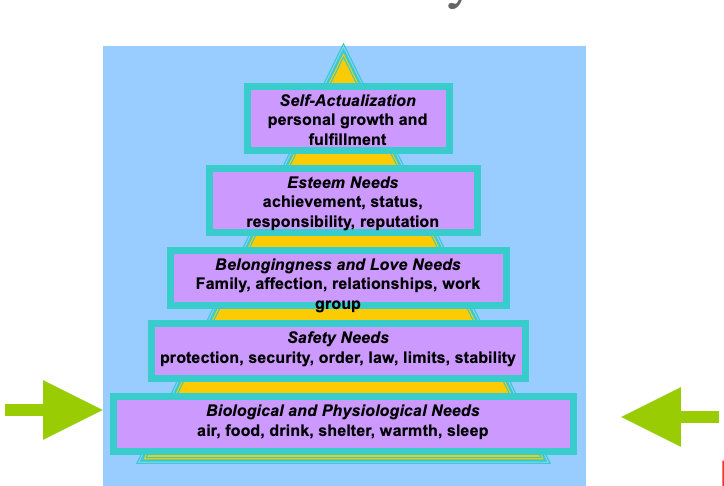
General neglect is defined as the failure to provide basic needs, including food, shelter, water, and medical care (Massullo et al., 2023; Finkelhor et al., 2023). A sense of belonging and community is also part of what a child requires to be well in society, although the formal definition of general neglect used in most research and policy contexts is limited to the basic survival needs listed above. A recurring theme in the literature is that most research attention is directed toward sexual abuse and fatal abuse, even though neglect is statistically the most common form of maltreatment affecting children (Massullo et al., 2023; Finkelhor et al., 2023).
Impact of Abuse on Wellbeing
Childhood maltreatment is associated with a wide range of adverse outcomes across the lifespan. On the physical health side, documented associations include diabetes, lung disease, vision problems, poor nutrition, sleep problems, and sexual difficulties. On the mental health side, associations include attachment difficulties, impaired executive functioning, posttraumatic stress disorder, depression, anxiety, suicidal ideation or attempts, self-harm, and body image issues (Daníelsdóttir et al., 2024). Some researchers characterize adverse childhood experiences as among the most impactful known contributors to diagnoses listed in the Diagnostic and Statistical Manual of Mental Disorders (DSM; Daníelsdóttir et al., 2024).
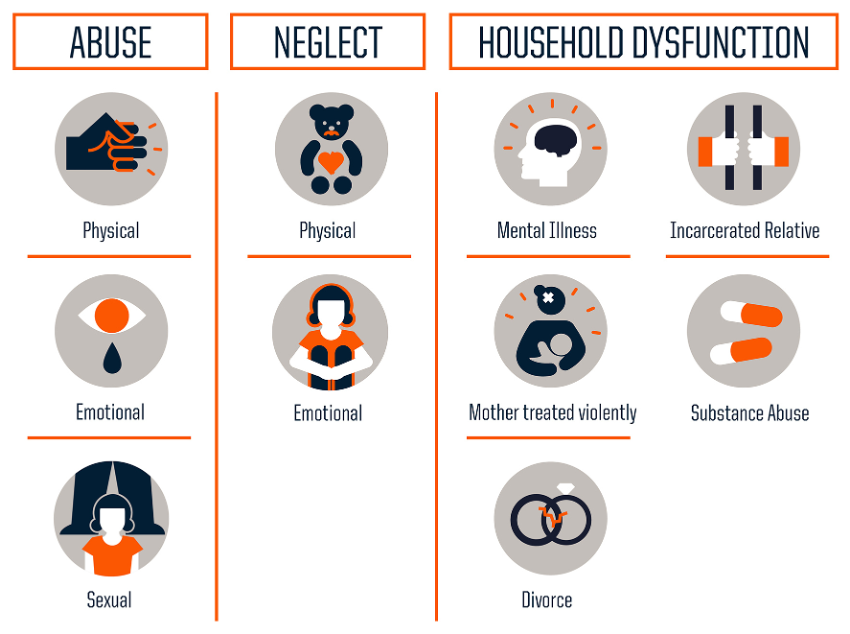
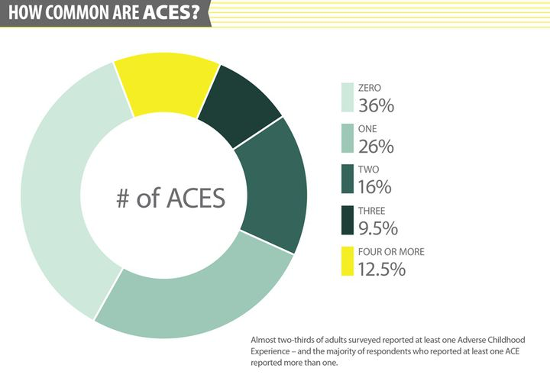
The adverse childhood experiences (ACEs) framework offers a structured assessment of experiences occurring between birth and age seventeen, including the various forms of child maltreatment described above as well as household exposure to substance use, domestic violence, and mental illness in a caregiver. An accumulation of these experiences is associated with substantially elevated risk of physical, mental, emotional, and social difficulties later in life. That elevated-risk trajectory reflects outcomes observed in the absence of intervention, and it is longitudinal research comparing groups with differing levels of childhood adversity that first allows the pattern to be identified at the population level. Impaired executive functioning is of particular interest because it may also play a role in the intergenerational continuation of abuse, insofar as adults who were themselves maltreated as children may carry functional impairments that affect their own parenting.
Impact on Youth Social Life
Childhood maltreatment also affects children's social functioning and relationships, including social cognition, emotional regulation, and sense of belonging. Research indicates that any type of maltreatment negatively affects sociality, popularity (measured by asking peers to name their friends), and social cohesion, while physical neglect specifically was found to affect all of these outcomes (Kamis & Copeland, 2024). In the sample referenced, more than 28 percent of children had experienced physical abuse, more than 4 percent had experienced sexual abuse, more than 17 percent had experienced emotional abuse, and more than 10 percent had experienced physical neglect (Kamis & Copeland, 2024).
These findings connect naturally to the concept of trauma-informed care: children experiencing abuse at home do not necessarily experience school as a place of reprieve, since the effects of maltreatment on emotional regulation and social functioning tend to follow a child into other settings. When children carrying these difficulties display behavioral or regulatory challenges at school, awareness of trauma-informed approaches can shift how educators and other professionals interpret and respond to that behavior. Trauma-informed care, as a practice framework, is not addressed in depth here, but the relationship flagged above warrants further professional development on its own terms.
Mandatory Reporting
Role of Health Professionals
Health professionals are mandatory reporters of suspected or confirmed child abuse. Social workers and behavioral health professionals, in particular, work with vulnerable populations, a term referring to groups that, compared with other groups in society, systematically have less access to resources, may be treated differently, or may experience a different life course that affects their ability to meet basic needs and maintain mental and emotional health. The existence of the social work profession reflects a societal response to these disparities, distributing support services to populations that need them, including children and individuals experiencing abuse.
Cultural competency, often required for professional licensure, follows naturally from this point. Cultural competency training has not been shown to have a large direct effect on patient outcomes on its own, in part because outcomes are also shaped by the structural and economic issues taken up later in this article. Cultural competency does not require a practitioner to become an expert on every culture encountered, nor does it require adopting the beliefs, practices, or attitudes of a given cultural group. Rather, it means recognizing that group and individual differences exist, avoiding assumptions, remaining open-minded, and making an effort to understand a client's context. That awareness can strengthen the therapeutic alliance between a practitioner and the people served, regardless of whether the practitioner shares the client's cultural background.
Child Abuse Reporting Act
Child abuse and neglect reporting requirements vary by state law. The general purpose of these statutes is to protect children from harm, and they require covered professionals to report suspected or confirmed cases of child abuse, whether encountered at work or outside of work. Reporting is required upon reasonable suspicion; a mandated reporter need not have witnessed the abuse directly or confirmed that it occurred before making a report.
Penalties for failing to report vary by state. As an illustrative example, the penalty in California for a mandated reporter who fails to report suspected abuse is up to six months of confinement in a county jail, a fine of up to $1,000, or both. Reporting laws of this kind are designed to place "eyes" on children across a wide range of settings by requiring a broad group of professionals who come into regular, close contact with children to receive training in recognizing and reporting suspected abuse. Worth noting as an editorial aside, not tied to a specific citation: certain settings associated with elevated abuse risk, such as some workplaces connected to trafficking, and certain professional roles that also work closely with youth outside of the categories below, are not explicitly named as covered professions, even though contact with children in those settings can be substantial.
Covered professionals
The category of mandated reporters is broad and includes the following groups, as identified on the accompanying slide:
- Physicians, dentists, medical residents or interns, hospital personnel and administrators, nurses, health care practitioners, chiropractors, osteopaths, pharmacists, optometrists, podiatrists, emergency medical technicians, ambulance drivers, undertakers, coroners, medical examiners, alcohol or drug treatment personnel, and persons performing a healing role or practicing the healing arts
- Psychologists, psychiatrists, and mental health professionals
- Social workers, and licensed or unlicensed marriage, family, and individual counselors
- Teachers, teacher's aides or assistants, school counselors and guidance personnel, school officials, and school administrators
- Child care workers and administrators
- Law enforcement personnel, probation officers, criminal prosecutors, and juvenile rehabilitation or detention facility employees
- Foster parents
- Commercial film and photo processors
Awareness of and training on suspected abuse indicators among frontline professionals, such as physicians and teachers, is a recognized element of early identification systems (Röders et al., 2024).
Trends & Variation
Stats
National data provide a sense of the scale of child abuse and neglect in the United States. In the most recent reporting year discussed on the slides, more than 3,081,715 children received some form of child protective services response, at a rate of approximately 7.4 children per 1,000, with the highest rate among children younger than 1 year of age. There were 546,159 confirmed victims of child abuse and neglect, of whom 64 percent experienced neglect only. Approximately 2,000 children died as a result of abuse or neglect in that year, and there were 422,117 identified perpetrators, an increase of nearly 20 percent compared with 2019. Approximately one in four cases involved a substance use factor, and approximately one in four involved a domestic violence factor. More than 1.76 million children received prevention services during the year. The overall prevalence of child abuse and neglect has not meaningfully decreased since the mid-1990s, despite increased investment in prevention efforts and expanded child protective services capacity.
The following table reproduces the core national statistics presented on the slide.
Measure Value Children with a child protective services response 3,081,715 Rate per 1,000 children 7.4 Confirmed victims of abuse and neglect 546,159 Share of victims who experienced neglect only 64% Child fatalities 2,000 Identified perpetrators 422,117 Increase in perpetrators since 2019 ~20% Cases with a substance use factor 25% Cases with a domestic violence factor 25% Children receiving prevention services 1,762,516 These figures likely underrepresent true prevalence, since many cases never come to the attention of any reporting authority, particularly when a child who is being controlled or coached by an abuser does not feel able to disclose what is happening.
State Differences
Reported rates of child abuse and neglect vary considerably by state. Massachusetts has the highest reported rate, at 16.5 per 100,000 (22,075 cases), followed by West Virginia, Iowa, Maine, and Alaska. New Jersey has the lowest reported rate, at 1.6 (3,146 cases), preceded by Pennsylvania, Washington, Virginia, and Kansas. Measured by raw number of cases rather than rate, Texas has the highest count, at 54,207, while Vermont has the lowest, at 672.
Several explanations account for this variation. States may define, count, and report child abuse differently, which limits the direct comparability of raw statistics across jurisdictions. Better-funded child protective services systems may also identify and record more cases simply because they have greater capacity to do so, meaning that a higher reported rate in a well-resourced state does not necessarily indicate a higher true prevalence of abuse. Legal treatment of practices such as corporal punishment also differs by state; in some states, including Oklahoma, corporal punishment such as spanking or slapping is treated as a matter of parental discretion unless it crosses into an excessive or injurious level, which is itself a subjective threshold.
Beyond definitional and administrative differences, sociological factors identified in connection with state and community "hotspots" of child abuse include housing instability, a lower volume of available services, unemployment, and substance abuse, particularly involving opioids and methamphetamine.
Digging Deeper
Self-report surveys that ask children directly about their own experiences provide an additional, and in some respects more complete, picture than administrative case data. According to national surveys of children's exposure to violence, 38.1 percent of children had experienced some form of maltreatment by age 17, with some sources placing the figure as high as half of all children. Of this experienced maltreatment, approximately 75 percent was neglect, 17 percent was physical abuse, 11 percent was sexual abuse, 4 to 7 percent was emotional abuse, and 0.2 percent involved trafficking.
Data drawn from the DHHS National Child Abuse and Neglect Data System for 2023 indicate that 90 percent of sexual abusers are known to the child, that one in four girls and one in twenty boys will experience sexual abuse in their lifetime, that 10.6 percent of children experience physical abuse only, that 7.5 percent experience sexual abuse only, and that 3.5 percent experience psychological maltreatment only.
The statistic that the large majority of sexual abusers are known to the child is sociologically significant on its own terms. Media coverage of child sexual abuse often emphasizes cases involving strangers or abduction, which are important but comparatively rare relative to abuse committed by someone already trusted by the child or the child's family, such as a relative, babysitter, or teacher. That pattern suggests that prevention efforts benefit from attention to family and other trusted relationship systems, in addition to stranger-danger messaging, even though this focus can feel uncomfortable or counterintuitive. Public attention to child abuse tends to concentrate heavily on cases involving a stranger or an abductor, coverage that is important and merited in its own right, but coverage of this kind can create a skewed public impression of where risk actually concentrates, since babysitters, teachers, relatives, and other trusted adults account for the substantial majority of sexual abuse cases.
Taken together, the scope of these figures supports the sociological argument that child abuse should be understood as what the discipline terms a public issue, meaning a problem so widespread that societal or environmental conditions are implicated, rather than solely a personal trouble affecting a small number of individuals. A personal trouble is an individual's private struggle or suffering; a public issue is a pattern that recurs across a large enough share of the population to suggest something happening at the level of the community, institution, or society, rather than only within a small number of disturbed or ill-intentioned individuals. That shift, from viewing child abuse as a personal trouble to viewing it as a public issue, is the central conceptual move underlying the analysis that follows, since it is this shift that justifies looking to community, economic, and cultural conditions, rather than exclusively to individual psychology, for both explanation and prevention.
Introduction
Ecological Model
The ecological model is a theoretical framework that integrates personal history, family systems, and societal-level factors to explain outcomes such as child abuse perpetration and victimization (Jip et al., 2025). At the individual level, the model considers a person's personal history and individual characteristics, including biological factors. At the family level, it considers the household's dynamics and functioning. At the societal level, it considers the broader social, economic, and cultural conditions in which individuals and families are embedded.
Effective prevention, under this framework, depends on a holistic and contextual understanding of a case or a population, rather than an exclusive focus on any single level of analysis (Jip et al., 2025). Existing research and intervention efforts tend to carry a bias toward individual risk factors, which can obscure the societal conditions that also underlie abuse rates (Jip et al., 2025). Socioeconomic conditions, cultural norms, and broader social problems contribute in layered ways to abuse rates (Jip et al., 2025). Consider a town whose economy depends heavily on a single large employer: when that employer closes or substantially reduces its workforce, subsequent community-level increases in substance use, depression, and anxiety can be observed, illustrating how an event affecting an entire community can raise risk across many individuals simultaneously, distinct from any one person's individual psychology.
Social Determinants
Individual/Psychopathological
At the individual level, mental health factors specific to a given person do not reliably predict whether that person will perpetrate abuse, and such factors are not generalizable to populations as a whole. Personality disorders, severe substance use, impulse-control difficulties, impaired cognitive functioning, low self-esteem, and needs related to power and control are among the individual-level factors that can contribute to the perpetration of abuse. Psychosocial comorbidities can also increase a child's risk of victimization. Carrying any of these individual risk factors does not mean that abuse will occur; these are population-level associations rather than deterministic predictions about any one person.
The sociological approach builds on this individual-level picture by analyzing the social conditions that can influence these same risk factors, effectively asking what is happening in a person's environment that may be shaping the individual vulnerabilities described above, rather than treating those vulnerabilities as freestanding or unexplained.
Focusing on Society
Reframed at the societal level, child abuse is best understood as a public health issue rather than solely an individual problem (Korbin, 1994; Luo et al., 2025). This framing is analogous to how public health has approached other large-scale problems, such as the opioid crisis or the COVID-19 pandemic, in which the effects extend well beyond any single affected individual, influencing healthcare costs, education costs, and social services spending across a population.
Addressing upstream factors, meaning the social and economic conditions that precede a crisis event such as a fatality, injury, or confirmed abuse case, is the most impactful point of intervention, since it affects the largest number of people before harm occurs, in contrast to downstream responses such as emergency services, removal of a child from the home, or punishment of a perpetrator after the fact. Individual development takes place within families, neighborhoods, and the broader sociocultural environment, meaning that all of these settings shape a child's outcomes, not the family alone (Korbin, 1994; Luo et al., 2025).
Social Factors
Social Factors
Certain social statuses are associated with increased risk of child maltreatment, including low socioeconomic status, low educational attainment, young parental age, single parenthood, having multiple dependent children, and low income (Hong et al., 2023; Nadan, Spilsbury, & Korbin, 2015). A social gradient is observed across these factors, meaning that differences in income, race, ethnicity, and LGBTQ+ status are all associated with differing levels of risk (Hong et al., 2023; Nadan, Spilsbury, & Korbin, 2015). Lower social status is associated with chronic stress arising from external conditions and unmet basic needs (Hong et al., 2023; Nadan, Spilsbury, & Korbin, 2015).
These comparisons are made at the group level and do not imply that individuals sharing a given social status are alike in other respects, nor that any one person in a higher-risk category will necessarily experience or perpetrate abuse. Rather, the purpose of identifying these statistically elevated-risk categories is to direct attention toward the structural conditions, such as educational access or income support, that may underlie the observed differences, rather than toward the individuals themselves.
Race & Social Statuses
Research on race and child abuse identification produces mixed results. Some studies find that Black and Hispanic children are overrepresented in the child welfare system and in hospitalization for abuse-related injury, indicating greater risk of family separation and higher associated healthcare costs (Salimi-Jazi et al., 2024). When socioeconomic status and other relevant variables are statistically controlled for, Black race continues to show an independent effect on these outcomes, while Hispanic ethnicity appears to serve as a buffer, a pattern attributable in part to cultural factors (Salimi-Jazi et al., 2024).
Assumptions made by reporters, clinicians, or other professionals about families from non-dominant racial or ethnic groups can themselves contribute to higher rates of reporting, independent of any underlying difference in the true prevalence of abuse. The concept of intersectionality, referring to the co-occurrence of multiple social statuses such as race, class, gender, and sexuality, is also relevant, since overlapping statuses can compound vulnerability to abuse and affect a family's access to protective resources.
Community Factors
A set of evidence-based community-level factors has been identified in research examining why some communities show markedly higher rates of child abuse than others (Sampson, Raudenbush, & Earls, 1997). These factors include the level of violence and crime in a community, the number of mandated reporters present, the availability of social support services, the concentration of children relative to adults (a higher concentration is linked to higher rates of abuse), low food access, social cohesion and integration, neighborhood disadvantage, and residential instability (Sampson, Raudenbush, & Earls, 1997). The overall level of social support available in a community, including help with childcare and positive role modeling, also affects maltreatment rates (Sampson, Raudenbush, & Earls, 1997).
Neighborhood disadvantage often follows a self-reinforcing pattern: higher crime and reduced business investment can lead to declining property values and lower property tax revenue, which in turn reduces funding available for local education and other public services, further compounding disadvantage over time. Because property tax revenue in most jurisdictions funds schools directly, this cycle also touches the concentration of mandated reporters described above, since schools and school-based staff are among the settings where sustained daily contact with children makes early identification of abuse most feasible; a neighborhood losing school funding is, in effect, also losing some of its reporting infrastructure at the same time that its other risk factors are increasing.
Culture: Norms & Socialization
Culture encompasses a society's beliefs, values, and norms, meaning its expected ways of behaving, and socialization is the process through which individuals learn to behave and express themselves within their given culture. Norms surrounding corporal punishment, gender roles, and stigma or silence around disclosure all affect both the prevalence and the reporting of abuse. State-level differences in the legal and normative treatment of corporal punishment, discussed above, illustrate how cultural norms shape what is considered acceptable parenting versus abuse.
Collectivist and individualist societies may differ in reporting patterns. The United States is generally described as an individualist society, whereas other societies or subgroups may be more collectivist. A collectivist orientation can serve as a protective buffer through greater social cohesion, but it may also be associated with lower reporting rates, as community reputation can create pressure against disclosure. Victim blaming, in which the person harmed is held responsible for the abuse, is also a cultural phenomenon, and abuse can become internalized by victims as a result.
Early Development & Abuse
Emotional bonds and attachment patterns formed early in life can increase the likelihood that a person will later perpetrate abuse, and low empathy and emotional awareness can impair a caregiver's ability to respond appropriately to a child's emotional needs. This perspective frames abuse as shaped, at least in part, by skill deficits or developmental gaps rather than exclusively as a product of deliberate ill intent.
That framing is offered as one lens among several, not as an excuse for abusive behavior. Consider a mother with attachment-related deficits, co-occurring substance use difficulties, and shame following the removal of her child: a skills-and-deficits framework applied to a case of this kind can identify additional points for intervention, such as building emotional regulation and parenting skills, without minimizing the seriousness or impact of the abuse itself.
Economic Drivers
Economic inequality, as distinct from the overall size or growth rate of an economy, is a major predictor of social problems generally, because it influences stress, social status, social trust, and the distribution of resources. Poverty and unemployment can lead to chronic stress, substance use, and erosion of mental and cognitive functioning, while housing instability and food insecurity directly undermine a family's ability to meet a child's basic needs. Poverty is one of the most consistently identified risk factors for child abuse and neglect in the broader research literature (Bywaters et al., 2022), and periods of economic insecurity have a documented temporal relationship with subsequent child maltreatment (Conrad-Hiebner & Byram, 2020).
Consider a parent facing simultaneous stressors, such as unemployment, housing precarity, and food insecurity: accumulated pressures of this kind can erode a parent's capacity to manage a child's ordinary behavioral challenges, without in any way excusing resulting harm. These economic conditions are best understood as contributing factors layered atop other individual and social factors, consistent with the ecological model discussed above. Human children have an unusually long period of developmental dependency compared with most other species, requiring near-constant care during infancy and early childhood; that extended dependency period helps explain why economic and housing instability during a child's earliest years carries disproportionate weight for outcomes such as neglect, and why the highest reported rates of child abuse and neglect response occur among children younger than one year of age, as noted in the Stats section above.
Social Isolation
Social isolation is one of the most significant risk factors affecting health and mortality outcomes generally, with some research suggesting its effect on premature death is comparable to or greater than that of heavy smoking, active alcohol use disorder, or a sedentary lifestyle. Weak social ties and disconnection from the community are associated with increased risk of perpetrating child abuse.
Societal disruptions such as the COVID-19 pandemic intensified social isolation and economic stress simultaneously. A study conducted only two weeks after the onset of the pandemic found that one in five adults in a broadly distributed sample had hit their child, with employment loss and isolation identified as risk factors net of other variables such as depression, income, and demographic characteristics (Lee, Ward, Lee, & Rodriguez, 2022). Perceived isolation, meaning an individual's own sense of being isolated, was also associated with changes in disciplinary behavior, including increased spanking and hitting, even among parents who reported that they would not otherwise have used these behaviors (Lee, Ward, Lee, & Rodriguez, 2022). Investigations conducted in specific jurisdictions during the pandemic period similarly documented shifts in the volume and pattern of child maltreatment investigations coinciding with pandemic-related disruption (Zhang, 2023).
Social Media & Technology
Image-based sexual abuse (IBSA) refers to harm caused through the creation, distribution, or misuse of explicit images, and is more commonly reported among sexual minority youth (Mitchell et al., 2025). More broadly, media content can normalize violence and exploitation, and experiencing abuse increases the likelihood of problematic social media use as well as body image dissatisfaction (Kircaburun, Griffiths, & Billieux, 2020). Problematic social media use associated with childhood maltreatment has also been linked to attachment difficulties and depression (Worsley et al., 2018).
Independent of other forms of sexual abuse or adversity, experiencing image-based sexual abuse specifically increases the odds of drug overdose, suicide attempt, and self-injury among affected youth (Mitchell et al., 2025). This area of risk receives comparatively little attention in standard psychology and social work curricula, despite its documented impact, and it warrants the same practitioner attention given to more traditional categories of abuse.
Prevention
Prevention: Policy
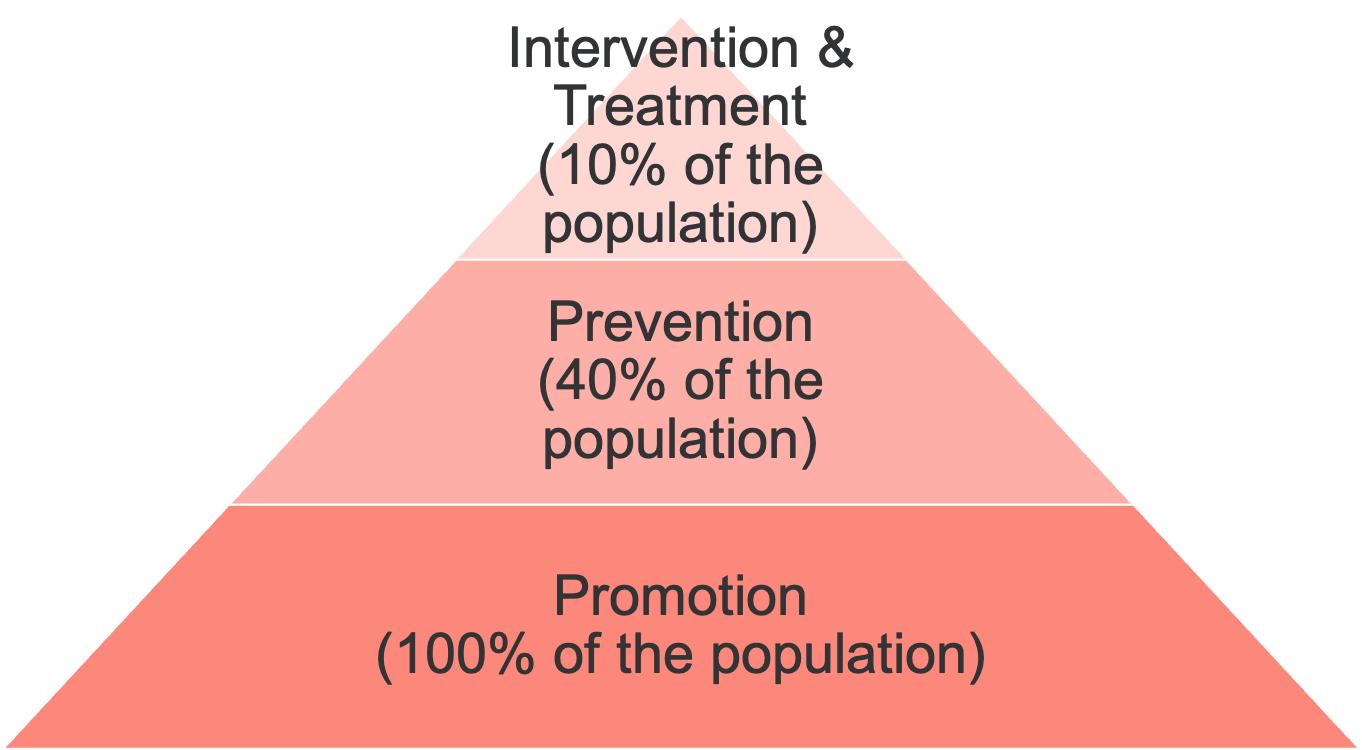
At the policy level, several categories of intervention are identified as evidence-relevant approaches to reducing child abuse and neglect. These include universal health care, the Earned Income Tax Credit (EITC), Temporary Assistance for Needy Families (TANF), and Department of Housing and Urban Development Community Development Block Grant funding that supports low-rent, stable housing in low-poverty areas. Additional systems-level change involves child welfare systems engaging more directly with income, employment, and housing conditions rather than operating in isolation from other social service systems. Reviews of potential structural solutions to reducing rates of child abuse and neglect similarly point toward income- and housing-focused policy levers as high-value targets for intervention (Heil, 2025).
Policies that improve family socioeconomic status have the greatest health impact on children because they increase a family's ability to meet basic needs and improve overall well-being. Many of the relevant systems, such as education, welfare, and criminal justice, tend to operate with limited coordination or communication, even though none of the underlying problems can be fully addressed within a single institutional silo.
This siloing has practical consequences for how prevention is funded and evaluated. A housing program and a child welfare program may each be judged by outcomes specific to their own mandate, housing stability on one hand and confirmed maltreatment cases on the other, without either program's evaluation capturing the interaction between the two. Yet the research summarized above suggests that the two are causally linked: stable housing reduces the chronic stress and instability associated with neglect, and a child welfare system that engages proactively with a family's housing and income situation is addressing a root cause rather than only a downstream symptom. Structural reviews of this problem point to the same conclusion: policy levers targeting income and housing consistently outperform narrowly targeted, abuse-specific interventions when measured by population-level impact (Heil, 2025).
Prevention: Community
At the community level, nurse family partnership programs are close to the gold standard among evidence-based interventions with a demonstrated impact on family outcomes (Levey et al., 2017). These programs typically involve home visitation, in which a nurse or trained case manager visits a family, often beginning before a child is born, and brings resources and support directly into the home. This model removes many practical barriers to service access, including transportation, comfort with clinical settings, and professionals' limited direct knowledge of home conditions, by bringing the intervention to the family rather than requiring the family to seek it out.
Additional community-level strategies include neighborhood representative groups and meetings focused on programs such as foster care, community organizing efforts that share information and resources directly among residents, and a broad range of support services, including parenting classes, mentoring, childcare, and healthcare support (Levey et al., 2017). Communities with high rates of child abuse often also have a low density of these support services, which reinforces the importance of considering service availability alongside other risk factors when planning prevention efforts.
Awareness & Advocacy
Awareness and advocacy strategies include media campaigns, integration of relevant content into school curricula, early childhood interventions such as preschool programming, and inclusion of child abuse as a topic in political and national news coverage, including coverage that uses individual cases to illustrate systemic problems. A further strategy involves explicitly linking the public issue of child abuse to economic, social, and healthcare policy discussions, since media coverage of child abuse is heavily weighted toward sexual abuse and trafficking, important topics in their own right, while economic and structural contributors to abuse receive comparatively little attention in public discourse.
Practice Applications
For professionals working directly with individuals and families, this material translates into several practical applications. These include looking beyond the individual to gain a fuller understanding of the motivations and context behind a case, identifying community resources that can help parents meet their children's basic needs, and attending to skills, emotional intelligence, and physiological or psychological impairments that may stem from a caregiver's own history of past abuse.
An open question worth sitting with: when a child is removed from a home following a confirmed or suspected abuse incident, it is often unclear how much support, whether recovery services, economic assistance, or mental health treatment, is subsequently directed toward the parent or caregiver involved, as opposed to resources directed solely toward the child. A parent with a substance use disorder or untreated mental health condition may lose custody following an incident, and in the absence of coordinated support for that parent's own recovery and economic stability, may experience worsening shame, isolation, and hardship that further compounds the underlying difficulties rather than resolving them. This is less an argument for a single fix than for a more coordinated, wraparound approach that considers the needs of the whole family system, including the parent, rather than treating removal of the child as the endpoint of intervention.
Identifying and connecting families to such resources is one of the more direct and achievable applications of this material for practitioners working at the individual and family level. Attending to physiological and psychological impairments that may stem from a caregiver's own history of past abuse expands a practitioner's understanding of a case beyond a simple moral judgment about a parent's fitness, without excusing harmful behavior, by bringing brain-based and skill-based factors explicitly into the clinical picture alongside social and economic context.
Closing Thoughts…
Several summary points follow from the analysis above. Professionals are cautioned against making assumptions about individuals based on group-level social statuses, since population-level research findings do not predict outcomes for any specific person. Social change is needed both in how child abuse is covered publicly and in how prevention efforts are targeted "upstream," toward conditions that precede abuse rather than only toward crisis response after abuse has occurred. Redistribution of resources stands out as an especially high-impact practice for reducing rates of abuse. Finally, perpetrators of abuse have complex, overlapping intentions and motivations, shaped by social, economic, physiological, and psychological factors together, rather than by any single cause.
None of this displaces individual accountability. Recognizing a social pattern behind an individual act is not the same as excusing that act, and the limitations stated at the outset of this article apply with full force here: population-level findings describe groups, not any single perpetrator's culpability, and a sociological account of why abuse clusters in certain conditions is a tool for prevention, not a defense. Held together, the individual, family, and societal levels of the ecological model give practitioners, policymakers, and researchers a shared vocabulary for locating where an intervention is likely to do the most good, whether that intervention is a single family's treatment plan or a state's housing policy.
Q&A
Questions arising from this material, comments, or requests for collaboration may be directed to info@widespreadwellness.org.
References
Bywaters, P., Skinner, G., Cooper, A., Kennedy, E., & Malik, A. (2022). The relationship between poverty and child abuse and neglect: New evidence. Nuffield Foundation.
Conrad-Hiebner, A., & Byram, E. (2020). The temporal impact of economic insecurity on child maltreatment: A systematic review. Trauma, Violence, & Abuse, 21(1), 157–178.
Daníelsdóttir, H. B., Aspelund, T., Shen, Q., Halldorsdottir, T., Jakobsdóttir, J., Song, H., & Valdimarsdóttir, U. A. (2024). Adverse childhood experiences and adult mental health outcomes. JAMA Psychiatry, 81(6), 586–594.
Finkelhor, D., Turner, H., Colburn, D., Mitchell, K., & Mathews, B. (2023). Child sexual abuse images and youth-produced images: The varieties of image-based sexual exploitation and abuse of children. Child Abuse & Neglect, 143, Article 106269.
Heil, L. C. (2025). Reducing rates of child abuse and neglect: An analysis of three potential solutions. The Mid-Southern Journal of Criminal Justice, 24(1), 2.
Hong, P. K. W., Santana, J. P., Larson, S. D., Berger, A., Mustafa, M. M., Taylor, J. A., & Petroze, R. T. (2023). Structural evaluation of child physical abuse in trauma: Social determinants of health at the population level. Journal of Pediatric Surgery, 58(1), 106–110.
Jip, J. V. G., van Koppen, M. V., Schoonmade, L. L., Vonk, M. J., & Harte, J. M. (2025). What we know about child maltreatment perpetrators: A scoping review of research focus and gaps. Aggression and Violent Behavior, Article 102122.
Kamis, C., & Copeland, M. (2024). Childhood maltreatment associated with adolescent peer networks: Withdrawal, avoidance, and fragmentation. Child Abuse & Neglect, 158, Article 107125.
Kircaburun, K., Griffiths, M. D., & Billieux, J. (2020). Childhood emotional maltreatment and problematic social media use among adolescents: The mediating role of body image dissatisfaction. International Journal of Mental Health and Addiction, 18(6), 1536–1547.
Korbin, J. E. (1994). Sociocultural factors in child maltreatment. In G. B. Melton & F. D. Barry (Eds.), Protecting children from abuse and neglect (pp. 182–223). Guilford Press.
Lee, S. J., Ward, K. P., Lee, J. Y., & Rodriguez, C. M. (2022). Parental social isolation and child maltreatment risk during the COVID-19 pandemic. Journal of Family Violence, 37(5), 813–824.
Levey, E. J., Gelaye, B., Bain, P., Rondon, M. B., Borba, C. P., Henderson, D. C., & Williams, M. A. (2017). A systematic review of randomized controlled trials of interventions designed to decrease child abuse in high-risk families. Child Abuse & Neglect, 65, 48–57.
Luo, Z., Chen, Y., & Epstein, R. A. (2025). Risk factors for child abuse and neglect: Systematic review and meta-analysis. Public Health, 241, 89–98.
Massullo, C., De Rossi, E., Carbone, G. A., et al. (2023). Child maltreatment, abuse, and neglect: An umbrella review of their prevalence and definitions. Clinical Neuropsychiatry, 20(2), 72–99.
Melton, G. B., & Barry, F. D. (Eds.). (1994). Protecting children from abuse and neglect. Guilford Press.
Mitchell, K. J., Colburn, D., Finkelhor, D., Gewirtz-Meydan, A., Turner, H. A., & Jones, L. M. (2025). Links between image-based sexual abuse and mental health in childhood among young adult social media users. Child Abuse & Neglect, 164, Article 107471.
Nadan, Y., Spilsbury, J. C., & Korbin, J. E. (2015). Culture and context in understanding child maltreatment: Contributions of intersectionality and neighborhood-based research. Child Abuse & Neglect, 41, 40–48.
Röders, M., Pauschek, J., Lehbrink, R., Schlicht, L., Jeschke, S., Neininger, M. P., & Bertsche, A. (2024). Early identification and awareness of child abuse and neglect among physicians and teachers. BMC Pediatrics, 24(1), Article 302.
Salimi-Jazi, F., Liang, N. E., Huang, Z., Tennakoon, L., Rafeeqi, T., Trickey, A., & Chao, S. D. (2024). Racial and ethnic disparities in child abuse identification and inpatient treatment. JAMA Network Open, 7(12), e2451588.
Sampson, R. J., Raudenbush, S. W., & Earls, F. (1997). Neighborhoods and violent crime: A multilevel study of collective efficacy. Science, 277, 918–924.
Worsley, J. D., McIntyre, J. C., Bentall, R. P., & Corcoran, R. (2018). Childhood maltreatment and problematic social media use: The role of attachment and depression. Psychiatry Research, 267, 88–93.
Zhang, Y. (2023). COVID-19 impact on child maltreatment: Evidence from abuse and neglect investigations in Texas. In SHS Web of Conferences (Vol. 178, Article 01022). EDP Sciences.
Nov 3, 2026
1 CE CreditElder Abuse and Child Abuse: Know the Signs and Your Role
Kathleen Weissberg, OTR/L, OTD
Editor’s note: This text-based course is a transcript of the webinar, Elder Abuse and Child Abuse: Know the Signs and Your Role, presented by Kathleen Weissberg, OTD, OTR/L.
Learning Outcomes
- After this course, participants will be able to recognize possible clinical, behavioral, and physical indicators of suspected elder and child abuse and neglect.
- After this course, participants will be able to list possible risk factors related to elder and/or child abuse and neglect.
- After this course, participants will be able to describe the reporting procedure for abuse and neglect.
- After this course, participants will be able to list resources that can be utilized for state-specific procedures.
Elder Abuse
Today, we are going to talk about elder abuse and child abuse, and sadly this is more common than you might think. Our goal for today is to learn to spot those warning signs and then to know what your responsibilities are or could possibly be with regard to reporting.
Some Statistics
- According to the U.S. Government Accountability Office (GAO), elder abuse is a widespread and growing problem
- Data reporting is a challenge
- Recent studies indicate that elder abuse incidence rates are far higher than once thought
According to a study by the United States Government Accountability Office, the GAO, elder abuse is really a widespread and growing problem. The data reporting in this area is a challenge, but despite that, recent studies indicate that elder abuse incident rates are far higher than we probably thought. This slide show includes a few different stories that have come up in the public sector.
- In NYS, incidence rates nearly 24X greater than the number of cases referred to authorities who can help (Lifespan of Greater Rochester et al., 2011)
- One in five Americans older than age 65 had been defrauded (Kiplinger’s Personal Finance, 2011)
- In most cases, the adult children of abused elders were unaware that their mother or father had received solicitations for money (Olson, 2011)
A collaborative public-private report on elder abuse in New York State, for example, found an incident rate of elder abuse nearly 24 times greater than the number of cases referred to social service, law enforcement, or legal authorities who have the capacity and the responsibility to assist adult older victims. And, as a nation, our response is disjointed. The minimal federal investment is only about 12 million dollars, give or take, and it is spread sparsely across eight agencies and two departments with very little coordination. I am going to digress for a second and say that recently the Office of Inspector General came out with a report related to elder abuse. I am not going to go through a lot of the details, but basically they found that a lot of individuals were coming into the emergency room and had diagnosis codes or situations indicative of abuse that was never reported to state authorities. I think we are going to see a little more oversight in the near future on this topic and probably some additional training from some of these government agencies. An Investors Protection Trust Survey found that one in five Americans older than the age of 65 had been defrauded. This is something that we are hearing about quite a bit about in the news. The conservative estimates of the personal cost to victims of financial abuse are easily three billion dollars annually. These reported cases only hint at the extent of the problem. We are not hearing a lot of the other stories that are probably out there. And, in a New York Times article, they talked about financial exploitation and the knowledge of adult children. Many are unaware that their mother or father had even received solicitations for money. Even attentive children, as involved as you can be with your parents, sometimes miss the warning signs. In that particular article, they highlighted the story of Dr. Robert Parker. He is the chief of community geriatrics at the University of Texas Health Medical Center in San Antonio. He failed to notice that his own mother was a victim of financial abuse. So, no matter how involved you are, sometimes you still miss some of these things.
A Chilling Example of Neglect
Before we get into some of the definitions, I wanted to share this story. It was a widely publicized case in Michigan. An elderly female nursing home resident began coughing one night. Her caretakers were busy, and she continued to just cough throughout the night. A couple of staff observed "white things" in her sputum and near her trach collar. It was not until the next morning that somebody actually checked into her mouth, and they found maggots. The maggots had created a partial airway obstruction causing her to suffer abnormal blood oxygen levels and labored breathing. The emergency medical services staff said that they could not even suction because of the very active maggots in the airway. This is just a terrible example and there is no evidence that that staff was disciplined for clearly neglecting this woman so severely.
Definitions
“Acts of omission or commission by a person who stands in a trust relationship that result in harm or threatened harm to the health and/or welfare of an older adult.”
Abuse Defined
- Willful infliction of injury
- Unreasonable confinement/Involuntary seclusion
- Intimidation with resulting physical harm, or pain, or mental anguish
- Punishment with resulting physical harm, or pain, or mental anguish
- Deprivation by an individual, including a caretaker, of goods or services that are necessary to attain or maintain physical, mental, or psychosocial well-being
- Corporal punishment & any physical or chemical restraint not required
- Abuse that includes that which is facilitated or enabled through the use of technology
I think the biggest piece here is that it is willful infliction. It can also include things like unreasonable confinement or involuntary seclusion, and that could happen in the home environment or in an institution. It might be where we are separating an individual from other individuals, from their room, or from another area where they want to go. This can be against their will or even against the will of that person's legal representative. It also could include intimidation or punishment with resulting physical harm, pain, or mental anguish. It could include things like deprivation by an individual, including a caretaker, of goods or services that are necessary to attain physical, mental, or psychosocial well-being. These are all the things that that person needs to be well. It can include corporal punishment or physical or chemical restraints that are not really required to treat that individual's symptoms or their issues. Again, it is anything that would cause pain or an issue, and it can also include things that are enabled through the use of technology. The individual acts deliberately.
- Elder abuse includes physical, emotional, or sexual harm inflicted upon an older adult, their financial exploitation, or neglect of their welfare by people who are directly responsible for their care
- Elder abuse tends to take place where the senior lives: where their abusers are often adult children, other family members such as grandchildren, or a spouse or partner. Elder abuse can also occur in institutional settings.
Now elder abuse includes, as we just said, physical, emotional, sexual harm potentially inflicted upon an older adult. It can also include financial exploitation and neglect of their welfare. It is done by somebody who is directly responsible for their care. And in the United States alone, more than half a million reports of elder abuse reach authorities every year, and many more go unreported. Now as older adults become more physically frail, they are less able to take care of themselves. They cannot stand up to bullying, and they cannot fight back a lot of times if they are attacked in some way.
The mental or physical ailment that they have can make them more trying to companions for those who live with them. They may not see, hear, or think as clearly as they used to. This leaves them open, unfortunately, for unscrupulous people to take advantage of them, and we definitely see that. The other thing to keep in mind is that elder abuse tends to take place where that individual lives. We hear stories of elder abuse that occurs somewhere out in the community, but typically, the senior lives with their abusers. The abusers can be adult children, other family members like grandchildren, a spouse, a partner, or a very good friend. The sad reality is that elder abuse can also occur in institutional settings especially long-term care facilities, that is where we hear about it most.
Forms of Abuse
- Verbal
- Physical
- Sexual
- Mental/Emotional
- Neglect
- Abandonment
- Financial exploitation
- Self-neglect
What are the different forms? Abuse of elders takes a lot of different forms. Some involve intimidation or threats against the elderly, some involve neglect and other financial trickery. The most common types are listed above. We will go through each one of these in a little more detail and look at some of the warning signs.
Verbal Abuse
- Oral, written or gestured language that includes disparaging and derogatory terms to the residents or their families to describe the resident within their hearing distance, regardless of their age &/or ability to comprehend or disability
This is almost like bullying. It is talking about that person in such a negative way so that they overhear it. The person feels, based upon this blame, diminished self-worth, or diminished ego, et cetera. This is, obviously, not something that we would want to do.
Physical Abuse
- The non-accidental use of force against an elderly person that results in physical pain, injury, or impairment. Such abuse includes not only physical assaults such as hitting or shoving but the inappropriate use of drugs, restraints, or confinement.
Physical abuse is pretty straightforward. This does not just include physical assault such as hitting or shoving, but it can also include things like the inappropriate use of drugs or medications, restraints, or even confinement. This can be in an institutional or home setting. The more common types of physical abuse that we see are things like hitting, slapping, pinching, scratching, spitting, holding that person roughly, holding them in their chair, or forcing them into their wheelchair. It also includes controlling behavior through corporal punishment. Unfortunately, we continue to see this in some of our settings. This a corporal type punishment of influence.
Sexual Abuse
- Contact with an elderly person without their consent. Includes but is not limited to humiliation, harassment, coercion, or sexual assault. Activities such as showing an elderly person pornographic material, forcing the person to watch sex acts, or forcing the elder to undress are also considered sexual elder abuse.
Again, you hear these outrageous stories on the news, and it makes you scratch your head. Sexual abuse includes but is not limited to things like humiliation, harassment, coercion, or even sexual assault. It is non-consensual sexual contact of any type with an individual. It is contact with that elderly person without their consent. It can involve physical sexual acts, but it can also involve other things like showing an elderly person pornographic materials and making them watch it or forcing the person to watch other sex acts or something else occurring in the environment. It can even include forcing the elder to undress in front of you. This would not be part of an ADL or helping them to use the restroom. This is forcing them to undress outside of those normal scenarios.
Emotional/Mental Abuse
- The treatment of an older adult in ways that cause emotional or psychological pain or distress, including:
- Intimidation through yelling or threats
- Humiliation and ridicule
- Habitual blaming or scapegoating
- Ignoring the elderly person
- Isolating an elder from friends or activities
- Terrorizing or menacing the elderly person
- Harassment
- Threats of punishment or deprivation.
This is the treatment of an older adult in ways that cause emotional or psychological pain or distress. It can be intimidation through yelling or threats, humiliation or ridicule, habitual blaming, or scapegoating. It can also be ignoring that elderly person or ignoring their requests, isolating an elder from their friends or their activities, and terrorizing or menacing the elderly person. You may not think that some of these things are necessarily emotional elder abuse, but they could be under the right set of circumstances. For example, if you take a photograph, and that person does not want to be photographed, that could constitute mental, physical, or some sort of abuse. Again, we should not be doing that in any of our settings or doing anything that might be considered humiliating toward an individual. During the delivery of care, depending on what we are doing with that individual, we need to make sure that we are keeping the person from public view like undressing to do an ADL. We need to make sure that we prevent any unnecessary exposure of body parts. That is what we do all the time normally, but if we did not, it could be potentially considered emotional or mental abuse.
My aunt, who has since passed away, was in a nursing home many years ago. She had dementia but she still knew enough to say I need to use the restroom when she truly needed to go. She had a urinary tract infection at the time was going much more frequently. I remember her saying, "I have to use the bathroom." She did not want me to take her and that was fine. She called for a nurse who came in and said, "Don't you realize you just went about an hour ago? You couldn't possibly need to go again. If you need to go, you're just going to have to go in your diaper." And I sat there and thought, "That's emotional abuse. That's humiliating to say to a person." And, this is in a premier community. There are the things that we need to look out for as they can certainly lead to emotional types of abuse. Whether that mental abuse has occurred or not is really determined by a reasonable person's standard and does not require a specific response from the individual. What I mean by that is a reasonable person would think that that is completely unacceptable. It does not necessarily have to have a response from the individual because that individual may have dementia or something else going on and cannot respond in an appropriate manner. We always use that "reasonable person standard" as our litmus test against whether or not something would be considered emotional or mental abuse.
Medication Diversion
- Knowingly, or intentionally, interrupting, obstructing, or altering the delivery, or administration of a prescription drug.
The next one is medication diversion. This is an interesting one. This is one we are hearing more and more about, but I think particularly in a home environment by a companion or caregiver (not necessarily paid) who might be looking to steal those medications for their own personal or financial gain. We are seeing a little bit more of this out in the community.
Elder Neglect
- Failure to provide goods and services necessary to avoid physical harm, mental anguish or mental illness. This constitutes more than half of all reported cases of elder abuse. It can be intentional or unintentional.
This is quite simply the failure to fulfill a caretaking obligation. Unfortunately, this constitutes more than half of all reported cases of elder abuse. It can be intentional or unintentional based on factors such as ignorance or denial that an elderly charge needs as much care as they do. Again, it is really just that failure to provide goods and services that are necessary for that person to avoid harm, and we will talk more about that in just a little bit.
Financial Exploitation
- The unauthorized use of an elderly person’s funds or property, either by a caregiver or an outside scam artist
- Misuse an elder’s personal checks, credit cards, or accounts
- Steal cash, income checks, or household goods
- Forge the elder’s signature
- Engage in identity theft
- Scams targeting the elderly
Another one that we are hearing a lot about now in the news is financial exploitation. This is the unauthorized use of an elderly person's funds or property either by a caregiver or by some outside person, a scam artist. It is deliberate misplacement, exploitation, wrongful temporary or permanent use of an individual's belongings or money without their consent. The important distinction is without their consent. An unscrupulous caregiver might do things like misuse a person's personal checks, their credit cards, or their accounts. They may steal cash, income checks, household goods, or get access to their accounts. They may be under the guise of helping the client with their bills, but they are skimming out of their accounts without that elder knowing. Forging the elder's signature and engaging in identity theft is very common. Another example is an announcement of a prize that the elderly person has won, but they have to pay money to claim. There can be phony charities and investment fraud. I have even heard of scammers showing up on an elder's doorstep. They claim to be from the utility company, or what have you, and they tell the homeowner that they need to pay their bill in cash.
Healthcare Fraud and Abuse
- Not providing healthcare, but charging for it
- Overcharging or double-billing
- Getting kickbacks for referrals
- Overmedicating or under medicating
- Recommending fraudulent remedies for illnesses
- Medicaid fraud
You may not think of this as elder abuse but it really is. This is carried out by unethical individuals like doctors, nurses, hospital personnel, and other professional providers. This includes not providing healthcare but charging for it, overcharging or double-billing from medical care or services, getting kickbacks for referrals to other providers, prescribing certain drugs, over-medicating or under-medicating, or recommending fraudulent remedies for illnesses or other medical conditions. This is anything that benefits the medical professional, not the client.
Elder Self-Neglect
- Physical or mental impairment or diminished capacity can mean that an older adult is no longer able to perform essential self-care
- May lack basic personal hygiene, appear malnourished, live in dirty conditions, be unable to pay bills or manage medications
- Can be a sign of depression, grief, dementia, or other medical problem
We already talked about neglect, but this is self-neglect. This is a common form of elder abuse that we see in healthcare. Physical or mental impairment or diminished capacity can mean that an older individual is no longer able to perform essential self-care, and we see that very commonly with cognitive decline, dementia, et cetera. They may lack basic personal hygiene, appear dehydrated, malnourished, underweight, or what have you. This can be a sign of depression, grief, dementia, some other medical problem, and in many cases, the older person refuses to seek assistance. They, oftentimes, are in denial. They feel ashamed about needing help or feel worried about losing their independence. If you see this self-neglect, this could be indicative of some other larger systemic issue going on with the elder.
Signs of elder abuse can, unfortunately, be very difficult to recognize, mistaken for symptoms of dementia, the elder person's frailty, or again the caregivers may explain them to you in that way and just pass them off. In fact, many of the signs and symptoms of elder abuse do overlap with symptoms of mental deterioration, but that does not mean that we want to dismiss them on the caregiver's say-so.
Warning Signs
If you suspect abuse but you are not sure, look for the warning signs. We are going to go through these quickly as it relates to each of the types of abuse.
Physical Abuse Warning Signs
- Unexplained signs of injury, such as bruises, welts, or scars
- Broken bones, sprains, or dislocations
- A report of drug overdose or an apparent failure to take medication
- Broken eyeglasses or frames
- Signs of being restrained, such as rope marks on wrists
- Caregiver’s refusal to allow you to see the elder alone
These can include unexplained signs of injury such as bruises, welts, scars, especially if they appear symmetrically on both sides of the body, broken bones, sprains, or dislocations, or fractures that are unexplained. Another warning sign is a report of either a drug overdose or an apparent failure to take their medication. When you go in to do your visit, you may see that there is a lot more of that prescription remaining than should be. They may have broken eyeglasses, broken frames, signs of being restrained, like rope marks on their wrists, or things maybe that came from a zip tie. The caregiver may refuse to allow you to see the elder alone. There can also be signs of burns, internal injuries, and abrasions. These are injuries that are unexplained or somebody is giving you an explanation and that explanation is just really not plausible.
Emotional Abuse Warning Signs
- Threatening, belittling, or controlling caregiver behavior
- Behavior from the elder that mimics dementia
- Depression, sleep and appetite disturbances
- Decreased social contact
- Evasiveness, anxiety, hostility
When we look at emotional abuse warning signs, these are things like threatening, belittling, or controlling caregiver behavior. You may observe the caregiver and what they are saying may not ring true. Your "spidey sense" may be alerted. Behavior from the elder that mimics dementia such as rocking, sucking, or mumbling to themselves. Depression, sleep and appetite disturbances, decreased social contact, loss of interest in their own self, apathy, suicidal ideation, evasiveness, anxiety, hostility, or any of those changes can be potential warning signs. This person who has always wanted to go to activities and been very involved suddenly does not want to go and have isolated themselves would be a big red flag.
Sexual Abuse Warning Signs
- Bruises around breasts or genitals
- Unexplained vaginal or anal bleeding
- Torn, stained, or bloody underclothing
- Fear of being touched
- Inappropriate modesty on evaluation
You may notice some of these things while doing an ADL. Other issues would be unexplained vaginal or anal bleeding, torn, stained, bloody underclothing, fear of being touched, or an inappropriate modesty when you are delivering standard treatment or evaluation. You might have draped that person appropriately, but they still just do not want you to see them.
Neglect Warning Signs
- Unusual weight loss, malnutrition, dehydration
- Untreated physical problems, such as bed sores
- Unsanitary living conditions
- Being left dirty or unbathed
- Unsuitable clothing or covering for the weather
- Unsafe living conditions
- Desertion of the elder at a public place
- Eccentric or idiosyncratic behavior, self-imposed isolation, marked indifference
Elder neglect or even self-neglect have some warning signs. These are things like unusual weight loss without a weight loss program, malnutrition, dehydration, untreated physical problems like bedsores or something else that should be treated, unsanitary living conditions, so dirt, bed bugs, or soiled bedding and clothing. They may be dirty or unbathed, or have unsuitable clothing or covering for the weather. For example, it could be cold outside yet the person has no coat. There may be no heat or running water, faulty electrical wiring, other fire hazards, or maybe they have been deserted at a public place. Another indication is the misuse or the absence of medication or an assistive device. You can also see things like eccentric or idiosyncratic behavior, self-imposed isolation, and a marked indifference to anything that is going on around them. All of those can be signs of neglect.
Financial Exploitation Warning Signs
- Significant withdrawals from the elder’s accounts
- Sudden changes in the elder’s financial condition
- Items or cash missing from the senior’s household
- Suspicious changes in wills, power of attorney, titles, and policies
- Addition of names to the senior’s signature card
- Financial activity the senior couldn’t have undertaken
- Unnecessary services, goods, or subscriptions
- The disparity between assets and appearance and general condition
Some of the warning signs here include significant withdrawals from that person's account, a sudden change in their financial condition, and items or cash missing from their household. Maybe, there have been changes in the will, in the power of attorney, and in titles and policies. They may have signed over these items to someone that just makes you scratch your head. There may be new additions of names to a signature card for the bank or other accounts. There may be financial activity that the person could not have possibly undertaken. For example, an ATM withdrawal when the account holder is bedridden or paying an account online when the person does not even have a computer. There could be unnecessary services, goods, or subscriptions. The client may also display fear, vague answers, or anxiety when asked about their personal finances. You may see a disparity between their assets and their appearance and their general condition.
Healthcare Fraud/Abuse Warning Signs
- Duplicate billings for the same medical service or device
- Evidence of overmedication or under-medication
- Evidence of inadequate care when bills are paid in full
- Problems with the care facility
Duplicate billings for the same medical service or device, evidence of overmedication or under-medication, evidence of inadequate care when the bills are truly paid in full are some warning signs in this category. All of their medical bills are paid, but they do not look like they are cared for. This could also happen in an institution where there are problems with the care facility. The staff could be poorly trained, poorly paid, insufficient staff, or overcrowding.
Risk Factors
- Caregiver stress
- Depression in the caregiver
- Lack of support from other potential caregivers
- Substance abuse by the caregiver
- The intensity of the elderly person’s illness or dementia
- Social isolation
- The elder’s role, at an earlier time, as an abusive parent or spouse
- A history of domestic violence in the home
- The elder’s own tendency toward verbal or physical aggression
Taking care of a senior who has a lot of different care needs can be difficult. Both the demands of caregiving and the needs of that elder can create situations in which abuse is more likely to occur. Many nonprofessional caregivers, spouses, adult children, other relatives, and friends find taking care of an elder to be really satisfying and enriching, but the responsibilities and demands of caregiving can escalate and cause stress as that person's condition deteriorates. The stress of elder care can lead to mental and physical health problems that leave the caregiver burned out, impatient, and more susceptible to neglecting or lashing out at the elder in their care. Even caregivers in institutional settings can experience that stress that can lead to elder abuse. Nursing home staff particularly may be prone to elder abuse if they lack training, have too many responsibilities, are unsuited to caregiving, or they work under poor conditions. In addition to that caregiver's inability to manage stress, some other significant risk factors for elder abuse include depression in the caregiver and lack of support from other caregivers. The caregiver's perception that taking care of the elder is burdensome without any sort of emotional reward is another problem. Other risk factors include substance abuse by the caregiver, the intensity of the elderly person's illness or their dementia, social isolation, meaning that the elder and the caregiver are alone most of the time together, the elder may have been an abusive parent or a spouse, a history of domestic violence in the home, and the elder's own tendency toward verbal or physical aggression.
Federal Reporting Requirements
- Elder Justice Act (EJA): designed to address crimes committed against older persons, raise national awareness of elder justice issues and apply resources to the efforts of those confronting elder abuse and neglect on the front lines in healthcare settings
These reporting requirements come from the Elder Justice Act. The purpose of that act is to detect, prevent, and prosecute elder abuse, neglect, and exploitation. The Elder Justice Act is designed to address crimes committed against older persons, raise national awareness of elder justice issues, and then apply resources to the efforts of those confronting elder abuse and neglect on the front lines in our healthcare settings. The Elder Justice Act as well adds new elder justice provisions and very specific provider requirements particularly in long-term care by amending various sections of several titles of the Social Security Act.
- Section 1150B of the Social Security Act (the Act), as established by section 6703(b)(3) of the Patient Protection and Affordable Care Act of 2010 (Affordable Care Act), requires specific individuals in applicable long-term care facilities to report any reasonable suspicion of crimes committed against a resident of that facility
- Facilities are required to conspicuously post, in an appropriate location, a notice for its employees specifying the employees’ rights, including the right to file a complaint under this statute. The notice must include a statement that an employee may file a complaint with the SA against an LTC facility that retaliates against an employee.
Section 1150B of the Social Security Act, as established by the Patient Protection and Affordable Care Act, requires that very specific individuals in applicable long-term care facilities report any reasonable suspicion of crimes committed against an individual of that facility. Now, this is required of any facility that receives at least $10,000 in federal funds under the act in the preceding year. That community is required to notify every covered individual of their obligation to report to the Secretary of Health and Human Services, known as the Secretary, and at least one local law enforcement entity, for any reasonable suspicion of a crime. A covered individual, in this case, is an owner, an operator, an employee, a manager, an agent, or a contractor. It includes pretty much everybody. Additionally, communities are required to post in a very conspicuous place a notice for employees specifying their rights including the right to file a complaint, and the notice also has to have a statement in it that an employee can file a complaint with the Secretary and they cannot be retaliated against.
- You have a duty to report any suspected acts involving mistreatment, neglect, abuse, etc.
- Facilities must report any reasonable suspicion of a crime against a resident or patient to:
- The Secretary of the U.S. Department of Health and Human Services (HHS), and
- The law enforcement authorities in the political subdivision where the facility is located.
You do have a duty to report any suspected acts involving individual mistreatment, neglect, abuse, crimes, misappropriation of resident property, injuries of an unknown source, et cetera. Again, these are healthcare facilities again that are receiving federal aid. These facilities need to report any reasonable suspicion of a crime against an individual or a patient, number one, to the Secretary of the United States Department of Health and Human Services, and then also to the law enforcement authorities in the political subdivision where that facility is located. There are two specific federal reporting requirements, and most of these apply to the long-term care segment of the industry as that is where most of our elders reside.
- Two-time limits for the reporting of reasonable suspicion of a crime
- Serious Bodily Injury – 2 Hour Limit
- Shall report the suspicion immediately, but not later than 2 hours after forming the suspicion
- All Others – Within 24 Hours
- If no serious bodily injury shall report the suspicion not later than 24 hours after forming the suspicion
- Serious Bodily Injury – 2 Hour Limit
- “Serious bodily injury” is one involving extreme physical pain or substantial risk of death; or an injury involving protracted loss or impairment of the function of a bodily member, organ, or mental faculty; or an injury requiring medical intervention such as surgery, hospitalization, or physical rehabilitation.
There are two-time limits for reporting reasonable suspicions of crime depending on the seriousness of the event that leads to that suspicion. The first is whether or not there is a serious bodily injury. Now under the Elder Justice Act, serious bodily injury is one involving extreme physical pain, substantial risk of death, or an injury involving protracted loss or impairment of the function of a bodily member, organ, or mental faculty. This is an injury requiring medical intervention such as surgery, hospitalization, or physical rehabilitation. If the events that cause a reasonable suspicion of harm or abuse and there is serious bodily injury, people are required to report immediately but no later than two hours after forming a suspicion to both local law enforcement and the Secretary of Health and Human Services. All others need to be reported within 24 hours. That is federal guidance.
State Reporting Requirements
- Each state may have specific reporting requirements related to abuse
- It is important that you familiarize yourself with the requirements for the state in which you work/provide services
- Report as required by state law
This is where it gets tricky because every state is different. Each state may have specific reporting requirements related to the abuse. And for you, it is important that you familiarize yourself with the requirements for the state where you work and where you provide the services. If you feel or have a reason to believe that somebody is being abused, you need to report this. As every state is different and you need to report as required by your state law.
Resources
- State Adult Protection Statutes:
- State Mandatory reporting Statutes:
Here are a couple of resources. One is the State Adult Protection Statutes, and the second link here is for State Mandatory Reporting Statutes. The second one specifically will tell you where to report, how to report, who is required to report, and what those timeframes are for your specific state. Hopefully, you can take the time to look those up as well.
Child Abuse
Federal Definition of Child Abuse
- Federal Child Abuse Prevention and Treatment Act (CAPTA) (42 U.S.C.A. § 5106g) defines child abuse and neglect as at minimum:
- "Any recent act or failure to act on the part of a parent or caretaker which results in death, serious physical or emotional harm, sexual abuse or exploitation"; or
- "An act or failure to act which presents an imminent risk of serious harm."
According to the United States Department of Health and Human Services, federal legislation provides guidance to states by identifying a minimum set of acts or behaviors that define child abuse and neglect. The Federal Child Abuse Prevention and Treatment Act or CAPTA, as amended by a Reauthorization Act in 2010, defines child abuse and neglect at a minimum to any recent act or failure to act on the part of a parent or caretaker which results in death, serious physical or emotional harm, sexual abuse or exploitation, and an act or failure to which presents an immediate or an imminent risk of serious harm.
Definitions
- A "child" generally means a person who is younger than age 18 or who is not an emancipated minor
- CAPTA does not provide specific definitions for types of maltreatment such as physical abuse, neglect, or emotional abuse
- Federal legislation sets minimum standards for States that accept CAPTA funding, each state provides its own definitions of maltreatment within civil and criminal statutes
Under these definitions, this definition refers very specifically to parents and other caregivers. A child under this definition generally means a person who is younger than the age of 18 or who is not an emancipated minor. And while CAPTA provides definitions for sexual abuse and the special cases of neglect related to withholding or failing to provide medically indicated treatment, it does not provide specific definitions for other types of maltreatment or things like physical abuse, neglect, or emotional abuse. While federal legislation sets those minimum standards for states that accept CAPTA funding, each state is going to go out on its own and provide its own definitions of maltreatment within civil and criminal statutes.
State Statutes
- Definitions of child abuse and neglect are typically located in two places within each State's statutory code:
- Civil statutes provide definitions of child maltreatment for mandated reporters
- Criminal statutes define those forms of child maltreatment subject to arrest and prosecution
The federal definition is out there, but the state has to be accepting CAPTA funding for that federal definition to apply. More often than not, each state is going to have its own set of statutes related to child abuse. We will talk about this on another slide, but that is again where it is up to you to figure out the requirements in your specific state. Are you a mandatory reporter? What are your training requirements? I gave you some resources to do that, and we will talk about that in a minute. The definitions of child abuse are going to be located typically in two places within each state's statutory code. The first statutory code will be the civil statutes, and these will provide those definitions of what is child maltreatment. It also will help to guide the mandatory reporters and other individuals as well as to identify and report suspected child abuse and determine the grounds for intervention by the state child protection agencies and the civil courts. This is the overarching area of what is abuse, who reports, how do you report, and what do we do when you report. The criminal statutes, on the other hand, will define those forms of child maltreatment that can subject an offender to arrest and prosecution in criminal courts. Most of them will list out very specifically the types of things that are absolutely positively against the law and what would warrant an arrest, prosecution, jail time, community service, or whatever it would happen to be.
Types of Abuse
- Many states recognize four major types of maltreatment
- Neglect
- Physical abuse
- Sexual abuse
- Emotional abuse or neglect
Many states recognize four major types of maltreatment in their definitions and these include neglect, physical abuse, sexual abuse, and emotional abuse or neglect. Let's look at these in a little more detail. I think the first step in helping an abused or neglected child is learning those warning signs. The presence of a single sign does not prove that child abuse is occurring but it could be. But, when you look at the situation a little bit more closely, you may see signs appear repeatedly or in combination. When you see a pattern, that is when you want to take notice. If you do suspect at any time that a child is being harmed, you have to report your suspicions because that is going to help protect that child and get some help for the family. We will talk about reporting in a second, but any person can report suspicions of child abuse and neglect. Mandatory reporters need to report under very specific circumstances defined by the state. Healthcare providers with very few exceptions would be considered mandatory reporters in those states.
Recognizing Child Abuse
- The Child:
- Shows sudden changes in behavior or school performance
- Has not received help for physical or medical problems
- Has learning problems that cannot be attributed to specific causes
- Is always watchful
- Lacks adult supervision
- Is overly compliant, passive, or withdrawn
- Comes to school or other activities early, stays late, and does not want to go home
These are the signs in a child that may signal child abuse or neglect. They show sudden changes in behavior or school performance. They were a wonderful student and now they are not. They have not received help for a physical or a medical problem that has been brought to the parent's attention. They have learning problems or difficulty concentrating in the classroom that cannot be attributed to a very specific physical or psychological cause. Or, maybe that child is always watchful as though they are always preparing for something bad to happen. They are looking for that other shoe to drop or looking over their shoulder. They lack adult supervision when they are not of an age to be unsupervised. They are overly compliant or very passive or withdrawn. They say yes ma'am or no sir to all requests. They come to school or to other activities early, they stay late, and they do not really want to go home when it is time for dismissal.
- The Parent:
- Shows little concern for the child
- Denies the existence of—or blames the child for—the child’s problems in school or at home
- Asks teachers to use harsh physical discipline
- Sees the child as entirely bad, worthless, or burdensome
- Demands a level of physical or academic performance the child cannot achieve
- Looks primarily to the child for care, attention, and satisfaction of emotional needs
This parent shows little concern for the child. They pass off some of the things that are happening with their child as not being important. They deny the existence of or even blame the child for the child's own problems in school or at home. They ask a teacher or a caregiver to use harsh physical discipline if that child misbehaves. It is okay to do X, Y, and Z if the child misbehaves. "This is what we do at home." They see the child as bad, worthless, or burdensome. They demand a level of physical or academic performance that the child cannot possibly achieve. This is different from encouraging them to be a better student or athlete. This is forcing something that they could not possibly achieve or do not have the physical or mental capacity to do. They look at the child primarily for care, attention, and satisfaction of their own emotional needs rather than providing the care to the child for the child's needs.
- The Parent and Child:
- Rarely touch or look at each other
- Consider their relationship entirely negative
- State that they do not like each other
We can also look at the parent and child dyad together. They rarely touch each other or look at each other. You do not see that bond or connection between the two of them. They consider their relationship entirely negative, and they may just flat out state that they do not like each other and truly mean that. We talked about the types of maltreatment that are generally defined in the state statute, and now, we are going to go through now some of the signs that are associated with the types of child abuse and neglect. It is important to note however that these types of abuse are typically found in combination rather than alone.
You will not typically just see physical abuse without also some sort of emotional or mental anguish as well. For example, a child who is sexually abused may also be neglected. You want to look for these in combination and look for some of those signs. And again, a lot of these are going to be very similar to what we just talked about with elder abuse.
Physical Abuse
- Has unexplained burns, bites, bruises, broken bones, or black eyes
- Has fading bruises or other marks noticeable after an absence from school
- Seems frightened of the parents and protests or cries when it is time to go home
- Shrinks at the approach of adults
- Reports injury by a parent or another adult caregiver
They may have unexplained burns, bites, bruises, broken bones, and black eyes. They may be consistently in the emergency room for some sort of treatment. They have fading bruises or other marks that are noticeable after an absence from school. They seem frightened of the parents. They protest or they cry when it is time to go home. They shrink at the approach of an adult and are wary of adults who are around them. They report injuries by a parent or another adult caregiver, or they report an injury and the explanation of that injury is just not plausible. The proverbial "I fell down the stairs" type of excuse.
- Consider physical abuse when the adult:
- Offers conflicting, unconvincing, or no explanation for the child’s injury
- Describes the child as “evil,” or in some other very negative way
- Uses harsh physical discipline with the child
- Has a history of abuse as a child
We might want to consider physical abuse if they are offering conflicting, unconvincing, or no explanation for the child's injury. "have no idea how that happened." Or, "Don't worry about it. It's no big deal." They describe the child as evil in some way, or they are very negative in their description of the child. They use harsh physical discipline with the child even when it is not warranted. Another one is that they themselves may have a history of abuse as a child.
Neglect
- The child is frequently absent from school
- Begs or steals food or money
- Lacks needed medical or dental care
- Is consistently dirty
- Lacks sufficient clothing for the weather
- Abuses alcohol/drugs
- States that there is no one at home to provide care
You want to consider the possibility of neglect when the child is frequently absent from school again without a reason. This is when they are not on vacation, not sick and at the physician, and not visiting their grandparents. They may beg or steal food in the cafeteria. They may lack the necessary medical or dental care that they should be having at their age. They may not have their immunizations not necessarily related to the opinions of the parent but because the parent refuses to give them. Maybe they need glasses, but they do not have glasses. They are consistently dirty and do not look well-kept. They have severe body odor or their hair is very dirty. They may have consistent issues with lice or other types of bugs. They may lack sufficient clothing for the weather, again very similar to elder abuse. It is cold outside but they do not have a coat. It is raining but they do not have anything to protect them from the elements. The child may be abusing alcohol, drugs, or other things more consistent in an older child. They may state that there is no one home to provide care for them. They may say, "I cook my own meals all the time." Another clue is, "I take care of a younger sibling."
- Consider neglect when the adult:
- Appears to be indifferent to the child
- Seems apathetic or depressed
- Behaves irrationally or in a bizarre manner
- Is abusing alcohol or other drugs
You also want to consider the possibility of neglect again when we look at the parent or the adult caregiver and they are indifferent to that child. They are apathetic and do not seem to care. They themselves are depressed and not in a position to care appropriately for that child. They behave irrationally or in a bizarre type of manner. Or, they may be abusing alcohol or other drugs themselves.
Sexual Child Abuse
- Has difficulty walking or sitting
- Suddenly refuses to change for gym
- Reports nightmares or bedwetting
- Experiences a sudden change in appetite
- Demonstrates bizarre, sophisticated, or unusual sexual knowledge
- Becomes pregnant or contracts a venereal disease
- Runs away
- Reports sexual abuse by a parent or another adult caregiver
Consider the possibility of sexual child abuse when that child has difficulty walking or sitting. You see that they have pain in their genital area. It is observable that they are very uncomfortable. They suddenly refuse to change for the gym, participate in physical activities, or maybe participate in your treatment session. They may report having nightmares or bedwetting. Their appetite may have gone down or up, and they may also have sleep disturbances. They have bizarre, sophisticated, or even unusual sexual knowledge or behavior for their age. Things that they should not know but they do. They may become pregnant or have a sexually transmitted infection, particularly at younger ages. They run away or they report some sort of sexual abuse by a parent or another adult or caregiver. You have to take these comments very seriously.
- Consider sexual abuse when the adult:
- Is unduly protective of the child or severely limits the child’s contact with other children, especially of the opposite sex
- Is secretive and isolated
- Is jealous or controlling with family members
We also want to consider the possibility of sexual abuse when the parent, adult caregiver, or older sibling is really protective of that child. This severely limits the child's contact with other children or other individuals, especially of the opposite sex. They are secretive and isolated. They look like they have an unhealthy type of family bond. They are very jealous and controlling with other family members.
Emotional Maltreatment
- Shows extremes in behavior
- Is either inappropriately adult or inappropriately infantile
- Is delayed in physical or emotional development
- Has attempted suicide
- Reports a lack of attachment to the parent
Signs of emotional maltreatment is when you see a child showing extremes in behavior. They may be overly demanding, extremely passive, or extremely aggressive. They are either inappropriately adult-like or infantile as examples. They may be delayed in their physical, emotional development, and cognitive development. Perhaps, they have attempted suicide or have even talked about suicide. They feel like their life is not worthy or unsatisfactory. They may report a lack of attachment to the parent. If we interact with that parent or caregiver, we may see that the adult constantly blames, belittles, or berates that child. They are really unconcerned about the child, their whereabouts, their well-being, and those sorts of things. They do not consider the offers of help for the child's problem.
How to Report Suspicions
- Suspected Child Maltreatment
- If in serious danger, call 911
- National and local resources are available to provide assistance and information about reporting suspected maltreatment.
- Suspected child abuse or neglect?
- Contact your local child protective services office or law enforcement agency
- Know the statutes if you are a mandatory reporter
If you see suspicions, what do you do? If you or someone else is in immediate danger, call 911. That is the best thing to do because there are both national and local resources that are available to provide immediate assistance to that child and family. You would want to report that information about suspected maltreatment. Again this is very state-specific, but at a bare minimum, you would contact your local Child Protective Services office or law enforcement agency. If you are a mandatory reporter in your state, you are going to need to know what their requirements are. I can tell you that I am licensed in a couple of states, and I look at my licensing requirements. There are very specific rules that you need to follow about timeframes, phone calls, and specific people to contact. Unfortunately, in the scope of this presentation, we cannot go into that level of detail, but you need to know what the statutes are for your specific state.
Who Can Report?
- Anyone can report suspected child abuse or neglect
- All U.S. States and territories have laws identifying mandatory reporters
- Mandatory reporters may include social workers, teachers, and other school personnel, childcare providers, physicians, and other health-care workers, mental health professionals, and law enforcement officers
Again all states have laws that identify persons who are mandatory reporters like social workers, teachers, school personnel, childcare providers, physicians, mental health professionals, and law enforcement officers. They are all identified in those state statutes, However, any person who suspects child abuse and neglect can and should report.
What Happens Next?
- Report a complete, honest account of what you observed that led you to your suspicion. Any reasonable suspicion is sufficient.
- Reports are sent to child protective services (CPS) for review
- If an investigation is deemed needed, CPS may talk with the family, the child, or others to help determine what is making the child unsafe
- For more information about where and how to file a report, contact your local child protective services agency or police department
You need to provide a completely honest account of what you observed that led you to suspect the occurrence of child abuse or neglect and any reasonable suspicion is sufficient. Do not make up details or leave out details - be clear, be honest about what you saw, what you heard, or what you observed. Do not base that on hearsay. It should only be based on your own report. This report is going to be sent over to Child Protective Services or CPS for review. Generally speaking, again for states, when they receive that report, the worker will review the information and determine if an investigation is necessary. That CPS worker may talk to the family, the child, or other individuals to help determine what possibly is making this child unsafe. They can also help parents and other caregivers get services, get an education, and get other assistance to help them through the situation.
Resources
- Childhelp National Child Abuse
- Call or text 1.800.4.A.CHILD (1.800.422.4453). Professional crisis counselors are available 24 hours a day, 7 days a week, in over 170 languages.
- National Center for Missing and Exploited Children’s CyberTipline
- Report online sexual exploitation of a child or if you suspect that a child has been inappropriately contacted online at the CyberTipline.
There are national resources that are available. For the Childhelp National Child Abuse resource, professional crisis counselors are available 24 hours a day, seven days a week in 170 different languages. Every call that is placed is completely confidential, and the hotline offers things like crisis intervention, information, referrals out to other emergency services, social services, and other sorts of resources that are available in the community. There is also the National Center for Missing and Exploited Children's Cyber. This is an online reporting if you suspect any sort of sexual exploitation of a child, and that would include human trafficking. You can also report if you suspect that a child has been inappropriately contacted online. Information again is made available to law enforcement in order to conduct that investigation.
- State Statutes for Child Protective Services:
- State reporting Phone Numbers:
Here are two resources for your states. The first one is the state statutes for Child Protective Services, and the second is the state reporting phone numbers. Now, these are not necessarily the end all be all. Again go back to your Practice Act, your licensure, etc. But, these are some good starting points so that you can start to read about what is required.
Citation
Weissberg, K. (2019). Elder abuse and child abuse: Know the signs and your role. Continued - Social Work, Article 111. Available at www.continued-social-work.com
Oct 29, 2026
The Effect of Childhood Family Trauma on Adult Relationships Podcast
Editor's note: This text-based course is a transcript of The Effect of Childhood Family Trauma on Adult Relationships Podcast, presented by podcast host Benjamin T. Bencomo, DSW LISW, LCSW, and podcast guest Kaytlyn Gillis, MSW, LCSW-BACS.
Learning Outcomes
After this course, participants will be able to:
- Describe childhood family trauma.
- Identify ways childhood family trauma can manifest in adult relationships.
- Identify the six stages of healing from childhood family trauma.
Podcast Discussion
Ben: Hello and good morning, Kaytee. I am very excited about our podcast today. We have with us, Kaytee Gillis. Kaytee Gillis is a psychotherapist, author, and consultant with a passion for working with survivors of traumatic relationships. She's a licensed clinical social worker and a board-approved clinical supervisor. Kaytee has extensive experience working with survivors of family trauma and dysfunction. Due to both her personal and professional experiences, Kaytee has focused her work on helping survivors grow in the aftermath of trauma. She has published two books on intimate partner abuse, and her third most recent book is being released this weekend, the first weekend of July, 2023. Through her published writing, as well as her presentations and trainings, Kaytee hopes to help others develop awareness and healing. Kaytee, I'm very excited for our conversation today. Thank you so much for joining us. I know it's a busy time for you, an exciting time for you. Thanks for being here.
Kaytee: Thank you so much for having me. I'm really excited to talk about this. I know it's weird to say exciting to talk about trauma, but it is really a passion of mine to talk about this topic.
Ben: Absolutely, and a passion for many of our listeners, I'm sure. So I'm sure that everything that you have to share with us today will be very well received by our listeners. Kaytee, I am always really interested in hearing about how people find social work or, better yet, how social work finds us. I find that very interesting. So if you wouldn't mind, would you share a little bit about your own path to social work? How did social work find you?
Kaytee: I love that you say it like that. I love that you say it finds us because that's actually how I was gonna answer that was, you know, I remember as a child always being like, "Oh, I wanna be a veterinarian," and I even could say that word as a child. And I remember my mom being like, "Oh, that's interesting. She can say that word at a very young age." So I really wanted to be a veterinarian. I really wanted to help animals. And then, for a while, I thought I was gonna be a lawyer for maybe a second or two. And then, all of a sudden, by the end of high school, I was like, "Oh, I'm going to go to school and study psychology."
And now I know, as most social workers and therapists, is that many of us, not all, but many of us, go into this field trying to kind of figure out our own history and like, "Oh, if I can study psychology, that'll make things make sense, or if I can solve other people's trauma, that'll help me kind of help my own." So I really think it just kind of fell on me like that. So it definitely, like you said, came to me.
Ben: My daughter is currently in the "I want to be a vet" stage, so she and I watch all of the vet shows as often as we can. But yes, it is interesting how social work at different points in our life just kind of starts to make sense for us as well. I know that I and many others are glad that social work found you and that you have been able to share a lot of your experiences already through your writing and presentations. So again, we are happy to have you here.
Kaytee: Thank you.
Ben: How did you first become interested in working in the specialized area of family trauma specifically?
Kaytee: So this is definitely another thing where, you know, it is weird because I feel like so many of us have kind of two minds. It is like we know we have dysfunctional history. You know, if we have dysfunctional history, we know it, but maybe we just kind of compartmentalize it, we put it on the back burner, so to speak. And we think, "Okay, well, it's not going to affect me. You know, I just am aware of it." And then I noticed that the universe has its way of sending you clients who you can relate to, like, have the issue that maybe you have or something. I really think the universe does that to us. So many of my clients, if not most or all, had some kind of family trauma, and even if they were coming in for other things, like relationship issues, I work a lot with domestic violence, it is a lot of people coming in for help with that of course, depression, anxiety, life stressors, things like that, but then we would find that there was some underlying dysfunction or some underlying trauma that was more than just the, like, and I'm using, like, my air quotes, like normal dysfunction or things like that, things that really stuck with them.
And so they were coming in for anxiety, yeah, they were coming in for insomnia or an unhealthy relationship or even an abusive relationship. But then we start talking about, oh, well, they haven't had any healthy relationships in their whole life, and we would really start to kind of unpack that. And I started being like, "Wow, okay this is really a pattern. It's a pattern among all my clients," like patterns I can see in them because of my professional experience with them, but also because I'm like, "Yeah, I remember that. I remember having those thoughts and those feelings and those kinds of awakening moments and things like that." So it really kind of all started to kind of come down from there.
Ben: Kaytee, can you define for us what is childhood family trauma specifically? To use some of your words, can you share information on the difference between, and I'm gonna use air quotes as well, between a normal level of dysfunction and what might make a family experience traumatic, especially in childhood?
Kaytee: Absolutely, okay, so I always kind of say that trauma, right now, is a buzzword. I feel like it is every third thing that you click on, especially if you are on, like, the TikToks and the Instagrams of the world. Everything is trauma, and that's good, but it is also kind of, you know, many argue that we are kind of watering it down and things like that. So I do want to say that I recognize that it is really broad right now, but I also wanna recognize that family trauma itself is broad. There is a normal level of dysfunction because I feel like no person, no human being, is going to go through this lifetime with a perfect childhood.
And people who do, I mean, good for them, but maybe, I don't know, I think that in itself would be a form of trauma because then you're sheltered, anyway, podcast for another day. But I really think that people who have gone through trauma, like family trauma, understand that this is something that affects them more than just the, "Okay, like Mom had her quirks, or Dad did his thing," or whatever. It's more than stuff like that. So, what I like to do is kind of give an example. A normal level of dysfunction is a family who can usually acknowledge that they're imperfect. Many times you'll hear them even joke about it.
I'm not saying it's exact, like it's an exact determinant to figure out what's normal dysfunction and what's not. But usually, families who are healthy in their imperfections, they're able to say, "Yeah, we're imperfect. Like this is something that we recognize," and you can bring it up. You can acknowledge it, and there's not a power struggle behind it. You know, you could probably say to your caregiver, "Hey, this is something you kind of do," and, "Oh, I do kind of do that." You know, and there's more of that give and take as opposed to the punishment that comes from growing up in a very dysfunctional environment that is weaponized. So I know I say all that, and that's very, very broad, but family trauma is, like, anything that a person feels happened in their family of origin and in their childhood that is affecting them today.
So it could be anything from growing up in a place where there was a national disaster, growing up in a war zone, having to flee your country and come to another country, or having parents who have a mental illness. I always like to specify it's untreated mental illness. I'm not trying to stigmatize mental illness. There are people every day, all day, managing mental health and parenting. And that's not at all automatically a trauma. I'm talking about untreated. You know, I have many clients whose parents were dealing with some serious mental health symptoms, and they were untreated, and that can be traumatizing for a child. And the same thing with substance use, untreated, I mean. So things like that that happen in the childhood environment that people feel impacts them today in their adult life.
Ben: That makes sense, and I'm glad you explained that because it is a bit of a double-sided coin when we see these conversations happening more readily in different circles. And so I appreciate that you explained that, that while we are excited that people are having these conversations and acknowledging traumatic experiences, we wanna make sure that it's not diluted and that we really understand what that traumatic experience might look like.
Kaytee: I always tell clients, you know, I work a lot with teens and adolescents, and they'll come to me and be like, "Oh, I found out on TikTok that," and whenever they start the sentence with, "I found out on social media that," I'm like, "Oh, yeah." So they're like, "Oh, this means that I have this disorder. This means that I have trauma." And they're not always wrong, but they're not always right. And so definitely, just be careful of where you get stuff. And I'm glad we're having these conversations, but on the other hand, I feel like there's always going to be, like you said, a give and take.
Ben: Yes, exactly. Kaytee, you started talking and defining some of these, but I wonder if we can go a little bit more into some of these major areas of problematic dysfunction that you talk about in family systems. Maybe if you can give us an example of what they might look like. You know, you spoke of untreated mental illness and substance use, but I know that there are many others. Would you mind going into those and giving us some examples?
Kaytee: Absolutely, so the ones I talk about in my book, and I'll just kind of give a rundown, and then I'll go back and give examples. So I talk about abuse and neglect, and I know that they are often linked, but they are not always the same. Many times, they are different. Abuse, as we know, is something that happens to a person, and neglect is the absence of things happening. Substance use or mental illness within the family that is untreated; divorce or death in the family; changes in the family structure that are not dealt with appropriately; parental abandonment; and then psychological or narcissistic family structure or family system. So the first one, abuse and neglect, are frequently linked together. And I do link them together in my book, just for the sake of explaining them.
But abuse, of course, as we know, is something that happens to the person. Emotional abuse, physical abuse, sexual abuse, and things like that. Neglect is, I find in my experience, and maybe other clinicians have had different experiences, I find that neglect often is something that was not done maliciously. It is kind of something that happens as a result of other things going on within the family. And I do want to say that many of the things I said, the reason why I listed them off first before explaining, is because so many of them can be intertwined. For example, let's say you have a parent who has an untreated mental illness or untreated substance abuse disorder, and they are really struggling with that. That can, of course, impact the whole rest of the family. And maybe the kid was, or the kids were neglected because the parent was struggling so bad with that mental illness that the kid was not getting the things that they needed for school and getting the care that they needed and the medical care and things like that.
So, so many of these things can really kind of happen together. It's not like they're mutually exclusive. So abuse and neglect, abuse happening to a child, of course, that's absolutely going to result in a traumatic history. Neglect, I find in my practice that neglect is something that so many people feel shame discussing because it's like abuse, for example, and not to minimize it in any way, shape, or form, but abuse you can come in, and you can say, "This happened to me. I was abused, this happened. I was hit, I was sexually abused," whatever. And you have almost, again, air quotes, evidence that it happened. And then that almost gives you the permission, again, air quotes, to grieve and be upset about it.
With neglect, there are so many other factors, especially when I work with clients from generations older than mine. So generations or cultures, where they were, like, "I wasn't neglected. I had to take care of my brothers and sisters. That was my role. That wasn't neglect." So there are so many different factors that come into that. It is definitely not something that is as easily examined. So I did talk about substance use and mental illness in the family, but again, untreated things like that.
I have had clients who wake up in the middle of the night, and Mom or Dad is acting paranoid or screaming with severe mental illness that is untreated. That is very traumatizing for a child because they do not know what is going on. Or absences where maybe a parent is hospitalized, or I have had a lot of clients whose parents have to be taken by EMTs or the police or stuff like that because of mental illness. It is that, right there, that is so traumatizing.
Divorce or death within a family. And again, I always wanna specify these are changes that are not dealt with appropriately. Having a divorce, like I always want to tell people, sometimes that is the best thing you can do. I'm not in any way trying to say do not divorce. It is not the divorce, and it is not the death. That is nobody's fault. Death happens, and, of course, it's scary to a child, and it's sad to a child, but it does not have to result in lasting trauma because ideally, in a loving, my air quotes again, perfect situation, the parents and the caregivers will help the child and say, "Yes, like this is what happened, the person," and dealt with it. However, it is that that family relates to death and how they want to kind of convey that message. What I find is traumatic is when it's something that's just brushed under the rug, like all of a sudden Mom never comes home, or all of a sudden Dad just, like, moves out one day and has another family. And then the kids are like, "Wait, what?" That needs to be explained. I have a lot of people come to me and say, "I'm really scared of getting divorced because I do not want to traumatize my child." And that is definitely a decision that I can never make for the client. But I always kind of want to stress that, on the other hand, we could be traumatizing kids by not doing the healthy thing and splitting a relationship that needs to be. So divorce that is not dealt with in a healthy way or any kind of change in a family structure; I usually use divorce and death, but anything that changes a family structure that is not dealt with.
Parental abandonment and this is not something like adoption. This is something like a parent just all of a sudden washing their hands of a child. And you see that a lot with kids who are involved in the criminal justice system. In my work with teens and a kid gets arrested, living in New Orleans, we have a lot of teen crime right now, and I know it is everywhere, but New Orleans really is dealing with a lot of it. So I have a lot of kids who are caught stealing a car, and their parents are, like, "I'm done with you." And you can not do that to a 15-year-old, and so it really fuels that cycle.
And then psychological or narcissistic family system, so when you have that psychological abuse. And I always like to differentiate psychological abuse from abuse; even though I know it is abuse and many times people use it the same as emotional abuse, I consider it as something that is just so unique and so different, and the experience is something that is so, like, it's hard to explain to people who have not really been through it. And so it is like a whole family system that works to kind of create the homeostasis of this dysfunctional system.
So those are the ones that I list in my book. I want to say these are not an exhaustive list. I mean, there are many other ways that people can say, "Okay, I had a different experience in my family that wasn't listed." These are some of the major ones that I see in my practice.
Ben: Absolutely. Thank you for that. Thank you for sharing those. I can see how so many of these can be very intertwined and interrelated, and you can have almost that layering, that compound trauma that happens within a family system that is experiencing, like you say, untreated substance use, untreated mental illness, and maybe there are absences of the parent because of the manifestations of some of that untreated mental illness or untreated substance use. And then there is also possibly acts of commission of abuse, acts of commission of neglect, and some of those things.
Kaytee: I like how you say that. "Layering." Because it is true, it is not like, okay, this one thing happened. So many of these things can affect each other.
Ben: Absolutely. Now, in your experience, what are some of the major ways that childhood family trauma can affect the survivors of those experiences into adulthood? In one of your articles published in Psychology Today it's entitled "10 Ways Childhood Trauma Can Manifest in Adult Relationships." So I am wondering if you wouldn't mind going into those ten specific ways that, in your experience, in your professional experience, those ten ways that those who experience that trauma that can find that this affects them in adulthood, can affect their relationships in adulthood, would you mind expanding on those a little bit for our listeners?
Kaytee: In my article, I have ten major ways that I have seen in my practice of having a childhood family dysfunction affecting us in relationships. And again, not an exhaustive list, but these are probably the major ten.
Number one is fear of abandonment. And that can look different in each of us. For some people, they are so scared of abandonment that they avoid relationships because if you never get into a relationship, then you are not going to be abandoned. And that even goes as far as some people struggling with friendships too. I mean, it does not always affect us in romantic relationships. A lot of times, it is with coworkers or things like that, you know, there is always like that guard up of this person is eventually going to hurt me, so I have to really kind of prepare accordingly. People who are in relationships and they find any kind of hint that the person is going to leave, they freak out. It really comes across as an anxious attachment. So anytime someone is like, "Okay, well, we just got in an argument, and I'm worried they're gonna leave," or they go out with friends or they do this, and it really is affecting every day, every aspect of their life. It's not just, "Okay, I have a fear of abandonment, and I acknowledge it." It's that, "I worry about my partner going to a guy's weekend because I'm scared they're gonna leave me," or stuff like that, that kind of thing where it affects their relationship, it affects the ability of the relationship to be a healthy trusting dynamic.
Number two, easily annoyed with others. I get a lot of interesting questions about this one, like, "What do you mean easily annoyed with others?" I have found that people who have had maybe narcissistic family structures allow psychological abuse in their family. They are very hyper-aware of things that other people might do that are going to set them off. And I am not excusing it in any way, but I find that it is like they are kind of in this constant state of hyper-arousal. So maybe their partner did not take out the dishes, and they're like, "Are you kidding me? Like, you didn't take out the dishes." Take out the dishes, I hope you aren't taking out the dishes. Put away the dishes or take out the trash. They took out the dishes!" So if the partner didn't take out the trash or something like that, "This is a sign that you don't love me. I knew it. You weren't listening to me." Things that are above, like, the normal, okay, if you're getting easily annoyed by other people and you're able to acknowledge it and you're able to say, "Okay, I'm feeling really irritable today." Like, I think we all have that time where we're like, "I'm feeling kind of irritable today, or maybe this weekend, maybe it's a change in our life," but what I'm looking for usually is a pattern. Like, are you constantly annoyed with the other person, like the way they sit, the way they dress, the way they sit down? This is usually a sign that you've been mistreated for so long in your childhood and you were unable to say anything. Because of the power differential, you were unable to say anything. So then, now that you have the freedom and this space, you're able to explain, and you're always in, like, that hyper-aware, hyper-aroused state.
Number three is kind of similar. Number three is needing a lot of time to yourself. And when I say it is similar, I mean that there are people who need a lot of time themselves, and there are people who get easily annoyed with others, and it has nothing to do with trauma. So especially for people who are neurodivergent, for example. That can just be who they are. So it does not necessarily mean that you have a history of trauma because you need a lot of time to yourself. But what I mean is a lot of times, these things, kind of like the things we were talking about earlier, they coexist at the same time. So people who have had a lot of overstimulation with being around other people or people who have a history of mistreatment in their childhood and were not allowed to take care of their own needs. So spending a lot of time by themself is a safe space because it is they were not allowed to do that. They were not allowed to take care of their own needs. They were not allowed to just be alone and things like that. So they take a lot of time to just be in that safe space.
Ben: Right, almost like an overcompensation for a lack of control in previous experiences and overcompensating by really wanting to over-control that experience.
Kaytee: Yeah, I like how you say that. It is funny because sometimes I'm like, it makes sense perfectly in my head. I feel like I find that when I'm writing, it makes perfect sense, and then I'm trying to explain it. I'm like, "How come it isn't coming across like how I wrote it in my article?" But yeah, you said it perfectly. That's exactly what I find. And I remember working with clients, and I would find that so many of them were like, "Oh, I just needed to take time to myself, like, after we had an argument or something." And I was like, "Huh, I'm seeing patterns here."
Number four is settling for unequal financial or household responsibilities. What I mean by this one is that the person is settling for mistreatment. I do not mean, "This is my responsibility, this is your responsibility, and then that's fine." And I'm not here to tell you what's yours and what's theirs. But settling for having someone who is, I have a lot of clients who someone was really mooching off them. Someone was really using them for their finances. They were using them for their home, and they always had some excuse of why they couldn't work or always had some kind of excuse of why they couldn't contribute. Or maybe they were working, but their money was going towards something else, and the person would just put up with it and put up with it and put up with it. And I would say, "What's going on here? What are you getting from this?" And it goes back to, again, sometimes, that fear of abandonment. Sometimes it's, "Well, they're gonna leave," or sometimes it's, "Well, this is the best I'm going to do in this relationship." And these are not, like, conscious statements. Like, people do not usually sit and say, "Oh, I'm never gonna get anyone better." It's usually something that's way back here in your head. You're not conscious of it, but somewhere the little voice, your inner child, is saying, "Okay, you're not going to get much better," or, "This is what you deserve," or things like that. That's common. Another common thing is people who observe that in their childhood, maybe they observed Dad never worked, and then Mom had to work three jobs, take care of the house, take care of the kids, that kind of thing. So they really learn that dynamic, and they learn that that is what happens and that you have to put up with it. So that is definitely something that is, definitely something that we would work through.
Staying in relationships much longer than their expiration date really follows that, so that is number five. And, like I said, a lot of these really kind of go together. So that one is something, again, goes back to that fear of abandonment, that fear of, "I'm never going to do anything, but I'm never going to get anyone better, I'm never going to get another relationship, like, this is the person who loves me. I might as well stay with them. This is the best I'm going to do." I mean, these are really this inner voice that many people are saying, and there's a lot of shame in that. There is a lot of shame in saying, "I feel like I can't do anything, do any better," but it's true. And it ends up with people staying maybe years past when the relationship was supposed to end. And a lot of times, in my work with domestic violence survivors, we will look back years before, and they will be like, "Well, that was red flag number one, and then this was red flag number," and I've been there, I've done that. "Okay, well, that was red flag number 70. Why did I ignore all these red flags? Probably because I grew up that I was supposed to ignore red flags or I was supposed to intellectualize them or excuse them or even deny them." Like, "Oh, that's not really happening. They're just having a bad day." So that is definitely something that we work with, that I work on with clients when they are dealing with that.
Another thing that ends up presenting a lot in the therapeutic session with couples is number seven, which is avoiding conflict. Wait, I'm sorry, that was number six. I jumped from number six, constant arguing and relationships or avoiding conflict at all costs. So that is something that I see a lot with couples where one person, I see that there is, like, one of two dynamics that will happen to the extreme. I mean, I feel like everyone kind of has their way of arguing. Everyone has their way of how they present themselves in an argument, and that is fine.
But I am talking about the extremes where, like, "I'm going to avoid any and all conflict because I'm scared of what's gonna happen," or, "I am going to like constantly argue to the 10th degree about everything like everything is a huge argument." And I always tell people, like, I worry about clients who are couples who will come in and say, "Oh, we never argue." And I'm like, "What do you mean never?" Like, you've been together ten years, and you've never had an argument? Like, I would kind of explore because I feel like arguing, even the word argue, the word fight, those things are such, like, negative words, but a lot of healthy things can come from having a healthy conflict as long as it's done in the right way.
Ben: Absolutely.
Kaytee: A lot of times, people who have had traumatic histories with family members where maybe communication felt like a war zone. If we say anything, it is going to get worse, so we really learn to just be quiet, or we learn that there is no way to just say, "Hey, I was kind of upset about this thing that you did. Maybe we can kind of talk about it." Instead, it is I look at it for those extremes.
And then number seven kind of follows up with that is not knowing how to repair after fights. And this is something that is very common that I see with people who grew up in arguments, grew up in environments where there were no healthy arguments. And this is why when I work with families, people say to me, "I don't wanna argue in front of the kids." And I'm like, I understand that. I do not think anyone, like, loves arguing. I do not think anyone wants to argue in front of other people, but I feel like kids, like all human beings, need to see how healthy conflict is managed. Like, yeah, I mean, it's basically from social learning theory. We learn how to express our needs and express our displeasure through watching others.
Ben: That is a life skill, that learning how to resolve those conflicts in a healthy manner.
Kaytee: Absolutely. So, kids who do not see that, they do not know how to have an argument. So maybe a lot of teens I work with, it's like, "Oh, she looked at me wrong, and next thing I know, we're fighting, and whoa, how do we get to this point?" Because that is what they are seeing. That is how conflict is managed. You know, they would never sit down and just have a conversation. So people who do not know how to repair after having an argument. Maybe they'll have an argument, and then they separate, and they do not talk for three days, or they just never address it again. It's almost like it's brushed under the rug, and it never is talked about again.
There are many ways that you can have an argument and then handle it in an unhealthy way. And then there are many ways you can have an argument and handle it in a healthy way. So the people who don't know how to repair, the people who don't know how to come back and say, "Okay, maybe that wasn't my best moment. And how can we prevent this from happening again? You know, what would you like me to do? Would you like me to make sure I take out the trash every day or something like that?"
Or take out the dishes. Take out the dishes, want new dishes. So number eight is serial monogamy. And that one is the people who are, like, so scared to be out of a relationship, and it kind of relates back to the fear of abandonment, but it's like a step above that. It's like I can't be alone. So you'll see the people who are, like, in, like, a long-term monogamous relationship, as soon as that ends, boom, the next one, and then boom, the next one. And for some people, that just happens, and it works out. Maybe someone is in a long-term relationship, and then they get another long-term relationship, and that's fine. But what I mean is that people who cannot be alone. They have to then look for the next person. Then they have to kind of have someone lined up before ending a relationship because the fear of being alone and the feeling of being alone is so much worse than being with someone who isn't right for them.
Ben: Right, so they feel that need to immediately look for that security that they find externally in a relationship.
Kaytee: Yeah, absolutely, it's like security. Like, they feel like, "Okay, I need to have that person, 'cause having someone is better than not having anyone," because there's that inner voice that many children who grew up with neglect or grew up with abuse or grew up with really unhealthy levels of dysfunction, grew up with a lot of trauma, there's that inner voice in the back of their head that's like, "See, you're not lovable, you're not worthy, you're not able to be loved, you're not going to be able to be in a healthy relationship. You're going to be alone. You're gonna end up alone." And again, it is not conscious. It's really, like, in the back of the head.
Unless you have enough insight, then it is conscious. But usually, it's something that people aren't necessarily aware of, but they just know that they feel uncomfortable alone or they know they feel anxious. And so being with someone, it, like, helps to kind of prove to them, "See, I'm not unlovable 'cause I have a relationship." It doesn't matter if the relationship is unhealthy, it doesn't matter if the relationship is past its expiration date, but they have a person, so it's proving that they're lovable.
Ben: Yeah, that makes sense.
Kaytee: Yeah, so number nine kind of plays off of that is worrying about commitment. So I notice that clients kind of do the, or survivors do one of two things. That's either serial monogamy or they're afraid of commitment. And again, it kind of goes back to that fear of abandonment, but not always. But the people who are like, "I'm kind of avoidant of relationships," or, "Okay, I'm kind of interested in this person, but I don't want to commit," or anytime the relationship starts to get serious, they get kind of anxious and things like that because, again, people who were close to them hurt them. So either going to have other people who are close to them, then they're setting themselves up again to be hurt.
Ben: Right.
Kaytee: And the last one is trying to change your partner. And I find that many survivors of family trauma try to change their partner. And I remember, I mean, many of us have done this. I did this for years. You know, being like, "Oh, if you would only just do this, or if you'd only not do that, or if you only didn't use substances, or if you only could just get a job," or whatever it is that you feel like the person needs to do, trying to change them. And that definitely goes back to trying to change that caregiver who you couldn't change, and you couldn't provoke any kind of change in your caregiver. You couldn't give them any kind of constructive feedback or any kind of you couldn't even really tell them what they were doing and how it affected you. So it's like your brain is almost like, "This is your chance to change this person." Yeah, so those are the 10.
Ben: Yeah, thank you. Thank you for sharing those. They make perfect sense. And I can tell that this is something that you have a lot of experience with. In one of my previous lives, I worked with teens who were aging out of foster care and starting to navigate those adult relationships and adult responsibilities, and because of the traumatic experiences that they had experienced, I think that I was able to picture each one of these as you were explaining them. And that was sort of a constant cyclical pattern of not having that sense of control in childhood and because of the trauma that they experienced and having to move in and out of state foster care systems, trying to gain that control or searching for it in any way that they could by putting up those walls and pushing people away, "I'll hurt you before you hurt me," or the opposite of, "I really need this in my life." I wasn't really sure what you meant at first by serial monogamy, but when you explained it, that process of having to always have that person to feel that sense of security was manifested in a lot of the kids that I worked with as well. So those polar extremes.
Kaytee: Yeah, I talk about a lot of people who've gone through foster care in my book because I feel like when we talk about family trauma, we always end up assuming it's the parents. And many times it is, but I mentioned that in my book. I'm like, for each one of us, it's gonna be whatever was your home environment, whether you were raised by two uncles, by your grandparents, whether you had a foster family, whatever. And so I talk a lot about the people who've gone through the foster systems. That's really interesting that you've gone through that. Yeah, I bet you could see them in the examples.
Ben: Yeah, absolutely. Thank you again. I feel like this is a good transition time maybe to start talking about, we've talked about what some of these traumatic experiences might be, what they might look like, and then how they might manifest at different stages of a person's life. Now, this weekend, for those listening or watching us on the Continued YouTube page, this weekend, the first weekend of July, 2023, your book goes live, I guess, is the right word, right?
Kaytee: Yes, it is live on Amazon.
Ben: Okay, all right, and that book, I think, is a good transition of looking at what we do now, right? And so that book entitled "The 6 Stages of Healing from Family Trauma." Now, based on what you were talking about in regard to those specific areas of dysfunction, how might we start that process? What would be the first step in healing from family trauma?
Kaytee: So the first step, and I'm gonna start by just kind of doing a quick run-through of the six, just to say the names, just because it kind of helps people kind of visualize that there are six steps. So there's pre-awareness, uncovering, digging in, healing, understanding, and nurturing. And I say that so people kind of get that visual of almost like the mountain like you start to climb the mountain, and you're in pre-awareness. Well, pre-awareness is really, like, before you even start hiking. It's like you're not really sure yet. You know that there's a lot of anxiety, you have a lot of anxiety, you have some unhealthy patterns. Maybe you keep getting into a relationship, or you keep repeating the same stuff.
People will come in and say to me, "I keep dating the same people, I keep falling for people who are mean to me, what's going on?" And so there's a lot of patterns there, but we haven't really started to uncover that there's a link between our history. Maybe we just think, "Oh, I'm just attracted to mean people." So pre-awareness is really, like, before you even start kind of doing the work of climbing the mountain. It's like you're kind of not really there yet. People are kind of still in, like, the denial phase. And there's a lot of safety in denial. It's really unsettling, sometimes unsafe, especially for younger people or people who don't have a lot of support.
It can be unsafe to examine our family trauma history, which is why I try not to go there too much with kids or people who are still, like, living, people who are still kind of, like, in that family system, especially if you're still living at home because you can't afford to move out. It can be difficult to start the uncovering process when you're still living at home. But pre-awareness is really, like, you're not really sure why it is that you're having these feelings, but you're recognizing that there's something kind of weird going on or some kind of patterns. So then there's uncovering. Uncovering is the second stage. So uncovering is when you start to realize, "Okay, yep, I'm seeing some patterns here, and I'm recognizing them, and I'm recognizing that there was some stuff that happened in my past that might be connected to that."
And so uncovering is when you start kind of ascending the mountain, and then you're like, okay, I, kind of getting the tools ready so people will, you know, we start to talk about all the ways to manage self-care and to manage the symptoms that come up. Because as you start looking at your history, a lot of negative feelings can come up, and a lot of negative feelings will come up. And unless you know how to handle that, unless you have your support system and things like that, you know, we work a lot on tools, like making sure that you're taking care of your body every day, whatever that looks like for you. If it looks like taking a walk, it looks like making sure you're drinking more water, you know, what kind of foods do you like to eat? Things like that that make you feel good. So that way, when you're starting to uncover, you have the tools needed to really kind of take care of yourself.
Ben: Yeah, so this third stage that you talked about is digging in. What might this look like in an adult who's experienced childhood family trauma?
Kaytee: So digging in is really when you start to look at, and I picture, go ahead and dig, like uncover the stuff. Start to look at patterns that went on in your childhood. Start to look at things in your childhood that maybe you had ignored, denied, excused. There are so many defense mechanisms that come in when we're going through our childhood to help us get through it. We intellectualize things. Oh, well, they're just having a bad day. We excuse things, we deny things. Maybe we, like, don't remember, like we block things out. And so digging in is really when we start to kinda look at those patterns and be like, "Okay, I blocked a lot of this stuff out, or I denied a lot of that, or I excused a lot of that, and that was really dysfunctional, and that was really traumatic."
And really kind of looking at, "Okay, these are the things that happened." How did it impact what you look like today or like what your patterns look like today? What can we do to uncover? For some clients, it looks like just coming in and talking. Some clients will come in and, okay, well, we just talk about patterns that happened. A lot of times, I find that people will start to notice patterns around holidays. For some reason, i have a lot of clients that will come in around holidays, and they'll be like, I think it's because of all the time that people have to spend with their family around the holidays. So they'll come in and say, "Oh, for the last, like, 10 Thanksgivings, I've had to host Thanksgiving at my house, and it always has to be me, and my mom always did this growing up."
It all starts to be uncovered because then, for the other ten months out of the year, it's easier to kind of just go on with your days because you're not dealing with your caregivers, your parents, like, every day. You know, it's not like when you're a child, and you're seeing them every day. Yeah, so like a lot of times, ten months will go by, and then people are all excited for Thanksgiving, and then they're coming into my office like the week after Thanksgiving, and they're like, "Ah, like, I remember she used to do this like she'd wake me up at quarter four in the morning to make me bake all these pies, and then we'd," stuff like that would come out.
And so digging in is really like allowing yourself to sit there and be like, "Yes, that happened." Many clients will tell me, for some reason, people have a lot of deep thoughts either when they're in the shower or driving, and, of course, exercising too, like if people are out walking and running and stuff like that. But clients will come in and be like, "Oh, I was driving, and I remembered this thing that happened." And then, we start talking about the pattern of why it is that they act a certain way because they were conditioned to act that way.
Ben: Right, that makes sense. Yeah, thank you for explaining that. When I first heard digging in, I immediately went to, oh, digging in their heels and being stubborn and not wanting to do that.
Kaytee: No!
Ben: Maybe it is because I'm raising a teenager right now.
Kaytee: Probably. But that is good insight because that helps to explain what I'm trying to say. It helps to know how that would come across, like that word. So that is why I give the visual of a mountain to depict digging into it. Actually leaning into it.
Ben: That makes sense, for sure. Thank you for that. So then we move to these final three stages. The next stage after digging in you have is healing. Can you go a bit into that stage of the process?
Kaytee: So doing the work of healing is when we're growing, we're learning. A lot of these stages are going to be some like each person hits the stage sometimes before even realizing that they're at the stage. And so healing for a lot of people is like, how are you growing? How are you moving forward? And a lot of times, we don't know that until we can look back and be like, "Wow, this year I've really grown." You know, I don't think people know, "Okay, today, June 26th, I'm hitting this healing stage." It's usually something that you can kind of notice in hindsight. But that is when we start to notice, or we start to work on, okay, what patterns were happening?
In what ways are you seeing your history manifest now? How can you do the work to change that? And so a lot of times that's done sometimes through therapy, sometimes just talking about it. If people have, like, a severe enough trauma history, so of course, sometimes I recommend other modalities to work through the trauma and stuff like that before you can do the work of healing. I always like to tell clients it's never anything where I'm like, you, like, have to hit stage three by a certain time, and we start healing. Like, I want you healing by a certain time. Like, no, no, no. It's something that usually people start to realize, "Okay, I'm recognizing, I'm seeing the behaviors in myself.
I noticed I was about to snap at my partner about such and such, but then I remembered, okay, and I took a breath, and I was able to change that pattern on my own." And so that is when they're noticing that they're growing or big things are like not reenacting the dysfunctional patterns with the caregivers. So a lot of times, people will get, maybe they have that dysfunctional issue with their mom or their dad. They get into that dynamic, and they're able to stop that. Maybe they're able to stop the argument, or they're able to disengage. And again, around the holidays, for some reason, that puts everyone into, people are really having to test their patience and stuff like that.
And so, excuse me; people will come back in January and be like, "Okay, I noticed a change. I was able to walk out of the room during Thanksgiving and go and set the table, or I was able to take the kids outside for a game of football or something like that," that they noticed, "Okay, whereas in the past, I would've sat and gone with my dad. Like, nope, and we're gonna argue about this, and we're gonna bring up all those unhealthy dynamics. But nope, now I was able to notice that I didn't see myself getting as activated," whether that looks like less arguing, whether it looks like removing yourself, whatever it looks like for you. So that's like the growing stage.
Ben: What an empowering moment, I imagine. That must be that feeling of recognition and of the fact that they were able to do that in that point.
Kaytee: It is.
Ben: The final two stages that you talk about are understanding and nurturing. What does understanding and nurturing mean? How might that look like for these people healing from this trauma?
Kaytee: So understanding is understanding how our past influences us. So this is what I usually refer to as, like, the aha moment. "Oh, this is why I do that." Or, "Oh, that's what I was doing that whole time." Or things like that, understanding why we do the things we do, how our past influenced us. And it's not about blame. I definitely wanna stress that it's not about blame. It's not like, "Oh, I'm like this because it's my parents' fault," or, "I'm like this because of my environment." I mean, is there a factor? Absolutely. We are a product of our history. However, it is also taking the responsibility of like, "Yes, this happened to me, and it was traumatic.
However, now as an adult, I have the tools and I have the resources available to me to work through it and to figure out what I'm gonna do. And I no longer have the right or the excuse to continue these dysfunctional patterns." And as a teenager, you go to school, and you're fighting with your peers, like literally fist fighting with your peers, and things like that. I'm not saying that that's okay, but you're an adolescent, and you're learning what it is that you've gone through. Now in our 30s and 40s, if we go to work and we're fighting with our peers and stuff like that, like no, we need to really do the work of healing, of recognizing, "Okay, I'm really triggered by this type of situation.
For some reason, I was really irritated by whatever happened in that meeting. I need to kind of do the work through that. The same pattern is happening with my partner again and again. What can I do to change that? Or what can I do to, like, what role am I playing in the dysfunctional pattern that I am continuing to perpetuate." And so that right there is something that, the reason why that is a later stage, of course, is because in the beginning that can be very, it feel very victim-blaming, and it can feel impossible. I mean if you talk to someone who's just starting to uncover or just starting to be comfortable enough acknowledging and recognizing how dysfunctional or even traumatic their family was, it's not likely for them to be like, "Okay, well, what part am I playing in the way that I'm perpetuating this dysfunction with my current partner?"
It's too much of a jump, and you can have people actually go the other way. So you need to take the time and go through the work of uncovering and go through the work of digging in and things like that. And number six nurturing. And the reason why I say nurturing is because it's more of like a maintenance stage. It's kind of like having a car like you have to do regular maintenance for your car. It's not like you get to healing, and then you're healed, and you're fine, and it never affects you again. Like, you get to the stage of healing, and then it turns to maintenance. We never fully recover. We never fully get to the point where it's, like, never gonna affect us or never gonna be a part of who we are.
Ben: Right, yeah, that process isn't necessarily finite in that we're looking to, "Oh, okay, I'm done. I'm done doing the work."
Kaytee: Yes, and that's it, and I'm healed. Yeah, and I'm going to put the cap on it. That is why I consider it kinda like a mountain. It is not like you get to the top of Everest, and you get the selfie, and you post on Instagram, "Okay, I've healed from my family trauma." Absolutely not. Now, will you get to the point where it's manageable? Absolutely.
Will you get to the point where you can go on and do podcasts and talk about it and help other people? Yes, but it is always something where there's maintenance. There's going to be things, or maybe you are driving along and a song pops up, and that song reminds you of your childhood or maybe there's a death in the family, and everyone is brought together for those events that have to take place and things like that. So there will be times in your life when things will pop up where it's almost like healing really ebbs and flows. It's not like a fine line.
Ben: That actually leads me to my next question. You talked a little bit about how there's not really a set time limit for a person to work through each one of these stages. Everyone kind of works through them at their own pace and based upon their own needs. But in your experience, is it common for people to progress through these stages, maybe in a different order, or for people to revert to a previous stage when they have that trigger, if you will, that kind of puts them back in that space of feeling the trauma in a very real way again? Is it common for people to work through those stages in different ways and revert to previous stages?
Kaytee: Yes, absolutely. I feel like most people are going to start with pre-awareness, whether or not that pre-awareness happened in your childhood. Some kids are very insightful and are able to know that there's something wrong, and they maybe are even in the uncovering, even as an adolescent. Most adolescents, just by nature of needing to survive their environment, are not aware of the level of trauma that's going on in their environment, just because that's how they survive. So I say all that to say most people start there, but it can go any, people can go back to other stages. You know, for example, death in the family is a common one, that people would be like, "Oh, I thought I was healed, and then my dad died, and then I had to go back, felt like I was going back to the digging in, felt like I was going back to uncovering. It's like it all came rushing back."
That is very normal. It is very much like Elisabeth Kubler-Ross with the stages of grief, she talked about how you can go back and forth from other stages, and it's very similar to that kind of pattern that she found with people recovering from, or people managing grief that you can go back and forth. And you can repeat stages. You can skip stages, you can go back and be like, "I thought I was in the understanding, but I guess I'm in uncovering. Maybe I'm kind of wavering back and forth." It's definitely something, kinda like what I said earlier, it's something that usually clients, like, or people know in hindsight that they've gone through the stages.
I mean, rarely, you know, people know, like, the second it happens. It's usually something where they can look back and be like, "Okay, yeah, I've gone six months without any headaches or insomnia or arguments with my mom or things like that." And then each person progresses for a different amount of time. There's no set amount of time. For some people, if they have a lot of support, maybe they do a lot of reading, they do listen to a lot of podcasts, they have a really good support group, a really, like, maybe strong spirituality, strong faith, I feel like they progress faster because they're able to use those resources.
Ben: We know that people have different support systems and different levels of resiliency and just different personalities, and it manifests differently in people. Is it realistic for everyone to expect that their history won't affect them in adulthood? We already talked about the fact that it's not really like you get to that point to where you're done doing the work, but rather you continue to nurture that process throughout the rest of your life. But in your experience, is it realistic for people to expect that the history won't affect them in any way?
Kaytee: I feel like it's unrealistic. I feel like our history affects who we are today and affects really everything from our sense of self, our self-esteem, to how we relate to other people. Now, we can do the work to kind of change that, but it definitely is not realistic to expect that it wouldn't affect us. I know a lot of people think that it doesn't, and I respect that. I think that's the stage of change that they're in, but no, I don't think it's realistic, unfortunately.
Ben: Our listeners are, by and large, social workers. So what are some interventions that might be utilized for social workers who are working with clients who are trying to understand more about their own traumatic experiences and their trauma history and how that's manifesting in adulthood? Are there any interventions specifically that you would recommend for those social workers working with that client?
Kaytee: There are a lot of different theories and interventions like EMDR. I personally really like IFS, but I also feel like it depends on the year or whatever is the popular therapeutic technique of choice. And I respect that. I have many clients who have benefited greatly from EMDR, and that was the only thing that worked. I have many clients that benefited greatly from IFS, and that was the only thing that worked. I really feel like the number one thing that's going to affect change in your client is your relationship with them. I mean more than the modality or anything like that. If you have a client and you feel like EMDR is, for example, the only thing that is going to work for them, absolutely, that is between you and the client, your clinical discretion of what you feel like you need to do for the client, if you need to refer out, whatever you need to do.
But the number one thing is really letting the client direct what they're comfortable talking about and your relationship with them and believing them. So many times, and I've had this experience too on the other side when I was in college where the therapist's saying you really need to get over that, that's in the past, and things like that. And that can do more damage to a client than any modality that you use that you shouldn't have used or something like that. Like, a lot of times, clinicians will say to me, "Well, I'm using CBT, but should I try this?" I worry more about, are you believing the client. Are you providing a safe space for them to talk about their history without judgment and without feeling like you're denying or minimizing? That is like the number one, above all else.
Ben: That makes sense. So for those looking to heal from their own history, many of us in this profession also have our own histories, right? And so, what would you recommend for people who are living in those stages currently and seeing the manifestations of that trauma? Is therapy necessary for everyone? Is it recommended for most? What would you say to help support people who are healing currently from their own histories of traumatic experiences?
Kaytee: So the thing I like to tell people is to do something that helps them develop their own self-awareness. So some people like journaling. For some people, that's the last thing they wanna do is journal. Gardening, going out and taking time to meditate, doing yoga, walking, whatever works for you. If I say, do yoga, and the thought makes you go, "Oh, that's the last thing I wanna do," don't do that. You know, whatever it is that works for you, you can take time to really self-reflect. The big things are self-reflecting. The big things are developing self-awareness, doing a lot of educating, listening to podcasts, reading books, things like that, talking to other people about their history, and reading.
I think that therapy is something I recommend if you feel like the symptoms are impacting your life. If you're feeling like it's impacting your sleep impacting your relationships, then then it's necessary. If you have a lot of support, or if you have what you feel like is the support you need, and you don't feel like you need anyone to help you manage any negative symptoms that are coming up, you're just kind of exploring and becoming aware, I don't think therapy is necessary.
Ben: Thank you for that and for this discussion, Kaytee. Now, for anyone listening who might want to learn more about this topic, how might they get a hold of you, or where can they get a copy of your books?
Kaytee: I would like just to direct everyone to my website. It's kind of confusing. My mom spelled my name kind of weird. It's www, and it's my full name, Kaytlyn Gillis, LCSW. So it's K-A-Y-T-L-Y-N G-I-L-L-I-S-L-C-S-W, for licensed clinical social worker, dot com. And my books are available all on Amazon, so you can put my name into Amazon, and my books will come up, or you can go to my website, and there should be links there.
Ben: All right. Well, perfect. Well, Kaytee, thank you so much for your time and for this conversation.
Kaytee: Thank you.
Ben: I know that I found it very helpful and enlightening, and I'm sure that our listeners will as well. Keep doing the incredible work that you're doing, and thanks again for joining us.
Kaytee: Thank you so much for having me.
References
Cai, J., Li, J., Liu, D., Gao, S., Zhao, Y., Zhang, J., & Liu, Q. (2023). Long‐term effects of childhood trauma subtypes on adult brain function. Brain & Behavior, 13(5), 1–9. https://doi.org/10.1002/brb3.2981
Gillis, K. (2023). Breaking the Cycle: The 6 Stages of Healing from Family Trauma. Lisa Nicole Publishing.
Hong, A., Zhou, S., Yang, C., Liu, X., Su, S., & Wang, Z. (2023). Impact of childhood trauma on the abnormal functional connectivity of brain regions in the fear network model of panic disorder. Journal of Affective Disorders, 329, 500–510. https://doi.org/10.1016/j.jad.2023.02.128
Laghaei, M., Mehrabizadeh Honarmand, M., Jobson, L., Abdollahpour Ranjbar, H., & Habibi Asgarabad, M. (2023). Pathways from childhood trauma to suicidal ideation: mediating through difficulties in emotion regulation and depressive symptoms. BMC Psychiatry, 23(1), 1–13. https://doi.org/10.1186/s12888-023-04699-8
Li, C., Fu, P., Wang, M., Xia, Y., Hu, C., Liu, M., Zhang, H., Sheng, X., & Yang, Y. (2023). The role of self-esteem and emotion regulation in the associations between childhood trauma and mental health in adulthood: a moderated mediation model. BMC Psychiatry, 23(1), 1–11. https://doi.org/10.1186/s12888-023-04719-7
Citation
Gillis, K., & Bencomo, B. T. (2023). The Effect of Childhood Family Trauma on Adult Relationships Podcast. Continued.com - Social Work, Article 220. Available at https://www.continued.com/social-work/
Jul 25, 2023
1 CE CreditPediatric Abusive Head Trauma: Recognition, Prevention, and Long-term Impact
Alison D. Peak, LCSW, IMH-E
Editor's note: This text-based course is an edited transcript of the webinar Pediatric Abusive Head Trauma: Recognition, Prevention, and Long-term Impact, presented by Alison D. Peak, LCSW, IMH-E.
Learning Outcomes
After this course, participants will be able to:
- Examine the legislation requiring PAHT continuing education, its origins, and its intentions.
- Identify the prevalence of PAHT, warning signs, and long-term outcomes.
- Analyze effective prevention programs and their role in preventing and mitigating PAHT in communities.
Introduction
We will talk about some heavy stuff today, and I want to ensure you know I will share stories as I share content. I encourage you to slow down, recognize your thoughts and emotions, and take care of yourself as we walk through this together. My great passion is working on behalf of children from birth through age five and their caregivers, working clinically, programmatically, and systemically on behalf of little ones and those who care for them. I also want you to know that I'm a social worker. I identify deeply as a social worker and love my work. It is part of who I am and all the things that come with me. It'll be a big part of my perspective and the stories I tell today.
I also want you to know that in the process of becoming a social worker, I spent four years as a floater in an early childcare center, so I have also been in early childhood classrooms. I remember working with 15 two-year-olds simultaneously and all the pieces that come with that. I remember those kiddos who were the first ones in the door, the last ones to leave, and who often spent more time with us than they did with caregivers at home. Even in that place of having children in your physical presence for long periods, there are still questions about what happens when they leave and what the rest of their day looks like.
This course is for both social workers and early childhood educators. I'll do my best to wear both hats and keep in mind all the different stories and perspectives you bring. Before we jump in, I want you to take a moment. I'm going to guide you through a grounding activity. As I said, we're going to deal with some pretty heavy content today, so I always like to make sure that we're deeply connected to our space and place and are present as we dive into these things.
I invite you to find a comfortable space. Make sure as you sit that your bones are deeply connected to your chair and that your feet are firmly grounded. After you read the instructions, close your eyes or stare softly about six feet in front of you, whichever is best for you. You're going to take three deep breaths. As you breathe in, count to four, then hold the breath for a count of seven, then breathe out for a count of eight. Do this three times, then come back to the course.
Pediatric Abusive Head Trauma (PAHT) in Kentucky
In 2010, the Kentucky General Assembly passed a bipartisan bill requiring many disciplines to receive consistent training in pediatric abusive head trauma. That original piece of legislation is tagged as Kentucky House Bill 285. That legislation has now been morphed into state policy and can be found in various locations throughout the state code. The original legislation is tagged as Kentucky House Bill 285. At that time, the goal was to increase recognition of signs and symptoms of pediatric abusive head trauma, increase prevention efforts for pediatric abusive head trauma, and ensure that professionals who interact with young children are aware of the potential outcomes of pediatric abusive head trauma given its considerable relationship to child well-being and child abuse.
In the state of Kentucky, the following people must be trained in pediatric abusive head trauma.
- Law enforcement
- High school students
- Inmates in state penitentiaries
- Guardian ad litems (attorneys specifically for the child welfare sector)
- Prospective adoptive parents
- Childcare providers
- Pediatricians, radiologists, family practitioners, trauma physicians, and family medicine physicians
- Physician assistants and nurse practitioners
- Paramedics, medical technicians, and first responders
- Nurses
- Social workers
I think it's intriguing to think about how, as individuals get closer to years in which they are no longer children but are becoming parents, we are preparing them to know what it means to take care of littles and show up on behalf of them.
What is Pediatric Abusive Head Trauma (PAHT)?
First and foremost, what is it? Pediatric abusive head trauma describes a constellation of signs and symptoms resulting from violent shaking and impacting an infant's or small child's head. In mainstream media, this more often gets referred to as Shaken Baby Syndrome, but the medical terminology is pediatric abusive head trauma. This definition clearly states that this does not occur and is not caused by general play, falls from a couch, or other things of that nature. Pediatric abusive head trauma is one of the primary physical child abuse incidents that occur in early childhood.
PAHT in the News and Media
We first saw pediatric abusive head trauma come into the news and media in 1962. At that time, a physician named Dr. C. Henry Kempe was beginning to identify a connection between aggressive and neglectful parenting and long-term behavioral and mental health symptomology within children who were the recipients of that aggressive and neglectful parenting. Sometimes in the literature, it gets referred to as scary parenting, based on the idea that the caregiver is the source that the child is afraid of. We think about those consistent moments when caregivers are large and out of control.
As I mentioned, we don't see this constellation of pediatric abusive head trauma with somebody who fell off the couch. Also, we know that all parents get upset sometimes, and kids get yelled at. However, at the other end of the spectrum, the parent may be the person children are afraid of and cannot seek comfort from. Think about really exaggerated, aggressive behavior, including physical abuse, intense emotional abuse, and neglect. Also, keep in mind the intense interpretations of a parent about a child's intentions.
Dr. Kempe's study in 1962 began to categorize these symptoms as battered child syndrome. It was revolutionary for the early '60s to think that child abuse occurred in all types of homes and all types of environments. This was not just seen in families experiencing extreme poverty or only in families with single-caregiver homes. They saw this show up in lots of places regardless of socioeconomic status or kind of caregiving dynamics. This laid the initial foundation for child abuse laws and mandated reporting. When this study came out, the recognition of battered child syndrome prompted legislation to realize that something had to be done. They couldn't just leave things where they were. There needed to be a response to this aggressive and neglectful parenting that deeply impacted these children.
A paper published in 1972 proposed the idea that the brain, as an organ, could sustain injury from being thrown about. They categorized it as whiplash-shaken infant syndrome. It also identified a triad of symptoms observable by X-ray that may or may not accompany other signs and symptoms of abuse, including cerebral swelling and hemorrhaging. Imagine being in a car accident, busting your head open, and needing stitches. There may not be an external manifestation of what is clearly an internal injury.
In 1997, a British nanny was charged with the murder of an eight-month-old baby in relation to a series of symptoms that physicians and police called shaken baby syndrome. This case sparked a series of concerns and awareness from the greater US public about shaken baby syndrome and its potential impacts on children and child well-being. We see this evolution of language from battered child syndrome to whiplash shaken infant syndrome, to the concept of shaken baby syndrome, and, currently, pediatric abusive head trauma.
I was a child when this occurred and remember it fairly clearly because I had an infant cousin at that time. I remember my family being really cautious, more so than they had been in prior years, about who got to hold the baby and where they were standing or sitting when holding the baby. There was an increased awareness that something terrible might happen because of the increased conversations around shaken baby syndrome.
Within broader news media, there is increasing conversation about the role of investigation in child abuse reports. People are slowing down to ask, what is happening, and what is it that occurs in families when there is the experience of pediatric abusive head trauma? Current media is also highlighting that in previous years, people were quick to identify a "victim" and a "culprit" without allowing for the due diligence of an investigation that holds multiple outcomes as a possibility. It is rare to have clear evidence without proof of pediatric head trauma. It's unlikely we're going to catch it on camera. One of the things we are increasingly aware of is that some of the symptoms we begin to see in early pediatric abusive head trauma may be related to an event that occurred weeks or days prior and may not be the thing that happened most recently.
Child Well-Being
Kentucky
Kentucky ranks 37th overall in child well-being for the United States. It ranks 38th in economic well-being for children but 26th in educational well-being for children. It ranks 42nd for family and community well-being. This ranking highlights an above-average presence of alternative caregivers, such as grandparent or kinship placements, single-parent homes, and high poverty. This does not include children engaged in the state child welfare system.
Nationally
Nationally, three out of every thousand children are in foster care. On average, the US spends about $1.3 billion on foster care placements, care, and associated adoption costs every year. Child welfare is not cheap. For the nation to step in and take care of vulnerable children and families comes at a price. I live and work in Tennessee, and right now, there are nearly 30,000 children in foster care in the state of Tennessee. While it might only be three out of every thousand, that is still a significant number of kids.
Regarding the connection between child welfare and child well-being, we want to consider those placement disruptions associated with foster care or other similar arrangements are generally connected to a six-month regression in development for each placement disruption. Statistically speaking, if we have a three-year-old who's removed from their primary caregiver and placed in a foster home, that's one disruption. If that foster home says, "I cannot manage this child. They're going to have to go someplace else," and they are then placed with another foster home, that's a second disruption. Then let's say, heaven forbid, that foster home says, "Oh my goodness, I have had an elderly parent who now has an end-of-life need, and I'm going to no longer be able to foster," and that child moves again, that would be the third disruption. Some of our kiddos in child welfare can be disrupted fairly frequently. It is not uncommon that in most states, children in foster care have an average of three and a half placements in their first year in child welfare.
If a child has three placement disruptions, and we think about that from a mathematical standpoint, that would be an average regression of 18 months' worth of development. That means we are in a place in child welfare where the children in foster care often function as children much younger than their chronological age and present with some significant challenges. Some states have what can generally be referred to as privatized foster care. These states will have programs or nonprofits where parents are allowed to give temporary custody to an agency instead of their child being placed in child welfare for things like rehab stays, short-term incarceration, and homelessness that appears as though it will resolve at some terminal point. Those may not be technically foster care, but they would be very similar. Those kinds of placement disruptions become connected to that six-month regression.
Taking care of our kiddos who've already had experiences of trauma and potentially scary parenting becomes really important because the more there is disruption, the more compounded we see the impact on development and delays. When possible, children are best raised in the care of their families. When that is not possible, we look for permanency in other settings. One of the major goals of child welfare is to try to keep kids in homes and connected to families as much as possible. Awareness, prevention, and intervention opportunities around pediatric abusive head trauma reduce the likelihood of child welfare placements or duration of placements and reduce the cost of long-term out-of-home stays.
Child Welfare
Kentucky
In 2020, 66.9 per every thousand children in Kentucky were the identified minors in a child welfare investigation. Remember, I said about three out of every thousand children go into foster care, but about 67 out of every thousand have some related Child Protective Services (CPS) report. CPS is generally a division of the child welfare system. Of those roughly 67 per thousand kids who were part of a child welfare investigation, about 17 of them had a substantiated abuse finding.
A substantiated abuse finding can be defined in a couple of ways. When a child welfare report comes into the mandated reporting system, it becomes the responsibility of that part of the child welfare system to identify whether or not a report is "valid." There are lots of reasons why a report might not be valid. There are times that folks have told me that they filed a report because they saw a caregiver spank a child in a grocery store, but they didn't know the child, didn't know the caregiver and didn't have names or any information. While they called that in, at the end of the day, the child welfare system couldn't figure out who it was. There's no way to connect it to an individual or to an option to investigate further. All of those calls pretty much get screened out because there's not enough information there to do anything with them.
There are also calls that get made to child welfare that may not rise to the definition of what is considered dependent abuse or neglect. I can think of reports I have filed that did not meet that qualification. There have been times when I was very worried about a family's dynamics and very concerned that choices were unhealthy. That can be difficult to communicate. Unhealthy decision-making does not necessarily equate to unsafe and may not leave bruises or indicate that a child doesn't have a place to sleep and a roof over their head. Those can be screened out.
There are many other reasons a report may not be "substantiated." But a substantiated abuse finding means that the state agrees that there's an issue and that we need some support. Those supports can look like lots of different things, such as foster care or additional services in the home. Of those 17 per every thousand children in Kentucky with a substantiated abuse report, not all of them entered the foster care system. However, of those roughly 17 per thousand, about one per every hundred thousand was specifically a child abuse-related fatality, meaning that the abuse had been egregious enough that the child did not survive. For 2020, there were about 16,750 children in foster care across the Commonwealth. Of those, about 15% were under a year old, and about 47% of all foster care children were age five or younger.
Nationally
I also highlight that, nationally, about 16% of all children engaged in child welfare were one year or younger. Nationally, 42% of all the children in child welfare were age five or younger. Kentucky is not alone in this. Consistently across all the states, infants and young children have the highest rate of engagement with child protective services and the highest rate of removal.
It's a curious statistic to take a step back and reflect on because, most of the time, when folks think about foster care, they think about school-aged children and often think about teenagers. They may have a picture in their head of a 15-year-old who needs a place to go because things at home are so intense and difficult. While nationally, 58% of the kids in child welfare are not aged five or under, the single largest age bracket engaged in child welfare is birth to five. Most of our kids in foster care are young. Most of them are in developmental spaces where they cannot fully give words to their experience or have the kind of cognitive development to connect cause and effect. They cannot understand how they got here and where they are.
Why?
Children aged five and under are at the most risk for CPS investigation and removal because infants and young children are much more dependent on caregivers. When we think about allegations of neglect that are substantiated to removal, it may be the difference between healthy and safe. A 10-year-old can find their own Pop-Tarts. While that may not be great, and it may not be the nutritional density that we would hope for, the reality is that they're fed. Often it is because they feed themselves. A two-year-old won't do that.
They are also less verbal or nonverbal than older children, meaning they cannot be an active narrator about their experiences. I think that makes pediatricians, CPS workers, and others involved aware of what may be happening in the world of young children. Whereas, I think, for older kids, there's some expectation that they'll tell us when something is wrong.
Littles have big emotions in little bodies. As part of the developmental trajectory, even with typical developing, best-case-scenario kiddos, the number of meltdowns children have between birth and 18 continuously decreases. Even more emotional kids have emotional stability the older they get. But littles have a lot of big feelings. One of the statistics we use in ZERO TO THREE talks about how the average number of meltdowns for a two-year-old in a day is about one meltdown every 24 minutes. It is typical that about every half an hour, a two-year-old is completely melting down with all the tears and feelings. We know as kids get older, that tends to dissipate. They can better internalize their coping skills, self-regulate in those moments, and hang in there a little bit longer with all those big emotions.
Children under five are also more at risk for CPS investigation and removal because they've got first-time parents. Often, families will tend to stabilize with repeat children, and first-time parents are often overwhelmed. Babies may very well find themselves welcomed into overwhelmed caregiving systems, where there may be a parental mental illness and parental substance abuse, and grandparents who don't live close by or have their own mental health and substance abuse concerns.
Coming into those spaces, I frequently say, "All babies mean change." The most wanted and planned-for and hoped-for babies mean change and change is hard. I had a meeting this morning with a colleague, and I said, "How's your week been?" She said, "You know, four-month sleep progression plus a time change is not my favorite weekend." Even the most wanted and planned-for babies can be hard. When this may have been a baby who was not planned for or when we think about systems that are already overwhelmed with mental health concerns, low socioeconomic status, and substance abuse concerns (risk factors), welcoming a very needy, very dependent, nonverbal being into the space is often a tipping point.
Across all states, it doesn't really matter where you are; the single largest category age-wise for kids at risk of child abuse is under six weeks of life. The first six weeks of life is the most volatile time and the most likely time for an incident of physical child abuse, specifically for that physical child abuse to be pediatric abusive head trauma.
Babies
As I said before, babies mean change. Even wanted, adored, and loved babies mean change. Change can be really hard, and a new baby is a major adaptation. I think about others in my world who say, "I wanted this baby so much, and I never leave my house. I haven't seen anybody else in weeks. I wanted to apply for this promotion, but it would be more time, and I don't have it to give." Even in the place of intentionally thought-about children, there's change. When we have not had the privilege of slowing down to think about what a baby may mean, that change will be even harder. I use the word privilege intentionally because when we think about insight and reflection, there is truth about it being a privilege. Not all of us live in spaces without risk factors such as mental health concerns, substance abuse, low socioeconomic status, incarceration, legal charges, etc.
When working to survive, we don't often slow down to think and wonder what this might be like. How might it be for all of these things to be different? Because we're just trying to keep a roof over our heads and keep going. Hold in mind that babies mean change. Also, hold in mind that the process of becoming a parent is one of the most emotionally evocative life changes that occur. It's a real dynamic shift to suddenly have someone who needs you far more than you have needed other folks. In that process of being needed and needing help, becoming a parent calls back to the parent's own experience of being parented.
When we've got a parent who had their own history of early neglect, abuse, or emotional abandonment, then when there is a new baby, there is a deep remembering that, oh, I want to do all of these things for this kiddo that I did not get, and grief that they did not get those things. Or, we see parents who say, "Well, it was good enough for me. I don't know why it wasn't good enough for them." We hear that a lot, and so in the process of becoming a parent, we call back to what it was for us to be parented and make decisions from that information.
Early childhood has a certain aspect of universality that nothing else has. Out of everybody who completes this course, there will not be a piece that everybody's ever had. Not everybody will have experienced psychosis. Not everybody will have dealt with a substance abuse issue. Not everybody will have a learning disability. But every single person who accesses this material will have at one time been three. In that space of thinking about infants and young children, there is a universality that also calls us to think about what it was for us to be little and how people cared for us.
I made the caveat early on about leaning into how you are feeling and thinking. Take time to take care of yourself. Take a moment to get up and walk around the room. Find some water and come back. The reality of the parallel between our work, the children we see, and the experience of what it was to be children ourselves is closely connected. As we walk through the next part of our time together, I will tell some stories. I mentioned that I'm a social worker. What I don't know that I named quite prolifically is that my clinical specialization is in severe early childhood trauma, and a lot of that looks like physical abuse.
I always find it very important to name at this point that some of my stories can be quite intense to hear. For me, they are humans, and so I know all of their stories. I know the funny moments in addition to the sad moments. I know the things that make them great and wonderful human beings. You all will get a snapshot for the purposes of educational demonstration. Sometimes that's intense material, and I want to name that outright.
The First Six Weeks
When we think about the statistic that the first six weeks of life are the highest likelihood for an incident of physical child abuse, most often pediatric head trauma, there are a number of reasons. One is that birth can be very traumatic. Frequently, unexpected complications, surgeries, the sense of feeling out of control, or recovery can take longer than expected. All of those things can be frustrating for caregivers.
When I think specifically about labor and delivery complications, mama may be out of pocket, those complications may result in longer healing time, or it may mean that mom is sleeping or has her own physical limitations. I think about a friend of mine who ended up having an emergency C-section and, six weeks later, had to have her gallbladder removed. She didn't sit upright for about 2 1/2 months. Some limitations from unexpected complications can put increased stress on an alternate individual. Sometimes that might be whoever that second biological caregiver is. It may be support from extended family called in, a nanny, or some other type of interim childcare that was hired. That person then is going to be in the position of the primary caregiver for that tiny baby.
The other piece, when we think about the experience of the first six weeks of life, is that the body releases several hormones immediately upon giving birth. The first we'll talk about is oxytocin. Oxytocin is the hormone that tells us to love babies. I always make this joke, and I inevitably get somebody who says, that's not accurate. But brand-new newborn babies are generally not that cute. If you take a step back for a moment and think about it, they're red and slimy, and they're really squished and swollen. Babies get cute after a few weeks as they fill out and have their appropriate color. But, right after they are born, babies are not particularly cute. Again, someone will always argue with me that their newborn baby was very cute, but I will also say that I think that's the oxytocin talking.
The hormone oxytocin that's released at birth is the thing that tells us from an evolutionary, biological state that we're supposed to love for and care about babies. It is the hormone released when you see a picture of a baby, and everybody in the room goes aw. It's a collective shared experience because our brain says, "Oh, that's a thing you're supposed to take care of. That's a thing you're supposed to love." It also happens with dogs. I would say it happens with cats, but I'm not a cat person, so I don't register with that experience. So oxytocin gets released, and we have this kind of euphoria that happens with a deep biological sense to take care of this being.
The second thing that happens is that your hormones crash into a pre-pubertal state. Think about that. You go from age 30 to 13 in about 45 seconds. That can make people fairly moody. For most folks, there's a period of about two weeks of what gets referred to as the baby blues, but for some folks, it can trigger some significant mental health concerns. Both of those pieces together, the hormone release and the possibility of birth trauma and complications, can increase our risk factors and shift our stress.
The other piece is the baby themselves. Babies are not blank slates. Babies come into the world with their own personalities. With that personality, they also bring parents' perceptions of who that baby is. In the first six weeks of life, babies' primary goals are to try to get in a pattern around breathing, eating, and sleeping. That's the goal in the first six weeks, meaning we don't have a pattern in those first six weeks.
Sometimes they're sleeping a lot, not sleeping, or cluster feeding, where they eat about 20 minutes apart and then don't eat for six hours. They're just trying to figure out how to breathe and get into a pattern of being. In the first six weeks, babies often cry excessively without the ability to be soothed. In infant and early childhood mental health, we talk about the concept of being with. One of the examples we give is the process of being the caregiver to a young child, walking the floor, and having no solution. If you have been the caregiver to littles, you know what it is to be up at 2:00 AM, pacing up and down a hallway with a screaming baby, saying, "I don't know what you want. I'm still here, but I have no idea what you want." We've tried all the things we know to try. In the first six weeks, the periods of really intense crying without the ability to be soothed are much more common. Also, during that time, babies don't sleep regularly. They're not predictable and are not yet in a pattern.
That also means that caregivers don't sleep regularly. Think about caregivers who may have had a traumatic experience. Their hormones are off and may have triggered some mental health episodes. Now they have only slept for three hours in the last 24, and their baby is screaming at the top of their lungs. They don't have any paid maternity or paternity leave. They're also concerned about whether or not they're going to make rent because Mom can't go back to work because now she has all of these complications from surgery. All those factors together in the first six weeks can make for a really intense perfect storm.
It is not uncommon in early childhood that parents perceive babies as fussy. There's always the reality that parents perceive their children to be in specific ways that the rest of the world may not. I think about some of the kiddos that I work with clinically that parents will describe as difficult, and they're no more difficult than anybody else. This is not an early childhood example, but we recently had a family who was extremely frustrated and kept referring to their 14-year-old as distracted. The 14-year-old was on Snapchat and losing track of time. They weren't distracted. They were just 14-year-olds on electronics. The same is true with infants. Some families perceive their baby to be fussy and, internally, feel less successful at calming that baby or soothing the process.
We talked about the oxytocin release right after labor and delivery. Remember, this release starts the biological process of bonding that leads us to an attachment relationship. There are situations in which we know that caregivers will produce less oxytocin. These include a history of major depressive disorder, severe mood disorders, anxiety, and obsessive-compulsive spectrum disorders. By virtue of that, this immediate bonding hormone may not be as strong.
When we know that families have support in place and they've got good resources, many families navigate that and can overcome and find their way. But that's not the case for all of our families. While the body will produce oxytocin as a biochemical reward for taking care of something and loving a thing, there's also the reality that the body produces cortisol whenever we're super stressed. When we're stressed, that cortisol comes out, and it says, "Something is wrong. Something is wrong. You have to fix it." I often tell my little kids that it's our brain's fire alarm. It's the thing that beeps and tells us something might not be safe.
In that first six weeks, we're trying to find those cues, develop our patterns, and be in that place. As the baby is soothed and parents feel successful, oxytocin produces the biochemical reward that says, "You did it. See? We did it together." Babies also produce oxytocin that says, "This person can help me feel better. Everything will be okay." On the other side, when we don't feel successful in that place, our body produces cortisol because it is stressful. The crying is really intense, which overwhelms the caregiver, who often feels they aren't doing things right. This will also produce increased cortisol levels in infants, who say, something's not right, and I don't know why, but I can't get calm.
Thinking about our folks engaged in child welfare when there have been persistent incidents of physical abuse and neglect, the overproduction of cortisol long-term can have neurological implications that we can see. Children have an intense stressed time in infancy and early childhood. They are much less able to tolerate shifts and change and self-regulate. Even as they age, they become much more easily overwhelmed and stressed and much quicker to respond to lower-level stimuli. I refer to this process as the ABA of neurodevelopment. If you do a thing well and connect, you get the oxytocin reward. Your brain says, "Good job." That's the thing you should do. When we're unable to find each other and match, our brain produces cortisol, which often means we don't want to do this and want to fix this as quickly as possible. That back and forth begins to add to that place of rhythm and getting into a routine, finding our own way. The first six weeks of that kind of cue and response helps lay that foundation.
The Crying Curve
In 1991, Barr, Kenner, et al. conducted a study examining infant crying to determine what happens, what it means for babies to be fussy, and how bad it is. The study found that generally, crying peaks in intensity and frequency at about six weeks old and then decreases. That study is usually referred to as the crying curve. Now, while the study found that, generally, crying peaks at six weeks and then decreases, that crying curve looks different for all babies. Even in stable, sustainable, consistent, and predictable caregiving environments, some babies just cry more, and others don't cry as much. While they may also reach their peak at six weeks, they may not have cried as much to begin with, and then also cry even less after that six-week mark. But, pretty consistently, crying increases and peaks at about six weeks and then dissipates from there forward.
The information gained from the crying curve established some containment that the experience of "fussy" crying was, to some extent, predictable and typical. We can say that the first six weeks will be rough, but it'll get better. We can't say how much better or exactly when, but we know it decreases after the first six weeks. That gives some normalcy to this process. The National Center on Shaken Baby Syndrome used this initial information from the crying curve to develop the awareness campaign called PURPLE Crying.
PURPLE Crying
PURPLE is an acronym that stands for:
- PEAK of Crying
- Unexpected
- Resists Soothing
- Pain-Like Face
- Long Lasting
- Evening
We know there will be a peak of crying in the first six weeks, which can often be unanticipated. For example, everything seemed fine, and now they're crying for the next 45 minutes, they're not easily soothed, they appear quite distressed, and it can last a while, more commonly in the evening hours. The Period of PURPLE Crying is a period of time, so the awareness campaign hopes to emphasize that this is a typical early childhood development phase, much like biting. No one loves that, and it's not a fun phase. If you've ever been the caregiver of a kiddo who was a biter, you know we want this phase to be over quickly. It is a typical early childhood development phase that we can name and talk about. We can normalize that this event occurs in early childhood and parenting. When we name a thing, we can contain a thing. It also emphasizes that there's an end. That end may not be today. Tomorrow may only be marginally better. But the reality is that there will be an end.
Pediatric abusive head trauma most often occurs during this intense six-week crying curve of the Period of PURPLE Crying. We discussed this already, but parents often report higher-than-average stress around crying when they perceive their baby to be fussy. Whether that baby's actually crying more or less than other babies does not matter. Parents will report increased stress because they perceive their children to be fussy. Some of this can also come from a parent's background or cultural expectations of whether children should be seen and not heard. Is there an expectation that babies obey even when they're very young? By this kind of excessive perceived crying, what does that say about this baby? Is this baby going to be a problem child? Is this baby going to disrupt life as I expected it?
I have heard parents say, "See, this baby already won't listen to me. How am I supposed to parent them when they get older?" That's pretty common. Perceptions of babies begin before birth and are often connected to parents' experiences as a child and to their thoughts about being a parent. One of the things we often wonder about in this space is, who is this baby, and who is this baby to me? Again, I feel like I should asterisk here before I launch into these stories. Know this is about to be intense content.
I think about families where I saw this play out. One of the families I think about most intensely was a family seeing me for their ninth child. The eight prior had all been removed from child welfare, placed, and adopted in various dynamics. The ninth child, who was seeing me, was currently placed in foster care. The 10th baby was born during that process of services. There were many stories about the 10th baby. One time, they got to the office, brought the baby in a stroller, and I dropped into what we generally refer to as mother ease, that vocal tone you use when talking to babies. I said, "Oh, sweet girl, what's the matter?" Her mom looked at me and said, "Nothin'. She just knows when she's around people she doesn't like." This was a four-month-old baby. The four-month-old baby, I promise, did not have an objection to my personality. Her mother, however, did. This is an example of the perception of how we understand babies and what we understand their cues to be.
Here's another story about that same family. There was one time they were with me when Mom asked for a bottle. Dad pulled the bottle out of the diaper bag, shook it up, looked at it, and said, "I'm pretty sure this has gone sour." Mom said, "Ah, she'll learn to live with it," took the cap off, and fed it to her anyway. This is a moment where there is that question of how we perceive who this baby is and who this baby is to me.
Pediatric abusive head trauma occurs most often in kids under six months old. It is generally connected to a caregiver's sense of being overwhelmed, feeling out of control, and having limited support or skills to navigate these intensive periods of crying. We know that higher risk factors in other situations increase risk factors for pediatric abusive head trauma and that frequently, afterward, parents will say, "I did not know how to make it stop. I did not know what to do."
Facts and Figures
Pediatric abusive head trauma occurs in about 1,300 child abuse cases annually. It is the leading cause of child abuse-related deaths in the US. While on a case-by-case basis, it doesn't often happen, usually at the point that it is recognized, which is part of our conversation today, it is very often fatal. For those kids who survive those traumatic experiences, the associated care, rehabilitative supports, educational supports, and child welfare interventions cost the US about $13.5 billion annually.
Possible Signs and Symptoms of PAHT
Possible signs and symptoms of pediatric abusive head trauma include seizures, difficulty breathing, cerebral swelling, and an infant being unable to lift their head when previously they could. A lot of these symptoms are associated with swelling, both cerebrally and into the spinal cord. Other signs and symptoms include unequal pupils, subdural hematomas, lethargy, and decreased muscle tone. With hematomas, there are times that pediatric abusive head trauma could be associated with stroke.
PAHT and Spinal Injuries
A study from the Cleveland Clinic found that spinal injuries are an often undiagnosed component of pediatric abusive head trauma that likely occurs more often than PAHT itself. Since there's no humane way to test pediatric abusive head trauma, the study took car crash mannequins and looked at the force of impact on the spine and the brain. Of the 131 mannequins in the crash simulations, 96% met the criteria for a spinal injury, while only 22% met pediatric abusive head trauma criteria.
As a clinician, I am now much more curious about my kiddos, who I know were involved in stressful early caregiving experiences. They may not have a diagnosis of pediatric abusive head trauma or even some symptoms, but what is the likelihood of some spinal damage that may result in low muscle tone, frustration, or increased pain response? Because of this study, we know that it's highly possible and likely that roughly cared-for babies may experience neck and spinal injuries before any neurological impact or PAHT.
PAHT and Cerebral Functioning
Animal simulations of pediatric abusive head trauma have highlighted a clear connection between subdural hematomas and oxygen loss that occur during shaking or other abusive interventions. The initial cerebral impact can stop oxygen during shaking or other abusive interactions. Loss of oxygen means long-term damage to cells within the brain, which can result in a lack of weight gain, growth restriction, and ongoing respiratory concerns. It can also cause issues with your frontal cortex, which is cause and effect, working memory, reading comprehension, and other things that come much later down the developmental trajectory.
Long-Term Outcomes
Thinking about the long term, pediatric abusive head trauma can cause learning disabilities, fine and gross motor delays, speech delays, cerebral palsy, seizures, and cognitive impairments. Cerebral palsy is a cluster of symptoms that can be diagnosed from a myriad of onsets. Still, it is possible that an event of pediatric abusive head trauma could result in a cerebral palsy diagnosis.
Cerebral Damage
Our brain has three primary regions that impact our social-emotional functioning: the frontal cortex, which sits at the front of your brain, your limbic system, and your brain stem. The frontal cortex supports cause-and-effect, impulse control, and higher levels of thinking. Damage in this area will result in increased impulsivity, difficulty with self-regulation, and learning difficulties. Our limbic system supports access to words and memory. Damage in this area may result in speech delays or speech loss and concerns with long-term, short-term, and working memory. Our brain stem is responsible for heart rate, blood pressure, and body temperature. Damage to the brain stem is generally life-threatening.
Risk Factors
We've talked a lot about risk factors, including the perception of the "fussy baby." Parental mental health concerns are a huge risk factor. When parents are more stressed, they are more likely to respond aggressively when they don't feel like they can problem-solve. In addition to mental health concerns, substance abuse concerns are a risk factor. Parents recently in recovery will fall into this category of being fairly stressed and unable to access all their coping skills.
Also, factors that contribute to low oxytocin include placement with alternative caregivers, single-parent homes, and fathers/boyfriends/stepfathers in the first six weeks of life. Previously I talked about the oxytocin release that happens at birth. That is a biologically triggered response, meaning if you didn't biologically give birth to this baby, you would not have an immediate oxytocin response. When we look at non-biological caregivers, we know that their oxytocin response comes on at about six weeks of life. Euphoric flooding will occur, but it's just not at the same time because there's not a biological process there. Fathers, boyfriends, and stepfathers often end up being the "aggressor" in the first six weeks of life. For example, we may have a mama out of commission for some complication. We've got a father, boyfriend, or stepfather with their own risk factors. We don't have that biological support online yet to say, "I know you're upset, and you've been crying for 45 minutes, but you're really cute." That will increase that difficulty in single-parent homes or with alternate caregivers.
Poverty, low socioeconomic status, and low education are also risk factors. Domestic violence, another risk factor, is part of a very stressed system in which some level of aggression has become typical for navigating big feelings. That then becomes a risk factor that we're going to use that same kind of dynamic with everybody around us, including the littles.
Another risk factor is prior CPS reports. Most infants and young children with pediatric abusive head trauma are found to have evidence of other forms of maltreatment, such as bruising or broken bones. I often think about young children and finger bruises. Thinking through what you might see, you should not have four oddly spaced bruises on the upper part of your bicep. Broken bones are commonly seen in shaking, and you may see a baby with bones in various healing stages. One of the other significant pieces we think about with that CPS report is story inconsistencies.
A Case Vignette
Here's a case vignette to think through. It is a real story and is a case that I worked on. All names and major indicating features have been changed for HIPAA compliance purposes.
Bella is a 10-month-old who was referred for therapy due to excessive crying, difficulty being consoled, and extreme physical responses when visiting with her biological caregivers. Bella was removed from biological caregivers at 3 1/2 months old after EMTs were notified that Bella had stopped breathing. EMTs found Bella unconscious upon arrival, with excessive bruising to her head and face. EMTs transported her to a large, Level 1 trauma hospital, who later identified several broken bones in various stages of healing, including a femur break, a collarbone break, and a broken arm. Bella is the first child of her parents, who live in an under-resourced rural area. Upon questioning, the biological caregivers reported that Bella had been at home with a younger cousin and that a game system controller had fallen off the coffee table and hit Bella in the head.
Holding that in mind, I invite you to pause for a few moments and consider what risk factors you see. What risk factors might not be named that we might be curious about?
Mandated Reporting
In the Commonwealth of Kentucky, any person who has reason to believe a child is dependent, neglected, or abused must report this to the Cabinet, the state or local police, or the local prosecutor's office. That results in making everyone in the Commonwealth of Kentucky a mandated reporter. It's not one's single burden, but everybody's job to do it. If there is suspicion that abuse or neglect may have occurred, individuals in Kentucky are to notify the Cabinet for Health and Family Services. While we are all mandated reporters, confronting the need to make a call can often be emotionally evocative, especially if it's not something you've done before. The first one is always really hard. After 15 years, I've made a lot of CPS calls. They don't bother me anymore. But, in the beginning, they do as you think about what will happen, if it's the right call, and what comes next.
Your role as a mandated reporter is to state facts. Authorities decide what happens next. Our role as mandated reporters is never to investigate, only to state what we know. Then it is up to the folks on the other end, trained in that, to decide where to go from here. Not all reports result in CPS involvement. An overwhelming majority of reports do not result in the child's removal. Even those reports that are substantiated, most get therapy, maybe rehab, and some supportive options. A child is rarely removed and placed in foster care. When that happens, there has to be substantial evidence that that was the choice to make, usually partly because of the legal burden.
PAHT as Public Health
Figure 1. Promotion, prevention, intervention, and treatment of pediatric abusive head trauma.
We've talked a lot about pediatric abusive head trauma and the idea of medical terminology or risk factors or those pieces, but there is also the reality that it is part of public health. When we think about public health models, we're looking for promotion efforts that reach about 100% of the population. Then we look at prevention efforts that reach about 40% of people with higher risk factors and need more intensive support. About 10% of the population will need some intervention and treatment services to address a problem, not just to prevent there from being a problem.
One example of a promotion effort is this course. Another example is that Kentucky must provide some level of education to all high school students. That's 100% of the population. You're getting this information if you go to high school in Kentucky.
Protective Factors
While all families have risk factors, we also want to name that all families have protective factors. When we think about the promotion, prevention, intervention, and treatment levels, we want to leverage the places where families have protective factors and increase parenting capacities to promote positive parenting during challenges. Babies are going to cry, and it's going to be stressful. It will be 2:00 AM at a four-month sleep progression on the weekend of a time change, and those are hard days. Leaning into those protective factors and supporting that place of building positive parenting goes a long way. The protective factors include:
- Knowledge and attachment
- Knowledge of parenting through a developmental lens
- Parental resilience
- Social connections
- Concrete supports for parents
- Social and emotional competence for children
We want to build out nurturing and attachment, knowledge of parenting through a developmental lens, and parental resilience. Often mental health literature presents an expectation that people are born with an internal resilience that will unfold itself magically and that if people are "resilient," they'll figure it out on their own. We know from resilience as a broader topic that resilient people know how to navigate their resources and access what they need. Others may need help building this. Regarding parental resilience, we're talking about those parents who can step away and say, "I've been at this for 45 minutes. My time is up. It is someone else's turn." They can step out, take a deep breath, and come back in.
Social connections mean they're not alone, have somebody to call, and have concrete supports. An example is that the baby goes to Grandma's house every Tuesday. There are predictable, consistent options available to parents. We're building social and emotional competence for children. This begins by thinking through and giving even the smallest babies words like, "You are so upset. Everything feels so big right now. We're going to figure it out together."
Nurturing and attachment include supporting routines, predictability, and shared affect. Shared affect means matching affect. I think about a child we did an observation with a couple of months ago. One of the things we do is ask a parent to leave a room for a brief time so that we can watch the separation and reunion. The caregiver left the room, the child burst into tears, and the caregiver started laughing on the other side of the door. There was a fundamental disconnect in that affect. The child is deeply sad and upset, and the caregiver's affect doesn't match what is expected when seeing the child so upset.
To build the protective factor of parenting and child development knowledge, provide parenting classes and bite-sized, brief information regarding child development and developmentally appropriate behaviors. For example, you may say, "Have you ever heard of PURPLE Crying? Let's check out this website together." Remind parents of developmentally appropriate behaviors and that things like biting happen and are normal. Increase parental resilience, support stress management, frustration tolerance, and flexibility.
Social connections include things like parent cafes. Many states do parent cafes electronically through Zoom so they can be done late at night. Parents don't have to have transportation, and they don't have to leave their houses. There's flexibility, and it doesn't have to be 3:00 PM while getting somebody off the bus. Many churches host moms of preschoolers (MOPs) groups or other support groups.
Concrete supports for parents include WIC offices, Early Head Start, rental assistance, and paid parental leave. I also think about our home visiting sector, including Healthy Families, Nurse-Family Partnership, and Parents as Teachers. There is a variety of home visiting programs. Building social and emotional competence for children includes giving words to feelings and emotions. Becky Bailey's "Conscious Discipline" and the Whole Brained Child can help do this.
Promotions That Work
Let's talk about some promotions, preventions, and interventions that work. A study in Texas conducted from 2017 to 2018 worked with 63 Hispanic mothers to provide education and consultation around infant crying and crying behaviors. The study identified these mothers as Hispanic. Generally, we think about that as Latinx, so I cannot define what they mean by Hispanic. The pre/post tests found that mothers' knowledge and beliefs around infant crying had shifted significantly. Once we talked about it, gave them some education, and normalized it, we saw a change. What is curious about this study is that the pre and post-tests still revealed continued concerns that the information might not apply to their baby. That goes back to the sense of perception of who they are. Am I doing this right? Am I good enough? Is there something wrong? That internal worry, what I often refer to clinically as the heart, can persist even when our head tells us, no, we know differently now.
In Egypt, there was a study of 150 mothers who were given an educational curriculum regarding pediatric abusive head trauma and infant crying. Pre/post-tests were utilized to assess mothers' knowledge, attitudes, and beliefs about infant crying. Post-tests revealed improved knowledge, attitudes, and beliefs and improved implementation of the coping skills gained through the curriculum.
In Turkey, a randomized control trial study administered an eight-week course on skills to calm crying babies and build awareness of pediatric abusive head trauma. Post-tests were administered for the intervention and control groups. Results were statistically significantly higher in the intervention group than in the control trial group, meaning that when they compared an intervention with doing nothing, those who got an education could shift their knowledge and awareness.
Synthesizing Findings
When we think about those promotion efforts, we know education matters. When we talk to caregivers about infant and early childhood crying, we normalize what can be a really difficult experience. When we're able to provide skills to families around self-regulation, they're often able to implement those skills and successfully navigate the trying times of parenting. They can recall that education and hold onto it at 2:00 AM when they walk the floor for 45 minutes.
Preventions That Work
In Kentucky, the statewide home visiting program is called Health Access Nurturing Development Services (HANDS). It is funded by the Maternal Infant Early Childhood Home Visiting program (MIECHV), which provides federal dollars to states to provide early prevention services to at-risk families. Those MIECHV-funded opportunities have federal oversight and specific requirements around implementation and fidelity. HANDS supports first-time parents from prenatal to age three for enrollment. They will stay with a family upon enrollment until that child's third birthday. However, there is a requirement that families must face multiple risk factors. There are places in the US that do what's referred to as universal home visiting, which means everybody's got access to it regardless of socioeconomic status or risk factors. But that's pretty rare and doesn't happen often. I encourage you to look up your state's MIECHV and find out what kind of programs they provide. There are 15 or more curriculums that the federal government approves.
Other in-home nursing supports, such as Nurses for Newborns or Nurse-Family Partnerships, are prevention options that support families in prenatal to early infancy. These programs provide additional resources, in-home support, lactation consultants, and increased screening and referrals for post-partum depression or parental mental health needs. It's like having a pediatric medical home for the parents. All of them have really strong outcomes.
Interventions That Work
Look back at figure one, and you'll see the top tier is intervention. This represents ten percent of the children who have had something happen, and now we have to figure out how to repair things that are not going well. This is infant and early childhood mental health in the early childhood sector. This broad-range clinical field takes a psychodynamic perspective. It states that behaviors are rooted in survival and are recognized to have subconscious depth beyond verbal value. Infant and early childhood mental health services are heavily play-based.
Earlier I told you about the family with the four-month-old baby. In that space of rooted-in-survival, it was deeply evocative to watch that mom feed the baby a potentially soured bottle. As a mandated reporter, I had to call that into their DCS worker, but the other piece was that mama had spent many years of her life without food. She had learned that if you've got something, you eat it regardless of whether it's what you want because you don't know where your next meal will come from. Part of her was rooted in thinking; this baby would take what she gets because we may not have another option someday. The infant and early childhood mental health lens will hold that parent's experience and recognize the motivator for behavior while also being able to say, like, "We can't do that."
Interventions in the early childhood sector include child-parent psychotherapy (CPP) and parent-child interaction therapy (PCIT). CPP is evidence-based for kids as young as six weeks old. Infant-parent psychotherapy is what they're calling the perinatal version. That would work even with moms who have yet to give birth. CPP is dyadic, meaning it is caregiver- and child-focused and frequent, meaning it should happen once a week or more. The assessment phase is lengthy, and it takes a long time to get to know everybody and put all the pieces together. CPP is really intentional about its process. It is what we refer to as trauma forward, meaning that we are intentionally addressing potentially traumatic events that may have occurred.
PCIT is an intervention generally used in children two-and-a-half years old through six years old. We may have a kiddo who has had a pediatric abusive head trauma and who's now getting PCIT. That intervention is behaviorally-based, typically focused on compliance, and parent-coaching focused. It is not technically a trauma treatment but should be fairly intensive with weekly sessions. The assessment period is less, and the duration and frequency of sessions vary. Clinicians are highly trained in parent-child work.
Parent-child interaction therapy (PCIT), child-parent psychotherapy (CPP), trauma-based relational intervention (TBRI), Theraplay, and infant-parent psychotherapy are all evidence-based for kids under six years. I want you to know about them. If you're a social worker and a clinician, I encourage you to find some training because there are never enough early childhood clinicians available in any state. As early childhood educators, I encourage you to know that vocabulary to advocate for the families and kiddos you work with. I want you to know that these interventions exist and should be considered. We should be asking about these things.
Regardless of your perspective, there should be caution around any modality with young children that don't heavily involve the caregiver. There should also be caution around heavily talk-based interventions such as CBT for children under five years or where there are language delays. I am always curious how someone can treat an 18-month-old when no caregiver is involved. 18-month-olds are horrible agents of change, so we must rely heavily on caregiver involvement. Play is the language of children. Play is how they tell us about their fears, how they tell us about the wonderful things, and all the space in between. We want to look at their play and consider it pretty intensely.
Summary
Regardless of our professional role, we can offer families the following tips and skills. Take a deep breath and count to 10. Call somebody for emotional support. Many states have fussy baby lines with somebody you can call to walk you through what it is to be in the moment with a really fussy infant. Call a pediatrician. There could be a medical concern. Sometimes babies cry excessively because things hurt, so check it out and make sure that there's not a problem going on. Advise caregivers to leave babies only with trusted caregivers or those who've had a background or reference check.
As we think about the research findings and our promotion, prevention, and intervention sectors, reflect on what caregivers are going through. Considering the study in Texas, is it that parents' concern that something is "wrong" with their baby persists despite education to the contrary? What causes them to think, maybe it is me, perhaps something is wrong with us, or maybe we are not figuring it out? Hold and name that anxiety, and think through some of the skills we talked about that we might be able to share in whatever setting we're in to support caregivers to care best for their fussy babies.
Our Role in PAHT
So what's our role in pediatric abusive head trauma? First of all, our role is to talk about it. A colleague of mine often says, "Lots of things are green, but that doesn't make them all grass." Grass is a thing. The same is true here. PURPLE Crying is a thing. Lots of things can elicit tears, but this really is its own thing. It's important to remember that caring for young babies is difficult and unique for every caregiver. It's a different journey for everybody involved. Know and remind caregivers that services, resources, and supports are available.
Our role is also to report it. If you've observed concerning behavior, interactions, or signs of abuse or neglect, then we are compelled by state mandate to report it. If you're not sure, but you're worried, or something feels off or just not quite right, consult a mentor, leader, or trusted colleague.
Questions and Answers
How is pediatric head trauma diagnosed?
Generally, much like my vignette about Bella, an event occurs that then becomes presented to an ER. We generally see X-rays, CAT scans, and other types of MRIs or imaging. Within that imaging, we're going to see that subdural hematoma. We'll see cerebral swelling and an impact point that may not be obvious externally. We may not have a child who's got a laceration and stitches, but through that imaging, we will see those kinds of symptoms.
Are there any free assessment tools that social workers or early childhood providers can use to assess risk factors for head trauma?
A couple of parental stress indexes are good tools that will give you risk factors across a broad range. They look at everything from socioeconomic status to parents' caregiving dynamic. An inventory called a Life Stressor Checklist (LSC) is helpful for social workers in thinking about what are all the things that a parent comes to this parenting relationship with. It's a thorough history of parents' perception of their baby and what it means to bring it into the world.
Do you have any suggestions for resources for working with parents and families, especially those that are at risk of causing head trauma?
I spoke about the MIECHV program. I'm a huge fan of MIECHV and have had the great privilege of working with them in the Tennessee statewide MIECHV program. Different states disseminate that differently. The evidence-based home visiting sector does such an incredible job. WIC offices are generally fairly well-trained in connecting folks in early prenatal and infancy to local resources. If there's an Early Head Start in your area, I strongly suggest you connect with them. Most states demonstrate Early Head Start as home visiting, not as childcare. That means you'll have somebody going into houses, looking at things, being responsive to phone calls, and connecting with folks in those first three years.
I also am a huge proponent of Part C services under Early Intervention. Even if a child is not terribly developmentally delayed if you think there is any reason that the child might need a developmental assessment, make that Part C referral. Those folks are great to come out. Even when development is on track, they're always offering parenting support groups or options about community-based programs, and they know what's available locally.
References
A complete list of references is available in the course handout.
Citation
Peak, A. (2022). Pediatric abusive head trauma: Recognition, prevention, and long-term impact. Continued Social Work, Article 204. Available from www.continued.com/social-work
Jan 20, 2023
1.5 CE CreditsImmigration and Sexual Abuse: Protecting Undocumented Children
April Dirks, LISW, PhD, MSW
Editor’s note: This text-based course is an edited transcript of the webinar, Immigration and Sexual Abuse: Protecting Undocumented Children, presented by April Dirks, PhD, MSW, LISW.
Learning Outcomes
After this course, participants will be able to:
- Determine best practices when working with Latino families who have experienced sexual abuse.
- Apply Trauma-Informed Care techniques when working with Latino families and children.
- Recognize how trauma might be expressed by unaccompanied immigrant children from Latin American countries.
Introduction
We are going to get into the details of what you can do as a helping professional when you do encounter folks who have experienced the topics we are going to cover today.
Who Are the Children in Need?
Asking who the children in need are is the biggest question. I imagine the first thing that comes to mind as a practitioner is the children in the detention centers at the border. We have heard horror stories about children being abused as they come into the United States and once they are in the detention centers. There is a high chance that they get abused on their journey, even to the border.
This can also be about the children next door. It may be someone in your neighborhood that has experienced sexual abuse and is a part of the Latinx community. Several of these kids are at high risk because their parents are undocumented. This can be used against children when they are told to keep quiet. One thing I know about sexual abuse from all my years in private practice and teaching courses is it is the secret abuse. A major component of power and control is for the abuser to tell the child that it is a secret and they are not supposed to tell.
The children of undocumented parents are often taught to fear law enforcement in the United States. They are told not to talk to police officers, teachers, social workers, or clergy about trauma in the home. Telling someone could mean that their whole family could get deported. What child wants to lose their home or their parents?
I was working at a school district in rural Iowa about 15 years ago. As a bilingual social worker, I was reporting abuse. At the time, the school district was 78 percent Latinx in a mostly white state in the Midwest. There was a high number of kids being sexually abused. The school board actually questioned the role of the social workers they had hired. The all-white school board thought that I was somehow the cause of an increase in children being abused. The truth is that these children had already been abused and nobody had been at the school that were masters in social work and could speak Spanish. This example shows that it is not just about kids at the border. Child prostitutes and human trafficking are factors as well. These children are being sexually abused every day. Additionally, many immigrants are children who come with their parents or other adults. However, some of these kids come completely by themselves. You can imagine that their risk of being abused is even higher at that point.
Unaccompanied Minors Apprehended by the U.S. Border Patrol
Figure 1 represents the number of unaccompanied minors who were apprehended by border patrol in the United States:
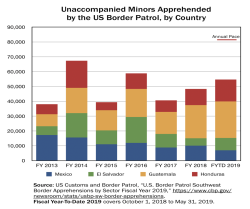
View Full Size Image [Figure 1]
This is a U.S. Customs and Border Patrol report from 2019. If we are looking at the peak in 2014, almost 70,000 undocumented children were apprehended at the U.S.-Mexico border. Depending on their age, the condition, and how they were apprehended, they were either set back across the border or put in a detention center. The numbers are still alarming and high. There were over 50,000 children apprehended without an adult in 2019.
As we talk about undocumented children, there are people who assume all immigrants crossing the border are Mexican. The percentage in Mexico has actually gone down. Those from Guatemala and Honduras are still coming to the U.S. These are ideas about some of the kids who may be at risk for sexual abuse when they cross the border. I want you to keep these statistics in mind, and these are only the children who are apprehended at the border. Think about how many more actually get across or are already living in the U.S. undocumented. It is important for social work practitioners to stay up to date on this population.
Types of Latinx Immigrants
There are documented and undocumented Latinx immigrants. There is an idea that undocumented immigrants share stories of risk, danger, hope, conditions of extreme poverty, bottomless needs, and loss of family. Some of these families live in third-world poverty situations. They are considered even more impoverished than the most impoverished group in the United States, which is often Native Americans. What we are looking at is families who do not have access to government resources because they are undocumented. Many people do not have access to any landlord or tenant rights. They end up living in trailers, apartment buildings, or even rural farmhouses that have no plumbing. They have their children living in unsafe and unsupervised situations.
I want you to keep in mind that this is not because the parents are bad people. I have met some of the most amazing and hardworking parents who brought their children to the United States and are undocumented. However, they can end up living in extreme poverty.
Unfortunately, another thing we know in social work research is that poverty is correlated with child abuse. When I teach my child welfare courses at the university level, I am always telling students to not misconstrue and say that poverty means children are going to be abused. There are amazing parents who live in poverty. But it is unfortunately correlated with an increased risk of child abuse. There are all sorts of factors there, but these children are definitely at risk for that.
Predators of Undocumented Children
Here are some of the predators of undocumented children:
- “Mexicans”
- “Americans”
- Soldiers & Border Patrol
- Gangs & Organized Crime
- Transients
- Mother Nature
- Clergy
- Detention Camps
There is the idea of getting a coyote to take the child across the border. This could either be in the trunk of a car, in a train, or walking or swimming across the border. Whichever way, many families pay someone for safe passage across the border. When I say “Mexicans” and “Americans” in air quotes, it means that these are human beings on both sides of the border that are involved in the smuggling of families back and forth. These folks do not have any regulation and are not under the radar of law enforcement. They are sometimes corrupt law enforcement agents and are not protecting the families. I have talked to several families who had a decent experience with their border crossing. It was traumatic, but the person that was hired to bring them across did not abuse them. However, these folks are potential predators for undocumented kids coming across. Additionally, soldiers include border patrol on either side.
Crime is a large entity at the U.S./Mexico border, as well as on both sides. The El Paso area encompasses both, but there is a very high presence along the border. Kids may be abducted by gangs and get involved in gang activity. They are therefore more likely to be trafficked, abducted, and raped. Also, transients are people that do not live on either side of the border and are definitely predators. Mother nature is a predator in this situation as well. Some of the main causes of death when crossing the border are things like dehydration or exposure. They need clean socks and clothes to help prevent infections or for when it gets cold at night.
Clergy are individuals in religious organizations that are of service to the family. Unfortunately, we know that there are times when the people whom the family trusts are the people that might be trafficking these kids or abusing them. Remember that predators against children within the Catholic church or any church is a delicate topic. Kids might be crossing the border with some sort of intention of getting help from a religious organization, and will then be abused that way. However, there are several religious organizations that do amazing work at the border. Let us not stereotype and assume all clergy abuse children, but it could be happening.
Detention camps are definitely possible predators of sexual abuse. There have been several reports of children saying that they were sexually abused in the camps by employees. I find that highly probable. However, the children are often discredited or there has been a long legal chain of command, even if it was decided as a substantiated case or not.
Sexual Abuse Among Undocumented Latinx Children & Adolescents
When talking about sexual abuse among undocumented Latinx children, the research is virtually nonexistent. There is very little information on the intersection of ethnicity and sexual abuse. There is even less research on undocumented children and sexual abuse. Some of the most profound research that came out on the topic is one report from over 10 years ago. It says that 23 percent of Latinx children report sexual abuse. More data indicates that Latinx children of immigrants are five times more likely to be confirmed as victims of childhood sexual abuse. Even though this information is old, I share it because this is still some of the most correct, empirically-driven data I have found.
The reason it is so difficult to get to these numbers is because how do you research secret abuse? The numbers are low if it is a substantiated case because not all children report, so not all people get caught. Also, how do you research children who are undocumented? They are even less likely to get help.
Children may also be victims of human trafficking for prostitution and pornography. That vulnerable population of Latinx children is often off the radar of helping professionals. Like I said, these children are told to not talk to teachers, coaches, clergy, social workers, or police officers. A regular side effect of abuse within this population is keeping it a secret from their family. Their family would certainly not want them to keep abuse a secret. Some of the children I have worked with had to report sexual abuse and the families were devastated. The question they ask themselves is, “How did I not see it?” We know that undocumented children have been told by their parents from a young age to not trust or talk to the police or their parents will have to go away. It was an unintended consequence that their child did not ask for help.
Barriers to Reporting Abuse
There are also cultural barriers to reporting abuse. Here are some of those barriers:
- Cultural Values: Shame, Familismo, Respecto
- Intense Fear of Deportation
- Religious Importance of Maintaining Virginity in Some Families
- Homophobic label for male victims of child sexual abuse
- Little Contact with Service Providers
- Language Differences
- Lack of Trust
There is fear of the shame that it would bring to the family to have either a survivor or a perpetrator of sexual abuse in the family. “Familismo” means “love of family,” which is important. Family comes first and if a child is being sexually abused by a family member, they will not tell anyone. “Respecto” means respect, and in this case, it means respect for elders. This would include whoever is abusing the child. Respecting the family system would mean keeping that abuse a secret. There is also the intense fear of deportation. These children are taught from a young age to not do anything that would cause deportation.
There is the religious importance of maintaining virginity in some families. The majority of Latinx families are Catholic and virginity is an important factor among many immigrant families. If a child, especially a female, has been sexually abused, it may be important for the family to keep that a secret. Even if the parents did not perpetrate the abuse, they might make sure that the child does not get help or make it public because they want to make sure the child and their perceived virginity is protected.
Another factor is the homophobic label for male victims of child sexual abuse. I lived in Venezuela for an academic year and I learned that some Latinx families believed that it was not okay to be gay. I am hoping that things are changing and my intent is not to generalize. As a social worker that comes from an accepting family, I was shocked by the homophobia I experienced. Social workers have to be anthropologists in the sense that we need to be respectful of a person's culture and where they come from rather than judge it. After working in rural Iowa, I learned that if a boy was sexually abused by a family member or extended friends, they would blame him for the behavior and say that he was gay. This is concerning because the families were not giving their child the care or emotional nurturing that they needed to survive a sexual abuse incident. Years later I ended up working with a Latinx man who had been sexually abused in Mexico for a number of years. When he told his mother, he was beaten and told he was gay. If his father ever found out, he would have disowned him. The family got the uncle away from him, but the police were never called. This is not just a factor in Central and Latin America, it is also here in the United States. They also may receive more physical or emotional abuse from their own family when they try to seek help.
Language differences and little contact with service providers are huge barriers. I am always telling my social work students that even if they cannot speak Spanish, learn some in order to show respect. Oftentimes family members translate when someone needs to talk to a teacher, police officer, or doctor. You do not want the children being the ones who have to translate when the child was the one who was abused.
Maslow’s Hierarchy of Needs
I want to point out Maslow's hierarchy of needs, represented here by Figure 2:
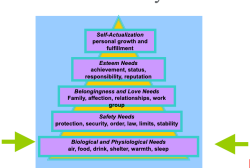
View Full Size Image [Figure 2]
When we are working with these kids, we are working towards biological and physiological needs. This includes air, food, drinks, shelter, warmth, safety, and sleep. Sometimes in order to get these things, they are put in situations where they are sexually abused.
I bring this up because we will be talking about trauma-informed care. What is trauma and how do you identify it? What do you do once you identify it? With Maslow's hierarchy, we need to remember that we are not working with children at higher levels. These kids need protection, security, and stability. If it is an undocumented child, they may have gone without all of these things for an unknown amount of time. We need to work on keeping them safe and stabilizing them in order to build trust.
Understand Immigrants May be Experiencing Traumatic Stress
Understand that immigrants may be experiencing traumatic stress or post-traumatic stress disorder (PTSD). They have been in situations where a prior or current event has caused intense fear, helplessness, or horror. This has a debilitating effect on a person's ability to function, communicate, make decisions, and feel safe. I want to add that if they are undocumented, they may potentially be without a guardian. It is important that these children have a social worker. That is the most important thing as far as the type of help they need unless there is a medical condition and they need a doctor.
Coming from this place of help, we do not want to traumatize them any more than they already have been. We should not react to their situation by being horrified ourselves. As social workers, many of us have been in positions where child abuse may bring tears to our own eyes. That is a part of being human, but be aware that you need to stabilize this person first before we have our own reaction.
Trauma-Informed Care
A traumatic event is when a person experiences actual or threatened death. Some people may say that victims of sexual abuse were not threatened by death, but they were. There is an actual fear of losing something, losing themselves, serious injury, or the threat to the physical integrity of self or another.
Here are some other things to remember when it comes to response:
- Intense fear
- Helplessness
- Horror
- Attachment Issues
Understand the Impact of Trauma
Our response to trauma tends to be fight, flight, or freeze. Another one I include is submit. This means participating in the abuse because that is how they think they will survive. This is different from freeze because that means becoming immobilized. You cannot talk, move, or run. Many victims of childhood sexual abuse have talked with me about that split decision to survive and submit. They often shut down nonessential tasks and rational thought is less possible at this time.
As we are asking these children or adults who have been abused to recount their experience, we need to remember that they may have shut down at that time and the events were not processed. If you are working with an undocumented child and they are talking about their sexual abuse, it is hard to prove that there was a stranger along their journey who abused them. However, despite this, it is important to believe them. This is because their story may be confusing and have conflicting evidence, but that may also be because of the type of abuse they endured.
Trauma-Informed Care: Three Phases to Treat Trauma
With trauma-informed care (TIC), there are three phases to treat trauma:
- Safety and Stabilization
- Processing of Traumatic Material
- Reconnection and Reintegration
How to Help Creating Safe Spaces
This first focus is on getting stabilized. Focus on their physical wellbeing, medical health, and their sleep. Make sure they feel in control of their own body. Help them establish a daily routine. This is because if they had been traveling during the abuse or do not know where their parents are, they will not feel any security.
Remember that trust takes time. As a social worker, you may be viewed as a threatening person who could hurt them. You need to take time to build trust and make sure they know you are safe. When I was a school social worker, I would always tell the families that the school district and I were a safe haven. We did not report to local or federal law enforcement about immigration status. Even with that knowledge, it would take some families months or even years to trust the social workers. For example, my colleague from Ecuador gained their trust much quicker because she was Ecuadorian.
Techniques for Helping Children
After gaining their trust, they are ready to go into the therapy part of dealing with sexual abuse and trauma.
These are the three factors here:
- Play Therapy
- Universal language for children
- Narrative Therapy
- Used as a way to listen to the “story” in the immigration experience
- Cognitive-Behavioral Therapy
- Specific model of CBT called Trauma-Focused Cognitive Behavioral Therapy is useful for treating victims of sexual abuse.
I consider play therapy a universal language for children. It does not matter the language, religion, or sometimes the type of abuse of the child. If you get a certified play therapist or use some play therapy techniques, interacting with the child at their level with universal toys can help them process.
Narrative therapy is used as a way to listen to immigration stories. It allows them to understand that their experiences can be processed with you in a way that is not traumatic.
Cognitive-behavioral therapy (CBT), specifically trauma-focused cognitive behavioral therapy (TFCBT), has been found to be effective in treating victims of sexual abuse. There are some techniques with CBT that allow people to identify the triggers from past trauma and make different decisions on how they behave related to those triggers.
Narrative Techniques
The practice of narrative therapy is culturally competent. This means that a person's identity, sense of self, and culture are important in their healing process. Cognitive-behavioral therapy is more of an empirically-based scientific approach to going through steps to address certain triggers.
Narrative techniques are a holistic view of working with someone. I would use these techniques while working with anyone that has experienced trauma or abuse, not just sexual abuse. It comes from this basic assumption that we all “story” our lives in order to make sense of what has happened to us. This helps us build resilience. The person you are working with can be a survivor and not be stamped as a victim of their abuse.
The client is in control of their own story. They are the expert in the situation as well as their own culture. I may let them know I speak Spanish in the case of working with Latinx immigrant children and I have done research and studied in both Central and South America. However, I am not Latinx or an expert on their situation. I am a fellow traveler on their journey. This allows the client to do some more self-exploring. They can explore why they had the reaction they did and what they did to survive. I am not telling them how I would have been resilient. I often teach my students that as a social worker, we have a metaphorical toolkit of resources to help someone who has been abused. The biggest thing is to empower them and leave them with tools of their own.
We want to ask reflective questions about new possibilities. We are in no way trying to paint a picture and say the abuse never happened. We are instead looking for a survivor within that incident. This can make a difference for a young person who has experienced traumatic sexual abuse, especially with being undocumented and other factors as well. Techniques from our toolkits and skills for resilience can help them throughout their life.
Help Trauma Victims Connect & Reintegrate with Self
Some of you may be in private practice and have the luxury of working with a client long-term. However, some of you may be in a hospital social work setting, youth shelter, or detention center. You do not have a lot of time with these kids, but you can work hard to develop trust with every kid you come in contact with. We want them to know that there are people to help and instill ideas that empower them. Narrative techniques can work in short-term situations as well.
One of my bilingual colleagues interviewed women on the East Coast who had crossed the border and experienced terrible abuse. She kept hearing a theme over and over in Spanish, and the phrase meant, “I was in between the sword and the wall.” In English, it translates to “a rock and a hard place.” This means being in a really difficult situation. In this case, the person she was interviewing had experienced sexual abuse along her journey multiple times. This concept is much more serious than a rock and a hard place. It is being up against a wall with the sword to your throat, making a decision to survive and submit to the sexual assault, or to get the sword. That narrative coming up in her research really exemplifies the power of words and how it relates to narrative therapy. This is such a powerful metaphor for how they felt because it was life or death. Getting inside that narrative can help empower them for being ready for surviving. For example, in this case, they are already understanding that they had no choice.
We want to figure out how the child develops a new, healthy identity, and sense of self. You want them to understand the importance of trust, relationships, and their surrounding environment. When they leave your trust bubble, you have been working with their family to do so. They need to be able to leave and reintegrate into society in a way that allows them to trust other people. This will help with their mental health and ability to get resources in their future in general. How do they trust people again?
Integrate a theme of resiliency. Narrative therapy is important here because it helps trauma victims connect and reintegrate with themself. I continue to mention narrative therapy because the concept of reintegration and resilience is about taking control of their story.
With strength-based practice, look for the exception or unique outcome. That can be a narrative technique as well. As undocumented children go through therapy, what is their unique outcome? For many survivors I have worked with, their unique outcome is that they made it to the United States. Those are important things to keep in mind.
Application of Culturally Competent Practice with Immigrant Children
Remember that regardless of the ethnicity of the social worker in the United States, we are looking at working with a child who is new or was undocumented when they came here. Unless you are an immigrant social worker yourself, there is a cultural learning curve.
Here are ways to be culturally competent:
- Consider the use of social influence & cultural bias.
- Avoid the deficit hypothesis.
- Recognize your own prejudice.
- Understand the concept of color blindness vs. color neutral.
- Move towards cultural pluralism.
- Learn from your mistakes.
- Learn more about ethnic groups in your community.
- Expose yourself to others different than your own.
First, consider the use of social influence and cultural bias in your work. We are all biased and use some sort of cultural influence. We need to look at your own prejudices but also keep that in mind as you are working with Latinx families. Where are my shortfalls? What are some assumptions I am jumping to?
As social workers, we can be guilty of jumping to the deficit hypothesis and we want to avoid this. This comes from Robert Brammer, who is a social worker and scholar on cultural competency. He says that as a helping professional, you assume you have no racial issues or biases of your own and that you are going to save the day. This is due to being focused on the fact that people you are interacting with have a deficit.
A generic example of this would be having a student who is doing her internship for the Department of Human Services. Someone walks in who looks Latinx and she immediately thinks they need a translator. When the person comes up to her and they speak English just fine, that is the deficit hypothesis. This is the idea that because we are advocates with training under our belts and good intentions, we quickly jump to help when we suspect a deficit. Just because we have had this workshop does not mean every child who has crossed the border has been sexually abused. There are children who cross the border and are undocumented who are not traumatized. We never want to assume.
Understand the concept of color blindness versus color neutrality. It is important to make sure that we are aware of all different racial and ethnic classes with the populations we work with. However, it can get complicated. For example, a dark-skinned child in a family I worked with was called “little Negrito.” I felt like it was racially offensive. I then found out that it means “little blackie” and they called him this because he was the darkest child in the family. He was very loved and was not offended by the name. Those are things to be aware of.
Move towards cultural pluralism, not colorblindness. We do not want to teach social work students that all cultures and races are the same. We want to look at the many different cultures and races. We want to integrate and learn as much as we can. Learn from your mistakes and expose yourselves to other people.
It is best to do this before working with certain families. If you are doing emergency room social work, I do not expect you to go research their culture. Just be as aware as you can. We are all learning, including me. We always want to learn how to better our practice, and that is being culturally competent.
Realize that we do not always have the answers. That is also where narrative therapy loops back in. Even as children, they can tell you about the stories that are passed down from their parents. This can include how their family feels about the abuse they endured, why they were told to keep quiet, if they felt shame, and so on. It is culturally relevant to let them be the expert.
Recommendations for Practitioners
Here are some recommendations to remember:
- Show respect & accept hospitality.
- Trust “confianza” is extremely important.
- Learn from the client's narrative – what is their story?
- Become familiar with cultural norms and, if working with children, key folktales, history of the village, etc.
- Careful not to label family overly enmeshed.
- Try not to be an Anthropologist!
- Apply the concept of cultural competence.
Regarding cultural norms and working with children, notice if there is something important as far as healing that goes along with the family and culture with an undocumented family. Make sure that you learn from them and help them heal in that way. I have also learned that the Bible can be important in the healing process for Latinx families. We do not have to have the same religion or beliefs as a family we are working with, but it is important to respect, learn, and participate. This is because the healing is not about us teaching someone how to heal from sexual abuse. It is about them, and part of that is us allowing them to use their cultural resources to do so.
Be careful not to label a family as over enmeshed. Latinx families are traditionally close. Do not assume that the parents are perpetrators if the male children still sleep in bed with their parents. Be aware of a close family versus an abusive family.
Try not to be an anthropologist. I know I said earlier that we have to be anthropologists in another culture, which is to put ourselves in another's shoes and respect their culture rather than judge it. However, there is a fine line between respecting the culture and also being involved. There is a lot to be said for respecting the family enough to step back and be culturally competent when it comes to dealing with trauma with this culture. However, you also want to make sure that you are also an activist. We can help after we have learned.
Summary
Here are some resources that you can always go to for data:
- Pew Hispanic Center
- U.S. Census Bureau, Population Division
- National Public Radio
- The National Child Traumatic Stress Network
- Migration Policy Institute
I get a lot of information from National Public Radio about immigration. I have also talked on National Public Radio about the topic. That is the place that you can go and look for current affairs related to immigration. Also, the National Child Traumatic Stress Network has a whole section dedicated to Latinx families.
The Migration Policy Institute is fascinating because it has a report for citizens that want information on what is going on at the border. They have the statistics, but they also have some reports on sexual abuse.
References
Refer to the course handout for a complete list of references.
Dirks, A. (2020). Immigration and Sexual Abuse: Protecting Undocumented Children. continued.com - Social Work, Article 70. Available at www.continued.com/social-work www.continued.com/social-work
Nov 29, 2020
1 CE CreditPerson-in-Environment Amplified: Understanding the Role of ACEs in Clinical Conceptualization
Alison D. Peak, LCSW, IMH-E
Editor’s note: This text-based course is an edited transcript of the webinar, Person-in-Environment Amplified: Understanding the Role of ACEs in Clinical Conceptualization presented by Alison D. Peak, MSW, LCSW, IMH-E.
Learning Outcomes
After this course, participants will be able to:
- Examine the development of Adverse Childhood Experiences (ACEs) as a research topic and as a method of understanding the context in which a client develops.
- Identify general research statistics on the impact of ACES on long-term health outcomes and health disparities.
- Consider the use of ACEs in clinical work and its ethical implications.
Introduction
We are going to look at ACEs as a research topic and a method of understanding the context in which clients develop these experiences. We are also going to look at general research statistics regarding the impact of ACEs on long-term health outcomes and disparities. We will then consider the use of ACEs in clinical work and the potential ethical implications for that.
What Are Adverse Childhood Experiences?
I work out of Tennessee, which has been a national leader with information and training regarding ACEs. However, there are other parts of the country that do not emphasize it as much. Some of you may already have some experience in ACEs training and others may see this as a new concept.
ACEs are a series of 10 items that have been found to be directly linked to the following:
- Childhood Development
- Brain Architecture
- Academic Success
- Health Outcomes
- Job Satisfaction
- Divorce Rates
- Life Expectancy
The Story of ACEs
ACEs came to be in the mid to late 1990s by a medical insurance company in California called Kaiser-Permanente. They noticed that there was a portion of their members consuming the majority of their financial resources, as well as the time of their physicians and healthcare providers. These super-users were experiencing multiple complex health presentations. An example of this would be a client having Type 2 diabetes and depression at the same time. These medical concerns were chronic in nature and often consumed a large amount of medical resources and funding of the insurance company.
The company sent out a research questionnaire with hundreds of questions about different experiences in health behaviors: How old were you when you learned to drive a car? What age were you when you started drinking? How many cross-country moves do you have? Have you ever been in a car accident? Genetic backgrounds and experiences were included in this as well. They then found that list of 10 items. If these occurred before the age of 18, this increased people's likelihoods of having long-term health outcomes. They also found that there was a complexity to those experiences that increased medical risk.
Figure 1. Image of the ten ACEs.
Those 10 key factors break down into two primary subtotals: abuse and neglect. This includes physical, emotional, and sexual abuse and physical and emotional neglect. There is also the realm of family and household dysfunction. There are many questions that can be asked: was there anybody in your home prior to the age of 18 who was diagnosed with a mental illness? Did you have a relative who resided with you and was incarcerated before your 18th birthday? Did you have a parent who experienced substance abuse? Were your parents divorced prior to your 18th birthday? Was someone in your family treated violently prior to your 18th birthday?
This list can be evocative and we need to recognize what this means for us as clinicians. People tend to look at the list of ACEs and begin to evaluate themselves. It is natural to be curious and want to see the world through our own lens. Many clinicians have not experienced these ACEs. However, there is a universality when we talk about early childhood. We have all been young, when our voices were small. We would get frustrated because when we attempted to communicate big emotions and needs, the adults around us did not always hear us. Those relationships are surrounded by rupture and repair. There is universality in ACEs as well because they may hit home with our experiences as young children. It can be an emotional learning experience. Spend this time by thinking about how this applies to clients.
However, the study for ACEs has some shortcomings. One issue is that the idea of domestic violence at the time was that it was perpetrated by a man onto a woman in a heterosexual relationship. The original question was, “Was your mother treated violently?” We now know that intimate partner violence looks different from what we previously assumed. The current question is, “Was anyone in your home treated violently by their significant other or partner?”
How Common Are ACEs?
How often do people experience adversity?
Figure 2. A chart showing the commonalities of ACEs.
The original study showed that 36 percent of those who took the questionnaire had zero ACEs. 26 percent had one ACE and 12.5 percent had four or more. Four ACEs is a cutoff point because research shows that changes start to occur in the body in terms of processing stress and adversity.
ACEs are cumulative and tend to build in risk and experience. The long-term data and health outcomes on one ACE are different from zero, but not statistically significant. When we start looking at compounding two or three ACEs, the data shifts considerably. When there are four or more ACEs, there is data about long-term health outcomes of those individuals.
There were limitations in the original study as well. It was completed on a specific sample size. Do those numbers still hold true when people outside of the specific population are tested? The ACEs study has been completed numerous times on a U.S. state-by-state basis to look at how those numbers apply to smaller localities.
Figure 3. Represents how the study has been conducted nationally.
On this graph, you will notice that some states have repeated the ACEs study numerous times. For example, Tennessee has repeated the study five or six times. We find that when states repeat it over the years, the breakdown remains valid. 12 to 13 percent of the population experiencing four or more ACEs remains consistent.
Research Across the Lifespan
Individuals who have four or more ACEs are at an increased risk for negative, long-term health outcomes. They also have higher rates of cardiovascular disease, chronic obstructive pulmonary disease (COPD), depression, anxiety, obesity, high blood pressure, strokes, and so on. For individuals who have six or more ACEs, their average life expectancy is 20 years shorter than someone who has fewer than four ACEs. Statistically speaking, individuals with 10 ACEs become developmentally delayed 100 percent of the time.
When we look at this concept from an insurance standpoint, an ACE score of four or more is estimated to cost about $124 billion to the U.S. economy per person. That number comes from the cost of medical care to those individuals, the lost contribution to the economy, the incarceration for individuals, and the additional government support.
These high scores are correlated to other social determinants. This includes poor job retention, difficulty in graduating college, and divorce. When we have high adversity in early childhood, we have difficulty navigating everything that society has deemed appropriate. This includes being on time and managing tasks. It is also about internal chaos. An example of this is someone being in a job for two years and feeling like they need something new. Individuals with four or more ACEs are also at an increased likelihood of being the parents to children who are involved in the child welfare system. Research shows that ACEs are intergenerational and can be passed down. Many of the effects that ACEs have on our body system often result in having difficulty identifying danger or ways to protect others from danger. That is what creates an intergenerational loop. This can show up through language and verbiage as well.
Understanding the Research
Regarding the shortcomings, the original sample size was predominantly white, middle-class, and mostly had Master's degrees. It was also published in the 1990s, but there was not a lot of conversation about it until 2010 when pediatrician Nadine Burke Harris did a TED Talk about it. She discussed the impact of ACEs and the distribution of public health as a representation of socio-economic injustice and racism. That conversation lit a fire across the nation regarding adversity in early childhood and what that means for our healthcare systems. Through recognizing the limitations in the studies, extreme poverty and incidents of racism have been supported to be ACEs. Extreme poverty is identified as being below the federal poverty line, which can indicate that individuals are on state-based Medicaid.
The questions are left to individual interpretation and what we identify as traumatic is up to the self. Our internalization of those experiences is representative of the way that our body stores those experiences, as well as the damage it does on our physical system. Many of us may not identify an experience as traumatic, but somebody else might. How people identify trauma and adversity in early childhood are reflective of their long-term health outcomes. All ACEs are traumas, but not all traumas are ACEs. This idea is linked to a research perspective that has evidence of impact on physical health. Events are traumatic, but they may not meet the threshold from a research standpoint. For example, our current experiences around COVID are not ACEs. There is no current research to show that living through quarantine has an impact on our long-term health outcomes. When we think about chronic exposure to trauma, the decaying of the body systems is due to wear and tear. This is how ACEs manifest in the body after being exposed to trauma on a daily basis.
ACEs in Early Childhood
ACEs are directly linked to chronic stress, so it is important to remember that not all traumas are ACES. There have been four deadly tornadoes in Tennessee in the last two months. They are not ACEs because ACEs are about chronic trauma, not single-incident trauma. The listed ACEs occur frequently across a period of time. For example, a car accident can be traumatic, but it has a clear beginning and a clear ending.
Constantly feeling the potential for chaos increases the level of chronic stress and exposure to chronic trauma. Chronic stress builds production of cortisol in the brain. This is a hormone that puts us into fight, flight, or freeze. Cortisol is important to have, but we are not supposed to remain in survival mode. When our brain continues to produce cortisol, the brain lowers function in other areas. It pulls the brain’s power back to the places that are going to ensure our survival the most. The parts that control heartbeat, blood pressure, body temperature, and impulse control are referred to as executive functions. From a survival standpoint, the brain is most concerned that we live through an experience. It is not important that we make a good decision during the situation, or that we use kind words. When we are consistently exposed to cortisol, we tend to stay in those parts of our brain for a longer period than normal.
Brain Architecture
We know that positive development and neurological formation during early childhood are foundational through relationships. They teach young children how to regulate themselves, what is safe and what is dangerous, how to ask for help, and how to use other people to effectively meet their own emotional needs. Being in relationships and connecting with others is our greatest survival skill.
Increased chronic stress damages impulse control, analytical thinking, and cause and effect. Children are not good at those things and when their brains are not fully formed, their development is delayed due to chronic exposure to stress. The brain gets stuck in order to make sure that we survive. It is not concerned with progressing from a developmental standpoint.
The anchoring point for experiences of adversity are safe and predictable relationships because they allow kids to do things like social reference. Through looking for security in these relationships, kids can then determine if a situation is safe or dangerous, as well as if there somebody who can help hold their feelings.
Executive Functioning
We often talk about executive functions representing an air traffic control system. It is the tower of the brain that is looking for everything that is incoming and being able to identify what should be navigated. Young children are constantly experiencing big feelings. When we become young adults, there are always questions: did I make the right decision about college? Should I take a gap year? What if people do not like me? Was it a mistake for me to go out with this person? Are my friends mad at me? It is about looming decisions that require air traffic control in order to regulate emotions, take in various sources of information, and modulate our own reactions. This way all of those planes can land safely.
When kids have numerous ACEs, it is often that their control tower is offline. This aspect is a part of the higher levels of incarceration and higher rates of difficulty maintaining a job. Our brain is working so hard to survive that the control tower is not doing its job to prioritize and work through situations.
Intergenerational Transmission of ACEs
Parents who have experienced abuse and neglect are likely to have children who also experience abuse and neglect. There is repetition throughout generations regarding adversity, and some of that comes from parenting in direct contrast to how they were parented. The opposite of unhealthy is just a different version of unhealthy. The middle ground, in dialectical behavior therapy (DBT) language, is where we find healthy parenting and healthy relationships. When parents have experienced ACEs and they either parent as they were parented or parent in direct contrast, we see that children experience repetition with those adversities.
We see this with animals as well. When mice pups are born, the parents engage in two patterns of essentially nursing. One is high arched-back nursing and the other is a dystonic-like, low back nursing. We see higher rates of cortisol in more apathetic nursing. On the other hand, there are higher rates of oxytocin and other positive hormones with high-backed participation nursing. Even when mice pups are switched to a caregiver who acts differently from their biological parent, their DNA will shift. When they become parents, they are able to engage in nursing that directly mimics the way they were nursed as babies. Our DNA holds the experience of how we were given care.
In the 1970s there was a researcher named Selma Fraiberg from the University of Michigan. She was the foundational author for early childhood work and infant mental health. She led a research project known as Ghosts in the Nursery about families dealing with a visual impairment. They did a controlled trial observation which involved a family at a hospital. The mother was 19 years old and as the team observed, the baby started to cry. The mom did not go to the baby or speak to the baby, but instead sat in the room for 20 minutes with a screaming infant. The team stepped back and wondered why the mother could not hear the baby. They began to recognize that there can be subconscious, unknown forces that lurk in the early experiences of parents and children. These forces motivate the way that we engage in and receive caregiving, and they impact long-term experiences of adversity.
Clinical Considerations of ACEs
What does this mean for clinicians? This may be applicable for those of you who work with young children. For those of you who do not work with children, how can this apply to you? ACEs underscore how we develop and are essential in navigating the world and understanding relationships. The duration of that lasts a lifetime. When we learn as young children that adults are unsafe or unhelpful, we hold that internal belief until there is possibility for it to be proven otherwise. Many of the experiences that we see in adults regarding gerontology, including substance abuse or personality disorders, is about asking ourselves if the people around us are safe. What am I doing in the context of relationships to find security and affirmation? Experiences from early childhood connect to the presentation of the problem at hand.
ACEs are cumulative, and we have the ability to provide insight to clients about what it means to have lived their life. It is a good place for us to provide that information to parents and families. I was watching a lecture series called Haruv From the Couch. Alicia Lieberman from the University of California at San Francisco used this lovely analogy of a wave: some people are good swimmers, and a large wave to a surfer is a place of excitement. For those of us who are not strong swimmers, a large wave would be terrifying and potentially lethal. Cumulative experiences of adversity make a difference for what feels dangerous to many of us. A wave from the perspective of a three-year-old looks much bigger than it does to an experienced surfer. It is important to understand the cumulative impact of ACEs that add depth to our client’s narrative. Know that their waves have been back-to-back.
ACEs allow for a grounding point during intake and assessment. This allows clinicians to consider how the client’s experiences are linked to their physical health. For those of us who have experience in medical social work or hospice care, there is always the consideration of the public health’s role in social determinants of health. From a public health standpoint, racism in community planning exposes individuals to higher rates of toxins. Those are moments when we are going to see higher rates of asthma and COPD. They also may be complicated by the adversity that an individual has experienced, as well as the internal stress on their body. Being able to hold those factors together allows us to do a thorough evaluation of the connection between an emotional and physical experience. It can also be helpful in considering linking ACEs as an assessment to an intervention. What is the priority in our clinical decision-making? Is there a current crisis that must be navigated?
The Power of Hope
Remember that ACEs are fact, not fate. Research says that with a score of greater than six, life expectancy is cut by 20 years. Understanding the complexity of ACEs has the opportunity to drive our decision-making and clinically look at how we are preventing and their impact. It also creates resiliency within individuals. That process along with work and positive relationships allow the opportunity for healing.
The largest factor around resiliency is a predictable relationship with an adult. It could be with a parent, guidance counselor, or neighbor. They could be any consistent person who loves the child. This creates a reparative option for chronic stress and trauma. In 2005, Alicia Lieberman worked on a project out of the University of California at San Francisco. She talked to a funder about Ghosts in the Nursery and the work that she did with Selma Fraiberg on intergenerational transmission of trauma. The funder suggested that there are angels as well. This was a turning point after 35 years of working on the subconscious forces that drive decision-making. There are also benevolent experiences that motivate us to go down a different path and help us realize that not all adults are scary.
This theory also states that hope is created when an individual knows they have multiple paths to reach a desired outcome. Even though childhood experiences may not have been positive on most days, there is an opportunity to take an alternative route and achieve that experience in a different way. One of our greatest responsibilities as clinicians is to foster hope and provide evidence for clients that do not have to go the way they have in the past.
Ethical Considerations of ACEs
There are some ethical considerations to keep in mind when we are thinking through the use of ACEs, specifically in the realm of research. It was not intended to be a clinical assessment for people to fill out on their own. Take a moment to think through how evocative that would be for each of you. When I teach at universities and do this presentation, I see people pull out a piece of paper and start making tally marks. We all have the internal need to know where we fit in the greater picture of this. There have been agencies and organizations who, with the best of intentions, give out ACEs screeners as part of intake paperwork. It is not designed to be an assessment tool.
They should always be associated in the context of psychoeducation and what that means for long-term health outcomes. There is solid grounding for ACEs within fact and not fate. People are given hope around their own experience because if they go home and research themselves, the information can be overwhelming.
If somebody uses an ACEs questionnaire, it is imperative that that associated information is shared in that moment so clients do not go find it on their own. That creates internal anxiety within the client because they want to know what is going on with them. It should be about the consideration of whether using an ACEs questionnaire is necessary. If you are doing a thorough biopsychosocial, all of that information should be in a trauma assessment.
There are also limitations. I have seen situations where organizations or individuals use an ACE questionnaire as the trauma assessment. This does not work because there are a lot of things it misses. Examples such as COVID, tornadoes, house fires, car accidents, and the death of a sibling are not ACEs. In that case, it is sufficient to use stand-alone assessments for traumatic experiences. It should be considered whether it is necessary before we provide it. We hold our own research lens that we are modeling, and that information is reflected in that larger, general biopsychosocial.
If you are going to provide an ACEs questionnaire, you should also consider where it is going to be stored. If you complete an ACEs questionnaire for the parents or foster parents of a child, where do those scores go? Does that mean there is another chart opened on those individuals? How do they feel about that? What does that mean for their treatment? If we are considering ACEs for parents, how do we communicate that information to those who may not have a clinical perspective or ACEs training?
We also want to remember that raw data is never to be submitted with a chart for legal review. It is a part of the Health Insurance Portability and Accountability Act (HIPAA) that is allowed to be left out when there is a subpoena for a chart. This is because raw data needs to be interpreted. That questionnaire could be sent to a judge who may not have any background in ACEs. They then do their own Googling and come to their own conclusion based on research, not healing.
There is a real consideration around doing any type of screener. What does it mean? Where is it going to be stored? What is the long-term purpose? We gain benefit from this by knowing the information and doing a thorough assessment. Risks include lacking a balance of what we know about outcomes for those with high scores and listening to the experiences of each client. We may know what the research says, but we do not know the narrative. Being able to hold knowledge and space for experience is important. Holding both of those equally can be difficult.
Conclusion
I want to direct you to the slide regarding cultural competence, specifically for the NASW standards. Today we talked about the role of ACEs and diversity, specifically how the original research played into it. The race component involves the white demographic that was originally tested, as well as events of racism being an additional ACE.
Questions and Answers
You spoke about being careful with charting ACEs. Can you speak about the negativity that is associated with that and why practitioners should stray from it?
Social workers should always hold a lens to the social stigma associated with services and the experiences of adversity. We see that within ACEs as well. ACEs are helpful because it presents our internal information about intergenerational trauma in a way that is accessible to those who are not clinicians. Those people can look at ACEs data and compute what it means for their work. It allows people to understand which early childhood experiences play a role in our long-term development. This is why snapshots can be dangerous. They do not capture the full picture and ACEs screeners can walk a fine line with that. We work with the child welfare system for our practice, so we will not release ACEs data. We will also politely decline when courts ask us to facilitate an ACEs screener if they simply want a thorough picture of the family. That social justice lens goes along with the ethical dynamic of giving a voice to the entire experience of a client. You can then make a decision.
References
Brain Architecture. (2014). Palix Foundation/Alberta Family Wellness. Retrieved from https://www.albertafamilywellness.org/resources/video/brain-architecture
Anda, R. F., Felitti, V. J., Walker, J., Whitfield, C. L., Bremner, J. D., Perry, B. D., Dube, S. R., & Giles, W. H. (2014). The enduring effects of abuse and related adverse experiences in childhood. A convergence of evidence from neurobiology and epidemiology. European Archives of Psychiatry Clinical Neuroscience, 56(3), 174–86.
Anda, R. F., Porter, L. E., & Brown, D. W. (2020). Inside the Adverse Childhood Experience Score: Strengths, Limitations, and Misapplications. American Journal of Preventive Medicine, 1-3.
Counts, J., Gillam, R., Shabrie, P., & Eggers, K. (2017). Lemonade for Life-A Pilot Study on a Hope-Infused, Trauma-Informed, Approach to Help Families Understand Their Past and Focus on the Future. Children and Youth Services Review, 79, 228-234.
Felitti, V. J., Anda, R. F., Nordenberg, D., Williamson, D. F., Spitz, A. M., Edwards, V., Koss, M. P., & Marks, J. S. (1998). Relationship of childhood abuse and household dysfunction to many of the leading causes of death in adults: The Adverse Childhood Experiences (ACE) Study. American Journal of Preventive Medicine, 14(4), 245–258.
Larkin H., Felitti, V. J., & Anda, R. F. (2014). Social work and Adverse Childhood Experiences (ACE) Research: implications for practice and health policy. Social Work in Public Health, 29(1), 1-16.
Loudermilk, E., Loudermilk K., Obenauer, J., & Quinn, M. (2018). Impact of Adverse Childhood Experiences (ACEs) on Adult Alcohol Consumption Behaviors. Child Abuse & Neglect, 86, 368-374.
Madison R. Schmidt, Angela J. Narayan, Victoria M. Atzl, Luisa M. Rivera & Alicia F. Lieberman (2020) Childhood Maltreatment on the Adverse Childhood Experiences (ACEs) Scale versus the Childhood Trauma Questionnaire (CTQ) in a Perinatal Sample, Journal of Aggression, Maltreatment & Trauma, 29:1, 38-56, DOI: 10.1080/10926771.2018.1524806
Stein, M.D., Conti, M.T., Kenney, S., et al. (2017). Adverse Childhood Experience Effects on Opioid Use Initiation, Injection Use, and Overdose Among Persons with Opioid Use Disorder. Drug and Alcohol Dependence, 179, 325-329.
Spratt, T., Devaney, J., & Frederick, J., (2019). Adverse Childhood Experiences: Beyond Signs of Safety; Reimagining the Organization and Practice of Social Work with Children and Families. British Journal of Social Work
The ACE Study Survey Data. (2016) Centers for Disease Control and Prevention, Kaiser Permanente. Atlanta, Georgia: U.S. Department of Health and Human Services, Centers for Disease Control and Prevention
Topitzes, J., Pate, D. J., Berman, N. D., & Medina-Kirchner, C. (2016). Adverse Childhood Experiences, Health, and Employment: A Study of Men Seeking Job Services. Child Abuse & Neglect, 61, 23-24.
Turney, K. (2018). Adverse Childhood Experiences Among Children of Incarcerated Parents. Children and Youth Services Review, 89, 218-225.
Citation
Peak, A. D. (2024). Person-in-environment amplified: Understanding the role of ACEs in clinical conceptualization. Continued.com, Article 32. Available at www.continued.com/social-work
Aug 14, 2020
1 CE Credit