Course Articles
Occupational Safety and Health Administration (OSHA) Bloodborne Pathogens Standards: What You Need to Know
Kathleen Weissberg, OTR/L, OTD
Editor’s note: This text-based course is an edited transcript of the webinar, Occupational Safety and Health Administration (OSHA) Bloodborne Pathogens Standards: What You Need to Know, presented by Kathleen Weissberg, OTD, OTR/L, CMDCP, CDP, CFPS.
Learning Outcomes
After this course, participants will be able to:
- Define key concepts related to bloodborne pathogens, occupational exposure
- Identify the minimum standards to which employers must comply related to bloodborne pathogens infection control
- List the 4 main methods of compliance as defined by the Occupational Safety Health Administration (OSHA) Bloodborne Pathogens Standards
- Identify best practices with regard to personal protective equipment, handwashing, handling contaminated items, record-keeping
Definitions
- Blood – human blood or component
- Bloodborne Pathogens – microorganisms transmitted in the bloodstream that can cause disease
- Contaminated – presence of blood or other potentially infectious materials on an item or surface
Honestly, I have tried hard to figure out how to make OSHA fun, exciting, riveting, and engaging I have not figured it out yet. Maybe after this session, we will figure that out. This is standard 1910.1030, in case you need that information. We probably know these intuitively, but let's review what OSHA means by each of these items. First, blood, human blood, and human components are products that might be made from human blood. When we talk about the term bloodborne pathogens, these are microorganisms that might be transmitted through the bloodstream that can cause disease, particularly in humans. These might include things like hepatitis B or HBV. You will see it abbreviated throughout Hep C or HBC. The human immunodeficiency virus or HIV. When you hear the word contaminated, we talk about the space where we practice. This means the presence or the reasonably anticipated presence of blood or any potentially other infectious materials. You might see that abbreviated throughout this as OPIM or other potentially infectious materials. These can be on an item we might be using during treatment or on some surface where we are placing something. For example, let's say we are talking about laundry or a surface that has been contaminated, it is reasonably anticipated, or we know that it is been soiled with blood or some other potentially infectious materials. Maybe in the case of laundry in a nursing situation, there could be sharps rolled up into that laundry. That could mean any object carrying infectious material that could puncture the skin. It could be a needle, a scalpel, broken glass, exposed ends of a dental wire, or something else. All those things would need to be decontaminated using physical or chemical means to inactivate or otherwise destroy the microorganisms there.
- Engineering Controls – things in a place of employment that isolate or remove a bloodborne pathogens hazard
- Exposure Incident – means contact with infectious materials by eye, mouth, other mucous membrane, non - intact skin, or parenteral contact
- Handwashing Facilities – adequate supply of running potable water, soap, and single-use towels or air-drying machines
Continuing on engineering controls, This means controls or things that we do in our place of employment. It might be a sharps disposal container, in a nursing situation, probably a self-sheathing needle, safer medical devices that might be out there, such as sharps with engineer sharps, injury protection, needleless systems, et cetera, that are going to isolate or otherwise remove the bloodborne pathogens in that hazard from the workplace. An exposure incident, we will talk about procedures related to this toward the end. This would mean a specific eye, mouth, or other mucus membranes, non-intact skin or parental contact with blood or OPIM, or other potentially infectious materials that result from the performance of some job duty that you have. Some part of you that is "open," or exposed, has come in contact with infectious material. This is actual exposure versus occupational exposure. Occupational exposure means that during the course of your daily work, you may be going to come in contact with potentially infected blood or body fluids. In all of our practices, we would expect some occupational exposure. Hand washing facilities are pretty basic, but the facility provides an adequate supply of running water, soap, single-use towels, or air drying machines. In a few slides, we will talk in detail about how and when to wash.
- Needleless systems – a device that does not use needles for:
- Collection of bodily fluids or withdrawal of body fluids after initial venous or arterial access is established:
- Administration of medication or fluids; or
- Any other procedure involving the potential for occupational exposure to bloodborne pathogens due to percutaneous injuries from contaminated sharps
A needleless system is a device that does not use needles to collect bodily fluids or withdraw bodily fluids after initial venous or arterial access is established. It could be for administering medication or fluids or any other procedure that might involve the potential for occupational exposure to bloodborne pathogens due to percutaneous injuries from contaminated sharps.
- Other Potentially Infectious Materials (OPIM) – body fluids
- Semen, vaginal secretions, cerebrospinal fluid, synovial fluid, pleural fluid, pericardial fluid, peritoneal fluid, amniotic fluid, saliva in dental procedures
- Any body fluid visibly contaminated with blood
- Situations where it is impossible to differentiate between body fluids
OPIM could mean unfixed tissues or organs from a human that could be living or dead or cells or tissues that contain some transmissible disease. For example, HIV, HPV, and other types of hepatitis, et cetera. For most of us, I think it is probably body fluids that we are coming in contact with. Things as cerebral spinal fluids, synovial fluid, semen, vaginal secretions, and pleural fluid. You can come across peritoneal fluid, amniotic fluid, saliva, suctioning, or something like that. , any body fluid visibly contaminated with blood, and all body fluids in situations where we cannot tell. It is difficult or impossible to differentiate what body fluids I see. Do they have blood, or do they not have blood? You are going to treat it as if it is potentially contaminated. How often we are indeed coming in contact with this, I do not know, but we have to know that definition as well.
- Personal Protective Equipment – specialized clothing or equipment worn by an employee for protection against a hazard
- Regulated Waste – liquid or semi-liquid blood or other potentially infectious materials or contaminated items
A couple of other definitions of personal protective equipment (PPE). We will discuss this in more detail, but this is specialized clothing or equipment that we wear to protect against a hazard. Remember that our general work clothes, your uniform, pants, shirt, blouse, scrubs, whatever, are not intended to protect against a hazard. They are not considered to be PPE. I think we inherently know that. PPE includes gloves, gowns, a face shield, an eye shield, boot covers, et cetera. Regulated waste means liquid, semi-liquid blood, potentially infectious material, or contaminated items. We all know that these need to be disposed of in a certain way. Sharps with engineered sharps injury protections is a non-needle sharp or needle device used for withdrawing body fluids, accessing a vein or artery, and administering medications or other fluids with a built-in safety feature or a mechanism that reduces the exposure or risk of an exposure incident.
Universal precautions are an approach to infection control recommended by the CDC and OSHA. According to universal precautions, all human blood and certain human body fluids are treated as if they are known to be infectious for various things, such as HIV, hepatitis, and other bloodborne pathogens. Work practical controls are controls that will reduce the likelihood of exposure by altering the manner in which a task is performed. For example, let's say you have to do a specific task. Needles are the easiest to talk about when doing something with sharps. A work practice control might be something like you are prohibited from recapping that by a two-handed technique. You have to use a one-handed scoop. That would potentially protect you from not an actual exposure incident.
The Standard
- Requirements state what employers must do to protect workers who are occupationally exposed to blood or other potentially infectious materials
- Requires employers to:
- Establish an exposure control plan
- Update the plan annually to reflect changes in tasks, procedures, and positions that affect occupational exposure, and also technological changes that eliminate or reduce occupational exposure
- Document procedure for the evaluation of circumstances surrounding exposure incidents
- Exposure plan is available and accessible
- Feedback needs to be from non - managerial
employees responsible for direct patient care
Let's talk about the standard requirements of what employers must do to protect workers who are occupationally exposed to blood or other OPIM. This standard protects workers in healthcare who can reasonably be anticipated to come in contact with blood or other body fluids or other infectious materials as a result of just doing their day-to-day job. In general, this requires the employer to do a few things. They have to establish an exposure control plan. This is a written plan that exists to eliminate or minimize occupational exposure. This has to be done. They must prepare an exposure determination that contains a list of job classifications in which all workers have occupational exposure. Then a different list of job classifications in which some workers have occupational exposure, like the people that always have occupational exposure and some that have some occupational exposure, along with a list of tasks and procedures that those people would be performing that result in their exposure. It is this list of what you can expect with regard to exposure. The other thing is the employer needs to update this plan annually to reflect any changes in tasks, procedures, positions, job classifications, or anything that could potentially affect occupational exposure. It would also include updates of any technological changes they have implemented or now exist that eliminate or reduce that possible exposure. In addition, annually, they need to document in the plan that they have begun using appropriate commercially available, effective, safer medical devices designed to eliminate or minimize occupational exposure. It does not mean they have to change or do something; there may not be something on the market that they can change, but they have to evaluate, consider, and look at that.
Employers must also document that they have solicited input from frontline workers in identifying, evaluating, and selecting some of those engineering controls and work practice controls. They are getting feedback from us on what is working, what is not, and what should change. The employer must document the procedure for evaluating circumstances surrounding those exposure incidents. How did they evaluate that this job classification or this task has an exposure, but this one does not? There has to be some methodology documented related to that. Employers we know must make sure that a copy of that exposure plan is available and accessible to all employers or employees. Typically you will find this in a policy procedure manual, maybe a clinical manual. I urge you to look at it and see what it says about the place where you are practicing. I talked about feedback because this is important in soliciting that feedback about things that are effective or ineffective. It must be from frontline workers, non-managerial employees responsible for direct patient care, and those potentially exposed to contaminated materials. Just in my history, I have seen where we do not always do that. Sometimes we keep it among the managerial team instead of going to the source to discover what could possibly help our frontline. We talked about exposure determination, but keep in mind without regard for the use of PPE. If I am going to be exposed, how was that determination made if I did not have PPE? If I did not have it, would I be exposed? What level of exposure would I see?
Methods of Compliance
- Universal Precautions
- Engineering and Work Practice Controls
- Personal Protective Equipment
- Housekeeping Practices
The four main methods of compliance refer to techniques and procedures that we can follow to minimize the risk of exposure to bloodborne pathogens. These are universal precautions, engineering work practice controls, PPE, and housekeeping practices. We will start with universal precautions because we all know about and have heard about this.
Universal Precautions
- Using disposable gloves and other protective barriers while examining all patients and while handling needles, scalpels, and other sharp instruments
- Washing hands and other skin surfaces that are contaminated with blood or body fluids immediately after a procedure or examination
- Changing gloves between patients and never reusing gloves
The OSHA standards are crystal clear about practicing universal precautions. We should observe these to prevent contact with blood or other potentially infectious materials. When you are not sure, you cannot differentiate. It is not clear. Treat it as if it is infectious. It is always better to protect yourself than to take that risk. I think way back when we started doing a lot of these things, there was this worry, Am I going to be offensive to my patient? Are they going to think that I think they have something? I do not think that is the case anymore. If nothing else, as we have come through COVID. As a strong expectation that we wear gloves and masks as these things are very standard practices. It is a good thing. It is nice to see that we have gotten there. This approach treats all human blood body fluids as if they contain bloodborne pathogens. What do universal precautions include? It's disposable gloves and other protective barriers.
We talk about what those are while examining all patients, handling needles, scalpels, sharp instruments, and the like. It is washing our hands. You cannot ever wash too much, I am convinced. Other skin surfaces, your arms, your elbows, your forearms, whatever could possibly be contaminated with blood or body fluids immediately after a procedure or an examination or as soon as practicable. I say that because sometimes, as we all know, the hand washing sink is not always readily available. We may pause and use hand sanitizer until we get to that sink. Changing gloves between our patients and never reusing gloves. There is nothing wrong with taking them off and grabbing a new pair. That is obviously what we should do. There are types of gloves that we can reuse, but certainly not the latex variety that we typically see in our clinics.
- Used to eliminate or minimize employee
- exposure
- If occupational exposure remains, PPE is used
- Employer must review, examine, maintain or replace controls on a regular schedule
- Provide handwashing stations
- If not feasible, provide appropriate antiseptic hand cleanser in conjunction with clean cloth/paper towels or antiseptic towelettes
We have mentioned this should be used to eliminate or minimize any exposure we would have where occupational exposure remains even after controls have been used. We have put policies and procedures in place. If there is still occupational exposure, then we use our PPE. The question is, what is the employer required to do? They must review, examine, maintain or replace these on a regular schedule to ensure they remain effective. That is the critical piece: maybe something we put in place 2-4 years ago is not appropriate anymore. Considering where we are today versus where we were four years ago. We constantly reevaluate. We get feedback to make sure that they remain pertinent. They do need to provide hand washing stations. If it is not feasible or unavailable in your space, the employer must provide an appropriate antiseptic hand cleanser. A hand sanitizer in conjunction with clean cloth paper towels or antiseptic towelettes. This one important piece is that the hand sanitizer has to be of a particular medical grade. It has to have a certain amount of alcohol to be effective. it is essential to use the stuff that your employer gives. Maybe some of them give trial sizes you can stash in your pocket.
- Handwashing
- Hand sanitizer does not take the place of appropriate handwashing
- Wash hands with soap and running water as soon as possible
- Hand hygiene is the first line of defense, and hand washing is generally considered the single most important procedure for preventing the spread of infection
Hand sanitizer is great. We love it, it is fabulous, but it does not take the place of appropriate hand washing. If you are using hand sanitizer as your stopgap, you want to quickly get somewhere where you can genuinely wash your hands with soap and running water. I am going to back up for just a quick second share that recently, I have been at several large national conferences, and I work in long-term care, and they were talking about tags related to state surveys. They said the number one most common tag deficiency that people are getting on their survey relates to infection control. It is not infection control as a global umbrella, it is hand hygiene. It is hand washing and the appropriate use of gloves. Those are such simple things. I do not know about you, but it seems like everywhere I go, signs say this is how you wash your hands or how long to wash your hands. I will call them engineering practices. Even on the doors, I do not have to pull the door open. I can pull it open with my foot, different things like that, that keep our hands nice clean. But it is the number one deficiency out there. I found that interesting. It is generally considered the most critical procedure for preventing the spread of nosocomial infection. It is used in conjunction with those standard precautions which keep us protected.
When do we wash our hands? When you complete any required task before you leave a laboratory if you happen to be taking a specimen or doing something like that in the course of your work. Immediately after the removal of your gloves and other PPE. Upon contact or when contamination with blood or other potentially infectious material is visible. It is recommended if you get something on your gloves, change your gloves pretty quickly. Before eating, that is gross not to wash our hands before we eat. Drinking, smoking, applying cosmetics, handling contact lenses, anything where we would be close to one of our mucus membranes that would be exposed or open to a microorganism. Before using the bathroom. Then before any activities in which hand contact is made with mucus membranes, the eyes, or any break in the skin. If you had a cut or an abrasion, or a wound.
How do you wash your hands? I have to say this is like kind of 101. I realize that but this is OSHA as I said, it is one of the most prominent tags that we see. You wet your hands with water, apply enough soap to cover all the surfaces, thoroughly wash all the parts of your hands and fingers up to the wrist, and rub your hands together between your fingers for at least 20 seconds. I do not know what you were taught, maybe it is saying the alphabet a couple of times, singing the happy birthday song, or you count. You rinse your hands with water, you dry them thoroughly with a paper towel. Use a paper towel to turn off the faucet, open the door if you can, turn off the light, and touch any surface that could have been touched by potentially contaminated hands now that your hands are clean. Employers need to ensure that employees wash their hands immediately or as soon as feasible after we remove gloves and other protective equipment. Additionally, we need to wash our hands and any other skin with soap water and flush the mucus membranes with water as soon as feasible following any contact with body areas, with blood, or any potentially infectious material. We do not go through like eye wash stations in this session, but I suspect those are on-site somewhere in your clinic or where you work. That might be another thing that you seek to say where is that? Should I ever need that? What is the procedure how do we go about using that?
Engineering and Work Practice Controls
- Contaminated needles and other contaminated sharps should not be bent, recapped, or removed with a few limited exceptions
- Shearing or breaking of contaminated needles is absolutely prohibited
- If sharps are to be reused, storage container must be puncture resistant; labeled or colorcoded; and leakproof on the sides and bottom
Contaminated needles contaminated sharps. There are a few limited exceptions there, but for the most part, they should not be bent, recapped, or removed. Shearing or breaking is positively prohibited. If they need to be bent, recapped, or something like that, that needs to be done through a mechanical device, or a one-handed technique may be where we scoop it but never two-handed. Because if you miss somehow, you can potentially puncture your skin. If sharps are reused, there are cases where that happens. They need to be in an appropriate container until they are reprocessed. We do not reprocess those. It will be by somebody else. Not sure who that is. If that is the case, that container does need to be puncture-resistant, labeled, and color-coded leakproof on the sides on the bottom. That is a general sharps container. My husband years ago had to give himself an injection once a month we had our very own little sharps container in our home.
- Eating, drinking, smoking, applying cosmetics or lip balm, and handling contact lenses are prohibited in work areas where there is a reasonable likelihood of occupational exposure
- Food and drink shall not be kept anywhere potentially infectious materials are present
- Standards also apply to equipment
Handling contact lenses is prohibited in areas with a reasonable likelihood of occupational exposure. I think that makes a lot of sense. Additionally, food and drinks should not be kept in refrigerators, freezers, shelves, cabinets, countertops, benches, and table tops, or where we may have blood or other potentially infectious materials. All procedures involving blood or other potentially infectious materials should be performed to minimize splashing, spraying, spattering, generating droplets, et cetera. I will not get into this a lot of detail, but the standards also apply to equipment. You want to make sure that you examine any equipment that you are using before using it. A piece of equipment could have had a blood splatter or something sprayed on it. You want to make sure that you look at it, you review it. If you had that happen during your treatment session, you want to alert whoever would take care of that because that needs to be decontaminated as quickly as possible. Unless that is not feasible, you want that decontaminated, you want that cleaned before somebody else uses it. I think in a lot of our clinics now, I do not know if you have seen this, but there are like plastic, I do not even know what I would call them, almost like a plastic sheath or a plastic bag that can be used over a lot of tubing probes different things that it is a single-use, it is not contaminated then that cleanliness is retained.
Personal Protective Equipment (PPE)
- Provision
- With occupational exposure, employer shall provide, at no cost to the employee, appropriate PPE
- PPE is considered “appropriate” only if it does not permit blood or other potentially infectious materials to pass through or underneath
What does the standard stay about PPE? The standard says provision. When there is occupational exposure, the employer shall provide PPE. I am reading directly from this at no cost to the employee appropriate personal protective equipment such as, but not limited to, gloves, gowns, laboratory coats, face shields, masks, eye protection, mouthpieces, resuscitation bags, pocket masks, or other ventilation devices. There is a lot of stuff included there. PPE will only be considered appropriate only if it does not permit blood or other potentially infectious materials to pass through or reach your work clothes, your straight clothes, your undergarments, skin, eyes, mouth, or other mucus membranes under normal conditions of use for the duration of time that you are wearing the PPE. Sometimes, you see this fancy cute stuff that people might be using. It is not PPE unless it genuinely protects you, the wearer underneath, from something saturating through it or coming through it, getting on your skin or to your undergarments or such.
- Use
- Ensure employees use PPE unless employee temporarily and briefly declined to use it or professional judgement demonstrates increased hazard to the safety of the worker
- Circumstances must be investigated and documented in order to determine whether changes can be instituted to prevent such occurrences in the future
The employer shall ensure that the employee uses appropriate PPE unless the employer shows that the employee briefly declined to use PPE when it was the employee's professional judgment under rare extraordinary circumstances. In this specific instance, its use would have prevented the delivery of healthcare or public safety services or would have posed an increased hazard to the safety of the worker or the coworker, meaning the employer has to make sure you wear the stuff that you use this stuff unless under some rare circumstance there is absolutely no way you can wear it and here is why. If you make that judgment, maybe during an emergency situation, a code, or something like that, the circumstances need to be investigated. They need to be documented. The reason is to go back to what the employer must do. They have to consistently look at the workplace engineering controls. Do they need to determine if there is something that should be instituted to prevent this from occurring in the future?
Also, with PPE accessibility, there are all sorts of rules related to this. The employers shall ensure that the appropriate PPE in the appropriate size is readily accessible at the workplace or is issued to the employee. It is either there for you to use on a day-to-day basis, or it is yours to keep. That could be hypoallergenic gloves, glove liners, powderless gloves, or things your size. How often have you seen you go in there are only large gloves, but you have small petite hands that just do not fit similar alternatives? You have to have something accessible for you. Allergies are big ones for people, such as latex allergies. Two other things are laundering and disposal. They need to clean, launder dispose of PPE. It is never to the cost of the employee. The employer needs to be responsible for that. Finally, repair and replacement. The employer shall repair or replace PPE as needed to maintain its effectiveness at no cost to the employee. If you have something your own, does it need to be repaired or replaced? That is up to the employer to do that. A few things about PPE. If a garment is penetrated by blood or other potentially infectious material, it must be taken off immediately or as soon as possible. For example, it may not always be feasible if you are in a code. It should be removed before leaving the work area. That could be your specific work area, or that could be the workplace. It is both. When PPE is removed, you are going to put it in the appropriate area, the appropriate container, depending on your employer, where they either store it, wash it, decontaminate it, dispose of it, replace it make sure you know where that is.
- Gloves
- Worn when it is anticipated to have hand contact with blood, OPIM, mucous membranes, nonintact skin and/or when handling or touching contaminated items
- Disposable gloves should be replaced as soon as practical when contaminated or if torn, punctured, compromised
- Should NOT be washed for re-use
I think gloves are probably our most common PPE when it can be reasonably anticipated that you will have hand contact with blood, OPIM, mucus membranes, or non-intact skin when you are handling or touching some contaminated item or you are working on some surface that is possibly contaminated. Disposable or single-use gloves should be replaced as soon as practical when they are contaminated. Soon as feasible, if they are torn or punctured, the inability to function as a barrier in some way, shape, or form has been compromised. If that happens, you get them off as soon as possible and put them where they belong. Maybe it is a red bag, the trash, but get a new pair on whatever the case. We never want to wash them, decontaminate them or reuse them. I did mention there is a type of glove those are utility gloves, which we are probably familiar with. Maybe our housekeepers use these or maintenance almost like a dish glove. Those can be decontaminated for reuse if the integrity of the glove is not compromised, meaning it has not been punctured, torn, ripped, cut, or anything like that. There is a process for doing that that your facility would utilize. I do not think we are using those, but there might be some folks in our communities that are.
How you take off your gloves sounds basic, but you would be surprised. You pinch to hold the outside of the glove near the wrist area, peel it downward away from the wrist, turn the glove inside out, and pull it away until the whole thing is removed from your hand. Hold the glove inside out with your other hand that still has the glove on it. With your unloved hand, you will go inside the other glove. that makes sense because the skin underneath is not contaminated. You take great care not to touch the outside of the glove with your clean hand, peel it downward away from the wrist, turn that glove inside out, and continue down until it is off. You will have both gloves contained in themselves inside out. This ensures that both gloves are inside out, one envelope inside the other, with no contamination on your bare hands. Now you will dispose of those and are free to wash your hands.
- Masks, Eye Protection, and Face Shields
- Worn whenever splashes, spray, spatter, or droplets of blood or OPIM may be generated, and contamination anticipated
- Surgical caps/hoods and/or shoe covers or boots
- When gross contamination is anticipated
Masks, eye protection, and face shields are worn whenever splashes, spray, spatter, or droplets of blood or OPIM may be generated, and contamination anticipated to the eye, nose, or mouth. It cannot just be the front because things can certainly come in through the side, or we see a lot of those chin-length face shields, some that connect here come the whole way down. Surgical caps or hoods, shoe covers, or boots would be worn when there is gross contamination that could be anticipated. I am not sure what that situation looks like, but if there is a possibility of a lot of blood or body fluids, we will want to use those.
- Gowns, Aprons, and Other Protective Body Clothing
- Will depend upon the task and degree of exposure anticipated
- Should fully cover torso from neck to knees, arms to end of wrists, and wrap around the back and be fastened in the back of the neck and the back
Gowns, aprons, and other protective body clothing would be worn in occupational exposure situations, depending on the situation. I should say this, it does not necessarily say this in the standard explicitly, but I think most policies and procedures would say, where of course, whatever you feel comfortable wearing, that choice is yours as the employee. Sometimes, we need to also look at the situation and ask, what is the risk here? Do I need the full hazmat suit, or can the glasses, goggles, gloves, and a mask be fine? I do not know. you make that judgment, but of course, do whatever you feel comfortable doing.
The gown type and the characteristic of that gown that you might wear depend on the task and degree of exposure that you might anticipate. To be effective, it should fully cover your torso, neck to knees, arms down to your wrists, wrap around the back, and fasten in the back, both at the neck and the back. That is important because sometimes, going back to having accessibility in your size, if you are very tall, some of the gowns that might be on the linen cart in the hospital or the clinic where you are working might not be long enough for you to come all the way down to your wrist down to your knees. But you want to make sure you are covered. If this is something you are wearing, your gloves are going to go far up, and your gown should cover over the end of that glove you want to make sure that that is happening. If that is not the case, you want to bring that up to management to have the right fit.
Removing a gown is the same as taking off our gloves. Unfasten gown ties, taking care that sleeves do not contact your body when reaching for ties. Pull the gown away from the neck and shoulders, touching the inside of the gown only. Turn the gown inside out, fold or roll it into a bundle, and discard it in a waste container. Hopefully, that was pretty basic for you. I think we know those things, but a review is not bad.
Housekeeping
Let's talk a little bit about housekeeping. Housekeeping is probably not our primary responsibility, but this is the next level of control or the next thing that OSHA would say for us to do. Employers must generally ensure that the work site is clean and sanitary. They need to determine and implement appropriate written schedules for cleaning what the method is for decontamination based on the location within your community, the type of surface to be cleaned, the type of soil, and the tasks or procedures being performed in those areas. oftentimes when we talk about cleaning, I think most of us in our clinics have a cleaning schedule. This equipment gets cleaned these times. This is what we do immediately at the end of a procedure. This is what happens at the end of the day. We have to make sure that that is maintained. What does that mean? We already talked a little about equipment, but equipment, environmental, working surfaces, and everything needs to be cleaned and decontaminated after contact with blood or other potentially infectious materials. Contaminated work surfaces need to be decontaminated with an appropriate disinfectant after completion of procedures as soon as they have been overtly contaminated at the end of the work shift if the surface may have been contaminated after its last cleaning. This means you have to have a regular cleaning schedule. The appropriate cleaner is also going to disinfect. I would refer you back to wherever it is that you are working. Typically they will have that for you in a spray bottle-free mixed, ready-to-go. You are cleaning that equipment at the end of the day, I would say throughout the course of the day as well. All bins, pales, cans, whatever, any receptacle that you have there intended for reuse that has the likelihood of becoming contaminated. You have to inspect and decontaminate as well. That might be up to housekeeping, or that might be up to us. If you have broken glassware, maybe you were just in the break room, or something broke, that is pretty easy. It does not necessarily have to be in a clinic. If it is contaminated, do not pick it up with your hands. I would not pick it up with my hands because you might get cut. You clean it up using mechanical means. That could be a broom, dustpan, tongs, forceps, brush, or appropriate.
Regulated waste is also a part of housekeeping practices. Contaminated sharps need to be discarded immediately or as soon as feasible. As I mentioned, those containers are puncture-resistant leaf proof on the sides on the bottom, labeled, and color-coded. They need to be easily accessible right near where we are using those sharps. They need to be maintained upright they need to be replaced routinely. Sometimes they overfill, which is super dangerous you cannot get anything new in there that should not be allowed to happen. These are things that are placed in closable containers. They are constructed to contain all the contents and prevent any leakage of the fluids in them during handling, storage, transport, and shipping. They are labeled, sometimes color-coded, and closed before removal to prevent any spilling or protrusion of the things in there while they are being moved or transported. Once the regulated waste is ready to go somewhere and be disposed of, it does not go in the regular trash. Your regular trashman does not pick this up. A waste management company that specializes in regulated medical waste will come to pick it up, take it offsite, and destroy it. They somehow process it and reduce any potential harm from it.
- Regulated Waste/“Red Bag
- Anything in contact with a potentially infectious agent
- Blood - soaked items
- Gauze
- Bandages
- Specimen cups
- Items containing dried blood or other fluids
- Gloves, gowns, intravenous bags
- Table paper
- PPE
You probably know this as the red bag. Regulated waste, anything that is in the red bag or regulated, is biohazardous. It is potentially infectious, it is a biohazardous waste. you might wonder what goes in there. Anything that comes in contact with a potentially infectious agent. Blood-soaked items, you can read it right with me. Gauze, bandages, specimen cups, and anything with dried blood or other fluids. Gloves, gowns, IV bags, soft plastic items, table paper that came off an exam table or a plinth, any PPE, and anything that could possibly have blood or body fluids on it should go in there. If you are not sure, put it in there. there is no harm and no foul in doing that. You would instead do that to protect the end user than a setup situation that would be dangerous.
The next part of housekeeping is laundry. Housekeeping practice is a big piece of the methods of compliance. contaminated laundry needs to be handled as little as possible. Bagged or containerized, right where it was used, we do not sort it, rinse it, or do nothing with it. These would be color-coded bags or containers. Typically red. They would be placed if there is any likelihood of soak-through or leakage. That laundry would be placed in a bag or a container which would prevent that leakage. If it is coming in contact with contaminated laundry, if you are, you want to make sure that you are wearing PPE. Now I am not going to go through this I do not even have it on the slide. there is also a whole section in the OSHA standards on the methods of compliance related to HIV, HEP B research laboratories production facilities. I do not think we work there, but I will mention that there are very specific requirements related to those types of facilities as to what we cannot do. If that applies to you, make sure you seek that information out.
- Hepatitis B Vaccination and Postexposure Evaluation and Follow-up
- Employer must make Hep B vaccine available to those with occupational exposure
- Must provide post - exposure evaluation and follow - up to all employees who have had an
- exposure incident
- No cost to the employee
- Reasonable time and place
- Under supervision of a licensed healthcare professional
- According to recommendations
Continuing on here, we have information on hepatitis. Generally speaking, the employer must make the Hep B vaccination, the whole vaccination series, available to all employees with occupational exposure. They must provide post-exposure evaluation and follow-up to all employees who have had an exposure incident. These are made available at no cost to the employee. They are made available to the employee at a reasonable time and place and performed under the supervision of a licensed physician or another licensed healthcare practitioner. Provided according to the recommendations of the United States Public Health Service, an accredited laboratory conducts all lab tests that would be required here at no expense and at no cost to the employee. The Hep B vaccination must be made available after the employee has received initial training within 10 working days of their initial assignment, i.e., their new hire to all employees who potentially have occupational exposure. Unless that person already had the vaccination series, antibody testing has revealed that the employee is immune. Or, for some reason, if the vaccination series is contraindicated for some medical or health concern. Now pre-screening cannot be a prerequisite for receiving the Hep B vaccination. Also, if the employee declines it but at a later date says, "I have changed my mind," while they are still covered under the standard they decide to accept, the employer needs to make it available at that time. If somebody does decline, they are required to sign a statement. If the routine booster is recommended at some future date down the road for whatever reason, maybe it was exposure, that booster needs to be made available as well.
What happens if you have been exposed? Your guidelines in your facility may be a little bit different. Still, following a report of an exposure incident, the employer needs to immediately make a medical evaluation available to that exposed employee, which is a confidential follow-up. There are a bunch of things that have to be included in there. First is the documentation of the route or the roots of exposure and the circumstances under which that incident occurred. What happened? What was going on there? Identification documentation of the source individual. where, like to whom, or with whom did you come in contact? Unless the employer can establish that identification is infeasible or if it is, for some reason, prohibited by state or local law. The source individual's blood should be tested as soon as feasible after consent is obtained to determine if there is some hepatitis or HIV infectivity. The employer must establish that legally required consent cannot be obtained if consent is not obtained. That has to be documented. When that is not required by law, the consent, the source individual's blood, if available, should be tested the results documented. If the source is already known to be infected with HPV or HIV, testing does not need to be repeated. Results of the source individual testing need to be made available to the exposed employee. The employee shall be informed then of applicable laws and regulations surrounding any disclosure of that source's identity or infectious state.
What else? The exposed employee's blood. It is also collected as soon as feasible and tested. Consent needs to be obtained there. If they consent to the baseline collection but do not consent to HIV serologic testing rights, the sample must be preserved for at least 90 days. If, within 90 days, the employees come back saying, "I changed my mind. I want to have it tested," they can have it tested as soon as feasible. The final thing that needs to be involved here is post-exposure prophylaxis when that is medically indicated and any counseling about the episode, mainly if that person has tested positive. then the evaluation of any reported illnesses. There is also information that is required to be provided to the healthcare professional, providing the follow-up or the vaccine. That would be a copy of the regulations. A description of the exposed employee's duties relating to the exposure incident.
Why was this person exposed? What were they doing? If available, document the rude or exposure, the circumstances, and the results of the source individual's blood testing. Then, all relevant medical records to the appropriate treatment if those are available. Then what happens? The healthcare professional gives a written opinion. The employer needs to provide that to the employee who was exposed within 15 days after the completion of the evaluation. If that is the case, the written opinion for the Hep B vaccination should be limited to whether or not the vaccination is indicated for the employee, whether or not they have received it, and that it cannot go anywhere past that. The written opinion for post-exposure is limited to the employee being informed of the evaluation results and that the employee has been told about any medical conditions resulting from that exposure to the blood or the OPIM, which require further evaluation treatment. Everything else is confidential and does not go in that written report. after an exposure incident, all the employee is allowed to know from the healthcare professional is the results and the medical conditions that might require treatment here, evaluation or treatment. It cannot go anywhere past that.
- Communication of Hazards to Employees
- Warning labels must be affixed where potentially infectious material might be
- Labels must be fluorescent orange or orange-red with lettering and symbols in a contrasting color
- Affixed as close as possible by a method that prevents loss or unintentional removal
- Red bags or red containers may be substituted for labels
The warning labels need to be put on containers of regulated waste. Maybe it is on a refrigerator or a freezer with something. Any potentially infectious material, other containers that might be used to store, transport, ship, whatever. typically you see these little biohazard labels. You will see maybe the red bin or the red bag, it will also have this biohazard on it. Typically these labels are fluorescent orange, maybe orange-red, or predominantly red with lettering symbols that are in a contrasting color. Typically you see black on orange or black on red. Labels need to be affixed as close as possible to the container by string, wire, adhesive, or something that will prevent it from falling off, getting lost, somebody unintentionally removing it or getting it stuck on something, or it falling off. Red bags or red containers can be substituted for labels, but we often see them in conjunction. If it is regulated waste that has been decontaminated, that is not color-coded because there is no contamination. This red bag or this biohazard is only that which is genuinely contaminated. If you are working in a place with significant hepatitis or HIV, maybe it is a research laboratory or something like that, specific signage needs to be posted there. I will not get into great detail because I am not sure that affects too many of us.
- Information and Training
- Employer must train each employee with occupational exposure
- No cost to the employee and during working hours
- Training provided at initial assignment and at least annually thereafter
- Re-trained with any changes (e.g., modification of tasks or procedures)
I think the final method of compliance that we are going to talk about is information training. The employer needs to train each employee with occupational exposure in accordance with the requirements of this particular section of OSHA. That training needs to be provided at no cost to the employee. It needs to be done during working hours. The employer needs to implement this training program and ensure employees participate. this is just my advice, take it for what it is worth. I love being up to date on this and knowing what the requirements are, but I will also go back to my employer to be absolutely sure I know their requirements. We know what OSHA requires right now. What we do not know is what does my clinic require? What are their policies and procedures? Where are these things stored? Where do I take my biohazard waste?
Training Program
The training does need to be provided at the time of initial assignment, i.e., their new hire annually after that. Typically in conjunction with when we update that manual or look at our procedures in place. Annual training for all employees shall be provided within one year of their previous training. Additionally, additional training would be provided if something changes. there is a modification of a task, procedure, or task, whatever happens. The additional training could be just limited to that new information. Now keep in mind too, health literacy, literacy in general, we have to make sure that that training is appropriate to person's language, their education level, et cetera. The person conducting the training needs to be knowledgeable in the subject matter. I will tell you this is a complete aside. Suppose anybody listening in works in skilled nursing, the updated phase three requirements of participation that surveyors will start using, well, maybe they started using October 24th. In that case, those require that infection prevention be on-site at least part-time for each skilled nursing facility. As I said earlier, it is the biggest reason people get citations. the training program needs to contain a whole bunch of stuff we will discuss on the next couple of slides here. A copy of the regulations or, at a bare minimum, where they can be found. A general explanation of epidemiology, symptoms of bloodborne diseases, and the modes of transmission of bloodborne pathogens.
What is the employer's exposure control plan? How can I get a copy of that Exposure Control Plan? Where is it kept? An explanation of the appropriate methods for recognizing tasks and other activities involving blood or body fluids exposure. An explanation of the use limitations of methods that will prevent exposure. Maybe it is those engineering controls that we talked about, the work practices, the PPE, the types, the proper use, the location, the removal, the handling, and the decontamination, all related to PPE. An explanation on the basis for the selection of PPE. Why do we have what we have in our clinic? Information on the Hep B vaccine, it is efficacy and safety. How is it administered? The benefit how that it is offered free of charge. Information on actions to be taken and persons to contact in an emergency. What is the procedure following an exposure incident? We just talked a little bit about what that would entail, but what is the facility's policy procedure related to that? What is the post-exposure evaluation follow-up that they are required to provide? What kind of signage do we use? What kind of labels? What kind of color coding? Where can you find that? then there has to be an opportunity for interactive Q&A with the person conducting the training session. You do not have to ask questions, but you must be allowed to do so. Now the final thing here is documentation. We cannot get away from it.
Record Keeping
The employer must establish and maintain an accurate record for each employee who potentially has occupational exposure. That record must include the employee's name and hepatitis vaccination status. Maybe it is a copy of when they got the vaccine, or if they declined, why. As a result of any examinations, medical testing, or follow-up, if there was an exposure incident, healthcare professional's written opinion, we talked about that. Then a copy of any information that was given to the healthcare professional. You, if you were exposed. The employer must ensure that all those records are kept confidential. They are not disclosed or reported without your written consent to any person within or outside the workplace unless it is required by law for some reason. Those records need to be maintained for the duration of employment plus 30 years, which is a pretty long time.
Then the training records, we talked about the training, but those records need to include as well the date of the training sessions. What was the content? Is it just an outline or a time-ordered agenda, even if it is just a copy of the reviewed handout? The names, the qualifications of the person who conducted that training then who attended. The name, the qualifications, the job titles, et cetera, of those individuals who were there. Those training records need to be maintained for at least three years from the date on which the training occurred. That would be a rolling three years because we are doing it annually. You will always have three years' worth of data. Additionally, those records need to be made available upon request of authority. A healthcare director, assistant secretary, or somebody who comes in and asks for them to examine them or copy them, they have to be made available. That would also include employee training records and employee medical records.
One final record we have to keep maybe not be pertinent to us, but it is a sharps injury log that is just what it sounds like. Any information on this log needs to be maintained to protect the confidentiality of the injured employee. At a minimum, it was the type, the brand of the device that was involved in that incident. Where did it occur? What was the department? What type of exposure was it? How did it happen? What is the explanation of how this incident occurred? The whole purpose of this is quality assurance and performance improvement that I can go back and look at, say, what happened here? What could we have done differently to prevent this from happening in the future? Those are engineering work practice controls that we continuously look up.
Summary
The employer is required, as per the OSHA standard, to establish an exposure control plan to update it, review it annually, implement the use of universal precautions, to identify the use of those engineering those work practice controls to ensure that they are being utilized. That is important because if they put all this stuff in place for us, yet, we do not use it, what is the point? We are only doing ourselves a disservice. We are not following policy procedures. They need to provide us with PPE. They need to make the Hep B vaccination available to all occupational exposure workers. They need to make available any evaluation or follow-up. If I am exposed, they need to make sure that I get the treatment and the evaluation to ensure that I am protected. They are responsible for using labels and signs, communicating, providing training, and maintaining those records. It is an awful lot. Typically, you will have a specific infection control practitioner, an infection preventionist, or a specific nurse. Somebody responsible for overseeing this. If it is a larger organization, maybe we will have more people to do that, but critically important.
References
Centers for Disease Control and Prevention. (n.d.). Sequence for Putting on Personal Protective Equipment. Accessed at: https://www.cdc.gov/hai/pdfs/ppe/ppesequence.pdf
Denault D, & Gardner H. (2021). OSHA Bloodborne Pathogen Standards. PMID: 34033323.
Faguy, K. (2017). Bloodborne Pathogens: A Review and Update. Radiologic Technology, 89(2), 139-154.
Michaels, D. & Wagner, G. (2020). Occupational Safety and Health Administration (OSHA) and Worker Safety During the COVID - 19 Pandemic. Journal of the American Medical Association, 324(14), 1389-1390.
Mitchell A.H. (2020) Occupational Safety and Health Administration (OSHA) Regulatory Compliance. In: Preventing Occupational Exposures to Infectious Disease in Health Care. Springer, Cham. https://doi.org/10.1007/978-3-030-56039-3_5
Mitchell, A. H., Pannell, M. A., Arbury, S., Thomas, R., & Hodgson, M. J. (2019). Bloodborne Pathogens Standard Enforcement at the Occupational Safety and Health Administration: The First Twenty-Five Years. NEW SOLUTIONS: A Journal of Environmental and Occupational Health Policy, 29(2), 172–185.
United States Department of Labor. (2019). Occupational Safety and Health Standards Standard Number: 1910.1030. Accessed at: https://www.osha.gov/lawsregs/regulations/standardnumber/1910/1910.1030.
Citation
Weissberg, K. (2022). Occupational safety health administration (OSHA) bloodborne pathogens standards: what you need to know. Continued.com - Respiratory Therapy, Article 164. Available at www.continued.com/respiratory-therapy.
Dec 1, 2022
1 CE HourHIV Education for Respiratory Therapists
Sara Pullen, PT, DPT, MPH, CHES
Editor’s note: This text-based course is an edited transcript of the webinar, HIV Education for Respiratory Therapists, presented by Sara Pullen, DPT, MPH.
Learning Outcomes
After this course, participants will be able to:
- Describe the basic disease process of HIV and AIDS.
- Identify the systems involved in HIV infection.
- Identify common HIV-related respiratory impairments.
Introduction
Hello everyone. I am thrilled to be back with continued. Today, we will be talking about HIV education for respiratory therapists. I am a physical therapist and see great collaboration between respiratory, physical, and occupational therapists in inpatient and outpatient areas. We all need to have a working and current knowledge of HIV.
Appropriate Terminology: 2021
- Appropriate terminology has been defined by scientific understanding and input from the HIV community.
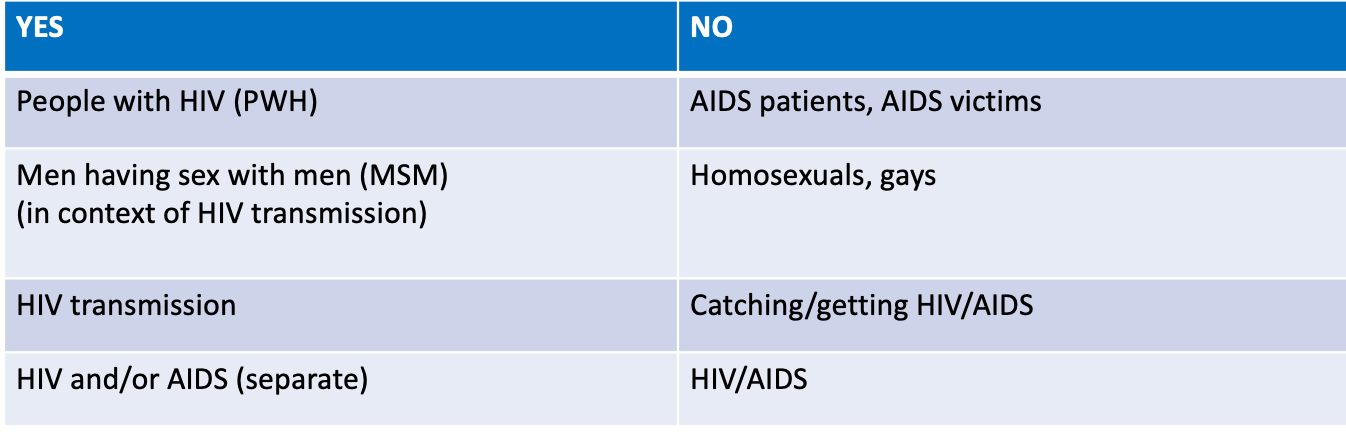
First, we will talk about the appropriate terminology for 2021. I put the year here because things do change. I last did this talk in 2020, and things have changed since then. Appropriate terminology has been defined by a scientific understanding and input from the HIV community. This collaboration between the scientific community and the HIV community is one of the exciting parts of HIV work and one of the reasons that I am so dedicated to it. See Figure 1 for some of the recent changes.
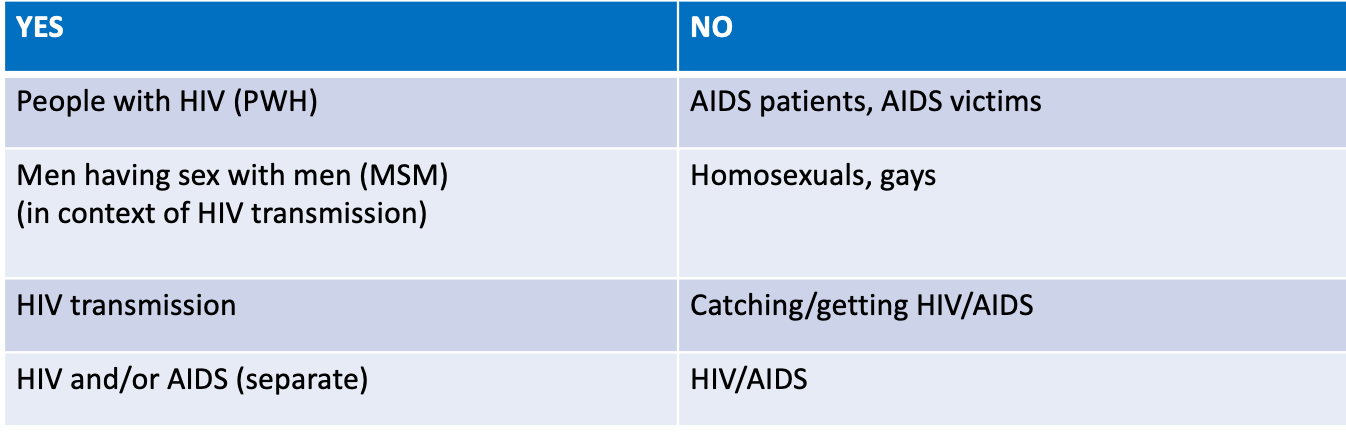
Figure 1. Appropriate terminology to use. Click to enlarge the image.
For example, we used to say HIV patients, but now we put the patient first. It is people with HIV. We also do not say AIDS patients or AIDS victims. We say men having sex with men (MSM) in the context of HIV transmission. This definition is significant because it has been referred to as homosexuals or gays in the past. It is who you are in a relationship with as opposed to what you do. Is that clear? I have plenty of patients who do not identify as gay, but they have perhaps had intimate relationships with other men, and that may be how they got HIV. We talk about it in terms of HIV transmission, not identity.
HIV transmission is the transmission of the virus. HIV and or AIDS are separate. HIV is the virus that causes AIDS, a syndrome of a full breakdown of your immune system. In the past, we said HIV/AIDS, but now those terms are separate.
HIV and AIDS Definitions
- HIV: Human Immunodeficiency Virus
- Progressive failure of the immune system allows life-threatening opportunistic illnesses (cancers, pneumocystis pneumonia (PCP), toxoplasmosis) to thrive.
- Untreated, HIV progresses to AIDS
- AIDS: Acquired Immunodeficiency Syndrome
- The immune system is severely compromised and vulnerable to opportunistic illnesses.
- CD4+ < 200 cells/mm3 (normal CD4+ 500-1600 cells/mm3)
- 1 or more opportunistic illnesses such as encephalopathy, tuberculosis, PCP, mycobacterium avium complex (MAC), lymphoma, herpes
- PWH
- People With HIV
Let's go over some basic definitions of HIV and AIDS. HIV stands for Human Immunodeficiency Virus. In a human, the immune system is deficient, caused by a virus. It is a progressive failure of the immune system that allows life-threatening opportunistic illnesses, such as certain types of cancers, pneumocystis pneumonia, PCP, which we will discuss at length later, and toxoplasmosis to thrive. In other words, your immune system is so weak that other illnesses are allowed to flourish. People die of AIDS-related symptoms or infections, not of HIV. You can live with HIV for a very long time.
AIDS is Acquired Immunodeficiency Syndrome. Your immune system is severely compromised and vulnerable to opportunistic illnesses. AIDS is measured through CD4 counts and viral load. We will talk about that in the next slide. CD4s are the helper cells that keep a person healthy. Anything less than 200 cells per mm3 is an AIDS diagnosis. An average CD4 count in a healthy individual is between 500 and 1600 cells per mm3. For example, if you are fighting a nasty virus, your CD4 cells can drop a little, and that is normal. However, anything under 200 in the context of HIV is an AIDS diagnosis. One or more opportunistic illnesses such as encephalopathy, tuberculosis, PCP pneumonia, mycobacterium avium complex MAC, lymphoma, or herpes are criteria for a diagnosis of AIDS. Lastly, the acronym PWH is for people with HIV.
- CD4+(“T-cell”): type of white blood cell that fights infection. Measured in cells/mm3
- Move throughout the body identifying and destroying viruses and bacteria
- HIV binds to and enters CD4 cells makes copies of itself gradual decline of CD4 cells and immune system
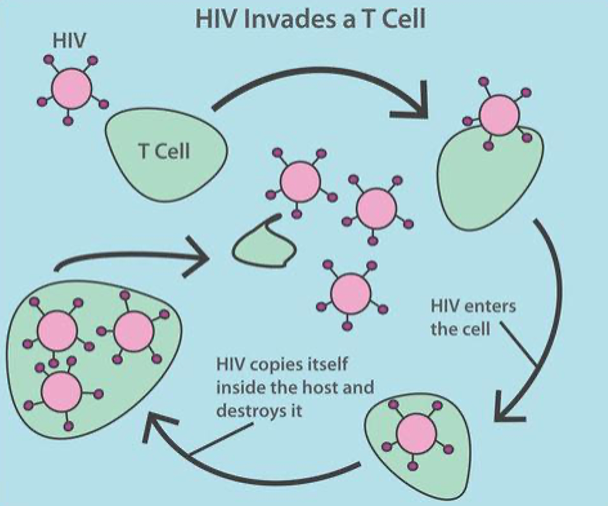
Here is a little more detail about the immunology of HIV and AIDS. You have probably heard of CD4 or T cells in the context of HIV. These are a type of white blood cell that fights infection and are measured in cells per mm3. Here is a visual in Figure 2.
Figure 2. Infographic of T cells and HIV.
The green is a healthy T cell in the top left. The T-cells move throughout the body identifying and destroying viruses and bacteria. For all of you who have had your COVID vaccine, the second shot can pack a punch as your T cells go into overtime. HIV is in pink. You can see it looks similar to the coronavirus. You can see how HIV copies itself inside the host to destroy the CD4/T cells. Now, one HIV copy has become three. The T-cell, or the helper healthy white blood cell, is destroyed. What is left is three copies of HIV when there was just one before.
HIV Disease Process
- Viral load: measurement of HIV copies in a blood sample. Measured in copies/mL
- Viral suppression: defined as having less than 200 copies of HIV per milliliter of blood. When medication makes viral load so low that a test can’t detect it, it is called an undetectable viral load.
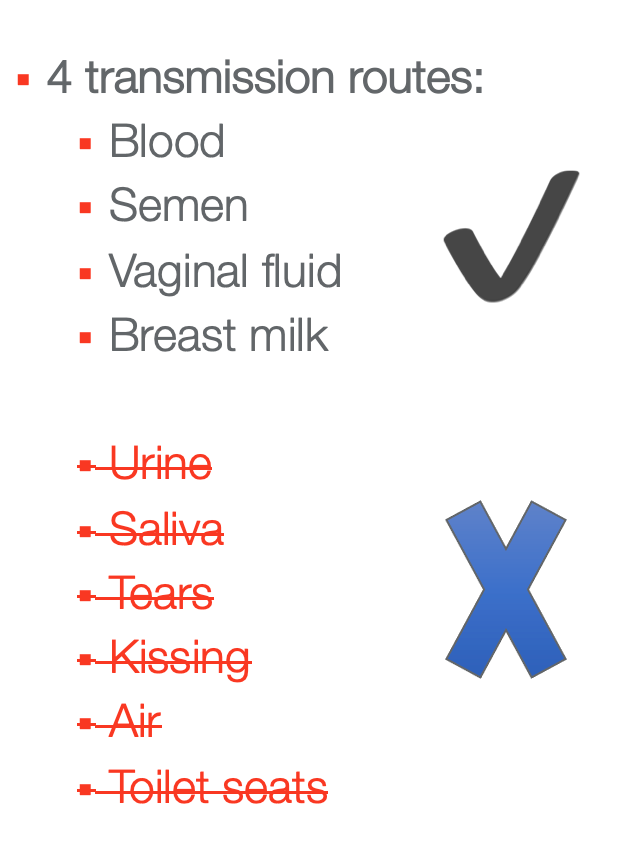
The viral load is a measurement of HIV copies in a blood sample measured in copies per milliliters. Viral suppression is having less than 200 copies of HIV per milliliter of blood. When medication makes the viral load so low that a test cannot detect it, it is called an undetectable viral load. In other words, you will have patients with a viral load of less than 200, meaning that the medication is working so well that it is keeping HIV at bay, and a blood test cannot detect it. They are still HIV positive but undetectable. Figure 3 shows the four transmission routes.
Figure 3. The four transmission routes of HIV.
The transmission routes of HIV are blood, semen, vaginal fluid, and breast milk. It can also be transmitted through pregnancy if the mother is not on HIV prophylaxis while she is pregnant. It can not be transferred through urine, saliva, tears, kissing, air, or toilet seats. There is a lot of misinformation out there.
HIV Treatment
- The pharmacologic treatment for HIV is called antiretroviral therapy (ART).
- The goal of ART is viral suppression.
- Current guidelines: Initiate ART in all adults with HIV who are willing/ready to start therapy regardless of CD4 count
- ART can't cure HIV but can help people with HIV live longer, healthier lives.
- PWH who initiate ART promptly live as long as their HIV-negative peers…IF they have access to medical care
The pharmacologic treatment for HIV is called Antiretroviral Therapy or ART. You may also see this as HAART, which is Highly Active Antiretroviral Treatment. You can see it written either way. The goal of ART is to suppress the virus to make someone's viral loads undetectable. Guidelines have changed over the years. It used to be that once someone's T-cells dropped below 200, you initiated ART. Now, guidelines are that all adults who test positive for HIV and are willing to start therapy, regardless of their CD4 count, should start right away. Early treatment is now preferred because if the patient's T-cells dropped too low, it was harder to pull them up. And, if the ART treatment starts right when the patient tests positive, it makes for greater outcomes. While ART cannot cure HIV, it can help people with HIV live longer, healthier lives. People with HIV who initiate ART promptly live as long as their HIV-negative peers if they have good access to medical care.
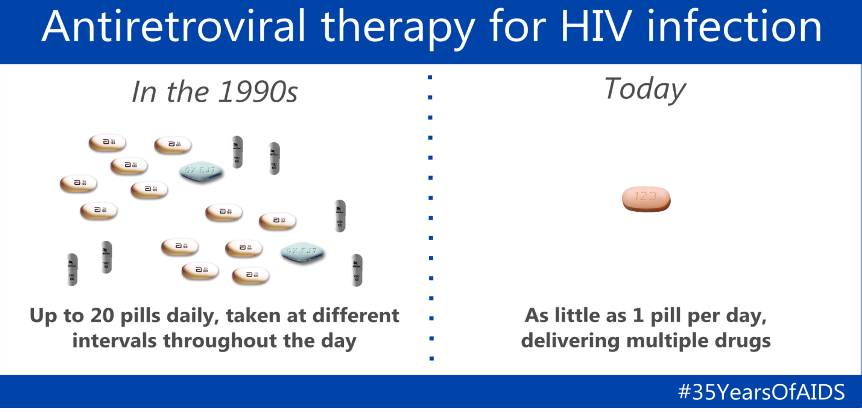
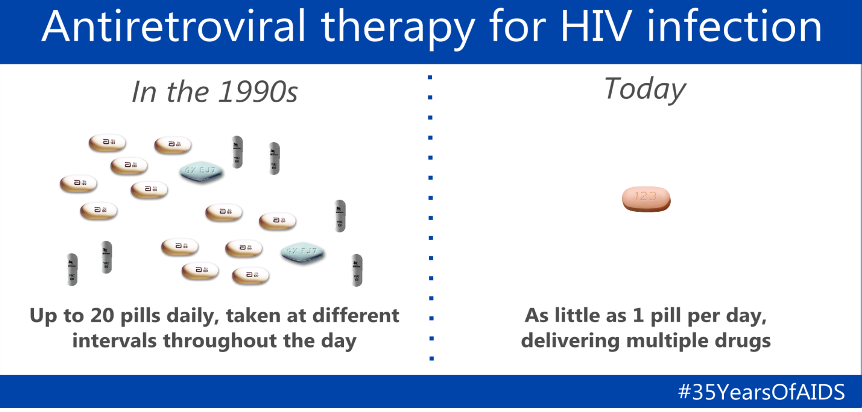
Science is outstanding for what it has done for people with HIV, but we all know science will not get you anywhere if you do not have access to medication. There are barriers to healthcare like a lack of transportation and stigma against people with HIV. This graphic (Figure 4) is one that I like to show. It compares the medicine regimens from the 1990s to now. In the '90s, people took up to 20 pills at different intervals throughout the day.
Figure 4. Antiretroviral therapy for HIV infection infographic. Click to enlarge the image.
Patients have told me about their strict regimen. "You had to take a few pills right when you woke up before you ate anything. Then, you had to wait an hour. The next round, you had to take with a full stomach. The next one had to be on an empty stomach." Right now, it is one pill per day. There are multiple drugs in one pill. This is a significant scientific advancement.
Stages of HIV Infection
- Acute HIV Infection (weeks 2-4 post-infection):
- Develop flu-like symptoms; “worst flu ever”
- Large amounts of HIV in the blood and immune system
- Greatest transmission risk
- Chronic HIV Infection:
- HIV reproduces at low levels
- People may be asymptomatic but still contagious
- With proper treatment – life expectancy = general population
An acute HIV infection is about two to four weeks post-infection. People typically say they have flu-like symptoms. There are large amounts of HIV in the blood and immune system during that time, and they are at the most significant transmission risk.
Chronic HIV infection is where HIV reproduces at low levels. People may be asymptomatic but still contagious. With proper treatment, life expectancy in the general population improves.
- AIDS – Final stage of HIV
- CD4+ count = less than 200 cells/mm3
- HIV has destroyed immune system
- The body can’t fight off opportunistic illnesses such as pneumonia and cancer --- cause of AIDS-related death
- Life expectancy without treatment = 3 years
The final stage of HIV, if it progresses to this, is when the CD4 count is less than 200 cells per mm3. HIV has destroyed the immune system, and the person's body cannot fight off opportunistic illnesses such as pneumonia and cancer, which is a significant cause of AIDS-related death. Life expectancy without treatment is three years.
You may have heard of something called U equals U. This means "undetectable equals untransmissable." Researchers have found that once you are undetectable, you cannot transmit HIV. The global HIV goal is to have everyone who has HIV become undetectable through medication to decrease transmission. What will that mean? If we get everyone the HIV medication they need, HIV transmission can hopefully stop.
HIV and AIDS: Historical Overview
My background is in physical therapy and public health. As therapists and medical providers, we need to understand the history of HIV to understand best what our patients may have gone through and are still going through. Right now, we will talk about a brief historical overview of HIV.
- 1981: 270 cases of “severe immune deficiency” among MSM- 121 of those individuals have died.
- 1982: 771 people with AIDS diagnoses. 618 reported deaths.
- 1983: 2,259 people with AIDS diagnoses. 917 reported deaths.
- 1987:
- The first mention of HIV and AIDS by the current president (Ronald Reagan)
- Cumulative known deaths from AIDS (1981-1987) 20,436
Figure 5. Early AIDS demonstration.
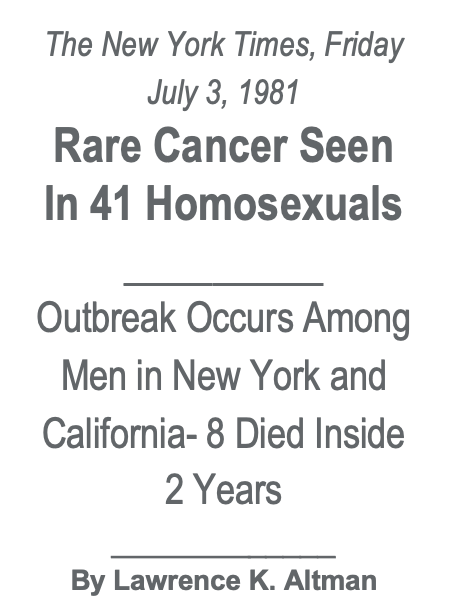
In 1981, 270 cases of severe immune deficiency were found among MSM (men having sex with men), and 121 of those individuals died that year. The CDC stated, "there is a strange disease among MSM." About half of those with the "severe immune deficiency" died. In 1982, just a year later, 771 people were diagnosed with AIDS, and 618 people died. In 1983, more than 2200 people had been diagnosed with HIV, and 917 had died. As you can imagine, HIV was affecting mainly MSM and IV drug users at this time. Specifically for MSM and the gay community, this was a terrifying time. The first mention of HIV and AIDS was by Ronald Reagan in 1987. By this time, more than 20,000 people had died. He joked around about it at a press conference. Figure 6 shows the first time HIV was ever mentioned in a major publication,
The New York Times on July 3rd, 1981.Figure 6. First time HIV noted in The New York Times.
We know it was not just cancer. We would also never say "41 homosexuals." I always get a chill looking at this headline because I know that many more than eight died within two years.
- The 1980s-1990s: Birth of grassroots organizations like ACT UP to
- Fight HIV and AIDS
- Put pressure on the government to recognize the crisis AND
- Pressure on the FDA to approve HIV drugs
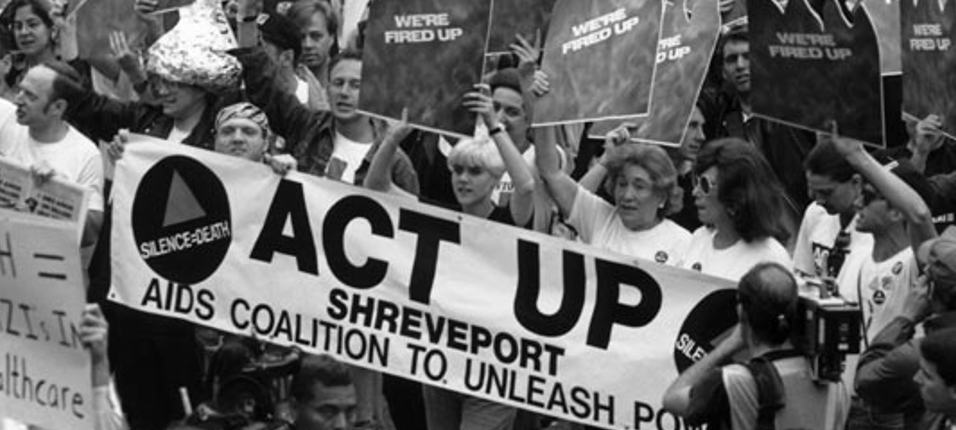
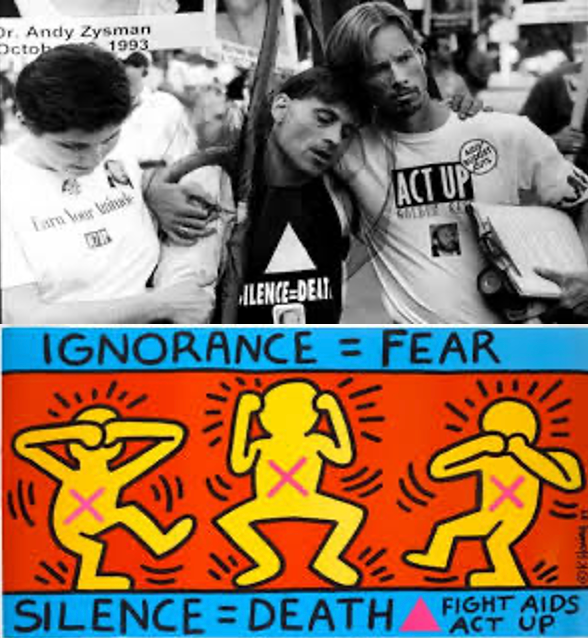
The 1980s and 90s saw the birth of HIV grassroots organizations as there was no government recognition or funding for HIV. ACT UP stands for AIDS Coalition to Unleash Power. Figure 7 shown an early 80's march.
Figure 7. An early march and infographic on HIV and AIDS. (CDC via the Library of Medicine).
In this early picture, you can see the man in the middle is being held up by his partner or a friend. These demonstrations pressured the government to recognize the crisis and pressure the FDA to approve HIV drugs.
Milestones in HIV History
- 1997 – highly active antiretroviral therapy (HAART/ART) becomes the primary treatment for HIV and AIDS
- Deaths related to AIDS decreased by 47% from the year before
- March 2012:
- Life expectancy with treatment once CD4+ reaches 500 cells/mm3 EQUAL to HIV negative counterpart
- July 2012 – FDA approves Pre-exposure Prophylaxis (PrEP)
- One pill each day (same medication used to treat HIV)
- Risk of HIV >90% lower for those who take the pill consistently
In 1997, highly active antiretroviral therapy (HAART) or ART became a primary treatment for HIV. Remember, 1981 was when things started. Before this, there were 16 years of people dying in vast numbers. In 1997, deaths related to AIDS decreased by 47% from the year before. In March 2012, life expectancy with treatment (once CD4 count is 500 cells mm3)was equal to an HIV-negative counterpart.
In 2012, the FDA approved pre-exposure prophylaxis or PrEP, one pill taken each day, similar to a birth control pill. It lowered the risk of HIV by over 90% for those who took the pill consistently. They realized that treatment equals prevention. There is so much more to say about the history of HIV. If any of you have any questions, please feel free to ask or email me about it. There is a lot of incredible reading and documentaries talking about the early days of HIV.
HIV: Epidemiological Profile
Current HIV Statistics
- 36,400 new HIV infections in 2019 in the US.
- 1.7 million new infections globally
- Approximately 1 million PWH are currently in the US.
- 1 in 7 HIV+ people is unaware of their infection.
- Among 13-24-year-olds, 51% don’t know they are infected
- Highest risk communities: economically disadvantaged urban areas in the US, the South, MSM (men who have sex with other men) and African-Americans (12% of US population; 41% of HIV infections), Geriatric population (55 or older) – 26% of all HIV infections in the US.
Let's talk about the epidemiological profile of HIV. Epidemiology is the study of medicine. This data is for 2019, but we should get the 2020 data soon. There were 36,400 new HIV infections in 2019 in the US and 1.7 million new infections globally. Remember, undetectable equals untransmissable. We want to cut down on new infections, of course, but as you can see, there are approximately 1 million people with HIV currently in the US right now. One in seven HIV-positive people is unaware of their infection. It is imperative to educate people to stay safe. Among 13 to 24-year-olds, 51% do not know they are infected. This statistic stops me in my tracks. This population is probably the most sexually active (young 20s) and at the highest risk of HIV transmission. The highest risk communities also include economically disadvantaged urban areas in the US, the South, and the Southeast. I live in Atlanta, where there is a massive HIV problem. Huge infection rates are also present in New Orleans, Miami, Baton Rouge, and many Southern cities.
MSM and African-Americans make up 12% of the US population but 41% of HIV infections. We talked about barriers to care. There will be another webinar about implicit bias in healthcare that I am doing for continued.com, including discrimination in healthcare. The senior population, 55 or older, is 26% of all HIV infections in the U S. That is not new infections but an HIV infection. People who are now living longer and aging with HIV. Thus, this statistic makes sense.
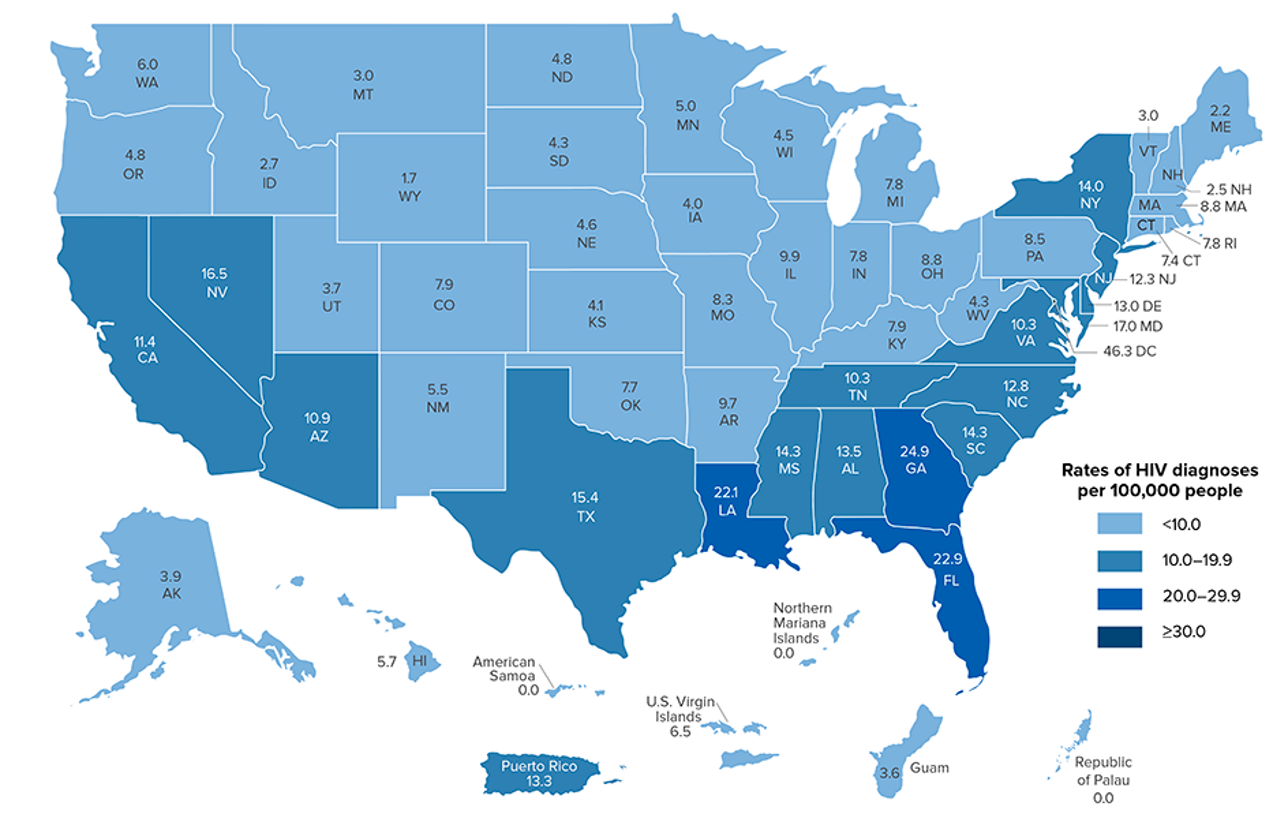
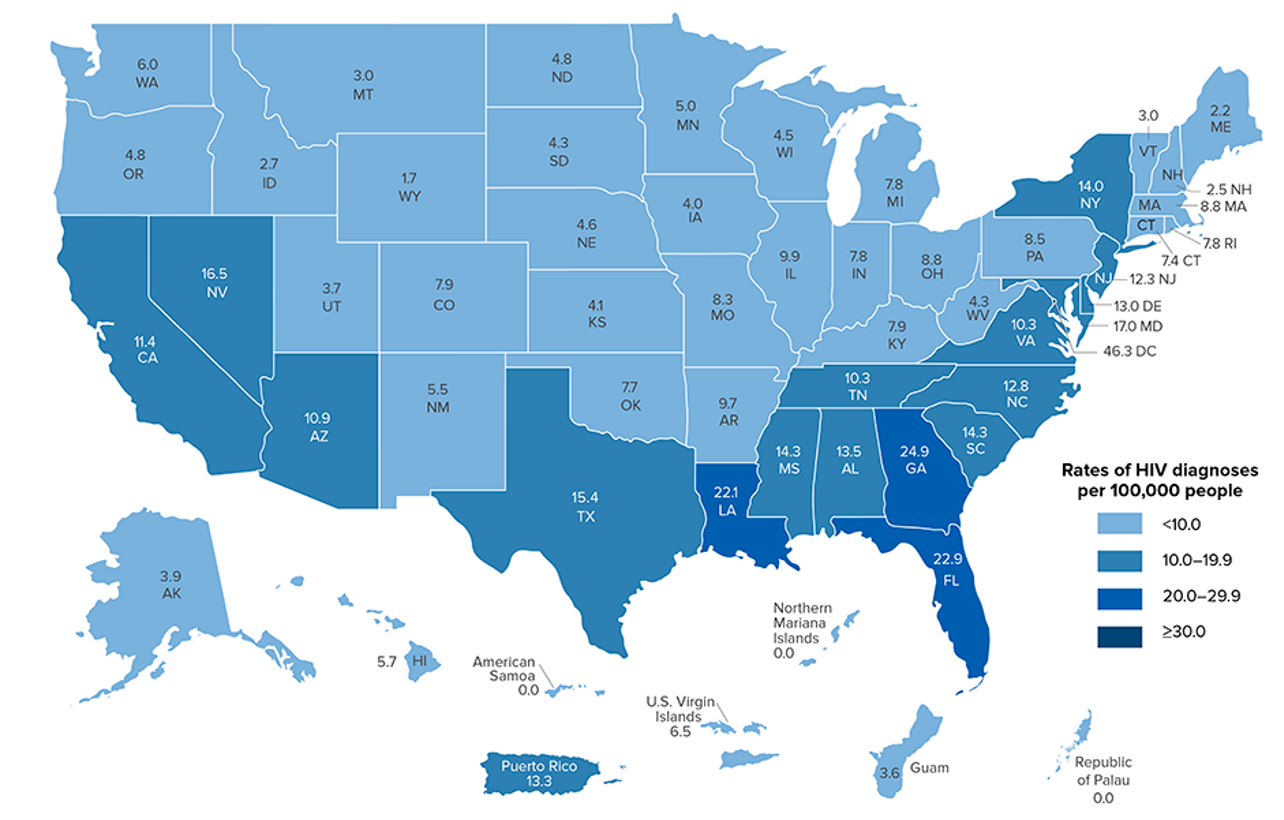
Geographical Spread of HIV Diagnoses, 2020
Let's look at this geographical spread of HIV diagnoses in 2020.
Figure 7. The geographical spread of HIV in 2020. Click to enlarge the image.
Do not get too caught up with the numbers, but you can see the darker color blue denotes the highest infection rates. The pattern shows the highest incidence of HIV throughout the South and the East coast specifically. There are many barriers to care, including poverty and HIV stigma. People talk about the "stroke belt" and "the Bible belt" of the Southeast. It is also the "HIV belt," unfortunately.
Barriers to Implementation of Effective, Long-term HIV Management
- Finances – personal income and lack of insurance
- Structural effects – housing
- Individual – substance abuse, social support
- Stigma – HIV-related, LGBTQ-related, race-related, gender-related
- Non-collaborative approach, i.e., “silo effect” of medical providers
Let's now talk about the barriers to the implementation of effective long-term HIV management. Do they have access to the following things: finances, personal income, and insurance? If people do not have insurance, that is a significant barrier as they are less likely to go to the doctor. There are payment insurance medication options for uninsured people in the US and globally for HIV. However, I also put personal income as a barrier as these individuals have to because we also have transportation and housing. There are other barriers like substance abuse and lack of social support. We also know there can be stigmas towards those with HIV, in the LGBTQ community, and about different genders and races.
A non-collaborative approach or a silo effect of medical providers can be prohibitive in terms of HIV care. For example, if someone needs to go to the dentist for a bad toothache and get to their HIV doctor, they are probably going to prioritize the dentist. They may delay picking up their meds until the next month. We need to have a collaborative approach with everything under one roof. If that is not possible, all the providers interacting with this client must think about the concept of a care team.
Multisystem Involvement in HIV and AIDS
Next, we will talk about multisystem involvement in HIV and AIDS.
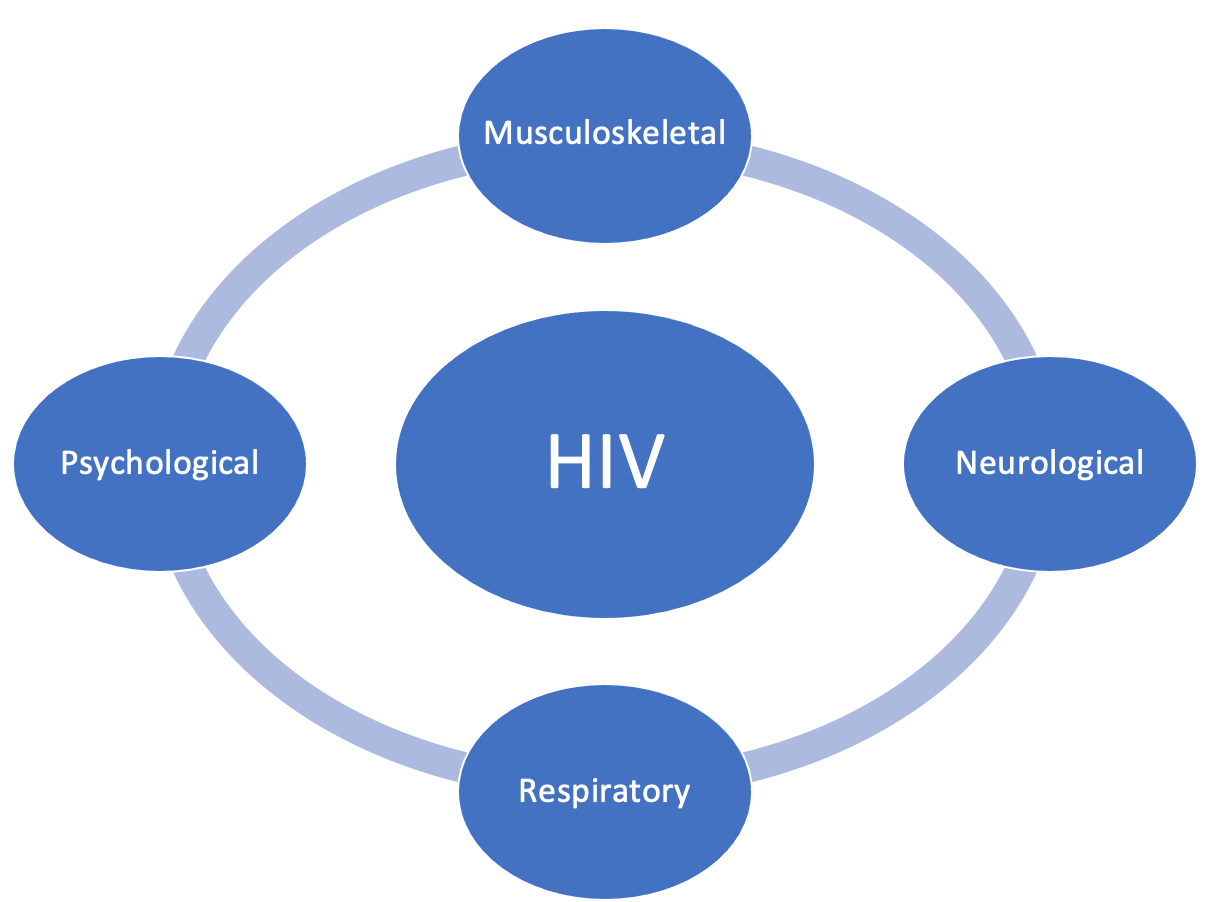
Figure 8. Graphic of the systems involved in HIV and AIDS.
HIV is in the middle, surrounded by the musculoskeletal, neurological, respiratory, and psychological systems in this graphic. This graphic shows how HIV affects almost every body system, including the integumentary, for example. However, for respiratory therapists, I included these four areas.
Musculoskeletal Involvement in HIV and AIDS
- Musculoskeletal manifestations in PWH are common and sometimes are the initial presentation of the disease.
- Musculoskeletal and orthopedic complications have emerged as potential results of the disease itself and/or the ART treatment regimen.
- Example: Low bone mineral density (BMD) has been associated independently with HIV disease itself and as a direct effect of ART
- All PWH should be screened for BMD/Vitamin D supplementation.
Which comes first, the chicken or the egg? Some things are caused by HIV and other manifestations by the medication. Back in the 80s and 90s, before there was medication available, there was muscle wasting in those with AIDS. Now, this is a little different as there are complications related to the medicines as well. Musculoskeletal and orthopedic complications have emerged as potential results of the disease and/or the ART treatment regimen. An example is that low bone mineral density has been associated independently with HIV and directly due to ART. All people with HIV should be screened for low bone mineral density (BMD) and Vitamin D supplementation.
Where do respiratory therapists play a part? Frailty is a significant danger for people with HIV, and it happens earlier than it would maybe in someone without HIV due to the medication. If you have a frail individual (maybe just in their 50s or 60s), you need to make sure to ask them if they are on vitamin D supplementation.
- Most commonly seen MSK impairments are myalgia, arthralgia, low back pain, osteoporosis, avascular necrosis of the femoral head.
- PWH have a higher prevalence of fractures compared to HIV(-) peers
- HIV affects bone remodeling bone fragility
- ART may also affect bone metabolism
The most commonly seen musculoskeletal impairments are myalgia, arthralgia, joint pain, low back pain, osteoporosis, and avascular necrosis of the femoral head. People with HIV have a higher prevalence of fractures as compared to HIV-negative peers. Often, they get hip and rib fractures due to falls. As a respiratory therapist, you might work with someone with a rib fracture. The disease itself does not typically affect an individual's lungs unless later in the condition. As a respiratory therapist, you need to know the risk of fractures and how the HIV and ART treatment affects bone remodeling, fragility, and bone metabolism.
Exercise and HIV
- Large systematic reviews indicate that continuous or interval aerobic exercise or a combination of progressive resistive and aerobic exercise is safe and potentially beneficial for medically stable adults living with HIV.
- In PWH, exercise was associated with improvements in cardiopulmonary measures, strength, weight, body composition, quality of life, and psychological status.
Weight training and aerobic exercise are safe and potentially beneficial for medically stable adults living with HIV. People with HIV exercise outcomes showed improved cardiopulmonary measures, strength, weight, body composition, quality of life, and psychological status.
- Dufour et al. (2013): adults with HIV who self-report exercising are approximately half as likely to show neurocognitive impairments in comparison to those who do not exercise
- Exercise in PWH has NOT been associated with adverse immunological/virological outcomes.
- Stable CD4+ count and viral load
Here is an excellent article by Dufour and colleagues. They said that adults with HIV who self-report exercising are approximately half as likely to show neurocognitive impairments compared to those who do not exercise. This is across the board. We all know that exercise is vital for physical strength and neurological function. Activity in people with HIV is not associated with adverse immunological or virological outcomes, and there are stable CD4 counts and viral loads. This is excellent news as we used to think that people with HIV should not exercise as it stressed the immune system and negatively affected CD4 counts and viral loads. The great news is that that has not been shown at all. We want to ensure our clients are getting in both cardio and aerobic exercise for the lungs, of course, with their primary doctor's approval.
Neurological Involvement in HIV and AIDS
- HIV-associated neurocognitive disorders (HAND) cluster of milder symptoms
- Viral infections Cytomegalovirus, progressive multifocal leukoencephalopathy (PML), rapidly progressing and often terminal
- Fungal/parasitic infections toxoplasmosis
- Neuropathy
- Vascular myelopathy most common in untreated HIV
- CNS Lymphomas
- Neurosyphilis
- AIDS Dementia Complex
HIV-associated neurocognitive disorders or HAND is a cluster of milder symptoms. Viral infections include cytomegalovirus, or CMV, and progressive multifocal leukoencephalopathy, or PML. These are rapidly progressing infections and often terminal. Fungal or parasitic infections like toxoplasmosis are other issues. Neuropathy is common, and vascular myelopathy is the most common in untreated HIV (people not on ART). Central nervous system lymphomas, neurosyphilis, and the AIDS dementia complex are other neurological problems.
- The virus can settle in the brain (CNS) as early as four months after infection.
- When HIV+ people are off treatment, the CNS can provide an additional reservoir for the virus, possibly leading to neurological damage/events.
- The combination of HIV and ART can result in an increased incidence of neuropathy/neurological impairments.
HIV can settle in the brain and the central nervous system as early as four months after initial infection. In some older HIV documentaries, you can see many individuals with AIDS, dementia, and brain dysfunction with untreated HIV. It was very tragic and sad for the patients and their loved ones who saw this deterioration. When HIV-positive people are off treatment, the CNS can provide an additional reservoir for the virus leading to neurological damage and events. Remember that graphic about HIV making its way around the body. The combination of HIV and ART can result in an increased incidence of neuropathy and neurological impairments.
- Encephalopathy
- May be associated with untreated or “treatment interrupted” HIV AIDS
- Stroke
- HIV infection can result in stroke via several mechanisms - opportunistic infection, vasculopathy, cardioembolism, and coagulopathy.
- Average age of stroke in PWH = 49-51 (Burke et al.), compared to the general population (65)
Encephalopathy may be associated with untreated or treatment interrupted HIV or AIDS. Encephalopathy is swelling in the brain and can lead to vast cognitive, neurological effects. We used to call interrupted treatment a "drug holiday." People who go off their medications for whatever reasons (lack of money, transportation) can lead to adverse effects. For example, HIV infection can result in stroke via several mechanisms like opportunistic infection, vasculopathy, cardioembolism, and coagulopathy. Burke and colleagues showed that the average age of stroke in people with HIV was 49 to 51 years old. This is much earlier than the general population, in which the average is 65.
Mental Health
- Increased prevalence of mental health disorders in PLH, especially depression, Alzheimer’s, dementia, PTSD
- Primary care providers are ideally positioned to manage some mental health issues and/or mental health referrals.
- HIV proteins alter the response to stressors and cortisol production
- Exercise has emerged as a significant protective factor for HIV-related cognitive decline
- MSM (men who have sex with men) who survived the 1990s with HIV likely have lost 9/10 of their immediate social group
There is an increased prevalence of mental health disorders in people living with HIV, especially depression, Alzheimer's, and PTSD. Primary care providers and all therapists are ideally positioned to manage some mental health issues and are mental health referrals. HIV proteins themselves alter the response to stressors and cortisol production. Exercise has emerged as a significant protective factor for HIV-related cognitive decline, as I said earlier.
A study probably five years ago stated that MSM, who survived the 1990s with HIV, have lost nine out of 10 of their immediate social group to AIDS. There is an incredible amount of trauma that they have survived, and understandably, some have PTSD. HIV proteins can alter the response to stressors and cortisol, and HIV itself is a stressor. Stressors can lead to depression. People living with HIV, no matter how long they have had it, worry that they will die.
Cardiopulmonary Involvement in HIV and AIDS
- Cardiopulmonary
- Long-term cardiac outcomes of HIV and/or ART can include
- Noninfectious cardiovascular complications, including cardiomegaly, pericarditis, myocarditis
- The lung is a frequent target organ for disorders associated with HIV infection, such as HIV-related pulmonary arterial hypertension
- Long-term cardiac outcomes of HIV and/or ART can include
Long-term cardiac outcomes of HIV and or ART can include noninfectious cardiovascular complications, including cardiomegaly, pericarditis, and myocarditis. The lung is a frequent target organ for disorders associated with HIV infection, such as HIV-related pulmonary arterial hypertension.
The Role of the Respiratory Therapist in the Care of PWH
I hope I have given you a good background on the virology of what HIV is doing in the body. I have also given you the epidemiology of HIV and its history. I have shared the statistics about where it is in the world and the country. Lastly, I have overviewed how it affects the different systems, which all in turn, of course, affect the respiratory system.
Respiratory System and HIV
- ART has drastically improved the lifespan and quality of life for PWH
- However, PWH report increased respiratory symptoms, including chronic cough and breathlessness, than their HIV-negative counterparts (Brown et al., 2016)
- Respiratory morbidities were historically linked to AIDS-related deaths, especially pre-ART
- We will review several respiratory comorbidities related to HIV to assist in clinical understanding
Antiretroviral therapy has drastically improved the lifespan in the quality of life for people with HIV. However, people with HIV report increased respiratory symptoms, including chronic cough and breathlessness, than their HIV-negative counterparts. Even though people with HIV have an improved lifespan and quality of life, people with HIV are more likely to report respiratory symptoms.
Respiratory morbidities were historically linked to AIDS-related deaths, especially pre-ART. I always wonder how respiratory therapy had been involved with HIV care from the beginning how impactful that could have been in terms of quality of life and survivability. Respiratory therapists still have an essential role.
Now, we will review several respiratory comorbidities related to HIV to assist in the clinical understanding of HIV with respiratory therapy.
Pneumocystis Pneumonia
- PCP is caused by a ubiquitous fungus.
- Symptoms: nonproductive cough, dyspnea, fever may be present, hypoxemia. The most common lung exam finding is inspiratory crackles, but the lung exam may be normal.
- Treatment: Typically Antibiotics
- Prognosis: mortality rate 30-50%
- PCP was – and still is – a common predictor of death once HIV has progressed to AIDS
Pneumocystis pneumonia is a primary ubiquitous fungus. I saw that terminology in an article and had to write it because it is descriptive and evocative. It is a fungus that is everywhere. If your immune system is in good shape and you are not immunocompromised, you are fine. We all have this fungus somewhere in our bodies. Symptoms of pneumocystis pneumonia are a nonproductive cough, dyspnea, fever, and hypoxemia. The most common lung exam finding is inspiratory crackles, but the lung exam may be normal. See Figure 9 for an example of this.
Figure 9. PCP - “ground glass” opacities.
Treatment for PCP is typically antibiotics. I usually say in front of all my "treatments" because I am not a physician or a pulmonologist. I cannot recommend anything particular. The mortality rate is still 30 to 50% which is very high. If someone has HIV that has progressed to AIDS and gets PCP, the mortality rate is pretty high. It was and still is a common predictor of death once HIV has progressed to AIDS. Before ART, PCP was the most common death.
Cytomegalovirus
- Cytomegalovirus (CMV) is a common virus: over half of adults in the US have it in their bodies by age 40
- Symptoms: nonproductive cough, dyspnea, fever, malaise.
- Can cause blindness
- Lung exam: may demonstrate crackles, but may be normal
- CMV pneumonitis is rarely found in isolation; it typically presents in the setting of disseminated disease
- CMV among PWH: most at risk CD4<100, CMV-retinitis, weakness, diarrhea, pneumonia, encephalopathy
- Prognosis: no cure but can be controlled with antifungals and ART
Cytomegalovirus (CMV) is also a common virus. Over half of adults in the US have it in their bodies by age 40. It is a virus that floats around the atmosphere. You may have it in your body but never know if your immune system is robust and not compromised. Symptoms of cytomegalovirus are a nonproductive cough, dyspnea, fever, and malaise. It can also cause blindness. A lung exam may demonstrate crackle, but it may show up as normal. It is rarely found in isolation. For example, someone would have HIV, progress to AIDS, and also have CMV. Among people with HIV, the most at risk for CMV are people with CD4 counts below 100. Remember, below 200 is an AIDS diagnosis. CMV retinitis, weakness, diarrhea, pneumonia, and encephalopathy are other issues. There is no cure, but it is controlled with antifungals and ART.
Tuberculosis
- HIV-TB co-infection is a global health priority
- Mycobacterium Tuberculosis bacteria are airborne
- Co-diagnosis of HIV and TB = AIDS-defining
- TB may present at any level of CD4 count
- Symptoms:
- CD4 counts >200: similar presentation to an HIV- negative person (fever, chills, night sweats, weight loss, productive cough, and occasional hemoptysis)
- Severely immunocompromised persons with advanced HIV: lymphadenopathy, central nervous system involvement)
- Treatment: isolation, drug combination
You all know about tuberculosis and have probably treated people with TB in your careers. HIV-TB co-infection is a global health priority. When I was researching and preparing this talk, I went down a rabbit hole looking at articles about HIV and TB. It is not controlled in nations and communities that are underserved and under-resourced. It is a priority because once HIV and TB both take up residence in your body, the prognosis is poor. A co-diagnosis of HIV and TB is AIDS-defining. In other words, if you have this, TB is one of the things that will define AIDS along with that CD4 count. And, TB can be present with any level of CD4 count. Symptoms include CD4 counts below 200. The symptoms with TB are similar to an HIV-negative person, including fever, chills, night sweats, weight loss, productive cough, and occasional hemoptysis. Severely immunocompromised people with advanced HIV can experience lymphadenopathy and central nervous system involvement. Due to TB being infectious and airborne, treatment is isolation and different drug combinations.
Mycobacterium Avium Complex
- Mycobacterium avium complex (MAC) – a group of bacteria related to TB
- Almost everyone has them in their body from food, water, soil
- PWH with low CD4 (<50) – most at risk
- Opportunistic infection
- Primary Symptoms: fever, weight loss, anorexia, hepatosplenomegaly, lymphadenopathy, abdominal pain, chronic diarrhea
- Disseminated MAC: MAC spreads all over the body and can lead to systemic infections, hepatitis, pneumonia
- Treatment: antibiotics
Mycobacterium avium complex or MAC is a group of bacteria related to TB. Almost everyone has them in their body from food, water, and soil. People with HIV with low CD4 lower than 50 are most at risk. It is an opportunistic infection. Primary symptoms are fever, weight loss, anorexia, loss of appetite, hepatosplenomegaly, lymphadenopathy, abdominal pain, and chronic diarrhea. Disseminated MAC is when MAC spreads all over the body. This is a bacteria and can lead to systemic infections, hepatitis, and pneumonia. MAC treatment includes antibiotics.
Immune Reconstitution Inflammatory Syndrome (IRIS)
- IRIS develops in the context of recovery of CD4 cell counts following the initiation of ART
- Typically develops within the first few weeks after starting ART
- Most commonly seen in conjunction with such infections as TB, PCP, MAC, and Cryptococcus, more rarely with Kaposi sarcoma
- Symptoms:
- Fevers, lymphadenopathy, meningeal symptoms, and pulmonary infiltrates
- Risk factors:
- Low CD4 count prior to initiation of ART
- There are no definitive diagnostic criteria for IRIS- diagnosis of exclusion.
- Treatment with corticosteroids can be life-saving in severe cases
- ART should be continued during IRIS if at all possible
Immune reconstitution inflammatory syndrome (IRIS) develops in the context of recovery of CD4 counts following ART initiation. You are diagnosed with HIV, you take ART just like you are supposed to, and the CD4 counts start to climb back up where they are supposed to be. Within the first few weeks of starting ART, you can get IRIS if you also have an infection such as TB, PCP, MAC, cryptococcus, or Kaposi sarcoma, which we will talk about in a second. The symptoms are fever, lymphadenopathy, meningeal signs, and pulmonary infiltrates. It is dire. The risk factors are low CD4 count before starting ART. There are no definitive diagnostic criteria for IRIS diagnosis, but rather it is a diagnosis of exclusion. In other words, you cannot point your finger and say that is IRIS. However, if you have all these other things, that can lead to a diagnosis. Treatment consists of corticosteroids and can be life-saving in severe cases. ART should be continued during IRIS if it is at all possible.
Malignancy: Kaposi Sarcoma
- Kaposi sarcoma (KS):
- Malignancy that was common in HIV patients prior to ART
- One of the markers of AIDS in the early days of the epidemic
- The primary risk factor is low CD4 count (particular <50, very rare with CD4 >200), and the incidence is higher in MSM
- Up to 15% of PWH with KS may have isolated pulmonary disease
- Presenting symptoms of pulmonary KS include dyspnea, cough, and fever; hemoptysis may be present
Kaposi sarcoma is something that you may recognize from early pictures of people with HIV and AIDS. It looks like a port wine spot. It could come like these smaller clusters or kind of big red splotches (Figure 10).
Figure 10. Kaposi sarcoma presentation on the arm.
It is a malignancy common in HIV patients before ART and one of the markers of AIDS in the early days of the epidemic. People would realize they had HIV when they saw those on their skin. The primary risk factor is a low CD4 count, particularly less than 50, and it is scarce with CD4 over 200. There is also a higher incidence of MSM. We are not sure why it affects this population more, but it could be how HIV is transmitted. Up to 15 percent of people with HIV and KS have isolated pulmonary disease and pulmonary symptoms like dyspnea, cough, and fever. Hemoptysis, or bloody cough, also may be present.
In Summary of Opportunistic Infections
- Often no cure, so ART initiation and ART fidelity are key
- If a patient with HIV presents with any persistent respiratory complaints, REFER immediately to a primary physician
There is often no cure for opportunistic infections. ART initiation and fidelity are fundamental. If a patient with HIV presents with persistent respiratory complaints, they need to be referred immediately to their primary physician. Right now, I work exclusively with people with HIV in an HIV clinic. I am highly honored to be doing this work. Before this, I saw patients with these symptoms and thought it sounded like HIV or AIDS. Once I referred them, the diagnosis was typically positive.
HIV as a Prevalent Disease
- Greater prevalence calls for an increasing role for rehabilitation in the continuum of care for PWH
- Respiratory therapists may treat PWH of all ages and in various clinical settings
- For example:
- Pediatric patient in the NICU
- Geriatric patient in a rehab setting
- For example:
- HIV and AIDS may be simply listed as a comorbidity, or the patient may have an HIV-related impairment as the primary diagnosis of referral
- Asthma with HIV only listed in PMH
- AIDS-related PCP
HIV is a prevalent disease. It is everywhere, and there is an increasing role for rehabilitation with this population. Respiratory therapists may treat people with HIV of all ages in various clinical settings, from the NICU to a senior rehab setting. HIV and AIDS may be listed as a comorbidity, or the patient may have an HIV-related impairment as a primary referral diagnosis. For example, they may have asthma and HIV or AIDS-related pneumocystis pneumonia listed in their history.
HIV as a Chronic Disease
- In the era of ART, people can increasingly live longer with HIV, delay or avoid opportunistic infections, and live with HIV as a chronic health condition.
- However…research shows that quality of life decreases with age, mostly related to physical decline, lower levels of independence, and poorer emotional wellbeing
- Chronic inflammation due to long-term HIV infection
- Autoimmune dysfunction, cardiovascular disease, neurocognitive disease, osteoporosis/frailty, liver disease, kidney disease, and some cancers
HIV is also chronic as people can live longer with HIV with ART treatment. ART can help clients to avoid opportunistic infections and live with HIV as a chronic health condition. However, research shows that quality of life decreases with age, mostly related to physical decline, with lower independence and poor emotional wellbeing. There can be chronic inflammation, autoimmune dysfunction, cardiovascular, neurocognitive, osteoporosis, liver, kidney, cancer, and respiratory issues with a long-term HIV infection.
- Effects from the disease itself and its pharmacological treatment can cause long-term and acute health complications.
- However - less than 1/3 of deaths among PLH are attributed to HIV-related causes
- Increasing role of “care team” in the long-term management of HIV and non-HIV-related impairments
- Increasing role of rehabilitation, mental health
- Collaborative effort between disciplines and AIDS Service Organizations for comprehensive care
The effects of the disease and ART can cause long-term and acute health complications. However, less than a third of deaths among people living with HIV are attributed to HIV-related causes. There is an increasing role of the care team in long-term management. There is also a growing role in the rehabilitation and mental health management of the disease and not just pharmacologic and infectious areas. We must have a collaborative effort between disciplines and AIDS service organizations for comprehensive care. We need to know what is going on in the HIV community to learn from that and supplement any areas of need.
HIV and Aging
- The number of PWH who are aged 50 years and older has tripled since 2000
- Several HIV-related factors could possibly prevent healthy aging: inflammatory processes, cardiovascular disease, frailty, social isolation
- Remember…It is estimated that MSM who survived the 1980s with HIV had 9/10 of their peers die of AIDS
The number of people with HIV who are age 50 and older has tripled since 2000. Part of it is that people with HIV are living longer. Also, people are getting newly infected at age 50 and older. One reason is that people 50 or older do not necessarily use birth control as pregnancy is not a concern. Several HIV-related factors can also prevent healthy aging like the inflammatory process, cardiovascular disease, frailty, and social isolation. Remember, it is estimated that MSM with HIV who survived the 1980s had nine out of 10 of their peers die of HIV. If that happened to someone in their 20s and now they are in their 60s, they will need plenty of support.
Long-term HIV Management
- The long-term care of people living with HIV is increasingly focused on chronic disease management and health promotion.
- Mental health; drug and alcohol use; sexual and reproductive health; cardiovascular, renal, liver, and bone disease; malignancies; and prevention
- The majority of people living with HIV can be managed in the general practice setting, with specialist support where appropriate.
The long-term care of people with HIV is increasingly focused on chronic disease management, health promotion, mental health, drug and alcohol management, sexual and reproductive health, cardiovascular, liver, and bone health, et cetera. We should focus on prevention in addition to treatment. Most people with HIV can be managed in a general practice setting with specialist support where appropriate instead of the big AIDS clinics in the past.
“How Do I Ask About It?”
- A client may not wish to disclose HIV status or, they may refer to it as “the virus,” “when I got infected,” etc.
- DO: Ask about medications: which ones, any side effects, any trouble with medication compliance, if they are followed regularly by an infectious disease doctor, if they know their most recent CD4 count
- Why is this important?
- DO NOT: Ask how they were infected
- DO: Ask about medications: which ones, any side effects, any trouble with medication compliance, if they are followed regularly by an infectious disease doctor, if they know their most recent CD4 count
How do I ask about it? You may choose not to ask as you do not need to, or the client may not want to disclose their HIV status. You do need to ask about medications and any side effects. You also want to know their medication compliance. If they are followed regularly by a doctor, they should know their recent CD4 count. As we know, going off of ART can be fatal and have vast effects on someone's health and mortality.
Here are some questions you can ask. "What medications are you on?" "Any trouble with those?" "Are you taking them every day?" "Are you followed regularly by an infectious disease doctor or primary care?" "Do you know your most recent CD4 count?" This is all you need to know. Do not ask how they were infected. It is incredible how many of my patients have said that people like their dentist or a nurse have asked how they got HIV. This is a no-no as it is not anyone's business.
Social Support
- This is especially important for PWH. It can affect both mental and physical health, including medication compliance.
- Family support?
- Friends ?– "Do you have people you feel like you can call if you are sad/having a hard time/in the middle of the night?"
- Partner/spouse?
- Who have they disclosed their status to?
- Living situation (stable housing or not, safety concerns)
- Be sensitive to stigma that client may have experienced – including from family, work, friends (yes, even in 2021)
Social support is critical for people with HIV. It can affect both mental and physical health, including medication compliance. "Do you have people you feel like you can call if you are having a sad or hard time in the middle of the night?" I always ask this question. Who have they disclosed their status to? Everyone should have at least one person who knows they have HIV. Do they have a good living situation? Be sensitive to the stigma the client may have experienced from family, work, and friends. Sadly even in 2021, there is still HIV-related stigma.
Physical Exam
- Generally, no different than for non-PWH, except if the patient has HIV and AIDS-specific diagnosis
- Universal precautions for blood-borne pathogens
- Reminder: how is HIV spread?
- Fellow staff may need a friendly reminder about HIV transmission
A physical exam is no different than for people without HIV except that there is an HIV or AIDS-specific diagnosis. If someone has PCP pneumonia from AIDS, of course, that is going to be a different exam than someone who comes off for an outpatient asthma appointment.
What are the universal precautions? How is HIV spread? It is not spread through casual contact, patient-provider contact, sputum, or saliva. Fellow staff may need a friendly reminder about HIV transmission.
Future Directions
- Multi-disciplinary collaboration to ensure that needs of this diverse population are met.
- Palliative care model
- HIV management in primary care
- HIV Prevention and screening at all life stages
- PrEP
- Screening older patients for sexual health-related risks
- National study: adults > age 50 at risk for HIV are 80% less likely to be tested for HIV than younger people
We need to have multi-disciplinary collaboration to ensure the needs of this diverse patient population are met. In a palliative care model, everyone comes together to improve the client's quality of life. HIV management (PrEP), primary care, and prevention screening are essential at all ages. It is also important to screen older patients for sexual health-related risks. People over age 50 are 80% less likely to be tested for HIV than younger people even though they are high risk.
In Summary
- As PWH live longer, fuller lives, they will inevitably present to rehabilitation therapy for both HIV-related and non-HIV-related issues.
- It is key to know the patient’s
- HIV status: viral load, recent CD4 count
- Antiretroviral regimen and adherence
- Social support networks
- Despite vast advances in treatment, stigma and isolation are still major issues facing PWH.
- As rehabilitation medicine practitioners, we must be both clinicians and advocates for this unique patient population.
As people with HIV live longer, inevitably, they will present to rehab therapy for both HIV and non-HIV-related issues. It is vital to know the patient's HIV status, viral load, CD4 count, antiretroviral regimen inherence, and social support and networks. Despite vast advances in treatments, stigma and isolation are still major issues for people with HIV. As rehabilitation practitioners, we must both be clinicians and advocates of this unique patient population.
This concludes our HIV education for respiratory therapists. If you have any questions or comments or information that you wish I had covered about respiratory therapy and HIV, I am always open to learning and questions. Please feel free to contact me at sara.pullen@emory.edu. Thank you so much for coming today and for being interested in this topic. Additionally, thank you for all of your work in the past year with coronavirus. My heart and thanks go out to each of you as you have borne the brunt of this past year. Thank you all for your work and compassion.
References
https://www.avert.org/stages-hiv-infection.htm
https://aidsinfo.nih.gov/education-materials/fact-sheets/19/45/hiv-aids--the-basics
Brown J, Roy A, Harris R, Filson S, Johnson M, Abubakar I, Lipman M. Respiratory symptoms in people living with HIV and the effect of antiretroviral therapy: a systematic review and meta-analysis. Thorax. 2017 Apr;72(4):355-366. doi: 10.1136/thoraxjnl-2016-208657. Epub 2016 Oct 24. PMID: 27965402; PMCID: PMC5520276.
Citation
Pullen, S. (2021). HIV education for respiratory therapists. Continued - Respiratory Therapy, Article 113. Available at www.continued.com/respiratory-therapy
May 11, 2021
1 CE Hour