Health Literacy & Delivering Culturally Competent Care
Published on 2025-03-10 11:56:44
Learning Outcomes
After this course, readers will be able to:
- After this course, participants will be able to define health literacy.
- After this course, participants will be able to recognize health literacy concepts including relevant statistics.
- After this course, participants will be able to identify appropriate assessment tools to evaluate health literacy levels.
- After this course, participants will be able to recognize factors that influence health literacy.
- After this course, participants will be able to describe techniques the practitioner can use to facilitate health literacy in his/her practice.
Health Literacy & Delivering Culturally Competent Care
Editor's Note: This text-based course is an edited transcript of the webinar, Health Literacy & Delivering Culturally Competent Care, presented by Kathleen Weissberg, PhD.
Learning Outcomes
After this course, participants will be able to:
- Define health literacy.
- Recognize health literacy concepts including relevant statistics.
- Identify appropriate assessment tools to evaluate health literacy levels.
- Recognize factors that influence health literacy.
- Describe techniques the practitioner can use to facilitate health literacy in his/her practice.
Introduction
Thank you to anyone who is listening today on this important topic, Health Literacy and Culturally Competent Care. I think these really go hand in hand and are critically important for anyone in any level of clinical practice.
Health literacy is the ability to read, compute, understand, and act on health information so that we can make informed decisions. Low health literacy is a serious threat to the wellbeing of persons who are seeking out any sort of medical care. With the increasing diversity of the clients that we are serving in our practice, we may observe that our communication skills are less effective with people from backgrounds that are different from our own.
In this session, we are going to provide an overview of health literacy and talk about techniques for clear and effective communication, both verbal and written. We are going to talk about selecting easy-to-read health materials, assessment tools, and some other things. Throughout all of this talk, we are going to be interweaving some conversation about cultural competence, because of course, these two items go hand in hand.
Definitions
- Literacy
- Ability to understand and use reading, writing, speaking, and other forms of communication as ways to participate in society and achieve one’s goals and potential
- Health literacy
- The degree to which individuals have the capacity to obtain, process, and understand basic health information and services needed to make appropriate health decisions
These definitions come directly out of Webster's. Literacy is the ability to understand and use reading, writing, speaking, and other forms of communication as ways to participate in society and to achieve one's goals and potential. Again, we are going to be talking about health literacy more, but this is being able to participate in your daily life, go to the grocery store, go to a place of worship, or whatever it is that you want to do. That is general literacy. Health literacy takes it a step further. It is the degree to which individuals have the capacity to obtain, process, and understand basic health information and services needed to make appropriate health decisions. As we will see in just a few minutes, the statistics related to health literacy in this country are really staggering.
We all work in the healthcare industry, and I think every one of us would even agree that sometimes it is even challenging for us to be able to navigate the healthcare system with all of the forms and different things that we need to do.
Health Literacy
- Individual and Systemic Factors
- Communication skills of laypersons and professionals
- Lay and professional knowledge of health topics
- Culture
- Demands of the healthcare and public health systems
- Demands of the situation/context
When we look at health literacy, it is dependent on several individual and systemic factors not only within myself but also within the environment where I happen to be. Some of those things are the communication skills of laypersons and professionals. How can I, as a professional, communicate to the person that I am trying to serve so that they can understand me? What are the lay and professional knowledge of health topics? It is not only the communication piece but also knowledge of the topic. As that person is communicating to me, can I understand and incorporate that knowledge? We also need to know about a culture, and we will talk more about this as we go on. There are also demands of the healthcare and the public health system, particularly for situations and content. A demand going to see your general practitioner for a checkup is one thing. A demand going to see your cardiologist because you are having a procedure is something totally different.
- What Does Health Literacy Affect?
- Affects people's ability to:
- Navigate the healthcare system, including filling out complex forms and locating providers and services
- Share personal information, such as health history, with providers
- Engage in self-care and chronic-disease management
- Understand mathematical concepts such as probability and risk
- Affects people's ability to:
Health literacy affects our ability to navigate the healthcare system. I just alluded to this. This includes filling out forms, locating providers, locating services, and choosing your healthcare benefits at open enrollment. It can be very difficult sometimes to navigate through that.
This is also sharing personal information such as health history with providers. How much do I share? What should I not share? How do I share that in a way that is understandable by the healthcare providers so that they can provide care for me?
This is also the ability to engage in self-care and chronic disease management. We are going to talk a lot about this. These are preventative types of things like getting your annual mammogram, routine cancer screenings, or as a diabetic checking your sugar.
It is also important to understand mathematical concepts, such as probability and risk. We may need to understand the dosage of medications or tracking health numbers to determine if is it necessary to call a physician or change medication.
Health Literacy Skills
- Numeracy skills
- E.g., measuring medications, choosing between health plans, calculating premiums & copays
- Health topics
- E.g., the body, causes of disease, diet, and exercise
Health literacy includes those numeracy skills. This could be calculating your cholesterol level, blood sugar level, measuring out medications and dosages, or understanding nutrition labels. This is very important, particularly for someone who needs to manage their sugar and fat content. Other topics include choosing between health plans, comparing prescription drug coverage, and calculating premiums, copays, and Medicare deductibles. All of this requires numeracy skills. As an aside, I have two young children at home and my daughter always says to me, "I don't understand why I need all this math?" The answer is that we use math every single day.
In addition to basic literacy skills, health literacy also requires knowledge of health topics. Individuals who have limited health literacy often do not have basic knowledge about health, their body, or the nature and cause of disease. In some cases, they may have misinformation about health. They may be getting their information from an unreliable source like social media. Somebody may have tried to give them the information, but they just could not process it. Without having that basic knowledge, they may not understand the relationship between lifestyle factors like diet and exercise and how that impacts various disease processes and health outcomes.
I alluded to this earlier. Health information can overwhelm even individuals with advanced literacy skills. We know that medical science progresses quite rapidly. Perhaps what a person learned about health or biology during their school years has changed. As healthcare professionals, we are most likely more up to date. However, the average person may have outdated or incomplete information. Moreover, health information that is provided during a stressful or unfamiliar situation is unlikely to be retained. A stressed brain does not take in that information always accurately, and there can be gaps. And, the stressed brain may fill in those gaps with misinformation.
Low Literacy
- Global crisis affecting many
- Plain language + Clear communication = A solution
- Without clear communication, we cannot expect people to adopt the healthy behaviors and recommendations that we champion
Low literacy is a global crisis as it affects a lot of people. This is why it is so important to address this issue and confront the facts head-on. Quite simply put, the responsibility is ours as healthcare professionals to communicate in what we call plain language. We will be talking more about that term in just a few minutes. Without clear communication, we cannot expect people to adopt healthy behaviors and the recommendations that we champion. When people receive accurate, easy to use, and easy to read information about a health issue, they are better able to take action to protect themselves and to promote their own health and wellness.
Plain Language
- Plain language is communication that users can understand the first time they read or hear it
- Elements include:
- Organizing information so that the most important points come first
- Breaking complex information into understandable chunks
- Using simple language and defining technical terms
- Using the active voice
Plain language is a strategy for making both written and oral information easier to understand. Users can understand plain language the very first time they read and hear it. Oftentimes, it is very conversational in nature. There also may be anecdotes or stories to get a point across. A plain language document is one where the person can get the information that they need and understand it. What is most important for us as healthcare professionals is to act appropriately on that understanding.
Key elements of plain language include the organization of information so that the most important points come first. These are the most important things that you want that person to know or takeaway. It has to be right up front. We also want to break down the complex information into understandable chunks. We do this when we are teaching and training. We want to use very simple language and define the technical terms. This is no place for jargon. Lastly, we want to use an active voice.
What is important to know about plain language is that it may be plain to one set of readers, but it may not be plain to another set. To put this in perspective, I am talking to a big group of professionals here today. You have a college education, and your level of plain language is going to be something very different from a person who may only have a fifth-grade education or their GED. It is critical to know your audience and test your materials before, during, and after they are developed. Make sure that you are meeting your objectives with your target audience.
Speaking plainly is just as important as writing plainly. These plain language techniques also apply to verbal messages. You want to avoid jargon and explain medical and technical terms. You must apply these concepts to both verbal and written information.
Health Literacy Incidence and Statistics
Let's talk a little bit about the incidents and statistics related to health literacy. I shared that some of these are really staggering.
Low Literacy Statistics
- 36 million adults in the US cannot read, write, or do math above a third-grade level
- Low literacy costs the US $225 billion+ per year
- $232 billion in healthcare costs are linked to low literacy
- Each year about 2 million immigrants come to the US, many lacking proficiency in English
More than 36 million adults in the United States cannot read, write, or do basic math above a third-grade level. Low literacy costs the United States about $225 billion or more every year in things like nonproductive work, crime, loss of revenue due to unemployment, and things like that. We spend in the United States about $232 billion every year in healthcare costs that are very specifically linked to low adult literacy skills. We will see more about this on another slide. A lot of that cost is in emergency room visits and other things that may have been mitigated through preventative services but were not. Each year about 2 million immigrants come to the United States. When you look at that group of people, about 58% of them lack a high school education and are not proficient in English.
- 43% did not understand the rights and responsibilities section of a Medicaid application
- 26% were unable to understand information on an appointment slip
- 60% did not understand a standard informed consent
- 33% were unable to read basic health care materials
- 42% could not comprehend directions for taking medication on an empty stomach
(Campinha-Bacote, D., 2005)
A study was done on health literacy by Campinha-Bacote back in 2005. It is a little old, but they found that of the patients surveyed, 43% did not understand the rights and responsibilities section of a Medicaid application. Twenty-six percent were not able to understand the basic information on an appointment slip like when to go back to see the physician or to go to outpatient for services. Sixty percent did not understand a standard informed consent form, and 33% were not able to read basic healthcare materials. Lastly, 42% could not comprehend directions for taking medication on an empty stomach. I have not seen updated statistics for these parameters, but I can only imagine they probably have not changed a lot. You may start to question how much of your teaching and training is really getting through. Although limited health literacy affects almost every adult at some point in time in their lives, there are some disparities in prevalence and severity.
Vulnerable Populations
- Adults over the age of 65
- Recent refugees and immigrants
- People with incomes at or below poverty levels
- Racial and ethnic groups other than white
- People with less than a high school degree or GED
- Non-native speakers of English
(National Center for Education Statistics, 2006)
Certain populations are more likely to experience limited health literacy. This is not saying that they absolutely will. For example, this does not mean that someone with only a high school diploma or GED has low health literacy. This is just saying that they are at a higher risk. Vulnerable populations include adults over the age of 65, recent refugees and immigrants coming to our country, people with incomes at or below poverty levels, racial and ethnic groups (other than Caucasian or white), individuals with less than a high school degree or a GED, and non-native speakers of English. Again, they are a little more vulnerable to the issue than maybe some other individuals.
Incidence and Identification
- Nearly nine out of every 10 people in the U.S. have limited health literacy
- Education level is not a good predictor of health literacy
- AHRQ recommends “universal precautions”
- Assume that most individuals will struggle to understand health information
(HHS AHRQ, 2015; Kutner, Greenberg, Jin, & Paulsen, 2006; Weiss, 2003; Weiss, 2007; HHS ODPHP, 2010)
Nearly nine out of every 10 people in the United States have limited health literacy and have experienced difficulty using health information to effectively manage their health and their health care. There is often a discrepancy between the health literacy level of the healthcare professional and that of the individual receiving health services. This discrepancy is a huge cause of poor communication in health and healthcare. I sometimes have to step back and think, "Did I say something over their head?" My parents are elderly, and I often have to explain different things to them. You have to give them the information in the language that they understand.
It is also important to note that somebody's education level is not a good predictor of his or her health literacy. Again, I can use the example of my parents. Both of them have college degrees, but they really struggle with setting up a new glucometer, doing their Medicare forms, et cetera. In fact, since almost 90% of individuals have limited health literacy, these are individuals of all races, ages, incomes, and education levels. For this reason, the Health and Human Services Agency's Healthcare Research and Quality (HHS AHRQ) recommends that we adopt a universal precautions approach. We are very familiar with that as it relates to infection control. But in this case, we are talking about is health and healthcare professionals. We need to assume that most individuals will struggle to understand health information.
Again, literacy skills are a very strong predictor of health status even more so than age, income, employment status, educational level, and racial or ethnic group. We cannot necessarily identify individuals who are going to have limited literacy skills. We are going to talk more about that in just a second, but clients may speak well or appear well-educated. They often do not tell anyone about their difficulties with reading and writing. They become very skilled at masking some of these things. If you adopt that universal precautions approach, you assume that all of your patients can have difficulty somewhere when understanding health information. To reduce the risk of communication issues, it is recommended to simplify all communication and confirm comprehension for all patients. If you do that more often than not, somebody with a higher health literacy is not going to be offended by the fact that you simplified it a little bit. Actually, they will probably be a little bit more appreciative.
Signs of Low Literacy
- Poor compliance with treatments and appointments
- Watching and mimicking others
- Not knowing the names of regularly used medications
- Making excuses for not reading
- Bringing someone who can read to appointments
- Vocalization or sub-vocalization when reading
- Confusion or frustration when reading
There are some signs of low literacy. There can be poor compliance with their treatments and appointments. They may not follow up on their medications. They often watch and mimic others to learn. They may not know the names of their regularly used medications or how often they need to take them. They may make excuses for not reading. "I'll just take this home with me," or "I'll read it later because I forgot my glasses for the appointment." Bringing someone with them to their appointments who can read and give them that information is helpful in these cases. They may also use vocalization or sub-vocalization as they are reading to themselves. They may demonstrate confusion or frustration on their face.
- Behaviors
- Patient registration forms are incomplete or contain mistakes
- The patient does not take medication as directed
- The patient does not follow through with lab tests, imaging tests, or referrals
- Responses to receiving written information:
- "I forgot my glasses. I’ll read this when I get home."
- "I forgot my glasses. Can you read this to me?"
- "Let me bring this home so I can discuss it with my children/spouse."
- Responses to questions about medication
- The patient is unable to name medications
- The patient is unable to explain a medication’s purpose
- The patient is unable to explain the schedule/frequency for taking a medication
(Weiss, 2003)
There are additional signs, and this comes from Weiss in 2003. They may make mistakes or have incomplete forms. The client may not take their medication correctly or not follow through with tests, referrals, or labs. They again use excuses like they forgot their glasses. They may ask if you can read the form to them or want to take it home. They may also say that they cannot make the decision right now or need to discuss it with their family member. They also often do not know the purpose of their medication or the schedule, dose, or frequency. Those are some of our signs that as you are working with individuals you may see.
Relationship Between Health Literacy and Health Outcomes
What is the relationship between health literacy and health outcomes?
Preventative Services
- More likely to skip important preventive measures
- Those with low literacy enter the healthcare system when they are sicker
(Scott, Gazmararian, Williams, & Baker, 2002; Bennet et al., 1998)
I have already alluded to some of these. According to research studies, persons with limited health literacy skills are more likely to skip important preventative measures. These are things like mammograms, Pap smears, flu shots, and routine vaccinations like the pneumonia shot or something like that. When you compare that to those individuals who have adequate health literacy skills, these clients enter the healthcare system sicker as they are skipping a lot of preventative services.
Knowledge of Conditions and Treatments
- More likely to have chronic conditions
- Less able to manage chronic conditions effectively
- Less knowledge of illnesses and management
(Williams, Baker, & Parker, 1998; Schillinger et al., 2002; Schillinger et al., 2003; Williams, Baker, Honig, Lee, & Nowlan, 1998; Kalichman, Ramachandran, & Catz, 1999; Kalichman & Rompa, 2000; Kalichman, Benotsch, Suarez, Catz, Miller, & Rompa, 2000)
Persons with limited health literacy skills are more likely to have chronic conditions, and they are less able to manage them effectively. Studies have found that patients with things like high blood pressure, diabetes, asthma, or HIV and AIDS often have limited health literacy skills. They have less knowledge about their illness and management. They then enter the healthcare system with more intense symptoms and are sicker than if they had this information.
Hospitalization
- Associated with increased preventable hospital visits and admissions
- Higher rate of hospitalization
- Higher frequency of emergency services use
(Baker, Parker, Williams, & Clark, 1997; Baker, Parker, Williams, & Clark, 1998; Baker et al., 2002; Gordon, Hampson, Capell, & Madhok, 2002)
The rates of hospitalization are higher as well. Limited health literacy skills are associated with an increase in preventable hospital visits and admissions. Studies have demonstrated a higher rate, not only of hospitalization but the use of ER services among patients with limited health literacy skills. They are not necessarily seeing routine physicians or using walk-in clinics. Instead, they are going straight to the ER.
Health Status
More likely to report their health as poor
(National Center for Education Statistics, 2006)
Additional studies show that individuals with limited health literacy skills are significantly more likely to report their health as poor than persons with adequate health literacy skills.
Healthcare Costs
- Greater use of services designed to treat complications of the disease
- Less preventative service use
- Higher hospitalization and ER use associated with higher healthcare costs
(Friedland, 1998; Howard, Gazmararian, & Parker, 2005)
There are healthcare costs. Persons with limited health literacy skills make greater use of services that are designed to treat complications of the disease and less use of services that are designed to prevent complications. In my community, they are trying to change this narrative by offering incentives or contests for people that use more of those preventative services. Whether or not it is working, I have no idea. I have not seen any sort of research or evidence, but I know communities are really trying hard to flip that narrative. In the above studies, a higher rate of hospitalization was noted in those with a lower rate of health literacy. As stated, there is a higher use of ER services by those with limited health literacy. Unfortunately, this translates into higher healthcare costs.
Stigma and Shame
- Negative psychological effects
- Sense of shame about skill level
- Individuals may hide reading or vocabulary difficulties to maintain
(Parikh et al., 1996; Baker et al., 1996)
Low health literacy has negative psychological effects. One study found that those with limited health literacy skills reported a sense of shame. This shame causes them to hide their reading or their vocabulary difficulties to maintain their dignity. As healthcare practitioners, we need to do everything that we can to communicate in a way that does not further exacerbate that stigma and shame. This gives the person a place of comfort where they feel good about communicating and sharing their information.
Practitioner's Role
Practitioner Role
- Ensure health-related information/education matches a person’s literacy abilities; cultural sensitivities; and verbal, cognitive, and social skills
- Provide information and education that promote self-management for optimum health and participation
- Facilitate health literacy by promoting systems of care or environments that adhere to health literacy principles and strategies
(DHHS, 2013)
We can make sure that all health-related information and education that we provide to our patients/families, colleagues, and other people match that person's literacy abilities, cultural sensitivities, and verbal, cognitive, and social skills. The Healthy People 2020 Campaign from the Department of Health and Human Services was published in 2013. It encourages that all clinicians use appropriate communication and education skills to help enable all people to gain access and to understand the services that we are providing. This includes information and education that promotes self-management for optimum health and participation. Besides, I believe we all have a role in facilitating clients' health literacy by promoting systems of care and promoting environments that adhere to health literacy principles and strategies. Within your own environment, you may have already adopted every single one of these principles. But if your environment is not adopting these, you may not be getting that leg up. It really has to be a systemic type of intervention and change.
Link to Literacy
- Stress the importance of:
5.Access to services and equity issues
(Levasseur & Carrier, 2010)
We, as healthcare professionals, are linked to health literacy because we stress the importance of somebody's capacities, capabilities, function, and participation. We want to empower our clients and using a holistic approach. We do not look at our clients in a silo. We want to have a client-centered practice to make sure we are delivering what our clients need. We teach information and use different methods to do that. Lastly, we look at access to service and equity issues within our professions.
Integrating Health Literacy Into Practice
- Be informed about health literacy and recognize it
- Learn about health literacy and ways to integrate it into practice
- Do not assume that all clients understand what they are told even if they nod their head or that they can read
- Recognize the powerlessness, shame, and sense of failure that some people may feel
- Identify your client’s characteristics
You might be wondering about strategies. How can I improve my client's health literacy? How do I integrate it within my practice? The first thing you need to do is be informed about health literacy and be able to recognize it. This refers to your knowledge, your ability to identify challenging health literacy information, and being able to look at an intake form or a brochure to identify if there is something amiss. What can we do to make this a little bit easier to understand?
You can learn about health literacy and ways to integrate it. Obviously, this is not assuming that all of your clients understand what they are told, even if they nod their head or can read. I think there is a saying out there that it takes you seven times of hearing something before you truly learn it. Seven times may not be the answer, but we cannot assume that they get it on the first try.
We also have to understand the powerlessness, shame, and sense of failure that some people may feel because they cannot understand and carry things through.
We need to identify clients' characteristics. This is their knowledge and teaching preferences. Not everybody is a verbal learner. What are their skills? What are their beliefs? What is their culture? What are their barriers to healthcare? Obviously, culture plays a big piece in that as well. We know that clients with low literacy levels are usually very reluctant to ask questions as they are skillful at hiding their problems.
- Important to recognize individual and societal barriers to the promotion of health literacy
- Functional declines associated with aging
- Lack of reading and writing proficiency
- Low levels of formal education or lack of health knowledge and skills
- Different mother tongue or cultural beliefs
- Living with disabilities and social stigma
- Experiences in early childhood
Although there are diverging opinions about whether or not we can truly evaluate health literacy, it is important to recognize that there are both individual and societal barriers to the promotion of health literacy. There are functional declines associated with aging. There can be a lack of reading and writing proficiency. There are low levels of formal education or lack of health knowledge and skills. A client can have a different mother tongue. There can be a different native language or cultural belief from where this person is accessing their services. They can have disabilities and incur social stigma. Then, of course, they may have experiences from early childhood. This is outside of the scope of this session, but there is a lot of research on trauma-informed care in the literature. Experiences in early childhood have a significant impact on how someone accesses and utilizes health services and their overall health behaviors later in life. It is all interwoven.
- Standardize practice to health literacy
- Develop professional standards and position statements for health communications and interactions
- Include health literacy criteria into quality and accreditation standards of health care organizations
We can also standardize practice to health literacy. What does that mean? This focuses on your ability to take into account a client's level of health literacy during your intervention. In addition to being informed, we all can go back to our national professional associations or our regulatory and licensing bodies. Those different organizations can contribute to developing professional standards, position papers, and position statements that really help to standardize the integration of health literacy into our practice. I think all of our boards have certainly done that. In fact, all employees may value health literacy, and it may be included in every health and medical care facility's policies and goal.
- Consider health literacy by making information accessible
- Adapt the information to individual needs, circumstances, and abilities to show how it is relevant
- Communicate in a comprehensive way using more than one way of exchanging information
- Combine oral instructions with written information
- Use a structured educational approach
- Use demonstration, experimentation, and repetition when teaching
We also need to consider health literacy by making the information accessible. This refers to the ability of us to improve how we use the information to educate our clients. We are adapting the information to individual needs, circumstances, and abilities. Are we showing them how it is relevant to their particular situation? Are we communicating in a comprehensive way and in more than one way of exchanging information? This can be verbal, gestures, and written information. This is combining oral along with the written information in a clear simple language for future reference. You can also use demonstration, audio, visual aids, videos, or equipment. This is using a structured educational approach. We also need to use demonstration, experimentation, and repetition to increase the effectiveness of that teaching.
- Design written information
- Active voice
- Clear simple language
- Pictures or drawings to illustrate procedures
- Interactive and with recaps
- Most important information placed first
- Personalized
We need to do this in the active voice. These are common words, short words, and short sentences with 10 words or less. This is not using technical terms, value judgment words, jargon, abbreviations, or acronyms. We should use examples to explain difficult words or maybe a story to explain them. You can use the same words throughout the entire material or use pictures or drawings to illustrate. This can be for an exercise or a breathing activity. You can also use photos to do that. You want it to be interactive with recaps along the way. The most important information should be first and it should be personalized. If the information is not personal to them, they are probably not going to retain it.
- Communicate effectively and simply
- Announce the subject
- Convey the message
- Ask clients to say in their own words what they remember of the information or methods taught
There are other ways to communicate. It is important to communicate effectively and simply in an atmosphere that is conducive to that communication. Announce the subject and convey the subject. We will talk about teach-back in a little bit. You want to ask the person about the information and have them say it back in their own words. "What do you remember about this information?" "What do you remember about what we just taught you?" I think we intuitively do this in our treatment. It allows us to identify any misunderstandings and correct them.
- Use the Ask Me 3
1.What is your main problem today?
2.What do I need to do for you concerning this problem?
3.Why is it important to you?
Use the Ask Me 3 method. "What is your main problem today? What do I need to do for you?" Or, "What are you seeking from me concerning this problem?" And, "Why is it important to you?" You can start every single session with that so that you know you are doing what is most important to that client.
- Help clients make optimal use of health services
- Increase the quality of professional communication
- Use anecdotal information as appropriate
- Do not overburden clients with information or recommendations
We can help our clients to make optimal use of health services and increasing the quality of our own communication. We have talked about that in our own professional competencies as it relates to health literacy. We can use anecdotal information. I already shared that. Personal stories sometimes hit home more than anything. Obviously, this is not overburdening our clients with information or recommendations. I see this so many times when we deliver home programs or home instruction. We just bombard them with everything under the sun. We do not need to do that. Let's just keep it simple on what they really need to focus on.
- Strengthen interactions
- Encourage clients to ask questions
- Take an understanding attitude
- Shame-free environment
- Increase the time spent on giving information
- Observe and listen actively
This goes back to creating an environment where they are comfortable. You want to encourage them to ask questions and have an understanding attitude rather than a blaming attitude. You wat a shame-free environment. We want to increase the time that we spend on giving information. Speak slowly, repeat, observe, and listen actively. One of the best things we can do is just be quiet. Give clients the time to organize their thoughts to identify what their issues are, their constraints, and to formulate their questions.
- Strengthen interactions
- Increase cultural competency
- Follow up on interventions to see if recommendations have been followed and if clients have questions
- Involve not only the client but also families
Increase your own cultural competency. Be a professional who really respects those differences. You want to be open to learning and willing to admit that there is more than one way to look at the world. Follow up on those interventions to see if the recommendations have been followed and if they have any questions. We want to involve the client and their families. The families are often cultural brokers for our clients.
- Intervene to increase client’s health literacy
- Optimize reading/writing skills including use of the Internet
- Increase knowledge of health
- Encourage clients to read every day
- Foster empowerment by using a client-centered approach
We want to increase the client's health literacy. These are interventions focusing on the client's health literacy level. You can use the internet to optimize their reading and writing skills. You want to increase their knowledge of health and health determinants. We have that opportunity to teach and train. You want to encourage them to read every day and take a local health literacy program. This is outside of our scope, but it is a nice thing to do. If you know there are programs in the community, turn these folks on to them. We want to foster empowerment, using a client-centered approach. Give them confidence in their ability to take more control of their life. Empowerment includes making them responsible for taking care of their health, making decisions about their health, and truly being engaged. They are responsible for their health and not just along for the ride and doing what the physician says. They are responsible, and we can help them to find ways to do that.
- Collaborate to increase clients’ health literacy
- Participate in intersectoral activities
- Provide education to other health care professionals about health literacy topics
We have an important advocacy role in influencing the goals of the health facility where we work regarding health literacy. We may want to participate in public health initiatives or research. We can raise awareness among other players in the clinical setting within our own organization, other stakeholders, support staff, managers, and community partners to lead the charge and work on education.
Effective Communication with Diverse Populations
There can be communication challenges as we start to care for an increasingly diverse patient population. We need to effectively gather information from patients to foster individual care and to demonstrate a cultural understanding. When we look at effective health communication, it is influenced by cultural values, attitudes, and beliefs. It involves providing healthcare-related information to an individual in a way that is understandable and increases their knowledge. Again, our end goal here is to positively influence their health behaviors and interventions.
Communication
- Verbal
- Sharing information in a one-on-one interaction, usually orally, to achieve a shared meaning
- Nonverbal
- Conveying meaning without words, including using gestures, facial expressions, eye contact, body language, and clothing
- Written
- Using written symbols, such as letters and numbers, as well as pictures and graphics
(Adeyanju, 2008; Wanless & Cameron, 2010; Norton, 1983; Poyatos, 1983)
There are three different ways that we communicate. We have verbal, non-verbal, and written. We use all of these when we communicate, but the linguistic characteristics can also include dialects, regional variants, literacy levels, and more. Even though you are using these types of communication, there are variations within them.
Communication and having a trusting relationship between the patient and the healthcare provider are critically important. Research shows that individuals with communication needs often have poor health outcomes, they have trouble following medical advice, and they are less satisfied with their healthcare interactions overall than individuals who do not have any sort of communication barriers. Recognize that every patient enters the healthcare system with their own unique illness experience. You can learn a lot about a person by adopting skills and communication techniques that are nonjudgmental to allow that person to share what is most important to them.
- Compared to patients who are simply told what to do, patients who are encouraged to discuss their perceptions of illness and expectations for treatment:
- Experience a greater sense of control and feel more involved in their care
- Suffer less from anxiety
- Are more likely to accept hospital routines and treatment schedules
(Muñoz & Luckmann, 2005)
Clients that are encouraged to be partners and discuss their perceptions and expectations have a greater sense of control. They feel more involved, have less anxiety, and most importantly are more likely to accept routines and treatment schedules. When a person cannot describe an experience of illness, you cannot communicate effectively about disease or treatment. You lack that basic connection that you need to provide appropriate care.
This is where we get into some assessments and guides and additional information to help us. These are additional resources available to you. There are a lot of different models out there that can help you to provide or facilitate patient-centered care. They promote effective communication and cross-cultural encounters. I will present these, but you need to take some time to feel comfortable using them in your daily practice. As you do, you can gain a better understanding of that patient's perspective about their illness in light of social, cultural, historical, and other factors that contribute to that experience.
Transcultural Assessment Guide
- Bio-cultural Variations and Cultural Aspects of the Incidence of Disease
- Communication
- Cultural Affiliations
- Cultural Sanctions and Restrictions
- Developmental Considerations Restrictions
- Educational Background
- Health-Related Beliefs and Practices
- Kinship and Social Networks and Practices
- Values Orientation
- Nutrition
- Religious Affiliation
(Boyle, 2003)
The first tool that we are going to talk about is Andrews' and Boyle's Transcultural Nursing Assessment Guide. It was initially designed for nurses, but there is a lot of applicability to other groups. The authors of this particular model found that a comprehensive cultural assessment is a foundation for culturally and linguistically competent nursing or healthcare. Looking at, what is my communication? What are my values as it relates to my culture? How do I approach nutrition? What is important to me as it relates to nutrition, religion, et cetera? And again, how do those guide my healthcare interactions? There is a lot more information about this and additional handouts.
Other Communication Models
- LEARN Model (Berlin & Fowkes, 1983)
- BATHE Model (Stuart & Lieberman, 1993)
- ETHNIC Model(Levine, Like, & Gottlieb, 2000)
Three others are out there, and these all use mnemonics. The LEARN Model suggests this framework for listening, explaining, acknowledging, recommending, and negotiating. The "N" or negotiating is what we put forth as a healthcare practitioner. We have to sometimes negotiate what the course of treatment is going to be and what kind of health outcomes we are looking for as it relates to what we are trying to achieve in this setting.
The next one is something called the BATHE Model. This helps us to understand the psychosocial context of the patient's experience with illness. We ask them very simple questions about background, affect, trouble, handling, and then expressing empathy. What is the background? "Tell me a little bit about this illness and what you're experiencing." "How has this caused you trouble in your daily life?" "How have you been handling it?" "Have you been seeking medical attention from a physician?" "Have you been seeking medical attention from an herbalist or using over the counter remedies? Then, you start to get an understanding of what is their primary health concern, and how are they addressing that. Once you know that, the next question is, "How can we help?" Remember, what their primary health concern is and what my primary health concern is for them may be totally separate things. You have to step back and this leads to negotiation. I see this all the time in long term care. People will come in and develop these grandiose care plans for them like they are going to lose weight, but that is not what the patient wants. If the goal is not something the client wants, they are never going to adhere to it.
The final one is ETHNIC. This is a framework to use for culturally competent clinical practice. Many of the questions are open-ended questions to garner their explanation (E) of their illness. The next is treatment. What treatment (T) have you tried or what advice have you have sought from healers (H)? Negotiation is the "N" and is about mutually acceptable outcomes. Lastly, there is intervention (I) and then collaboration (C). Obviously, you can see a theme with all of these models. One appeal of this particular model is that it does not frame the patient's beliefs as exotic or different. If they are seeing an herbalist or a cultural or spiritual type of healer, it is seen as okay as it is part of their culture. It looks at how that fits with what they are engaging in right now in the healthcare continuum. Your most successful care plans are the ones where you marry those two together.
Language Assistance Services
Overview
- Interpretation of verbal communication
- Translation of written documents
- Using interpreter services and translated documents ensure better understanding by providing a common language.
- Language assistance services help you provide quality care to all of your patients by facilitating effective communication
(Shi, Lebrun, and Tsai (2009)
When we look at language assistance services, these include the interpretation of verbal communication and the translation of written documents. Using interpreter services and translated documents ensures better understanding by providing a common language. Hopefully, these are things that are available to you in your setting. Many settings have said that the provider must offer these types of services. You might need to just ask around what is available to you. Communicating in different languages during a healthcare encounter can lead to a lot of confusion. It affects the quality of care, treatment decisions, and understanding. The bottom line is that it affects compliance with healthcare recommendations and treatment plans. Therefore, effective clinical encounters depend on mutual understanding between the healthcare provider and the patient. The language assistance services can help you to provide quality care to all of your patients by facilitating effective communication with individuals with any sort of communication needs, including limited English proficiency. You will see this acronym, LEP, or limited English proficiency, in some of the other slides.
Again, when we are talking about translation and interpretation, this may not just be somebody who maybe speaks a different language. It could be someone who has hearing difficulty. It could be somebody who maybe has a speech and language communication type of issue. We know that language assistance will help you do your job better when you and your patients can understand each other. You are more likely to deliver quality care and services because you are more aware of your patient's needs.
With Language Assistance
- Interpretation and translation
- Trained interpreters, who can communicate fluently with both the patient and health care provider
- Translated written materials such as intake forms and patient education
- Graphics and signage
(National Council on Interpreting in Health Care, 2008; Torres, 2001)
With language assistance, your patients are more likely to understand their health conditions, to understand their treatment plans, to follow the recommendations that you are giving to them, and to rate their care satisfactorily. This might be outside of your scope, but this is very important for all of our providers is to have really good satisfaction surveys at the end of care. We want to make sure that we are giving people information in a way that they can understand.
Language Assistance Services
- Interpretation and translation
- Trained interpreters, who can communicate fluently with both the patient and health care provider
- Translated written materials such as intake forms and patient education
- Graphics and signage
(National Council on Interpreting in Health Care, 2008; Torres, 2001)
Again, interpretation is verbal, and the translation is written. We are going to talk about both of those as we go along. These terms are very different and are not used interchangeably as they require two totally different skillsets. Interpretation requires strong listening and speaking skills. Translation involves reading and writing skills.
When we talk about language assistance services, we are going to talk a lot about trained interpreters and trained translators. Trained interpreters are those who can communicate fluently with both the patient and the healthcare provider. These are people who can provide valuable assistance during encounters with patients with limited English proficiency and other issues to improve the quality of care.
Also, we need to really look at our written materials. These are intake forms, consent forms, assessment tools, and patient education materials. I will only speak from my own experience. Within my organization, we started quite some time ago converting materials that we were giving out to our therapists, patients, and providers. We translated these into multiple languages because we realized that we just were not hitting the mark. Thus, we need to look at what we are doing so that we can develop and translate forms into a patient's language, into a provider's language, or a colleague's language.
Graphics and signage are other areas. We will be talking a little bit more about that in just a few minutes. These help to make sure that individuals with limited English proficiency can understand healthcare instructions and navigate through the healthcare system. Even if the material is not verbal, you can oftentimes get there through photos, gestures, demonstration, and signage with pictographs.
Issues with Language Barriers
- Impact access to health services
- Jeopardize comprehension of diagnosis, treatment, and follow-up care
- Diminish quality of care
- Increase health care costs
(Perkins, 2003; Grantmakers in Health, 2003)
When language assistance services are minimal or non-existent, the resulting language barriers present a lot of different challenges within the healthcare system. As an example, language barriers have been shown to impact access to health services at a lot of different entry points. It is not just when you are providing treatment, but it can affect whether a client has health insurance or receives basic preventative and specialty care. It may also jeopardize a patient's comprehension of their diagnosis, treatment, treatment options, and follow-up care. It can diminish the quality of care, and ultimately, lead to adverse clinical outcomes because the person did not follow through with recommendations. It can increase healthcare costs due to inefficiencies. Research suggests that language barriers can impede access to health services as much as the lack of health insurance can.
Interpreter Services
- “The process of understanding and analyzing a spoken or signed message and re-expressing that message faithfully, accurately, and objectively in another language, taking the cultural and social context into account “
- Provided for low English proficiency status
- Limited ability to read, speak, write, or understand English
(HHS OCR, 2003; (National Health Law Program, 2010)
Interpreter services facilitate communication between two or more individuals who do not speak the same language. This is a basic definition from the National Health Law Program. It is also defined as the process of understanding and analyzing a spoken or assigned message and then re-expressing that message faithfully, accurately, objectively in another language, taking the cultural and the social context into account.
Interpreter services can be provided to those with limited English proficiency or low English proficiency, hearing loss, or any other circumstance that would make it difficult for that person to hear or understand a conversation. It can also be instructions, advice, or any oral communication. Limited English proficiency status includes a limited ability to read, speak, write, or understand basic English. The vast majority of our healthcare system is in English. We need to understand this to navigate.
Interpreter Service Skill Set
- Proficiency in both the language of the patient and the provider (typically English)
- Cultural competency
- The ability to work in stressful situations
- Avoid the use of untrained interpreters and/or minors including family, friends, and ad hoc clinical staff interpreters
Interpreters have different skills including proficiency in both the language of the patient and the provider, typically English. It is also not just the language. I find this so interesting because I am engaged in doing a lot of translation services. It is not just language, but it is also dialect. You may have someone who speaks Mandarin, Spanish, or Cajun French. There are also different dialects for very specific words and phrases. You really have to know where is that coming from and make sure that the interpreter is trained in that dialect, not just the language.
The person should also have cultural competency and an understanding of what culture brings to the table. Culture impacts every aspect of communication. They also have to have the ability to work in stressful situations. When people use this service, it is because someone is accessing the healthcare continuum and need your services. They need respiratory services and are accessing your service. This is a stressful situation, and you do not want your interpreter to cause any more stress or grief for your patient than they are already going through.
We know that interpreters sometimes can be really tough to find, but you can recruit them from bilingual staff members. Again, I will take a page out of my own book as this is what we have done within our own organization. We have found individuals who speak various languages, and they assist with those types of services. You can also use a dedicated staff interpreter that you have hired or use a contract agency. There are specific agencies out there and also community volunteers. I remember working in a community where the primary language was Russian. It was really interesting. We brought in individuals from that community at large to assist us with those types of activities. It does not matter who you use, but you do have to make sure that their language skills have been assessed and they are appropriately trained to provide these interpretation services.
Do not use untrained interpreters, minors, family, or friends. Minors and family members do not always give the whole message as they are too close to the situation. Untrained interpreters have been associated with poor quality of care. There is a conflict of interest and mixed agenda. They have their own agenda. And, higher rates of interpreter errors can really lead to severe clinical consequences.
Providing Written Materials
- Written materials are appropriate for patients with communication needs
- Translated written materials may include:
- Signage
- Applications
- Consent forms
- Medical/treatment/exercise instructions
- Clearly identify the audience for the materials, including literacy level, culture, and language
We have talked a lot about providing written materials already. Written materials improve communication. We want to make sure that written materials are available in other languages through the translation of existing written materials. Now, keep in mind that the translated written materials should never substitute for oral interpretation if an oral interpretation is more appropriate. If you want to do a verbal education, that would be the way to go.
Again, when we think about translated materials, it is signage in our office and community, applications, consent forms, instructions, pamphlets, marketing materials, et cetera. Everything that you touch within your organization might need to be translated.
There are web-based applications. My smartphone just updated, and there is a translation app on it now that I never had before. Those are great in a pinch, but those are not necessarily the types of translation materials that you want to create. If I use this app to translate something to another language and send it to a person that is fluent in that language, often they will say that the phase is not the way they would have said it. Thus, I would strongly caution you from overusing this option.
As we start to look at the written materials that we might need to develop, we should identify the audience for the material and their literacy level? What is their culture? What is their language? What is their dialect? And as we are translating materials, they should go through a rigorous review and back translation. Back translation is the process where one translator translates a document into a target language, and then a second independent translator translates the document back into English to check that the appropriate meaning is conveyed. For example, I use a person to translate my Spanish materials for me. I am fluent in Spanish so I then translate the document back into English to make sure that it all looks and says what it should.
Again, technology makes it a little bit easier, but it is really preferable to use professionally translated materials. And if possible, it is actually preferable to develop the materials in the language and the intended audience, rather than translating. I know this is not always possible, but that is definitely the ideal.
Use of Symbols
We already talked a little bit about the use of symbols and this comes directly from Hablamos Juntos which is a Robert Wood Johnson program. These are universal symbols that we see all over the place (Figure 1).
Figure 1. Universal symbols in health care (Attribution: Hablamos Juntos and SEGD.ORG -permission granted).
You can see symbols for things like a nurse, healthcare, or a physician. It is helpful to use some of these when creating signage. It helps our patients really to feel more comfortable and confident within the setting.
Graphic Cards
We can also use graphics cards. This particular graphic card is the Wong-Baker Faces Pain Rating Scale as seen in Figure 2.
Figure 2. Wong-Baker Faces Pain Rating Scale (Lord Belbury, CC BY-SA 4.0 <https://creativecommons.org/licenses/by-sa/4.0>, via Wikimedia Commons).
These can be used for those who are not literate or may have developmental or cognitive impairments. You can have pictures to show services or symptoms. There are a lot of these different types of tools that are out there in the public domain. Keep in mind that this is where culture comes back into play. In Figure 2, these faces make sense to me, but this may not be universally appropriate to all cultures. For example, different cultures view pain in different ways. This may not be appropriate to use if a person's culture does not recognize, treat, address, or comment on pain in the same way that we would.
Obtaining Translated Materials
- Using trained, internal bilingual staff members as translators
- Hiring translation companies
- Collaborating with the community of the target audience
- Purchasing translated materials
- Locating web-based resources
- Researching other resources, such as state Medicaid programs, insurance companies, or pharmaceutical companies
If you cannot create the materials in the original language, which is again our ideal, there are a lot of different options out there. I have already touched on some of these. Using trained internal bilingual staff as translators are one option. This could be part of their job description, or they do it on the side for you. If somebody is bilingual, often they will have a laptop or a keyboard in their language. In contrast, if you look at a traditional keyboard here in the United States, it is an English Anglo type of keyboard. But, if I speak Spanish or Russian, I may have a keyboard that has the symbols and the letters that are appropriate for that language. This can be a real bonus to have that available to you.
We can hire translation companies. Collaborating with the community of the target audience may be another option. A family member who is part of this cultural group at large may be able to help you. You can certainly purchase translated materials, and there are web-based resources out there. There are a lot of other different resources.
Our state Medicaid programs, insurance companies, and pharmaceutical companies have translated materials. I know Pfizer and Lilly and a couple of others have a lot of different translated patient education materials in a variety of different languages. I think whatever the source is of your written materials, you have to evaluate them to make sure that they really do state the health information and are appropriate for the intended audiences' literacy level, their culture, and their language.
Translator Qualifications
- Previous education, training, and experience in translation
- Command of both English and the language into which the material will be translated
- Familiarity with medical terminology
If you are planning to use a translator, make sure that that person has the appropriate qualifications, education, and training. They also should have experience in translation. If they do not have the experience, you can put them through a rigorous on-the-job interview. They need to have a command of both English and the language into which the material will be translated and familiarity with medical terminology. This is really important. The medical terminology for respiratory therapy or terminology related to cancer as an example can include a lot of words with no equivalent in other languages. Thus, that person has to really understand what you are talking about to be able to put that into another language and be able to explain it with any degree of accuracy.
Again, we have already talked about involving the community. If you have no other way to do it, bring in somebody from the community who speaks that language. It can be one of your volunteers or someone who visits your site.
Involve the Community
- Ensures materials:
- Meet community needs
- Reflect differences in dialect and culture
- Are appropriate for the community’s cultures, education, and literacy levels
Make sure your materials meet the community needs and reflect those differences that we have talked about as it relates to dialect and culture. Spelling, grammar, and punctuation might seem silly, but we need to make sure those are all appropriate, particularly as it relates to things like verb conjugation. This all needs to be appropriate for the community culture, their education, and their literacy level. This is where cultural competency intersects with health literacy. This is knowing what is important to that culture and knowing their general views and ideas as it relates to health and incorporating that. Again, it is not my story, but it is that person's story. We want to make sure that it is accurate, useful, and it truly reflects their lifestyle and what it is that they need to be doing.
Signage for Right to Interpreter
Many facilities post signage regarding the right to an interpreter as shown in Figure 3. These are posted in a language that is most appropriate for the culture of the community of clients that are being served.
Figure 3. Example of signage for the right to an interpreter.
I see these a lot of times in hospital-based systems. You want to look these types of things up because everyone has that right to interpretation services. This gets back to the provider to be able to offer this. I cannot stress this enough. Go back and ask the questions. What do we have available and how can we handle this? This is taking a page out of my own industry, which is long-term care. We are required to complete the minimum data set. It actually states right in there if they want interpreter services. If they do, you have to provide that. It is right there. A provider cannot say that they cannot do that. If we do not provide those services, we are limiting access to that person's ability to obtain the healthcare services they need.
"I Speak" Cards
We also may find that people have, "I Speak" Cards. Hopefully, you have seen these. An example is in Figure 4.
Figure 4. Example of "I speak" cards (Attribution: https://www.census.gov/).
There is a phrase in different languages so a patient can communicate to others which language they speak. They can hand this to someone.
Interpreter Qualifications
- Proficiency and ability to communicate information accurately in both languages
- Knowledge in both languages of specialized terms/ concepts
- Understand confidentiality and impartiality rules
- Understand regionalisms, dialects
- Understand and adhere to the role of interpreter
(HHS OCR, 2003)
Here are a couple of the things about interpretation and translation before we move on to some health literacy tools or readability tools. This comes directly from OCR and health and human services. They need to demonstrate proficiency and an ability to communicate information accurately in both languages. They also need to identify the most appropriate mode of interpreting whether that is verbal, written, or in some other way. They need to know both languages to the extent necessary to convey specialized terms or concepts and any specialized words or phrases that might be utilized in your particular industry or setting. They have to understand confidentiality, impartiality rules, regionalisms, dialects, and differences in language use. We will talk about this on another slide, but they have to adhere to the role of interpreter and cannot shift out of that role into some other role. They have to stick with that. This is a problem sometimes with interpreters. They are there solely to interpret and sometimes we see them getting a little more involved on a personal level. We do not want to see this.
Interpreter Roles
- Conduit
- Conveys verbatim in the target language what has been said by the other in the source language, without additions, omissions, editing, or polishing
- Culture Broker
- Provides a cultural framework for understanding message interpreted
- Clarifier
- Explains terms that have no linguistic equivalent and checks for understanding
There are three basic roles that an interpreter may have. The first one is called a conduit, and this is the default role. This is the most basic. This is the role that we typically see of an interpreter. In this role, the interpreter conveys verbatim to the target language what has been said by another person in the source language. They do not add, omit, edit, polish, or put their spin on it. It is a verbatim translation. This is the typical role that we will see of an interpreter.
Another role is called a culture broker. I love this particular person. I will say that I have gone to this type of person many times because this person will give you a cultural framework for understanding the message that is being interpreted. This person gives you the background and framework of the person's culture and how this is impacting their health decisions and access to the healthcare system.
Then, there is the clarifier. I like this role as well. In this case, the interpreter explains or makes what we call word pictures of terms that have no linguistic equivalent or whose linguistic equivalent will not be understood by the patient and then checks for understanding. As I translate materials, some phrases have no equivalent in other languages. You have to use something to describe what this activity or what this term means. We have a lot of jargon in our industry so we want to make sure that everything is understood.
Again, in the healthcare setting, the preferred role for an interpreter is that of the conduit.
Child Interpreters
- The HHS Office for Civil Rights discourages the use of minors
- Role reversal
- Editing
- Mistakes
(Kaiser Permanente, 2006)
I alluded to this already, but child interpreters can create a lot of problems. This practice is highly discouraged. Many negative consequences have occurred with the use of children. The use of minors in healthcare interpreting is discouraged. It is because of the role reversal. The child ends up having to process information and provide support for the parent, when in fact it should be the other way around. A child may intentionally leave out information to spare parents from suffering, and that creates a significant burden on the minor child. There can also be mistakes. There is no guarantee that that child will truly understand the intended message even when they say they do. My personal take is that even older children of mom or dad will sometimes edit out information. They do not make mistakes necessarily, but they do not give the full picture to mom or dad because they are trying to spare them some of that information. This does not always occur.
Triadic Interview
- Between you, the patient, and the interpreter
- Face the patient
- Speak directly to the patient
- The interpreter should remain unobtrusive
- Prior to the session, meet with the interpreter to clarify the purpose of the visit, establish ground rules, acceptable roles
As we are talking more about interpreters, recognize that if you are using an interpreter in your session, you are conducting what we call a triadic interview between you, the patient, and the interpreter. You always have to go back to the fact that this is your session with the patient. This is not your session with the interpreter. You need to be face-to-face and speak directly to the patient. You are not speaking to the interpreter. The interpreter should remain unobtrusive. Before your session, ideally, you should meet quickly with the interpreter to clarify the purpose of your visit and the purpose of the intervention. Why are you here today? What are you trying to get out of the session? Establish the ground roles and how it is all going to go down before you get into that session.
Keep in Mind
- Interpreter and patient speak the same language and dialect
- Give the interpreter a brief summary of the patient
- Establish, with the interpreter, goals for the session
- Insist on sentence-by-sentence interpretation
- Explain that the interpreter is not to answer for the patient
- Invite the interpreter to interrupt or intervene as necessary to ensure understanding
- Document the name of the interpreter in the notes
- Ask the interpreter to teach you to correctly pronounce the patient's name
Here are a few things that you want to keep in mind as it relates to that. Make sure the interpreter and the patient speak the same language with the same dialect. You are going to give the interpreter a brief summary of the patient as we are going to assume that they do not know them. We are going to give them a summary. If they do know them, then maybe you do not need to do that. Again, we establish with the interpreter the goals for the session. You need to insist on a sentence by sentence, word for word interpretation. You do not want to give your whole spiel and then they summarize it. It does need to be sentence by sentence. We also need to explain that the interpreter is not to answer for the patient, but instead convey the message that we just conveyed, get the answer from the patient, and then convey that directly back. Say to the interpreter, "Feel free to interrupt, intervene, or do whatever is necessary throughout the course of this session to make sure that you understand what it is that I'm saying to you so that you can adequately convey it."
It is important if you are going to use an interpreter for any kind of documentation that you use the name of the interpreter and any sessions that they sat in on. You may even have to go so far as to ask the interpreter to teach you how to correctly pronounce the patient's name. And, remember that you as the healthcare provider, not the interpreter, are responsible for the interview. You are conducting this session so that person should not be overtaking it.
- Speak slowly and clearly use simple and straightforward language, and avoid metaphors, jargon, and slang
- Clearly explain medical terminology
- Allow the interpreter to ask open-ended questions to clarify what the patient says
- Allow the patient time for questions and clarifications
- Be aware of your own attitudes and shortcomings
- Verify a patient’s understanding by having them repeat what they are to do and why
Speak slowly and clearly. Go back to what we talked about at the beginning. Use clear, simple, straightforward plain language. Avoid metaphors, jargon, and slang as it is difficult to translate that. Clearly explain medical terminology and allow the interpreter to ask open-ended questions. Allow the patient time for questions. I think it is essential to be aware of your own attitudes and shortcomings. This is where your cultural competence comes into play. Make sure that you are not bringing any sort of attitudes or stereotypes to the triadic. And then, of course, verify the patient's understanding. Have them repeat back to the interpreter what they are to do and why or have them demonstrate it to you so you can get a visual and know that they have in fact understood.
Readability Tools
Statistics: Do You Know?
- 75 out of 100 Americans can read at the 6th-grade reading level without difficulty
- Readability score
- 4th to 6th grade
- Readable by most adults
- 7th to 8th grade
- Readable by half or more adults
- High school and above
- Readable by few adults
- 4th to 6th grade
Did you know that 75 out of 100 Americans can read at the sixth-grade reading level without difficulty? What does that mean? Sixth-grade reading level and no higher is what that means for 75% of Americans. A fourth to sixth-grade reading level is readable by most adults, and a seventh to eighth-grade reading level is readable only by about half or more adults. A high school and above is readable by few adults. I know I am talking to a group of professionals here. I am going to assume that the vast majority of your communication, written, or verbal is probably at a high school level and above. However, for the general population, we have to figure out what level they are at.
Clinician Role
- We need to provide education to our clients
- We must be mindful of clients’ literacy skills, including reading ability and comprehension
- We can formally assess reading ability
- Can informally discuss with clients their previous level of schooling, educational achievement, and perceived reading ability
Let's go back to the clinician role. Why is this important? Reading is important because we are providing education to our clients. We have to provide education so that they are involved in treatment decisions. They follow our treatment plan and our recommendations, and a lot of that is in writing. We have to be very mindful of literacy skills, including their reading ability and comprehension.
We can formally assess their reading ability. There are some very quick reading assessments. Many of these are available out in the public domain and free of charge. This can help you to figure out how to develop materials.
We can also informally discuss their previous level of schooling and their perceived reading ability. There is nothing wrong with that. I think about the Mini-Mental State Exam (MMSE). I do not know if that is a familiar tool to you or not, but it is a cognitive assessment. One of the questions asks, "How far did you go in school? How are you at math?" If we ask this of every single person that we talk to then we are not creating any stigma or shame. We are not isolating a group of people. This can allow us to be the best clinicians that we can be and develop tools that are going to be useful and helpful to the clients whom we serve.
Common Readability Tools
- Fry Readability Formula
- The Flesch-Kincaid Grade Level Readability Formulas
- Microsoft Word
There are a few common readability tools, and they are listed here.
Fry Readability Formula.
- Assigns an approximate grade-level reading to a passage of text
- The formula depends on the vocabulary and sentence structure of the text, not the organization or content
- Grade reading level is found by plotting the average number of sentences and syllables on a graph
- The graph measures reading levels from 1st grade to college years
The Fry Readability Formula is available to you in the public domain. You get a passage of text and put it into this tool. It assigns an approximate grade level of reading to a passage of text. All of these formulas depend on the vocabulary and the sentence structure of that text to assign a grade level. It is not the organization of the content. We will talk a little bit about organization and content in just a little bit. These tools just look at vocabulary and sentences. The grade reading level is found by plotting the average number of sentences and syllables on a Fry Readability Graph. The graph measures reading levels all the way from first grade up to college level. This is a way for us to assess the health literacy level of education materials, which can then be modified to fit the recommended reading level of the client based on their health literacy assessment. We want to make sure that the client can truly understand what it is that we are trying to impart to them.
Flesch-Kincaid Grade Level Readability Formula.
- Uses 7 different popular readability formulas to calculate the average grade level, reading age, and text difficulty of your sample text
- Considered one of the oldest, yet most reliable readability formulas
Here is the website that you can use: www.readabilityformulas.com
Another one is the Flesch-Kincaid Grade Level Readability Formula. This uses seven different popular readability formulas to calculate the average grade level, the reading age, the text difficulty, et cetera. Again, you dump in the sample text, and it will give you that reading level. It is one of the oldest formulas, but it is also incredibly reliable. Below is a sample text.
“The rate of medical complications following hip replacement surgery is extremely low. Serious infections, such as a hip joint infection, occur in less than 2 percent of patients. The most common cause of infection occurs when bacteria enter the bloodstream during dental procedures, urinary tract infections, or skin infections. After your surgery, you should take antibiotics before having any dental work or surgical procedure performed. Blood clots in the leg veins or pelvis are the most common complication of hip replacement surgery. These clots can become life-threatening if they move to the brain, lungs, or heart. However, your orthopedic surgeon will have a blood clot prevention plan that includes medication and support stockings. If you do experience any symptoms of blood clots, you should call your surgeon immediately. Your doctor and nurse will discuss what symptoms to look for.”
I found this in a handout related to hip surgery that was online and originated in California. It was published for patients receiving hip surgery at this hospital. I guarantee every one of you understood what this says. There are definitely some words in there maybe that are a little bit higher level. The sentence structure maybe is a little bit higher level. This is the pamphlet that this hospital was distributing to their patients. I ran it through the Flesch-Kincaid readability formula and no shocker, it came up at an 11th-grade level. I then went back to a different segment that was also at an 11th-grade level. I rephrased it and here is the edited example.
“Most people who have hip surgery have less pain. They can get back to doing things they need to do -- like getting dressed, bathing, and walking. After surgery, you will not be allowed to do certain things like play certain sports or jog. Before surgery, you need to see your doctor who will tell you if surgery is safe for you. You will be in the hospital for surgery and it will only take a few hours. You will usually stay in the hospital for a few days. After surgery, you will feel pain in your hip. The nurses will give you something to help with the pain. Exercise is important and you need to start moving as soon as you can.”
When I ran this one through the Flesch-Kincaid Readability Formula, I got a fifth-grade level. As I noted, a fourth to sixth-grade level is readable by most adults. This means it will be readable by at least 75% of adults. That is pretty decent. You are going to miss out on 25%, but we will talk in a minute about what you might need to do for those individuals.
Microsoft Word.
- Includes a feature providing reading ease statistics:
- Comprehensive counts
- Words
- Paragraphs
- Characters
- Sentences
- Comprehensive counts
Many of us use Microsoft Word or some other type of program similar to that in our day-to-day life with patient education materials. There is a feature within Microsoft Word that also includes reading ease statistics. This gives you a comprehensive count for words, paragraphs, characters, and sentences.
- Averages
- Sentences per paragraph
- Words per sentence
- Readability level
- Passivity
- Flesch-Kincaid level
It also gives you an average number of sentences per paragraph and an average number of words per sentence. We will see on an upcoming slide why this is so important. I have some screenshots on the next slide so you can kind of see where that is (Figure 5).
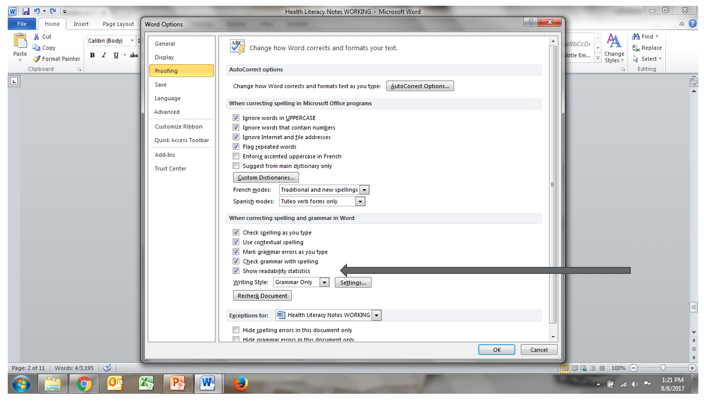
Figure 5. Screenshot to show where Microsoft Word tools are located.
If you go under your options where spellcheck is, you can see where my arrow is pointing at the very last bullet point. This is readability statistics. You can choose the writing style and what have you. The next one shows spelling and grammar. If you go to that review and you already have that box toggled, you can highlight a passage of text or even a whole document. By clicking on spelling and grammar, you can look for commas and punctuation (Figure 6).
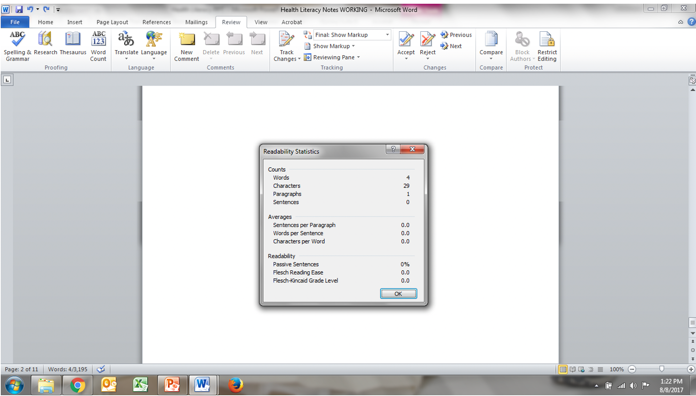
Figure 6. Screenshot showing where the readability statistics are located.
You can see words, characters, et cetera. If you go down to the bottom, that is your passivity level. Remember as we just said, you are communicating as you are educating. As you are talking to your patients and developing materials, you want to develop those in an active voice, not a passive voice. It needs to be active and how you would normally speak. This is what that parameter is showing.
There is also a Flesch Reading Ease and a Flesch-Kincaid Grade Level. The Flesch Reading Ease is on a percentage level, and it also gives you a Flesch-Kincaid Grade Level. I love these options. As you are creating materials, like home exercise programs or whatever, you can use these tools to assess their readability. Using these tools, you may have to adjust the materials if needed.
Health Literacy Assessment Tools
Health literacy assessment tools are also available in the public domain. They are all in English, but some have been translated into other languages as well.
Test of Functional Health Literacy in Adults (TOFHLA)
- Measures functional literacy using real-life health care materials including patient education information, prescription bottle labels, registration forms, etc.
- Assesses numeracy and reading comprehension
- Total of 67 items
- Numeracy includes 17 items
- Reading comprehension includes 50 items.
The first test is the Test of Functional Health Literacy in Adults or the TOFHLA. This measures the functional literacy level of patients using real-life healthcare materials. You give the patient information about a specific health type of situation or prescription bottle labels. They are asked to read a prescription label and answer questions about that. There are sample registration forms, instructions for diagnostic tests, instructions for appointments, and that sort of thing. They are asked to read and then answer questions about these items. This assesses two main constructs numeracy and reading comprehension. There are a total of 67 items. The numeracy scale looks at reading and understanding numbers. There are 17 items for that area, and then the reading comprehension has 50 items. This shows how well a patient can read and understand healthcare-related passages.
- Two additional versions of the TOFHLA
- TOFHLA-S: Spanish translation
- S-TOFHLA: Short form
There are two additional versions of the TOFHLA. I do not know why they named them as such because it sometimes confuses me. The TOFHLA-S is a validated Spanish translation, and then there is the S-TOFHLA, which is the short form of this. The original TOFHLA, off the top of my head, takes about 25 or so minutes to administer. The short form takes about 12 minutes to administer.
Rapid Estimate of Adult Literacy in Medicine—Short Form (REALM-SF)
- 7-item word recognition test
- A quick assessment of patient health literacy
- Validated and field-tested
- Excellent agreement with the 66-item REALM instrument
The next one is the REALM, and this is the REALM short form. There is also a REALM longer form that gives an estimate of adult literacy in medicine. I love the short form as it takes just a couple of seconds to administer. It is a seven-item word recognition test that provides you with a super quick but valid assessment of someone's health literacy.
- Behavior _____
- Exercise _____
- Menopause _____
- Rectal _____
- Antibiotics _____
- Anemia _____
- Jaundice _____
You show the client these words on a piece of paper and say, "Please read me these seven words," and you check how many they got right. Scoring is very easy as you can see in Figure 7.
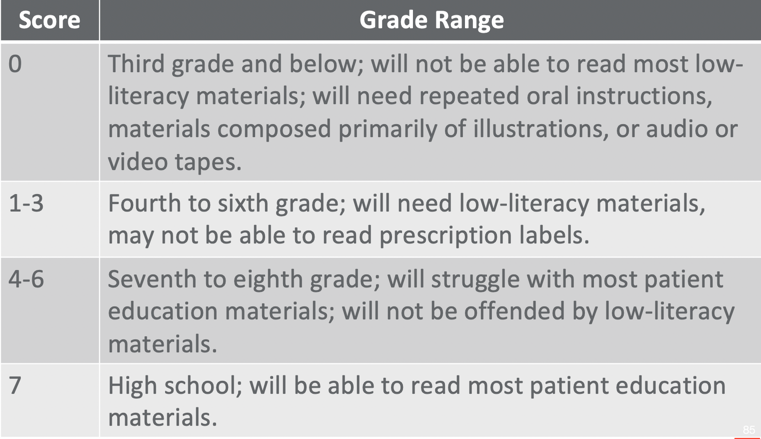
Figure 7. Rapid Estimate of Adult Literacy in Medicine—Short Form (REALM-SF) Grade Range.
If they get none correct, they are probably at a third-grade reading level or below. What that means for you as a clinician is they are not going to be able to read even the lowest literacy materials. Even if you have materials developed for the 5th-6th grade reading levels, they may not be able to read those. You may need to completely change how you educate and communicate with them. Perhaps, you might choose to educate orally, use illustrations or videotape with say YouTube clips.
If they get one to three of the words correct, they are at a 4th-6th grade reading level, and they are going to need those low literacy materials. They may not, however, be able to read prescription bottles or prescription labels. You may need to do some additional education there if it is part of your treatment plan.
If they get four to six words correct, they are probably at about a 7th-8th grade level. They are not going to struggle with a lot of patient education materials. However, as I said before if you give them the low literacy materials, they are not going to be offended by it.
If they get all seven, they are at a high school level and are probably set. They should be able to read most of the patient education materials that are out there or in development.
The Newest Vital Sign
- Quickly and simply assess a patient’s health literacy skills
- Administered in 3 minutes
- English and Spanish
- Uses ice cream nutrition label for review and questions
The Newest Vital Sign is reasonably new. It was designed to quickly and simply assess a patient's health literacy skills. Hopefully, some of you are already familiar with it. This is also available in the public domain, and it is free of charge. It can be administered in three minutes. What happens is the patient is given a specially designed ice cream nutrition label to review, and then we ask them a series of questions about it. Based on the number of the correct answers that they get, we can assess what their health literacy level is and then adjust how we communicate with them.
- Administration
- Administer at the same time that other vital signs are being taken
- Ask the patient to participate
- “We are asking our patients to help us learn how well patients can understand the medical information that doctors give them. Would you be willing to help us by looking at some health information and then answering a few questions about that information? Your answers will help our doctors learn how to provide medical information in ways that patients will understand. It will only take about 3 minutes.”
Why is it called The Newest Vital Sign? It was set up in a way such that a nurse or any other trained staff like a respiratory therapist, could administer it at the same time they are taking vitals like blood pressure, pulse ox, and respirations per minute. You ask the patient to participate. This is the language that comes directly from the assessment. We ask them this, "We're asking our patients to help us learn how well patients can understand the medical information that doctors give them. Would you be willing to help us by looking at some health information and then answering a few questions about that information? Your answers will help our doctors learn how to provide medical information in ways the patients will understand, it will only take about three minutes." Again, this is taken directly off the tool.
- Administration
- Hand the nutrition label to the patient
- Retain label throughout the administration
- Refer to label as often as needed
- Asking the 6 questions, one by one, giving the patient as much time as needed to answer
- No maximum time allowed – the average is 3 minutes
- If struggling with the first or second question after 2 or 3 minutes, likely has limited literacy and assessment can stop
You then hand the nutrition label to the patient. The patient can and should retain the nutrition label throughout the administration of the entire Newest Vital Sign, or the NVS. The patient can also refer to the label as often as they need to throughout the entire test. You ask the six questions one by one. You give the patient as much time as he or she needs to refer to that nutrition label to answer the questions. And, there is no maximum time allowed to answer the questions. The average time needed to do all six of the questions is about three minutes. However, if the patient is still struggling with the first or the second question after a few minutes, the patient likely has limited literacy, and you can probably just stop the assessment.
- Administration
- Ask the questions in sequence
- Continue even if the patient gets the first few questions wrong
- If #5 answered incorrectly, do not ask #6
- With 4 correct responses, stop -- patient has adequate literacy
- Do not prompt
- Do not show the score sheet to patients
- Do not tell patients if they have answered correctly or incorrectly
You are required to ask the questions in a sequence, and you are going to continue the test even if the patient gets the first few questions wrong. However, and again this will make more sense when we start to ask the questions if the patient gets number five wrong you do not move to number six. You can stop asking the questions if the patient gets the first four questions correct.
With four correct responses, the patient almost certainly has adequate literacy. You cannot prompt a patient who cannot answer a question because as with any standardized assessment, prompting could jeopardize the accuracy of the test. You just need to say, "No big deal. We're just going to go on to the next question." You also cannot show the score sheet to the patients.
When you look at this assessment, it is an entire assessment booklet, and the score sheet shows the answer. If they ask to see it, you say, "I can't show it to you because it contains the answers, and showing the answers spoils the whole point of asking the questions, does it not?" You also cannot tell them if they answer correctly or incorrectly. They are going to ask things like, "How did I do?" "Am I doing okay?" "How's it going?" You just say, "I can't show you the answers until you are finished, but for now you are doing just fine. Let's go on to the next question." You need to be encouraging without giving them the answers.
As you score this, this is why that four questions make sense, you give them one point for every correct answer for a maximum of six points (Figure 8).
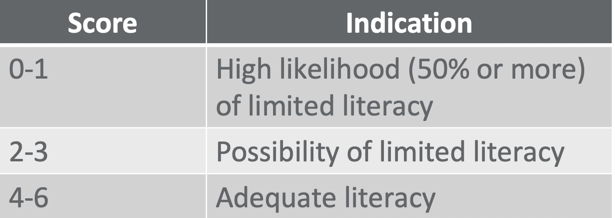
Figure 8. Scoring for The New Vital Sign.
With a score of zero to one, there is a high likelihood of 50% or more of limited health literacy. Again, your takeaway here is you need to go back and develop your materials in a way that is going to be a sixth grade or below and communicate in plain language. A score of two to three suggests the possibility of limited literacy. They are probably not going to be offended if you give them low literacy materials, but they may not need them either. A score of four to six almost always indicates that the person has adequate literacy. Again, if they get the first four questions right, you do not technically have to ask questions five and six. I like to complete the whole test, but if they get the first four, chances are pretty good that they have adequate literacy.
- Why an ice cream label?
- Analyzing a nutrition label requires the same skills to understand medical instructions
- Understanding and application of words (prose)
- Numbers (numeracy)
- Forms (documents)
- Whether it’s a food label or medical instructions, one needs to:
- Remember numbers/make calculations
- Identify potentially harmful ingredients
- Make decisions about actions based on information
- Analyzing a nutrition label requires the same skills to understand medical instructions
Why does an ice cream label work as a predictor of the ability to understand medical instructions? A patient's ability to read and analyze a nutrition label requires the same types of analytical and conceptual skills that are needed to understand and then follow a provider's medical instructions. There are three different and specific types of skills here. An understanding and application of words are prose literacy. The application of numbers, which we have been talking about throughout the course, is numeracy literacy. And then, there are forms or documents.
Recent research in the "American Journal of Preventive Medicine" has shown that poor comprehension of food labels correlates very highly with low-level literacy and numeracy skills. Whether they are reading a food label or following medical instructions, they need to be able to remember numbers and make mathematical calculations. It could be figuring out their caloric intake for the day. Or, figuring out on a sliding scale, what insulin dosage they need. Their physician may say to stop your medication on a certain date before a procedure. They need to remember those numbers and make calculations. It might be identifying and being mindful of different ingredients that could be potentially harmful to them. They need to make decisions about their actions based on the given information. Do I hold my meds? Do I take my meds? Do I do my breathing treatment? Do I not?
Let's go back through those three examples before we do the test together.
- Prose Literacy Example
- Clinical example
- The patient has scheduled some blood tests and is instructed in writing to fast the night before the tests
- Ice cream label example
- The patient needs this skill to read the label and determine if he can eat the ice cream if he is allergic to peanuts
- Clinical example
For the prose literacy example, the patient has scheduled some blood tests and is instructed in writing to fast the night before they take those tests. In that case, the patient would need that same skill to be able to read the label and determine if that person can eat the ice cream if they have a peanut allergy. It is the same type of literacy skills that would be utilized there.
- Numeracy Example
- Clinical example
- A patient is given a prescription for a new medication that needs to be taken at a certain dosage twice a day
- Ice cream label example
- The patient needs this same skill to calculate how many calories are in a serving of ice cream
- Clinical example
A numeracy example would be if a patient is given a prescription for a new medication that needs to be taken at a very specific dosage, and they have to take it twice a day. For the ice cream label, the patient needs that same skill to calculate how many calories are in a serving of ice cream.
- Document Literacy Example
- Clinical example
- The patient is told to buy a glucose meter and use it 30 minutes before each meal and before going to bed. If the number is higher than 200, he should call the office.
- Ice cream label example
- The patient needs this skill to identify the amount of saturated fat in a serving of ice cream and how it will affect his daily diet if he doesn’t eat it
- Clinical example
Then, there is document or forms literacy. In the clinical example, the patient is told to buy a glucose meter or a glucometer and use it 30 minutes before each meal and before going to bed. If the number is higher than 200, he should call the office, or higher than around 120 to 140 to do something with the insulin dosage. The parallel on the ice cream label is to identify the amount of saturated fat in a serving of ice cream, and then determine how that will affect his or her daily diet if they do not eat it.
We are going to have a little fun now. Take out a piece of paper, and as we go through the questions on the next slide, you can determine how well you do. Figure 9 shows the ice cream label that you are going to give to the patient.
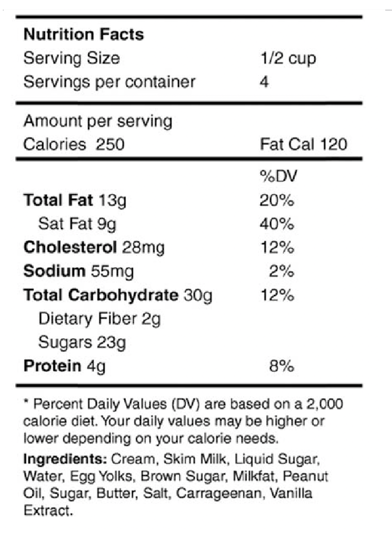
Figure 9. Ice cream label.
- Questions
- 1.If you eat the entire container, how many calories will you eat?
- Answer: 1,000 is the only correct answer
- 2.If you are allowed to eat 60 grams of carbohydrates as a snack, how much ice cream could you have?
- Answer: Any of the following is correct: 1 cup (or any amount up to 1 cup), half the container. Note: If the patient answers “two servings,” ask “How much ice cream would that be if you were to measure it into a bowl?”
- 3.Your doctor advises you to reduce the amount of saturated fat in your diet. You usually have 42 g of saturated fat each day, which includes one serving of ice cream. If you stop eating ice cream, how many grams of saturated fat would you be consuming each day?
- Answer: 33 is the only correct answer
- 4.If you usually eat 2,500 calories in a day, what percentage of your daily value of calories will you be eating if you eat one serving?
- Answer: 10% is the only correct answer
- READ TO SUBJECT: Pretend that you are allergic to the following substances: penicillin, peanuts, latex gloves, and bee stings.
- 5.Is it safe for you to eat this ice cream?
- Answer: No
- 6. (Ask only if the patient responds “no” to question 5): Why not?
- Answer: Because it has peanut oil.
- 1.If you eat the entire container, how many calories will you eat?
Follow along and write down your answers. Question 1: If you eat the entire container of ice cream, how many calories will you eat? Question 2: If you were allowed to eat 60 grams of carbohydrates as a snack, how much ice cream could you have? Question 3: Your doctor advises you to reduce the amount of saturated fat in your diet. You usually have 42 grams of saturated fat each day, which includes one serving of ice cream. If you stop eating ice cream, how many grams of saturated fat will you be consuming each day? Question 4: If you usually eat 2,500, what percentage of your daily value of calories will you be eating if you eat one serving of ice cream? Pretend you are allergic to the following substances: penicillin, peanuts, latex gloves, and bee stings. Question 5: Is it safe for you to eat this ice cream? Yes or no? And then depending on what you answered, if you said, "No," why not? That is the whole test. As an aside, I read those to you verbally. This is ideally how you should do this. I suspect that if you had to, you could put these questions on like a cue card or something for the person to read them if that was necessary. I would need to confirm that with the test booklet.
Let's go back through the questions. Question one, if you eat the entire container, how many calories will you eat? The answer here is 1,000. This is the only correct answer because there are four servings and each serving is 250 calories. If you were allowed to eat 60 grams of carbohydrates as a snack, how much ice cream could you have? Any of the following answers would be correct. You could say one cup or any amount up to one cup, or half the container. If the patient were to say two servings, you need to go back to them and ask, "How much is a serving?" "How much ice cream would that be if you measured it out and you put it into a bowl?" Question three, your doctor advises you to reduce the amount of saturated fat in your diet. You usually have 42 grams of saturated fat each day, which includes one serving of ice cream. If you stop eating ice cream, how many grams of saturated fat would you be consuming each day? The answer is 33 grams of saturated fat. If you usually eat 2,500 calories in a day, what percentage of your daily value of calories will you be eating if you eat one serving of ice cream? Again, the only answer is 10%, because it is 250 calories per serving. Lastly, with the allergy question, the answer to that is no. If they answer, "No," you ask them why. The answer is no as there is peanut oil in this ice cream.
Again, you ask all the questions in order. If they get question five wrong, you do not even ask question six. If they answer, "Yes," it is safe for them to eat it, they clearly did not understand that there was peanut oil in the ingredient list, and they probably should not be eating it.
This is a great test that was developed by one of the drug manufacturers. Again, it takes three minutes to administer it, and you immediately know with any one of these tasks reading comprehension and the literacy level of the client. It just helps you to put everything that you are doing with them into focus at a level that is going to be meaningful, useful, and get your point across. It also increases health outcomes.
Recap of the Assessments
Figure 10 is a recap of those assessments and the references for each of them.
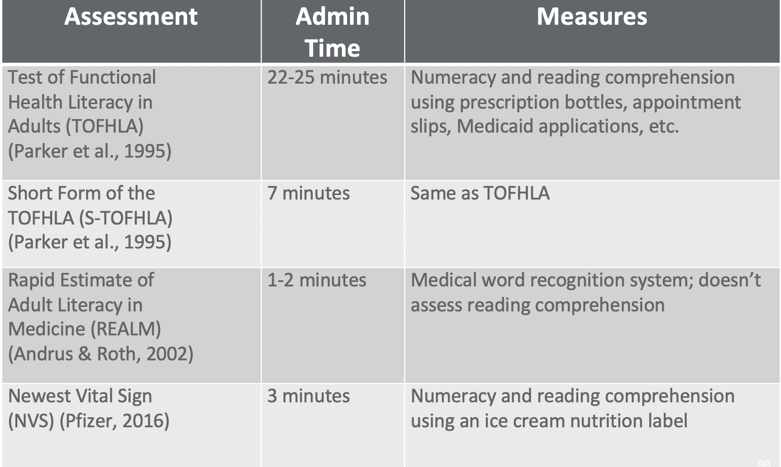
Figure 10. Chart showing assessment information.
There is the TOFHLA. It takes 22 to 25 minutes to administer that. The short form of the TOFHLA takes about seven minutes. The short form of the REALM, that we just talked about, with the seven words takes one to two minutes. The full 66 item test takes about 25 to 30 minutes. Lastly, The Newest Vital Sign, from Pfizer, is about three minutes long. These tests are available for you to get the information that you need.
Effective Verbal and Written Communication
Ask Me 3
- 1.What is my main problem?
- 2.What do I need to do?
- 3.Why is it important for me to do this?
- Intended to help patients become more active members of their health care team
- Improve communication
- Develop patient-centered goals
We talked about the Ask Me 3 earlier on. This is a great educational program that encourages our patients and families to ask three specific questions of their providers to help them understand their health conditions a little bit better. It also helps them to understand what they need to do to not only stay healthy but also to be compliant with any sort of healthcare regime or instructions. What is my main problem? What do I need to do? Why is it important for me to do this? We flip-flop those. Remember, when we talked about them before it was, "What problem are you bringing to me?" "What do you want from me to do this?" And, "Why is it important to you?" This is flip-flopping this narrative and helps patients become more active members of their healthcare team. It is a critical platform that improves communications between them and us. More than anything, it helps us to develop those patient-centered goals. If the goal is not centered on the patient, meaningful, or motivational to them, what is the point?
Teach Back
- The client repeats the information in his or her own words to show understanding
- Useful to assess YOUR OWN communication skills with the patient
- For example:
- Tell me what you have understood
- Can you show me how you are going to do your exercises?
We have talked about teach back before. We probably intuitively do this, but we do this to make sure that the client understands. They repeat the information back to us in their own words to show understanding. This helps us to assess our communication skills with the patient. Did I do my job? Did I get my point across? "Tell me what you understood. I want to make sure that I've explained it thoroughly to you?" "What I would like you to do for your respiratory home program. Tell me how you're going to do your exercises as it relates to your breathing?" Or, "How are you going to do your plan at home? Can you show me how you're going to do those exercises?" You are looking to see if you got your point across and how are they doing with it. If their return demonstration is not at 100%, then you have a little bit of work to do. You may even have to go back to the drawing board and figure out how to parlay that education a little bit differently.
Content and Organization
- Ensure the purpose is immediately outlined and clear to the reader
- Ensure content is balanced, accurate, and up-to-date
- Include a publication or revision date on all materials
- Provide how-to information of relevance to the reader’s situation
- Use subheadings, question and answer format, bullet points, and summaries
Content and organization are critically important. Make sure that the purpose is immediately outlined and clear to the reader. The purpose of written documents should not be hidden at the end of the first paragraph or the end. It should be smack dab right there at the very beginning. You want to make sure that the content is balanced, accurate, and up to date. You may even want to put a reference date in the footer of your document so you know the last time that it was updated. Was it updated in 2003 or was it updated in 2020? Provide how-to, relevant information, and keep out the extraneous. Use subheadings to help you to organize. A Q&A format is wonderful. You can also use bullet points and short little summaries to break down the information into small and reasonable chunks.
Layout and Illustrations
- Use ample white space
- Use serif typefaces, minimum 12-point font size, good contrast between text and background
- Avoid capitalizing all letters in words, italicizing, and the use of Roman numerals
- Use instructive, culturally appropriate illustrations but only if they augment the message
- Position illustrations next to the text they refer to
- Clearly label all illustrations
When you look at your layout and illustrations, there should be ample white space. It is very distracting if there are tons and tons of words on a slide or a piece of paper. Ues serif typefaces. It is also good practice to use a minimum 12 point font size with good contrast between the text and the background. Some people will try to use white letters on a black background, and while that has good contrast, it is very difficult for people to read. Black on white is always going to be best. Avoid capitalizing all the letters in the words, italics, and the use of Roman numerals. If you use illustrations, make sure that they are instructive, culturally appropriate, and not offensive. Only include them if they actually augment the message. If not, they probably do not need to be there. And if you are going to use photos or illustrations, make sure that they are next to the text that they refer to. And of course, label all of your illustrations so that somebody knows what that illustration is about.
Language
- Aim for 5th to 6th-grade reading level
- Use clear, simple, common language, and short sentences and words
- Avoid jargon and define specialist terminology
- Write in active voice and second person
We have talked about language already quite a bit. Aim for the fifth to sixth-grade reading level with a simple, clear common language and short sentences. You want less than 10 words per sentence. Avoid jargon and special terminology. And, write in an active voice.
Writing Tips for All Readers
- Use plain English
- Make every word count
- Be clear and brief
- Use positive words
- Short lists or bullet points, not long sentences
- Concrete, familiar words
- Charts and pictures
- One or two-syllable word when possible
We already talked about plain English. These are just writing tips for all readers. I think that if you just do this consistently, no one is going to be offended. Everyone is going to be helped. Make every word count and cut out the unnecessary fluff if you do not need it. Be clear, be brief, and use positive words. Instead of saying, "Don't do this," instead say, "Do this." Use positive words, short lists, bullets, short sentences, and concrete and familiar words. If you use abstract words, sometimes the translation gets lost. Use very familiar words unless you have to use a very technical term. Charts and pictures are very helpful. Using one syllable or even two-syllable words when possible is going to be better.
- Follow grammar rules:
- Subject and verb together if possible
- Vivid, active verbs
- Active voice
- Short, simple sentences
- Personal pronouns
- Few – ing words
- Few prepositional phrases
Follow grammar rules. I am probably the only person in the world who uses proper grammar and punctuation in a text message. Use your subject and your verb together, and make them part of the same sentence. Vivid, active action verbs are better than passive. Use personal pronouns like we and you. Use few -ing words. Keep out those prepositional phrases. And when possible, do not end your sentence with a preposition.
Text Appearance Matters
- Text greatly affects readability
- Use font sizes between 12 and 14 points
- For headings, use a font size at least 2 points larger than the main text size
- Use fonts with serifs
- Serifs are the little “feet” on letters
Text greatly affects your readability. Choose the appropriate font style and size. It is really important to create health communication materials that are easy for our patients to read. Font sizes should be between 12 and 14 points. If someone has low vision on top of other things, you might want to go a little bit bigger or use low vision materials. Anything less than 12 points can be too small for individuals. If you have headings, you are going to use a font size that is at least two points larger than the main text. We want to use serif fonts as they are easier to read than sans-serif fonts. The serif makes the individual letters more distinct and easier for our brains to quickly and easily recognize. The serifs are the little feet that are on letters. If you are not sure if something is a serif or not, go back to Microsoft Word. This is not certainly a plug for them, but if you look at your font list, it will say sans-serif. Sans-serif means it does not have feet. For example, Times New Roman font has the feet.
- Do not use FANCY or script lettering
- Use both upper and lower case letters
- Use grammatically correct punctuation
- Use bold type to emphasize words or phrases
- Limit the use of italics or underlining
- Use dark letters on a light background
Do not use fancy or script lettering. I know it looks really fun, but it is very difficult to read. Make sure that you use both upper and lower case letters just as you would with any sort of paragraph that you are writing or reading. Do not use all caps. Make sure that you are using grammatically correct punctuation like commas, semi-colons, and periods. If you do want to emphasize a word or emphasize a phrase, use bold type to do that as italics and underlining are very difficult to read. You want to avoid those. Keep it simple. And I think simple plain language, go back to that. That's exactly what we need it to be.
Summary
This brings us to the conclusion of this session. Thank you so much for listening. My contact information is on the final slide. If you have any questions or would like additional information, do not hesitate to reach out.
References
Available in the handout.
Citation
Weissberg, K. (2021). Health literacy and delivering culturally competent care. Continued - RespiratoryTherapy, Article 19. Available at www.continued.com/respiratory-therapy
Kathleen Weissberg
OTD, OTR/L
Related Courses
Recognizing the Bias Within Us
This course allows clinicians a safe and informative place to learn about the different types of bias they may encounter within their roles. Clinicians will be provided with a supportive space to gain an understanding of their own personal biases, how these impact patient interactions, and strategies to overcome misinformed preconceived notions. Additionally, clinicians gain knowledge as to the biases patients may approach services in the healthcare industry with.Implicit Bias: Impact on Maternal Health in Minority Populations
This text course examines how implicit bias and structural racism contribute to disparities in maternal and infant health among minority populations in the United States. It defines and differentiates implicit and explicit bias, explains how bias forms and operates within clinical relationships and power differentials, and connects these forces to structural racism and to documented patterns of maternal and infant morbidity and mortality. Learners explore the most recent national data on these disparities, including the populations at highest and least visible risk, and the everyday clinical moments where bias is most likely to influence care. The course then turns to practical, evidence-informed strategies that individuals, teams, and systems can use to recognize and reduce the impact of bias and structural racism on childbearing patients and their infants. This course was designed for an interprofessional audience.
Diversity, Equity, and Inclusion in Health Care: It's Not Just Black and White - Access to Healthcare
This webinar is the third in a series of webinars that address diversity, equity, and inclusion in healthcare. This webinar focuses on access and the impact of implicit bias on access to healthcare services, quality of service, and service delivery. In addition, this webinar provides tools for facilitating and implementing effective diversity and inclusion initiatives.