Course Articles
The Sociology of Child Abuse & Evidence-Based Prevention
Sophie Nathenson, PhD
Course overview
This article develops a sociological perspective on child abuse and neglect, shifting the frame of analysis from the individual to the societal level. It examines how culture, norms, technology, economics, social relations, and policy shape the prevalence and distribution of child maltreatment across populations. The discussion moves from foundational definitions of abuse and neglect, through mandatory reporting obligations for health and behavioral health professionals, national and state-level trends and statistics, and an ecological model that situates individual and family risk within broader social conditions, before turning to evidence-informed prevention strategies at the policy, community, and practice levels. The material is intended for health, behavioral health, and social service professionals who want to integrate a population-level, contextual understanding of child maltreatment into direct practice with individuals and families. As structured, the activity is designed to occupy approximately one hour of independent study time, consistent with a single continuing education contact hour.
Course information
Limitations/Risks
- This presentation does not cover the entirety of research, statistics, or variation in types and prevalence of child abuse
- All research is at the population level and should not be applied to all groups or individuals as a whole
- Research seeking to explain the motivation and function of child abuse should not be interpreted as condoning behavior
- Research on social factors should not be interpreted as obscuring personal responsibility and individual choice
- All research is at the population level and should not be applied to all groups or individuals as a whole.
Learning Outcomes
After this course, participants will be able to:
- Explain the Child Abuse and Neglect Reporting Act as it relates to your professional role.
- Identify four community-level factors in child abuse and neglect.
- Describe two evidence-based approaches to preventing child abuse in communities.
Introduction
The Sociological Perspective
Sociology, like psychology, economics, political science, and anthropology, is a discipline concerned with human behavior. What distinguishes the sociological perspective is its unit of analysis. Rather than asking what makes a particular individual behave in a particular way, sociology examines rates of behavior and compares outcomes across groups, looking for patterns that suggest something about a group, a location, or a social experience that may be influencing the behavior in question, rather than something occurring to only a few isolated individuals.
That societal lens applies directly to child abuse and neglect. Any measurable characteristic of how a society functions can be examined for its relationship to social problems, including culture, which the United States contains many overlapping forms of. Norms are the expected ways of behaving within a given community. Technology represents a substantial influence on society as a whole, and the nature and pace of technological change differ from one society to another. Economic structure, including how an economy is organized and how resources are distributed, has effects that trickle down to shape individual lives. Social relations rank among the most significant influences on mental health, and policy, meaning laws and the workings of social institutions such as the healthcare system, the educational system, and the criminal justice system, represent another layer through which society shapes individual outcomes.
Most clinical, behavioral health, and social work training curricula focus heavily on preparing practitioners to work directly with individuals, leaving comparatively little curricular space for analyzing the social factors and environmental conditions that shape a client's life circumstances. Bringing a population-level, big-picture perspective to frontline practitioners is not offered here as a replacement for individual clinical skill, but as a complementary lens that can be folded into direct practice with clients and families, since the institutional and structural pieces of society, including the healthcare, education, and criminal justice systems, are what allow sociology to complement, rather than replace, the individually focused work done in psychology, social work, and other helping professions. That framing recurs throughout the sections that follow, each of which takes a phenomenon often understood primarily as an individual failing or an individual pathology and asks what group-level, environmental, or structural conditions might also be contributing to it.
This dual focus matters because clinical training and sociological training tend to answer different questions. A clinician trained to work one-on-one with a client is well equipped to ask what is happening for this particular person, in this particular family, at this particular moment. A sociologist is better equipped to ask why rates of a given outcome differ across neighborhoods, states, or demographic groups, and what that difference might reveal about shared conditions rather than shared personality traits. Neither question subsumes the other. A practitioner who can hold both questions at once, treating the individual in front of them with clinical attention while also recognizing the community-level patterns that individual's circumstances reflect, is in a stronger position to identify appropriate referrals, anticipate systemic barriers, and avoid mistaking a structural problem for a personal one.
Child Maltreatment
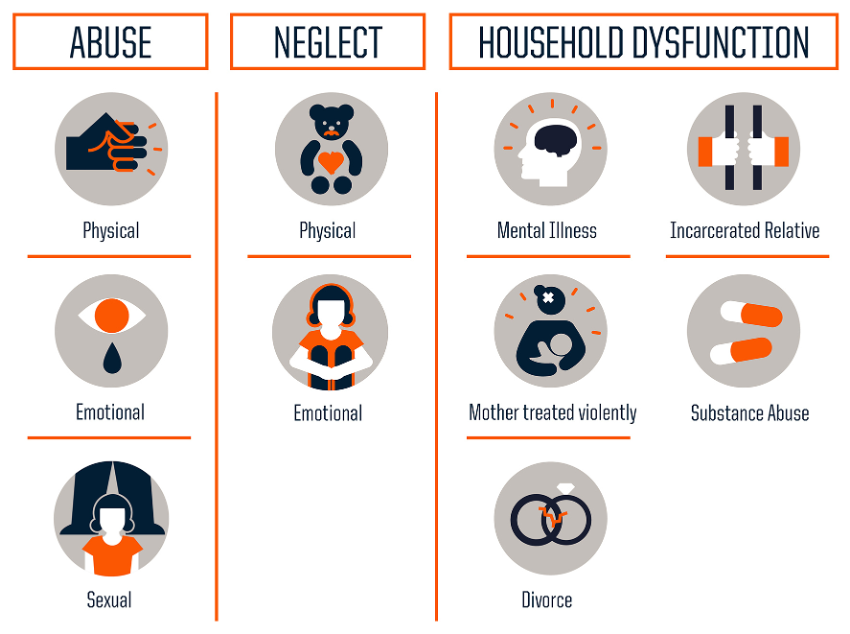
Child maltreatment is generally categorized into several forms, including physical abuse, emotional abuse, sexual abuse, neglect, and exposure to violence. Childhood emotional maltreatment (CEM) is defined as not receiving love and support, and may also involve verbal assault or demeaning treatment, such as being repeatedly called names (Massullo et al., 2023; Finkelhor et al., 2023). This category of abuse carries long-term effects comparable to those associated with physical or sexual abuse.
General neglect is defined as the failure to provide basic needs, including food, shelter, water, and medical care (Massullo et al., 2023; Finkelhor et al., 2023). A sense of belonging and community is also part of what a child requires to be well in society, although the formal definition of general neglect used in most research and policy contexts is limited to the basic survival needs listed above. A recurring theme in the literature is that most research attention is directed toward sexual abuse and fatal abuse, even though neglect is statistically the most common form of maltreatment affecting children (Massullo et al., 2023; Finkelhor et al., 2023).
Impact of Abuse on Wellbeing
Childhood maltreatment is associated with a wide range of adverse outcomes across the lifespan. On the physical health side, documented associations include diabetes, lung disease, vision problems, poor nutrition, sleep problems, and sexual difficulties. On the mental health side, associations include attachment difficulties, impaired executive functioning, posttraumatic stress disorder, depression, anxiety, suicidal ideation or attempts, self-harm, and body image issues (Daníelsdóttir et al., 2024). Some researchers characterize adverse childhood experiences as among the most impactful known contributors to diagnoses listed in the Diagnostic and Statistical Manual of Mental Disorders (DSM; Daníelsdóttir et al., 2024).
The adverse childhood experiences (ACEs) framework offers a structured assessment of experiences occurring between birth and age seventeen, including the various forms of child maltreatment described above as well as household exposure to substance use, domestic violence, and mental illness in a caregiver. An accumulation of these experiences is associated with substantially elevated risk of physical, mental, emotional, and social difficulties later in life. That elevated-risk trajectory reflects outcomes observed in the absence of intervention, and it is longitudinal research comparing groups with differing levels of childhood adversity that first allows the pattern to be identified at the population level. Impaired executive functioning is of particular interest because it may also play a role in the intergenerational continuation of abuse, insofar as adults who were themselves maltreated as children may carry functional impairments that affect their own parenting.
Impact on Youth Social Life
Childhood maltreatment also affects children's social functioning and relationships, including social cognition, emotional regulation, and sense of belonging. Research indicates that any type of maltreatment negatively affects sociality, popularity (measured by asking peers to name their friends), and social cohesion, while physical neglect specifically was found to affect all of these outcomes (Kamis & Copeland, 2024). In the sample referenced, more than 28 percent of children had experienced physical abuse, more than 4 percent had experienced sexual abuse, more than 17 percent had experienced emotional abuse, and more than 10 percent had experienced physical neglect (Kamis & Copeland, 2024).
These findings connect naturally to the concept of trauma-informed care: children experiencing abuse at home do not necessarily experience school as a place of reprieve, since the effects of maltreatment on emotional regulation and social functioning tend to follow a child into other settings. When children carrying these difficulties display behavioral or regulatory challenges at school, awareness of trauma-informed approaches can shift how educators and other professionals interpret and respond to that behavior. Trauma-informed care, as a practice framework, is not addressed in depth here, but the relationship flagged above warrants further professional development on its own terms.
Mandatory Reporting
Role of Health Professionals
Health professionals are mandatory reporters of suspected or confirmed child abuse. Social workers and behavioral health professionals, in particular, work with vulnerable populations, a term referring to groups that, compared with other groups in society, systematically have less access to resources, may be treated differently, or may experience a different life course that affects their ability to meet basic needs and maintain mental and emotional health. The existence of the social work profession reflects a societal response to these disparities, distributing support services to populations that need them, including children and individuals experiencing abuse.
Cultural competency, often required for professional licensure, follows naturally from this point. Cultural competency training has not been shown to have a large direct effect on patient outcomes on its own, in part because outcomes are also shaped by the structural and economic issues taken up later in this article. Cultural competency does not require a practitioner to become an expert on every culture encountered, nor does it require adopting the beliefs, practices, or attitudes of a given cultural group. Rather, it means recognizing that group and individual differences exist, avoiding assumptions, remaining open-minded, and making an effort to understand a client's context. That awareness can strengthen the therapeutic alliance between a practitioner and the people served, regardless of whether the practitioner shares the client's cultural background.
Child Abuse Reporting Act
Child abuse and neglect reporting requirements vary by state law. The general purpose of these statutes is to protect children from harm, and they require covered professionals to report suspected or confirmed cases of child abuse, whether encountered at work or outside of work. Reporting is required upon reasonable suspicion; a mandated reporter need not have witnessed the abuse directly or confirmed that it occurred before making a report.
Penalties for failing to report vary by state. As an illustrative example, the penalty in California for a mandated reporter who fails to report suspected abuse is up to six months of confinement in a county jail, a fine of up to $1,000, or both. Reporting laws of this kind are designed to place "eyes" on children across a wide range of settings by requiring a broad group of professionals who come into regular, close contact with children to receive training in recognizing and reporting suspected abuse. Worth noting as an editorial aside, not tied to a specific citation: certain settings associated with elevated abuse risk, such as some workplaces connected to trafficking, and certain professional roles that also work closely with youth outside of the categories below, are not explicitly named as covered professions, even though contact with children in those settings can be substantial.
Covered professionals
The category of mandated reporters is broad and includes the following groups, as identified on the accompanying slide:
- Physicians, dentists, medical residents or interns, hospital personnel and administrators, nurses, health care practitioners, chiropractors, osteopaths, pharmacists, optometrists, podiatrists, emergency medical technicians, ambulance drivers, undertakers, coroners, medical examiners, alcohol or drug treatment personnel, and persons performing a healing role or practicing the healing arts
- Psychologists, psychiatrists, and mental health professionals
- Social workers, and licensed or unlicensed marriage, family, and individual counselors
- Teachers, teacher's aides or assistants, school counselors and guidance personnel, school officials, and school administrators
- Child care workers and administrators
- Law enforcement personnel, probation officers, criminal prosecutors, and juvenile rehabilitation or detention facility employees
- Foster parents
- Commercial film and photo processors
Awareness of and training on suspected abuse indicators among frontline professionals, such as physicians and teachers, is a recognized element of early identification systems (Röders et al., 2024).
Trends & Variation
Stats
National data provide a sense of the scale of child abuse and neglect in the United States. In the most recent reporting year discussed on the slides, more than 3,081,715 children received some form of child protective services response, at a rate of approximately 7.4 children per 1,000, with the highest rate among children younger than 1 year of age. There were 546,159 confirmed victims of child abuse and neglect, of whom 64 percent experienced neglect only. Approximately 2,000 children died as a result of abuse or neglect in that year, and there were 422,117 identified perpetrators, an increase of nearly 20 percent compared with 2019. Approximately one in four cases involved a substance use factor, and approximately one in four involved a domestic violence factor. More than 1.76 million children received prevention services during the year. The overall prevalence of child abuse and neglect has not meaningfully decreased since the mid-1990s, despite increased investment in prevention efforts and expanded child protective services capacity.
The following table reproduces the core national statistics presented on the slide.
Measure Value Children with a child protective services response 3,081,715 Rate per 1,000 children 7.4 Confirmed victims of abuse and neglect 546,159 Share of victims who experienced neglect only 64% Child fatalities 2,000 Identified perpetrators 422,117 Increase in perpetrators since 2019 ~20% Cases with a substance use factor 25% Cases with a domestic violence factor 25% Children receiving prevention services 1,762,516 These figures likely underrepresent true prevalence, since many cases never come to the attention of any reporting authority, particularly when a child who is being controlled or coached by an abuser does not feel able to disclose what is happening.
State Differences
Reported rates of child abuse and neglect vary considerably by state. Massachusetts has the highest reported rate, at 16.5 per 100,000 (22,075 cases), followed by West Virginia, Iowa, Maine, and Alaska. New Jersey has the lowest reported rate, at 1.6 (3,146 cases), preceded by Pennsylvania, Washington, Virginia, and Kansas. Measured by raw number of cases rather than rate, Texas has the highest count, at 54,207, while Vermont has the lowest, at 672.
Several explanations account for this variation. States may define, count, and report child abuse differently, which limits the direct comparability of raw statistics across jurisdictions. Better-funded child protective services systems may also identify and record more cases simply because they have greater capacity to do so, meaning that a higher reported rate in a well-resourced state does not necessarily indicate a higher true prevalence of abuse. Legal treatment of practices such as corporal punishment also differs by state; in some states, including Oklahoma, corporal punishment such as spanking or slapping is treated as a matter of parental discretion unless it crosses into an excessive or injurious level, which is itself a subjective threshold.
Beyond definitional and administrative differences, sociological factors identified in connection with state and community "hotspots" of child abuse include housing instability, a lower volume of available services, unemployment, and substance abuse, particularly involving opioids and methamphetamine.
Digging Deeper
Self-report surveys that ask children directly about their own experiences provide an additional, and in some respects more complete, picture than administrative case data. According to national surveys of children's exposure to violence, 38.1 percent of children had experienced some form of maltreatment by age 17, with some sources placing the figure as high as half of all children. Of this experienced maltreatment, approximately 75 percent was neglect, 17 percent was physical abuse, 11 percent was sexual abuse, 4 to 7 percent was emotional abuse, and 0.2 percent involved trafficking.
Data drawn from the DHHS National Child Abuse and Neglect Data System for 2023 indicate that 90 percent of sexual abusers are known to the child, that one in four girls and one in twenty boys will experience sexual abuse in their lifetime, that 10.6 percent of children experience physical abuse only, that 7.5 percent experience sexual abuse only, and that 3.5 percent experience psychological maltreatment only.
The statistic that the large majority of sexual abusers are known to the child is sociologically significant on its own terms. Media coverage of child sexual abuse often emphasizes cases involving strangers or abduction, which are important but comparatively rare relative to abuse committed by someone already trusted by the child or the child's family, such as a relative, babysitter, or teacher. That pattern suggests that prevention efforts benefit from attention to family and other trusted relationship systems, in addition to stranger-danger messaging, even though this focus can feel uncomfortable or counterintuitive. Public attention to child abuse tends to concentrate heavily on cases involving a stranger or an abductor, coverage that is important and merited in its own right, but coverage of this kind can create a skewed public impression of where risk actually concentrates, since babysitters, teachers, relatives, and other trusted adults account for the substantial majority of sexual abuse cases.
Taken together, the scope of these figures supports the sociological argument that child abuse should be understood as what the discipline terms a public issue, meaning a problem so widespread that societal or environmental conditions are implicated, rather than solely a personal trouble affecting a small number of individuals. A personal trouble is an individual's private struggle or suffering; a public issue is a pattern that recurs across a large enough share of the population to suggest something happening at the level of the community, institution, or society, rather than only within a small number of disturbed or ill-intentioned individuals. That shift, from viewing child abuse as a personal trouble to viewing it as a public issue, is the central conceptual move underlying the analysis that follows, since it is this shift that justifies looking to community, economic, and cultural conditions, rather than exclusively to individual psychology, for both explanation and prevention.
Introduction
Ecological Model
The ecological model is a theoretical framework that integrates personal history, family systems, and societal-level factors to explain outcomes such as child abuse perpetration and victimization (Jip et al., 2025). At the individual level, the model considers a person's personal history and individual characteristics, including biological factors. At the family level, it considers the household's dynamics and functioning. At the societal level, it considers the broader social, economic, and cultural conditions in which individuals and families are embedded.
Effective prevention, under this framework, depends on a holistic and contextual understanding of a case or a population, rather than an exclusive focus on any single level of analysis (Jip et al., 2025). Existing research and intervention efforts tend to carry a bias toward individual risk factors, which can obscure the societal conditions that also underlie abuse rates (Jip et al., 2025). Socioeconomic conditions, cultural norms, and broader social problems contribute in layered ways to abuse rates (Jip et al., 2025). Consider a town whose economy depends heavily on a single large employer: when that employer closes or substantially reduces its workforce, subsequent community-level increases in substance use, depression, and anxiety can be observed, illustrating how an event affecting an entire community can raise risk across many individuals simultaneously, distinct from any one person's individual psychology.
Social Determinants
Individual/Psychopathological
At the individual level, mental health factors specific to a given person do not reliably predict whether that person will perpetrate abuse, and such factors are not generalizable to populations as a whole. Personality disorders, severe substance use, impulse-control difficulties, impaired cognitive functioning, low self-esteem, and needs related to power and control are among the individual-level factors that can contribute to the perpetration of abuse. Psychosocial comorbidities can also increase a child's risk of victimization. Carrying any of these individual risk factors does not mean that abuse will occur; these are population-level associations rather than deterministic predictions about any one person.
The sociological approach builds on this individual-level picture by analyzing the social conditions that can influence these same risk factors, effectively asking what is happening in a person's environment that may be shaping the individual vulnerabilities described above, rather than treating those vulnerabilities as freestanding or unexplained.
Focusing on Society
Reframed at the societal level, child abuse is best understood as a public health issue rather than solely an individual problem (Korbin, 1994; Luo et al., 2025). This framing is analogous to how public health has approached other large-scale problems, such as the opioid crisis or the COVID-19 pandemic, in which the effects extend well beyond any single affected individual, influencing healthcare costs, education costs, and social services spending across a population.
Addressing upstream factors, meaning the social and economic conditions that precede a crisis event such as a fatality, injury, or confirmed abuse case, is the most impactful point of intervention, since it affects the largest number of people before harm occurs, in contrast to downstream responses such as emergency services, removal of a child from the home, or punishment of a perpetrator after the fact. Individual development takes place within families, neighborhoods, and the broader sociocultural environment, meaning that all of these settings shape a child's outcomes, not the family alone (Korbin, 1994; Luo et al., 2025).
Social Factors
Social Factors
Certain social statuses are associated with increased risk of child maltreatment, including low socioeconomic status, low educational attainment, young parental age, single parenthood, having multiple dependent children, and low income (Hong et al., 2023; Nadan, Spilsbury, & Korbin, 2015). A social gradient is observed across these factors, meaning that differences in income, race, ethnicity, and LGBTQ+ status are all associated with differing levels of risk (Hong et al., 2023; Nadan, Spilsbury, & Korbin, 2015). Lower social status is associated with chronic stress arising from external conditions and unmet basic needs (Hong et al., 2023; Nadan, Spilsbury, & Korbin, 2015).
These comparisons are made at the group level and do not imply that individuals sharing a given social status are alike in other respects, nor that any one person in a higher-risk category will necessarily experience or perpetrate abuse. Rather, the purpose of identifying these statistically elevated-risk categories is to direct attention toward the structural conditions, such as educational access or income support, that may underlie the observed differences, rather than toward the individuals themselves.
Race & Social Statuses
Research on race and child abuse identification produces mixed results. Some studies find that Black and Hispanic children are overrepresented in the child welfare system and in hospitalization for abuse-related injury, indicating greater risk of family separation and higher associated healthcare costs (Salimi-Jazi et al., 2024). When socioeconomic status and other relevant variables are statistically controlled for, Black race continues to show an independent effect on these outcomes, while Hispanic ethnicity appears to serve as a buffer, a pattern attributable in part to cultural factors (Salimi-Jazi et al., 2024).
Assumptions made by reporters, clinicians, or other professionals about families from non-dominant racial or ethnic groups can themselves contribute to higher rates of reporting, independent of any underlying difference in the true prevalence of abuse. The concept of intersectionality, referring to the co-occurrence of multiple social statuses such as race, class, gender, and sexuality, is also relevant, since overlapping statuses can compound vulnerability to abuse and affect a family's access to protective resources.
Community Factors
A set of evidence-based community-level factors has been identified in research examining why some communities show markedly higher rates of child abuse than others (Sampson, Raudenbush, & Earls, 1997). These factors include the level of violence and crime in a community, the number of mandated reporters present, the availability of social support services, the concentration of children relative to adults (a higher concentration is linked to higher rates of abuse), low food access, social cohesion and integration, neighborhood disadvantage, and residential instability (Sampson, Raudenbush, & Earls, 1997). The overall level of social support available in a community, including help with childcare and positive role modeling, also affects maltreatment rates (Sampson, Raudenbush, & Earls, 1997).
Neighborhood disadvantage often follows a self-reinforcing pattern: higher crime and reduced business investment can lead to declining property values and lower property tax revenue, which in turn reduces funding available for local education and other public services, further compounding disadvantage over time. Because property tax revenue in most jurisdictions funds schools directly, this cycle also touches the concentration of mandated reporters described above, since schools and school-based staff are among the settings where sustained daily contact with children makes early identification of abuse most feasible; a neighborhood losing school funding is, in effect, also losing some of its reporting infrastructure at the same time that its other risk factors are increasing.
Culture: Norms & Socialization
Culture encompasses a society's beliefs, values, and norms, meaning its expected ways of behaving, and socialization is the process through which individuals learn to behave and express themselves within their given culture. Norms surrounding corporal punishment, gender roles, and stigma or silence around disclosure all affect both the prevalence and the reporting of abuse. State-level differences in the legal and normative treatment of corporal punishment, discussed above, illustrate how cultural norms shape what is considered acceptable parenting versus abuse.
Collectivist and individualist societies may differ in reporting patterns. The United States is generally described as an individualist society, whereas other societies or subgroups may be more collectivist. A collectivist orientation can serve as a protective buffer through greater social cohesion, but it may also be associated with lower reporting rates, as community reputation can create pressure against disclosure. Victim blaming, in which the person harmed is held responsible for the abuse, is also a cultural phenomenon, and abuse can become internalized by victims as a result.
Early Development & Abuse
Emotional bonds and attachment patterns formed early in life can increase the likelihood that a person will later perpetrate abuse, and low empathy and emotional awareness can impair a caregiver's ability to respond appropriately to a child's emotional needs. This perspective frames abuse as shaped, at least in part, by skill deficits or developmental gaps rather than exclusively as a product of deliberate ill intent.
That framing is offered as one lens among several, not as an excuse for abusive behavior. Consider a mother with attachment-related deficits, co-occurring substance use difficulties, and shame following the removal of her child: a skills-and-deficits framework applied to a case of this kind can identify additional points for intervention, such as building emotional regulation and parenting skills, without minimizing the seriousness or impact of the abuse itself.
Economic Drivers
Economic inequality, as distinct from the overall size or growth rate of an economy, is a major predictor of social problems generally, because it influences stress, social status, social trust, and the distribution of resources. Poverty and unemployment can lead to chronic stress, substance use, and erosion of mental and cognitive functioning, while housing instability and food insecurity directly undermine a family's ability to meet a child's basic needs. Poverty is one of the most consistently identified risk factors for child abuse and neglect in the broader research literature (Bywaters et al., 2022), and periods of economic insecurity have a documented temporal relationship with subsequent child maltreatment (Conrad-Hiebner & Byram, 2020).
Consider a parent facing simultaneous stressors, such as unemployment, housing precarity, and food insecurity: accumulated pressures of this kind can erode a parent's capacity to manage a child's ordinary behavioral challenges, without in any way excusing resulting harm. These economic conditions are best understood as contributing factors layered atop other individual and social factors, consistent with the ecological model discussed above. Human children have an unusually long period of developmental dependency compared with most other species, requiring near-constant care during infancy and early childhood; that extended dependency period helps explain why economic and housing instability during a child's earliest years carries disproportionate weight for outcomes such as neglect, and why the highest reported rates of child abuse and neglect response occur among children younger than one year of age, as noted in the Stats section above.
Social Isolation
Social isolation is one of the most significant risk factors affecting health and mortality outcomes generally, with some research suggesting its effect on premature death is comparable to or greater than that of heavy smoking, active alcohol use disorder, or a sedentary lifestyle. Weak social ties and disconnection from the community are associated with increased risk of perpetrating child abuse.
Societal disruptions such as the COVID-19 pandemic intensified social isolation and economic stress simultaneously. A study conducted only two weeks after the onset of the pandemic found that one in five adults in a broadly distributed sample had hit their child, with employment loss and isolation identified as risk factors net of other variables such as depression, income, and demographic characteristics (Lee, Ward, Lee, & Rodriguez, 2022). Perceived isolation, meaning an individual's own sense of being isolated, was also associated with changes in disciplinary behavior, including increased spanking and hitting, even among parents who reported that they would not otherwise have used these behaviors (Lee, Ward, Lee, & Rodriguez, 2022). Investigations conducted in specific jurisdictions during the pandemic period similarly documented shifts in the volume and pattern of child maltreatment investigations coinciding with pandemic-related disruption (Zhang, 2023).
Social Media & Technology
Image-based sexual abuse (IBSA) refers to harm caused through the creation, distribution, or misuse of explicit images, and is more commonly reported among sexual minority youth (Mitchell et al., 2025). More broadly, media content can normalize violence and exploitation, and experiencing abuse increases the likelihood of problematic social media use as well as body image dissatisfaction (Kircaburun, Griffiths, & Billieux, 2020). Problematic social media use associated with childhood maltreatment has also been linked to attachment difficulties and depression (Worsley et al., 2018).
Independent of other forms of sexual abuse or adversity, experiencing image-based sexual abuse specifically increases the odds of drug overdose, suicide attempt, and self-injury among affected youth (Mitchell et al., 2025). This area of risk receives comparatively little attention in standard psychology and social work curricula, despite its documented impact, and it warrants the same practitioner attention given to more traditional categories of abuse.
Prevention
Prevention: Policy
At the policy level, several categories of intervention are identified as evidence-relevant approaches to reducing child abuse and neglect. These include universal health care, the Earned Income Tax Credit (EITC), Temporary Assistance for Needy Families (TANF), and Department of Housing and Urban Development Community Development Block Grant funding that supports low-rent, stable housing in low-poverty areas. Additional systems-level change involves child welfare systems engaging more directly with income, employment, and housing conditions rather than operating in isolation from other social service systems. Reviews of potential structural solutions to reducing rates of child abuse and neglect similarly point toward income- and housing-focused policy levers as high-value targets for intervention (Heil, 2025).
Policies that improve family socioeconomic status have the greatest health impact on children because they increase a family's ability to meet basic needs and improve overall well-being. Many of the relevant systems, such as education, welfare, and criminal justice, tend to operate with limited coordination or communication, even though none of the underlying problems can be fully addressed within a single institutional silo.
This siloing has practical consequences for how prevention is funded and evaluated. A housing program and a child welfare program may each be judged by outcomes specific to their own mandate, housing stability on one hand and confirmed maltreatment cases on the other, without either program's evaluation capturing the interaction between the two. Yet the research summarized above suggests that the two are causally linked: stable housing reduces the chronic stress and instability associated with neglect, and a child welfare system that engages proactively with a family's housing and income situation is addressing a root cause rather than only a downstream symptom. Structural reviews of this problem point to the same conclusion: policy levers targeting income and housing consistently outperform narrowly targeted, abuse-specific interventions when measured by population-level impact (Heil, 2025).
Prevention: Community
At the community level, nurse family partnership programs are close to the gold standard among evidence-based interventions with a demonstrated impact on family outcomes (Levey et al., 2017). These programs typically involve home visitation, in which a nurse or trained case manager visits a family, often beginning before a child is born, and brings resources and support directly into the home. This model removes many practical barriers to service access, including transportation, comfort with clinical settings, and professionals' limited direct knowledge of home conditions, by bringing the intervention to the family rather than requiring the family to seek it out.
Additional community-level strategies include neighborhood representative groups and meetings focused on programs such as foster care, community organizing efforts that share information and resources directly among residents, and a broad range of support services, including parenting classes, mentoring, childcare, and healthcare support (Levey et al., 2017). Communities with high rates of child abuse often also have a low density of these support services, which reinforces the importance of considering service availability alongside other risk factors when planning prevention efforts.
Awareness & Advocacy
Awareness and advocacy strategies include media campaigns, integration of relevant content into school curricula, early childhood interventions such as preschool programming, and inclusion of child abuse as a topic in political and national news coverage, including coverage that uses individual cases to illustrate systemic problems. A further strategy involves explicitly linking the public issue of child abuse to economic, social, and healthcare policy discussions, since media coverage of child abuse is heavily weighted toward sexual abuse and trafficking, important topics in their own right, while economic and structural contributors to abuse receive comparatively little attention in public discourse.
Practice Applications
For professionals working directly with individuals and families, this material translates into several practical applications. These include looking beyond the individual to gain a fuller understanding of the motivations and context behind a case, identifying community resources that can help parents meet their children's basic needs, and attending to skills, emotional intelligence, and physiological or psychological impairments that may stem from a caregiver's own history of past abuse.
An open question worth sitting with: when a child is removed from a home following a confirmed or suspected abuse incident, it is often unclear how much support, whether recovery services, economic assistance, or mental health treatment, is subsequently directed toward the parent or caregiver involved, as opposed to resources directed solely toward the child. A parent with a substance use disorder or untreated mental health condition may lose custody following an incident, and in the absence of coordinated support for that parent's own recovery and economic stability, may experience worsening shame, isolation, and hardship that further compounds the underlying difficulties rather than resolving them. This is less an argument for a single fix than for a more coordinated, wraparound approach that considers the needs of the whole family system, including the parent, rather than treating removal of the child as the endpoint of intervention.
Identifying and connecting families to such resources is one of the more direct and achievable applications of this material for practitioners working at the individual and family level. Attending to physiological and psychological impairments that may stem from a caregiver's own history of past abuse expands a practitioner's understanding of a case beyond a simple moral judgment about a parent's fitness, without excusing harmful behavior, by bringing brain-based and skill-based factors explicitly into the clinical picture alongside social and economic context.
Closing Thoughts…
Several summary points follow from the analysis above. Professionals are cautioned against making assumptions about individuals based on group-level social statuses, since population-level research findings do not predict outcomes for any specific person. Social change is needed both in how child abuse is covered publicly and in how prevention efforts are targeted "upstream," toward conditions that precede abuse rather than only toward crisis response after abuse has occurred. Redistribution of resources stands out as an especially high-impact practice for reducing rates of abuse. Finally, perpetrators of abuse have complex, overlapping intentions and motivations, shaped by social, economic, physiological, and psychological factors together, rather than by any single cause.
None of this displaces individual accountability. Recognizing a social pattern behind an individual act is not the same as excusing that act, and the limitations stated at the outset of this article apply with full force here: population-level findings describe groups, not any single perpetrator's culpability, and a sociological account of why abuse clusters in certain conditions is a tool for prevention, not a defense. Held together, the individual, family, and societal levels of the ecological model give practitioners, policymakers, and researchers a shared vocabulary for locating where an intervention is likely to do the most good, whether that intervention is a single family's treatment plan or a state's housing policy.
Q&A
Questions arising from this material, comments, or requests for collaboration may be directed to info@widespreadwellness.org.
References
Bywaters, P., Skinner, G., Cooper, A., Kennedy, E., & Malik, A. (2022). The relationship between poverty and child abuse and neglect: New evidence. Nuffield Foundation.
Conrad-Hiebner, A., & Byram, E. (2020). The temporal impact of economic insecurity on child maltreatment: A systematic review. Trauma, Violence, & Abuse, 21(1), 157–178.
Daníelsdóttir, H. B., Aspelund, T., Shen, Q., Halldorsdottir, T., Jakobsdóttir, J., Song, H., & Valdimarsdóttir, U. A. (2024). Adverse childhood experiences and adult mental health outcomes. JAMA Psychiatry, 81(6), 586–594.
Finkelhor, D., Turner, H., Colburn, D., Mitchell, K., & Mathews, B. (2023). Child sexual abuse images and youth-produced images: The varieties of image-based sexual exploitation and abuse of children. Child Abuse & Neglect, 143, Article 106269.
Heil, L. C. (2025). Reducing rates of child abuse and neglect: An analysis of three potential solutions. The Mid-Southern Journal of Criminal Justice, 24(1), 2.
Hong, P. K. W., Santana, J. P., Larson, S. D., Berger, A., Mustafa, M. M., Taylor, J. A., & Petroze, R. T. (2023). Structural evaluation of child physical abuse in trauma: Social determinants of health at the population level. Journal of Pediatric Surgery, 58(1), 106–110.
Jip, J. V. G., van Koppen, M. V., Schoonmade, L. L., Vonk, M. J., & Harte, J. M. (2025). What we know about child maltreatment perpetrators: A scoping review of research focus and gaps. Aggression and Violent Behavior, Article 102122.
Kamis, C., & Copeland, M. (2024). Childhood maltreatment associated with adolescent peer networks: Withdrawal, avoidance, and fragmentation. Child Abuse & Neglect, 158, Article 107125.
Kircaburun, K., Griffiths, M. D., & Billieux, J. (2020). Childhood emotional maltreatment and problematic social media use among adolescents: The mediating role of body image dissatisfaction. International Journal of Mental Health and Addiction, 18(6), 1536–1547.
Korbin, J. E. (1994). Sociocultural factors in child maltreatment. In G. B. Melton & F. D. Barry (Eds.), Protecting children from abuse and neglect (pp. 182–223). Guilford Press.
Lee, S. J., Ward, K. P., Lee, J. Y., & Rodriguez, C. M. (2022). Parental social isolation and child maltreatment risk during the COVID-19 pandemic. Journal of Family Violence, 37(5), 813–824.
Levey, E. J., Gelaye, B., Bain, P., Rondon, M. B., Borba, C. P., Henderson, D. C., & Williams, M. A. (2017). A systematic review of randomized controlled trials of interventions designed to decrease child abuse in high-risk families. Child Abuse & Neglect, 65, 48–57.
Luo, Z., Chen, Y., & Epstein, R. A. (2025). Risk factors for child abuse and neglect: Systematic review and meta-analysis. Public Health, 241, 89–98.
Massullo, C., De Rossi, E., Carbone, G. A., et al. (2023). Child maltreatment, abuse, and neglect: An umbrella review of their prevalence and definitions. Clinical Neuropsychiatry, 20(2), 72–99.
Melton, G. B., & Barry, F. D. (Eds.). (1994). Protecting children from abuse and neglect. Guilford Press.
Mitchell, K. J., Colburn, D., Finkelhor, D., Gewirtz-Meydan, A., Turner, H. A., & Jones, L. M. (2025). Links between image-based sexual abuse and mental health in childhood among young adult social media users. Child Abuse & Neglect, 164, Article 107471.
Nadan, Y., Spilsbury, J. C., & Korbin, J. E. (2015). Culture and context in understanding child maltreatment: Contributions of intersectionality and neighborhood-based research. Child Abuse & Neglect, 41, 40–48.
Röders, M., Pauschek, J., Lehbrink, R., Schlicht, L., Jeschke, S., Neininger, M. P., & Bertsche, A. (2024). Early identification and awareness of child abuse and neglect among physicians and teachers. BMC Pediatrics, 24(1), Article 302.
Salimi-Jazi, F., Liang, N. E., Huang, Z., Tennakoon, L., Rafeeqi, T., Trickey, A., & Chao, S. D. (2024). Racial and ethnic disparities in child abuse identification and inpatient treatment. JAMA Network Open, 7(12), e2451588.
Sampson, R. J., Raudenbush, S. W., & Earls, F. (1997). Neighborhoods and violent crime: A multilevel study of collective efficacy. Science, 277, 918–924.
Worsley, J. D., McIntyre, J. C., Bentall, R. P., & Corcoran, R. (2018). Childhood maltreatment and problematic social media use: The role of attachment and depression. Psychiatry Research, 267, 88–93.
Zhang, Y. (2023). COVID-19 impact on child maltreatment: Evidence from abuse and neglect investigations in Texas. In SHS Web of Conferences (Vol. 178, Article 01022). EDP Sciences.
Nov 3, 2026
1 CE CreditElder Abuse and Child Abuse: Know the Signs and Your Role
Kathleen Weissberg, OTR/L, OTD
Editor’s note: This text-based course is a transcript of the webinar, Elder Abuse and Child Abuse: Know the Signs and Your Role, presented by Kathleen Weissberg, OTD, OTR/L.
Learning Outcomes
- After this course, participants will be able to recognize possible clinical, behavioral, and physical indicators of suspected elder and child abuse and neglect.
- After this course, participants will be able to list possible risk factors related to elder and/or child abuse and neglect.
- After this course, participants will be able to describe the reporting procedure for abuse and neglect.
- After this course, participants will be able to list resources that can be utilized for state-specific procedures.
Elder Abuse
Today, we are going to talk about elder abuse and child abuse, and sadly this is more common than you might think. Our goal for today is to learn to spot those warning signs and then to know what your responsibilities are or could possibly be with regard to reporting.
Some Statistics
- According to the U.S. Government Accountability Office (GAO), elder abuse is a widespread and growing problem
- Data reporting is a challenge
- Recent studies indicate that elder abuse incidence rates are far higher than once thought
According to a study by the United States Government Accountability Office, the GAO, elder abuse is really a widespread and growing problem. The data reporting in this area is a challenge, but despite that, recent studies indicate that elder abuse incident rates are far higher than we probably thought. This slide show includes a few different stories that have come up in the public sector.
- In NYS, incidence rates nearly 24X greater than the number of cases referred to authorities who can help (Lifespan of Greater Rochester et al., 2011)
- One in five Americans older than age 65 had been defrauded (Kiplinger’s Personal Finance, 2011)
- In most cases, the adult children of abused elders were unaware that their mother or father had received solicitations for money (Olson, 2011)
A collaborative public-private report on elder abuse in New York State, for example, found an incident rate of elder abuse nearly 24 times greater than the number of cases referred to social service, law enforcement, or legal authorities who have the capacity and the responsibility to assist adult older victims. And, as a nation, our response is disjointed. The minimal federal investment is only about 12 million dollars, give or take, and it is spread sparsely across eight agencies and two departments with very little coordination. I am going to digress for a second and say that recently the Office of Inspector General came out with a report related to elder abuse. I am not going to go through a lot of the details, but basically they found that a lot of individuals were coming into the emergency room and had diagnosis codes or situations indicative of abuse that was never reported to state authorities. I think we are going to see a little more oversight in the near future on this topic and probably some additional training from some of these government agencies. An Investors Protection Trust Survey found that one in five Americans older than the age of 65 had been defrauded. This is something that we are hearing about quite a bit about in the news. The conservative estimates of the personal cost to victims of financial abuse are easily three billion dollars annually. These reported cases only hint at the extent of the problem. We are not hearing a lot of the other stories that are probably out there. And, in a New York Times article, they talked about financial exploitation and the knowledge of adult children. Many are unaware that their mother or father had even received solicitations for money. Even attentive children, as involved as you can be with your parents, sometimes miss the warning signs. In that particular article, they highlighted the story of Dr. Robert Parker. He is the chief of community geriatrics at the University of Texas Health Medical Center in San Antonio. He failed to notice that his own mother was a victim of financial abuse. So, no matter how involved you are, sometimes you still miss some of these things.
A Chilling Example of Neglect
Before we get into some of the definitions, I wanted to share this story. It was a widely publicized case in Michigan. An elderly female nursing home resident began coughing one night. Her caretakers were busy, and she continued to just cough throughout the night. A couple of staff observed "white things" in her sputum and near her trach collar. It was not until the next morning that somebody actually checked into her mouth, and they found maggots. The maggots had created a partial airway obstruction causing her to suffer abnormal blood oxygen levels and labored breathing. The emergency medical services staff said that they could not even suction because of the very active maggots in the airway. This is just a terrible example and there is no evidence that that staff was disciplined for clearly neglecting this woman so severely.
Definitions
“Acts of omission or commission by a person who stands in a trust relationship that result in harm or threatened harm to the health and/or welfare of an older adult.”
Abuse Defined
- Willful infliction of injury
- Unreasonable confinement/Involuntary seclusion
- Intimidation with resulting physical harm, or pain, or mental anguish
- Punishment with resulting physical harm, or pain, or mental anguish
- Deprivation by an individual, including a caretaker, of goods or services that are necessary to attain or maintain physical, mental, or psychosocial well-being
- Corporal punishment & any physical or chemical restraint not required
- Abuse that includes that which is facilitated or enabled through the use of technology
I think the biggest piece here is that it is willful infliction. It can also include things like unreasonable confinement or involuntary seclusion, and that could happen in the home environment or in an institution. It might be where we are separating an individual from other individuals, from their room, or from another area where they want to go. This can be against their will or even against the will of that person's legal representative. It also could include intimidation or punishment with resulting physical harm, pain, or mental anguish. It could include things like deprivation by an individual, including a caretaker, of goods or services that are necessary to attain physical, mental, or psychosocial well-being. These are all the things that that person needs to be well. It can include corporal punishment or physical or chemical restraints that are not really required to treat that individual's symptoms or their issues. Again, it is anything that would cause pain or an issue, and it can also include things that are enabled through the use of technology. The individual acts deliberately.
- Elder abuse includes physical, emotional, or sexual harm inflicted upon an older adult, their financial exploitation, or neglect of their welfare by people who are directly responsible for their care
- Elder abuse tends to take place where the senior lives: where their abusers are often adult children, other family members such as grandchildren, or a spouse or partner. Elder abuse can also occur in institutional settings.
Now elder abuse includes, as we just said, physical, emotional, sexual harm potentially inflicted upon an older adult. It can also include financial exploitation and neglect of their welfare. It is done by somebody who is directly responsible for their care. And in the United States alone, more than half a million reports of elder abuse reach authorities every year, and many more go unreported. Now as older adults become more physically frail, they are less able to take care of themselves. They cannot stand up to bullying, and they cannot fight back a lot of times if they are attacked in some way.
The mental or physical ailment that they have can make them more trying to companions for those who live with them. They may not see, hear, or think as clearly as they used to. This leaves them open, unfortunately, for unscrupulous people to take advantage of them, and we definitely see that. The other thing to keep in mind is that elder abuse tends to take place where that individual lives. We hear stories of elder abuse that occurs somewhere out in the community, but typically, the senior lives with their abusers. The abusers can be adult children, other family members like grandchildren, a spouse, a partner, or a very good friend. The sad reality is that elder abuse can also occur in institutional settings especially long-term care facilities, that is where we hear about it most.
Forms of Abuse
- Verbal
- Physical
- Sexual
- Mental/Emotional
- Neglect
- Abandonment
- Financial exploitation
- Self-neglect
What are the different forms? Abuse of elders takes a lot of different forms. Some involve intimidation or threats against the elderly, some involve neglect and other financial trickery. The most common types are listed above. We will go through each one of these in a little more detail and look at some of the warning signs.
Verbal Abuse
- Oral, written or gestured language that includes disparaging and derogatory terms to the residents or their families to describe the resident within their hearing distance, regardless of their age &/or ability to comprehend or disability
This is almost like bullying. It is talking about that person in such a negative way so that they overhear it. The person feels, based upon this blame, diminished self-worth, or diminished ego, et cetera. This is, obviously, not something that we would want to do.
Physical Abuse
- The non-accidental use of force against an elderly person that results in physical pain, injury, or impairment. Such abuse includes not only physical assaults such as hitting or shoving but the inappropriate use of drugs, restraints, or confinement.
Physical abuse is pretty straightforward. This does not just include physical assault such as hitting or shoving, but it can also include things like the inappropriate use of drugs or medications, restraints, or even confinement. This can be in an institutional or home setting. The more common types of physical abuse that we see are things like hitting, slapping, pinching, scratching, spitting, holding that person roughly, holding them in their chair, or forcing them into their wheelchair. It also includes controlling behavior through corporal punishment. Unfortunately, we continue to see this in some of our settings. This a corporal type punishment of influence.
Sexual Abuse
- Contact with an elderly person without their consent. Includes but is not limited to humiliation, harassment, coercion, or sexual assault. Activities such as showing an elderly person pornographic material, forcing the person to watch sex acts, or forcing the elder to undress are also considered sexual elder abuse.
Again, you hear these outrageous stories on the news, and it makes you scratch your head. Sexual abuse includes but is not limited to things like humiliation, harassment, coercion, or even sexual assault. It is non-consensual sexual contact of any type with an individual. It is contact with that elderly person without their consent. It can involve physical sexual acts, but it can also involve other things like showing an elderly person pornographic materials and making them watch it or forcing the person to watch other sex acts or something else occurring in the environment. It can even include forcing the elder to undress in front of you. This would not be part of an ADL or helping them to use the restroom. This is forcing them to undress outside of those normal scenarios.
Emotional/Mental Abuse
- The treatment of an older adult in ways that cause emotional or psychological pain or distress, including:
- Intimidation through yelling or threats
- Humiliation and ridicule
- Habitual blaming or scapegoating
- Ignoring the elderly person
- Isolating an elder from friends or activities
- Terrorizing or menacing the elderly person
- Harassment
- Threats of punishment or deprivation.
This is the treatment of an older adult in ways that cause emotional or psychological pain or distress. It can be intimidation through yelling or threats, humiliation or ridicule, habitual blaming, or scapegoating. It can also be ignoring that elderly person or ignoring their requests, isolating an elder from their friends or their activities, and terrorizing or menacing the elderly person. You may not think that some of these things are necessarily emotional elder abuse, but they could be under the right set of circumstances. For example, if you take a photograph, and that person does not want to be photographed, that could constitute mental, physical, or some sort of abuse. Again, we should not be doing that in any of our settings or doing anything that might be considered humiliating toward an individual. During the delivery of care, depending on what we are doing with that individual, we need to make sure that we are keeping the person from public view like undressing to do an ADL. We need to make sure that we prevent any unnecessary exposure of body parts. That is what we do all the time normally, but if we did not, it could be potentially considered emotional or mental abuse.
My aunt, who has since passed away, was in a nursing home many years ago. She had dementia but she still knew enough to say I need to use the restroom when she truly needed to go. She had a urinary tract infection at the time was going much more frequently. I remember her saying, "I have to use the bathroom." She did not want me to take her and that was fine. She called for a nurse who came in and said, "Don't you realize you just went about an hour ago? You couldn't possibly need to go again. If you need to go, you're just going to have to go in your diaper." And I sat there and thought, "That's emotional abuse. That's humiliating to say to a person." And, this is in a premier community. There are the things that we need to look out for as they can certainly lead to emotional types of abuse. Whether that mental abuse has occurred or not is really determined by a reasonable person's standard and does not require a specific response from the individual. What I mean by that is a reasonable person would think that that is completely unacceptable. It does not necessarily have to have a response from the individual because that individual may have dementia or something else going on and cannot respond in an appropriate manner. We always use that "reasonable person standard" as our litmus test against whether or not something would be considered emotional or mental abuse.
Medication Diversion
- Knowingly, or intentionally, interrupting, obstructing, or altering the delivery, or administration of a prescription drug.
The next one is medication diversion. This is an interesting one. This is one we are hearing more and more about, but I think particularly in a home environment by a companion or caregiver (not necessarily paid) who might be looking to steal those medications for their own personal or financial gain. We are seeing a little bit more of this out in the community.
Elder Neglect
- Failure to provide goods and services necessary to avoid physical harm, mental anguish or mental illness. This constitutes more than half of all reported cases of elder abuse. It can be intentional or unintentional.
This is quite simply the failure to fulfill a caretaking obligation. Unfortunately, this constitutes more than half of all reported cases of elder abuse. It can be intentional or unintentional based on factors such as ignorance or denial that an elderly charge needs as much care as they do. Again, it is really just that failure to provide goods and services that are necessary for that person to avoid harm, and we will talk more about that in just a little bit.
Financial Exploitation
- The unauthorized use of an elderly person’s funds or property, either by a caregiver or an outside scam artist
- Misuse an elder’s personal checks, credit cards, or accounts
- Steal cash, income checks, or household goods
- Forge the elder’s signature
- Engage in identity theft
- Scams targeting the elderly
Another one that we are hearing a lot about now in the news is financial exploitation. This is the unauthorized use of an elderly person's funds or property either by a caregiver or by some outside person, a scam artist. It is deliberate misplacement, exploitation, wrongful temporary or permanent use of an individual's belongings or money without their consent. The important distinction is without their consent. An unscrupulous caregiver might do things like misuse a person's personal checks, their credit cards, or their accounts. They may steal cash, income checks, household goods, or get access to their accounts. They may be under the guise of helping the client with their bills, but they are skimming out of their accounts without that elder knowing. Forging the elder's signature and engaging in identity theft is very common. Another example is an announcement of a prize that the elderly person has won, but they have to pay money to claim. There can be phony charities and investment fraud. I have even heard of scammers showing up on an elder's doorstep. They claim to be from the utility company, or what have you, and they tell the homeowner that they need to pay their bill in cash.
Healthcare Fraud and Abuse
- Not providing healthcare, but charging for it
- Overcharging or double-billing
- Getting kickbacks for referrals
- Overmedicating or under medicating
- Recommending fraudulent remedies for illnesses
- Medicaid fraud
You may not think of this as elder abuse but it really is. This is carried out by unethical individuals like doctors, nurses, hospital personnel, and other professional providers. This includes not providing healthcare but charging for it, overcharging or double-billing from medical care or services, getting kickbacks for referrals to other providers, prescribing certain drugs, over-medicating or under-medicating, or recommending fraudulent remedies for illnesses or other medical conditions. This is anything that benefits the medical professional, not the client.
Elder Self-Neglect
- Physical or mental impairment or diminished capacity can mean that an older adult is no longer able to perform essential self-care
- May lack basic personal hygiene, appear malnourished, live in dirty conditions, be unable to pay bills or manage medications
- Can be a sign of depression, grief, dementia, or other medical problem
We already talked about neglect, but this is self-neglect. This is a common form of elder abuse that we see in healthcare. Physical or mental impairment or diminished capacity can mean that an older individual is no longer able to perform essential self-care, and we see that very commonly with cognitive decline, dementia, et cetera. They may lack basic personal hygiene, appear dehydrated, malnourished, underweight, or what have you. This can be a sign of depression, grief, dementia, some other medical problem, and in many cases, the older person refuses to seek assistance. They, oftentimes, are in denial. They feel ashamed about needing help or feel worried about losing their independence. If you see this self-neglect, this could be indicative of some other larger systemic issue going on with the elder.
Signs of elder abuse can, unfortunately, be very difficult to recognize, mistaken for symptoms of dementia, the elder person's frailty, or again the caregivers may explain them to you in that way and just pass them off. In fact, many of the signs and symptoms of elder abuse do overlap with symptoms of mental deterioration, but that does not mean that we want to dismiss them on the caregiver's say-so.
Warning Signs
If you suspect abuse but you are not sure, look for the warning signs. We are going to go through these quickly as it relates to each of the types of abuse.
Physical Abuse Warning Signs
- Unexplained signs of injury, such as bruises, welts, or scars
- Broken bones, sprains, or dislocations
- A report of drug overdose or an apparent failure to take medication
- Broken eyeglasses or frames
- Signs of being restrained, such as rope marks on wrists
- Caregiver’s refusal to allow you to see the elder alone
These can include unexplained signs of injury such as bruises, welts, scars, especially if they appear symmetrically on both sides of the body, broken bones, sprains, or dislocations, or fractures that are unexplained. Another warning sign is a report of either a drug overdose or an apparent failure to take their medication. When you go in to do your visit, you may see that there is a lot more of that prescription remaining than should be. They may have broken eyeglasses, broken frames, signs of being restrained, like rope marks on their wrists, or things maybe that came from a zip tie. The caregiver may refuse to allow you to see the elder alone. There can also be signs of burns, internal injuries, and abrasions. These are injuries that are unexplained or somebody is giving you an explanation and that explanation is just really not plausible.
Emotional Abuse Warning Signs
- Threatening, belittling, or controlling caregiver behavior
- Behavior from the elder that mimics dementia
- Depression, sleep and appetite disturbances
- Decreased social contact
- Evasiveness, anxiety, hostility
When we look at emotional abuse warning signs, these are things like threatening, belittling, or controlling caregiver behavior. You may observe the caregiver and what they are saying may not ring true. Your "spidey sense" may be alerted. Behavior from the elder that mimics dementia such as rocking, sucking, or mumbling to themselves. Depression, sleep and appetite disturbances, decreased social contact, loss of interest in their own self, apathy, suicidal ideation, evasiveness, anxiety, hostility, or any of those changes can be potential warning signs. This person who has always wanted to go to activities and been very involved suddenly does not want to go and have isolated themselves would be a big red flag.
Sexual Abuse Warning Signs
- Bruises around breasts or genitals
- Unexplained vaginal or anal bleeding
- Torn, stained, or bloody underclothing
- Fear of being touched
- Inappropriate modesty on evaluation
You may notice some of these things while doing an ADL. Other issues would be unexplained vaginal or anal bleeding, torn, stained, bloody underclothing, fear of being touched, or an inappropriate modesty when you are delivering standard treatment or evaluation. You might have draped that person appropriately, but they still just do not want you to see them.
Neglect Warning Signs
- Unusual weight loss, malnutrition, dehydration
- Untreated physical problems, such as bed sores
- Unsanitary living conditions
- Being left dirty or unbathed
- Unsuitable clothing or covering for the weather
- Unsafe living conditions
- Desertion of the elder at a public place
- Eccentric or idiosyncratic behavior, self-imposed isolation, marked indifference
Elder neglect or even self-neglect have some warning signs. These are things like unusual weight loss without a weight loss program, malnutrition, dehydration, untreated physical problems like bedsores or something else that should be treated, unsanitary living conditions, so dirt, bed bugs, or soiled bedding and clothing. They may be dirty or unbathed, or have unsuitable clothing or covering for the weather. For example, it could be cold outside yet the person has no coat. There may be no heat or running water, faulty electrical wiring, other fire hazards, or maybe they have been deserted at a public place. Another indication is the misuse or the absence of medication or an assistive device. You can also see things like eccentric or idiosyncratic behavior, self-imposed isolation, and a marked indifference to anything that is going on around them. All of those can be signs of neglect.
Financial Exploitation Warning Signs
- Significant withdrawals from the elder’s accounts
- Sudden changes in the elder’s financial condition
- Items or cash missing from the senior’s household
- Suspicious changes in wills, power of attorney, titles, and policies
- Addition of names to the senior’s signature card
- Financial activity the senior couldn’t have undertaken
- Unnecessary services, goods, or subscriptions
- The disparity between assets and appearance and general condition
Some of the warning signs here include significant withdrawals from that person's account, a sudden change in their financial condition, and items or cash missing from their household. Maybe, there have been changes in the will, in the power of attorney, and in titles and policies. They may have signed over these items to someone that just makes you scratch your head. There may be new additions of names to a signature card for the bank or other accounts. There may be financial activity that the person could not have possibly undertaken. For example, an ATM withdrawal when the account holder is bedridden or paying an account online when the person does not even have a computer. There could be unnecessary services, goods, or subscriptions. The client may also display fear, vague answers, or anxiety when asked about their personal finances. You may see a disparity between their assets and their appearance and their general condition.
Healthcare Fraud/Abuse Warning Signs
- Duplicate billings for the same medical service or device
- Evidence of overmedication or under-medication
- Evidence of inadequate care when bills are paid in full
- Problems with the care facility
Duplicate billings for the same medical service or device, evidence of overmedication or under-medication, evidence of inadequate care when the bills are truly paid in full are some warning signs in this category. All of their medical bills are paid, but they do not look like they are cared for. This could also happen in an institution where there are problems with the care facility. The staff could be poorly trained, poorly paid, insufficient staff, or overcrowding.
Risk Factors
- Caregiver stress
- Depression in the caregiver
- Lack of support from other potential caregivers
- Substance abuse by the caregiver
- The intensity of the elderly person’s illness or dementia
- Social isolation
- The elder’s role, at an earlier time, as an abusive parent or spouse
- A history of domestic violence in the home
- The elder’s own tendency toward verbal or physical aggression
Taking care of a senior who has a lot of different care needs can be difficult. Both the demands of caregiving and the needs of that elder can create situations in which abuse is more likely to occur. Many nonprofessional caregivers, spouses, adult children, other relatives, and friends find taking care of an elder to be really satisfying and enriching, but the responsibilities and demands of caregiving can escalate and cause stress as that person's condition deteriorates. The stress of elder care can lead to mental and physical health problems that leave the caregiver burned out, impatient, and more susceptible to neglecting or lashing out at the elder in their care. Even caregivers in institutional settings can experience that stress that can lead to elder abuse. Nursing home staff particularly may be prone to elder abuse if they lack training, have too many responsibilities, are unsuited to caregiving, or they work under poor conditions. In addition to that caregiver's inability to manage stress, some other significant risk factors for elder abuse include depression in the caregiver and lack of support from other caregivers. The caregiver's perception that taking care of the elder is burdensome without any sort of emotional reward is another problem. Other risk factors include substance abuse by the caregiver, the intensity of the elderly person's illness or their dementia, social isolation, meaning that the elder and the caregiver are alone most of the time together, the elder may have been an abusive parent or a spouse, a history of domestic violence in the home, and the elder's own tendency toward verbal or physical aggression.
Federal Reporting Requirements
- Elder Justice Act (EJA): designed to address crimes committed against older persons, raise national awareness of elder justice issues and apply resources to the efforts of those confronting elder abuse and neglect on the front lines in healthcare settings
These reporting requirements come from the Elder Justice Act. The purpose of that act is to detect, prevent, and prosecute elder abuse, neglect, and exploitation. The Elder Justice Act is designed to address crimes committed against older persons, raise national awareness of elder justice issues, and then apply resources to the efforts of those confronting elder abuse and neglect on the front lines in our healthcare settings. The Elder Justice Act as well adds new elder justice provisions and very specific provider requirements particularly in long-term care by amending various sections of several titles of the Social Security Act.
- Section 1150B of the Social Security Act (the Act), as established by section 6703(b)(3) of the Patient Protection and Affordable Care Act of 2010 (Affordable Care Act), requires specific individuals in applicable long-term care facilities to report any reasonable suspicion of crimes committed against a resident of that facility
- Facilities are required to conspicuously post, in an appropriate location, a notice for its employees specifying the employees’ rights, including the right to file a complaint under this statute. The notice must include a statement that an employee may file a complaint with the SA against an LTC facility that retaliates against an employee.
Section 1150B of the Social Security Act, as established by the Patient Protection and Affordable Care Act, requires that very specific individuals in applicable long-term care facilities report any reasonable suspicion of crimes committed against an individual of that facility. Now, this is required of any facility that receives at least $10,000 in federal funds under the act in the preceding year. That community is required to notify every covered individual of their obligation to report to the Secretary of Health and Human Services, known as the Secretary, and at least one local law enforcement entity, for any reasonable suspicion of a crime. A covered individual, in this case, is an owner, an operator, an employee, a manager, an agent, or a contractor. It includes pretty much everybody. Additionally, communities are required to post in a very conspicuous place a notice for employees specifying their rights including the right to file a complaint, and the notice also has to have a statement in it that an employee can file a complaint with the Secretary and they cannot be retaliated against.
- You have a duty to report any suspected acts involving mistreatment, neglect, abuse, etc.
- Facilities must report any reasonable suspicion of a crime against a resident or patient to:
- The Secretary of the U.S. Department of Health and Human Services (HHS), and
- The law enforcement authorities in the political subdivision where the facility is located.
You do have a duty to report any suspected acts involving individual mistreatment, neglect, abuse, crimes, misappropriation of resident property, injuries of an unknown source, et cetera. Again, these are healthcare facilities again that are receiving federal aid. These facilities need to report any reasonable suspicion of a crime against an individual or a patient, number one, to the Secretary of the United States Department of Health and Human Services, and then also to the law enforcement authorities in the political subdivision where that facility is located. There are two specific federal reporting requirements, and most of these apply to the long-term care segment of the industry as that is where most of our elders reside.
- Two-time limits for the reporting of reasonable suspicion of a crime
- Serious Bodily Injury – 2 Hour Limit
- Shall report the suspicion immediately, but not later than 2 hours after forming the suspicion
- All Others – Within 24 Hours
- If no serious bodily injury shall report the suspicion not later than 24 hours after forming the suspicion
- Serious Bodily Injury – 2 Hour Limit
- “Serious bodily injury” is one involving extreme physical pain or substantial risk of death; or an injury involving protracted loss or impairment of the function of a bodily member, organ, or mental faculty; or an injury requiring medical intervention such as surgery, hospitalization, or physical rehabilitation.
There are two-time limits for reporting reasonable suspicions of crime depending on the seriousness of the event that leads to that suspicion. The first is whether or not there is a serious bodily injury. Now under the Elder Justice Act, serious bodily injury is one involving extreme physical pain, substantial risk of death, or an injury involving protracted loss or impairment of the function of a bodily member, organ, or mental faculty. This is an injury requiring medical intervention such as surgery, hospitalization, or physical rehabilitation. If the events that cause a reasonable suspicion of harm or abuse and there is serious bodily injury, people are required to report immediately but no later than two hours after forming a suspicion to both local law enforcement and the Secretary of Health and Human Services. All others need to be reported within 24 hours. That is federal guidance.
State Reporting Requirements
- Each state may have specific reporting requirements related to abuse
- It is important that you familiarize yourself with the requirements for the state in which you work/provide services
- Report as required by state law
This is where it gets tricky because every state is different. Each state may have specific reporting requirements related to the abuse. And for you, it is important that you familiarize yourself with the requirements for the state where you work and where you provide the services. If you feel or have a reason to believe that somebody is being abused, you need to report this. As every state is different and you need to report as required by your state law.
Resources
- State Adult Protection Statutes:
- State Mandatory reporting Statutes:
Here are a couple of resources. One is the State Adult Protection Statutes, and the second link here is for State Mandatory Reporting Statutes. The second one specifically will tell you where to report, how to report, who is required to report, and what those timeframes are for your specific state. Hopefully, you can take the time to look those up as well.
Child Abuse
Federal Definition of Child Abuse
- Federal Child Abuse Prevention and Treatment Act (CAPTA) (42 U.S.C.A. § 5106g) defines child abuse and neglect as at minimum:
- "Any recent act or failure to act on the part of a parent or caretaker which results in death, serious physical or emotional harm, sexual abuse or exploitation"; or
- "An act or failure to act which presents an imminent risk of serious harm."
According to the United States Department of Health and Human Services, federal legislation provides guidance to states by identifying a minimum set of acts or behaviors that define child abuse and neglect. The Federal Child Abuse Prevention and Treatment Act or CAPTA, as amended by a Reauthorization Act in 2010, defines child abuse and neglect at a minimum to any recent act or failure to act on the part of a parent or caretaker which results in death, serious physical or emotional harm, sexual abuse or exploitation, and an act or failure to which presents an immediate or an imminent risk of serious harm.
Definitions
- A "child" generally means a person who is younger than age 18 or who is not an emancipated minor
- CAPTA does not provide specific definitions for types of maltreatment such as physical abuse, neglect, or emotional abuse
- Federal legislation sets minimum standards for States that accept CAPTA funding, each state provides its own definitions of maltreatment within civil and criminal statutes
Under these definitions, this definition refers very specifically to parents and other caregivers. A child under this definition generally means a person who is younger than the age of 18 or who is not an emancipated minor. And while CAPTA provides definitions for sexual abuse and the special cases of neglect related to withholding or failing to provide medically indicated treatment, it does not provide specific definitions for other types of maltreatment or things like physical abuse, neglect, or emotional abuse. While federal legislation sets those minimum standards for states that accept CAPTA funding, each state is going to go out on its own and provide its own definitions of maltreatment within civil and criminal statutes.
State Statutes
- Definitions of child abuse and neglect are typically located in two places within each State's statutory code:
- Civil statutes provide definitions of child maltreatment for mandated reporters
- Criminal statutes define those forms of child maltreatment subject to arrest and prosecution
The federal definition is out there, but the state has to be accepting CAPTA funding for that federal definition to apply. More often than not, each state is going to have its own set of statutes related to child abuse. We will talk about this on another slide, but that is again where it is up to you to figure out the requirements in your specific state. Are you a mandatory reporter? What are your training requirements? I gave you some resources to do that, and we will talk about that in a minute. The definitions of child abuse are going to be located typically in two places within each state's statutory code. The first statutory code will be the civil statutes, and these will provide those definitions of what is child maltreatment. It also will help to guide the mandatory reporters and other individuals as well as to identify and report suspected child abuse and determine the grounds for intervention by the state child protection agencies and the civil courts. This is the overarching area of what is abuse, who reports, how do you report, and what do we do when you report. The criminal statutes, on the other hand, will define those forms of child maltreatment that can subject an offender to arrest and prosecution in criminal courts. Most of them will list out very specifically the types of things that are absolutely positively against the law and what would warrant an arrest, prosecution, jail time, community service, or whatever it would happen to be.
Types of Abuse
- Many states recognize four major types of maltreatment
- Neglect
- Physical abuse
- Sexual abuse
- Emotional abuse or neglect
Many states recognize four major types of maltreatment in their definitions and these include neglect, physical abuse, sexual abuse, and emotional abuse or neglect. Let's look at these in a little more detail. I think the first step in helping an abused or neglected child is learning those warning signs. The presence of a single sign does not prove that child abuse is occurring but it could be. But, when you look at the situation a little bit more closely, you may see signs appear repeatedly or in combination. When you see a pattern, that is when you want to take notice. If you do suspect at any time that a child is being harmed, you have to report your suspicions because that is going to help protect that child and get some help for the family. We will talk about reporting in a second, but any person can report suspicions of child abuse and neglect. Mandatory reporters need to report under very specific circumstances defined by the state. Healthcare providers with very few exceptions would be considered mandatory reporters in those states.
Recognizing Child Abuse
- The Child:
- Shows sudden changes in behavior or school performance
- Has not received help for physical or medical problems
- Has learning problems that cannot be attributed to specific causes
- Is always watchful
- Lacks adult supervision
- Is overly compliant, passive, or withdrawn
- Comes to school or other activities early, stays late, and does not want to go home
These are the signs in a child that may signal child abuse or neglect. They show sudden changes in behavior or school performance. They were a wonderful student and now they are not. They have not received help for a physical or a medical problem that has been brought to the parent's attention. They have learning problems or difficulty concentrating in the classroom that cannot be attributed to a very specific physical or psychological cause. Or, maybe that child is always watchful as though they are always preparing for something bad to happen. They are looking for that other shoe to drop or looking over their shoulder. They lack adult supervision when they are not of an age to be unsupervised. They are overly compliant or very passive or withdrawn. They say yes ma'am or no sir to all requests. They come to school or to other activities early, they stay late, and they do not really want to go home when it is time for dismissal.
- The Parent:
- Shows little concern for the child
- Denies the existence of—or blames the child for—the child’s problems in school or at home
- Asks teachers to use harsh physical discipline
- Sees the child as entirely bad, worthless, or burdensome
- Demands a level of physical or academic performance the child cannot achieve
- Looks primarily to the child for care, attention, and satisfaction of emotional needs
This parent shows little concern for the child. They pass off some of the things that are happening with their child as not being important. They deny the existence of or even blame the child for the child's own problems in school or at home. They ask a teacher or a caregiver to use harsh physical discipline if that child misbehaves. It is okay to do X, Y, and Z if the child misbehaves. "This is what we do at home." They see the child as bad, worthless, or burdensome. They demand a level of physical or academic performance that the child cannot possibly achieve. This is different from encouraging them to be a better student or athlete. This is forcing something that they could not possibly achieve or do not have the physical or mental capacity to do. They look at the child primarily for care, attention, and satisfaction of their own emotional needs rather than providing the care to the child for the child's needs.
- The Parent and Child:
- Rarely touch or look at each other
- Consider their relationship entirely negative
- State that they do not like each other
We can also look at the parent and child dyad together. They rarely touch each other or look at each other. You do not see that bond or connection between the two of them. They consider their relationship entirely negative, and they may just flat out state that they do not like each other and truly mean that. We talked about the types of maltreatment that are generally defined in the state statute, and now, we are going to go through now some of the signs that are associated with the types of child abuse and neglect. It is important to note however that these types of abuse are typically found in combination rather than alone.
You will not typically just see physical abuse without also some sort of emotional or mental anguish as well. For example, a child who is sexually abused may also be neglected. You want to look for these in combination and look for some of those signs. And again, a lot of these are going to be very similar to what we just talked about with elder abuse.
Physical Abuse
- Has unexplained burns, bites, bruises, broken bones, or black eyes
- Has fading bruises or other marks noticeable after an absence from school
- Seems frightened of the parents and protests or cries when it is time to go home
- Shrinks at the approach of adults
- Reports injury by a parent or another adult caregiver
They may have unexplained burns, bites, bruises, broken bones, and black eyes. They may be consistently in the emergency room for some sort of treatment. They have fading bruises or other marks that are noticeable after an absence from school. They seem frightened of the parents. They protest or they cry when it is time to go home. They shrink at the approach of an adult and are wary of adults who are around them. They report injuries by a parent or another adult caregiver, or they report an injury and the explanation of that injury is just not plausible. The proverbial "I fell down the stairs" type of excuse.
- Consider physical abuse when the adult:
- Offers conflicting, unconvincing, or no explanation for the child’s injury
- Describes the child as “evil,” or in some other very negative way
- Uses harsh physical discipline with the child
- Has a history of abuse as a child
We might want to consider physical abuse if they are offering conflicting, unconvincing, or no explanation for the child's injury. "have no idea how that happened." Or, "Don't worry about it. It's no big deal." They describe the child as evil in some way, or they are very negative in their description of the child. They use harsh physical discipline with the child even when it is not warranted. Another one is that they themselves may have a history of abuse as a child.
Neglect
- The child is frequently absent from school
- Begs or steals food or money
- Lacks needed medical or dental care
- Is consistently dirty
- Lacks sufficient clothing for the weather
- Abuses alcohol/drugs
- States that there is no one at home to provide care
You want to consider the possibility of neglect when the child is frequently absent from school again without a reason. This is when they are not on vacation, not sick and at the physician, and not visiting their grandparents. They may beg or steal food in the cafeteria. They may lack the necessary medical or dental care that they should be having at their age. They may not have their immunizations not necessarily related to the opinions of the parent but because the parent refuses to give them. Maybe they need glasses, but they do not have glasses. They are consistently dirty and do not look well-kept. They have severe body odor or their hair is very dirty. They may have consistent issues with lice or other types of bugs. They may lack sufficient clothing for the weather, again very similar to elder abuse. It is cold outside but they do not have a coat. It is raining but they do not have anything to protect them from the elements. The child may be abusing alcohol, drugs, or other things more consistent in an older child. They may state that there is no one home to provide care for them. They may say, "I cook my own meals all the time." Another clue is, "I take care of a younger sibling."
- Consider neglect when the adult:
- Appears to be indifferent to the child
- Seems apathetic or depressed
- Behaves irrationally or in a bizarre manner
- Is abusing alcohol or other drugs
You also want to consider the possibility of neglect again when we look at the parent or the adult caregiver and they are indifferent to that child. They are apathetic and do not seem to care. They themselves are depressed and not in a position to care appropriately for that child. They behave irrationally or in a bizarre type of manner. Or, they may be abusing alcohol or other drugs themselves.
Sexual Child Abuse
- Has difficulty walking or sitting
- Suddenly refuses to change for gym
- Reports nightmares or bedwetting
- Experiences a sudden change in appetite
- Demonstrates bizarre, sophisticated, or unusual sexual knowledge
- Becomes pregnant or contracts a venereal disease
- Runs away
- Reports sexual abuse by a parent or another adult caregiver
Consider the possibility of sexual child abuse when that child has difficulty walking or sitting. You see that they have pain in their genital area. It is observable that they are very uncomfortable. They suddenly refuse to change for the gym, participate in physical activities, or maybe participate in your treatment session. They may report having nightmares or bedwetting. Their appetite may have gone down or up, and they may also have sleep disturbances. They have bizarre, sophisticated, or even unusual sexual knowledge or behavior for their age. Things that they should not know but they do. They may become pregnant or have a sexually transmitted infection, particularly at younger ages. They run away or they report some sort of sexual abuse by a parent or another adult or caregiver. You have to take these comments very seriously.
- Consider sexual abuse when the adult:
- Is unduly protective of the child or severely limits the child’s contact with other children, especially of the opposite sex
- Is secretive and isolated
- Is jealous or controlling with family members
We also want to consider the possibility of sexual abuse when the parent, adult caregiver, or older sibling is really protective of that child. This severely limits the child's contact with other children or other individuals, especially of the opposite sex. They are secretive and isolated. They look like they have an unhealthy type of family bond. They are very jealous and controlling with other family members.
Emotional Maltreatment
- Shows extremes in behavior
- Is either inappropriately adult or inappropriately infantile
- Is delayed in physical or emotional development
- Has attempted suicide
- Reports a lack of attachment to the parent
Signs of emotional maltreatment is when you see a child showing extremes in behavior. They may be overly demanding, extremely passive, or extremely aggressive. They are either inappropriately adult-like or infantile as examples. They may be delayed in their physical, emotional development, and cognitive development. Perhaps, they have attempted suicide or have even talked about suicide. They feel like their life is not worthy or unsatisfactory. They may report a lack of attachment to the parent. If we interact with that parent or caregiver, we may see that the adult constantly blames, belittles, or berates that child. They are really unconcerned about the child, their whereabouts, their well-being, and those sorts of things. They do not consider the offers of help for the child's problem.
How to Report Suspicions
- Suspected Child Maltreatment
- If in serious danger, call 911
- National and local resources are available to provide assistance and information about reporting suspected maltreatment.
- Suspected child abuse or neglect?
- Contact your local child protective services office or law enforcement agency
- Know the statutes if you are a mandatory reporter
If you see suspicions, what do you do? If you or someone else is in immediate danger, call 911. That is the best thing to do because there are both national and local resources that are available to provide immediate assistance to that child and family. You would want to report that information about suspected maltreatment. Again this is very state-specific, but at a bare minimum, you would contact your local Child Protective Services office or law enforcement agency. If you are a mandatory reporter in your state, you are going to need to know what their requirements are. I can tell you that I am licensed in a couple of states, and I look at my licensing requirements. There are very specific rules that you need to follow about timeframes, phone calls, and specific people to contact. Unfortunately, in the scope of this presentation, we cannot go into that level of detail, but you need to know what the statutes are for your specific state.
Who Can Report?
- Anyone can report suspected child abuse or neglect
- All U.S. States and territories have laws identifying mandatory reporters
- Mandatory reporters may include social workers, teachers, and other school personnel, childcare providers, physicians, and other health-care workers, mental health professionals, and law enforcement officers
Again all states have laws that identify persons who are mandatory reporters like social workers, teachers, school personnel, childcare providers, physicians, mental health professionals, and law enforcement officers. They are all identified in those state statutes, However, any person who suspects child abuse and neglect can and should report.
What Happens Next?
- Report a complete, honest account of what you observed that led you to your suspicion. Any reasonable suspicion is sufficient.
- Reports are sent to child protective services (CPS) for review
- If an investigation is deemed needed, CPS may talk with the family, the child, or others to help determine what is making the child unsafe
- For more information about where and how to file a report, contact your local child protective services agency or police department
You need to provide a completely honest account of what you observed that led you to suspect the occurrence of child abuse or neglect and any reasonable suspicion is sufficient. Do not make up details or leave out details - be clear, be honest about what you saw, what you heard, or what you observed. Do not base that on hearsay. It should only be based on your own report. This report is going to be sent over to Child Protective Services or CPS for review. Generally speaking, again for states, when they receive that report, the worker will review the information and determine if an investigation is necessary. That CPS worker may talk to the family, the child, or other individuals to help determine what possibly is making this child unsafe. They can also help parents and other caregivers get services, get an education, and get other assistance to help them through the situation.
Resources
- Childhelp National Child Abuse
- Call or text 1.800.4.A.CHILD (1.800.422.4453). Professional crisis counselors are available 24 hours a day, 7 days a week, in over 170 languages.
- National Center for Missing and Exploited Children’s CyberTipline
- Report online sexual exploitation of a child or if you suspect that a child has been inappropriately contacted online at the CyberTipline.
There are national resources that are available. For the Childhelp National Child Abuse resource, there are professional crisis counselors there 24 hours a day, seven days a week available in 170 different languages. Every call that is placed is completely confidential, and the hotline offers things like crisis intervention, information, referrals out to other emergency services, social services, and other sorts of resources that are available in the community. There is also the National Center for Missing and Exploited Children's Cyber. This is an online reporting if you suspect any sort of sexual exploitation of a child, and that would include human trafficking. You can also report if you suspect that a child has been inappropriately contacted online. Information again is made available to law enforcement in order to conduct that investigation.
- State Statutes for Child Protective Services:
- State reporting Phone Numbers:
Here are two resources for your states. The first one is the state statutes for Child Protective Services, and the second is the state reporting phone numbers. Now, these are not necessarily the end all be all. Again go back to your Practice Act, your licensure, etc. But, these are some good starting points so that you can start to read about what is required.
Citation
Weissberg, K. (2019). Elder abuse and child abuse: Know the signs and your role. Continued - Counseling, Article 20. Available at www.continued.com/counseling
Oct 29, 2026
Protecting Vulnerable Populations: Human Trafficking Identification for Health Professionals
Sophie Nathenson, PhD
This text-based course is an edited transcript from a live webinar presented by Sophie Nathenson, PhD.
This material is for educational purposes and does not replace clinical judgment or local policy.
Course Overview
This course provides health professionals with a comprehensive framework for understanding and identifying human trafficking in the United States. Grounded in a sociological perspective, the material examines the complex definitions, scope, and societal factors that contribute to trafficking. Participants will learn to recognize the physical, behavioral, and psychological indicators of trafficking in both adult and minor victims, with a specific focus on signs that may present in healthcare settings. The course offers practical guidance on trauma-informed communication, clinical assessment, and the use of national resources to report suspected cases and support vulnerable individuals.
Learning Outcomes
After this course, participants will be able to:
Describe the different types and venues of human trafficking prevalent in the United States.
Explain at least two risk factors and warning signs, including social and systemic factors, of human trafficking for both adult and minor victims.
Identify five specific indicators of trafficking that can be identified in healthcare settings and appropriate resources and protocols for reporting suspected cases.
Risks/Limitations
Generalization of Trends: Trends presented change over time and population.
Limited Cultural Representation: The course may not fully encompass the diversity of experiences with human trafficking or the regional or global scope and differences.
Research Scope: This course does not contain an exhaustive review of research conducted on these topics.
Definitions of Human Trafficking
Understanding the formal definitions of human trafficking is the first step in distinguishing it from other related criminal activities. These definitions provide the legal framework for identification, reporting, and prosecution, establishing clear boundaries for what constitutes this severe violation of human rights.
Federal Definitions
The primary federal legislation governing human trafficking in the United States is the Trafficking Victims Protection Act (TVPA). First enacted in 2000, this act establishes clear definitions for the main forms of trafficking and provides a framework for prosecution, protection, and prevention (U.S. Department of Justice, 2024).
Sex Trafficking: This is defined as the recruitment, harboring, transportation, provision, obtaining, patronizing, or soliciting of a person for the purpose of a commercial sex act, where the commercial sex act is induced by force, fraud, or coercion.
Labor Trafficking: This involves the recruitment, harboring, transportation, provision, or obtaining of a person for labor or services, through the use of force, fraud, or coercion for the purpose of subjection to involuntary servitude, peonage, debt bondage, or slavery.
A critical provision of the TVPA relates to minors. Any individual under the age of 18 who is engaged in commercial sex is legally considered a trafficking victim, regardless of whether force, fraud, or coercion can be proven (U.S. Department of Justice, 2024). This removes the burden of proving manipulation in cases involving children, acknowledging their inherent vulnerability. Beyond these two primary categories, other forms of trafficking exist, including child trafficking for non-sexual labor, bonded labor (debt peonage), forced marriage, and organ trafficking.
Michigan State Law
State laws often provide additional specificity that reflects local priorities and legal structures. For example, the Michigan Penal Code defines human trafficking as the knowing exploitation of an individual, with a particular focus on vulnerable populations (State of Michigan, 1931). The key element in this definition is the concept of "knowingly." A person is not culpable if they are caught in a situation without awareness of the context or details of the exploitation.
The Michigan statute includes specific actions, such as:
Benefitting financially from the exploitation.
Controlling an individual's access to controlled substances as a means of coercion (State of Michigan, 1931). This tactic is a common method used to maintain control over a victim, creating a physiological dependency that compounds psychological manipulation.
Distinctions from Other Crimes
Human trafficking is often confused with other serious crimes, but its methods and motivations are distinct. It is not always a violent crime, and the signs of abuse may not be physically visible. While violence can be a component, psychological control is often the primary and most powerful tool.
Smuggling: This crime involves providing transportation across a border, typically with the consent of the individual being transported. While dangerous and illegal, it is not trafficking unless the relationship transitions into a situation of force, fraud, or coercion after the transport is complete. Smuggling is a crime against a nation's border, whereas trafficking is a crime against a person.
Kidnapping: This typically involves taking someone against their will for a specific purpose, such as a ransom. The motivation is often a one-time event or payment, whereas trafficking is an ongoing form of exploitation for labor or commercial sex.
Trafficking is far more likely to rely on psychological means of control rather than physical restraint. These tactics include manipulation, defrauding individuals with false promises, and making threats against the victim or their loved ones (Eryarsoy et al., 2024). This sustained psychological pressure paralyzes individuals, preventing them from seeking help even when physical escape appears possible.
Tactics
The methods used by traffickers are often subtle and designed to break down a person's autonomy over time. Psychological means are more common than physical confinement, particularly when a family member is the trafficker, as the pre-existing emotional ties can be powerfully exploited (Eryarsoy et al., 2024).
Common tactics include:
Fraud: This involves making false promises to lure a victim into a situation of dependency. Examples include offering a good job with a specific salary, a safe place to live, a marriage proposal, or support for their family. Once the victim is isolated, these promises are broken, and the exploitation begins.
Threats: Traffickers frequently use threats to maintain control. This can include threats of physical violence against the victim, threats of harm to their family members and loved ones, or threats of deportation for undocumented individuals. The fear these threats generate can be a more effective restraint than any physical barrier.
Debt and Intimidation: Many victims are trapped through debt bondage. A trafficker might withhold pay, create a fraudulent debt for transportation or lodging, hold personal documents like passports or identification as collateral, and use various forms of intimidation to ensure the "debt" can never be repaid (Eryarsoy et al., 2024).
Sociological Perspective
To effectively identify and prevent human trafficking, it is essential to look beyond individual cases and examine the broader societal conditions that allow it to flourish. A sociological perspective focuses on the "upstream" factors—the social and systemic issues that create vulnerability in the first place. This approach studies group differences rather than individual pathologies to understand how belonging to certain demographic groups can increase risk. This view shifts the focus from asking "What is wrong with this person?" to "What is happening in our society that allows this to occur?"
This perspective emphasizes several key areas:
Social Factors: These include a person's demographics, such as race, gender, sexuality, marital status, and employment status. Analysis of these factors can reveal patterns of vulnerability within a population.
Prevention Focus: By examining upstream factors, the focus shifts from intervention to prevention. Addressing the root causes of vulnerability—such as poverty, lack of education, and discrimination—can reduce the pool of potential victims.
Systemic Factors: These are issues embedded within our societal systems, such as healthcare, education, and justice. A lack of access to resources, for example, is a systemic factor that can increase an individual's risk of being trafficked.
Role of Institutions: This involves analyzing how institutions like schools and hospitals can either contribute to a person's vulnerability or serve as critical points for identification and support.
Social Environment: A person's environment—including their family, neighborhood, and experiences with discrimination—profoundly affects their psychological and even physiological well-being. A hostile or unstable social environment creates the fertile ground in which traffickers operate.
Role of Behavioral Health Professionals
Behavioral health professionals are uniquely positioned to identify and support victims of human trafficking. The growing awareness of this issue has highlighted the critical role clinicians play in the response system, serving as a potential lifeline for individuals who may not encounter other service providers.
Key responsibilities include:
Mandatory Reporting: Professionals must be aware of and comply with their state's mandatory reporting laws regarding suspected abuse and trafficking, particularly concerning minors.
Identifying and Supporting Victims: This involves recognizing the subtle signs of trafficking and understanding the resources available to help victims.
Addressing Consequences: Clinicians must be prepared to address the specific and severe mental, physical, and emotional consequences of trafficking, which often manifest as complex trauma.
Providing Trauma-Informed Care: It is crucial to use a trauma-informed approach to avoid re-traumatizing victims during assessment and treatment.
Collaboration and Coordination: Effective support requires collaboration with specialized organizations, law enforcement, and social services that are equipped to handle trafficking cases. No single provider can meet all of a survivor's needs.
Empowering Vulnerable Individuals: A key prevention strategy is to empower at-risk individuals by providing them with the support and resources needed to reduce their vulnerabilities before a trafficker can exploit them.
Identification
Identifying victims is a challenging but critical task. Traffickers are skilled at manipulation, and victims often do not self-identify due to fear, shame, or psychological control. It is a misconception that trafficking only occurs in other countries; it is a significant problem within the United States.
Victims who are not believed or are met with inadequate responses from institutions can experience re-victimization, which reinforces their sense of helplessness and distrust of authority. A major barrier to identification is the stigma associated with the circumstances of trafficking. Labeling a victim as a "criminal," "delinquent," or "prostitute" prevents professionals from seeing the underlying coercion and exploitation. Overcoming this stigma is essential for effective identification (Toney-Butler et al., 2017).
Policy
Several key policies have been enacted to address human trafficking at both the national and international levels, creating tools for both law enforcement and victim support services.
The Trafficking Victims Protection Act (TVPA) of 2000 was a landmark piece of federal legislation. It allows trafficked foreign nationals to be eligible for federally funded benefits, including healthcare and immigration assistance.
The T Visa is a specific provision that offers immigration relief to victims of human trafficking. It prohibits deportation and provides a pathway to potential permanent residency, which encourages victims to come forward and cooperate with law enforcement without fear of being removed from the country.
The United Nations Sustainable Development Goals also address this issue, with Goal 8 aiming to promote "decent work and economic growth," directly targeting the exploitative labor conditions that trafficking creates.
Scope of Trafficking
Human trafficking, including domestic servitude, occurs in every region of the world. However, measuring its true prevalence is difficult due to the hidden nature of the crime.
Global Estimates: The estimated number of people in modern slavery varies widely, with figures ranging from 12.3 million to over 45.8 million worldwide. This vast range reflects the significant challenges in data collection.
Types of Trafficking: According to the United Nations Office on Drugs and Crime, sex trafficking accounts for approximately 50% of all trafficking cases. The International Labour Organization provides a more conservative estimate of 23%.
Victim Demographics: Children constitute a large portion of victims, making up around 46% of cases. In high-income countries, child trafficking is often for sexual exploitation, forced criminality, or begging, whereas globally it is more often for forced labor (Trafficking, n.d.). Traffickers disproportionately target the extremely poor, those from dysfunctional homes, and individuals who have been abandoned. Approximately 61% of all victims are women and girls.
Runaways: In the U.S., the link between running away and trafficking is strong. The National Center for Missing and Exploited Children estimates that one in six endangered runaways is likely a victim of child sex trafficking.
Trafficker Profiles: Trafficking is not typically perpetrated by lone individuals. The majority of cases (57%) are run by organized criminal enterprises. Other structures include "governance-type" organized crime (18%), opportunistic associations (14%), and individual traffickers (11%). This highlights that trafficking is often a business, and identifying one victim may lead to a much larger network.
National Prevalence
In the United States, several organizations work to track the scope of the problem, providing the best available data on this clandestine activity.
The Polaris Project: This is a leading research and advocacy organization that has handled over 400,000 contacts related to trafficking since its inception.
National Human Trafficking Hotline: In 2023 alone, the hotline received over 30,000 "signals"—including calls, texts, emails, and web chats. These signals led to the identification of over 9,600 potential cases involving nearly 17,000 victims.
Michigan Data: In 2023, Michigan accounted for 779 of these tips, which resulted in 254 confirmed cases and 506 victims. The running total of data for Michigan reflects nearly 10,000 tips, over 3,000 confirmed cases, and more than 6,200 victims since the hotline began collecting data.
Across the U.S., victims of both sex and child trafficking are disproportionately women and girls, with women and girls of color being impacted at even higher rates.
Data Limitations
Despite these numbers, there are major gaps in the research on trafficking prevalence and identification (Barrick & Pfeffer, 2024). The data we have likely represents only a fraction of the true scope of the problem.
Key limitations include:
Hidden Population: Trafficking is a clandestine crime. Victims are difficult to reach and may not self-identify, making accurate counts nearly impossible (Barrick & Pfeffer, 2024).
Varied Definitions: Different agencies and jurisdictions may use slightly different definitions of trafficking, leading to inconsistencies in data collection.
Multiple Data Sources: Data is collected by various entities, including social services, healthcare systems, and the criminal justice system, but these sources are often not integrated.
Difficulty of Proof: Proving trafficking, especially when it involves psychological manipulation rather than physical confinement, is much harder than proving other crimes. This leads to a significant drop-off between potential cases and official prosecutions. For instance, of 11,500 potential situations identified by the National Human Trafficking Hotline in 2019, federal law enforcement opened only 1,830 cases (U.S. Department of State, 2020).
Social Factors
Certain social factors create and exacerbate the vulnerabilities that traffickers exploit. These factors often relate to instability and a lack of a protective social network.
Unstable or Insecure Housing: Individuals who are homeless or at risk of homelessness are prime targets. This includes youth aging out of the foster care system, who often lack the support services needed to transition to stable independence.
Displacement: Displaced populations, such as undocumented migrant workers and refugees, are particularly vulnerable. Language barriers can prevent them from understanding the true nature of a fraudulent offer, and the fear of deportation is a powerful tool of coercion.
Minority or Disability Status: Individuals belonging to minority groups or those with disabilities often face discrimination and marginalization, which increases their risk.
Poverty and Marginalization: Poverty creates a desperation that traffickers prey on. When people lack access to basic resources, a false promise of a job or a safe home can be incredibly alluring.
These vulnerable populations are disproportionately impacted because their life circumstances align perfectly with the manipulative tactics used by traffickers.
Systemic Contributors
Beyond individual social factors, broader systemic issues within a society contribute to an environment where trafficking can thrive. These are large-scale problems that increase risk for entire communities.
Systemic contributors include:
Lack of access to quality healthcare
Inadequate educational opportunities
Limited access to stable, living-wage employment
Shortages of safe, affordable housing
Harmful cultural norms and attitudes around sex, gender, and labor
These systemic failures create a constant state of precarity for many people, making them more susceptible to the false promises of exploiters.
Previous Trauma as a Risk Factor
A history of trauma is one of the most significant risk factors for becoming a victim of human trafficking. Traffickers specifically target individuals who have already been victimized, as they are often more easily manipulated and controlled.
Key trauma-related risk factors include:
Adverse Childhood Experiences (ACEs): A high ACE score, which measures experiences like abuse, neglect, and household dysfunction before the age of 17, is strongly correlated with a wide range of negative life outcomes, including vulnerability to trafficking (De Vries & Goggin, 2020).
Neglect from Caretakers: A history of neglect can leave individuals with a profound need for safety and affection, which traffickers exploit through "loverboy" tactics of feigned love and security.
Intimate Partner Violence (IPV) and Sexual Abuse: Prior experiences with IPV or sexual abuse can normalize exploitation and make it harder for a victim to recognize and resist a trafficking situation.
Gender Identity: Transgender individuals face high rates of discrimination, family rejection, and homelessness, leading to increased vulnerability. According to a 2015 survey by the National Center for Transgender Equality, 1 in 25 transgender individuals had engaged in sex work, and 19% had participated in "survival sex" to meet basic needs.
In Hospitals
Healthcare settings are a critical, and often missed, opportunity for intervention. Research indicates that as many as 87% of trafficking victims in captivity seek medical treatment at some point during their exploitation but do not receive assistance (Toney-Butler et al., 2017).
Healthcare professionals should be aware of the following dynamics:
Use of Translators: If a translator is needed for a suspected victim, it should never be a family member or the person who accompanied them to the appointment. This person could be the trafficker. An independent, professional interpreter is essential (Hachey & Phillippi, 2017).
Trafficker Behavior: Traffickers often seek the fastest possible care to minimize exposure. They may become aggressive or agitated over long wait times in an emergency department and may "hospital shop" to get in and out quickly.
Victims from All Backgrounds: While it is important to be aware of risk factors, professionals must remember that victims can come from any social group or economic background. A person who appears to come from a stable home can still be a victim.
In Child Welfare & Juvenile Justice Systems
The child welfare and juvenile justice systems are high-risk environments for trafficking. Youth in these systems are often dealing with the exact vulnerabilities—such as a history of trauma, instability, and lack of a protective family—that traffickers seek out.
Although research in this area is limited, existing studies show a strong overlap. A study in Florida of over 12,000 allegations found that half of the children with a human trafficking abuse allegation were already involved in the child welfare system at the time (Scaggs et al., 2024).
Further findings from this study include:
Females were more likely than males to be involved in the child welfare system.
Black children were more likely than white children to be involved in both the child welfare and juvenile justice systems.
Victims of sex trafficking were more likely than victims of labor trafficking to be involved in both systems (Scaggs et al., 2024).
This data underscores the need for professionals in these systems to shift their perspective. An adolescent who appears to be a "perpetrator" of a crime may, in fact, be a victim of trafficking. Adopting a mindset that views these youth as potential victims first is crucial for breaking the cycle of exploitation.
Signs of Human Trafficking
Recognizing the signs of human trafficking requires a multi-faceted approach that looks at physical, behavioral, and psychological indicators. It is also important to understand the common venues where trafficking occurs and the characteristics of potential victims. However, it is essential to remember that many victims may fall outside of a typical profile (Rambhatla et al., 2021).
Physical Indicators
Physical signs are often the most direct evidence of abuse, though they are not always present.
Injuries and Neglect: Look for unexplained injuries, signs of physical abuse or neglect, poor hygiene, and signs of malnutrition or dehydration (Rambhatla et al., 2021).
Specific Wounds: Certain types of injuries are highly suggestive of trafficking, such as abrasions from ropes or belts, scratches, road rash, and small, circular cigarette burns.
Branding and Tattoos: Research has shown that brandings, tattoos (especially those indicating ownership), and rashes are more common in sex trafficking. In contrast, victims of labor trafficking are more likely to present with burns and deep cuts related to hazardous working conditions (Rambhatla et al., 2021).
Behavioral Indicators
Behavioral indicators often reflect the fear and control that define a victim's experience.
Demeanor: A victim may appear fearful, anxious, submissive, or hyper-vigilant.
Reluctance to Share Information: Evasiveness or reluctance to share personal information is a major red flag.
Detachment: The person may speak about their experiences in the third person, a form of mind-body separation common in trauma survivors.
Physical State: They may appear sleep-deprived or impaired by substances.
Inconsistent Stories: Pay close attention to inconsistencies in their stories about their home life, job, or relationships.
Unexplained Absences: For minors, this can manifest as unexplained absences from school, poor attendance, or runaway behavior.
Pride in Travel: Paradoxically, a young person might boast about travel, which could be a red flag if the details are vague or do not add up.
Psychological Indicators
The psychological toll of trafficking is immense and often presents with symptoms that overlap with other mental health conditions.
Trauma Symptoms: Victims frequently exhibit symptoms of Post-Traumatic Stress Disorder (PTSD), such as nightmares, flashbacks, irrational fears, and irritability (Hopper & Gonzalez, 2018; Okech et al., 2018).
Mood and Anxiety Disorders: Depression and anxiety are extremely common (Hopper & Gonzalez, 2018).
Other Conditions: Substance abuse and suicidal ideation are also prevalent among survivors (Sidun, 2025).
Trauma Bonding: Victims may show a strong, seemingly loyal attachment to a controlling or abusive individual. This phenomenon, known as trauma bonding, is a survival mechanism that can be mistaken for a consensual relationship.
Social Isolation: Traffickers work to isolate their victims from friends and family to maintain control. This isolation becomes a significant psychological indicator (Okech et al., 2018).
Identifying Venues
Trafficking can happen anywhere, but certain venues and industries are known hotspots for recruitment and exploitation.
Online and Youth-Centered Venues: Recruitment often happens online through social media and chat rooms. After-school programs can also be venues, with traffickers sometimes being other students.
Advertisements: Job advertisements may contain red flags, such as obscured phone numbers, language over-emphasizing trustworthiness ("this is a safe job"), or specifications about ethnicity or youth.
High-Risk Activities: Activities such as stripping, pornography, forced begging, and drug sales are often linked to or serve as entry points into trafficking.
Common Labor Venues: Labor trafficking is common in restaurants, hair and nail salons, domestic work (as nannies or au pairs), and agricultural settings.
Common Sex Trafficking Venues: Sex trafficking frequently occurs in hotels and motels, on the street, in brothels (which may be disguised as homes or legitimate businesses), through escort services, and at truck stops, bars, and strip clubs.
Clinical Red Flags
In a clinical setting, several red flags can indicate that a patient may be a victim of trafficking.
Controlling Companion: The person is accompanied by a dominant individual who speaks for them, refuses to let them be alone, or becomes agitated when the patient is addressed directly.
Lack of Documents: The patient lacks identification documents, such as a driver's license or passport, or is not in control of them.
Inability to Keep Appointments: They are unable to schedule or attend appointments independently.
Signs of Control: There are signs that the person is working excessively long hours, is being constantly monitored, or has their movements restricted.
Health Indicators: Recurrent sexually transmitted infections (STIs), especially in a minor, are a major red flag. Other signs can include signs of addiction and injuries that the patient claims are self-inflicted (Hachey & Phillippi, 2017).
Questions to Ask: Identifying Trafficking Red Flags
Because victims may be afraid to disclose their situation directly, asking indirect questions can help gather information and identify red flags. These questions should be asked in a private, safe setting without anyone else present.
Work and Finances
Are you being paid the wages that were part of the initial agreement?
Can you change jobs if you want to? Would anything happen to you if you quit your job?
Did you pay a fee to get your job? Do you owe a debt to your employer?
Do you have access to your money and your identification?
Freedom of Movement
Can you come and go as you please, take bathroom breaks, and eat when you want?
Have you moved around a lot? Do you know your current address?
Are there locks on the doors or bars on the windows where you live? Can you leave freely?
Living and Working Conditions
What are your home conditions like? Do you have your own bed?
Is it too cold or too hot where you live or work?
Are you provided with safety equipment for your job, like masks, gloves, or a safety harness?
Does your employer provide your housing?
Safety and Threats
Has your employer or anyone else ever threatened you?
Are you concerned about your safety? What about your family's safety?
(Adapted from the National Human Trafficking Resource Center)
Trauma-Informed Care
A trauma-informed care approach is essential when working with potential victims of trafficking. This approach is designed to create an environment of safety and trust and to minimize the risk of re-traumatization.
Key principles include:
Recognize Trauma Signs: Be aware of the signs of trauma, including nonverbal cues, and make appropriate referrals.
Create a Safe Environment: Use slow, calm speech, maintain respectful eye contact, and position oneself at the same physical level as the client. The physical layout of the room, including the location of the door, should be considered to enhance feelings of safety.
Empower the Client: The goal is to restore a sense of power and control to the client. Allow them to make choices and lead the conversation where possible. Avoid creating a dynamic where the professional is an authority figure to be feared. It is not enough to say "this is a safe space"; the professional must earn that trust through their actions.
Communicating
The language used with a potential victim is critical for building trust. Communication should be supportive, non-judgmental, and clear.
Here are some suggested phrases:
"We are here to help you, and our priority is your safety. We can help keep you safe."
"Everyone has the right to live without being abused or hurt, and that includes you."
"You deserve to be independent and make your own choices. We can help you with that."
"We can get you help to protect your family and your children."
"You have rights, and I will do everything in my power to help you."
"You can decide what is best for you, but let me give you a number you can call for help 24 hours a day. You don’t even have to tell them your name."
Crucially, do not make false promises. Only offer assistance that can realistically be provided. Offering help and failing to deliver can be deeply re-traumatizing.
(Adapted from the Department of Health and Human Services)
Cultural Competency
Cultural competency is the ability to work effectively with diverse populations. In the context of human trafficking, it involves understanding how cultural factors can influence a victim's experience and disclosure.
Avoid Assumptions: Do not write off potential signs of trafficking as mere "cultural differences."
Recognize Language Barriers: Language barriers can obscure discrepancies in a person's story, causing professionals to miss red flags. As stated previously, always use a professional, independent interpreter.
Understand Cultural Stigma: A victim's immigration status or cultural stigmas around sex and abuse can be powerful barriers to disclosure.
Examine Personal Biases: All professionals have biases. It is critical to reflect on these biases and prevent them from interfering with identification and care. For example, a bias that a person "should have known better" can completely shut down a provider's ability to see the coercion involved.
Barriers to Identification
Several factors can prevent the successful identification of trafficking victims.
Lack of Protocols or Resources: Many organizations lack clear protocols for how to respond to a suspected case of trafficking.
Stigma, Myths, and Stereotypes: Preconceived notions about what trafficking is and who it affects can blind professionals to the reality in front of them (e.g., the myth that it only happens in other countries).
Lack of Privacy: It can be difficult to separate a potential victim from their trafficker, both physically and psychologically, due to the strong trauma bond that may exist.
Incomplete History: A client may not give a full or accurate history, making it impossible to identify them as a victim.
Clinical Applications
To apply this knowledge in a clinical setting, professionals should focus on several key actions:
Establish Trust: Work actively to identify potential victims by establishing trust and consistently practicing trauma-informed care.
Know Local Resources: Become familiar with the National Human Trafficking Hotline as well as local shelters, advocacy groups, and other support services. Being able to provide a direct, local referral can make all the difference.
Understand Reporting Laws: Learn the specifics of the mandatory reporting laws in the applicable state or jurisdiction.
Pursue Further Education: Take advantage of further training opportunities, such as simulations or role-playing exercises, to build skills and confidence in identifying and responding to trafficking.
Head-to-Toe Assessment, 1
A systematic physical assessment can reveal numerous indicators of human trafficking. The following is a comprehensive guide to potential findings from a head-to-toe evaluation.
Head/Face: Look for bruising (old, new, or healing), lacerations, hematomas, and signs of acute or chronic head trauma or headache. Check for missing hair or bald spots from hair-pulling.
Ears/Mouth: Assess for hearing trouble, damage to the auditory canal or eardrum, and trauma to the oropharynx (e.g., lacerations, burns, ulcerations). Note any broken teeth, tooth decay, or gum irritation. The oral mucosa can also show signs of anemia or dehydration.
Eyes/Neck: Note any visual defects, tattoos or brands hidden in the hairline or on the neck, and any signs of strangulation, such as bruising.
Chest/Cardiovascular: Check for signs of chest trauma, heart murmurs, cigarette burns, and tattoos that imply ownership. Be aware of stress-related cardiovascular issues like arrhythmias or high blood pressure.
Respiratory/Environmental: Inhalation injuries may be present from exposure to chemicals, toxic fumes, asbestos, or mold. Meth lab exposure can cause burning to the eyes, nose, and mouth, chest pain, and dizziness. Look for signs of tuberculosis (night sweats, coughing up blood, fever, weight loss) or signs of hypothermia/hyperthermia from poor working conditions.
Gastrointestinal: Assess for chronic GI issues like nausea, vomiting, or abdominal pain. Check for rectal trauma, bleeding, or parasites.
Head-to-Toe Assessment, 2
The assessment should continue through the rest of the body systems, paying close attention to signs of sexual and physical abuse.
Back/Genitourinary: Look for bruising or scarring on the back. Sexually explicit tattoos or tattoos implying advertisement in the pubic area are a major red flag.
Obstetrical/Gynecological: Note any OB/GYN complaints, especially recurrent STIs. An STI in a minor is a powerful indicator of sexual abuse. Other signs include repeated unwanted pregnancies, forced abortions, anogenital trauma, and evidence of retained foreign bodies in the vagina. Inquire about the number of sexual partners and condom use.
Musculoskeletal: Look for signs of repetitive trauma, work-related injuries, or injuries from forced acts (e.g., back problems from wearing heels for long hours, jaw problems from forced oral sex). Note any fractures (old or new) and contractures.
Extremities/Skin: Check for cigarette or scald burns. Ligature marks or scars around the wrists and ankles are highly indicative of bondage. Look for skin conditions like scabies, infestations, impetigo, or fungal infections.
Nutritional: Signs of nutritional deficits can include Vitamin D deficiency (from lack of sunlight), anemia, fine or brittle hair, signs of anorexia or bulimia, and severe electrolyte abnormalities. In children, look for growth abnormalities and poor dental health.
Neurological: Neurological issues can include unexplained memory loss, inability to concentrate, migraines, vertigo, numbness or tingling, and seizures or pseudo-seizures. Insomnia and nightmares are also common.
Key Resource: National Human Trafficking Hotline
The single most important resource for professionals and victims is the National Human Trafficking Hotline.
Phone: Call 1-888-373-7888.
Text: Text "HELP" to 233733.
Emergency: Call 911 for immediate danger.
Live Chat: humantraffickinghotline.org
Email: help@humantraffickinghotline.org
This confidential service does more than take tips. It connects victims and survivors to services in their local area and provides training and technical assistance to professionals. Support is available in English, Spanish, and over 200 other languages through interpreters.
Take-Home Messages
Human trafficking is a complex issue, but awareness and diligence can save lives.
Be aware of the upstream social factors and community characteristics that make certain groups more susceptible to exploitation.
Remember that trafficking affects people from all walks of life; do not let stereotypes prevent identification.
Identification can happen before or during confinement. Recognizing early warning signs is a key part of prevention.
Do not be afraid to ask direct, non-judgmental questions in a safe and private setting.
Understand that many victims may not have the capacity or willingness to leave their situation immediately due to intense psychological manipulation and fear. Be patient and persistent in offering support.
References
Barrick, K., & Pfeffer, R. (2024). Advances in measurement: A scoping review of prior human trafficking prevalence studies and recommendations for future research. Journal of Human Trafficking, 10(1), 1–19.
Eryarsoy, E., Topuz, K., & Demiroglu, C. (2024). Disentangling human trafficking types and the identification of pathways to forced labor and sex: An explainable analytics approach. Annals of Operations Research, 335(2), 761–795.
Hopper, E. K., & Gonzalez, L. D. (2018). A comparison of psychological symptoms in survivors of sex and labor trafficking. Behavioral Medicine, 44(3), 177–188.
Okech, D., Hansen, N., Howard, W., Anarfi, J. K., & Burns, A. C. (2018). Social support, dysfunctional coping, and community reintegration as predictors of PTSD among human trafficking survivors. Behavioral Medicine, 44(3), 209–218.
Rambhatla, R., Jamgochian, M., Ricco, C., Shah, R., Ghani, H., Silence, C., ... & Kourosh, A. S. (2021). Identification of skin signs in human-trafficking survivors. International Journal of Women’s Dermatology, 7(5), 677–682.
Scaggs, S. J., Starseed, S. C., Kluckman, M., Tueller, S., & Yu, L. (2024). A state-wide analysis of characteristics and predictors of dual system involvement among child victims of human trafficking. Child Abuse & Neglect, 147, 106530.
Sidun, N. M. (2025). Understanding and combating human trafficking: A psychological perspective. American Psychologist.
State of Michigan. (1931). The Michigan Penal Code (Excerpt), Act 328 of 1931, Chapter LXVIIA: Human Trafficking. https://www.legislature.mi.gov/Laws/MCL?objectName=mcl-328-1931-LXVIIA
Trafficking, W. I. H. (n.d.). Human trafficking of children in the United States: A fact sheet for schools. Retrieved July 1, 2025.
Citation
Nathenson, S. (2025). Protecting Vulnerable Populations: Human Trafficking Identification for Health Professionals. Continued Counseling, Article 113. www.continued.com/counseling
Jul 18, 2025
1 CE CreditMastering Telehealth in Behavioral Health: Ethical Considerations, Clinical Interventions, and Building Human Connection
Ryan Kirk, HSPP, PsyD, MSW
This text-based course is an edited transcript of a live webinar presented by Ryan Kirk, PsyD.
This material is for educational purposes and does not replace clinical judgment or local policy.
Risks/Limitations
- This course provides foundational training but does not certify clinicians in EMDR or specialized trauma interventions.
- Clinicians are encouraged to seek further supervised training specific to EMDR protocols and advanced telehealth competencies.
- Due to diverse client populations, cultural competence strategies discussed may require tailored adaptations in unique clinical contexts.
- Participants are advised to consult state-specific telehealth guidelines for complete compliance.
Learning Outcomes
After this course, participants will be able to:
- Identify ethical considerations, diversity, equity, and inclusion (DEI) strategies, and best practices for culturally competent telehealth services.
- Describe strategies for effectively adapting trauma interventions, EMDR, and child and play therapy techniques for telehealth settings.
- Explain methods to establish and maintain human connection and therapeutic rapport during virtual sessions.
Introduction
Telehealth has undergone a profound transformation, particularly since 2020, becoming an indispensable modality in behavioral health. This shift, largely accelerated by global events such as the COVID-19 pandemic, has necessitated that clinicians across various disciplines, including those in primary care and behavioral health, integrate some form of telehealth intervention into their practice. This article aims to explore key insights for mastering telehealth in behavioral health, focusing on ethical guidelines, diversity, equity, and inclusion (DEI) considerations, and the adaptation of clinical interventions. Specific attention will be given to trauma treatments, EMDR, and play therapy, alongside a discussion of various virtual platforms and, crucially, techniques for fostering rapport and human connection in teletherapy.
The growth of telehealth has been exponential, offering unprecedented access to mental health services for individuals who might otherwise face significant barriers. These barriers can include geographical distance, transportation challenges, physical limitations, or privacy concerns. The ability to deliver care remotely has not only expanded the reach of behavioral health professionals but has also introduced a new set of complexities and considerations that demand careful navigation. This article will delve into these aspects, providing a comprehensive overview for clinicians seeking to enhance their telehealth practice.
Telehealth Behavioral Health Case Study
To provide a practical framework for applying the concepts discussed, we will follow a case study involving Daniel, an 8-year-old Latino male. Daniel's primary concern is increased anxiety and behavioral disruptions at school following witnessing domestic violence in his home. He was recently referred by his school counselor due to noticeable anxiety, a decrease in school performance, and aggressive behaviors towards his classmates.
Daniel's mother, Sofia, scheduled a telehealth session due to transportation barriers and privacy concerns that prevented in-person visits. The family resides in a rural community with limited access to mental health services, highlighting the critical role telehealth can play in bridging service gaps. As we proceed through the various sections of this article, we will revisit Daniel's case to illustrate how ethical considerations, DEI strategies, and adapted clinical interventions can be effectively applied in a real-world telehealth scenario.
Ethics Codes
Ethical practice forms the cornerstone of all clinical work, and its importance is amplified in the context of telehealth. Every major behavioral health profession has, to our knowledge, addressed telehealth within its ethics code. Clinicians are strongly advised to consult their specific ethical guidelines to ensure compliance and best practice. Resources for various professional organizations include:
- American Association for Marriage and Family Therapy (AAMFT)
- American Counseling Association (ACA)
- American Psychological Association (APA)
- National Board for Certified Counselors (NBCC)
- National Association of Addiction Professionals (NAADAC)
- National Association of Social Workers (NASW)
Additionally, clinicians must be aware of and adhere to their state-specific laws and administrative rules governing telehealth practice. These guidelines provide the foundational framework for ensuring ethical and responsible service delivery in the virtual environment.
Ethical and DEI Considerations – Brief Review
Ethical practice is foundational, particularly in telehealth. It is paramount to ensure privacy and confidentiality, which encompasses not only the use of secure video platforms but also safeguarding the virtual workspace. Clinicians must clearly communicate informed consent, detailing telehealth-specific risks and limitations. Proper documentation is essential to meet compliance standards and ensure quality care within one's organization or practice.
Diversity, Equity, and Inclusion (DEI) are equally important. Clinicians must be mindful of cultural differences and language barriers, which can be even more challenging to detect in an online platform. Strategies such as culturally sensitive communication and providing resources in the client's preferred language are crucial. Awareness of digital literacy levels is also vital. While some older individuals may need assistance with computer technology, younger generations, though comfortable with cell phones or tablets, may find these devices less ideal for telehealth interventions. The goal is to meet the patient where they are, understanding their typical interaction with technology.
Accessibility challenges related to disability or limited technological resources must also be considered. In Daniel's case, residing in a rural community with limited access to technology underscores the need for tailored approaches. Clinicians must always adapt their approach on a case-by-case basis, even when working with a general population, to ensure that telehealth services are accessible and effective for all clients.
Case Study: Diversity, Equity, and Inclusion (DEI) in Telehealth
Daniel and Sofia represent a diverse cultural and socioeconomic background, making the application of DEI principles in telehealth particularly relevant. Practicing diversity, equity, and inclusion in telehealth necessitates culturally sensitive communication, ensuring that language is both accessible and inclusive. It also requires understanding cultural views on mental health. How do Daniel and his mother generally perceive mental health practitioners or accessing therapy services? This understanding is crucial, as it adds another layer to how they might interact with technology and how these two aspects converge.
Acknowledging barriers to service access, such as their rural location, is vital. Openly addressing any cultural stigma related to counseling can foster greater engagement and trust. Several questions arise when considering cultural considerations in telehealth sessions with Daniel and Sofia. One might consider potential stigma surrounding mental health discussions and familial dynamics. Who is involved in the treatment, and who might wish to be involved? In a brick-and-mortar setting, one might anticipate meeting only the mother and child, but in a digital format, several additional relatives might wish to participate. How does this dynamic translate to a virtual environment?
Culturally appropriate methods of emotional expression also warrant attention. To what extent are nonverbal cues captured on screen? If the clinician is only visible from the shoulders up, how might this limit the observation of whole-body dynamics or nonverbal communication beyond traditional talk therapy? These discussions are essential for ensuring a comprehensive understanding of the client's emotional world.
Socioeconomic factors significantly influence Daniel's engagement and access to telehealth. Internet access limitations, including the speed required to sustain a video conference, and device availability are critical considerations. Clinicians must assess what devices the family possesses and how they interact with the clinician's chosen platforms. Offering practical solutions, such as phone check-ins or leveraging community resources, is paramount if reliable telehealth connectivity becomes an issue. For instance, an organization might set up a room with a computer in a different location within a rural community, allowing clients to access telehealth services even without home internet. This creative problem-solving is vital, while also being mindful of limiting solutions that involve public spaces, such as libraries, where full privacy may not be guaranteed.
Informed Consent and Client Autonomy
Informed consent and client autonomy are fundamental to building a strong therapeutic alliance, whether in traditional or virtual therapy settings. It is imperative for the patient to clearly understand telehealth procedures. This includes detailing the session structure, such as the expectation of using a virtual waiting room or preparing microphones and video before the session begins. Confidentiality measures must be thoroughly explained; patients may not fully grasp the security protocols simply by seeing a portion of the clinician's screen. Transparency about the measures the clinician personally takes to safeguard privacy is invaluable.
Data privacy is another critical aspect. Patients should be informed about whether sessions are recorded (typically they are not without explicit consent) and that data is generally not retained. A thorough discussion of the risks and benefits of telehealth compared to in-person therapy is also essential. If a clinician has reservations about telehealth ultimately benefiting a patient, it is best not to proceed with this modality.
When working with minors, as in play therapy or trauma therapies, obtaining informed consent from parents or legal guardians and assent from the child is crucial. The comprehension level must be appropriate for each developmental stage. For example, when conducting sand tray therapy, the clinician should explain how the virtual experience might differ from an in-person session where direct guidance or coaching is possible.
Best practices for informed consent include providing written documents that clearly detail telehealth-specific concerns, as recommended by APA guidelines. Ample time should be allocated for questions, not just at the intake or the beginning of treatment, but throughout the therapeutic process. This ongoing dialogue allows patients to express their comfort levels and helps gauge whether telehealth remains a suitable fit. Ultimately, ensuring that the client and caregiver clearly understand their rights and roles in telehealth services is paramount.
Confidentiality and Privacy
Confidentiality and privacy are paramount in telehealth. Practitioners must utilize secure, encrypted communication platforms that comply with HIPAA regulations. The era of using platforms like FaceTime for therapy is long past; secure options such as Zoom for business and healthcare, and other specialized platforms, are now standard. A list of hyperlinked resources will be provided at the end of this article, offering various platforms, some specifically designed for interventions like EMDR, bilateral stimulation aids, or group therapy modalities.
It is crucial to clearly communicate potential limitations of confidentiality in telehealth. This includes addressing accidental disclosures if someone enters the client's private space during a session. Clinicians should prepare for scenarios such as a patient attempting to find privacy in a public restroom, as this highlights the need for continuous assessment of the confidentiality of the client's environment. If a client is interrupted, any sensitive discussions should be paused to ensure no one overhears the private conversation. Particular attention must be paid to privacy issues in child and trauma-focused therapies, as sensitive disclosures may raise additional confidentiality concerns.
Best practices involve confirming that the client has a confidential and secure environment, free from disruptions, for each session. This might involve a virtual tour of the space. Regular reminders about the importance and limitations of confidentiality are essential, especially for minors and trauma survivors, ensuring they understand who has access to session content. Just as in traditional therapy, minors must understand that parents will be contacted in certain situations where confidentiality must be breached, clarifying that this does not mean parents will be brought into the video session without the child's knowledge.
Competence and Professional Boundaries
Ensuring professional competence in using telehealth technology and platforms is vital. This includes proficiency in technical troubleshooting and ethical decision-making within a virtual environment. It is advisable to conduct some of this troubleshooting during the initial intake to establish a safe environment, confirm good internet speeds, and ensure the patient is comfortable interacting on screen.
Clinicians must also recognize the limitations of telehealth in accurately assessing nonverbal cues, particularly in child therapy or trauma work, and adjust their practice accordingly. Patients do not need to be so close to the screen that only their head is visible. If an intervention involves bilateral stimulation or "butterfly hugs," a conversation should occur at the outset to determine the best setup for the technology, allowing the patient or parent to arrange it before the session. This proactive approach prevents the patient from feeling pressure to perform correctly while simultaneously discussing sensitive information. The goal is to avoid creating anticipatory anxiety related to the technology.
Maintaining clear professional boundaries in virtual interactions, especially regarding out-of-session communications, is equally important. Best practices include pursuing ongoing training and certification specific to telehealth best practices and ethical standards. For those engaging in specialty interventions, consulting the accrediting bodies or developers of those interventions for telehealth guidance is highly encouraged, as most now offer relevant literature. Establishing clear communication guidelines and protocols for session scheduling, rescheduling, and after-hours contact is also crucial. While the virtual format may make it seem easier for patients to text, email, or call, clinicians must clearly define these limitations, just as they would in standard therapy.
Trauma-Informed Ethical Practices
Applying trauma-informed care principles to telehealth practice is essential, prioritizing safety, transparency, and client empowerment. This guidance, derived from SAMHSA, emphasizes that patients must feel comfortable engaging in this modality, a comfort that may take several sessions to achieve. The aim is to ensure forward progress in the therapeutic journey.
It is crucial to acknowledge that trauma work via telehealth carries a risk of re-traumatization if not carefully managed. Clinicians must consider potential technological breakdowns, lag, or loss of connection during deep meditative states. These possibilities warrant upfront discussions with patients. A backup plan, such as a phone call to continue the session, should always be in place to prevent patients from feeling stranded during critical moments of trauma processing.
Best practices involve utilizing virtual grounding and containment strategies specifically designed for telehealth settings. These adaptations help patients remain grounded during sessions. Regular monitoring for emotional safety is also vital, requiring clinicians to adjust their therapeutic approach to reduce client distress and ensure supportive follow-up care.
Ethical Considerations for Child Therapy and Play Therapy
Child therapy and play therapy in a telehealth format often require significant adaptation. Direct physical interaction, as in traditional in-person sessions, is typically not possible. The primary goal is to maintain therapeutic effectiveness while upholding ethical standards. The Association for Play Therapy, in 2020, released recommendations for such adaptations, which clinicians are encouraged to consult.
Considering developmental appropriateness and age-specific confidentiality is paramount. Working with a 10-year-old differs significantly from working with a 3- or 4-year-old. The role of the parent or caregiver in facilitating the session may also increase, potentially involving more interaction between them and the child than would typically occur in an office setting.
Best practices include selecting age-appropriate virtual play interventions and ensuring caregiver involvement in creating a therapeutic space conducive to online play therapy. Clear communication of expectations and boundaries for both caregivers and child clients regarding interactions within teletherapy sessions is essential. For instance, clinicians might advise parents that while they can assist with setting up the digital format, they should not simply "pop in and out" of the session to maintain child confidentiality. A brief 5-minute start or close with parents, with the middle of the session dedicated solely to the clinician and child, can help maintain this boundary.
Ethics, Diversity, Equity, and Inclusion (DEI)
Ethically sound telehealth practice must actively consider diversity, equity, and inclusion by recognizing the multifaceted barriers clients face. These barriers can include language differences, which may necessitate a translator, similar to in-office settings. Cultural stigma surrounding mental health is another significant factor; clinicians must understand how patients perceive accessing therapy in general, and then layer on how they feel about accessing telehealth specifically. Socioeconomic constraints, such as the cost of devices and internet access, also impact access to telehealth. Clinicians should strive to level the playing field as much as possible, exploring creative approaches such as directing clients to community resources or designated office spaces where technology can be accessed.
Addressing potential implicit biases in telehealth interactions is crucial, as these can influence the therapeutic alliance or clinical judgment. For example, if a clinician expects a patient to maintain direct eye contact with the camera, but the patient's cultural background dictates a more deferential interaction style, the clinician must be well-versed in these nuances. Understanding that this is not a lack of respect but a cultural norm allows for appropriate adjustment of expectations.
Best practices involve actively engaging in cultural humility and seeking education on culturally responsive telehealth strategies. The growing body of research in this area provides valuable insights into interaction strategies for specific populations in telehealth. Providing equitable services is also paramount, which includes accommodating client needs through language assistance, culturally appropriate interventions, and flexible scheduling to address access barriers. This might mean adjusting session times to align with when community resources for technology are available.
Crisis Management and Ethical Decision-Making
Telehealth practitioners must anticipate and proactively prepare for crisis situations during virtual therapy sessions, especially when working with trauma and high-risk client populations. This guidance is reinforced by APA articles from 2017. It is crucial to clarify protocols for managing crises remotely, including suicidal ideation, threats of harm, or disclosures of ongoing abuse. When geographical distance is a factor, safety plans with nearby support systems may need to be established to assist at-risk patients.
Best practices involve creating and clearly communicating telehealth-specific crisis response plans. These plans should include immediate contact numbers, such as suicide hotlines or other interventions typically provided in face-to-face settings. Procedures for emergency intervention must be clearly outlined, including agreements to remain online beyond the scheduled therapeutic hour if necessary, to ensure the patient's safety and stabilization, and potentially arranging for a safe person to join them. Detailed, written crisis protocols outlining exact steps for both the client and clinician to follow in urgent situations are also essential.
Ethics Summary
Ethical practice within telehealth is critical for ensuring the delivery of effective, safe, and culturally responsive behavioral health services. By diligently adhering to established ethical guidelines, behavioral health clinicians can successfully provide trauma-informed care, implement child-focused interventions, and offer diversity-inclusive therapy services remotely. It is imperative for clinicians to engage in continuous professional development through regular training and to maintain familiarity with current ethical codes. This ongoing commitment provides the necessary foundation for sound ethical decision-making within the evolving landscape of telehealth practice.
Case Study: Best Practices and Ethical Considerations in Telehealth
Returning to our case study, as we meet with Daniel and his mother for their initial telehealth appointment, it is critical to integrate ethical guidelines and best practices. The first step involves obtaining clear and specific informed consent from Sofia regarding the nuances of telehealth sessions. This conversation must ensure she thoroughly understands the potential risks, the privacy safeguards we will implement, and the privacy measures she should also take. Additionally, a plan for addressing emergencies or technological interruptions must be established. Utilizing an encrypted, HIPAA-compliant telehealth platform and clearly outlining data security measures will enhance trust in the telehealth process.
To handle informed consent with Daniel's mother and ensure her understanding, a clear, age-appropriate explanation of telehealth, its functionality, and what to expect should be provided. Verification of understanding can be achieved by asking Sofia to paraphrase or recite her understanding of how the telehealth sessions will work, with this consent thoroughly documented.
To confirm confidentiality and data security with Daniel's family, it is essential to clarify that the platform is encrypted and to discuss privacy settings so they understand that session content is not shared with others. The clinician's unwavering commitment to confidentiality should be emphasized. Furthermore, providing a written detailed explanation or a frequently asked questions (FAQ) document can be a valuable resource, particularly if telehealth is a regular component of the clinician's practice.
Telehealth for Trauma Treatment and EMDR
We now turn our attention to Eye Movement Desensitization and Reprocessing (EMDR), specifically examining how this powerful, evidence-based trauma intervention can be adapted for telehealth settings. While early research and interventions for EMDR were primarily conducted face-to-face, telehealth has significantly broadened its accessibility, providing essential trauma treatment to clients who might otherwise face limited access due to geographic, physical, or logistical barriers. Shapiro's 2017 article, referenced at the end of this document, provides valuable insights into this expansion. Successfully translating EMDR to virtual environments necessitates thoughtful modifications, specialized tools, and careful ethical considerations to ensure both effectiveness and client safety.
EMDR Brief Summary
EMDR is an evidence-based therapeutic modality primarily used for addressing trauma and distressing experiences. Developed by Francine Shapiro, EMDR integrates bilateral stimulation, such as guided eye movements across the midsection, to facilitate the brain's natural processing mechanisms. This approach enables clients to reprocess traumatic memories, thereby reducing their emotional intensity and associated distress. EMDR has demonstrated high effectiveness as an evidence-based intervention for post-traumatic stress disorder (PTSD), anxiety disorders, and depression, often leading to a more rapid alleviation of symptoms compared to some traditional therapies. Its incorporation expands the therapeutic toolbox, offering a powerful resource for supporting clients on their healing journey.
How to Obtain Training
EMDR training is typically available to licensed behavioral health professionals, including psychologists, social workers, counselors, marriage and family therapists, and psychiatric nurses. The training process generally involves completing an EMDR International Association (EMDRIA) approved course. These courses consist of intensive workshops that combine didactic learning, live demonstrations, supervised practice, and consultation sessions. Training usually spans several weekends or a week-long intensive program, followed by substantial supervised clinical practice sessions to ensure competency. After initial training, ongoing supervision and consultation are crucial for therapists to refine their skills. Completing this comprehensive training equips clinicians with a robust, evidence-based therapeutic tool that significantly enhances their ability to work with patients experiencing trauma and anxiety.
Virtual Bilateral Stimulation Methods
Bilateral stimulation is at the core of EMDR treatment. Traditionally, this involves eye movements guided by a therapist in person. In telehealth, several virtual methods are utilized. Visual methods may include following a therapist's finger across the webcam or using digital platforms specifically designed for EMDR, some of which feature tools that facilitate back-and-forth eye tracking, such as RemotEMDR or BilateralStimulation.io. These resources are listed in the references section. Another common method involves auditory bilateral stimulation, where clients use headphones to listen to alternating audio tones, facilitated by specialized EMDR platforms. Clinicians may need to provide additional coaching to patients on setting up their virtual environment, including the use of headphones, to achieve this.
Tactile stimulation offers another avenue, involving methods clients can perform themselves, such as alternately tapping on their shoulders or legs, often referred to as a "butterfly hug" technique. All these methods aim to activate bilateral brain activity, which is essential for EMDR processing, while maintaining client comfort and engagement in a virtual format. It is crucial to clearly demonstrate and practice virtual bilateral techniques with clients before starting treatment. This proactive approach prevents the first exposure to these techniques from coinciding with the discussion of a traumatic experience, thereby reducing anticipatory anxiety. The goal is to ensure clients feel comfortable and competent with the technology before engaging in sensitive processing.
These methods have proven effective when clearly demonstrated, practiced, and discussed with clients prior to therapy sessions, as highlighted in Parnell's research. The therapist's role is to select the bilateral stimulation method most suitable for the client's comfort, preference, and technological capabilities.
Telehealth Adapted EMDR Protocol
Adapting the standard EMDR protocol, which typically includes eight phases—history taking, preparation, assessment, desensitization, installation, body scan, closure, and reevaluation—to a teletherapy format requires maintaining fidelity to the original methodology. While adaptations are necessary, the fundamental phases must still be followed, just as they would be with an in-person patient. Telehealth adaptations primarily focus on utilizing secure virtual environments to ensure privacy and compliance with HIPAA regulations. It is crucial to adequately prepare clients for what to expect during remote sessions.
Reinforcing the structure of EMDR virtually and thoroughly explaining each phase is critical. Adjusting the pacing of the session and transparently communicating these adjustments to the patient empowers them with information about the pros and cons of the virtual format. If a patient ultimately decides that an in-person approach is preferable, that wish should be respected.
Remote Resourcing and Stabilization
A critical component of EMDR therapy, especially when addressing severe trauma, is ensuring clients possess effective emotional regulation tools. In telehealth settings, this may involve guiding clients through virtual mindfulness exercises, grounding techniques, or guided imagery. Helping the client create a "calm place" and "safe place" virtually can significantly enhance their resilience. This is particularly important when discussing sensitive, trauma-related issues, as it helps reduce emotional flooding during processing and ultimately reinforces the client's sense of agency.
This process requires regular practice and consistent reinforcement of these resources at the beginning and end of sessions to help clients manage distress. When considering adaptations, it may be necessary to dedicate more time to ensuring the initial starting point or location is quiet and confidential, fostering a calm environment conducive to entering a meditative headspace.
Trauma-Focused Telehealth EMDR
When utilizing EMDR specifically for trauma-focused therapy via telehealth, special attention must be given to remote containment strategies, crisis planning, and any immediate safety measures that might be necessary if the patient experiences emotional flooding during the session. A clear plan must be in place to manage such situations and guide the patient back to a calm state.
During trauma-focused sessions, emotional activation is expected. As clinicians, we must carefully assess a client's readiness and stability before initiating EMDR online. Clear emergency protocols and crisis planning must be firmly established, and clients should be provided with explicit guidelines or frequently asked questions (FAQs) regarding crisis procedures. This might include providing resources such as the National Suicide Hotline (988) and establishing a specific telehealth safety plan to ensure immediate access to crisis interventions if needed.
Virtual EMDR Group Protocols
Virtual EMDR group therapy is an emerging and increasingly beneficial approach, particularly in scenarios involving shared trauma, such as natural disasters, community violence, or supporting healthcare workers during events like the COVID-19 pandemic. Much of the research in this area originated from the need to provide an outlet for highly fatigued and overtaxed healthcare workers to process shared experiences with peers.
Group EMDR protocols necessitate special attention to informed consent regarding confidentiality and group safety. It is crucial to ensure that the virtual environment is private, meaning that individuals in the background of one participant do not have access to the confidential information of other participants. This mirrors the in-person imperative to prevent information from leaving the group. Facilitators must ensure a secure environment, clarify boundaries, roles, and expectations prior to initiation, and continuously reinforce confidentiality, especially given the increased number of linked devices in a group format.
EMDR Telehealth Ethics Reminder, Resources and References
For further guidance on EMDR telehealth ethics, several key resources are available. The EMDR International Association (EMDRIA) provides specific guidelines on virtual EMDR, accessible through their website. Additionally, the American Psychological Association (APA) offers comprehensive telepsychology guidelines that are highly relevant.
In terms of specific EMDR telehealth platforms and tools, several options exist. RemotEMDR is a dedicated online EMDR therapy platform. BilateralStimulation.io offers a free virtual bilateral stimulation tool, and Easy EMDR provides an online platform for visual and auditory bilateral stimulation.
For client safety and crisis resources, the National Suicide Prevention Lifeline (988) offers 24/7 crisis support. The Crisis Text Line provides text-based crisis support by texting HOME to 741741.
Recommended literature for clinicians seeking to deepen their understanding and training in EMDR includes:
- Shapiro, F. (2017). Eye Movement Desensitization and Reprocessing (EMDR) Therapy: Basic Principles, Protocols, and Procedures (3rd ed.). Guilford Press.
- Leeds, A. (2016). A Guide to the Standard EMDR Therapy Protocols for Clinicians, Supervisors, and Consultants (2nd ed.). Springer Publishing Company.
- Parnell, L. (2013). Attachment-Focused EMDR: Healing Relational Trauma. W.W. Norton & Company.
These resources provide comprehensive information for those looking to pursue more training or enhance their EMDR practice in a telehealth context.
Case Study: Effective Rapport-Building via Telehealth
Returning to Daniel and Sophia's case, building rapport through telehealth requires very intentional efforts. Sessions can begin with engaging, age-appropriate icebreakers. For instance, asking Daniel about his favorite hobbies or inviting him to a "virtual show and tell" where he can share objects or activities from his home that he wouldn't typically bring to an in-person session can be highly effective. This might include introducing pets, which can be a powerful way to build rapport and bond with the patient.
Consistently maintaining direct eye contact, assuming it is culturally appropriate, involves looking into the camera and modeling how to interact on screen. This clearly demonstrates to Daniel that the clinician is focused and attentive, serving as positive modeling not only for children but also for adults, showing a high comfort level with the technology and a genuine presence.
To modify communication style for building trust and rapport online with a child client, clinicians should adjust their voice tone, utilize visual gestures, and employ expressive facial expressions. Incorporating interactive elements that foster emotional connection is also crucial.
Regarding virtual tools or activities that might engage Daniel effectively, the internet offers numerous possibilities. Shared online games, such as chess, checkers, or word games, can be beneficial, provided they are compatible with a HIPAA-compliant platform. Digital drawing tools and storytelling applications, akin to a journaling practice, can also enhance engagement and make sessions more enjoyable for Daniel.
Case Study: Trauma Therapy via Telehealth
In addressing Daniel's trauma from witnessing domestic violence, a trauma-informed care approach specifically adapted for telehealth is essential, guided by best practice guidelines. Before delving into traumatic memories, it is paramount to ensure Daniel is in a safe, comfortable, and confidential space at home. Virtual grounding exercises should be employed, teaching Daniel breathing or sensory grounding skills to manage distress. This foundational work and coaching, which might be more extensive than in face-to-face therapy, are crucial to ensure that if Daniel becomes overwhelmed by the additional element of technology, he can utilize techniques like deep breathing to regain presence in the session.
To adapt trauma-focused interventions for Daniel via telehealth, clinicians might use visual aids, such as a breathing exercise, and virtual grounding techniques like counting backward from 10. Each step should be clearly demonstrated over video to eliminate any ambiguity, ensuring Daniel does not have to guess how to perform the technique.
Telehealth-specific safety measures must also be considered. Working collaboratively with Sofia, Daniel's mother, to establish a clear safety plan is vital. This plan should ensure Daniel has access to supportive resources and emergency contacts in case of any distress he might experience during sessions, particularly given the potential for traumatic events related to domestic violence to arise.
Adapting Child and Play Therapy for Virtual Care
Child and play therapy necessitate creativity when transitioning to an online format. The integration of engaging, interactive virtual activities that align with the child's developmental stage is crucial. Encouraging caregiver involvement when appropriate facilitates meaningful therapeutic interaction, even in a remote setting. Examples of such activities include guided drawing, where a child might draw their family and describe its members, or a more specific prompt like drawing how they wish to be perceived by peers. Interactive storytelling or bibliotherapy can also be employed, perhaps through shared digital storybooks or collaborative drawing platforms. Virtual sand tray therapy, using digital tools that allow children to select and place symbolic objects, helps externalize internal experiences. Emotion-focused games, virtual puppet therapy, and mindfulness or virtual yoga sessions are also valuable options. Clinicians must guide parents in setting up a conducive therapy space at home to maximize effectiveness and ensure safety, potentially sending FAQs or emails in advance.
Modifying Therapy Techniques for Virtual Sessions
When transitioning play therapy to a virtual platform, careful selection of methods that are engaging, interactive, and developmentally appropriate is essential. Virtual interventions must be clearly structured and easy for the child to follow remotely. The principle of "less is more" often applies; steps should be easily digestible. It is important to anticipate and resolve any technology challenges. If additional interactions involving hyperlinks or navigation to other areas are incorporated, their number should be limited to avoid overwhelming the child or parent. Selecting virtual tools such as digital drawing platforms, online stories, and interactive games can significantly enhance engagement and outcomes, offering age-appropriate alternatives to standard talk therapies.
Integrating Caregivers Effectively
Caregivers, especially for children, play a crucial role in virtual therapy. Their involvement in teleplay therapy sessions is paramount, as virtual therapy takes place within the home environment, making caregiver support central to therapeutic activities. Clinicians can engage parents through phone calls or virtual video calls to outline session intentions and specific timestamps for their involvement. Gil's 2015 article provides good examples of how to prepare and converse with family members or caregivers. For instance, caregivers might set up a safe, comfortable therapy environment, assist with technology setup, and reinforce session activities. In a virtual sand tray therapy scenario, extensive coaching with the parent might enable them to facilitate the physical interaction that would otherwise occur in a face-to-face setting, with the practice extending as homework.
Tele-Play Therapy Examples
Several tele-play therapy examples can be effectively adapted for virtual settings. Guided drawing and expressive arts encourage children to express emotions through interactive drawing tasks. Clinicians might prompt a child to create a safe space or draw their feelings, then discuss these creations to gain insights into their emotional world. Interactive storytelling and bibliotherapy can involve digital storybooks or shared screens, allowing for collaborative drawing or storytelling. Virtual sand tray therapy, utilizing digital platforms, enables children to select and place symbolic objects, helping them externalize internal experiences safely. Emotion-focused games, such as feeling charades or emotion matching, promote emotional identification and expression. Virtual puppet therapy offers a unique dramatic element, leveraging the unseen space to facilitate safe emotional expression through puppets. Finally, mindfulness and virtual yoga, through simple exercises or brief child-friendly sessions, can help reduce anxiety and improve emotional regulation. Clinical judgment is always essential to determine the best fit for the child, their family's comfort, and their overall interaction and growth.
Family and Parent-Child Interactive Teletherapy
Family involvement through structured interactive teletherapy can be a powerful tool, particularly in addressing relationship dynamics. This approach can help strengthen attachment bonds and reinforce session outcomes within the home environment. Various methods can facilitate family interaction on screen, including joint art projects, collaborative storytelling, or structured emotion-sharing tasks. Anything that promotes effective communication and supports family wellness can be beneficial.
Trauma-Focused Approaches and EMDR Adaptations
Shapiro's 2017 article highlights the significant therapeutic value of integrating trauma-informed strategies, such as virtual EMDR or trauma-focused Cognitive Behavioral Therapy (TF-CBT), adapted for telehealth. The article specifically discusses carefully adapted trauma processing techniques, including virtual bilateral stimulation through guided tapping activities or "butterfly hugs," which support children in safely exploring and processing traumatic memories remotely. Clinicians engaging in these trauma-related processing techniques via telehealth are strongly encouraged to consult this article for comprehensive guidance.
Considerations for Diversity, Equity, and Inclusion (DEI)
Adapting child and play therapy techniques virtually also requires careful attention to cultural sensitivity, diversity, equity, and inclusion. It is paramount to ensure that all activities are culturally relevant, inclusive, and sensitive to the family's background. This necessitates an open discussion at the outset of therapy, prompting clinicians to thoughtfully consider the cultural differences that may exist based on the patient in front of them.
Ethical Considerations in Virtual Child Therapy
Several ethical considerations are paramount in virtual child therapy. Confidentiality and privacy are critical, requiring the exclusive use of HIPAA-compliant telehealth platforms. Informed consent is equally crucial; caregivers must be fully informed about telehealth specifics, potential risks, and their responsibilities during sessions. They need to understand the pros and cons of engaging in this format, as convenience alone does not guarantee suitability for their presenting problems or symptoms. Competence is another key ethical pillar; clinicians must continuously develop their skills related to virtual care delivery, ensuring familiarity with technological platforms and the utilization of age-appropriate virtual therapy methods. Finally, safety protocols are essential. Clinicians must have a clear safety plan and established procedures for implementation should a crisis arise during a session.
Adapting Child/Play Therapy to Telehealth Wrap-up
As we conclude this section, it is evident that teleplay therapy offers innovative, accessible, and highly effective avenues for delivering therapeutic services remotely. Clinicians are strongly encouraged to continuously expand their telehealth toolkit through ongoing professional education, consulting with experienced colleagues, and seeking guidance from professional associations that have developed specific guidelines, such as the Association for Play Therapy and the National Child Traumatic Stress Network (NCTSN), which are excellent resources for ongoing training.
For Daniel's case, to facilitate play-based emotional expression, specific virtual interventions could include utilizing virtual sand tray tools, guided storytelling, and drawing platforms. In this scenario, such approaches could encourage Daniel to open up more emotionally and be more willing to explore his experiences, thereby building stronger rapport. To monitor and maintain engagement and emotional safety during virtual child therapy, clinicians should regularly observe Daniel's emotional reactions, frequently check his comfort level, and use rating scales or check-ins and check-outs. This continuous assessment, not just at the start of treatment but at each subsequent visit, helps gauge his comfort and the effectiveness of the therapeutic relationship.
Building Human Connection Virtually
Establishing a strong therapeutic alliance remains paramount in a virtual setting, just as it is in person. This involves building trust and rapport, increasing emotional attunement remotely, and effectively managing any virtual crises. When patients know that their clinician has a plan for managing emergencies, it fosters a sense of security and trust.
Telehealth Best Practices: Key Takeaways
To recap the essential elements for mastering telehealth in behavioral health:
- Quick review of ethical guidelines: Clinicians must regularly consult their specific ethical guidelines and state regulations to ensure compliant and responsible practice.
- Cultural responsiveness in telehealth: Understanding and adapting to diverse cultural backgrounds, language barriers, and digital literacy levels is crucial for providing equitable and effective care.
- Effective virtual therapeutic techniques: Employing creative, engaging, and age-appropriate interventions, especially for trauma and child therapies, is key to maintaining clinical effectiveness in a remote environment.
Ultimately, the aim is to create compassionate, effective, and ethical care remotely. The resources discussed throughout this article, including specific platforms for trauma-based interventions like EMDR and general ethical guidelines from organizations such as the APA, ACA, and NASW, provide invaluable support for clinicians in achieving this goal (NASW, 2021).
Telehealth Course Resources
Copy and paste the links into a new browser window.
Child and Play Therapy via Telehealth
- Virtual Sandtray Therapy: https://www.sandtrayplay.com
- Interactive Storytelling and Bibliotherapy: https://www.storybird.com
- Virtual Puppet Therapy: https://puppetools.com
- Online Playrooms and Interactive Games: https://toytheater.com
- Virtual Mindfulness and Yoga Activities: https://www.cosmickids.com
EMDR and Trauma-focused Telehealth Resources
- EMDR International Association (EMDRIA): https://www.emdria.org
- Virtual EMDR Platform: https://virtualemdr.com
- Trauma-focused Cognitive Behavioral Therapy (TF-CBT): https://www.nctsn.org/interventions/trauma-focused-cognitive-behavioral-therapy
- PTSD Telehealth Toolkit (Veterans Affairs): https://telehealth.va.gov
Telehealth Ethical Guidelines and Resources
- American Psychological Association (APA) Guidelines for Telepsychology: https://www.apa.org/practice/guidelines/telepsychology
- American Counseling Association (ACA) Code of Ethics (Telehealth): https://www.counseling.org
- National Association of Social Workers (NASW) Standards for Technology: https://www.socialworkers.org
References
American Counseling Association. (2014). ACA code of ethics. Retrieved from https://www.counseling.org/Resources/aca-code-of-ethics.pdf
American Psychological Association. (2017). Ethical principles of psychologists and code of conduct. Retrieved from https://www.apa.org/ethics/code
American Psychological Association. (2020). Publication manual of the American Psychological Association (7th ed.). https://doi.org/10.1037/0000165-000
American Psychological Association. (2021). Guidelines for the practice of telepsychology. Retrieved from https://www.apa.org/practice/guidelines/telepsychology
Association for Play Therapy. (2020). Play therapy best practices. Retrieved from https://www.a4pt.org/page/PTBestPractices
EMDR International Association. (2020). EMDR therapy and telehealth guidelines. Retrieved from https://www.emdria.org
Gil, E. (2015). Play in family therapy (2nd ed.). Guilford Press.
Landreth, G. L. (2021). Play therapy: The art of the relationship (4th ed.). Routledge.
Leeds, A. (2016). A guide to the standard EMDR therapy protocols for clinicians, supervisors, and consultants (2nd ed.). Springer Publishing Company.
National Association of Social Workers. (2017). NASW standards for technology in social work practice. Retrieved from https://www.socialworkers.org
National Association of Social Workers. (2021). NASW code of ethics. Retrieved from https://www.socialworkers.org/About/Ethics/Code-of-Ethics
National Child Traumatic Stress Network. (2021). Trauma-focused cognitive behavioral therapy. Retrieved from https://www.nctsn.org/interventions/trauma-focused-cognitive-behavioral-therapy
Norwood, C., Moghaddam, N. G., Malins, S., & Sabin‐Farrell, R. (2020). Working alliance and outcome effectiveness in videoconferencing psychotherapy: A systematic review and noninferiority meta‐analysis. Clinical Psychology & Psychotherapy, 27(6), 797–808. https://doi.org/10.1002/cpp.2456
Parnell, L. (2013). Attachment-focused EMDR: Healing relational trauma. W.W. Norton & Company.
Perry, B. D., & Hambrick, E. P. (2008). The neurosequential model of therapeutics. Child Trauma Academy. Retrieved from https://childtrauma.org
Shapiro, F. (2017). Eye movement desensitization and reprocessing (EMDR) therapy: Basic principles, protocols, and procedures (3rd ed.). Guilford Press.
Substance Abuse and Mental Health Services Administration. (2014). SAMHSA’s concept of trauma and guidance for a trauma-informed approach. Retrieved from https://store.samhsa.gov/sites/default/files/d7/priv/sma14-4884.pdf
Veterans Affairs Telehealth Services. (2021). PTSD and trauma telehealth toolkit. U.S. Department of Veterans Affairs. Retrieved from https://telehealth.va.gov
Additional Current References
These references were added as additional information on the topic for course participants; the presenter did not use them in developing the course.
Adedoyin, A. C., Wynn, S., Adunlin, G., Adegboyega, A., Holly, H., Makanjuola, D. I., Adedoyin, O. O., Bolaji, O., Olawoyin, E., & Makanjuola, O. E. (2025). Telehealth access inequality for african americans in rural areas: Interventions from an interprofessional education perspective. Journal of Human Behavior in the Social Environment. Advance online publication. https://doi.org/10.1080/10911359.2025.2470901
Choi, S., Hussain, S., Wang, Y., D'Aunno, T., Mijanovich, T., & Neighbors, C. J. (2025). Telehealth disparities in outpatient substance use disorder (sud) treatment among medicaid beneficiaries during covid-19. Substance Use & Misuse. Advance online publication. https://doi.org/10.1080/10826084.2025.2478603
Palfai, T. P., Kratzer, M. P. L., Taylor, J. L., Otis, J. D., & Winter, M. R. (2025). Addressing pain and heavy drinking among patients in hiv-care: A pilot study of an integrated telehealth intervention. AIDS and Behavior. Advance online publication. https://doi.org/10.1007/s10461-025-04660-8
Torres, V. A., Coe, E., Jackson, J., Leonard, K., Rostockyj, J., Swensen, K., Meyer, E., Gulliver, S. B., & Jones, S. (2025). Data‐informed selection of evidence‐based treatments for posttraumatic stress disorder and co‐occurring symptoms. Journal of Traumatic Stress. Advance online publication. https://doi.org/10.1002/jts.23133
Young, J. F., Jones, J. D., Schwartz, K. T. G., So, A., Dysart, G. C., Kanine, R. M., Gillham, J. E., Gallop, R., & Davis, M. (2025). Telehealth-delivered depression prevention: Short-term outcomes from a school-based randomized controlled trial. Journal of Consulting and Clinical Psychology, 93(4), 213–225. https://doi.org/10.1037/ccp0000913
Citation
Kirk, R. (2025). Mastering telehealth in behavioral health: Ethical considerations, clinical Interventions, and building human connection. Continued - Counseling, Article 108. Available at www.continued.com/counselingJun 4, 2025
1 CE CreditRecognizing and Identifying Teen Dating Violence
Kaytlyn Gillis, LCSW-BACS, MSW
Editor's Note: This text-based course is an edited transcript of the webinar, Recognizing and Identifying Teen Dating Violence, presented by Kaytlyn Gillis, MSW, LCSW-BACS.
Learning Outcomes
After this course, participants will be able to:
- Identify the various ways IPV takes place in teen relationships.
- Explain unhealthy vs healthy teen relationships.
- Identify best practices for developing a safety plan for teen victims of IPV and understanding when to report and/or involve parents.
Risks and Limitations
This course includes information about relationship abuse, addressing various forms, including those specific to the LGBTQ+ community. Given the wide range of abusive and traumatic experiences in relationships, this is not an exhaustive overview. Some experiences may differ from those described here. Participants are encouraged to analyze this material within the context of their professional climate and practice. The roles and practices of individuals who support survivors vary greatly, so these experiences may also appear differently depending on your specific role.
Presenter Positionality
Before we begin, I’d like to share a bit about my positionality to provide context for my perspective. I am a white woman, which affords me the privilege of presenting as white and benefiting from the societal advantages that come with that. I am also a member of the queer and LGBTQ+ community.
I have personal experience as a queer teen navigating the challenges of coming out. While I faced bias and discrimination related to my identity, I also carried the privilege associated with being white. Additionally, I am a survivor of intimate partner violence and relationship trauma. When I speak on these topics, I draw from both firsthand experience and professional expertise.
As a therapist, I work with survivors of family and relationship trauma across a broad spectrum, including those who have experienced domestic violence within their families or relationships. My clients span all ages, from young people to older adults. I regularly provide training on recognizing intimate partner violence and have worked extensively with the legal system, offering education and raising awareness about IPV, which is often overlooked in that context.
In terms of education, I earned my bachelor’s degree from Clark University, a master’s degree in social work from Tulane University, and am a current Ph.D. student at Michigan State University, focusing on domestic violence.
What is IPV?
Intimate partner violence (IPV) is defined by the CDC as abuse or aggression occurring within a romantic relationship. Broadly, it includes any intentional behavior in a relationship that causes emotional or physical harm. While this definition may seem vague, the flexibility is intentional to encompass the diverse ways IPV manifests.
Different behaviors qualify as abusive depending on the individual and the context. What one person considers harmful might not be perceived the same way by someone else. That said, there are clear criteria for identifying and categorizing domestic violence.
IPV can happen to anyone, regardless of gender, race, nationality, sexuality, faith, socioeconomic status, or age. It’s important to emphasize this point because certain groups—such as teens and older adults—are often excluded from discussions about IPV. These populations are frequently overlooked in IPV assessments and broader conversations, even within clinical settings. Ensuring inclusivity in these discussions is crucial to addressing IPV for all age groups.
Why is it Important to Learn About IPV in Teens?
Understanding IPV in teens is essential because healthcare workers are often the first point of contact for individuals experiencing abuse. Our work spans a variety of settings—healthcare facilities, clinics, schools, and policymaking spaces, among others. While I can’t list every role represented here today, it’s safe to say we work in diverse environments.
Most, if not all, of us will encounter a client who has been a victim of IPV at some point in our careers. However, many of us might not recognize that this has occurred. This isn’t necessarily a fault of the clinician; not every client will disclose their experiences, especially if it doesn’t feel relevant to the situation at hand.
Still, given the prevalence and relevance of IPV, it’s vital to understand our unique role. We are often the first professionals to identify abuse simply because of the nature of our interactions with clients. Whether in emergency rooms, social services, or other settings, we’re often the initial point of contact. By creating safe spaces for teens to disclose their experiences, we increase the likelihood that they’ll feel comfortable coming forward. Equally important is knowing how to respond and take appropriate next steps when they do.
Terminology
Before diving deeper, let’s review some key terms for this training:
- Victim and Survivor: I use these terms interchangeably, depending on the context. I recognize that people have strong preferences for one term over the other, and I aim to use both respectfully.
- Perpetrator: Refers to the individual committing the abusive act. This person is often the partner but not always.
- Intimate Partner Violence (IPV), Domestic Violence (DV), and Teen Dating Violence: These are related but distinct terms that I will use throughout the session, with context provided as needed.
Understanding and respecting these terms is critical as we navigate discussions about IPV.
2-Minute Reflection Exercise
The purpose of this quick reflection exercise is to help us, as clinicians, reflect on our biases—because we all have them. Consider this question: Is intimate partner violence (IPV) in teen relationships the same as in adult relationships? Why or why not?
There is no right or wrong answer. Experiences vary widely, and your response will be shaped by your own knowledge and perspective. Whether this is your first time learning about IPV or you’ve had personal or professional exposure, reflect on what you’re bringing into this discussion. Keep this in mind as we move forward, as this reflection will frame how you engage with the material.
Forms of Dating Violence in Teen Relationships
When discussing forms of dating violence in teen relationships, it’s essential to consider the context. Many terms will be familiar, either from working with adults or encountering them in social media discussions. However, teens often experience these behaviors in unique ways. Let’s explore some of these forms and how they may present in teen relationships.
Physical Abuse
Physical abuse is often the first form that comes to mind when people think of domestic violence. It includes actions like hitting, slapping, throwing objects, or using physical force to harm someone. Unfortunately, this type of abuse is frequently prioritized in legal assessments, sometimes overshadowing other forms of IPV. While physical abuse remains a critical concern, we now understand that IPV encompasses many other harmful behaviors.
Coercive Control
Coercive control involves behaviors aimed at dominating or manipulating a partner through threats, punishment, or retaliation. For teens, this might look like a partner threatening to break up, exposing private information, or sharing intimate photos on social media. Other examples include refusing to use—or lying about using—birth control, or pressuring a partner to do the same. These behaviors often exploit vulnerabilities unique to adolescents, such as social reputation or family dynamics.
Emotional Abuse
Emotional abuse includes actions like name-calling, intentional humiliation, and stonewalling (e.g., ignoring or giving the silent treatment). Teens may report partners calling them names or refusing to engage in communication as forms of punishment. It’s worth noting that these behaviors often overlap with other forms of abuse, compounding their impact.
Sexual Abuse
Sexual abuse can involve forced sexual contact, sharing intimate content without consent, or lying about sexually transmitted infections (STIs). Among teens, sharing explicit photos or videos on social media without permission has become an alarming trend. These violations of trust and privacy can have lasting emotional consequences and are increasingly prevalent among young people.
Psychological Abuse
Psychological abuse often includes manipulative behaviors like gaslighting, stalking, or spiritual abuse. While teens might describe their experiences using terms like "narcissistic abuse," it’s important to approach these statements with curiosity rather than judgment. For example, when a teen claims their ex is a "narcissist," it provides an opportunity to explore what they’re experiencing and how it’s affecting them. The goal is not to define or label but to understand and support.
Case Studies
Case Vignette 1: Jesse
Jesse, a 13-year-old student, was referred after being caught skipping class. She shares that her relationship stress has made school feel unimportant. Initially, her truancy appears to be the main issue, but through active listening, it becomes clear that her relationship is the root cause.
When Jesse describes her partner as “not in school anymore,” it raises a red flag. This vague detail prompts further exploration into her concerns and discomforts. By providing education on healthy versus unhealthy relationships and information about consent laws, clinicians can empower teens like Jesse without making them feel judged or pressured. Avoiding direct confrontation about her partner’s age helps maintain trust, ensuring she feels safe to share more when ready.
Case Vignette 2: Braden
Braden, a 15-year-old, seeks help, describing his relationship as “toxic.” Rather than imposing definitions, the focus is on understanding his perspective: What feels toxic? What’s happening? This allows Braden to define his experience in his own terms.
It’s crucial not to assume the gender of Braden’s partner. Using neutral pronouns like “they” creates a more inclusive environment, especially for queer teens who may fear disclosing their identity. Braden expresses concerns about being outed—a common fear among LGBTQ+ youth—and receives education on healthy versus unhealthy relationships, tailored to his situation.
Unique Factors of IPV in Teens
Intimate partner violence (IPV) among teens presents unique challenges, often making it difficult to recognize and address. Teens are frequently overlooked in IPV assessments, and many don’t realize they are experiencing abuse. This lack of awareness can stem from various factors, including behaviors being normalized, excused, or influenced by harmful trends on social media. Some teens may not understand what constitutes abuse because they come from family environments where abusive behavior is common. For these teens, what they experience in their relationships may feel normal, making recognition even harder.
Fear of getting into trouble can also deter teens from seeking help. Some may face restrictions about dating altogether or may worry about dating someone their parents disapprove of—whether that person is of the same gender, a different race, or a different faith. These fears can lead them to hide their relationships, further complicating their ability to address IPV.
How is Dating Violence Different with Teens?
Dating violence among teens differs significantly from that experienced by adults, and context is key to understanding these differences. While no age excuses bad or unhealthy behavior, it’s important to approach young relationships with an awareness of developmental factors. Teens are still learning about boundaries, emotions, and relationships. Labeling certain behaviors as abusive without considering context can sometimes complicate the conversation.
Take, for example, the term “gaslighting.” It was named Word of the Year recently, largely due to its prevalence on social media. While the concept holds merit in many situations, social media often dilutes its meaning, applying it broadly to any form of conflict or miscommunication. This highlights the importance of carefully assessing what teens are describing without immediately assigning labels.
How is Dating Violence Different with LGBTQ+ Teens?
Approximately 26% of female teens and 15% of male teens experience dating violence. While comprehensive statistics for LGBTQ+ teens are limited, it’s clear that teens of all genders face these challenges. For LGBTQ+ teens, the experience can be uniquely complex.
Take Braden’s story as an example. LGBTQ+ teens often fear being outed. Their families, schools, or communities may not be accepting of their sexuality or gender identity. Sharing their experiences of abuse or dysfunction can risk exposing their identities, creating a dangerous situation. For many, the potential consequences of being outed—such as rejection, hostility, or homelessness—are so severe that they choose to remain silent about the abuse.
Social environments often compound these difficulties. Teens may grow up hearing negative messages about LGBTQ+ people, internalizing fear and shame. Recent legal changes in some regions have only heightened this fear, discouraging teens from disclosing information that might reveal their identities.
For healthcare workers, it’s crucial to validate these fears. Disclosure for LGBTQ+ teens isn’t just a conversation—it can feel like a life-or-death decision. Some teens I’ve worked with have been kicked out of their homes at young ages, while others live in constant fear of such an outcome. The stakes are incredibly high for these individuals.
Abuse within LGBTQ+ relationships can also take specific forms. A partner may threaten to out the teen to their family or community if they attempt to leave or report the abuse. This coercion forces many teens to remain in harmful relationships, reasoning that enduring the abuse is safer than the potential fallout of being outed. Additionally, queer teens may experience unique forms of sexual abuse, such as being forced to have unprotected sex under the assumption that pregnancy is not a risk.
These layered complexities demand a nuanced and compassionate approach from those working with LGBTQ+ teens experiencing IPV.
Common Ways Teens May Excuse Abuse
Teens often rationalize or excuse abusive behavior in ways that reflect their environment, developmental stage, or lack of awareness. Some common examples include:
Intellectualizing: Teens may justify their partner’s actions, saying, “He was just angry; he’s not normally like this.”
Desensitization: Teens who grow up in abusive families or violent communities may have a diminished emotional response to abuse. They’ve been exposed to so much violence or trauma that they fail to recognize abusive behaviors as abnormal.
Excusing: Teens might downplay harmful behavior by attributing it to external stressors. For example, they might say, “She was just stressed about finals; it’s not usually like this.”
Beliefs About Gender Roles: Some teens internalize harmful societal norms. A boy might say, “Men just act like this sometimes. I shouldn’t get upset.”
Reasoning or Bargaining: Teens may try to negotiate with their abuser, saying things like, “Please don’t out me. I’ll stay with you, just stop doing this.”
Self-Blame: Like survivors of all ages, teens often blame themselves for the abuse. Developmentally, they are particularly prone to internalizing guilt for negative events, believing, “If something bad happened, it must be my fault.”
Denial: Many teens mimic the justifications they’ve heard in their families. A teen might say, “My boyfriend wasn’t angry, he was just tired,” echoing what they’ve heard parents say, such as, “Dad wasn’t angry, he was just tired,” or, “Mom wasn’t loud, she was just frustrated.”
This cycle of denial and minimization is deeply ingrained in many young people. It reflects a learned tendency to downplay bad behavior and compare it to others, often concluding, “It’s not that bad. Other people have it worse.”
By recognizing these patterns, we can better support teens in identifying unhealthy relationships and breaking free from harmful cycles.
“Toxic” Relationships
Let’s take a moment to talk about the buzzword “toxic.” If you’ve been on social media over the past couple of years or if you work with kids, you’ve likely encountered this term. It’s everywhere right now, and while it’s a useful descriptor in some cases, it’s important to understand how its meaning varies.
As clinicians, we know that not all toxic relationships are abusive. Toxicity exists on a spectrum. When I hear the term in a clinical setting, I associate it with specific behaviors—those that are abusive, extremely unhealthy, or even dangerous. However, teens often use the word differently.
For many young people, “toxic” might simply describe a personality conflict or an ongoing disagreement. There’s also a generational difference in how these terms are applied, which can create a gap in understanding between adults and teens. My goal is not to label their usage as right or wrong but rather to gain insight into their perspective.
I’ve worked with clinicians who, upon hearing a teen describe their relationship as “toxic,” immediately assume the teen is experiencing abuse. While that could be the case, it’s essential to pause and explore further. Jumping to conclusions—either to dismiss or validate their claim—can overlook the nuances of their experience. Treatment is most effective when it centers the teen’s perspective and meets them where they are.
What is “Normal” in Teen Relationships?
What qualifies as “normal” in teen relationships? It’s a complicated question, as adolescence is a time of exploration and growth. Here are some behaviors that often fall within the realm of normal:
- Occasional name-calling
- Arguments and disagreements
- Competition or jealousy
- Frequent changes in romantic interests
- Online arguments or drama
- Curiosity about sexuality
While these behaviors might not always be healthy, they are common developmental milestones for teens. Many of us can likely relate to some of these experiences from our own younger years.
On the other hand, certain behaviors cross the line and are decidedly not normal. These include:
- Physical violence (hitting, punching, etc.)
- Sexual violence
- Excessive name-calling
- Bullying or cruelty
Occasional name-calling, for instance, can fall into the realm of normal depending on the context. Teens often refer to it as “josing” or playful banter, and it’s important to assess whether the behavior is mutual or intended to cause harm. Bullying or intentionally cruel behavior, however, is never acceptable.
When discussing intimate partner violence (IPV) or teen dating violence, it’s vital to stress that bad behavior is never excusable. However, I encourage viewing each situation as an opportunity to educate teens about healthy relationships. By considering the context of their behavior, we can guide them toward better understanding and healthier interactions.
Younger teens, for example, might react with more extreme emotions due to their developmental stage. While it’s not acceptable for someone to endure this, understanding that they are still learning what is and isn’t okay can help frame conversations. Cultural differences may also influence what is considered typical behavior.
Ultimately, “normal” doesn’t always mean healthy, and it doesn’t mean acceptable. Everything—good or bad—becomes an opportunity to explore, educate, and guide teens toward healthier relationships while reinforcing that dating violence is never excusable.
IPV in Modern Times
Intimate partner violence (IPV) among teens has evolved in modern times, introducing challenges that are often overlooked in traditional IPV assessments. Technology plays a significant role, with issues such as tracking devices, stalking, and surveillance through social media becoming increasingly common. Social media, in particular, has become a powerful tool for perpetuating teen dating violence.
Teens often underestimate the permanence and impact of online activity. Many believe that platforms like Snapchat or Instagram stories are fleeting, thinking, “It’s only on my story, so no one will see it later.” They don’t always realize that content shared online rarely disappears entirely. As clinicians, our role includes educating teens about these risks, even if the information doesn’t seem to resonate immediately.
I recognize that when I bring up these topics with teens, it might go in one ear and out the other. That’s part of the challenge of working with this age group. If someone had tried to explain these concepts to me as a teenager, I might have dismissed it too. But our responsibility is to educate, persistently and patiently, and provide tools for navigating these modern risks. Small things like tagging locations or sharing check-ins might seem harmless to them, but they’re often used by others to monitor their movements or activities.
Why Teens May Seek Support
Teens come to us for a variety of reasons, and it’s not always obvious at first that IPV is involved. For example, as I mentioned earlier with Braden, a teen might openly say, “My relationship isn’t going well,” or use the word “toxic.” But more often, they come to us for unrelated issues, and only later do we uncover dating violence beneath the surface.
There are certain signs that may point to underlying IPV, such as:
- Poor self-esteem
- Mental health concerns like depression or anxiety
- Sleep difficulties
- Appetite changes
- Personality shifts
- Academic or behavioral changes
For instance, imagine a straight-A student who sits at the front of the class every day. Suddenly, they start failing their classes, sleeping through lectures, or showing no interest in school. Such drastic changes should prompt us to ask, “What’s going on here?”
Teens may also get into legal trouble or face disciplinary action at school, which can sometimes be connected to relationship stress or abuse. Parents often play a key role in these situations. Some will approach us saying, “Here’s my teen. Fix them. They’re the problem.” Others will be more supportive, expressing a desire to help their child navigate their struggles.
Supportive parents can make a significant difference. When a parent encourages their teen to engage in therapy or conversations about their challenges, it often creates a productive environment. However, in cases where the teen feels forced into counseling, it can backfire. For example, you might start a session by saying, “Well, since you’re here anyway, let’s play Uno while we talk.” This relaxed approach can help ease the tension and make the teen feel less pushed.
Whether a teen feels supported or pressured, the goal is to meet them where they are, gradually building trust and creating space for honest conversations about what they’re experiencing.
How Can We Support Teen Clients During this Time?
Supporting teen clients during this time involves many of the same principles we use with all clients, but with added sensitivity to their unique developmental needs. Listening empathetically and allowing them to share their story without interruption is critical. Often, clinicians worry about the smaller details, like exact times or dates, but those specifics aren’t our priority. If a teen says something happened on Friday night but isn’t sure if it was at 10:00 or 11:00, that’s okay. Our role isn’t to be detectives—it’s to help them process and heal. The healing begins when they feel heard.
Encouraging documentation can also be empowering. For example, if reporting is necessary, I model transparency by showing them what I’m writing. I explain, “This is the information I have, and here’s how it might be shared—whether that’s with a parent, school staff, or law enforcement.” This practice ensures they’re informed and minimizes surprises, helping build trust.
Having open conversations is equally important. For anyone working with young people, one crucial reminder is to avoid taking their anger or frustration personally. Teens often react with extreme emotions; it’s part of their developmental stage. While this doesn’t mean we should tolerate inappropriate behavior, it helps to remember that their reactions are rarely about us.
Avoid instructing them to leave their relationship. Saying, “You need to end it,” can alienate them, making them less likely to trust or confide in us. Similarly, trying to explain or reason with teens often backfires. They’re likely to push back even harder—sometimes just for the sake of arguing. I’ve had teens argue with me about the color of the sky simply because they wanted to challenge something.
Instead, take a nonjudgmental approach. If a teen says something like, “I have to stay in this relationship because I’m keeping them alive,” respond with curiosity rather than judgment. Say, “Tell me more about that.” Avoid insisting they report their situation unless legally required, as forcing this step can strip away their sense of autonomy.
Finally, avoid making assumptions about their gender, sexuality, or faith. Comments like, “This is God’s plan,” or suggesting they pray can be alienating unless you know their faith aligns with such sentiments. Instead, meet them where they are and let them guide the conversation.
Who is at Risk?
Which teens are most at risk for dating violence? Certain factors increase vulnerability. Teens who experience abuse or dysfunction at home are particularly susceptible. Those with poor self-esteem, depression, or other mental health struggles are also at higher risk.
Living in violent environments or witnessing domestic violence at home is another significant factor. In my work, I often see connections between unhealthy family dynamics and later relationship patterns. For example, a teen who grows up watching their father abuse their mother—or a grandfather mistreat an aunt—may come to view gender-based violence as normal. This normalization increases their likelihood of experiencing or perpetrating dating violence.
Research also highlights a link between early sexual or dating behaviors and higher risks of teen dating violence. While there are many theories about why this happens, it’s a pattern worth considering. Additionally, having friends who experience dating violence can normalize the behavior within social circles, further perpetuating the cycle.
How Will I Know if a Teen is Experiencing Dating Violence?
Identifying dating violence in teens isn’t always straightforward. Some teens will self-report, as in Braden’s case, directly telling you about their situation. Others might display visible signs, such as body language, physical injuries, or behavioral changes.
In some cases, external factors bring teens to your attention. Schools might mandate sessions with a counselor due to legal troubles, disciplinary issues, or behavioral concerns. For instance, a teen caught fighting might reveal they were defending themselves from a violent partner. Similarly, substance use or self-medication could indicate an underlying issue like dating violence.
Mandated sessions can go either way. Sometimes, they create an opportunity to connect with a teen, while other times, the teen resents being forced into therapy. When a teen is resistant, a low-pressure approach can help. For example, start with something casual like, “Since you’re here anyway, let’s play a quick game of Uno.”
Listen carefully to what teens say. Phrases like, “I’m afraid to break up with them,” or “My partner controls me,” can be red flags. Teens might also blame themselves, saying, “Maybe it’s my fault,” or express fear of retaliation, such as, “They’ll out me if I tell anyone.”
Social media complicates these situations. Sharing passwords is, for some reason, a current trend among teens, and it often enables controlling behaviors. A teen might say, “I can’t tell you what happened because they have my Snapchat password.”
Keep in mind that many teens won’t disclose their experiences immediately, or at all. You might work with a teen for weeks or months before uncovering signs of dating violence. Maintaining an open mind and a judgment-free environment is crucial to creating a space where they feel safe to share.
Assessing and Screening
When assessing and screening, the first step is ensuring confidentiality while being transparent about exceptions. When I work with teens, I start by reassuring them: “I’m not going to tell your parents what we talk about.” Most teens are deeply concerned about confidentiality, and for good reason. I explain that everything they share stays private unless it falls under specific exceptions, which I review with them to avoid surprises later.
Always conduct assessments alone—especially without parents present. This ensures the teen feels safe to speak openly. If a parent insists on being involved, I adapt my approach depending on the situation. Sometimes, I’ll explain that it’s policy to meet with the teen individually. Other times, I’ll agree to a joint meeting first, followed by private sessions with the teen going forward. In certain cases, I meet with the teen privately before bringing in the parent. There’s no one-size-fits-all approach, so flexibility is key.
Referrals and ongoing safety assessments are crucial. For instance, if a teen comes in with visible bruises or scrapes, they may need a referral to their primary care doctor. It’s important to provide clear, actionable resources so they know where to turn for additional help.
One critical reminder: never include information about dating violence on discharge paperwork. Teens often toss these papers into their backpack, where a parent, friend, or partner might find them. A discovery like that could put the teen in an unsafe situation. Instead, provide education verbally and create a safe space for them to process their experiences. Avoid trying to convince them they’re in an abusive situation—they’ll resist. Instead, focus on education and let them come to their own conclusions in a supportive environment.
Always ask about other forms of abuse, not just physical violence. While this is starting to change, many assessments still focus heavily on physical abuse. Stay gender-neutral and avoid assuming sexuality or gender. Use open-ended questions like, “What’s your relationship like with your partner?” or “How do they treat you?” rather than asking directly if they’ve been emotionally abused.
Teens may not immediately recognize or acknowledge their social supports. When creating safety plans, I’ve had kids suddenly remember a coach or teacher who has been a source of encouragement. These moments can be empowering and remind teens that they’re not alone.
Lastly, don’t rush to report unless there’s an immediate safety issue. Reporting is sometimes necessary, but it should never be done impulsively. I’ll address this in more detail later.
Documenting and Reporting
When documenting and reporting, accuracy and clarity are essential. Always record as much detail as possible in the teen’s own words, including the date, time, location, and specific events they describe. If they say something happened “Friday night after the football game,” write exactly that. It’s not our role to investigate whether it was 10:00 p.m. or sunset or who was present—we document what the teen shares, not what we suspect or assume.
Safety assessments, referrals, and resource recommendations should all be part of your notes. Always seek consultation or support when needed. No matter how experienced we are, it’s helpful to bounce ideas off a colleague, whether it’s to determine if something is reportable or to gain a fresh perspective on a safety concern.
It’s also important to remember that clinical notes are not the same as police reports. While this distinction may be familiar to many, it’s worth emphasizing. Police reports are investigative and involve gathering evidence, whereas clinical notes reflect the client’s narrative and our professional observations.
In summary, thoughtful documentation and collaborative consultation are key to providing effective support while maintaining ethical standards.
Legal Issues and Reporting
I’ve encountered situations where clinicians mistakenly shared their clinical notes with the police. It’s important to clarify that our documentation serves a different purpose. Clinical notes are for therapeutic and professional use, not for investigation. Legal requirements, however, vary depending on your state and professional license.
Each license comes with specific mandates. Some states require healthcare practitioners to report certain situations, while others do not. These laws are changing frequently, making it crucial to stay updated on current regulations.
Here are common examples of reportable scenarios:
- Sexual abuse or assault
- Threats of harm to oneself or others
- Dating violence involving a partner over 18
However, the specifics depend on your jurisdiction, license, and agency policies. For instance, some agencies may require reporting a sexual assault to a supervisor, even if it doesn’t meet state-mandated thresholds. Similarly, in schools, if a student discloses suicidal ideation with a plan, that may need to be escalated to administrators, parents, or law enforcement.
Confidentiality is critical when working with any client, especially protected populations. For example, if a teen has a younger sibling exposed to abuse or neglect, or if the teen is a parent themselves, reporting laws may apply differently. These considerations make it essential to understand both the specifics of the law and the unique circumstances of each case.
Different Types of Reporting Laws
There are four primary categories of reporting laws, though these can vary by jurisdiction:
- Injuries caused by weapons
- Abuse, neglect, or exploitation of children
- Abuse, neglect, or exploitation of vulnerable adults or elders
- Situations involving other exposed individuals, such as younger siblings or dependents
For example, if a teen comes to you with a baby, your reporting obligations may extend to the child’s safety as well. Similarly, you may need to report if the teen’s younger sibling is in harm’s way, even if the teen themselves isn’t the primary focus. Each situation requires a careful assessment of who is at risk and the context surrounding the abuse or neglect.
Unintended Consequences of Reporting
While reporting is sometimes necessary, it’s important to be mindful of unintended consequences. I’m not suggesting we avoid reporting, but we need to consider the potential risks.
For LGBTQ+ teens, reporting can unintentionally out them to their family or school, potentially placing them in a life-threatening situation. Forced outing may make them feel unsafe, isolated, or at greater risk of harm. Similarly, teens of color face disproportionate representation in the child welfare system. Historically, children of color have been removed from their families at much higher rates than their white peers, creating additional trauma and systemic inequities.
Other fears teens express include:
- Fear of Child Protective Services (CPS) involvement
- Fear of police or legal action
- Fear of retaliation from their family or abuser
Some teens, especially those from undocumented families, worry about the implications for their family’s immigration status. Others might have had negative past experiences with authority figures, healthcare workers, or law enforcement, further compounding their fears.
For many, the idea of involving parents can feel worse than the abuse itself. I’ve had teens tell me, “If you tell my dad, it’ll be so much worse than what I’m already dealing with.” In such cases, family violence or abuse may already be present, adding layers of complexity to the reporting decision.
Shame and embarrassment are also common barriers to disclosure, particularly for teens who feel they’re at the mercy of adults making decisions about their lives. These factors highlight the importance of balancing legal obligations with compassion and careful judgment.
Things to Be Mindful of When Reporting
When reporting, consider the following:
- Impact: Who will be affected, and how?
- Biases: Are implicit biases influencing your decision?
- HarmReduction: Assess the risks and benefits of reporting to ensure you minimize harm.
Consultation is invaluable. When I worked in a school, I often relied on colleagues to bounce ideas off of. Talking through a case can help you avoid rushing into a decision or missing something important.
When you must report, be honest with the teen. For older teens, I model transparency by saying, “Here’s what you told me. This is the information I’m required to share, and here’s who I’ll share it with.” For example: “You said it happened Saturday night after the football game, and you were sexually assaulted. That’s the information I’ll need to report.”
This approach ensures they’re not blindsided by a visit from CPS or law enforcement. It empowers them to understand the process and feel less helpless.
Should You Report?
Most situations aren’t clear-cut yes or no decisions. Some are obvious, but many require careful consideration. Here are a few examples to reflect on:
A gay teen discloses an abusive relationship with an older female partner, involving physical fights and name-calling.
Questions to consider: How much older is the partner? Does the behavior meet the threshold for abuse or reporting in your jurisdiction?A young teen reports living in a violent household with physical abuse, substance use, and a three-year-old sibling present.
Here, the risks extend beyond the teen to their younger sibling. Assessing the safety of everyone in the household is critical.A young male discloses that his female partner yells at him and makes him feel bad.
This might not warrant reporting, but it’s worth exploring further to determine whether there’s a pattern of abuse or harm.
In each scenario, the key is to weigh the risks, consult when necessary, and prioritize the teen’s safety and well-being.
Safety Planning
When working with teens on safety planning, the process is similar to working with adults but requires adjustments to suit their developmental stage and unique needs. Safety plans should always be personalized and tailored to the individual. They can be handwritten, saved in their phone, or even verbalized. What’s most important is that the plan is memorable.
In high-stress or crisis situations, teens are unlikely to pull out a written safety plan. Instead, the conversations we’ve had and the tools we’ve discussed stay in their minds, helping them recall where to go or who to contact. For instance, a teen might suddenly remember they can go to Coach Johnson’s office because we talked about it during safety planning. This process lights up those mental connections and reinforces their support network.
Start by identifying priorities. Protect living things first, and create a list of people they can call. Review their support system, including friends, school staff, or trusted adults. Having a point of contact at school is often crucial since that’s where teens spend most of their time. This could be a teacher, coach, school counselor, or social worker.
If applicable, explore their faith or social communities. Teens may find support through a youth pastor, a trusted neighbor, or older relatives like cousins or siblings. While parents are often the first line of support, extended family members can also play a vital role in providing safety and guidance.
Safe spaces are equally important. Ask where they feel secure. While many teens say their room, encourage them to think of other places as well. I’ve had teens say they feel safe in the choir room or other familiar spaces at school. Knowing where they can retreat during difficult times is an essential part of the plan.
Ongoing safety assessments are critical. In addition to evaluating risks related to dating violence, assess for suicidal or homicidal ideations, as these risks often escalate in crisis situations.
Crisis Resources
It’s also important to prepare teens to access crisis resources quickly. Go over how to call 911, as even simple actions like locating the emergency button on a phone can feel overwhelming during a crisis. Some teens freeze, unsure whether to press the red button, type “911,” or use the emergency lock screen. Reviewing these steps in advance can make a big difference.
Provide additional resources like the 988 Suicide & Crisis Lifeline and the teen-specific crisis text line (741741). For privacy, teens can save the number under a nondescript name like “Chris from Math Class” to avoid questions if someone looks through their phone.
Discuss online safety as well. Teens should change passwords if they’ve shared them with a partner or anyone else who might misuse them. While messages about not checking in or minimizing social media posts often go in one ear and out the other, repeating these points over time can help them sink in.
Finally, provide psychoeducation on laws and safety around sharing photos. This issue is prevalent, and while teens may not want to disclose whether it applies to them, giving them the information empowers them to make safer choices.
Examples of Safety Plans
Here’s an example of a safety plan for Braden. He identified his older cousin Erica as a key support, which is great, along with her mom. He also mentioned his favorite teacher, Miss Terry, as someone he could turn to for help.
We reviewed how to pull up emergency numbers on his phone. While this might seem basic, in a crisis, having practiced it can make all the difference. For crisis support, we identified his safe place: the teen LGBTQ+ center. Braden loves painting and playing Dungeons & Dragons, so we talked about how engaging with his D&D group chat could provide a positive distraction. Sending silly memes or connecting with the group is a small but meaningful way to cope.
We also addressed online safety. Braden changed the passwords for his Instagram and Snapchat accounts, which his boyfriend had previously accessed. Additionally, we discussed strategies for staying safe online, emphasizing the importance of privacy and protection.
Jessie’s safety plan followed a similar approach. Her support network included her mom, close friends, youth pastor, and volleyball coach. She saved crisis numbers like 911, the 988 lifeline, and the teen crisis text line (741741) on her phone.
For her safe place, Jessie chose her room, but we also explored other options. She listed coping skills that work for her, and we incorporated the same psychoeducation we provided to Braden. This included discussions on online safety and maintaining her privacy.
Why Safety Plans Matter
As you may notice, these safety plans include similar steps:
- Building a social support system
- Ensuring access to crisis numbers
- Identifying safe spaces
- Listing effective coping strategies
- Providing ongoing psychoeducation
The repetition is intentional. These steps reinforce critical tools and resources that teens might rely on during difficult moments. Most kids won’t pull out a written safety plan during a crisis. Instead, these conversations jog their memory when it matters most.
For example, if it’s a Saturday night and Jessie can’t reach her teacher or school counselor, she remembers she can text the crisis line or call a trusted friend. Similarly, Braden might think of his D&D group chat or the LGBTQ+ center when he’s feeling overwhelmed. Safety plans don’t just serve as lists—they create mental roadmaps, empowering teens to take action and access support when they need it.
Frequent Questions and Summary
One of the most common questions I receive during these trainings—especially over the past couple of years—is about how changes in laws or societal shifts are affecting clinicians, and whether these changes are relevant to teen dating violence.
This is a complex question, and the answer often depends on the state you’re in. It’s clear that many of us are grappling with this issue in various ways. The challenge lies in holding space for clients experiencing feelings of powerlessness. For example, when teens express frustration or fear about things beyond their control, it’s important to acknowledge their struggles without pretending we can solve them.
Sometimes, safety plans will need to be adapted to these circumstances. I may adjust how much I document or carefully consider the wording I use, always keeping the teen’s safety and privacy in mind. My focus in these situations often shifts to being present—holding space for their fear, uncertainty, and vulnerability. As clinicians, it can be difficult to sit with the reality that we can’t always provide immediate solutions, but the act of being there is powerful in itself.
Another frequent question I get is how therapists or clinicians with personal experiences of intimate partner violence (IPV) or family violence can use their history to help teens. This is an important topic, and I want to emphasize a few key points.
First, maintaining boundaries is essential. Each of us will have different relationships with the teens we serve, and it’s crucial to know what aspects of our history are relevant to the session. For instance, I once worked in a small town outside New Orleans, where everyone seemed to know everyone else. Many of the teens I saw were connected to teachers or counselors at their school. While I wasn’t from that area and didn’t share a history with them, some of my colleagues did. In those cases, maintaining professional boundaries became even more critical to avoid overstepping or bringing personal history into the session unnecessarily.
Second, use personal insight wisely. Remembering yourself as a young person can provide valuable perspective. For example, when discussing social media, I often reflect on how invincible I felt as a teen. If someone had warned me not to overshare on MySpace or similar platforms, I probably wouldn’t have listened. Now, with hindsight, I can frame my advice in a way that feels relatable rather than preachy.
Third, model resilience and recovery. Teens often assume that adults in helping roles have perfect lives and have never faced challenges. By normalizing the human experience, we show them that growth and healing are possible. For instance, acknowledging that everyone makes mistakes or faces struggles helps break down unrealistic expectations and creates a space for openness and connection.
As we close, I want to leave you with this: Continuous growth is a lifelong journey, both as individuals and as clinicians. Whether it’s examining our biases, reflecting on how our personal history shapes us, or finding ways to strengthen our practice, growth is about more than avoiding blame or shame. It’s about striving to be better for ourselves and the people we serve.
Ask yourself:
- How does my history impact who I am?
- How does it shape me as a clinician, a healthcare worker, a partner, or a member of society?
These reflections help us stay grounded in our work and support our ongoing evolution as professionals. By embracing growth, we can better serve our clients and make a meaningful difference in their lives.
References
Centers for Disease Control and Prevention. (2019). Understanding teen dating violence: Fact sheet. Retrieved from https://www.cdc.gov/violenceprevention/pdf/tdv-factsheet.pdf
Font, S. A., Berger, L. M., & Slack, K. S. (2012). Examining racial disproportionality in child protective services case decisions. Children and Youth Services Review, 34(11), 2188–2200. https://doi.org/10.1016/j.childyouth.2012.07.012
Foshee, V., McNaughton Reyes, H., Chen, M., Ennett, S., Basile, K., DeGue, S., Vivolo Kantor, A., Moracco, K., & Bowling, J. (2016). Shared risk factors for the perpetration of physical dating violence, bullying, and sexual harassment among adolescents exposed to domestic violence. Journal of Youth and Adolescence, 45(4), 672–686. https://doi.org/10.1007/s10964-015-0404-z
Gillis, K. (2021). Invisible bruises: Understanding and breaking the patterns of domestic violence. Lisa Nicole Publishing.
Harland, K. K., Vakkalanka, J. P., Peek-Asa, C., & Saftlas, A. F. (2021). State-level teen dating violence education laws and teen dating violence victimization in the USA: A cross-sectional analysis of 36 states. Injury Prevention, 27(3), 257–263. https://doi.org/10.1136/injuryprev-2020-043960
Pastor-Bravo, M. D. M., Vargas, E., & Medina-Maldonado, V. (2023). Strategies to prevent and cope with adolescent dating violence: A qualitative study. International Journal of Environmental Research and Public Health, 20(3), 2355. https://doi.org/10.3390/ijerph20032355
Rochford, H. I., Peek-Asa, C., Abbott, A., Estin, A., & Harland, K. (2022). United States' teen dating violence policies: Summary of policy element variation. Journal of Public Health Policy, 43(4), 503–514. https://doi.org/10.1057/s41271-022-00365-7
Taquette, S. R., & Monteiro, D. L. M. (2019). Causes and consequences of adolescent dating violence: A systematic review. Journal of Injury & Violence Research, 11(2), 137–147. https://doi.org/10.5249/jivr.v11i2.1061
The Trevor Project. (2021, February 12). Physical dating violence and suicide risk among LGBTQ youth. The Trevor Project. Retrieved from https://www.thetrevorproject.org/research-briefs/physical-dating-violence-and-suicide-risk-among-lgbtq-youth/
Zaza, S., Kann, L., & Barrios, L. C. (2016). Lesbian, gay, and bisexual adolescents: Population estimate and prevalence of health behaviors. JAMA, 316(22), 2355–2356. https://doi.org/10.1001/jama.2016.14741
Additional Current References
Please Note: The following resources have been included for members to view additional resources associated with this topic area. These resources were not used by the presenter when creating this course.
Ackard, D. M., & Eisenberg, M. E. (2024). Verbal, physical, and sexual dating violence among a population-based sample of teens: Does exposure to intimate partner violence in the home account for the association between dating violence and mental health? Child Abuse & Neglect, 147, Article 106581. https://doi.org/10.1016/j.chiabu.2023.106581
Brewer, N. Q., Thomas, K. A., & Guadalupe-Diaz, X. (2024). “It’s their consent you have to wait for”: Intimate partner violence and BDSM among gender and sexual minority youth. Journal of Interpersonal Violence, 39(1–2), 35–58. https://doi.org/10.1177/08862605231193445
Dasgupta, S., & Melvin, E. (2024). Technology-based intimate partner violence intervention services for Generation Z victims of violence. Social Sciences, 13(3), Article 169. https://doi.org/10.3390/socsci13030169
Hubbell, J. T. (2024). Elucidating intimate partner violence rate disparities between same- and opposite-sex couples: A demographic approach. Journal of Interpersonal Violence, 39(3–4), 651–675. https://doi.org/10.1177/08862605231197781
Nydegger, L. A., Blanco, L., Marti, C. N., & Kreitzberg, D. (2024). Moderation effects of gender on the association between intimate partner violence and suicidal ideation or attempt among adolescents: A secondary analysis of the 2017 YRBS. Archives of Suicide Research, 28(1), 310–323. https://doi.org/10.1080/13811118.2023.2173112
Citation
Gillis, K. (2024). Recognizing and identifying teen dating violence. Continued.com, Article 75. Available at www.continued.com/counseling
May 8, 2024
1 CE CreditRelationship Violence and Research
Wind Goodfriend, PhD, MS, BA
This text-based course is an edited transcript of the webinar, Relationship Violence and Research, presented by Wind Goodfriend, PhD.
Learning Outcomes
After this course, participants will be able to:
- Compare and contrast different forms of relationship violence.
- Identify and explain several theories regarding the psychology of perpetrators and survivors of relationship violence.
- Describe steps toward escape from violent relationships and research on healing after relationship trauma.
Risks and Limitations
It is important to note that there are some limitations and risks, especially with a topic such as this one. For this course limitations or this webinar, most research focuses on heterosexual couples with male perpetrators and female victims and survivors. The research covered in this webinar is mostly from United States samples, so that is a limitation. Risks include: This course contains sensitive material, including physical and sexual violence, so take a break as needed and/or seek out resources for help if you have any adverse reactions.
Outline
What I would like to accomplish with you today is outlined as follows: We will start with an introduction to the topic. I would like to tell you a little bit about why I have chosen this area of research for my career and talk about why this is such an important topic. Then we are going to cover forms of relationship violence and how research has tried to describe relationship violence over the years. Then we will dive into the psychology of perpetrators. Why would someone do this to their romantic partner? Are there theories from psychology that can help explain the perpetrator's perspective or background? Then we will talk about the psychology of the victims or survivors, and when we get to that section, I'll make a note of the difference between the term victim and survivors and what that means. We will end with how people can escape from relationship violence and then a little bit on healing. There is a lot to cover today, and again, I encourage you to take a break if you need to. It is heavy material, but it is important for us to be talking about this not only in a research setting but in communities all over the world. It is equally important to discuss these problems and what can be done about them.
Introduction
I would like to start with this introduction. If we think about relationship violence, it is something that, in psychology specifically, we have only been able to study as a field for the past 40 years or so. I personally have been studying this topic for over 20 years. The reason that there was a delay in psychology addressing this issue is because it is such a personal topic, and the idea was we are not going to get people to be honest in studies about this. We are not even sure how often it happens. Maybe it is not our business to get involved in people's private affairs, and certainly, I can understand those concerns. But at the same time, as someone who is a social psychologist, someone who's interested in studying issues that we have in our home lives, and in our everyday interactions, relationship violence is something that we cannot simply ignore and hope it goes away.
It is something that is important for both basic and applied research. What I mean by that is, as a researcher, the basic research would be just understanding the phenomenon: Why is it happening? What are some theoretical models that we can use to understand it? But even more important will be the application, the applied research. What can we do with this information to actually prevent it from happening in the first place, ideally, or at least respond to it when it does happen? It is important across the board to be looking at the questions that we are covering in the next couple of hours together, as well as then thinking, okay, how can we apply this information to individual people in our lives, to individual clients, to individual students if you are an educator. Unfortunately, there will be people in all the contexts of our lives who are suffering from some form of relationship violence.
Regarding frequency, when we try to estimate the scope of this problem, it is difficult to understand exactly how big the problem is. Just one example of a statistic that we might be able to use is that the National Center for Victims of Crime (2018) estimated that 47% of people in the United States will experience some form of relationship abuse or violence or aggression in their lives. That is a significant number, basically half. Now, that number does include all forms of relationship violence, which is our next topic. This includes physical violence, sexual, emotional, and psychological. It includes the broad idea of what could count as relationship violence or aggression or abuse. That said, it is still a huge problem, in my opinion, and I assume the opinion of most people engaged in this webinar. One percent would be too high, right? We have to think about what we can be doing about this. Talking about it and understanding it are the first steps. I appreciate everyone who is here today and giving their time to this problem. One more thing about this is that the numbers of how often people are experiencing relationship violence is speculation at this point because many people rarely report these kinds of crimes to any kind of authority, or we might not be capturing them in our research. How often this is happening is still an empirical question. I will say it is happening too often and we can all likely agree on that. One time would be too often, in my opinion. It is a bit of background to help think about why is this such an important issue.
Forms of Violence
The next thing I would like to talk about is just forms of violence. I have already mentioned a bit of that now, but let us dig into that so we can understand more details about what this problem looks like. For years when people were first starting to look at this question from a psychological point of view, they were unsure where to start. The first questions that a lot of researchers asked are as follows: How often is this happening? What kinds of violence are out there? What do couples look like who experience this kind of thing? Basically, the questions focused on describing the problem. That led to the next questions: How are we going to do that research? How are we going to operationalize our variables? How are we going to define something like relationship abuse? Since these are abstract or subjective ideas, how are we going to measure that in studies? There were two approaches that early researchers used to try to understand and describe what relationship violence looks like in the United States.
The first approach was the archival data approach. Archival data in research is any data that was gathered for some other purpose, but we are now using that for research purposes to look at patterns or trends. Archival data related to relationship violence would be, for instance, "Who is calling the police in any given community for domestic violence incidents?" We can look at police reports, and we can look at hospitals where someone is coming in with a potential injury. Hopefully, the medical staff are asking questions to detect, "Did this happen because of relationship violence?" We can look at places like emergency shelters, which did exist when these questions were being asked in research. Questions such as: "Who is going to emergency shelters?" "How long are they staying?" "What are their plans after staying in the shelter?" "Are they planning on going back to the relationship or are they looking for a permanent exit from the relationship?" Using that approach, looking at these archival areas of data, led to a picture of relationship violence that matches many people's stereotypes about relationship violence. In other words, the picture looked like it was not all that common. When you look at the population of an entire town you wonder how many people are reporting this? It did not seem that frequent, although again, any frequency is bad. However, it did look as though the people who were experiencing it were experiencing very severe behaviors. Behaviors that were physically violent, leading to injury, and would require hospitalization. Overall, mostly high severity. Most of the data looked like it was in heterosexual couples with a male perpetrator and a female victim, which is what most people think of when they think of a typical relationship violence situation. At the same time, other researchers approached the question from a different perspective. This often came from criminal justice researchers who were administering, for example, national anonymous surveys of a wide variety of crimes. Relationship violence just happened to be one of the crimes on the survey. What they would do is get a list of people in a given city, randomly select people from that list, and then send them this survey. In the beginning, it was in the actual physical mail. You would receive this survey, and they would ask you, "Hey, do you mind filling this out, it will be anonymous." Some people did, some people did not. However, the surveys that they got back indicated a very different picture of what relationship violence looked like. From these national anonymous surveys, what we see is it is more frequent than we thought based on the archival data. It seems like people of any gender could be a perpetrator or a survivor or victim. I am going to try to avoid saying "both genders" because I am a Psychology and Gender Studies professor, and I believe there are more than two genders. We will say "all genders" are capable of perpetrating or being a survivor or a victim of relationship violence. In these national anonymous surveys, people would admit it is mutual. "I get into fights with my partner, and both of us can escalate to the kinds of things that might be considered aggression or violence or abuse." That is a very different picture from what we saw in the archival data.
All of that said, there were lots of debates going on in the psychology field, in the social work field, and in the criminal justice field on what are we even talking about here when we talk about the problem of relationship violence in a community. This led to many debates. There were people who were saying, "We should only look at heterosexual couples and male perpetrators" and "We only need shelters for women," for example. Other people were saying, "Well, that is leaving out a lot of people who say that they actually might need resources," but just imagine that you are the mayor of a town and you can only have so much money to throw at this problem. If I build a shelter for male victims, is that taking away a resource from a female victim? if there are statistically more female victims, would it not be better served to give my money to a larger population? These debates led to a lot of important pragmatic debates about how we can best address this problem and where our resources should go. This debate lasted for several years, and I will say that people eventually landed on the idea that all of these ideas and results are true. All of these versions of relationship violence are true. It is a bigger problem than just one type of issue. The data from the archives are correct, but so are the data from the national surveys.
Ultimately, this came to a head in the research world and in the academic world by a paper written by Michael Johnson. In 1995, Johnson wrote the first paper, then in 2007 wrote an update of his own ideas. Johnson says, "We need to acknowledge all of these forms of relationship violence and think about them as different problems that might need different kinds of resources or different kinds of solutions." What I want to do next is take you through these three kinds of relationship violence that Johnson has identified:
Situational Couple Violence
Intimate Terrorism
Violent Resistance
Situational Couple Violence
We will go through them one by one. We will start with situational couple violence. In his original paper, Johnson (1995) called this "Common Couple Violence." He changed the name of it in his later paper, but originally it was called "Common Couple Violence" because he was trying to make the point that this form of violence is actually more common than the stereotypical kind that we will talk about next. This common couple violence is the same as mutual violence that was identified in the national surveys where we have two people in a couple, and when they have a conflict, it escalates. Both people can do things that, from a psychological perspective, we would say are not healthy interactions or dynamics. For example, they might insult each other or they might push each other. But that said, while those behaviors are not healthy, they remain at a low level and are relatively stable. These behaviors are not intended to strike fear in the partner or control the partner as much as what we think of with that stereotype. He changed the name of it to situational couple violence because he explained it as violence as a result of the situation. maybe these people are not violent in any other context. It is the particular dynamics of this relationship that are causing this escalation to occur. It does seem to be relatively mutual. Any gender can be a perpetrator. Any gender can be a survivor or a victim. Johnson says, the people in this kind of relationship do not necessarily even identify it as problematic or something that would need to be reported or even maybe something that would need therapy because it is just how they fight. Again, from our perspective, we would not say that that is a healthy way to deal with your romantic partner, but from their perspective, it is a low level of severity, they do not necessarily identify it as abuse or aggression, and it is just how they fight. That is very different from this kind of stereotypical image of domestic violence that we think of, which he calls "intimate terrorism."
Intimate Terrorism
In Johnson's (1995, 2007) paper, he originally calls this "patriarchal terrorism" because he believes that this is far more common to happen with male perpetrators and female victims. He later revised this due to pushback from people who are saying that there are other kinds of gender dynamics. He now calls this "intimate terrorism," and I think this is a better name. The idea is that one person is the perpetrator, and one person is the victim or survivor. It is one-sided and no longer mutual. The intention of the perpetrator's behaviors is to terrorize their partner and/or to control their partner. We are going to talk about why that might be the case a little bit later today. The idea is that this includes more severe behaviors. It is very controlling, and it is very frightening. It is severe, and it is potentially very physical. It includes sexual violence, and it includes the psychological manipulation that we see portrayed in media. We perhaps know some people who are experiencing this or have experienced it. It is very frightening, and it is very, of course, unhealthy and inappropriate. This is the stereotypical relationship violence that we think of. Now, I mentioned that in this kind of couple we have physical violence, we also have sexual violence, and psychological or emotional violence. Something that we often refer to if you are working with people who might be current victims of this kind of abuse, is what we call the "Power and Control Wheel" (Pence & Paymar, 1993). This came out in 1993, and it was a tool that therapists or counselors or social workers could use to help their clients identify what kinds of violence they are experiencing. There is an update on this, see Øverlien et al. (2020). This is still a very common tool. Let me describe the Power and Control Wheel for you so that you can see what we are talking about here. The power and control wheel is depicted as a literal wheel. There is an outside, and then there are spokes or little pies, like a pie graph. The idea is that the outer part of this wheel, the outer rim, is the physical and sexual violence. The idea is that physical and sexual violence is so horrible to experience that it is trapping you, and it is the overall threat that you are always feeling. "I never know when my partner is going to use this physical or sexual violence against me." Within the wheel, these little pieces of pie or spokes are the different forms of psychological and emotional manipulation or abuse that your partner might be using on you.
Coercion and threats
Intimidation
Emotional abuse
Isolation
Manipulation of children
Economic abuse
Minimizing, denying, and blaming (“gaslighting”)
Male privilege
I will provide a few examples from this list to help illustrate the kinds of violence that someone might be experiencing. You can see things like "manipulation of children." That is going to be emotionally horrible for anyone if the perpetrator is trying to use the children against you. The perpetrator may say things like, "You know, boy, they [mommy or daddy] should have thought twice about what they did, shouldn't they? Don't you feel like they [mommy or daddy] are a bad person?" This is an attempt to get the kids to side with the perpetrator. They may also say things like, "If you ever tried to leave me, I would get custody of the children." These are examples of that manipulation of children. Another example is "economic abuse." Economic abuse would include, "I don't ever allow you to have access to cash," "You don't have a credit card," "I might not allow you to have a job so that you have no economic independence," or "You have no resources." If you do decide that you want to leave, you have no money, so you might not be able to get a job if you leave. You might not be able to establish your own household, and this form of manipulation is a way of keeping you here. It is a way of controlling you. You can imagine the different examples based on the names of the different pieces of this wheel. I encourage you to just do an online search for the Power and Control Wheel if you are interested in seeing more about this. You can see more examples and how it is used in settings like therapy or social work. When you think about the second form of violence that Johnson (1995, 2007) has identified, intimate terrorism, you can see how controlling one person is to another person in a relationship. I would like to mention a couple of updates to the Power and Control Wheel because there are several versions of this. One is that in the original Power and Control Wheel, one of the spokes is "using male privilege." It is the idea that if you are a heterosexual couple with a male perpetrator, he might say things like, "I'm the king of the castle," or "I'm the primary breadwinner, so I get to make all the decisions." That is a very traditional heteronormative type of relationship. If we wanted to update that, we might say using gender privilege. In LGBTQIA2S+ relationships, that might be something like threatening to "out" my partner against their will. You could imagine that this would have slightly different examples if you were not in a heterosexual male perpetrator type of relationship. There are also specific wheels for different kinds of populations, such as a specific Power and Control Wheel for college students. Here you can see things like, "My partner signs up for all the same classes that I do so that they can follow me around campus," or "My partner monopolizes my time, so I never have time to study," or "My partner won't let me sign up for clubs that I'm interested in because my partner's afraid that I'll make friends and have resources if they ever wanted to leave." It is interesting to think about the different forms of this kind of emotional manipulation that can happen in different kinds of relationships.
Key literature in this area includes Øverlien et al. (2020), Pence and Paymar (1993), and Stults et al. (2022).
Violent Resistance
The third form of violence that Johnson (1995, 2007) identified in his paper was "violent resistance," which is interesting from a criminal justice perspective or a law perspective because it is the idea that if you have actually been the target of this kind of violence for an extended period of time, sometimes people start to fight back, maybe even physically. There have been cases where someone who was a victim for several years ended up actually killing their partner. The legal question then becomes, does that count as self-defense? As you can imagine, it is controversial. Some juries would say "yes," and some juries would say "no." There are people who have committed the act of killing a perpetrator, and some of those people are in jail for murder or manslaughter, and some of those people were found not guilty. Now, this becomes even more nuanced as an interesting legal question, because for a while there was actually a mental health diagnosis that you could get if you were the survivor of relationship violence for several years. The lawyer could argue that you "snapped" after going through all of this for so long. They called it "battered women's syndrome." Here again, we have the traditional gender violence language here. The idea was that women who had been perpetrated against for years and years, killed their husbands and they could be found "not guilty" through an insanity defense or a crime of passion defense if they could claim that they had battered woman's syndrome. There were all these criteria for qualifying as basically having a mental illness that led you to kill your perpetrator. That seems to help at first because several women were found not guilty of killing their husbands through this battered women's syndrome defense. It ended up backfiring though, because if there were children involved, and I just was found mentally ill to avoid being convicted of murder, my children may be taken away from me because the courts would not want to send children to a woman who is mentally ill. This defense is not used anymore because of the backfire idea that it might lead you to have a mental illness diagnosis. There is a stigma that goes along with that and legal ramifications. It is interesting to think about the history of how our legal system has dealt with this issue and how that has changed from decade to decade depending on the political or cultural context.
Psychology of Perpetrators
All right, the next big topic is the psychology of perpetrators. From a research perspective, I find this topic fascinating and horrible, but the idea is when I think of a happy relationship, a happy romantic relationship, in my view, your partner is the one who should be the most supportive of you, the most loving toward you. In these cases of relationship violence, that's simply not the case. Often it's the person who's causing you the most psychological damage. We have to think about what kind of person is driven to these kinds of behaviors. There are lots of possible answers to that, so let's talk about that for a few minutes. We're going to cover three specific models that try to explain the psychology of perpetrators today. But one thing I want to make sure to point out is we often kind of vilify people who do these kinds of behaviors, and I absolutely understand that, I don't understand why people would do this. I find it horrible. I certainly blame people for doing these kinds of behaviors. At the same time, many perpetrators are actually survivors themselves. Many of them had childhood experiences where they either witnessed their parents in these kinds of relationships or they are survivors of child abuse. So we always have to remember, people are humans, right? They always need dignity and respect. It's interesting to think about why are people doing this, and the applied reason to ask that question is, could we have some form of therapy or treatment that would actually be able to solve this problem while still treating people with dignity, but holding them responsible for their choices, right? There are people who are survivors of child abuse, who are not perpetrators of relationship violence, right? We still need to hold people accountable for their behaviors.
The I3 Model
I want to talk about these three models that try to explain why are some people sometimes violent toward their partners. We're going to start with this first model. It's pronounced I Cubed. The I Cubed model comes from someone named Eli Finkel. He's a professor of psychology in Chicago. Finkel decided that he wanted to try to understand all the factors that might help us predict when is violence in a relationship more or less likely to occur. You can think about it almost like a mathematical model where it's sort of like algebra. If we have X, Y, and Z, can we predict the outcome? It's called I Cubed because Finkel identifies these three parts of any relationship situation that could help us predict whether violence is more or less likely.
The first one is called instigation. Instigation is the idea that at the moment that maybe there's a relationship fight, things are escalating, what is the perspective of the perpetrator? Are they thinking I'm jealous of my partner and I'm going to act in a way that sort of protects my partner from access to people who might potentially lead them astray? Have they, from my perspective, provoked me? I told them I like things a certain way, and they didn't do that, and so now I have to teach them a lesson, right, from the perpetrator's point of view. Instigation is what factors in that kind of immediate situation have made the violence more likely to occur? If you look at the original research, Fikel gives several other examples of this.
The second factor is called impedance, and that's the idea of sort of more long-term or distal factors that might be predicting relationship violence. It's things like, am I a survivor of violence myself? Did I experience this or witness this in childhood? But also my personality. Am I someone who's quick to anger? Am I someone who gets jealous very easily, just kind of as a person? Has a person, am I predisposed to violence? If the first one is sort of situational factors, the second one is more person factors, what about the people involved might make violence more or less likely to occur?
The third one kind of goes in the opposite direction. It's inhibition. Are there factors involved that might make the violence less likely to occur? This might be where things like therapy, and intervention, could be helpful. Is the perpetrator someone who maybe has been perpetrating, but they are now in anger management or counseling, or they're taking some sort of helpful medication, like an antidepressant medication where things have been cooled off or controlled more? There's research that argues that some of those things may be more or less effective. But the idea is are there any factors that might help the de-escalation of the situation? Are there factors that might help the perpetrator think about things from a different perspective?
Maybe try a different approach to this kind of conflict. Things like therapy, social work, any of those kinds of resources that we could provide a couple that might actually help de-escalate, prevent, or at least make things less severe. The idea is from this kind of big picture, what are factors that are contributing to the likelihood of relationship violence? This is a pretty interesting model, and it's led to lots of follow-up research studies looking at what are the different factors that matter, and how we could actually try to manipulate those factors to help any given couple.
Key literature in this area includes Finkel (2008, 2014) and Finkel and Hall (2018).
Pit Bulls and Cobras
The second model I want to discuss is one that my students always find fascinating because there's sort of a surprise ending. This research was done primarily by, you can see Jacobson and Gottman (1998). They were researchers in Seattle, Washington, and they were interested in just in general in relationship dynamics. They have a research lab that they called the Love Lab, and they weren't just studying abusive relationships, they were just studying all relationships. One of the things that they did in their research was they put up advertisements throughout Seattle saying, we're doing research on romantic couples, married couples. It's longitudinal, so this will take place over several years, and you'll get paid if you come in and participate in our study. They got a wide variety of couples to come into their lab. The research I want to describe to you for this purpose is people who kind of admitted in their intake surveys that there was some fairly severe violence in the couple. Both couple members agreed this is true. The couples that they had in their study, kind of narrowed it down. The research that I'll be describing to you today is all heterosexual couples with a male perpetrator and a female survivor or a victim. They asked them, after filling out these initial surveys, would you please get in a fight and let us watch? I find this procedure kind of fascinating because I always imagine if I brought my partner to a lab and I knew they were watching me fight, I imagine that I would, you know, be very kind and nurturing to my partner and say things like, you know, "Oh, that's a good point, let me consider that," but these couples did come in, and they got into fights, and they were not always very nice to each other in the lab. The fascinating thing about this procedure was they actually hooked the couple members up to a variety of physiological measures to see how their bodies would react while this fight was escalating, so it was things like, how quickly are you breathing, what's your heart rate doing? Do you have sweat on your palms? So galvanic skin response. A wide variety of these physiological measures, and they are looking at the results of these physiological measures while the fight is escalating, and then deescalating at the end, they made sure that would deescalate for ethical purposes. Their hypothesis was that people who are perpetrators of relationship violence would show steady increases in all of these physiological measures as the fight went on.
Essentially they would get more and more upset psychologically, but also physically, right? They're going to get angry, and they're going to start yelling, and their heart rate is going to go up, and they're going to start to sweat, and they're going to get red in the face, and that's what they were expecting. That hypothesis was confirmed for the majority of the men that they had in their lab. For 80% of the men, that's what happened. These physiological measures all shot up and kept going up while the fight was going on, so these men were yelling, getting red in the face, they were clearly showing anger. The metaphor that Jacobson and Gottman used for this particular type of perpetrator is pit bulls, now, I always have students in my classes who want to stop me. They're dog lovers, and they say, oh, pit bulls are stereotyped, and I agree with that. I love dogs too, but that's the term that they used in this study. I think it's very kind of a graphic term. It helps you understand immediately what they're talking about, right? Because if you're in front of an angry pit bull, you know it's angry, right? It's growling at you. The idea is that these men are clearly showing their anger, their frustration. When they did follow-up research with these men, they found that the triggers that made them the angriest were things like jealousy and fear of abandonment. That led to research on attachment theory, which is the idea that because of how you were raised, you might have sort of persistent low self-esteem.
You might always want validation from your relationships that you're worthy of love and attention. That seems to be a pattern in the majority of these men. It seemed like that was what caused the most frequent fights, and they would, they would clearly show their jealousy and anger. These relationships when they were followed over time were more likely to end in divorce because of these unhealthy dynamics. But I told you earlier that there was a sort of surprise ending to this research, and that's the part that I actually find the most psychologically fascinating, but also kind of chilling, is the what about the other 20% of men? What they found was that in 20% of the men in this study, as the fight started to escalate, their physiological measures showed that they were getting calmer. They would absolutely sort of relax. They would lean back in their chair, they might even smile a little bit. It's very frightening to imagine this happening. The metaphor that Jacobson and Gottman used for these men is the cobra because the idea is that the cobra sort of is very still, and then it'll strike at you in an almost unpredictable way. That makes it even scarier because you can't see it coming. It might even be a purposeful manipulation tactic of these men where they're trying to make it so that you can't predict so that they can constantly have you in a state of fear. I never know when this person's going to strike at me. These men tended to have more emotional and psychological abuse in their relationships in addition to physical and sexual abuse. They were definitely fitting into what we talked about earlier with that intimate terrorism kind of dynamic. But they were less likely to end in divorce as the relationships went on. Jacobson and Gottman said it's because their victims were much more afraid of what would happen if I tried to leave, their argument was, he might kill me basically. What was interesting though is that if you dive into their research, often the cobras would respond in an opposite way, which was basically like, well, good riddance, and they would immediately try to find someone else to replace you. It's a very different psychological perspective of these two different kinds of perpetrators and follow-up research has been done, some people have found the same pattern, and other people have failed to replicate what they found in their lab. But it's interesting just to sort of step back and think about what are the person's triggers. Why do they have those triggers? Once we've identified those, could we potentially do anything to intervene?
Key literature in this area includes Jacobson and Gottman (1998).
Personality Disorders
The last model that I think is interesting from psychology to try to understand the perpetrators, and again, there are more models that we could talk about today. This is just kind of a sampling of what I found the most important or interesting comes from a woman named Amy Holtzworth-Munroe. Her perspective was, are there mental illnesses that we could potentially use to diagnose perpetrators of relationship violence? That would be helpful because we could look at all the clinical and counseling research on these illnesses, and we could potentially get them inappropriate therapy or medications. Holtzworth-Munroe identified three different kinds of perpetrators and sort of affiliated each of those with different mental illness needs. You can see here that the first type is what she calls family only. Again, that's still bad. But the idea is that the people who are only violent in this context with this particular relationship, sometimes they don't necessarily qualify for an official mental illness or an official sort of clinical diagnosis. That tends to be less severe people. It maybe goes back to what we talked about earlier with Michael Johnson's model of maybe the common couple violence where it's low level, it doesn't seem to escalate, and maybe it doesn't include the terrorism and psychological abuse that we see in other couples. She said in that kind of situational violence, maybe there's not a mental illness diagnosis that's applicable. But she said in these other two forms of violence, maybe there is a mental illness diagnosis that we could use.
One is the idea of borderline personality disorder. I had a job for a couple of years in graduate school working at a mental hospital, a mental health facility, and I did encounter several patients there who were being treated for borderline personality disorder. The hallmarks of borderline are basically people who have a sort of emotional immaturity. They often want attention, they want validation. They'll often do things for that attention that we might consider unhealthy behaviors. Things like threatening self-harm to get attention and to get validation, tend to be emotionally volatile, as it says on the screen here on the slide, and impulsive. Holtzworth-Munroe has identified this personality disorder as one that might often go with being a perpetrator of relationship violence. The parallel there is probably the pit bulls that we talked about just a few minutes ago. It's people who very clearly show their emotions, and they have this kind of impulsive nature, this maybe emotionally volatile nature where they get upset very easily, they show that they're upset, and it's this kind of emotional rollercoaster.
Holtzworth-Munroe's third type of perpetrator is associated with antisocial personality disorder. This is the personality disorder that some people consider the most frightening, the most likely to be tied to criminals, and again, we're sort of stigmatizing people with disorders, and we're stigmatizing criminals. But the idea is that occasionally these two things will go together. Sometimes people who have extreme clinical levels of anti-social personality disorder will have a lack of empathy for other people and will have selfish behaviors. It's stereotypically tied to people who are maybe serial rapists or murderers or con artists. The idea is that they're very psychologically manipulative of other people in ways that will benefit them. This is probably more likely to be associated with the kind of person we talked about a few minutes ago who we labeled a cobra, right? They're actually going to have the outward appearance of being very calm. They're not necessarily going to show that they're upset because they don't have that lack of, or they don't have that empathy, and they appear to be very calm and collected on the surface, but they sometimes, because of that lack of empathy will be very abusive because it's basically I'll do whatever it takes to get what I want. What's interesting to think about the idea, is the big picture here is that there are lots of different kinds of perpetrators. They don't all fit into one stereotype. They don't all fit into one box. Because we have this variety, it means that resolving the problem of relationship violence is complicated because we can't just say there's one simple solution because every situation is going to be different. We have to kind of be creative and tenacious about the idea of doing this research and finding solutions that we can fit a particular issue or a particular person, because it is so complicated, not, there isn't one thing that will work for everyone.
Key literature in the area includes Holtzworth-Munroe and Stuart (1994) and Edhammer et al. (2022).
Psychology of Victims/Survivors
Let's talk about the psychology of victims and survivors, a very important thing to understand. I have a lot of important things to kind of keep in mind while we're talking about this issue. The most important thing is we're going to try to understand the perspective of people who are going through relationship violence. The most common error to make when we think about people who are experiencing this is to say, why don't they just leave, right? This is the most common question that people have if they maybe haven't experienced this before, if they don't know anyone who has experienced this, at least they're not aware of that, the experience of family or friends, why don't they just leave, right? Well, I wouldn't put up with that. I would just leave. That's a problematic question to ask because it's basically blaming the person who is the target of the crime, for the bad behavior. It's important to think about this research because it's not going to be a simple answer. There are reasons that people might not be able to leave right away. There are reasons that people might legitimately need to stay, just as one example, maybe they are trying to protect children who are involved in this family. We're not doing this research that we can blame people for their choices, right? Often people who are the victims or survivors of relationship violence have already taken their choices away. So a common thing that we try to remember if we're involved in any kind of intervention is we want to honor the dignity of all people, and they have the right to make their own choices. They have the right to decide what works for them. We want to avoid trying to be judgemental or ever-blaming someone who's going through this. That said, I also want to mention just how I'll talk about this research today.
One is it's important to think about the term victim versus the word survivor. There are a lot of advocates in the field, academic researchers, and people who are involved in the community who would say, we should never use the word victim when we're talking about people who have experienced relationship violence. The perspective there is that the word victim makes it seem like someone is helpless, it takes away their agency. It's not a very empowering word, whereas survivor is, it's honoring what you've gone through, it's saying, you know, you've gone through this, and you've come out the other end, it's a more empowering, more respectful word, and I absolutely agree with that. I am going to occasionally use the word victim here because I'm making the academic distinction between: Are you still experiencing it? You are in fact being victimized by your perpetrator. You are in fact being targeted by someone, and that is not your fault, just as if you were the victim of any other kind of crime. Then "survivor" is going to be used for people who have successfully gotten out of the relationship, right? It's just to kind of distinguish what phase of the relationship you are in right now. I also am going to be referring to several research studies in this part of the webinar on understanding the perspective of victims or survivors. Most frequently when I talk about victims or survivors, I'll use the word she for my pronoun, because most of this research is on heterosexual couples with male perpetrators and female victims or survivors. Most of the papers do say she when talking about the victim or survivor. Again, I want to emphasize that I believe that people of any gender could be anywhere in this relationship. So I just want to make sure to point out that I think a common mistake that people make in this field is that they forget about other kinds of victims or survivors. I personally know several men who have been the victims or survivors of relationship violence, both in gay relationships and from female perpetrators. I don't think that they get enough attention or resources. That's one thing I always like to point out just as a kind of caveat before we move forward.
The E3 Model
I want to say that a possible review that you might find interesting is a book that I published just a few months ago, so you can see that here Goodfriend and Simcock (2022), we propose a model called the E3 model. It's kind of paralleling what we saw before with the I Cubed model, but the E3 model is from the perpetrator of the person who's being targeted. It's called E3 because in this paper, it's sort of like a short book basically, or a long article. It's the idea that when you go through this as the target, there are three phases of psychological experience that you might have.
Phase one is what we call entrapment. This is a term that we got from previous research, and it's the idea that when you're first starting the relationship, it's probably not abusive or aggressive or violent on the first date. It's probably quite wonderful on the first date, and that's probably because your perpetrator is not going to, you know, show these behaviors right at the beginning. They might sort of slowly try to seduce you in thinking that they're going to treat you this nicely the entire time. Then slowly over time start to test your boundaries, start to show their behaviors, and see how you respond to those. It can be very manipulative, but that entrapment phase is when they're kind of trying to get you to commit to them, starting to test your boundaries. It's not probably going to be violent right at the beginning. That first phase is one that most people don't even realize they've gone through until maybe they get to phase two, which is where they've identified this relationship is not healthy, the dynamics are not what I deserve or what I expected. Now I get to the escape phase. We will talk about ways that people can successfully escape and barriers that they have to escape here in this webinar. The third phase is called what we call elevation. This is once you've gotten out of the relationship and you now need to heal from the trauma that you have experienced. Elevation refers to building back your self-esteem, building back your confidence, and trying to go through the posttraumatic growth that we'll talk about in a few minutes. Our model kind of honors all of those phases that survivors go through. We point out that the phases are not mutually exclusive. It's not like stairs on a step, steps on a staircase. It's not like I was here and now I'm here, and now I'm here. The idea is that you can move back and forth among these phases. There can be times when I leave for a little while, and then I go back to my partner for a little while, and that kind of back and forth actually very frequently happens multiple times before someone permanently leaves. I can feel like I'm making progress in therapy after I've left, I can feel like I've gotten some confidence back and then something that can happen that maybe triggers me and makes me feel like, oh, I haven't made as much progress as I thought I had.
It's important to honor this journey and to acknowledge it's going to be different for everyone. It depends on all of the factors that we've talked about, plus many more. It's interesting to just think about how challenging this process must be, and how brave, how courageous people are who go through this and to honor that journey. That's what the E3 model is all about. We also then talk about policies, and government support that is needed to help people get through all three of these phases. It's something that you might look into if you're interested in it, but it tries to have this comprehensive look, and it reviews a lot of the research that we're about to discuss.
Cycle of Violence
In addition to the E3 model that I just described today, we are now going to cover three additional models or theoretical frameworks to try to understand what the psychological experience is like of going through being the target of this kind of violence or abuse. Let's start with the oldest of these ideas, which is called the cycle of violence. The cycle of violence was originally suggested by a woman named Lenore Walker (1979, 1984). You can see this is a relatively old model, you know, by our standards, but it's still a very interesting model, and it still produces a lot of research studies. Walker was trying to understand sort of the dynamic of you being a victim or a target of this kind of relationship violence and the idea that it's probably not violent or abusive all the time. There are probably times when your partner is nice to you or you know, relatively calm or loving, and other times when they're not. She points out that it's not this kind of steady constant stream for most people. She actually identifies this cycle where an individual level, this could take just a few minutes, this could take a week to go through all three phases, but she says that there will be this kind of roller coaster or up and down dynamic in many couples. The idea is that maybe things are going fine for a while. Things seem calm, things are loving, and something happens that starts to build tension. We could go back to the I Cubed model and think about maybe there was something in the situation, maybe there was something going on with one of the people. They were reminded of a trauma from their childhood, whatever it was, set this in motion. The tension builds potentially very slowly, but the person who's going to be the target or a victim of the violence often starts to sense this, right? My partner is starting to act in a different way. They may be sort of starting to be meaner to me. I'm starting to feel this pressure build-up. Maybe I'm starting to sort of figuratively walk on eggshells, trying to not upset them further, but I can tell that this is headed in a bad direction, right, so this tension sort of builds. Then at some point, it will get to the second phase, which is the explosion phase, so the violence now comes out. That could be in any of the forms we've talked about, physical, sexual, emotional, financial, or any of those kinds of forms, but something explodes.
Now, Walker suggested that often from her perspective, from the research that she had done, there will be a third phase, which she called the contrition phase. She said, this is basically when the perpetrator realizes, okay, I'm going to get in trouble, or you might be thinking about leaving me, and now I have to switch back into management where I'm going to manipulate you to forgive me or to not leave. Or I'm going to try to maybe say it wasn't as big of a deal as you seem to think it was. There can be an apology, there can be promises that this won't happen again. I was just temporarily upset because of something at work, or I was drunk, and I didn't know what I was doing. There are often excuses made for the behavior. There might be an apology, but it's controversial, whether that apology is sincere. Some people would argue that's just another manipulation tactic, if you apologize, but then you keep doing it, is it an apology? Other people have argued, that maybe it is a sincere apology, but the person has not learned how to control their behaviors. They haven't learned how to de-escalate in other ways. But Walker's point generally was that the contrition phase is very positive from the victim's perspective, right? My partner is saying all the right things. My partner is making promises that this is not going to happen again. The idea is that things seem good during this phase. So maybe if I thought about leaving during the other two phases, this would sort of bring me back, and maybe I do love my partner, Walker even makes the point that this kind of positive behavior for my partner is not constant, because it's only occasional, she even sometimes talks about, I can maybe even get addicted to the idea that if I just wait long enough, I'll get my partner back, I'll get the person I love back. It's almost like an addiction in her terminology, the idea that that's what I live for, right? Yes, I know I'm going through this hard time, but soon I'll get the person I love back. It's interesting to think about how long these phases have to occur for people to make certain decisions about staying or leaving. What kinds of explosion might factor into someone's choices? It's just interesting to think about the idea that it's not a constant negative relationship probably for most people, right? It goes through these phases, and it's important to acknowledge that that's going to be a factor in all of these behaviors and perspectives of everyone involved.
Romantic Myths
Karen Rosen (1996) has done a lot of interesting qualitative research that my students enjoy. They always enjoy qualitative research more than quantitative research. But I also appreciate Rosen's research because she wants to honor individual voices, which is often what qualitative research has as a big advantage. Rosen has published several studies in which she has done in-depth interviews of people who are either still experiencing relationship violence or have gotten out of violent situations, and she asks them interview questions, which are very insightful. What I want to highlight today is questions about that entrapment phase or that seduction phase, and what about our culture or the messages that we've learned growing up about what love should look like, factors into our perceptions when relationship violence occurs? She's identified what she calls cultural myths that have contributed to the perspective of potential victims or survivors, so if you look at her research, she's identified more than the three examples that I have for you on the screen here. But this will just kind of give you a nice sampling of the type of research that she does. Most of the people that she interviews are young women. Some of them are still in high school, and some of them are a little bit older than those in their twenties. She identifies what she calls these cultural myths, which are, the idea that we grow up hearing fairy tales. You can see Cinderella, Beauty The Beast. It's possible that some of the messages in these fairy tales portray messages that romanticize behaviors that in real life might qualify as being manipulative or abusive. She asks her interviewees questions like, "What attracted you to this person?" Can you describe the first time that he did something that you thought maybe even looking back was not an appropriate response, or how did you respond when these kinds of abusive behaviors occurred? What was your perspective? How did your family react? I want to just talk about sort of these three examples. The first is what she calls the Cinderella effect. So you're probably familiar with the story, right? But just to put it in context here, the fairytale of Cinderella is that, when her father dies, she's living with her stepmother and her stepsisters, and they're basically abusing her. She meets this charming young man and basically marries him after one date, where they don't even talk to each other, they just dance.
The idea is what if that were real life? She says many people who are in relationship violence situations, many of them have experienced traumas in their childhood, and maybe they are not particularly happy with their current situation. They've been taught a Prince Charming can rescue you. All you have to do is find a man who will take you away from all of this. Often perpetrators know that we've been taught these messages and they say, "Well, all I have to do is portray myself as Prince Charming and sort of love bomb you and sweep you off your feet, and now you're in my clutches," so to speak. The idea is that people in her interviews said things like, you know, he put me on a pedestal. He treated me like a princess. I was in a bad situation. When he asked me to marry him after three dates, I thought it was very romantic. So I moved in with him, I married him, and I cut ties to everything that I had known in the past. But the issue there is you are now basically under his control, right? So you're living with this person, you have cut all of those ties, you've maybe sort of lost those bridges or those resources, and you maybe don't even necessarily know this person very well, right? Again, it's important to think about how the perpetrator might have done this on purpose, right? The perpetrator might have targeted you and manipulated you to be in the situation. She said, you know, several of the people she interviewed described this kind of situation where I thought I was getting out of a bad situation and going with Prince Charming, and then it ended up that he was just controlling me too. It's interesting to think about what messages are we sending young people in these kinds of fairy tales, and whether are we romanticizing maybe bad choices from the idea that you can expect another person to save you, and maybe it would be more empowering to teach young people, especially young girls, how to empower yourself, how to save yourself.
The second one is what she calls "the Romeo and Juliet phenomenon," and again, you're probably familiar with the Shakespeare story, but it's not a good story, right? Juliet was 13, and Romeo was 16 I think, they fell in love against their family's wishes, again, after seeing each other at one party. And then they said, "We're doing this all on our own," which ended up badly, right? They both died at the end, spoiler alert. The idea is that when she interviewed people, they would say, I was more attracted to this person because my family disapproved. That's why she picked this Romeo and Juliet metaphor or analogy. The idea is that it's very common in young adult years to sort of have that rebellious phase. If part of your rebellion is dating someone because your family disapproved or because they don't sort of fit into your culture, that's understandable sort of from a teenage perspective. I certainly did some of that myself. But the idea is that maybe there are reasons that your family disapproved. Maybe they saw things that you weren't able to see, maybe because they were manipulating you, right? And so again, just like in the real story of Romano and Juliet, maybe that's going to end badly.
The third one that I'm choosing to talk about today, and again, there are more examples of this in her original papers, is what she calls the "Beauty and the Beast phenomenon." Again, we're romanticizing in the original fairytale the idea that, so the beast captures the beauty, or Belle, and locks her up. It's because maybe he has this curse, and all he needs is true love to magically end this curse. If you are just patient enough, you can magically heal someone who is exhibiting all of these beastly behaviors. It justifies the beastly behaviors, especially if the perpetrator can say things like, I've gone through hard times, I am a survivor. Which again, might be true, but if they're not taking responsibility for their choices, the idea is that we're teaching people, you can fix someone basically, you can heal someone, and all they need is your patience and your love. If you wait long enough, they'll turn into a prince, and then they'll be so grateful that they'll treat you like a princess for the rest of your life. It's the idea that it teaches you to put up with these negative behaviors because it's like testing your love instead of saying, I don't deserve to be treated like that, I want someone who treats me with respect. It basically keeps people in these relationships longer than they deserve to be in because of this cultural messaging that if you loved someone, you would stay and try to heal them when it's not your responsibility to do that. It's interesting to think about these other cultural messages. We have other research talking about things like the myth of love at first sight or the myth of soulmates. That these myths do more harm than good, especially in terms of teaching people to maintain sort of the status quo of patriarchy or sexism that's often involved in this sort of heteronormative type of culture.
Cognitive Reframing
I also want to talk about a psychological phenomenon that I personally find fascinating. I'm a social psychologist, and the idea of cognitive dissonance comes from social psychology research. Just to back up a little bit, the idea of cognitive dissonance is that we like our world to make sense, if I have an attitude, I want my behavior to match that. If I have the attitude that voting is important, I should always make sure to vote, otherwise, I'm maybe a little bit of a hypocrite, right? The idea is if you are someone who says, relationship violence is bad, I would not stay in a violent relationship, and then I find myself in a violent relationship, that might cause me some cognitive dissonance, right? I might not feel comfortable with the fact that I'm going against the person I thought I was or the principles that I've said I have. I can resolve that cognitive dissonance by changing how I perceived the situation, I could leave the relationship if I have the resources to do that, which we'll talk about in a minute. Or I could change my perception of what's happening. I want to mention some research that I did. I published this in 2018 with one of my mentors from graduate school, her name is Jimena Arriaga. We were interested in the idea that there might be people currently victims of relationship violence, who cannot leave the relationship for one of the many pragmatic reasons that we'll talk about in a few minutes. Maybe they're protecting children, maybe they don't have any financial independence. Maybe they are a religious person, and they believe that the marriage vows that they took are religiously valid, right? They made a promise to God. There are lots of reasons that people might not feel like they can leave the relationship, at least maybe right now. If that's the case, then maybe if I psychologically change my perception of what's happening, in some ways it's a coping mechanism. It's a way for me to sort of put this on hold while maybe I gather the resources that I need, or I need to sort of process what's happening to me. It's the idea that people who are currently in the situation might not see things the way that an objective outsider person sees it because they have the psychological motivation to change their perception for some reason. This ties into why maybe from an outside perspective, maybe you have a friend or a family member who's in a violent relationship. It's very frustrating from our perspective because you think, you know, you're not seeing things the way that I'm seeing things, but maybe it's a coping mechanism for them. That's what we were interested in. In this particular study, we looked into the idea that if you're in love with someone, if you're committed to someone, if you for some reason have decided for some potentially valid reason, have decided that I am not ready to leave, at least right now, you might sort of change your perception to maybe make an excuse for what's happening so that it's not your perpetrator's fault, or you might shift the way that you perceive it. This comes from this cognitive dissonance research.
There's another theory in psychology called balance theory, which is the same idea that I need to my opinions and behavior so they all align. We've summarized those psychological theories with this phrase that we used called cognitive reframing, which is just my view of the world in a way that protects my needs at this given time. The way that we did this research was we went to a local shelter for emergency shelter for women, many of whom were at least temporarily getting out of violent situations, and we interviewed them, we asked them several questions. Two of those questions were: "Can you tell us the most violent incident that has ever happened in this relationship? Describe that for us." Then after they described that, we asked them, "Why did that happen?" We left it very open-ended, but I want to know what is your perspective on why this occurred. Then we looked for patterns in those answers that seemed like evidence of this kind of cognitive reframing. Maybe they're viewing it in a way that an objective outsider would not. We found four patterns or themes that were across multiple perspectives or multiple participants in our study. What we found was that several of the women that we interviewed, several of them had perspectives or explanations for what happened that we thought qualified for this kind of cognitive reframing. The first was blaming themselves for what happened. Again, as I mentioned before, it's never the victim's fault for what happens, right? The perpetrator should always take responsibility for what's happening. But if your perpetrator is telling you over and over again that "this is your fault," maybe on some level you incorporate that, maybe on some level that sinks in, and you start to believe the perpetrator that this is your fault. This is heartbreaking, of course, from our perspective, because we know it's not their fault, but it's possible that they start to think that, especially again if they're being manipulated by their perpetrator. In the original article, if you want to look it up, you'll see quotations from our interviews that illustrate these four different ways of reframing.
- It's me: Self-blame
- It's him: Uncontrollable personality (alcohol, PTSD, etc.)
- It's us: "For better or worse"
- It's the culture: Redefining violence
I'll just read a little piece of one of the quotations from our article here. This woman said, quote, "Maybe there was something else I could have done. There must be something that I'm doing wrong if he's hitting me or beating me up." It's just this idea, what am I doing wrong? I should have done something different, right? Again, that's never the case. You never deserve to get hit or beat up or any of the things that we've talked about. The second pattern that we noticed was what we called "uncontrollable personality." This was the idea that I was acknowledging that my partner is doing these things that are not okay, but I'm shifting the responsibility to something outside of my partner. I might say, my partner does this only because he's an alcoholic, and when he drinks, he can't control himself. If we could just get treatment for alcoholism, then this problem would go away. Another example is, "My partner has a mental health need - my partner has a disorder, and that's what's causing this issue." So again, if my partner could get treatment for that mental health need, then this other problem would go away. We had a couple of women who were married to military veterans, and they had a very interesting perspective that the abuse was a result of their partner's military service. They had maybe post-traumatic stress disorder. Interestingly, two of the women we interviewed said, I can't leave my partner because the reason he's doing this is because he's a veteran, and so leaving would be unpatriotic. It's such an interesting perspective that I had never considered before talking to these women, right? Again, it's a way to just highlight the idea that we need to honor their perspective and do what is going to feel good to them and not make decisions for them, right? We have to always understand their perspective.
The third thing that we noticed was what we called for better or worse, and again, this ties back to the idea that if you are a person of religious faith and you married someone, and you took vows that you considered to be sort of religious vows. You might believe "I cannot break those vows." That's also an interesting perspective that we have to think about how we can approach this particular individual with respect and dignity by honoring their perspective and meeting their needs and not just sort of making the decision for them.
The fourth one, I have another quote here for, and so this is what we call "redefining violence." So this was the idea that people would say, "I'm not in an abusive relationship. My partner's not abusing me, right? It's not violent." But what they had done is they had redefined abuse or violence in a way, so they did not fit that definition, right? If I define it in a way specifically so that I don't match that definition, then I can tell myself I'm not being abused. I'm not in a violent relationship, right? Because it doesn't fit this definition. Here's a quotation that I always find kind of heartbreaking, but it illustrates this point. We asked this woman, "Why did that happen to you?" Then a little bit later, "So do you feel like your partner is being violent toward you?" And here's what she said, "The only thing he's done is push, he threw a lamp stand at me, but it didn't hit me. He knows if he hits me, he'll get his gun permit taken away. He's never used his hands on me. He hit my daughter, he's thrown several things at me, he's kicked me, but that's it. I've been lucky with him not hitting me." It seems like she's defining violence in this very specific way, he has to hit me with a closed fist, and anything else doesn't qualify or doesn't count. Again, that's heartbreaking because she's experiencing this awfulness as is apparently her daughter. But if the perpetrator finds out that this is her definition, potentially he could use that against her. So it's another way that he could manipulate her. The general point here, which I'll emphasize one more time, is we have to honor what's going on in their mind and make sure that any resources, any interventions, are going to serve their needs and meet their perspective. It might take time, and it might take resources for that perspective to shift, but we can't put a perspective on someone. We have to try to understand where they're coming from.
Key literature in this area includes Goodfriend and Arriaga (2018).
Escape
Okay, we have two more things to discuss, and potentially they're some of the most important things to discuss, which is: How could people get out of these kinds of relationships? Then: How could people heal from these kinds of relationships? This is of course, our hope that we can offer these kinds of resources, whether it's friends and family, whether you're working in your community, whether you have clients or students who are in these kinds of relationships. Again, we're not going to be able to cover all of the possible options or resources or research on this from a psychological perspective today, but hopefully, this is a little bit of a sampler. Then you can look at the resources that I've provided at the end and that will again take you to additional resources as well. Just some things to think about, some ways to get started maybe today.
Psychological Steps
Going back to the same woman I mentioned earlier, Karen Rosen, Rosen in those same interviews, talked to people about what was your process of escape for the people who had gone from victim to survivor. You can see here that she talked about that escape process, and one of her important points was it's not something that can just happen easily, right? You can't just decide, "Oh, I think that this relationship is abusive, I'm going to leave now." That's just not realistic, often it takes a long period of time, and people might leave and go back multiple times. The psychological experience of deciding it's a time that I can leave or deciding, I'm going to label these things as abusive, is a step-by-step process. I find this paper interesting in that she describes these steps psychologically, that people can take, and she points out, that not every person will experience all of these steps, right? They don't necessarily go in this order, you won't necessarily experience all of these steps. You might move back and forth. But it's interesting to think about when you are talking to someone who you perceive might be a current victim, again, a student, a client, a friend, or a family member. It's interesting to think about whether you could identify what step they're in because that will help you to know what would be the most appropriate intervention at this step. Because maybe it's not saying, "Well, we need to get you out of the relationship right now." Maybe it's saying, "We just need to get you from step two to step three."
What are those steps? The first step that she describes is what she calls "seeds of doubt." This is almost on a subconscious or unconscious level, basically, where the person who's the target, the person who's the current victim might not even realize that they have a seed of doubt yet, but it's just a little tiny sort of hint of what might be coming in the future. This might be something that they see on TV. They might see someone who sees abusive behavior from the perpetrator in public and maybe frowns or asks, "Are you okay, right?" It can be anything that's these little small things, and they can be multiple at once. They can build up over time, and again, it's not necessarily that the person will consciously realize, I have a doubt. It's just sort of sitting there in the background, and even if they're not responding to that right now, maybe it will sort of germinate over time. Maybe that will change their perspective over time.
The second is what she calls turning points. This is when those seeds of doubt may move from the unconscious level to the conscious level, and you realize, "Oh, maybe I do have some doubts. Maybe this is not going to go away. Maybe this isn't something that was just a one-time thing." It's moving to this conscious realization that maybe the behaviors are not respectful, maybe the behaviors are not healthy. So I'm going to start to think about this a little bit more or name these things or realize from more of an objective perspective what's happening here. But even then, you're not jumping all the way to the end. She says the next step for many of the people she interviewed is what she called "objective reflections." Objective reflections are the idea that again, you're now seeing things almost like you're viewing yourself from a third perspective. In the past maybe you would have friends or family members or professionals say, "You know, that's not okay, what's happening?" You would sort of minimize it or disagree or say, well, you don't know the whole story, or you had to be there. Now you're actually starting to see things from that outside perspective, and you're starting to see more objectively maybe, okay, in the past, maybe I had these sort of frames or perspectives that were coping mechanisms that I needed at the time, but maybe now some of those are starting to lift. You are able to maybe relate more to what a friend or family member is telling you, or what a counselor or social worker is telling you about how you could potentially label what's happening to you and maybe start to think about moving on to the next step in the process here.
Number four is what she calls "self-reclaiming actions." I'm still in the relationship now, but I'm starting to label it. I'm starting to see that things are not necessarily healthy and I'm going to start building myself back up. If I've been the victim of this person for a long time, if they've been purposely manipulating me, lowering my self-esteem, cutting me down, insulting me, and having power over my choices, I might have lost my confidence and my empowerment and my agency. I might have given up hobbies that I previously loved. I might not have talked to friends who used to be my dear friends for years and years. Self-reclaiming actions are any of those steps, and they're not necessarily directly about the relationship, but they're about me, right? Things like I might start painting again. I might start reading novels again. I might wear something that my partner said that they don't like, maybe when they're not around, but it's just sort of my own joy that I'm bringing back to myself. It might be talking to a friend that I haven't talked to for a long time. It might also be things that are more directly tied to the relationship, so it might be things like imagining, "Okay if I were to leave, where would I sleep tonight? Do I have transportation? Do I have luggage? Can I start saving money in a place that my perpetrator does not have access to?" Even if it's just a little bit of change every once in a while. For example: "Any money that I consider my money that I have access to that cannot be taken away from me." This is a way to make them feel like they have a little bit of power back. There's an update on this that you can see in the slide here, which is the idea that often people who have been victimized have that very deep self-criticism and guilt and self-blame. That's an article about steps that people can overcome, that sort of internalization of what they've been told for years by their perpetrator.
The next step is what she calls "paradigm shifts." Paradigm shifts are important steps where it's like your entire perspective sort of clicks, and you do make the decision, I need to leave this relationship. You might not leave at that moment. It's just the decision that "Eventually I need to leave." It's more sort of an internal decision, and it might be framed in a variety of different ways. It might be, that "As soon as I save up X amount of money, I'm going to leave" or "I'm going to give my person one more chance. I'm saying very explicitly, if you do this one more time, I'm going to leave. I mean it this time." There could be a variety of different ways that this looks for different people, but it's this very conscious and sincere decision that "I will eventually leave this relationship at least if things don't change."
Then finally, Rosen identifies what she calls "the last straw event," which is the idea that something does inevitably happen for people who become survivors, where they do say, "Okay, I am now leaving." She describes that this is often when the violence is either so severe that "I feel like I might actually die if I don't leave" or another frequent example is "If the violence has been directed at me, that's different than when you now directed at my child. I am now leaving to protect my child" or "It's the first time that this has happened in front of my child and I don't want my child to have that exposure." Again, this is going to be different for different types of victims or survivors, but it's something that for them, was sort of the metaphorical straw that broke the camel's back, right? That's why it's called the last straw event. The idea is that all of these other steps that have been building up have given me the strength and the resources that I need to finally be able to feel like this is my choice, and I am in a place where I can now leave the situation. All of that said, I've been mentioning a few times today that we can't blame people for not leaving when we want them to leave, because there are lots of pragmatic reasons why people might not be able to leave right away.
Key literature in this area includes Rosen and Stith (1997).
Obstacles to Leaving
Kirkwood (1993) has an interesting paper, and I know that this seems a little bit old by our standards from 1993, but there is a lot of follow-up research that shows that what Kirkwood pointed out is still pretty true today. Kirkwood is establishing the idea that people need pragmatic resources in order to be able to have a safe way of leaving, so immediate things are finding housing. Finding housing was, according to Kirkwood's research, what the vast majority of survivors said was their most important and immediate need. "I need a place to sleep and live at least temporarily, right?" Housing was actually the number one priority for many of the people that Kirkwood discussed this with. After that, we have things like establishing economic independence and getting a job. "I might not have had a job for years. I don't have a resume, I don't have experience. I need an employer who will understand all of those things. I need to obtain medical aid and medical insurance so I can go get checked out. I might have sort of recurring chronic health issues as a result of being a victim. I might have, again, children for whom I'm trying to care and I need to be able to take them to the doctor." Those kinds of very pragmatic, immediate needs. Some people will want help from the legal system to get things like protection orders. Some people might want to sue for custody, right? Some people might want child support payments, alimony, or any of those kinds of issues. That kind of legal support is going to be very important. Then on a more psychological basis, resources to help me adjust to the change of life circumstances, right? Being able to go to the store and maybe my partner made all the decisions for me. Just trying to decide what kind of shampoo I want to buy, and what kind of deodorant I want to buy. In some ways, that can be very freeing, right? It can be very empowering to say, "I get to make these choices." Sometimes people find that very overwhelming. The idea that you're going to be experiencing a lot of emotions, some of them are going to be very positive, right? A feeling of achievement, a feeling of pride, a feeling of relief, but some of them will also be negative. Some dissociation, some numbness, some shock. Fear that my person, that my ex is coming after me, triggers in the environment. There's going to be a lot of psychological transition and making sure that people have the resources they need to process all of that in the healthiest way possible.
There's a paper that's a more recent paper that you can see here from Huerta (2022) that talks about all of these needs from the perspective that these are going to be more important for some kinds of people compared to others because of things like privilege or systemic oppression. If you're someone who comes from a population that has historically not had as much privilege, so if you're a person of color, if you're an immigrant or have any kind of stereotypes or stigma about immigrant status, if you're low socioeconomic status, any of those kinds of issues, that's going to provide even more barriers for you. So we need to especially think about resources for these populations that have been sort of systemically oppressed and make sure that we're providing resources to them, especially because they might not have the kind of resources if as more privileged people might have.
Key literature in this area includes Kirkwood (1993) and Huerta (2022).
Healing
Let's end on sort of a happier and more optimistic note. The goal is that all survivors will be able to experience this kind of healing at the end of their journey. There's a lot of research on this note that I did not choose to include in this presentation, research on the treatment of perpetrators. I will just point out at this point before we talk about the healing of survivors, there is a lot of research on how to best deal with perpetrators, again, this is a little bit of a political and academic debate. Some people believe that the best response to people who are perpetrators is to send them to prison. I can understand that perspective. There are some people who seem that they don't respond to any kind of treatment. There are some people who argue that if we have a prison system in place for perpetrators, it's sending the message that our culture does not find this behavior acceptable and that there are real consequences to this. It's basically instilling in the culture the idea that we will not tolerate domestic violence in any form. I agree with those messages. I think that we need to have this kind of authority figure in our culture saying these behaviors are not acceptable.
On the other hand, ideally, we are also helping people, and trying to resolve these situations so they don't continue again, the next time someone is in a relationship. Many perpetrators are survivors themselves. There is a lot of research on what might be effective treatments. There are things like anger management. The most common treatment for perpetrators is something that's called the Duluth model, as in Duluth, Minnesota. So that's kind of the feminist perspective model that we need to sort of treat someone holistically. There are a lot of group therapy sessions in the Duluth model. I'm not a clinical psychologist, so I don't want to get too detailed there because I don't have the experience of actually running one of those types of treatments. But I'll say that is probably the most common form of treatment in the United States as far as I'm aware. Several people tend to say that it can be effective, at least for certain types of perpetrators. But again, it depends on all those factors we talked about before. What kind of perpetrator are you, etc. I'll just mention a couple of those terms if you're interested in them, and invite you to look up that research on your own if you're interested. What I want to focus on again is the healing of the survivors and some interesting research on that experience. There's a lot of research on this, which is good. We need to be giving survivors our attention and give them as many resources as possible.
I've sort of chosen to go in threes today. We're going to talk about three areas of focus today for possible healing research with survivors of relationship violence, so that's going to be healing through storytelling, which is an approach that I've been involved with a little bit, post-traumatic growth, and then we will end on allyship. I do think we'll have time for a few questions at the end as well.
Healing Through Storytelling
The first is healing through storytelling. Telling your own story in your own voice can be very empowering and healing. I'll mention that there's a book by a researcher named Jamie Pennebaker, it's not on the list of resources, it's a little bit older now, but if you're interested, it's called "Opening Up." That research is about people from a wide variety of traumas, not just relationship violence, but Holocaust survivors, people who have gone through natural disasters, and any kind of trauma that you can think of. Pennebaker's research is about how often you don't talk about your trauma at all. You might feel a sense of shame about trauma. You might feel like, well, people don't want to listen to me complain. You might feel like I'll be able to work through it on my own, I don't need help. So often people never talk about what they've been through. Pennebaker's book is about how holding in your story and never sharing it can cause you a lot of damage, both psychologically and even physically. He shows that people have chronic health problems like high blood pressure, or potentially even issues such as cancer or hernias because you're holding in that trauma and you're not ever letting it out, so it's a physical burden almost. Again, the book "Opening Up," talks about he's got research where he brings people in and he asks them to tell their stories about traumas, and he then follows those people over time. The people who go through this experimental procedure of telling their story, especially if they're physically writing it down, often will have much better physical health afterward. Temporarily, their health might actually go down and get worse a little bit, because they're reliving the trauma. But long-term, getting it out leads to all sorts of benefits. I'll point you to that resource, but that has been translated into several therapeutic approaches that use storytelling in this kind of counseling environment to help people go through and process trauma. You can see here that narrative exposure therapy is just one example of that form of therapy, but there are lots of different kinds of therapies today that use this idea of storytelling. You can see that I mentioned just one example of a research-based article on why telling my narrative helps. This article pointed out three specific ways that sharing my story can help me heal from trauma.
The first is that by writing my story, telling it is okay, physically writing it like in a journal is even better according to research because it helps me slow down and I can maybe go back and edit if I want, if other things emerge, memories come up. But the idea is that by writing all that out or by sharing it verbally, I have to process it chronologically. I have to think about different events, what order did they occur in? I can take it maybe moment by moment, which helps it seem more accessible to me. If I just have memory and it's just this one big sort of ball of trauma, that can be intimidating for me to try to access. By telling my story, it makes it more accessible because I can just say, "What happened on this one day?" It makes it so that I can find that more approachable and take it in pieces and process each piece at a time. Again, it allows it to be accessible. That leads to me being able to have that awareness and insight instead of just sort of maybe being afraid or being intimidated to approach it at all because it's so massive. So I can talk, I have this insight into what happened, and how it affected other people. I can try to write my story from someone else's perspective to get that third-person idea of how other people saw what was happening to me. It's an effective way for me to process what happens to me in these more accessible pieces or less intimidating pieces.
Another important part of this is renewal and reconstruction. The idea that we go back to those self-reclaiming actions that we talked about before, so through this process, I can see times when I was brave, times that I decided I deserved better than this, times that I protected someone else, times that I stood up for myself. It's a way for me to honor my own experience. Instead of having that guilt and shame, to be proud of myself and to show ways that I am a survivor, ways that I have overcome challenges, and it helps me establish boundaries moving forward. I might be afraid to start a new relationship because I don't want to repeat what I've been through before. Now I can make sure that I establish healthy boundaries, that I can say very early on, I don't want you to tell me what to wear when we go out, right? That is not okay. It's this way of reclaiming that empowerment. It's a way of reclaiming my empowerment.
The last one here is transformation and meaning-making. The idea that I'm allowed to feel happy, I'm allowed to have pride in myself, that's okay. I encourage myself to feel proud of myself, I can say, "I'm awesome, I am smart, I am beautiful, I accomplish things, I'm a good mother, or I'm a good friend." Whatever it is that's meaningful to me. It's helping people find their joy again. That can be an important part of the end of the story. What is the end of the story? The idea that I can make the end of my own story. I'm the author of my own path. That ending can also be very powerful.
Key literature in this area includes D'Amore et al. (2018) and Volpe et al. (2017).
Post-Traumatic Growth
I also wanted to talk about something that you might already be familiar with. It's a very popular idea of post-traumatic growth. Just in case you're not already familiar with this, this idea of post-traumatic growth has been around now for about 30 years, and it's about the notion that people who go through traumas are certainly affected by those traumas, right? But it doesn't always have to be in a bad way. It's not saying "Yay, trauma," but rather that we can overcome those traumas and build on them in ways that show us how strong we are. It can renew our priorities and help us say, "I'm not going to take things for granted. I'm going to find my joy again." There's actually a survey by Tedeschi and Calhoun (1996) that can measure these different areas of post-traumatic growth. They've identified five specific ways that people who have come through traumas and are now on the other side can become even more powerful because they have gone through this and have seen their strength to get through it.
You can see here the five areas of growth that are identified:
- Relating to others
- New possibilities
- Personal strength
- Spiritual change
- Appreciation of life
I have the actual survey that they created, and I can read a couple of the items that they used to measure this just so you get an idea. This is available if you do an online search for it. It's a way to kind of measure someone's growth over time, so you could also do this longitudinally. You could have someone fill this out now, fill it out next month or maybe in six months or a year, and show them the change that they've gone through. I'll just go through a couple of these.
First off, we have "Relating to others." An example of an item on their scale that measures relating to others is things like, "I have more compassion for others," or "I put more effort into my relationships now."
"New possibilities." I think is an important one, having people be able to see all of these options that they have for their life, right? An example of an item on their scale for new possibilities is, "I have established a new path for my life," or "I'm more likely to try to change things that need changing." So, it's this idea that I feel in control, I have an internal locus of control, I can make decisions, and they matter.
The third one here is "Personal strength," which of course is going to be very important. Personal strength is about things like, "I have a greater feeling of self-reliance," or "I'm better able to accept the way that things work out." It's not saying everything always has to go my way because that's unrealistic, but it's the idea that I can sort of control the things that I can control and make peace with the things that I can't control.
Number four is "Spiritual change." This is going to be on an individual level depending on what the person's individual faith or philosophy is. But spiritual change for many people will be very important. Spiritual change items are things like, "I have a better understanding of spiritual matters." It's just that I've maybe gone through some doubt or some questions, and I've decided what is going to work for me.
The last one on here is "Appreciation of life." I think this is so important. The fifth factor here includes things like, "I have a greater appreciation for the value of my own life." I love that item because it's just saying "I matter, I'm important, I'm valuable, and I want other people to see that too." What are ways that I can make sure that I'm getting that validation in healthy ways? That I'm accomplishing my own dreams, my own goals. Post-traumatic growth is a good way to help people see that the effects of trauma don't only have to be bad things. They can help you realize your priorities or make you realize that you want to live life to the fullest.
Allyship
The last thing I'll talk about today before we get to some questions is the idea of allyship. Many people who are involved in research or community activism or therapy or social work or any kind of area of helping are people who have gone through something similar themselves, and they're now looking for ways to use what they went through to try to help other people. It's the idea that I can understand this perspective. I know what it's like to be judged. I know what it's like to go through this, and so I want to help other people have it a little bit easier than what I went through. We know that a lot of people who are survivors get involved somehow in trying to prevent domestic violence from happening or help responses be more educated or more sort of empathetic. That is a fantastic way for you to help your own healing journey. At the same time, it can be re-traumatizing because it can remind you of what you went through. You can sort of have that vicarious trauma with the people that you're helping. So sometimes this leads to burnout. There's an interesting article, for a qualitative study of people who are survivors who are now serving as advocates and sort of the pros and cons of working in this kind of field if you are a survivor yourself (Wood, 2017). Some of the challenges that people go through, such as setting boundaries and making sure that I'm not getting too personal with my clients or my students. That's a challenge for many people because they want to help so much, right? But you need to still create space for yourself to be able to go home at the end of the day. You need to be able to sort of set up your own self-care, but getting involved is a good way to continue that empowerment of healing.
Summary and Questions
I've created a list of some sort of frequently asked questions that I get from students here at the university. I teach a class on relationship violence, and I also often give lectures in the community or at conferences about this research. I've created a list of questions that I often get, and I'm happy that we have a few minutes for me to go over those with us, with you today. One is several people who are listening to this webinar are maybe educators. A common question I get is, "How can we talk about this in an educational setting without it being too much or maybe re-traumatizing people who are in the classroom?" It's important that whenever we're having conversations about this in public or with students, we're definitely going to be able to offer resources. So have a counselor on-site, if possible, have flyers for local resources, and anonymous national resources. That's always important. One of the ways that I like to talk about this issue in a way that is not ignoring it but is maybe a little bit more accessible to students is to show a movie in class that features some fictional relationship violence story, and then ask my students to analyze that movie based on the research that we've talked about in class. If you're looking for something like that, or if you just sort of want to go through that experience yourself of seeing these movies, some movies that I've used in class before: "Sleeping With The Enemy" is an early Julia Roberts movie that each shows things like intimate terrorism. That's an interesting film that my students usually respond very well to. There's a movie called "Enough," in which Jennifer Lopez actually physically fights back. It's interesting to think back to the very beginning of this webinar where we talked about the Michael Johnson kind of reactions. So that shows that sort of physical self-defense aspect of relationship violence. "Safe Haven" is based on a Nicholas Sparks book, so lots of students like that because it's maybe a little bit more modern. There's a film called "Till Death Do Us Part," which features an all-African-American cast. It's a nice way to show some diversity in the media that we're using in our classes. The last one that I sometimes use is called "Gaslight". In the power and control wheel that we talked about before, one of the psychological manipulation tactics is the idea of gaslighting your partner. People are using this term gaslight more and more, and it's the idea of someone trying to manipulate your perceptions of reality and saying, "Well, that's not what happened" or "You're blowing this out of proportion" or "You're exaggerating." That comes from a film, an old black and white film called "Gaslight," which was about a man who was trying to emotionally manipulate his wife to basically steal her money, and it came from literal lights in their house that were gas powered. He would go up into the attic, and he would manipulate the gas that was going in the lights into the entire house, and so while he was doing that, the lights in her room would dim, and he would come back into the room later, and she would say, "The lights were dimming what was going on?" He would say, "No, they weren't dimming. You're making that up, you must be crazy." So it's interesting to think about the historical perspectives on things like relationship violence. So you could have a conversation about how has our culture changed or has it? What kinds of psychological manipulation are important in addition to the more stereotypical physical types of abuse that we see?
I also often get a question from people about what we can be doing to educate people who are maybe not an academic audience about relationship violence. So I like to talk about a play called "Voices Of Hope," and it's free access to it if you are using it for educational purposes. It's only one hour long. It's manageable, and it is suggested to have no scenery. It features the stories of nine true survivors of relationship violence. It comes from research with qualitative research with real survivors, and it features a variety of different kinds of experiences. It includes both male and female voices. It includes people who have experienced adult relationship violence and child sexual abuse. It tries to show kind of a diversity of perspectives, and the play ends with all of them surviving and becoming empowered and healing, so it has sort of a happy ending, which makes it more accessible to audiences. The real reason that I like the idea of having a theatrical performance to highlight relationship violence is because people will go to that more, and it will maybe strike them emotionally in ways that are very different than saying, "Come to a lecture at the library about domestic violence." People don't want to do that, but they might go to a play. You could do it as a fundraiser for a local shelter. Now I'm educating the community, they're finding an emotional way to connect to the audience. We're honoring survivors, and potentially it's actually helping a local resource if we use it as a fundraiser. I encourage you to think about something like that. Again the name of this particular play is called "Voices Of Hope." You could email me if you want more information about how to access the play. But it's just one example of the sort of thing that you could do a little bit more creatively in the community to talk about the issue in ways that are not a traditional academic lecture that not everyone is excited about.
I mentioned earlier the treatment of perpetrators. I want to just highlight again, the idea that there's a lot of research on potential treatments for perpetrators. Some of them are things like traditional therapy, and some of them are things like anger management. There will also be some maybe pharmaceutical types of treatments, so there might be things like antidepressants, and anti-anxiety medications. The main point that I think I'll emphasize there is from a research perspective, there isn't any kind of one cure-all, of course, or would be using it, right? It's such a complicated issue. So many people involved in relationship violence from any kind of perspective, perpetrator, survivor, it's a lot of nuance. They've often gone through something themselves. So there is definitely more of a research need for effective treatment for perpetrators. If you're interested in the research aspect of this, I would emphasize that that's definitely a need that we have in the field, talking just about what we could do that's more effective, or maybe how we can modify treatment to be the most effective for the person involved.
One issue that I'll bring up that's important to communities is sometimes if someone is convicted of domestic violence or relationship abuse, there will be a fine. That in and of itself is controversial. Is a financial fine a good thing or a bad thing for the community? My perspective is often a fine is not great for the victim of relationship violence because that's taking money away from the family, right? That means you're also taking the money away from the victim if they're married if they share a bank account, now you're also fining the victim, right? That's punishing that person as well as the perpetrator. I've brought that up to many of my friends who are, you know, in criminal justice or involved in that aspect of the community and their perspective is the money from those fines goes to funding things like the emergency shelter. If we don't have those fines, we're now taking resources away from the community. That's an interesting perspective that I hadn't considered, and again, it just shows how nuanced and complicated this issue is. Everyone's going to have a personal perspective because we care about this issue, or because we have personal experience, or we have a family member. It's easy to get very emotional and to say, "You know, my perspective is the only correct perspective." But what I'll emphasize here is that anyone who's involved in trying to educate the community or provide resources or prevent this from happening or doing research on it, they're all contributing to helping this situation in some way, right? They all have a positive motivation, they all have a good perspective. So by fighting with each other, we're dividing, and we need to make sure that we're all allies, we're all in this together. We need to think of each other as one big team, and maybe we're coming at the problem from different perspectives, but we need everyone's perspective to get a full picture of what's needed and to make sure that we're solving this problem in the most comprehensive way. It's just a good example of how I need to remind myself of that sometimes too.
The last thing I'll mention is at the very beginning of this webinar, we talked about some limitations. One of the limitations was that this research is almost all from the United States, and also that most of this research is on heterosexual couples. I'll emphasize one more time that we need research that comes from other perspectives. There is more and more research on LGBTQIA2S+ community members and the resources that they need, the unique forms of potential manipulation or abuse that those kinds of partnerships can include, such as forced outing of a couple member, and the historical reality that people in that community don't necessarily want to rely on calling the police if they've been victimized by the police in the past or if they felt like the police don't have the training needed to help me or my relationship. We need more resources and more education and more research on that particular community, including male victims. Again, I'll say I have several family members who are men. They have been in physically abusive relationships with their wives, and when they've tried to seek out those resources, they've been told either this is just for women or they've been told we don't believe you, or, well, it couldn't have hurt that much, she's a girl, basically. I just want to emphasize something that's important to me is empathy for all survivors and victims, and trying to make sure that we're thinking about this as a comprehensive problem. This is a community problem. It's not just the particular victims or survivors or even perpetrators that we need to be helping. It's a community-level issue. If we think about that from this big picture, sort of macro perspective, even if you don't personally know someone that you think is involved in this kind of relationship, addressing this issue makes the entire community happier and healthier. This is an important issue.
I'm so glad that you've chosen to stick with me for the last two hours. I know sometimes it can be draining and hard to hear and hard to focus when we talk about issues that are so personal and so depressing in some ways. But it's so important that we don't stop talking about this, that we don't sort of bury our heads in the sand or look away or decide to think about something that's easier. Of course, we need to take breaks and have self-care, but we can't let this issue go away until we resolve it because it's affecting all of us. Even if you don't think it's affecting you personally, it probably is. You probably know someone who is experiencing this, and you just didn't realize it, and even on the community level, it's something that we need to think about the holistic nature of our community and the idea that our culture should emphasize respect and love in the healthiest way possible, and the idea that we should be thinking about our partnerships with this kind of trust and excitement that everyone deserves. If you have any questions other than the ones that I've talked about, you should be able to find me. I hope that everyone got what they wanted out of this, and I appreciate your time and attention. Thank you so much.
References
D’Amore, C., Martin, S. L., Wood, K., & Brooks, C. (2018). Themes of healing and posttraumatic growth in women survivors’ narratives of intimate partner violence. Journal of Interpersonal Violence, 36(5-6), 1-28. https://doi.org/10.1177/0886260518767909
Edhammer, H., Petersson, J. & Strand, S. J. (2022). Vulnerability factors of intimate partner violence among victims of partner only and generally violent perpetrators. Journal of Family Violence, [online], 1-11. https://doi.org/10.1007/s10896-022-00476-5
Finkel, E. J. (2008). Intimate partner violence perpetration: Insights from the science of self regulation. In J. P. Forgas & J. Fitness (Eds.), Social relationships: Cognitive, affective, and motivational processes (pp. 271-288). Psychology Press.
Finkel, E. J. (2014). The I3 model: Metatheory, theory, and evidence. Advances in Experimental Social Psychology, 49, 1-104. https://doi.org/10.1016/B978-0-12-800052-6.00001-9
Finkel, E. J., & Hall, A. N. (2018). The I3 model: A metatheoretical framework for understanding aggression. Current Opinion in Psychology, 19, 125-130. https://doi.org/10.1016/j.copsyc.2017.03.013
Goodfriend, W., & Arriaga, X. B. (2018). Cognitive reframing of intimate partner aggression: Social and contextual influences. International Journal of Environmental Research and Public Health, 15(11), 1-15. https://doi.org/10.3390/ijerph15112464
Goodfriend, W., & Simcock, P. (2022). Entrapment, escape, and elevation from relationship violence. Cambridge University Press.
Holtzworth-Munroe, A., & Stuart, G. L. (1994). Typologies of male batterers: Three subtypes and the differences among them. Psychological Bulletin, 116(3), 476-497. https://doi.org/10.1037/0033-2909.116.3.476
Huerta, B. (2022). Domestic violence advocates’ perceptions about barriers to help-seeking among minority victims (Doctoral dissertation, California State University, Fresno).
Jacobson, N., & Gottman, J. (1998). When men batter women: New insights into ending abusive relationships. Simon & Schuster.
Johnson, M. P. (1995). Patriarchal terrorism and common couple violence: Two forms of violence against women. Journal of Marriage and the Family, 57(2), 283-294. https://doi.org/10.2307/353683
Johnson, M. P. (2007). Domestic violence: The intersection of gender and control. In L. O’Toole, J. R. Schiffman, & M. L. K. Edwards (Eds.), Gender violence: Interdisciplinary perspectives (2nd ed.; pp. 257-268). New York University Press.
Kirkwood, C. (1993). Leaving abusive partners: From the scars of survival to the wisdom for change. Sage.
Naismith, I., Ripoll-Nuñez, K., & Henao, G. B. (2022). Depression, anxiety, and posttraumatic stress disorder following intimate partner violence: The role of self-criticism, guilt, and gender beliefs. Violence Against Women, [online], 1-21. https://doi.org/10.1177/10778012221142917
Øverlien, C., Hellevik, P. M., & Korkmaz, S. (2020). Young women’s experiences of intimate partner violence–narratives of control, terror, and resistance. Journal of Family Violence, 35(8), 803-814. https://doi.org/10.1007/s10896-019-00120-9
Pence, E., & Paymar, M. (1993). Education groups for men who batter: The Duluth model. Springer.
Rosen, K. (1996). The ties that bind women to violent premarital relationships. In D. D. Cahn & S. A. Lloyd (Eds.), Family violence from a communication perspective (pp. 151-176). Sage.
Rosen, K. H., & Stith, S. M. (1997). Surviving abusive dating relationships: Processes of leaving, healing, and moving on. In G. K. Kantor & J. L. Jasinski (Eds.), Out of the darkness: Contemporary perspectives on family violence (pp. 170-182). Sage.
Stults, C. B., Brandt, S. A., Hale, J. F., Rogers, N., Kreienberg, A. E., & Griffin, M. (2022). A qualitative study of intimate partner violence among young gay and bisexual men. Journal of Interpersonal Violence, 37(3-4), 1-37. https://doi.org/10.1177/0886260520936365
Tedeschi, R. G., & Calhoun, L. G. (1996). The Posttraumatic Growth Inventory: Measuring the positive legacy of trauma. Journal of Traumatic Stress, 9(3), 455-471. http://dx.doi.org/10.1002/jts.2490090305
Volpe, E. M., Quinn, C. R., Resch, K., Sommers, M. A., Wieling, E., & Cerulli, C. (2017). Narrative exposure therapy: A proposed model to address IPV-related PTSD in parenting and pregnant adolescents. Family Community Health, 40(3), 258-277. https://doi.org/10.1097/FCH.0000000000000072
Walker, L. E. (1979). Behind the closed doors of the middle-class wifebeater’s family. Contemporary Psychology, 24(5), 404-405. https://doi.org/10.1037/019018
Walker, L. E. (1984). Battered women, psychology, and public policy. American Psychologist, 39(10), 1178-1182. https://doi.org/10.1037/0003-066X.39.10.1178
Wood, L. (2017). “I look across from me and I see me”: Survivors as advocates in intimate partner violence agencies. Violence Against Women, 23(3), 309-329. https://doi.org/10.1177/1077801216641518
Citation
Goodfriend, W. (2023). Relationship violence and research. Continued.com - Social Work, Article 206. Available at www.continued.com-socialwork
Feb 6, 2023
2 CE CreditsStreamlined Suicide Assessment & Safety Planning
Khara Croswaite Brindle, LPC, ACS, CFT-I, MA
Editor's Note: This text-based course is a transcript of the webinar, Streamlined Suicide Assessment & Safety Planning, presented by Khara Croswaite Brindle, MA, LPC, ACS, CFT-I.
Learning Outcomes
- After this course, participants will be able to identify and explore the interaction between risk and protective factors when engaging a person at risk in a formal suicide assessment.
- After this course, participants will be able to identify engagement strategies for a person at risk in suicide assessment and safety planning to support symptom management.
- After this course, participants will be able to analyze a case study for application of suicide assessment and safety planning clinical steps.
Limitations/Risks
- Limitations include ongoing suicide prevention research additions impacting the relevance of the materials presented. A second limitation is that the current research reflects the white majority. Additionally, limitations of religious context can serve as a barrier to open dialogue around suicide.
- Risks include 1) clinician discomfort or lived experience with suicide and 2) Imposed subjective perspective.
I am excited to be here. This will be a lot of content, and hopefully, this will feel very relevant and empowering for all of you.
Limitations include that ongoing suicide prevention research additions are impacting the relevance of the material presented. In other words, we are always learning something new about suicide assessment and risk. We want to ensure our information is updated, but we recognize that it changes constantly. A second limitation is that the current research reflects the white majority. Additionally, limitations of religious context can serve as a barrier to open dialogue around suicide.
Risks include clinician discomfort or lived experience with suicide and imposed subjective perspective. In other words, this topic is heavy. I want to respect that for everyone.
Introductions
- Lived Experience
- Professional Experience
I am talking to you about this topic because I have lived experience of suicide, like many of you who are taking this course. Several family members died by suicide before I was 18 years old. This shaped my family and professional life and why I became a counselor and a licensed professional therapist. It has been a passion of mine to talk about suicide with clinicians since 2017. I wanted to ensure clinicians had the strategies and tools to help clients.
Our Client
Throughout the presentation, here is the image I want you to think of for our case study.
Figure 1. Image of a sad woman for the case study.
For today, the case study is a 27-year-old female named Daphne. You have done an intake, another two sessions, and now you see her for a third session. As we can see in this image, she does not feel very well. There may be some questions you have for Daphne as we go forward and assess her for suicide.
Suicide Response
- Suicide Assessment
- Crisis Response
- Verbal Contracts
- Safety Planning
- Referrals and Resources
As mental health professionals, there are several different suicide responses. Suicide assessment is where we will spend most of our time in today's presentation.
Another thing to note would be crisis response. What crisis response is available in your area? This is everything from a mobile crisis to a stabilization unit. Is there a specific mental health walk-in clinic that folks can go to that is a little more appropriate for suicidal thoughts than an ER? Is the local ER easily accessible for your clients? Knowing all those options can be valuable to you as a mental health professional.
I want to stir the pot by asking about verbal contracts. Verbal contracts were popular in the '80s and '90s; however, they were not effective. For example, verbal contracts have clients agreeing not to kill themselves within the next 24 hours. As a clinician, we would ask them to have a contract for safety. Unfortunately, the research shows that the contract does not prevent them from that attempt. Instead, it was just giving clinicians peace of mind. Verbal contracts do not save lives. Some of you were trained in contracts, but the data does not support them.
Instead, we want to focus on safety planning, a part of today's training. Safety planning is meant to be a collaborative empowerment tool to help the client figure out what can be done first, second, and third to help them feel safe before a suicide attempt is made. We are going to talk about those working components of a safety plan.
We must know the referrals and resources in your area. What are the higher levels of care and resources? The Suicide and Crisis Hotline is 988. There may also be a local hotline or a text line.
As we talked about with risk, we all have our stuff that shows up with suicide. We may have lived or professional experiences with suicide, and this matters. The American Association of Suicidology says that each death by suicide impacts a minimum of 135 people. When we think about highly publicized suicides, we can see how the impact grows exponentially. Additionally, the data shows us that 25% of mental health professionals at the master's level will have a client die by suicide somewhere in their career.
This topic is relevant to all of us, and it feels a little heavy knowing that 25% of us will experience that. The fact that you are here is because you hope there is something you can do to save lives. With that being said, let's talk about engagement.
Engagement
- Space
- Mannerisms
- Tone
- How to ask the question
For engaging the client, there are things I want you to keep in mind. What space are you discussing suicide? Are you working in a community mental health center or a school? Knowing the space for confidentiality and safety helps the client either open up about their suicide story or stay clammed up. We want to have a safe space. Additionally, we want to consider the space in terms of lighting, exits/doors, and furniture. For example, is there a coffee table or something in between you that would be considered a physical barrier?
How do you show up as a mental health professional in the room? What are your mannerisms when it comes to asking about suicide? For example, if you are asking about suicide with raised shoulders or a concerned look on your face, this might not encourage a client to share or disclose what is going on. You may think you are comfortable talking about suicide, but your body is saying something else. Are you recoiling, closed off, or have a protective pillow in front of you? These things are worth noting, just like we would note with a client.
We also want to pay attention to our tone. What is your tone of voice? You do not want to say, "You're not thinking of suicide, are you?" We want to normalize it by saying, "Other clients I have worked with have had this experience which has led them to some suicidal thoughts. Is that part of your experience?" Having a very warm tone without judgment, criticism, or shame is crucial. We also do not want to use double negatives.
How do you even ask the question? One popular way is, "Are you thinking of hurting yourself?" The problem with that question is that many are concrete thinkers, especially teenagers and young adults. They might say, "No, I'm not thinking of hurting myself," but they are thinking of dying by suicide. They may think "hurt" versus suicide is two completely different things. Instead of circling the question, we want to directly state, "Are you thinking of suicide or having suicidal thoughts?" We want to ensure that the client truly understands what we are asking so that we can get a clear picture of their suicide story.
Returning to our client Daphne, we want to ask, "Are you thinking of suicide?" Practicing those direct questions is the first tip of this training.
Suicide Assessment
- A Ask: Suicide Inquiry
- L Listen: Risk Factors
- E Engage: Protective Factors
- R Respond: Safety Measures & Intervention/Plan
- T Tasks: Next Steps/Documentation
As we move forward, I will break down suicide assessment into this ALERT acronym that I have used since 2017. "A" is for ask and the elements of a suicide inquiry or suicide story, which is the other way to label it. Listen is "L," which are the risk factors, and there are dozens. "E" is for engage and protective factors. You want to know what is keeping them alive. "R" is for respond, including safety measures and intervention/plans. Tasks are "T" because if we do not document them, it does not happen. We want to ensure that this is all reflected in the suicide assessment process.
Ask: Suicide Inquiry
- Direct Questions
- Frequency/Controllability/Duration
- Visual/Imagery
- Personal Meaning
(Freedenthal, S., 2018)
Ask is the suicide inquiry, and we already discussed using direct questions. We are not asking if they will hurt themself; we are asking directly about suicidal intent. Some trainings have clinicians practice this repeatedly until they are more comfortable with this question. By no means do we expect someone to be comfortable with this from the get-go unless you have had a lot of experience or training. We can still have a lot of compassion while asking questions.
Other things to ask as we start the conversation on suicide are frequency, controllability, and duration. How often are they having suicidal thoughts? They may say every moment, every day, or only when they were a teenager. Controllability is how easy or difficult it is to control suicidal thoughts. One person's response, "It's easy to control. I just push it out of my mind. I'm fine," feels very different than someone saying, "I can't control it at all as it's constant." Finally, duration is how long it lasts. Are the suicidal thoughts fleeting or every day, with no respite? As a clinician, we assess their suicidal risk based on the answer to these three questions.
Additionally, we want to ask about the visual or imagery, which is a more modern question in suicide assessment. When you think about suicide, what do you see? For the youngest generations, this is a compelling question. It could add a lot of context to what is going on for them. Perhaps the visual is that they see themselves at peace and are no longer tortured by something. They may see themselves reunited with a loved one. Maybe all of the stressors are gone, and they feel more relaxed. For someone else, it might be blank or blackness, which does not add a lot of context, but it does help us sit in the suicide story. We are showing the client that we are comfortable being here and having this conversation.
Lastly, personal meaning. When they think about suicide, what does this mean to them? Many times, you are going to hear, "This will bring me peace," "I'll no longer be tortured," or "I'll no longer be in pain." Suicide research shows that people who die by suicide are not focused on the death component but are thinking about inescapable pain, which increases suicidal risk. Looking at the personal meaning and the visual imagery is a critical component of what to ask.
- Suicidal Thoughts
- Exposure to Suicide
- Plan/Preparatory Acts
- Lethality of Plan
- Rehearsal
- Intent
(Flemons, D., & Gralnik, L., 2013)
We need to talk about suicidal thoughts as it gives us more information about their context. It might surprise you, or maybe not, that 10.3 million people have had suicidal thoughts. This is an experience for many people so just having a suicidal thought is not enough to determine risk. Suicidal thought is part of the human experience. It is the thought of driving down a windy road and wondering what it would be like to lose control and fall off the side of a cliff. On a lighter note, it also can be a life phenomenon to think about what it would be like if I never existed or I was never born. Asking about suicidal thoughts here and now are helpful, but we need to go a little deeper than that.
What is their exposure to suicide? Are they suicide loss survivors with family members who have died by suicide or been exposed in their community? Exposure matters and will change the risk level for a client.
We also want to know if they have a plan. If they have a plan, what preparation or preparatory acts have they done? Maybe their goal is to stop eating, which feels like a different level of risk than someone who says, "I have a loaded firearm in the back of my car." What are their preparatory acts? They may have bought a firearm, gathered pills, or Googled how to tie a noose. These are things that a client might tell you if they feel safe.
Based on that plan, what is the lethality? The lethality of a firearm is pretty high. It sounds crass, but it is hard to mess that up or to miss. As such, guns continue to be the most lethal means of suicide. It is very different from someone who takes pills or tries hanging themselves.
Have they rehearsed their suicide plan, such as loading the firearm, tying the noose, putting it around their neck, or visiting a place where they want to die? For example, some of you are familiar with Kevin Hines' work, who is a world speaker on suicide prevention. When Kevin was young, he suffered from many different things, including decreased mental health, and he decided he did not want to live any longer. Part of his rehearsal was visiting the Golden Gate Bridge several times before he made his attempt. In his documentary, which is popular now, he says he got on a bus and decided he wanted to die. Part of his rehearsal was, "I'm here going through the motions, but if one person asks me if I'm okay, I won't go through with it." I am sure you are all hoping for a happy ending to this story, which is that someone saw him visibly upset and said, "Are you okay?" Unfortunately, that was not Kevin's experience. He went through the whole bus ride with no one asking, even though he was visibly upset, with tears falling down his cheeks. He got to the Golden Gate Bridge and decided, "This is the last chance for someone to ask if I'm okay." When he heard someone say, "Excuse me," he thought, "Good, someone's finally going to ask me, 'Are you okay?'" Instead, they asked, "Will you take my picture?" This question makes sense as it is a tourist trap, but it is still very painful. He takes the picture and then launches himself over the side of the bridge. Falling at 75 miles an hour, he breaks his back and survives. Since then, he has become a national speaker about suicide. As soon as his feet left that bridge, he realized he did not want to die but wanted the pain to stop. This story reinforces how suicide is about an inescapable pain more than it is about death.
When we think about intent, this is where a lot of clinicians have some gray areas regarding self-harming behaviors. It may or may not surprise you that suicide is one of nine reasons for self-harm. There is no cause-and-effect relationship between self-harm and suicide. We need to ask about intent. What was your intention for doing this behavior? What was your intention for scratching your arm, burning your arm, or doing other self-harming behaviors? Be upfront and direct with those questions.
As we take in the information about the ask, let's think about Daphne, our 27-year-old female client. She looked distressed, sad, and closed off in the third session. Imagine she is curled up in your chair or couch in your office. She is not making eye contact, and your gut says, "I need to figure out what is going on." You are going to ask Daphne a direct question about suicide. You want to know the context to see if something has happened. Let's assume that Daphne is telling you that she has ended a committed relationship recently, is struggling in her workplace, and her parents are getting a divorce. These are significant stressors.
Listen: Risk Factors
- Suicidal Behaviors
- Current/Past Mental Health Disorders
- Symptoms
(Joiner, T., 2005)
As we move on to L for listen, there are a lot of risk factors. There is no cause-and-effect relationship where one risk factor equals suicide. If that were the case, this training would be over. Instead, we need to look at all those risk factors and how they interplay to say, "This is a cause for concern." There are certain signs.
Suicidal behaviors are the first one. Maybe this is the first time they have had a suicidal thought, and perhaps it is not. Have they had previous suicide attempts, plans, or thoughts? These are things to ask them.
You also want to know if they have any current or past mental health diagnoses. Any mental health diagnosis puts someone at greater risk for suicide. If they have a formal diagnosis, something is causing dysfunction or disruption to their life. It has to be significant enough to have a diagnosis. It might feel inescapable and painful and is part of the person's experience. That said, there are five mental health diagnoses at the top end of high risk for suicide. Number one is depression. The media latches onto depression and tries to say depression equals suicide, which we know is not that simple. It is much more complex than that. Number two is PTSD, three is substance use, four is bipolar disorder, and five is a borderline personality disorder. When you think about those top five, there is some overlap in those five diagnoses and things like disruptive sleep, insomnia, and hypersomnia when you think of depression. They may think, "This my third or fourth bout of depression in my lifetime," which may feel heavy. Things like loss of appetite, weight gain, and loss of pleasure are common with these five.
Additionally, people speak most freely about symptoms to mental health professionals and their doctors. They may say they feel lethargic or anxious or they cannot sleep. They might be verbally saying all of that, but the health professionals are not making the connection to suicide, which has been a problem in our mental health and medical arenas. This also contributes to the risks of folks that have gone to the ER or their doctor and then, within 30 days, have died by suicide. It is a small subset of people, but it comes from missed symptoms or missed opportunities to connect it back to suicide. Some people are dying by suicide because they feel like going to the ER or doctor was their last-ditch effort to get relief, to get a pill, or to have something change. The good news is that we recognize this from the data and are now trying to be more forthcoming with doctors and using screening tools in an intake. We are trying to reduce the risk of suicide as part of a 30-day turnaround for someone saying, "I need support" or "I need help."
- Other Risk Factors
- Family History
- Access to Firearms
- Physical Illness
- Lack of Social Connection/Support
- Psychiatric Hospitalization
(Jointer, T., 2005)
Other risk factors include having a family history or being a suicide loss survivor. I was surprised that I was automatically put in a higher risk category just because my family members died by suicide. Yet, it is a factor. There are two components as to why this is a thing. The first of which is now it has been modeled as okay to die by suicide or that it is an option. The other factor is people who are very close to that family member might want to feel reunited or reconnected with them based on their spiritual beliefs. To die by suicide might feel like a justified response.
Access to firearms, as we mentioned, is the highest lethality regarding a suicide plan. People who have access to weapons and have the impulse to die by suicide scare mental health professionals. There is not much we can do when the firearm is easily accessible. We are advised to help clients to safety plan around a firearm. Reducing the risk may include having them hand the firearm to a trusted friend or family member, secure it in a gun safe, or move the ammunition. We are trying to deter people from having loaded firearms on their nightstands. Right now, if the client is not willing to surrender the firearm to a family member or friend, the best practice is to encourage them to store the ammunition separately from the firearm to reduce the impulsivity component. If we remove the firearm, they do not get creative and use a different means. Most people have been thinking about this for a while, even months or years. Reducing access to a firearm or ammunition can be part of an effective safety plan for folks. Police departments will no longer take people's firearms to hold them, so we must encourage them to find a trusty family member or friend.
Physical illness is also part of our risk factor combination due to inescapable pain. If we have someone with chronic pain or a terminal illness, suicide might show up as a possibility. Physical illness may feel like it will never change and puts the person at high risk for suicide.
Additionally, for our youngest populations, we're hearing a lot more about lack of social connection and support as a risk factor for suicide. Statements like, "No one would notice I'm gone," "People would be happier if I was away," or "I'd be less of a burden on my family" are statements you might hear. The statement that people would not notice they were gone is heartbreaking when you think of a teenager or a young person saying this with conviction and believing it to be true. They are saying they feel disconnected and that people do not care about them.
Lastly, psychiatric hospitalization is a factor. We want to make sure that we reflect on how often they are psychiatrically hospitalized and the impact on their functioning. For some folks, there is a disconnect between how they function at home versus the hospital experience. Maybe the hospital was supportive, and they got their needs met, but then they came back out, and nothing changed in their home environment. Perhaps they changed their medications, which now makes them more at risk for suicide because they have more energy to make an attempt. This is why many hospitals try to secure a visit with you, if they know you exist, to ensure that the client is seen within 24 hours of discharge. In those 24 hours, a client is most at risk for suicide.
Let's think about Daphne for a moment. Daphne tells you that in addition to her stressors (parents getting a divorce, struggling in the workplace, and ending a long-term relationship), she has an uncle who died by suicide. She does not have access to firearms. She is also physically healthy at 27 but feels disconnected without much social support.
Engage: Stressors
- Work
- Home
- Relationships
- Financial
(Flemons, D., & Gralnik, L., 2013)
As we move to E of the ALERT acronym, we need to engage folks around stressors. Everything we have discussed so far in the ask and listen categories can be present in a person, and they may not be at risk for suicide. Plenty of people function with all those stressors and not be at risk of suicide until something is added, like more stressors or changes. For example, maybe a stressor is around work. Did they get laid off or passed up for promotion? Are they struggling with toxic workplaces and burnout?
At home, are they feeling supported, or are they isolated? Are they struggling with someone's addiction at home? Or do they feel like they are a burden? We start hearing these things from clients when it comes to suicide.
Relationally, what is going on in their relationships? Do they feel supported there, or is it part of their stress? Is there domestic violence? Is there a financial hardship? We see this with people when there are stock market losses. They may feel like they have lost everything, and suicide becomes possible with someone impulsive and a fast burn versus a slow burn client.
We want to feel like we can have an intervention or do something about these stressors, but it depends on what is happening. I highlight stressors for teenagers specifically because community members will say, "They seemed so happy and put together," or "They are an A student and going to college." Then something in the stressor category happens, and they die by suicide the next day. They may experience a loss, a relationship breakup, or not get into a particular school. All sorts of stressors may contribute to suicide risk for a young person.
- Latest research
- Veterans
- GLBTQ
- Burden
- Isolation
- Capacity to complete suicide (Joiner, 2005)
- Technology Use
(Alter, A., 2018, Joiner, T., 2005, Twenge, J., 2017)
Something else to highlight in the E for engage is the latest research. Research changes all the time, but at this moment, there are some categories or risk groups worth naming as part of the suicide assessment presentation. Veterans continue to be an at-risk group for suicide. Part of that is the capacity to complete suicide, which is Dr. Thomas Joiner's work, and it is the second to last bullet point on this slide. When you look at Dr. Joiner's work, I want you to imagine a Venn diagram with three intersecting circles. The circles are burdensomeness, isolation, and fearlessness. Dr. Joiner would say, "When burdensomeness, fearlessness, and isolation are present, we have the capacity to complete suicide." I, as a professional, had a light bulb moment in how this applied to veterans. Veterans leave a close military community and try to acclimate to their past lives. They may struggle with addiction or PTSD and feel isolated in their current community. For fearlessness, they have seen things that I cannot even imagine, so death itself might not scare them. Veterans as a high-risk group make sense.
The GLBTQ+ community is also considered an at-risk group. Now, let me be clear. This is an at-risk group not because of their lifestyle, choices, beliefs, or identity but it is for how the community responds to them. There may be discrimination, harassment, and rejection. An example is a person who comes out to their family and is kicked out of their home. The fact that they are experiencing discrimination, homelessness, and rejection makes them an at-risk group, not because of their lifestyle or how they conduct themselves. Trevor Project came out with a research study that said that we could reduce young people's risks for suicide by 40% if they have just one well-meaning, positive adult in their life. It does not have to be a parent and could be a coach, mentor, teacher, or community member.
We have already named burden, isolation, and a capacity for suicide as a powerful combination. Last but not least would be technology use. Currently, we are still gathering a lot of data on technology and social media. What if I told you there was a certain number of hours of social media that subjects you to a higher risk for suicide? Some of you are hoping it is like six to 10 hours, but the magic number is three. Three or more hours of social media a day increases your risk for suicide. The researchers are saying part of it is where you fit it in. Let's apply this to teenagers once again. Teenagers, at this point, are overscheduled and do not have much extra time. Some work after school and have extracurricular activities, so their days are full. Many are not on social media until the wee hours of the morning, way past their bedtime. It may be 2 or 3 am, and they are sleep deprived. Now we have this vicious combination of not only comparing themselves to others through social media, but they are now sleep-deprived, anxious, and depressed. Teens are the most anxious and depressed we have ever seen, according to Dr. Jean Twenge's work. Three or more hours of social media a day increases our risk, not because of the social media itself, but what it does to us. It is worth thinking about as you work with clients to ask them about their technology use, specifically social media.
As we continue to engage, we also need to look at the other side of the coin. We have looked at risk and stressors, and now we must look at protective factors. What is keeping your client alive? If you are comfortable, you can outright say that. "Thank you so much for telling me what's going on. What's keeping you alive? What's keeping you here with me today?"
- Suicide Protective Factors
- External
- Internal
(Flemons, D., & Gralnik, L., 2013)
We can break protective factors into external versus internal. External factors are things outside of them that are keeping them alive, like a job, a pet, a family member, a spouse, a child, religious beliefs, or a community. It might also be unfinished projects they want to complete before they die.
Internal examples would be things like spiritual beliefs. Religious or spiritual beliefs can be in both categories depending on the person. There could also be a fear of death and pain. Maybe they have a fear that if they make an attempt and survive it, their life will be worse than it is now. They may also not want to put their family through that. Sometimes, these are the deeper, darker conversations around protective factors. What we are doing impacts their emotions or state of mind. Internal could also be things like hope. Maybe they still have hope for something better. If they are a young 20-something, they may think, "I may get a great job," or, "If I find the love of my life, my life will change." Sometimes that shows up on the internal protective factors list.
With that being said, the one thing I can recommend to all of you is not to suggest protective factors to your clients. Learn from all of our mistakes. We cannot say that their family or a pet is a protective factor. This does not bode well for a client. They need to develop their protective factors as part of a safety plan. The idea here is quantity over quality. We want as many protective factors as possible. For example, a veteran on a crisis hotline days before I went into grad school said, "I'm suicidal, and I have a plan and a means, but I have one protective factor." His one protective factor was his dog. He was worried that if he died by suicide, no one would be there to take care of his dog. As you can imagine, if something happened to that dog, we would have problems keeping him safe—the more protective factors, the better. Helping the clients reflect on what is keeping them alive currently or even using memories of what would keep them alive is crucial.
Returning to Daphne, we are starting to talk about her stressors. She has some significant stressors around work, her relationship ending, and her parent's divorce. She also has anxiety and depression, so she started working with you. When asked about protective factors and she said, "I have two. I have my grandma and my cat." These are two things that are keeping her alive. We need to file this information away to work with our client around safety planning as that next step.
Respond: Level of Risk
- High Risk
- Moderate Risk
- Low Risk
(Erbacher, T., 2005)
Before we get to safety planning, we need to respond by identifying our clients' risk levels. The level of risk is problematic because the categories do not fit everyone. This is our best effort right now. These are subject to change because these three categories are not intuitive or helpful for all populations.
A high-risk person has suicidal thoughts, plans, means, and intent. All the boxes are checked, and they have many risk factors. They also may have minimal protective factors. There is immediacy, and we need to do something right now. An example is a client who says, "I'm going to die using that firearm that is loaded in the back of my car."
Additionally, if you have a client where everything feels like a risk or weapon for them to die by suicide, they are also high risk. This person may say, "I could take this pencil or paperclip and kill myself," or "I could jump off that overpass over there." This is also a high-risk individual because we cannot keep them safe if everything is a risk for their plan of suicide.
Moderate risk is the most challenging and tricky of all categories because anything can bump them up to high risk, like that veteran losing his dog. They may also bump down to low risk if they have a healthy relationship that keeps them present and with us. However, most of us will monitor their suicidal thoughts and provide resources. We may also schedule more sessions with them to have a clear view of what is happening and navigate their level of risk.
In contrast, the 10.3 million people who have had suicidal thoughts are automatically categorized as low risk. This is a problem with this rating system. It could have been decades ago that a person had a suicidal thought, but they are still low risk. I think these categories will change down the road, but for now, low risk is suicidal thoughts, even in the past. They need resources like a hotline, a text line, and plenty of protective factors.
- Acute vs. Chronic Risk
- Acute
- Chronic
- Action Steps
(Freedenthal, S., 2018)
One thing to distinguish for this risk category is acute versus chronic. Acute is immediate. When we think about the medical model, acute is, "I have to respond immediately." This might be 911, an ambulance, someone coming to get them, hospitalization, M1 hold, 72-hour hold, or any of those things. Acute is immediate action taken by us.
Chronic, on the other hand, is a response to a population of people who are showing up saying, "I have had suicidal thoughts for many years. Currently, I am not at risk of myself or of others." How does this look? As comedian Frank King would say, "Suicide is always on the menu for someone who has chronic risk." An example is a flat tire. Your options are changing the tire, getting someone to help you change the tire, or you could die by suicide." This is the dark humor of Frank King. Many people with chronic suicidal thoughts say this is relatable because they are always there. If you are having a bad day, you could just die. However, there are no action steps. "I need to pursue this right now." For the chronic person, the action steps will look significantly different. We will not hospitalize someone with chronic suicidal thoughts because they are not at risk. We will monitor them and keep talking about it. But to this person, suicide is a comfort, almost like a last resort. Telling them to take it off the table or the menu is not worthwhile and not productive for a chronically suicidal person. Instead, we are going to look at their relationships and protective factors.
Action steps for acute and chronic are about relationship building, coping skills, etc. With Daphne, we know her risk factors, stressors, and protective factors. At this point, we are trying to figure out the risk level of what she has going on. As we talk more about suicide, she says, "I have a plan. I plan to jump off the overpass by my house." This is a significant plan because there are many overpasses where she lives. This puts her in a high-risk category because everything is a risk. A different client might say, "I plan to stop eating." This would be a different risk level as compared to Daphne. Hopefully, this is helping you to put all the puzzle pieces together. Next, we will see how to support Daphne with safety planning.
- Safety Planning
- Baseline Wellness
- Warning Signs and Triggers
- Personal and Professional Supports
- Make the Environment Safe
- Action Plan
(Flemons, D., & Gralnik, L., 2013)
Daphne is at high risk because of the overpass plan. Let's say that she is coming back into care with you after a hospitalization, and she needs to have a safety plan in place. Frankly, safety plans are good for all sorts of things like domestic violence, addiction, substance use, and suicide. I think safety plans can be applicable in lots of different areas.
There are five components of a typical safety plan. The first is baseline wellness. What does it look like when they are well? Does the client have self-awareness? "When I am well, I am animated, take my medications, go to work on time, and am present in my relationships." You also want to see if they can identify specific, measurable things, like what it looks like when they are well versus unwell. Self-awareness can be powerful in starting the conversation of safety planning. It is not just about, "Let's keep you from killing yourself." It is asking how we know when you are functioning and well versus unwell.
From there, it transitions nicely into warning signs and triggers. Warning signs are internal things. What is happening inside that tells them they are not doing well? They may feel nervous, anxious, tearful, have a short fuse, and are angrier. They may be restless and not sleeping well.
In contrast, triggers are the things outside of them that are happening that could contribute to their risk for suicide but also contribute to safety needs. Triggers like relationship conflict, a significant other relapsing, or times of the year like holidays and trauma anniversaries. I cannot tell you how often clients have come in and said, "I do not feel good," or "I'm feeling down." I first ask, "Is there anything significant about today, this month, or this season that might be contributing to how you feel?" And nine times out of 10, the client says, "This was the season when I was sexually assaulted," "This is when my grandma died," or "This is when I got in a car accident." It may be the holidays, and the client has not seen their children in 10 years because they are estranged. Many triggers contribute to why someone is feeling unwell.
I want them to have that dialogue with us about what is on the inside and what is around them, not making them feel well. From there, we can talk about personal and professional support. Personal support for the youngest generation is critical because we often hear, "Nobody cares. I do not feel connected." We have to be careful how we frame this question. Personal support may be, "Who can you call or has distracted you in a healthy or lighthearted way?"
Although people are more willing to talk about their mental health, they are resistant to talking about suicide because they fear that someone will hospitalize them. Personal support might be more about healthy distraction than talking about suicidal thoughts. So I frame it as, "Who can distract you? Who sends you funny cat videos or memes that cheer you? Who can talk about themselves to get you out of your head?" When framed that way, all of a sudden, even that young person has somebody they have for their safety plan. Personal support does not have to be linked entirely to the suicidal component, but someone who can provide a healthy distraction can be helpful. Professional supports include you and me, the hotline, the text line, and other supports around suicide and mental health, like the ER. You can say, "These are your options when you are not feeling well mentally or suicidal."
What are the action steps that are going to support the person in making their environment safe? For example, are we making sure that the medications are secure, or do they have a partner or spouse that can monitor that those are not accessible? Do we need to remove firearms, sharp objects, or secure things that could be considered a weapon?
They may need to be supervised. After-school hours when there is no supervision, from 3 to 5 pm, are when most youths attempt suicide. Part of the safety plan may be that the client will hang out at a friend's house, go to grandma's, or stay in the after-school program. They need some structure to help them have a safe environment. For each client, that is going to be unique to them and customized to their experience. There is not a one-and-done plan for the environmental safety piece. It needs to be a collaborative element with your client. We want them to start talking about what they are willing to do or what they are resistant to doing so that it is feasible.
Last but not least, what are the action steps? What will they try first, second, and third to reduce their intensity of wanting to die by suicide? Is it calling a friend or using the hotline? Is it playing a sport or watching a show? What will help take some of that intensity or be a healthy distraction? Is the action plan going to go into a crisis stabilization unit? The plan may be that they will walk themselves into the ER, call support, and say, "I'm not okay. Help me."
The beauty of safety plans is that they can be changed and modified anytime. You may have a first draft with a client, and the next week, they say, "You know what, I tried those things, and they did not work." Updating or modifying the plan is always okay to ensure we try something else to meet the client's needs. Safety plans are all about empowering the client to have a choice other than dying by suicide via healthy coping skills.
Daphne's safety plan includes grandma and her cat because those are protective factors for her. We also identified that she enjoys being out in nature when she is not stressed out about work. Thus, part of her safety plan may include walking and being out in nature, calling grandma for a chat, and petting her cat. You want action steps customized to the client they are willing to try.
Anyone who is part of the safety plan or an action step should be informed. It would be best if you tried to get a release to talk to that person or encourage your client to tell them. In Daphne's case, grandma is not surprised to see her when she shows up. It is much easier for the client in a vulnerable place to do this if everyone is on the same page.
Tasks: Documentation
- Level of risk, including factors
- Steps taken by professional and/or family members
- Outcome
(Shea, S., 2011)
The last part of our acronym, of ALERT, is tasks. As I mentioned earlier, if you do not document it, it did not happen. We need to document the level of risk, including the factors, steps taken by other people or us, and hopefully an outcome. The steps taken by you or other people are crucial.
A formal suicide assessment and a note about your time with them should be in the file. If you have a family member coming to pick up the teenager to take them to the ER, we need to document that the family member verbally agreed to take them. You are not responsible for the family member not following through, which, unfortunately, does happen. They tell you one thing and do something else. It is crucial to document what they verbally agreed to do.
The outcome might be that they were evaluated in the ER and then sent home. You should update your documentation with this timestamp to show an outcome of what you did as a mental health professional assessing for suicide. In Daphe's case, they decided to hold her for a week to help her stabilize and adjust some medications for her depression and anxiety. The safety plan is in place for her release, with documented outcomes and conversations with the hospital staff.
That is a quick rundown of the ALERT acronym.
Summary
I have included the references I mentioned today in our presentation, which covers everything from that technology component we talked about to social media to tips and techniques for professionals asking someone about suicide. Check them out for further development of your professionalism around suicide.
You can contact me, as I am always happy to be a resource for all of you. I hope you feel more confident about assessment and treatment using the ALERT acronym. This is the best practice response right now for suicide.
Frequently Asked Questions
One of the most common questions from our community is, "What if they do not have any warning signs?"
This is the type of client that scares us. We cannot help them or provide any helpful component to keep them alive if there are no warning signs. These clients are outliers, as most clients will have warning signs that we can see based on all the risk factors we discussed today. They are going to have different stressors even if they are hiding certain things from loved ones. Sometimes it is about putting puzzle pieces together.
The good news is if a client is talking about suicide, the hope is they want something to change. They are telling us that things are not good or that they feel hopeless. Hopefully, this is helping you feel reassured.
With the statistic that 25% of us that will have a client die by suicide, I want to ensure that there is a support network in place for all of us. There are many other trainings out there. It is essential to have these conversations about the impact. Cliniciansurvivor.org is a website for clinicians who have unfortunately had the experience of a client dying by suicide. The American Association of Suicidology, also known as suicidology.org, has lots of resources for clients, families, and us as clinicians.
References
Alter, Adam L. (2018). Irresistible: The rise of addictive technology and the business of keeping us hooked. Penguin Books.
Erbacher, T. A., Singer, J., & Poland, S. (2014). Suicide in schools: A practitioner's guide to multi-level prevention, assessment, intervention, and postvention (school-based practice in action) (1st ed.). Routledge.
Freedenthal, S. (2018). Helping the suicidal person: Tips and techniques for professionals. Routledge.
Flemons, D. G., & Gralnik, L. M. (2013). Relational suicide assessment: Risks, resources, and possibilities for safety. W.W. Norton & Company.
Joiner, T. E. (2005). Why people die by suicide. Harvard University Press.
Shea, S. C. (2011). The practical art of suicide assessment: A guide for mental health professionals and substance abuse counselors. Mental Health Presses.
Twenge, J. M. (2017). IGEN Why today's super-connected kids are growing up less rebellious, more tolerant, less happy-and completely unprepared for adulthood and (what this means for the rest of us). Atria Books.
Citation
Croswaite Brindle, K. (2022). Streamlined suicide assessment & safety planning. Continued Psychology, Article 197. Available from www.continued.com/psychology.
Dec 16, 2022
1 CE CreditFostering Post-traumatic Growth in Trauma Survivors
Patrice Berry, LCP, PsyD
Editor's Note: This text-based course is a transcript of the webinar, Fostering Post-traumatic Growth in Trauma Survivors, presented by Patrice Berry, PsyD, LCP.
Learning Outcomes
- After this course, participants will be able to describe post-traumatic growth discuss three ways it differs from resilience.
- After this course, participants will be able to identify areas of a trauma survivor’s life to assess/monitor for signs of post-traumatic growth.
- After this course, participants will be able to identify three interventions that can be used to enhance post-traumatic growth in children, teens, families, adult trauma survivors.
Course Introduction
- Learning about PTG benefits psychologists in all settings (School, Justice System, Medical/Hospital Settings, Community Programs, Outpatient Clinics, Residential/Group Homes, etc.) who encounter individuals who have experienced trauma
- Intermediate Course: assumes a foundational knowledge of trauma, trauma-informed care, the Adverse Childhood Experiences Study (ACEs)
Learning about post-traumatic growth benefits all psychologists in every setting. I have operated within many of these different settings. This includes schools, the justice system, hospital or medical settings, community programs, outpatient clinics, or residential group home settings. Trauma is anything that overwhelms someone's system. Anyone working with individuals who have experienced trauma includes many of the people I have been working with during this time. We are recording in 2022 with COVID, many different changes happening, and people presenting with increased trauma symptoms. Fostering post-traumatic growth is great for psychologists to have this information to best benefit their clients. This intermediate course assumes a foundational knowledge of trauma, trauma-informed care, and adverse childhood experiences studied (ACEs).
Limitations
- Some of the treatments listed in this presentation require additional training this training is not a comprehensive review of these treatment protocols.
- Mental Health professionals are responsible for reviewing their scope of practice, not indulging in activities that are beyond the boundaries of practice, and engaging only in those activities that comply with their professional standards.
Some of the treatments I will discuss in this presentation require additional training. This training is not a comprehensive review of these treatment protocols. Mental health professionals are responsible for reviewing their scope of practice, indulging in activities beyond that scope of practice, and adhering to local ethics boards that comply with your professional standards.
Post-traumatic Growth Defined
- Resilience is “the process of adapting well in the face of adversity, trauma, tragedy, threats or significant sources of stress” https://www.apa.org/topics/resilience
- PTG is psychological transformation “positive change experienced as a result of the struggle with a major life crisis or a traumatic event.” https://ptgi.uncc.edu/what-is-ptg/
- Difference between PTG resilience
- Is a process where someone is struggling after a traumatic event finds a deeper sense of meaning…PTG "takes a lot of time, energy struggle," Taku says. https://www.apa.org/monitor/2016/11/growth-trauma
- According to Taku, person who is already resilient may not experience PTG
- Recent research found greater levels of PTG the greater the severity of the incident (Ewert., & Tessneer, 2019)
Let's start by defining post-traumatic growth and looking at the difference between post-traumatic growth and resilience. Resilience, within APA topics, is defined as the process of adapting well in the face of adversity, trauma, tragedy, threats, or significant sources of stress; and after a negative life event a person is able to adapt at the end of it.
Post-traumatic growth is about transformation. This positive change is experienced as a result of the struggle with a major life crisis or a traumatic event. As a result, the person changes in this transformational way. It is not about coming out well at the end. It is about this transformation process. The biggest difference between post-traumatic growth and resilience, and is also within an APA article discussing growth after trauma, post-traumatic growth is described as a process where someone is struggling after a traumatic event, and they find a deeper sense of meaning. Much research has been done on post-traumatic growth. According to Taku, a person who is already resilient may not experience post-traumatic growth.
When we look at resilience, that is about coming out strong in the midst of it. Post-traumatic growth is about a change that happens within the person where they might be even better off than where they started. Recent research has found greater levels of post-traumatic growth based on the severity of the incident. People who go through something very severe often report very high levels of post-traumatic growth following that event. This is not something that you have or do not have. Same thing with resilience. It is not something that a person has or does not have. These are things that we can cultivate within our clients.
Why Is This Important?
- "Everyone has a right to have a present future that are not completely dominated dictated by the past" ~Karen Saakvitne
- After a traumatic event(s) 30-70% of people report positive change growth (Joseph Butler, 2010)
- Launched development of Psychological First Aid
- Encourages people to look for positive outcomes after negative life events
- Helps explain why some people may experience a horrific event experience few negative symptoms (COVID)
- Helps survivors see themselves as more than victims capable of transformation change
(Brooks, Amlôt, Rubin, Greenberg, 2020). (Finstad, G. L., Giorgi, G., Lulli, L. G., Pandolfi, C., Foti, G., León-Perez, J. M., ... & Mucci, N., 2021).
I like this quote, "Everyone has a right to have a present and future that are not completely dominated or dictated by the past." Often people will come into treatment feeling stuck, as though they cannot move forward. This can even get into traumatic grief. The DSM-5 has even added prolonged grief. Sometimes prolonged grief can have these little symptoms that are similar to trauma symptoms as well. After a traumatic event, 30 to 70% of people reported a positive change in growth.
This was an older study by Joseph Butler, where post-traumatic growth launched the development of psychological first aid. Psychological first aid after a traumatic event shifted from giving people a list of all the trauma symptoms they could have after a negative event to giving people a list of some of the positive things to look for after the event. The research suggested that showing people those positive things increased levels of resilience and post-traumatic growth after the event versus showing them a list of all the trauma symptoms for people that might not have been experiencing those symptoms yet. Meaning, if you show people a list of the negative symptoms, they are more likely to have those negative symptoms.
We want to have people on the lookout for the positive, which encourages them to look for positive outcomes after negative life events. This is not in a toxic positivity way where we are overshadowing the negative event and telling people to get over it. This in no way invalidates their experience. It is a way to help them regain control of their life of what they have been through and move forward. It also helps explain why some people may experience a horrific event and come out with very few negative symptoms.
Two people can go through the same thing and have very different responses and reactions. There are a lot of different reasons for that. As psychologists, there are things we can do to increase the likelihood that a person may have some of these positive outcomes. It helps survivors see themselves as more than victims. It even helps with the hope that they are capable of transforming change and that after this event, they have some power to transform change for the future.
Beyond Surviving to Thriving
- Succumbing to PTSD symptoms
- Survival with some PTSD symptoms
- •Recovery (Resilience)
- Thriving (PTG)
(Finstad, G. L., Giorgi, G., Lulli, L. G., Pandolfi, C., Foti, G., León-Perez, J. M., ... & Mucci, N., 2021; Ledesma, 2014)
The article took a look at four different levels. The first level is after a negative event, a person is having a lot of PTSD symptoms, and they are succumbing to these symptoms. It is overwhelming. It is pervasive. This is often when a person presents for treatment or care.
In the second level, we survive with some PTSD symptoms. This person may be getting back into work, getting back into their everyday life but still having some trauma symptoms. Then we have a recovery phase where the person has very few symptoms. They are doing well. We might consider that phase to be resilience. Beyond that, we have "thriving," of what I went through, of this experience. Maybe I am now motivated to help others, or I will launch a nonprofit that helps benefit this area. I have become an advocate for this group and am now thriving on what I went through.
It is nice to talk about assessing. Where is my client within these different phases? Somebody that is succumbing to PTSD symptoms, somebody that is feeling overwhelmed, they are not at a place to start thriving. You have to do this in steps, or else the person will or could lose hope if the therapist is pushing them too far beyond where they can even see themselves being.
Race/Ethnicity PTG
- Research showed that African American breast cancer survivors with higher levels of support seeking/participating in aftercare groups (but generally showed lower levels of participation) (Kent, Alfano, Smith, Bernstein, McTiernan, Baumgartner, & Ballard-Barbash, 2013)
- Gently challenging thoughts about seeking help, talking with outsiders, vulnerability while acknowledging that it may be difficult for the client to seek outside support
- Brené Brown Quotes from her book Daring Greatly (2012)
- “Vulnerability sounds like truth feels like courage.
- “Because true belonging only happens when we present our authentic, imperfect selves to the world, our sense of belonging can never be greater than our level of self-acceptance.”
This was an article looking at African American breast cancer survivors with higher levels of help support that sought to participate in aftercare groups. They had higher levels of post-traumatic growth. Especially having those supports within the community, but they might have shown lower levels of participation within some of those aftercare groups.
We want to be able to challenge thoughts about help-seeking within different communities gently. In some communities, you do not go to outsiders or talk with others. It is looked at as a negative thing to talk about what is going on with you emotionally or maybe to focus more on physical symptoms, not taking a look at mental health symptoms.
There is a lot of great work, both by Brene Brown and Bell Hooks. Many other phenomenal writers talk about vulnerability, acknowledging that while it may be difficult for a client to seek outside help support, what are some ways that they could benefit from doing this? If someone is already in your office sometimes using the DSM-5, there is a cultural formation survey to use. Using things like that to assess is okay within your culture and community. How is help-seeking seen? Do the family members even know that the person is seeking treatment? Awareness of that can help if we face any barriers in treatment along the way.
I like some Brene Brown quotes from her book, Daring Greatly. "Vulnerability sounds like truth feels like courage." Pointing out the fact that vulnerability is difficult. It is not easy. The next quote is, " true belonging only happens when we present our authentic, imperfect selves to the world, our sense of belonging can never be greater than our level of self-acceptance." Often I have had many clients that have connected with some of these quotes in talking and thinking about where they are and how they view help-seeking reaching out for support. Other resources talk about it. It is okay not to be okay, but sometimes that can go against what is known or thought about within somebody's culture. It can be helpful to bring that up in treatment.
Assessing PTG
- Post-Traumatic Growth Inventory (PTGI) (Tedeschi Calhoun, 1996) looks at positive change in these five areas
- Appreciation of life
- Relationships with others
- New possibilities in life
- Personal strength
- Spiritual change
- PTG Short Form (Cann, A., Calhoun, L. G., Tedeschi, R. G., Taku, K., Vishnevsky, T., Triplett, K. N., & Danhauer, S. C., 2010)
In looking at assessing for posttraumatic growth, there is an inventory that was developed for research. It takes a look at these five different areas. If a person has high levels of appreciation of life, that can be a signal of higher levels of post-traumatic growth. How are their relationships with others? Sometimes people can go through a negative event and isolate themselves or disconnect from others. Still, higher levels of relationship connecting with other people can be associated with higher levels of post-traumatic growth.
Are they looking at new possibilities in life? Maybe as a result of this event that a person went through, now they see a different career that they are interested in, or they see new opportunities, new possibilities that somehow opened the door to something positive for them. That is associated with higher levels of push traumatic growth. Then a person's assessment of their strength is common after somebody goes through something that they can feel broken and weak. As though they are not enough. It can affect a person's sense of self. That is a difference between somebody viewing where they are right now and are they viewing themselves as a victim. I always use survivor language with people that have been through traumatic events. That is how I see them.
When looking at the self as a survivor sees the self as strong. Even though this event happened, the person still has some strength even if they are falling apart on the inside. Then for people that do, if they have a spiritual connection, if they identify with that, another thing that the push traumatic growth inventory assesses is any spiritual change. Does the person feel more connected spiritually? Are they engaging in more spiritual activities? Assessing the level of spiritual change. There is the PTGI which is a long form. There is a shortened form, PTG, of this inventory as well.
Things to Avoid...Things to Do/Say
- Oversharing about your own experiences…Listen to theirs
- Invalidating their experience/poking holes in story before you have rapport...Validate
- Avoid reinforcing that they are currently a victim…remind them that they are a survivor of their strength despite current level of functioning
Things to avoid to things to not do as a clinician, as you are working with trauma survivors. The one thing that I do not want to do is overshare my own experiences. I talk about this with parents. Maybe have a child that is going through something traumatic. Sometimes people are trying to connect. I think It is okay if my client knows, "Hey, I have been through some things, but do not go into details as therapists, we want to make sure that we have good boundaries within our sessions to not overshare about our things, that we are connecting with our clients listening to their experiences, seeing things from their perspective." I also do not want to invalidate a client in their experience or poke holes in their story before I have rapport.
When somebody comes in, they talk about what they have been through, and there are times when timelines are not quite making sense. I am trying to understand what happened or what the person is saying, but I do not want to make a judgment of whether something happened or not. That can be incredibly invalidating can. As the client, they can experience that as yet another trauma, not being believed, not being heard, and not being seen within their therapeutic environment. The only caveat is if you are doing any assessment for social services or the justice system. Sometimes you have to poke a little more before you have that rapport, and the purpose of that eval would be different.
When doing an outpatient eval where somebody is presenting the services on their own, we are trying to find, from a strength-based approach, what is going well for this client. Then I want to avoid reinforcing that they are a victim and remind the client that they are a survivor of their strength, despite their current level of functioning. Some easy ways to do this is if a client is struggling, always coming in with all the things going wrong, and intentionally having them talk about what is going right. What are some things that are positive within their life right now? The analogy that I have heard online that I repeat to my clients is that often when bad things happen, the bad stuff will stick like glue.
Our brain is in survival mode. If I am surviving, I need to be aware of all the bad, but in order to thrive, I have to calm my amygdala. I have to calm that fight or flight, freeze or fawn response, and be able to look for some of the good intentionally. I do not need to see the flowers if a bear is chasing me. I do not need to see the positive things, but the only difference is that trauma survivors can chronically feel in this state of hypervigilance of everything's wrong and be in survival mode all the time. A way to move forward to resilience post-traumatic growth is to calm those parts of the brain and start to look for the good.
Here are some ways we can foster post-traumatic growth in families of young kids. I talk about it from a family perspective because, let's say, the child or family experiences something. For young kids, the parents are going to have the biggest role in helping create safety and security, reassuring children of love and safety. Then I can, in a one-hour-a-week session, make sure the parents are on board that there are things in place at home that can foster post-traumatic growth, not only in the child but also in the family. Play therapy within. Maybe even bringing the parent into the session encourages positive interactions with the child's parent. Maybe the parent has been disconnected, or they are constantly redirecting the child, not letting the child have a sense of autonomy and control.
Often when people have been through something negative, they feel out of control. They will try to control everything. For many families who have survived trauma, we try to find healthy ways to let the child have some control. We want to have consistency in a routine. The one thing that can help foster post-traumatic growth is when the child knows what to expect. Now, this routine does not have to be rigid. It does not have to be exactly at 12:00 PM every day, we are going to have lunch, but there is some general flow to the day that the child knows, "Okay, I am going to wake up, do my hygiene, then breakfast." There is a general flow to the day. The brain is not constantly alert for what is next. When am I going to eat? What are we going to do? Kids who have some reassurance of that consistent routine can help their brain settle.
Fostering PTG in Families of Young Kids
- Activities that build a sense of security by reassuring children of love safety
- Play Therapy
- Consistency/routine
- Education to family on healthy ways to cope after trauma/crisis
- Parents teaching modeling coping skills
- Parents managing their reactions monitoring exposing kids to things that are outside of their developmental level
- Parents receiving their own support/therapy when needed/if there is a lack of knowledge about healthy coping
(Triplett, K. N., Tedeschi, R. G., Cann, A., Calhoun, L. G., & Reeve, C. L. 2012)
I want to educate the family on healthy ways to cope after a trauma crisis, fostering time together, playing games, talking and listening to one another, and helping them. Let's say the child is having nightmares at night. In what ways can we build safety within the home versus the parent invalidating that emotion by saying, "You are a big baby, or I do not know." Instead of invalidating that moment, being able to support them at that moment. Parents teaching and modeling healthy coping skills. Sometimes I have to work with the parent individually because they might not have some of those skills when we start.
Then parents manage their reactions, ensuring they are not exposing kids to things outside their developmental level. Particularly with listening to the news, the news will have all of these things going on, and little ears are always paying attention. I want to be careful that the child has this sense of safety within their home and life. Safety has to be felt. I can physically be safe, not feeling safe. If a child is hearing things all the time, they are hypervigilant and hyper-aware of things. They might then be worrying about things happening in other countries or all of this. I want to reinforce that feeling of safety within the home. Parents receive their support in therapy if needed especially if there is a major skills deficit with healthy coping.
Fostering PTG in Teens and Adults
- Community/social connection-support groups, churches/religious groups, etc.
- Narrative Therapy
- Create a safe space for people to safely express feel their positive negative emotions
- Poetry
- Music
- Journaling
- Normalize validate negative emotions prime them to look for and/or create the positive/meaning making
- Dialectical Behavior Therapy Skills (DBT)
(Aiena, B. J., Buchanan, E. M., Smith, C. V., & Schulenberg, S. E., 2016)
Research shows self-fostering and post-traumatic growth in teens and adults through community and social connections. A lot of times for teens, they do that online. That is where the parents want to monitor. We want to make sure that they have healthy connections and that they are engaging in healthy activities. Being able to connect with others can be a positive thing. Narrative therapy has been shown to be very positive, fostering post-traumatic growth, where we are talking through the trauma and working through it.
I want to create a safe place for them to express positive and negative emotions. Within therapy, make sure that they are able to express themselves fully. I do not mind teens using curse words in a session as long as they are not cussing at a family member or at me. If they have had a rough day, they use choice words. I do not redirect that at all, but if It is directed at someone in an aggressive way, then that is when we redirect it. Being able to fully express, to feel seen and heard within a session is incredibly helpful. Often connecting through poetry, music, or journaling. I will often ask clients, "What is a song they have connected to lately, or what is a song that brings to mind what they have been going through?"
Younger kids' picks can vary. When I hear the song, I can see how it directly relates to what they are experiencing, sometimes in a deeper way than they have even expressed verbally. I want to normalize and validate negative emotions that their brain is having a normal reaction to an abnormal situation. That comes from a trauma-informed care perspective. It is about what happened and not what they are doing that we are trying to get to—understanding what happened, talking, and working through those things. Then to help them create and find positive meaning-making. I believe I am going to get into that a little bit more. Dialectical behavior skills therapy teaches clients skills of how to be more mindful, how to be in the moment, and manage their emotions through teaching specific skills. This one does require additional training if you are going to incorporate that into your practice. I have seen skills development be very helpful, especially for clients that have difficulty expressing emotions. They either mute their emotions and turn them off, or their emotions are very reactive and expressive. Going over some DBT skills training can often be helpful.
- CBT to address problematic thinking
- Hypervigilance/threat scanning
- Catastrophizing
- Excessive Worry
- Fortune telling
- Emotional Reasoning
- Planning/Trying to return to “normal”
- Gratitude
- Breathing increasing feeling of control during difficult symptoms
- Psychoeducation on PTG
(El-Gabalawy, R., Mackenzie, C. S., Starzyk, K. B., & Sommer, J. L., 2020), (Ewert, A., & Tessneer, S., 2019)
The one note I will make with CBT is that I want to ensure that if I am working with a client and their parent is at risk of being deported, that is a real fear. It brings up a lot of feelings for them. I do not want to negate the risk of parents being deported. That is not an irrational thought, yet having excessive worry about it will not be helpful for the client. Making sure that I am able to balance some of the worries might be valid. Being able to work with clients on that can be helpful. Trying to find ways to return to some sense of normal. I think last school year in our local area was the big year where kids were going back to school full-time. It was a huge adjustment year. Anytime you have major adjustments, major changes, especially after trauma, they are going to be some feelings of anxiety, some feelings of dread. They are going to be some feelings that come up where kids and teens show that they are not okay through their behaviors. That is where I work with the parents as well. For now, what they have been through does not justify negative behavior, but it helps me understand—being able to connect with the client. We know, "Okay, school started, and they are struggling to get acclimated," what support can we get for them? They are still going to have consequences if there was something happened. I do not want to miss addressing that deeper need that behavior was communicating.
When we talk about trauma, the brain sticks to the bad like glue, and the good rolls right off. Practicing gratitude actively goes against that process. Within the session, clients will tell me about all the bad before they tell me about some of the good. Reinforce the good and practice it as a family. There are these gratitude jars that people have started, and every day you put one thing that you are grateful for. Maybe as a family, we look at it at the end of the week or the month's end. It is a way as a group to practice gratitude. Sometimes people will do that individually for themselves, if they live alone or if an adult is also looking to practice gratitude.
Breathing increases focusing on what I do have control over during difficult symptoms. Using the breath to get out of that emotional brain activates my thinking brain. Teaching some of those breathing techniques can be helpful. Some clients need an external reminder like an app. They need to do something physical, remembering to breathe when calm. It is easy to remember when you are upset. It can be more difficult to remember some of these tools, but a lot of kids, teens, and adults have their phones accessible. Having something that is accessible to them can sometimes be helpful. Educate clients' families on posttraumatic growth. The fact that It is even a thing is something that we can work towards.
Psychological First Aid
- Crisis response training that focuses on empirical strategies that reduce negative symptoms after trauma to children, teens, adults
- Provided quickly following incident
- PFA is not “psychological debriefing”
- Eight “Core Actions” from PFA Guide on www.nctsn.org: 1. Contact Engagement 2. Safety Comfort 3. Stabilization 4. Information Gathering 5. Practical Assistance 6. Connection with Social Supports 7. Coping Information 8. Linkage with Collaborative Services.
Brymer M, Jacobs A, Layne C, Pynoos R, Ruzek J, Steinberg A, Vernberg E, Watson P, (National Child Traumatic Stress Network National Center for PTSD, 2006).
I mentioned psychological first aid earlier. It is a crisis response training that focuses on empirical strategies that reduce negative symptoms after trauma in children, teens, and adults. It is provided right after an incident. It is not a psychological debriefing. There are eight core actions. You can look at the guide on nctsn.org. We first want to have contact engagement. We want to talk about safety and comfort. Talk about stabilization, gather information, and give some practical assistance. Maybe people need to locate their children, or children need to locate their parents.
Giving practical assistance, connecting with social supports, giving information about coping, then linking people with collaborative services. That is the process of that psychological first aid. Many organizations, schools, I have heard of some churches, and lots of different groups are getting trained in this, especially as we hear about more incidents happening.
Meaning Making
- Viktor Frankl, developed logotherapy, an existential analysis to help people find meaning after tragedy. Quotes from his book Man's search for meaning: An introduction to logotherapy (1984)
- “Those who have a ‘why’ to live, can bear with almost any ‘how’.”
- More Viktor Frankl quotes that encourage internal locus of control
- “An abnormal reaction to an abnormal situation is normal behavior.”
- “Between stimulus response, there is a space. In that space is our power to choose our response. In our response lies our growth our freedom. ”
- “Everything can be taken from a man but one thing: the last of the human freedoms—to choose one’s attitude in any given set of circumstances, to choose one’s own way.”
- “When we are no longer able to change a situation, we are challenged to change ourselves.” (Frankl, 1984)
Dr. Viktor Frankl is a psychiatrist that survived the Holocaust. He wrote a book, "Man's Search for Meaning: An Introduction to Logotherapy." He talks about an existential analysis to help people find meaning after the tragedy. A quote from the book I love is, "Those who have a 'why' to live can bear with almost any how."
Suppose you have a "why," you can get through almost anything. He encourages focusing on an internal locus of control. That internal locus of control is I have some control over what happens, over what I can do over my emotions and behavior, versus having the external locus of control, where everything is happening to me, I do not have any control. One of his quotes is an abnormal reaction to an abnormal situation is normal behavior. Another one of my favorites is "Between stimulus response, there is a space. In that space is our power to choose our response. In our response lies our growth, our freedom." There will always be things that happen that we want to have intention. That is that space. I often talk with clients about increasing that space because clients with ADHD go through trauma. We want to add space to choose our response, not say, "This person made me mad. This person ruined the day but I am able to choose." This person upset me. Then I decided to leave. Choosing a response that can activate our growth and our freedom. Another quote is, "Everything can be taken from a man but one thing: the last of human freedoms- to choose one's attitude any given set of circumstances, to choose one's own way." Once again, focusing on the power of choice in the midst of a situation that might be out of my control. The last one is, "When we are no longer able to change a situation, we are challenged to change ourselves." If a situation is completely out of my control, remember that I can focus on myself. These are some quotes that I will sometimes bring up in session, then talk with a client to see what they think about it and what they are getting from that.
Survivor Mentality
- Quote from CBT Psychological Associates “Victims often identify with negative, self-defeating emotions such as shame, guilt, anger, resentment, etc… A survivor mentality focuses on overcoming the negative activating events promotes the individual’s adaptive behaviors.” (https://cbtpsychologicalassociates.com/the-survivor-mentality/)
- Accept personal responsibility
- Internal locus of control
(Orejuela-Dávila, A. I., Levens, S. M., Sagui-Henson, S. J., Tedeschi, R. G., & Sheppes, G. 2019)
I talked earlier about creating that survival mentality. A quote from CBT Psychological Associates, "Victims often identify with negative self-defeating emotions, such as shame, guilt, anger, resentment, et cetera." All of those feelings are incredibly valid. A survival mentality focuses on overcoming the negative activating events that promote the individual's adaptive behavior. If I stay in those self-defeating emotions, I will likely increase the risk of engaging in some negative coping. It is going to increase depression anxiety versus in the midst of those emotions if I am able to find some ways to express those in healthier ways and have some adaptive behaviors. Maybe I intentionally go for a walk every day. Even though it is incredibly scary, I do not have control over who's outside or what happens—being able to increase more adaptive behaviors. A survival mentality also increases accepting personal responsibility. We always talk about if somebody went through something that is not their fault, but then what I now do. I have to take personal responsibility for my actions, my thoughts, and what I have control over. That increases that internal locus of control that I do have some control over what happens. Some things are out of my control.
Accepting Uncertainty
- Instead of fighting uncertainty increasing ability to tolerate manage uncertainty
- Implementing healthy coping skills monitoring for use of negative coping
- Psychoeducation about emotion regulation the importance of negative emotions
- Challenging when threat is perceived
- Medication
(El-Gabalawy, R., Mackenzie, C. S., Starzyk, K. B., & Sommer, J. L. 2020; Lee, D., Yu, E. S., & Kim, N. H., 2020; Orejuela-Dávila, A. I., Levens, S. M., Sagui-Henson, S. J., Tedeschi, R. G., & Sheppes, G. 2019)
From the work of Reed Wilson and Dr. Lynne Lyons, they talk about how anxiety wants certainty and control. Trauma can trigger anxiety. One of the things I have to accept is uncertainty. Instead of fighting uncertainty with the example I gave about going outside. They are going to be people outside that I do not know, that I do not have control over. I am going to have to accept, okay, the situation is uncertain and increasing our ability to tolerate and manage not knowing the uncertainty can make people feel unsafe.
That is where we find ways to find safety in the midst of uncertainty. The more I approach that uncertainty, the more I can cope with and manage it. I can then get back to how things were. I can get back. I can engage in my life again. I want to implement healthy coping skills and monitor for negative coping. As a therapist, I want to give psychoeducation about emotion regulation the importance. Negative emotions are there for a reason. If somebody went through something bad, did not feel like it, and was kind of happy about it, that would be odd that it is incredible that there is a reason for sadness.
There is a reason for anxiety in these emotions. The problem comes when those emotions are overwhelming. Now we are going to talk about how to manage them better and better cope with those in healthy ways. Then challenging, when a threat is perceived, the perceived threat often trauma survivors to when they go out or even if they are at home, they might be very hypervigilant. They might be very hypervigilant. I have to increase knowing that if I feel a threat, there is no threat to be able to sit in safety that here at this moment, anything could happen. There is a lot of perceived threat here in this room. I am 100% safe here.
Being able to sit with felt safety, a lot of that comes from the work of Dr. Eric Gentry. Sometimes referring for a medication evaluation. Sometimes the level of depression and anxiety, they need to talk about their options with their medical provider or psychiatrist.
Resources
- The Post-Traumatic Growth Guidebook: Practical Mind-Body Tools to Heal Trauma, Foster Resilience Awaken Your Potential by Arielle Schwartz
- Struggle Well: Thriving in the Aftermath of Trauma Paperback – March 28, 2018 by Ken Falke, Josh Goldberg
- The Will to Meaning: Foundations Applications of Logotherapy by Viktor E. Frankl
Many resources talk about addressing coping with post-traumatic growth. Here is a guidebook, The Post-Traumatic Guidebook: Practical Mind-Body Tools to Heal Trauma, Foster Resilience, Awaken Your Potential. Going over some of these resources with clients and talking about them can be incredibly helpful to take a step back and work through a physical book.
Sometimes if I am giving clients resources verbally, I like to follow up with videos or book resources. Not everybody will be at a place where they can accept all of that, but working through something physical gives clients something they can do outside the session. Often people are coming and do not have much hope in coping or healing. Then as a therapist, I want to be careful that I do not own my client's treatment. This was something I learned early in practice is that the client is the one that does the work. I am the guide and support, but the client owns their progress. They own their treatment.
If someone is not the right fit or a client needs a specific type of therapy or a specific intervention or resource that I am not skilled in, being able to refer them to the appropriate people is one thing. It can go against building post-traumatic growth if the person does not have the tools to address what is going on. This training is a great first step to saying, "Okay, I want to learn more as a therapist and clinician. How can I better meet the needs of my clients?" Another resource my clients have found helpful is struggling well, thriving in the aftermath of trauma, and acknowledging that there is a way to struggle well often gives people the idea that they can cope. Building some hope that the future can look different. That is something that can come from the therapist. Dr. Viktor Frankl also wrote The Will to Meaning: Foundations Applications of Logotherapy.
Summary/Review of Learning Objectives
- Describe posttraumatic growth discuss three ways it differs from resilience
- Identify areas of a trauma survivors life to assess/monitor for signs of posttraumatic growth
- Identify three interventions that can be used to enhance posttraumatic growth in children, teens, families, adult trauma survivors
In summary, we talked about what post-traumatic growth is. Post-traumatic growth is being able to struggle well after the trauma. After what I have been through now, I am able to be even better at what I went through and how it differs from resilience. Resilience is coming out better or coming out the same. Returning to where things were, post-traumatic growth is even better than where I was before.
Then we also talked about identifying areas of the trauma survivor's life to assess and monitor for signs of post-traumatic growth—a review of some of those areas. I want to look at their social, how they are doing, and connecting with others. How are they doing spiritually? If that is something the client identifies with, how are they doing in their work life? How are they functioning in areas of their life purpose and goals after this event, and how are they doing? Then I also want to identify three interventions that can enhance post-traumatic growth in children, teens, families, and adult trauma survivors. I encourage you to take a family systems approach, especially when working with children and teens.
Then even some of my adult trauma survivors have wanted to include a family member or partner in aspects of their treatment. To be able to help everybody else understand what they are currently going through can be incredibly invalidating when the person's environment is not supportive. Finding ways to include the whole system can be helpful as one person changes. Sometimes there can be other things that pop up within the system. Having access to the whole system, I think, can be helpful.
Online Resources
- How to Help Traumatized Clients Move Out of “What Was” into “What Can Be”: Practical Treatment Strategies to Foster Post-Traumatic Growth https://www.nicabm.com/program/post-traumatic-growth/
- Psychological first aid: Guide for field workers from World Health Organization https://www.who.int/mental_health/publications/guide_field_workers/en/
- https://www.nctsn.org/treatments-and-practices/psychological-first-aid-and-skills-for-psychological-recovery/about-pfa
Some additional resources, I love sharing resources with people. How to help traumatized clients move out of what was to what can be practical treatment strategies to foster post-traumatic growth. Here is a resource for psychological first aid. If you wanted to look at that intervention a little bit more, there are psychological first aid pieces of training. There is whole training that people do to be certified in psychological first aid and references for the training.
Questions Answers
What happens, or how should a therapist handle it when a client is not moving fast enough or gets stuck in this process?
Yes, as a therapist, I want to be careful about pushing a client too fast or not pushing them enough. That will vary based on the situation of a client that is had maybe one traumatic event. They might move through this process faster than a client with complex or developmental trauma. Maybe a new incident has opened up a lot of other doors. If, as a therapist, I feel like the client is stuck where they currently are, be able to sometimes check in with the client with how they feel progress is going and what they are willing to do. I encourage you to talk with the client about it and possibly seek outside consultation to talk with another professional.
In talking with the client, they own that part of the treatment. They can say, "Yes, I want to be pushed a little more. I realize that I am minimizing what I am currently going through." They are willing to push it a little bit more, but sometimes a client, I might see them having the ability to go further, but where they currently are, they are not there yet. , I might have to pull back some support from them where they currently are. Then as a therapist, I manage my frustrations. That is why I talked about not the client owning their progress in treatment. It not being on the therapist. We both contribute to it. If a client is not ready to progress further, supporting them where they are, they might cancel a treatment if I push too much. There could be some negative things that happen with that.
I know you have a lot of experience working with children. Do we see post-traumatic growth in children? Does it manifest or unfold in the same way we see it in adults?
Yes, the awesome thing about kids is that their brains are able to adapt and adjust faster when they get positive interventions. They have done the research they have measured post-traumatic growth in kids. How I have seen it in clinical practice is a child that has been through a lot. Now they want to help other kids like them. They want to go into nursing or to be a therapist, or because of what they have been through, they now want to help others who go through similar things. I will also say that for kids, their home environment is important, that the family and the therapist, if I am working with a client for 45 minutes to an hour, are in a good place. They could go out to the lobby. The parent gives them one look. It unravels everything. That is why I talk about the importance of including their family. If safe, if possible, they will have the biggest impact, often educating the parents on trauma recovery, appropriate discipline, and things like that. That can be helpful.
Can you talk a little bit about the impact of a setback as it relates to if you have a client that maybe is moving in the right direction, you are seeing this post-traumatic growth develop in that client? Then something happens they have a setback or a trigger. How does that impact their ability to move on, or do they get stuck?
Every client is going to be different. Some people I have seen a setback unravel a lot of the work, especially people that have histories of substance abuse. If they fall back into a state of, if they start using again, that that can build up, bring up a lot of shame and guilt, that might be a major setback. for clients that do have the dual diagnoses of trauma substance, making sure that I am partnering with their addiction provider as well, or if the therapist is treating both diagnoses, being able to come in take the judgment out of it. When a client comes in with a setback, in fact, as a person, I might be disappointed, but I do not let them see that.
It is like, I am glad you are here. I am glad we took a step back, but that is what the healing process looks like. I think talking about the fact that healing is not linear, It is not always going to be a straight-up that healing is messy and that they are going to be setbacks. There are going to be times when things get harder. I think the therapist is able to come from a non-judgmental place. Nonjudgment means I am focusing on the facts. I am not saying I am disappointed or like you were doing well. I am not going to say things like that. I am going to say it must have been hard for you to bring that up today, or how was it? What did you think I was going to say? How did you think I might feel? In the midst of your story, based on what you have talked about, I can understand how that trigger brought up this other thing. Then you start from there and move forward to see where the client is. It is common for people to get stuck, especially when we have these other things. I have also seen how sometimes, for people, food is their source of addiction or that addiction can be any coping that is negative falling back into it. It can be difficult for the person to get back out of it, often reviewing are you ready to do this process again?
The therapists believe they can because research has shown that the therapeutic relationship is the most important thing, the specific intervention you do, but what is that connection? Making sure that does not mean we are addressing that therapeutic relationship so we can move forward. I have seen doing it from a place of non-judgment, which is helpful because the client often judges themselves. I have seen people cancel a session after that was hard for them to get back into the office after having a major setback. You brought up two very important points that I think we have to focus on: this type of growth or healing is not linear. I think sometimes we get into this work. We want it to be a straight shot, but our clients' lives are multidimensional. Their healing is not going to be linear. Regardless of our intervention, we will not foster the type of growth that we seek or our client needs, as the importance of the therapeutic relationship is that we are not a safe place if we do not instill hope in our clients.
References
Aiena, B. J., Buchanan, E. M., Smith, C. V., & Schulenberg, S. E. (2016). Meaning, resilience, traumatic stress after the Deepwater Horizon oil spill: A study of Mississippi coastal residents seeking mental health services. Journal of Clinical Psychology, 72, 1264–1278.
Ali, D. A., Figley, C. R., Tedeschi, R. G., Galarneau, D., & Amara, S. (2021). Shared trauma, resilience, growth: A roadmap toward transcultural conceptualization. Psychological Trauma: Theory, Research, Practice, Policy.
Brooks S, Amlôt R, Rubin GJ, Greenberg N. (2020). Psychological resilience post-traumatic growth in disaster-exposed organizations: overview of the literature. BMJ Mil Health,166(1):52‐56.
Brown, B. (2012). Daring greatly: How the courage to be vulnerable transforms the way we live, love, parent, lead. New York: Gotham Books.
Brymer, M., Jacobs, A., Layne, C., Pynoos, R., Ruzek, J., Steinberg, A., Vernberg, E., & Watson, P. (National Child Traumatic Stress Network National Center for PTSD). (2006). Psychological first aid: Field operations Guide, 2nd Edition. Available on: www.nctsn.org www.ncptsd.va.gov.
Cann, A., Calhoun, L. G., Tedeschi, R. G., Taku, K., Vishnevsky, T., Triplett, K. N., & Danhauer, S. C. (2010). A short form of the Posttraumatic Growth Inventory. Anxiety, stress, coping, 23(2), 127–137.
Collier, L. (2016, November). Growth after trauma. Monitor on Psychology, 47(10). http://www.apa.org/monitor/2016/11/growth-trauma
DeAngelis, T. (2011). Helping kids cope in an uncertain world, American Psychiatric Association, 42, 8.
El-Gabalawy, R., Mackenzie, C. S., Starzyk, K. B., & Sommer, J. L. (2020). Understanding the relationship between traumatic suffering, posttraumatic growth, prosocial variables. Journal of American college health: J of ACH, 1–9.
Ewert, A., & Tessneer, S. (2019). Psychological resilience posttraumatic growth: An exploratory analysis. Journal of Experiential Education, 42(3), 280–296.
Finstad, G. L., Giorgi, G., Lulli, L. G., Pandolfi, C., Foti, G., León-Perez, J. M., ... & Mucci, N. (2021). Resilience, coping strategies posttraumatic growth in the workplace following COVID-19: A narrative review on the positive aspects of trauma. International Journal of Environmental Research Public Health, 18(18), 9453.
Frankl, V. E. (1984). Man's search for meaning: An introduction to logotherapy. New York: Simon & Schuster.
Gonda, X., & Tarazi, F. I. (2022). Well-being, resilience post-traumatic growth in the era of Covid-19 pandemic. European Neuropsychopharmacology, 54, 65–66. https://doi.org/10.1016/j.euroneuro.2021.08.266
Jankovic, C., Sharp, J., & Thielking, M. (2022). Child maltreatment post-traumatic growth: Implications for the well-being of young adults. Child Abuse & Neglect, 131, N.PAG. https://doi.org/10.1016/j.chiabu.2022.105783
Joseph, S., & Butler, L. D. (2010). Positive changes following adversity. PTSD Research Quarterly, 21(3), 1-3.
Kelly IV, J. D., & Kelly, J. D. 4th. (2022). Your best life: In the lowest moments, an opportunity for post-traumatic growth. Clinical Orthopaedics & Related Research®, 480(1), 33 - 35. https://doi.org/10.1097/CORR.0000000000002070
Kent, E. E., Alfano, C. M., Smith, A. W., Bernstein, L., McTiernan, A., Baumgartner, K. B., & Ballard-Barbash, R. (2013). The roles of support seeking race/ethnicity in posttraumatic growth among breast cancer survivors. Journal of psychosocial oncology, 31(4), 393–412. https://doi.org/10.1080/07347332.2013.798759
Kilmer, R. P., & Gil-Rivas, V. (2010). Exploring posttraumatic growth in children impacted by Hurricane Katrina: correlates of the phenomenon developmental considerations. Child development, 81(4), 1211–1227.
Ledesma, J. (2014). Conceptual frameworks research models on resilience in leadership. Sage Open, 4(3), 2158244014545464.
Lee, D., Yu, E. S., & Kim, N. H. (2020). Resilience as a mediator in the relationship between posttraumatic stress posttraumatic growth among adult accident or crime victims: the moderated mediating effect of childhood trauma. European journal of psychotraumatology, 11(1), 1704563.
Orejuela-Dávila, A. I., Levens, S. M., Sagui-Henson, S. J., Tedeschi, R. G., & Sheppes, G. (2019). The relation between emotion regulation choice posttraumatic growth. Cognition & emotion, 33(8), 1709–1717.
Tedeschi, R. G., & Calhoun, L. G. (1996). The Posttraumatic Growth Inventory: measuring the positive legacy of trauma. Journal of traumatic stress, 9(3), 455–471.
Triplett, K. N., Tedeschi, R. G., Cann, A., Calhoun, L. G., & Reeve, C. L. (2012). Posttraumatic growth, meaning in life, life satisfaction in response to trauma. Psychological Trauma: Theory, Research, Practice, Policy, 4(4), 400–410.
Citation
Berry, P. (2022). Fostering post-traumatic growth in trauma survivors. Continued Psychology, Article 193. Available from www.continued.com/psychology.
Dec 7, 2022
1 CE CreditPerson-in-Environment Amplified: Understanding the Role of ACEs in Clinical Conceptualization
Alison D. Peak, LCSW, IMH-E
Editor’s note: This text-based course is an edited transcript of the webinar, Person-in-Environment Amplified: Understanding the Role of ACEs in Clinical Conceptualization presented by Alison D. Peak, MSW, LCSW, IMH-E.
Learning Outcomes
- After this course, participants will be able to examine the development of Adverse Childhood Experiences (ACEs) as a research topic and as a method of understanding the context in which a client develops.
- After this course, participants will be able to identify general research statistics on the impact of ACES on long-term health outcomes and health disparities.
- After this course, participants will be able to consider the use of ACEs in clinical work and its ethical implications.
Introduction
We are going to look at ACEs as a research topic and a method of understanding the context in which clients develop these experiences. We are also going to look at general research statistics regarding the impact of ACEs on long-term health outcomes and disparities. We will then consider the use of ACEs in clinical work and the potential ethical implications for that.
What Are Adverse Childhood Experiences?
I work out of Tennessee, which has been a national leader with information and training regarding ACEs. However, there are other parts of the country that do not emphasize it as much. Some of you may already have some experience in ACEs training and others may see this as a new concept.
ACEs are a series of 10 items that have been found to be directly linked to the following:
- Childhood Development
- Brain Architecture
- Academic Success
- Health Outcomes
- Job Satisfaction
- Divorce Rates
- Life Expectancy
The Story of ACEs
ACEs came to be in the mid to late 1990s by a medical insurance company in California called Kaiser-Permanente. They noticed that there was a portion of their members consuming the majority of their financial resources, as well as the time of their physicians and healthcare providers. These super-users were experiencing multiple complex health presentations. An example of this would be a client having Type 2 diabetes and depression at the same time. These medical concerns were chronic in nature and often consumed a large amount of medical resources and funding of the insurance company.
The company sent out a research questionnaire with hundreds of questions about different experiences in health behaviors: How old were you when you learned to drive a car? What age were you when you started drinking? How many cross-country moves do you have? Have you ever been in a car accident? Genetic backgrounds and experiences were included in this as well. They then found that list of 10 items. If these occurred before the age of 18, this increased people's likelihoods of having long-term health outcomes. They also found that there was a complexity to those experiences that increased medical risk.
Figure 1 is an image of the 10 ACEs:
[Figure 1]
Those 10 key factors break down into two primary subtotals: abuse and neglect. This includes physical, emotional, and sexual abuse and physical and emotional neglect. There is also the realm of family and household dysfunction. There are many questions that can be asked: was there anybody in your home prior to the age of 18 who was diagnosed with a mental illness? Did you have a relative who resided with you and was incarcerated before your 18th birthday? Did you have a parent who experienced substance abuse? Were your parents divorced prior to your 18th birthday? Was someone in your family treated violently prior to your 18th birthday?
This list can be evocative and we need to recognize what this means for us as clinicians. People tend to look at the list of ACEs and begin to evaluate themselves. It is natural to be curious and want to see the world through our own lens. Many clinicians have not experienced these ACEs. However, there is a universality when we talk about early childhood. We have all been young, when our voices were small. We would get frustrated because when we attempted to communicate big emotions and needs, the adults around us did not always hear us. Those relationships are surrounded by rupture and repair. There is universality in ACEs as well because they may hit home with our experiences as young children. It can be an emotional learning experience. Spend this time by thinking about how this applies to clients.
However, the study for ACEs has some shortcomings. One issue is that the idea of domestic violence at the time was that it was perpetrated by a man onto a woman in a heterosexual relationship. The original question was, “Was your mother treated violently?” We now know that intimate partner violence looks different from what we previously assumed. The current question is, “Was anyone in your home treated violently by their significant other or partner?”
How Common Are ACEs?
How often do people experience adversity?
Figure 2 is a chart showing the commonalities of ACEs:
[Figure 2]
The original study showed that 36 percent of those who took the questionnaire had zero ACEs. 26 percent had one ACE and 12.5 percent had four or more. Four ACEs is a cutoff point because research shows that changes start to occur in the body in terms of processing stress and adversity.
ACEs are cumulative and tend to build in risk and experience. The long-term data and health outcomes on one ACE are different from zero, but not statistically significant. When we start looking at compounding two or three ACEs, the data shifts considerably. When there are four or more ACEs, there is data about long-term health outcomes of those individuals.
There were limitations in the original study as well. It was completed on a specific sample size. Do those numbers still hold true when people outside of the specific population are tested? The ACEs study has been completed numerous times on a U.S. state-by-state basis to look at how those numbers apply to smaller localities.
Figure 3 represents how the study has been conducted nationally:
[Figure 3]
On this graph, you will notice that some states have repeated the ACEs study numerous times. For example, Tennessee has repeated the study five or six times. We find that when states repeat it over the years, the breakdown remains valid. 12 to 13 percent of the population experiencing four or more ACEs remains consistent.
Research Across the Lifespan
Individuals who have four or more ACEs are at an increased risk for negative, long-term health outcomes. They also have higher rates of cardiovascular disease, chronic obstructive pulmonary disease (COPD), depression, anxiety, obesity, high blood pressure, strokes, and so on. For individuals who have six or more ACEs, their average life expectancy is 20 years shorter than someone who has fewer than four ACEs. Statistically speaking, individuals with 10 ACEs become developmentally delayed 100 percent of the time.
When we look at this concept from an insurance standpoint, an ACE score of four or more is estimated to cost about $124 billion to the U.S. economy per person. That number comes from the cost of medical care to those individuals, the lost contribution to the economy, the incarceration for individuals, and the additional government support.
These high scores are correlated to other social determinants. This includes poor job retention, difficulty in graduating college, and divorce. When we have high adversity in early childhood, we have difficulty navigating everything that society has deemed appropriate. This includes being on time and managing tasks. It is also about internal chaos. An example of this is someone being in a job for two years and feeling like they need something new. Individuals with four or more ACEs are also at an increased likelihood of being the parents to children who are involved in the child welfare system. Research shows that ACEs are intergenerational and can be passed down. Many of the effects that ACEs have on our body system often result in having difficulty identifying danger or ways to protect others from danger. That is what creates an intergenerational loop. This can show up through language and verbiage as well.
Understanding the Research
Regarding the shortcomings, the original sample size was predominantly white, middle-class, and mostly had Master's degrees. It was also published in the 1990s, but there was not a lot of conversation about it until 2010 when pediatrician Nadine Burke Harris did a TED Talk about it. She discussed the impact of ACEs and the distribution of public health as a representation of socio-economic injustice and racism. That conversation lit a fire across the nation regarding adversity in early childhood and what that means for our healthcare systems. Through recognizing the limitations in the studies, extreme poverty and incidents of racism have been supported to be ACEs. Extreme poverty is identified as being below the federal poverty line, which can indicate that individuals are on state-based Medicaid.
The questions are left to individual interpretation and what we identify as traumatic is up to the self. Our internalization of those experiences is representative of the way that our body stores those experiences, as well as the damage it does on our physical system. Many of us may not identify an experience as traumatic, but somebody else might. How people identify trauma and adversity in early childhood are reflective of their long-term health outcomes. All ACEs are traumas, but not all traumas are ACEs. This idea is linked to a research perspective that has evidence of impact on physical health. Events are traumatic, but they may not meet the threshold from a research standpoint. For example, our current experiences around COVID are not ACEs. There is no current research to show that living through quarantine has an impact on our long-term health outcomes. When we think about chronic exposure to trauma, the decaying of the body systems is due to wear and tear. This is how ACEs manifest in the body after being exposed to trauma on a daily basis.
ACEs in Early Childhood
ACEs are directly linked to chronic stress, so it is important to remember that not all traumas are ACES. There have been four deadly tornadoes in Tennessee in the last two months. They are not ACEs because ACEs are about chronic trauma, not single-incident trauma. The listed ACEs occur frequently across a period of time. For example, a car accident can be traumatic, but it has a clear beginning and a clear ending.
Constantly feeling the potential for chaos increases the level of chronic stress and exposure to chronic trauma. Chronic stress builds production of cortisol in the brain. This is a hormone that puts us into fight, flight, or freeze. Cortisol is important to have, but we are not supposed to remain in survival mode. When our brain continues to produce cortisol, the brain lowers function in other areas. It pulls the brain’s power back to the places that are going to ensure our survival the most. The parts that control heartbeat, blood pressure, body temperature, and impulse control are referred to as executive functions. From a survival standpoint, the brain is most concerned that we live through an experience. It is not important that we make a good decision during the situation, or that we use kind words. When we are consistently exposed to cortisol, we tend to stay in those parts of our brain for a longer period than normal.
Brain Architecture
We know that positive development and neurological formation during early childhood are foundational through relationships. They teach young children how to regulate themselves, what is safe and what is dangerous, how to ask for help, and how to use other people to effectively meet their own emotional needs. Being in relationships and connecting with others is our greatest survival skill.
Increased chronic stress damages impulse control, analytical thinking, and cause and effect. Children are not good at those things and when their brains are not fully formed, their development is delayed due to chronic exposure to stress. The brain gets stuck in order to make sure that we survive. It is not concerned with progressing from a developmental standpoint.
The anchoring point for experiences of adversity are safe and predictable relationships because they allow kids to do things like social reference. Through looking for security in these relationships, kids can then determine if a situation is safe or dangerous, as well as if there somebody who can help hold their feelings.
Executive Functioning
We often talk about executive functions representing an air traffic control system. It is the tower of the brain that is looking for everything that is incoming and being able to identify what should be navigated. Young children are constantly experiencing big feelings. When we become young adults, there are always questions: did I make the right decision about college? Should I take a gap year? What if people do not like me? Was it a mistake for me to go out with this person? Are my friends mad at me? It is about looming decisions that require air traffic control in order to regulate emotions, take in various sources of information, and modulate our own reactions. This way all of those planes can land safely.
When kids have numerous ACEs, it is often that their control tower is offline. This aspect is a part of the higher levels of incarceration and higher rates of difficulty maintaining a job. Our brain is working so hard to survive that the control tower is not doing its job to prioritize and work through situations.
Intergenerational Transmission of ACEs
Parents who have experienced abuse and neglect are likely to have children who also experience abuse and neglect. There is repetition throughout generations regarding adversity, and some of that comes from parenting in direct contrast to how they were parented. The opposite of unhealthy is just a different version of unhealthy. The middle ground, in dialectical behavior therapy (DBT) language, is where we find healthy parenting and healthy relationships. When parents have experienced ACEs and they either parent as they were parented or parent in direct contrast, we see that children experience repetition with those adversities.
We see this with animals as well. When mice pups are born, the parents engage in two patterns of essentially nursing. One is high arched-back nursing and the other is a dystonic-like, low back nursing. We see higher rates of cortisol in more apathetic nursing. On the other hand, there are higher rates of oxytocin and other positive hormones with high-backed participation nursing. Even when mice pups are switched to a caregiver who acts differently from their biological parent, their DNA will shift. When they become parents, they are able to engage in nursing that directly mimics the way they were nursed as babies. Our DNA holds the experience of how we were given care.
In the 1970s there was a researcher named Selma Fraiberg from the University of Michigan. She was the foundational author for early childhood work and infant mental health. She led a research project known as Ghosts in the Nursery about families dealing with a visual impairment. They did a controlled trial observation which involved a family at a hospital. The mother was 19 years old and as the team observed, the baby started to cry. The mom did not go to the baby or speak to the baby, but instead sat in the room for 20 minutes with a screaming infant. The team stepped back and wondered why the mother could not hear the baby. They began to recognize that there can be subconscious, unknown forces that lurk in the early experiences of parents and children. These forces motivate the way that we engage in and receive caregiving, and they impact long-term experiences of adversity.
Clinical Considerations of ACEs
What does this mean for clinicians? This may be applicable for those of you who work with young children. For those of you who do not work with children, how can this apply to you? ACEs underscore how we develop and are essential in navigating the world and understanding relationships. The duration of that lasts a lifetime. When we learn as young children that adults are unsafe or unhelpful, we hold that internal belief until there is possibility for it to be proven otherwise. Many of the experiences that we see in adults regarding gerontology, including substance abuse or personality disorders, is about asking ourselves if the people around us are safe. What am I doing in the context of relationships to find security and affirmation? Experiences from early childhood connect to the presentation of the problem at hand.
ACEs are cumulative, and we have the ability to provide insight to clients about what it means to have lived their life. It is a good place for us to provide that information to parents and families. I was watching a lecture series called Haruv From the Couch. Alicia Lieberman from the University of California at San Francisco used this lovely analogy of a wave: some people are good swimmers, and a large wave to a surfer is a place of excitement. For those of us who are not strong swimmers, a large wave would be terrifying and potentially lethal. Cumulative experiences of adversity make a difference for what feels dangerous to many of us. A wave from the perspective of a three-year-old looks much bigger than it does to an experienced surfer. It is important to understand the cumulative impact of ACEs that add depth to our client’s narrative. Know that their waves have been back-to-back.
ACEs allow for a grounding point during intake and assessment. This allows clinicians to consider how the client’s experiences are linked to their physical health. For those of us who have experience in medical social work or hospice care, there is always the consideration of the public health’s role in social determinants of health. From a public health standpoint, racism in community planning exposes individuals to higher rates of toxins. Those are moments when we are going to see higher rates of asthma and COPD. They also may be complicated by the adversity that an individual has experienced, as well as the internal stress on their body. Being able to hold those factors together allows us to do a thorough evaluation of the connection between an emotional and physical experience. It can also be helpful in considering linking ACEs as an assessment to an intervention. What is the priority in our clinical decision-making? Is there a current crisis that must be navigated?
The Power of Hope
Remember that ACEs are fact, not fate. Research says that with a score of greater than six, life expectancy is cut by 20 years. Understanding the complexity of ACEs has the opportunity to drive our decision-making and clinically look at how we are preventing and their impact. It also creates resiliency within individuals. That process along with work and positive relationships allow the opportunity for healing.
The largest factor around resiliency is a predictable relationship with an adult. It could be with a parent, guidance counselor, or neighbor. They could be any consistent person who loves the child. This creates a reparative option for chronic stress and trauma. In 2005, Alicia Lieberman worked on a project out of the University of California at San Francisco. She talked to a funder about Ghosts in the Nursery and the work that she did with Selma Fraiberg on intergenerational transmission of trauma. The funder suggested that there are angels as well. This was a turning point after 35 years of working on the subconscious forces that drive decision-making. There are also benevolent experiences that motivate us to go down a different path and help us realize that not all adults are scary.
This theory also states that hope is created when an individual knows they have multiple paths to reach a desired outcome. Even though childhood experiences may not have been positive on most days, there is an opportunity to take an alternative route and achieve that experience in a different way. One of our greatest responsibilities as clinicians is to foster hope and provide evidence for clients that do not have to go the way they have in the past.
Ethical Considerations of ACEs
There are some ethical considerations to keep in mind when we are thinking through the use of ACEs, specifically in the realm of research. It was not intended to be a clinical assessment for people to fill out on their own. Take a moment to think through how evocative that would be for each of you. When I teach at universities and do this presentation, I see people pull out a piece of paper and start making tally marks. We all have the internal need to know where we fit in the greater picture of this. There have been agencies and organizations who, with the best of intentions, give out ACEs screeners as part of intake paperwork. It is not designed to be an assessment tool.
They should always be associated in the context of psychoeducation and what that means for long-term health outcomes. There is solid grounding for ACEs within fact and not fate. People are given hope around their own experience because if they go home and research themselves, the information can be overwhelming.
If somebody uses an ACEs questionnaire, it is imperative that that associated information is shared in that moment so clients do not go find it on their own. That creates internal anxiety within the client because they want to know what is going on with them. It should be about the consideration of whether using an ACEs questionnaire is necessary. If you are doing a thorough biopsychosocial, all of that information should be in a trauma assessment.
There are also limitations. I have seen situations where organizations or individuals use an ACE questionnaire as the trauma assessment. This does not work because there are a lot of things it misses. Examples such as COVID, tornadoes, house fires, car accidents, and the death of a sibling are not ACEs. In that case, it is sufficient to use stand-alone assessments for traumatic experiences. It should be considered whether it is necessary before we provide it. We hold our own research lens that we are modeling, and that information is reflected in that larger, general biopsychosocial.
If you are going to provide an ACEs questionnaire, you should also consider where it is going to be stored. If you complete an ACEs questionnaire for the parents or foster parents of a child, where do those scores go? Does that mean there is another chart opened on those individuals? How do they feel about that? What does that mean for their treatment? If we are considering ACEs for parents, how do we communicate that information to those who may not have a clinical perspective or ACEs training?
We also want to remember that raw data is never to be submitted with a chart for legal review. It is a part of the Health Insurance Portability and Accountability Act (HIPAA) that is allowed to be left out when there is a subpoena for a chart. This is because raw data needs to be interpreted. That questionnaire could be sent to a judge who may not have any background in ACEs. They then do their own Googling and come to their own conclusion based on research, not healing.
There is a real consideration around doing any type of screener. What does it mean? Where is it going to be stored? What is the long-term purpose? We gain benefit from this by knowing the information and doing a thorough assessment. Risks include lacking a balance of what we know about outcomes for those with high scores and listening to the experiences of each client. We may know what the research says, but we do not know the narrative. Being able to hold knowledge and space for experience is important. Holding both of those equally can be difficult.
Conclusion
I want to direct you to the slide regarding cultural competence, specifically for the NASW standards. Today we talked about the role of ACEs and diversity, specifically how the original research played into it. The race component involves the white demographic that was originally tested, as well as events of racism being an additional ACE.
Questions and Answers
You spoke about being careful with charting ACEs. Can you speak about the negativity that is associated with that and why practitioners should stray from it?
Social workers should always hold a lens to the social stigma associated with services and the experiences of adversity. We see that within ACEs as well. ACEs are helpful because it presents our internal information about intergenerational trauma in a way that is accessible to those who are not clinicians. Those people can look at ACEs data and compute what it means for their work. It allows people to understand which early childhood experiences play a role in our long-term development. This is why snapshots can be dangerous. They do not capture the full picture and ACEs screeners can walk a fine line with that. We work with the child welfare system for our practice, so we will not release ACEs data. We will also politely decline when courts ask us to facilitate an ACEs screener if they simply want a thorough picture of the family. That social justice lens goes along with the ethical dynamic of giving a voice to the entire experience of a client. You can then make a decision.
References
Brain Architecture. (2014). Palix Foundation/Alberta Family Wellness. Retrieved from https://www.albertafamilywellness.org/resources/video/brain-architecture
Anda, R. F., Felitti, V. J., Walker, J., Whitfield, C. L., Bremner, J. D., Perry, B. D., Dube, S. R., & Giles, W. H. (2014). The enduring effects of abuse and related adverse experiences in childhood. A convergence of evidence from neurobiology and epidemiology. European Archives of Psychiatry Clinical Neuroscience, 56(3), 174–86.
Anda, R. F., Porter, L. E., & Brown, D. W. (2020). Inside the Adverse Childhood Experience Score: Strengths, Limitations, and Misapplications. American Journal of Preventive Medicine, 1-3.
Counts, J., Gillam, R., Shabrie, P., & Eggers, K. (2017). Lemonade for Life-A Pilot Study on a Hope-Infused, Trauma-Informed, Approach to Help Families Understand Their Past and Focus on the Future. Children and Youth Services Review, 79, 228-234.
Felitti, V. J., Anda, R. F., Nordenberg, D., Williamson, D. F., Spitz, A. M., Edwards, V., Koss, M. P., & Marks, J. S. (1998). Relationship of childhood abuse and household dysfunction to many of the leading causes of death in adults: The Adverse Childhood Experiences (ACE) Study. American Journal of Preventive Medicine, 14(4), 245–258.
Larkin H., Felitti, V. J., & Anda, R. F. (2014). Social work and Adverse Childhood Experiences (ACE) Research: implications for practice and health policy. Social Work in Public Health, 29(1), 1-16.
Loudermilk, E., Loudermilk K., Obenauer, J., & Quinn, M. (2018). Impact of Adverse Childhood Experiences (ACEs) on Adult Alcohol Consumption Behaviors. Child Abuse & Neglect, 86, 368-374.
Madison R. Schmidt, Angela J. Narayan, Victoria M. Atzl, Luisa M. Rivera & Alicia F. Lieberman (2020) Childhood Maltreatment on the Adverse Childhood Experiences (ACEs) Scale versus the Childhood Trauma Questionnaire (CTQ) in a Perinatal Sample, Journal of Aggression, Maltreatment & Trauma, 29:1, 38-56, DOI: 10.1080/10926771.2018.1524806
Stein, M.D., Conti, M.T., Kenney, S., et al. (2017). Adverse Childhood Experience Effects on Opioid Use Initiation, Injection Use, and Overdose Among Persons with Opioid Use Disorder. Drug and Alcohol Dependence, 179, 325-329.
Spratt, T., Devaney, J., & Frederick, J., (2019). Adverse Childhood Experiences: Beyond Signs of Safety; Reimagining the Organization and Practice of Social Work with Children and Families. British Journal of Social Work
The ACE Study Survey Data. (2016) Centers for Disease Control and Prevention, Kaiser Permanente. Atlanta, Georgia: U.S. Department of Health and Human Services, Centers for Disease Control and Prevention
Topitzes, J., Pate, D. J., Berman, N. D., & Medina-Kirchner, C. (2016). Adverse Childhood Experiences, Health, and Employment: A Study of Men Seeking Job Services. Child Abuse & Neglect, 61, 23-24.
Turney, K. (2018). Adverse Childhood Experiences Among Children of Incarcerated Parents. Children and Youth Services Review, 89, 218-225.
Apr 27, 2020
1 CE CreditSolution-Focused Interventions with Trauma Survivors
Kim Anderson, LCSW, PhD, MSSW
Editor’s note: This text-based course is a transcript of the webinar, Solution Focused Interventions with Trauma Survivors, presented by Kim Anderson, PhD, MSSW, LCSW.
Learning Outcomes
After this course, participants will be able to:
- Identify how trauma impacts the individual.
- Recognize how helping paradigms impact practice.
- Describe how to apply solution-focused strategies to effect change.
Introduction
The focus of today's presentation is solution-focused interventions. This has been quite popular and has become more mainstream within counseling, mental health, et cetera. However, it is often difficult as it is present-oriented. This lecture is about combining two frameworks of looking at solution-focused interventions with trauma theory.
Paradigms/Worldviews
- Paradigms/Worldviews are the underlying:
- explanations
- theories
- fundamental models or
- frames of reference
used to organize our observations and reasoning to make sense of the world. (Babbie & Benaquisto, 2002, p. 32)
- How does one’s paradigm impact one’s practice?
- Trauma-Informed—viewing survivors through the lens of trauma
- Empowerment, Solution-focused, Strengths-based-viewing survivors through the lens of strengths
We will begin by talking about paradigms/worldviews. These are the underlying ways that we view the world. These can be shaped by explanations, theories of human development, or in the social world fundamental models or frames of reference. We basically use this to organize our observations and reasoning to make sense of the world. For instance, I have a great nephew who is two years old. I gave him a miniature toolset. One of the tools is a hammer, and I showed him how to use the hammer with the tools. As he started to understand the connection, he started to take the hammer and hammer not only the nails but also me and everything around the room. This is how paradigms sometimes work. We use a paradigm and apply it to everything. We need to think about how to use paradigms to view the world and how to impact the world.
Let's now talk about a couple of different paradigms working with survivors of trauma. One of them is trauma-informed. This is very important in viewing the survivor and the pain and the suffering that they have endured. This is understanding their reactions and their worldview. Often, their worldview has been shaped by shattered assumptions. Shattered assumptions are that the world is safe, that you can trust people, and the people that you care about will not hurt you.
Another framework that we talk about particularly in social work is strengths-based practice. This is looking at and identifying people's strengths, assets, aspirations, skills, knowledge, et cetera. This is also understanding that people, regardless of the problems that they endure, have strengths. This goes along with some of our other theoretical frameworks, with a solution focus. Again, this is a way to not only look at individuals in the present but also to help them get beyond those shattered assumptions that occur due to trauma. With these shattered assumptions, they cannot make a change or achieve their goals or aspirations. Empowerment is not something that we give individuals. Instead, it is helping them once they connect with their strengths to feel empowered to make the changes they need or want in their life situations.
What is Trauma?
- Traumatic events impact a person’s sense of control, connection, and meaning.
- Feelings of intense fear, helplessness, loss of control, and the threat of annihilation.
- Disconnection: negatively impact systems of attachment and belief systems that give meaning to the human experience. (Loss of trust in themselves, in other people, and in a higher power.)
What is trauma? A lot of this presentation comes from some of the seminal work in trauma and recovery by Judith Herman. She states that traumatic events impact a person's sense of control, connection, and meaning. Essentially, people feel like they have no control and have a loss of connection with individuals due to trauma and betrayal. They also have intense feelings of fear, helplessness, loss of control, and for some, the threat of annihilation or death. That disconnection then negatively impacts our systems of attachment and belief systems that give us meaning to the human experience. If we cannot trust people, for instance, in family bonds the people that love us, then it makes it much more difficult to also extend such trust to other people. This may even be connections outside oneself like a higher power. Questions that someone may ask, "If I'm a good person, why did this happen to me?" Or, "If there is a God, why is there suffering in the world?"
Five Basic Needs Often Disrupted by Trauma
These basic needs are disrupted by trauma:
- Safety
- Trust
- Control
- Esteem
- Intimacy
There is a loss of both physical and emotional safety. There can be post-traumatic stress symptoms such as not feeling safe because of flashbacks. We do not want to say to somebody that they can trust us. This is something that needs to be earned. We would not expect people, whose trust has been betrayed, to automatically then trust us or to feel safe. That is up to us to show that that is possible. We talked about the loss of control earlier. This loss of control can impact counseling. It is important to give them control, but sometimes when we ask for them to make decisions, they often say, "I don't know." That is a pretty normal response because they are coming to you for information and advice. However, their worlds have been shattered. Thus, when we give people choices sometimes this can be overwhelming, particularly when they themselves had to make choices that were life or death for them or for someone else.
As far as esteem, they are impacted by shame and blame. These negative perceptions of self lead to helplessness and powerlessness. Their esteem is not only low, but it is also something that has such a significant impact on how they view the world. When we first meet with survivors to build trust, safety, and control, we do that by pointing out their strengths. However, this does not really fit with their worldview of themselves. They may say, "Well, that's not the way it is for me." We can respond, "All I want you to do is think about that that perhaps both could be true in the sense of how you see yourself. The strengths make-up who you are." You can also ask, "What don't you like?" And, intimacy, whether that is sexual, physical, or emotional, is often disrupted.
All of these basic needs work together and can test relationships. Survivors of trauma are often labeled manipulative. Thinking in this way can negatively impact the work we do. We need to be solution-focused and use an informed framework that is based on trauma.
Trauma-Informed Care
- A trauma-informed approach is based on the recognition that many behaviors and responses expressed by survivors and directly related to traumatic experiences.
- Traumatic reactions are Normal responses to Abnormal situations
Let's talk a little bit about trauma-informed care. A trauma-informed approach is very popular now. Trauma-informed care and trauma-informed frameworks go beyond the micro-level to also include the community. We see this happening on a larger scale, and it helps us to look at behaviors and responses expressed by survivors and how they are shaped by traumatic experiences. Traumatic reactions are normal even though they do not feel normal. The difficulty is that they try to use these same mechanisms where they are no longer under threat or are in a safe environment. Disassociation or separating someone from their feelings or experiences and the overwhelmingness related to that can be a good thing. However, to disassociate in a relationship with someone makes it difficult to build that intimacy. And, there are some reactions that we want to honor as that helps a person to strive and persevere. We might need to talk with them about modifying or adapting these reactions in situations that are no longer under threat.
- Basic understanding of trauma and how trauma impacts survivors
- Understanding trauma triggers and unique vulnerabilities of trauma survivors
- Designing services to acknowledge the impact of violence and trauma on people’s lives
Again, trauma-informed care is a basic understanding of trauma and how it impacts survivors. I think we have come a long way. Instead of labeling people as damaged or as incapable of knowing their situation, it is understanding that being victimized does not mean that you cannot make decisions about your life or change that life trajectory. This approach also helps us to understand trauma triggers and the unique vulnerabilities of trauma survivors. This is important when we start looking at survivors' ways of reacting rather than responding. Many triggers come from the senses as traumatic memories are encoded that way. For instance, a person can be disconnected from an image or event but then smelling alcohol can suddenly trigger a panic attack. This could be that when they were abused the person smelled like alcohol. And so, there are these unique vulnerabilities. We talk about how the body remembers. This is difficult for survivors as they feel that their bodies are betraying them or that there are things happening in their bodies that they do not understand.
With trauma-informed care, we want to design services to acknowledge the impact of violence and trauma on people's lives. We want to also understand those needs that are disrupted and the physiological aspects of how trauma can either shut someone down physically or make them hyper-alert or hyper-vigilant. They can have flashbacks, have difficulty remembering something, or have a hyper memory where they remember everything in every detail. There can also be a lack of feelings or emotions. They can have negative thoughts or feel numb. We want to help them to learn strategies and skills to manage these feelings to both survive and thrive.
Transforming Trauma
- “If you cannot get rid of the family skeleton, make it dance.” (George Bernard Shaw)
- “Extraordinary growth occurs when we cease to be ashamed or embarrassed by our hardships and no longer try to ward them off—but instead let ourselves experience them and be changed by them.” (Sanford, 1990)
As we look at the aspect of transforming trauma, one of the favorite quotes is from George Bernard Shaw, "If you cannot get rid of the family skeleton, make it dance." I think sometimes in trauma treatment, we want the trauma to go away. We cannot change what happened to people or change the trauma, but we can change the impact that has had with someone. We want to give survivors a choice on how much impact that family skeleton has on them and how to respond to it.
The second quote is by Sanford from a book called "Strong at the Broken Places." "Extraordinary growth occurs when we cease to be ashamed or embarrassed by our hardships and no longer try to ward them off--but instead let ourselves experienced them and be changed by them." Instead of avoiding the experiences and the effects of trauma, it is sitting with it, navigating one's way through it, and finding oneself. This is an integration of the past, present, and future.
Recovery
- Helping survivor connect with his/her power:
- Survivor’s self-determination in his/her recovery.
- Survivor has expertise in his/her life and has strengths that need to be supported. (This fits with feminist/empowerment, strengths-based, and trauma-informed care.)
When we are looking at recovery with survivors, we are helping survivors with self-determination in their recovery by giving people information. When someone says "What should I do," we can say, "Here are the choices, and here are the implications of those choices. What do you think would work for you?" Survivors have expertise in their own life, and they have strengths that need to be supported. I have been in this field for 30 years and never cease to be amazed at the strength, resolve, resourcefulness, and compassion in people who have been mistreated in ways that are inhumane. We can see how this might fit with many perspectives such as feminist empowerment, a strengths-based approach, and trauma-informed care.
The Strengths Perspective in Trauma Practice (Anderson, 2010)
- The strengths perspective emphasizes a helping framework that honors people’s abilities and potential for growth.
- Resilience and impairment are not necessarily opposites, but instead, appear to be different aspects of the overall experience of coping and adjustment.
- Standing alongside the entire range of debilitating effects of trauma, most survivors display a stunning capacity for survival and perseverance.
I wrote a book called "Enhancing Resilience "in Survivors of Family Violence." This book looks at an extended version of this presentation and how we take these paradigms and integrate a strengths perspective into a solution-focused trauma approach to assist survivors in their journey of healing. This strengths perspective emphasizes a helping framework that honors people's abilities and potential for growth. The key to this is that you have to believe that no matter what someone's circumstances are they have the ability to grow. I think that sometimes we get lost in diagnosing rather than seeing their strengths.
My mentor was Dennis Levy who was one of the key people that talked about the strengths perspective and trauma practice. He always said there should be a new DSM, and it should be the "diagnostic strengths manual." When we talk about the strengths perspective, we want to look at people's strengths first. Instead of asking people what is wrong with them, we want to start by asking them what their goals are and what is strong in them. Resilience and impairment are not necessarily opposites. I have studied resilience research and literature for most of my career. It started with looking at resilience, as either people have it or they don't, and how they face adversity and bounce back. I have found that many survivors are very resilient. However, it might not show up on standardized measures of self-esteem or coping, but they are extremely resilient to even show up and continue on with life, let alone taking steps towards changing that life. Most survivors display a stunning capacity for survival and perseverance. I have completed research with domestic violence survivors, and I often use a strategies index that is a standardized measure. "What did you do to survive and to protect yourself?" They often say "Nothing. I did whatever he said to me." Or, "I did whatever I needed to do to get it over with." Again, this is very powerful and impactful. I started digging deeper with questions like, "Did you ever hide the children? Did you ever, …” I found that within this sample of 38 women on average they used 22 different strategies to protect themselves or their children in the relationship.
Operating from a Strengths Perspective
- Assumptions:
- The worker’s role is to inquire, listen, and assist individuals in discovering, clarifying, and articulating their strengths.
- Survivors’ life stories provide numerous examples of strengths as they use their struggles with overcoming their adversity as a catalyst for growth and change.
- The worker can minimize the power imbalance inherent in the helping relationship by stressing the importance of the survivor’s understandings and wants.
- Survivors, whether they volunteer for services or are mandated, are always striving toward healing albeit encountering frustration, obstacles, and missteps along the way.
Anytime that people are faced with adversity, they are also working at fighting that adversity and resisting that in person. Our assumption is that the worker's role is to inquire, listen, and assist individuals in discovering and articulating their strengths. It is not up to us to tell them what their strengths are, but it is up to us to help them navigate their stories and to shine the light on those strengths. Survivor's life stories provide numerous examples of strengths that they used to overcome adversity as a catalyst for growth and change. Oftentimes, they do not give themselves the credit that they deserve in relation to those strengths. They do not recognize or give themselves credit for everything that they have done. The worker can minimize the power imbalance, but they cannot make the power imbalance go away. No matter what, if someone is coming to you for services, there is a power imbalance. It is inherent in the helping relationship. However, we can stress the importance of the survivor's understandings and wants.
As a caveat here, we do not want to say that we do not have the answers or that the answers are within them. Why come to somebody then if they are not going to assist you. It can be a pretty helpless feeling. When people ask, "Do you think I can change?", I say, "Yes. We will work together on that. You and I might not know right now what that looks like, but we will figure that out." This moves us into a solution-focused perspective. There is not only one solution but often many solutions. I have found in my work that any solutions I offer are not as good as the solutions that we work on together or that the survivor decides upon. Whether the survivor volunteers for services or is mandated, they are always striving towards healing. That does not mean, however, that they do not encounter frustration, obstacles, and missteps along the way.
Solution Focused Practice (O’Hanlon, 2019)
- Acknowledge distress.
- Focus on success.
- Solution or goal talk is necessary and it is independent of problem processes.
- Building on the problem when it is not a problem—exceptions
One of Bill O'Hanlon's books is, "Do Something Different." If something does not work, instead of doing it over and over again, let's look at doing something different. Solution-focused practice acknowledges the stress and validates the pain. It focuses on managing and impacting that distress. Solution or goal talk is necessary, and it is independent of problem processes. For instance, somebody could be struggling with depression, and from a problem-centered perspective, the thought would be for us to look at the root cause of depression and how it is impacting their lives. A goal might not be lessening the depression, but rather, asking them about how they would like their life to be instead. They might say, "I want to have friends." We then start at what it is they want to add to their lives rather than what they want to remove from their lives.
How Do We Build Solutions? (O’Hanlon, 2019)
- Joining With the Survivor
- Define what the survivor wants (rather than what he/she does not want).
- Focus on “doing” – What are the action steps the survivor needs to take?
One of the main things in solution-focused practice is identifying exceptions to the problem. How do we build solutions with the survivor? We talked about joining with a survivor. Joining means believing and collaborating with them to provide information when asked and provide support to help the survivor to navigate their way towards their goals. We define what they want rather than what they do not want. We start with what the problem is. And, as they describe it, we then ask, "What would you like to happen instead if depression was no longer a part of your life?"
There is also a focus on doing. This is a little bit different in solution-focused treatment because it does not really focus on feelings. This does not mean that you do not acknowledge feelings or validate people's pain. Believe me, they will let you know when you are not doing that. It is really looking at what they would do differently. What are the actions and steps they need to take? It is focused on the present. And, when it is looking at the past, it looks at when the problem was less of a problem. What was the person like in this situation? As we look at these aspects, then we can look at these assumptions.
Assumptions of a Solution-Focused Approach
- Small change is generative.
- Collaboration is possible.
- People are resourceful—are capable.
The belief system is that small change is generative. What that means is that it does not take a big grand gesture for change to occur. It can be something small that gets things moving. For instance, I worked with a client on the 12 step program. One of the steps is to do a personal inventory. This client said that she could not do it. When we were talking about it, I asked, "Do you have something to write with?" She said, "Oh yes, I have a notebook that I carry in my car but I have not used it in a long time." And, as we were talking about making one small change, I asked, "What do you want to do the next week?" She said, "I want to write in the book." This may seem like a small step, but that was a major step for this client. As she had not been able to do it for months, I did not think that in one week she would easily be able to do that. I suggested that she did not have to write but just open it. That was the step. It was concrete, specific, and it was in her control. When she came back the following week, she had written in it in the book. I think had we had the goal to write in the book, that may have been too overwhelming.
I do believe collaboration is possible even in mandated clients. When I am working with mandated clients, let's say for substance abuse issues, and they often say "I don't have a problem." I use this as an opportunity to say, "Oh, tell me more about that, I'd like to know when you know it's not a problem. Let me know when you're able to manage it." These interactions are even possible in court-ordered cases. "What has to change for you so that the judge will let you off?" "What do you need to do to be off of probation?
Lastly, people are resourceful and capable. I see that in everybody. Depending on our paradigms, we may not see things as resourceful when we see problems as opposed to the client being resourceful.
Building Solutions
- Assumptions:
- Focusing on solutions facilitates change in the desired direction.
- Exceptions to EVERY problem can be created.
- Change is happening all the time.
How do we build solutions? Focusing on solutions facilitates change in the desired direction. If we focus on solutions, then that will can help us to continue to focus on additional solutions, and that will pick up momentum. There are exceptions to every problem that can be created. For example, if you are stuck, you can talk with a supervisor or peers. There are solutions that we may not have figured it out yet.
The other aspect of this is that change is happening all the time. Even though people can have setbacks or they relapse, the relapse is never the same each time. Awareness is different, and there are things that have changed. Change is happening all the time. No one can abuse substances 24/7. There are these times when that is not happening. It may not look like change, but that generally is more of a problem with how we view the client and their work, as opposed to, whether we view them as changing or not. I often hear workers talk about resistant clients. I do not know that there are resistant clients from a solution-focused perspective. "Resistant workers" may not be doing what we want them to do, but this might mean that this does not fit in with their goals or that we are not listening to what it is that they feel is important.
Rules to Follow
- If it works don’t fix it! Stay out of the person’s way.
- If everything you are doing is not working, do something different (instead of “If at first, you don’t succeed try, try, again!”).
- Keep it simple.
If something works, do not fix it. Stay out of the person's way. And if everything you are doing is not working, do something different. I worked in child welfare for a long time. We would have court reports with the same kinds of recommendations. In fact, the clients who had been involved with the system more than once could tell you all about the individual counseling, group counseling, parent education, and substance abuse assessments. However, this was not working. We thought if we kept doing it or if it was a court order that somehow it would change instead of trying something different. Nothing is really simple when you try to make changes in life. If it was, more people would be able to do that. So, any step that a person takes, even if you fall on your face, you are falling forward and still making progress.
Modes of Cooperating
- Being supportive and future-oriented
- Supporting survivors who are barely coping: “How are you managing as much as you are?”
- “Yes, but” individual—advocate for the parts that are hurting or fearful
- Scaling (0-10)
Modes of cooperating include being supportive and future-oriented. Supporting survivors who are barely coping is important. "How are you managing as much as you are.?" There is also "the yes, but" individual. They are the folks that state, "I've tried that and it didn't work," or, "Yes, but I wouldn't be able to do that." A lot of this might be related to fear or from hurting. We want to advocate for that aspect of themselves that does want that change. Something that I find that has been helpful is looking at scaling. The scaling aspect of a problem looks at confidence or motivation. "On a scale from zero to 10, zero being you have no motivation to 10 being you're highly motivated, where do you fall?" When they say, "Four," I ask them, "Why not a two or three?" And then I ask them if they are a four, what would it take to go to a five? This is working in small steps. This is advocating for the parts of themselves that they want to move up that scale. This is also recognizing how far they have come. Wherever they start on the scale, we should ask about the next level. If zero, then we ask about a one.
Language Makes a Difference
- Instead of saying:
- “She’s a cutter."
- “He’s manipulative.”
- Say instead:
- “She cuts herself under stress. We haven’t figured out why yet.”
- “He’s usually indirect when asking for something.”
Language does make a difference. Instead of saying, "She is a cutter," we say, "She cuts herself under distress, and we haven't figured out why yet." Instead of He's manipulative," we say, "He's usually indirect when asking for something. We tend to use language as a way to put everything together and define the client to makes things more manageable. However, this approach does look at other aspects. It is only one side of the story. We do not do this in other parts of our lives. For example, I do not go around and introduce "my depressed friend Kathy." That may be an aspect of her, but that is not the main aspect and that is not how I define my relationship with her. We do not want to define others by their behavior either.
What Hurts and What Helps?
- WHAT HURTS?
- Interactions that are humiliating, harsh, impersonal, disrespectful, critical, demanding, judgmental
- WHAT HELPS?
- Interactions that express kindness, patience, reassurance, calm and acceptance and listening
- Frequent use of words like PLEASE and THANK YOU
What hurts and what helps in a relationship? Obviously, interactions that are humiliating, harsh, impersonal, disrespectful, critical, demanding, or judgmental are hurtful. We know what that is like in our own experiences, and that is not something we would want to promote in our relationships with survivors. However, sometimes, when we are not taking care of ourselves or perhaps we are suffering compassion fatigue, we might have interactions that are not necessarily hurtful but they are not helpful. In a genuine relationship, there are going to be ups and downs. I have found that when I acknowledged that and say, "I was distracted, and I wasn't listening as fully as I could have," that people are appreciative of that. We do not want to set it up that we have people taking care of us. If they pick up on something and ask me, I always say, "There is, however, I'm here for you. Thank you for asking." Interactions that express kindness, patience, reassurance, calm, acceptance, and listening are things that help. We need to use the words please and thank you frequently in our interactions with clients.
The Importance of our Attitudes and Beliefs
- WHAT HURTS?
- Asking questions that convey the idea that “there is something wrong with the person”
- Judgments and prejudices based on cultural ignorance
- Regarding a person’s difficulties only as symptoms of mental health, substance use or medical problem
- WHAT HELPS?
- Asking questions for the purpose of understanding what harmful events may contribute to current problems
- Understanding the role of culture in trauma response
- Recognizing that symptoms are often a person’s way of coping with trauma or are adaptations
It is also our attitudes and beliefs that can be seen as hurtful. If we ask questions that convey the idea that there is something wrong with the person, this can be harmful. Instead, we can ask questions about how events may have contributed to their current problems. We also may have judgments and prejudices when we work with clients that have been difficult. Based on past interactions, we may make judgments and or have prejudices of how they may act in the present. We may not understand their culture. We may also regard a person's difficulties only as symptoms of mental health rather than a person's way of coping or adapting to trauma.
Interacting with Survivors
- We begin to ask:
- "What happened to you?" rather than "What is wrong with you?"
- We have to ask:
- "What's strong in you" rather than "What's wrong?"
From a solution-focused approach, we begin to ask, "What happened to you?" rather than "What's wrong with you?" We also want to know what makes them strong rather than what is wrong.
Initiating Goals
- “I am very sorry to hear how things are going. Can you tell me what about this you would like to change or handle differently?”
- “I am sorry to hear how bad things have been going. Can you tell me what about this I can help you with?”
How do we start initiating goals? We want to make sure to not invalidate people's pain and where they are at. But, we can ask, "Tell me about what you would like to change or handle differently." We can also acknowledge their pain by stating, "I'm sorry to hear how bad things have been going. Can you tell me what I can help you with?"
Well-Defined Goals
- Stated in the positive—What will you be doing instead?
- Stated in a process form—How will you be doing this?
- In the here-and-now—As you leave here today, and are on track…
- As specific as possible—How specifically…
- In the individual's control—What will you be doing…
- In the individual’s language
This helps us then move into developing well-defined goals. Oftentimes the goals that we work on with clients are missing one of these qualities above. It is helpful to look at those goals and incorporate these elements. The goal needs to be stated in the positive, and asking, What will you be doing instead?" If somebody says I want to lose weight, we ask, What would you like to be doing instead?" They might say, "I want to eat healthier." That is positive, and it may be stated in a process of how they will be doing this. It is still more "a want." We could say, "If you're eating healthier, what would you be doing?"
We also need to make these goals in the here and now. We talked about we always look at each meeting as the last meeting. "As you leave here today, and you're on track, what would be the first step that you would take towards your goal? How specifically would you do that?" We may even talk about the time and the place. This is in the individual's control typically. Some may say, "I can't make a change until someone else makes the change." We can reply, "Let's say that they did make the change. How would you act differently?" And, "Is there any part of that that you could start doing now, regardless if that person changes?" We also need to use the individual's language when making the goals.
Problem Statement and Exceptions
- “When doesn’t the problem happen?”
- If they answer that the problem happens all the time then ask, “So when does the problem happen a little bit less?”
When a client first comes in, we ask about the problem. That is the paradigm that we have set up with problem-centered practice. However, what we are interested in more than how many times somebody is cutting is when they do not cut when they could have. What stops the problem? If they answer that the problem happens all the time, then we might ask, "When is a time when it has been a little bit less?
Exception Finding - Building on Strengths
- Who, what, where, when, and how of times when the problem was not a problem.
- Exceptions are praised and followed up on.
- “How did you do that?”
- “How did you get that to happen?”
- “How have you overcome problems in the past?”
We talked about exception finding to build on these strengths. When we do find exceptions of when someone's not hurting themselves, for instance, we want to know the details about that like who, what, where, when, and how. We want to really acknowledge those exceptions. We ask questions like, "How did you do that?" And, "How have you overcome problems in the past?" I like to use humor, and I do this so much, that often they know that I am going to ask, "How did you do that?" They will say, "I don't know how I did that," but they know that that is not going to stop the conversation. I might then add, "Let's say if you did know what might be some ideas or theories on how you did that?" I try to get them to think about how things do not just happen.
Externalizing the Problem
- Separate the person from the problem
- “the anger,” “the blame,” “the craving”
- “When are you able to stand up to the self-blame, so it doesn’t take a hold of you?”
Another way is to stand up to the problem which is separating the person from the issue. If they have anger, relentless blaming of themselves, or craving, we can talk about the problem and label what is. This is standing up to this unwanted visitor. You can ask as an example, When are you able to stand up to XYZ so that it doesn't take a hold of you?"
The Hypothetical Solution Frame
- Creating invitations into possibilities—thinking about how the future, as opposed to the past, can impact the present
- Focusing on how life will be different
- Focus on “doing” rather than “feeling”
- Miracle questions “So tell me about sometimes when this (the hypothetical solution) may be happening a little bit now.”
We can also go the route of thinking about hypothetical situations and creating invitations to possibilities. Thinking about the future as opposed to the past can impact the present. This is focusing on how life might be different, but I want to caution people with this because you do not want to act like it never happened. The client may have been sexually abused and suffer from anxiety. We are not saying that in a hypothetical solution you were never sexually abused, but we are saying hypothetically what would your life be like if you were no longer anxious. What would you be doing differently? This is not asking how you would feel differently. You might ask, "If you were no longer anxious, what would you do in the morning?" "How would you interact with others?" "How would you go about your day?" Then, there are miracle questions. "Tell me about some times when the anxiety is no longer a problem." I found this question to be quite impactful. Survivors are relieved to think about a life where the problems that brought them in for counseling no longer are there, and what that life would be like. Again, the miracle is not that we have changed the past. The miracle is that anxiety, depression, and self-blame no longer exist, and what would that look like for them.
If the Helper and Client/Survivor Are Not Progressing
- Who is the client?
- What is the client’s goal?
- Is the goal well-defined?
- Are you and the client looking for too much too fast?
- Maybe provide feedback to think about rather than doing.
- Maybe you and the client are in a negative pattern.
If the helper and the client are not progressing, there may be some other issues. Perhaps the client is really not the person that needs to change, but it might be somebody else in that system. Are we working on the client's goal? Is the goal well-defined? Maybe, you are trying to look at too much, too fast. Or, you are providing feedback to think about rather than doing. It could be that you and your client are in a negative pattern. You might be doing the same things over and over instead of determining that it is not working. Again, try something different.
Making an Action Plan for a Preferred Future
- What could you do in the near future that would be steps toward realizing your visions and dreams?
- What would you do as soon as you leave here?
- What would you do tonight?
- What feeling would you have in your body as you took those steps?
- What would you be thinking that would help you take those steps?
- What images or metaphors are helpful to you in taking these steps?
We want them to make an action plan, and these are questions that you can ask to help them to imagine a preferred future. Again, we are helping people look at the present, but then starting to steps towards their preferred future.
References
Finally, here are lists of our references.
Anderson, K. M. (2010). Enhancing resilience in survivors of family violence. New York: Springer Publishing Company. ISBN: 9780826111395
Anderson, K. M. (2011). Assessing strengths: Identifying acts of resistance to violence and oppression. In D. Saleebey (Ed). The Strengths Perspective in Social Work Practice, 6th edition (pp.182-202). Boston, MA: Pearson.
Anderson, K. M. (2019). Enhancing resilience in adult daughters of abused women. Social Work in Mental Health. DOI:10.1080/15332985.2019.1577789
Babbie, E., & Benaquisto, L. (2002). Fundamentals of social research (1st Canadian ed.). Scarborough, ON: Thompson Canada Limited.
Herman, J. (2019). Trauma and recovery: The aftermath of violence--from domestic abuse to political terror. Hachette Audio.
O'hanlon, B. (2019). Do one thing different: Ten simple ways to change your life. HarperCollins.
Renner, L. M., Driessen, M. C., & Lewis-Dmello, A. (2020). A Pilot Study Evaluation of a Parent Group for Survivors of Intimate Partner Violence. Journal of Family Violence, 35(2), 203–215. https://doi.org/10.1007/s10896-019-00118-3
Saleebey, D. (2011). Some basic ideas about the strengths perspective. Social work treatment: Interlocking theoretical approaches, 5, 477-4850.
Sanford, L. T. (1990). Strong at the broken places: Overcoming the trauma of childhood abuse. New York: Random House.
Schneider, F. D., Loveland Cook, C. A., Salas, J., Scherrer, J., Cleveland, I. N., & Burge, S. K. (2020). Childhood Trauma, Social Networks, and the Mental Health of Adult Survivors. Journal of Interpersonal Violence, 35(5/6), 1492– 1514. https://doi.org/10.1177/0886260517696855
There are a few articles in there for myself that I've authored in relationship to resilience strengths-based practice et cetera. And then we also have additional references here in this regard to strengths perspective, trauma theory, and solution-focused practice. I want to thank you for participating in this webinar, and we'll conclude, at this point, unless there are additional questions.
Questions
In thinking about some of the solution-focused interventions that you've discussed, what would you say the success rate is when these have been applied with survivors?
Solution-focused interventions have been highly successful because of the ownership that survivors take. It really is through this collaboration that they find the solutions that work best for them to achieve their goals. It also works well for the worker because oftentimes we feel like we are responsible for helping that person directly and accomplish their goals in a timely manner. If we can always think about ourselves as workers and that there are always solutions, we are going to be able to figure something out. This will also carry over to the client themselves. They begin asking themselves those same questions. "If I was to do something different, what would I do?" I've seen some significant changes in people as they start small and make those steps towards a solution. They then generate more and more towards their goals.
We talked a lot about traumatic experiences, especially as they relate to family violence, but would you say that these interventions can be applied to clients regardless of the traumatic experiences?
I have found that it can except in the area of grief and bereavement. It is not appropriate to think about solutions in this case. Clients need to process that grief. Eventually, they can get through the process and move to the day to day aspects of how they would like to change. But initially, this paradigm is not a good fit for people who have suffered a loss as it feels invalidating and rushed. With other situations of trauma, whether that is family violence or environmental crises like hurricanes, it is all about starting with Maslow's hierarchy of needs. We need to have safety and security first, and we need to provide the resources. From there, once the crisis has been addressed, we can start looking at the day to day and the future aspects of their lives.
Summary
Katrinna Matthews: Dr. Anderson thank you for addressing those questions for me. Also thank you so much for sharing your expertise with us. Trauma is prevalent among the clients the social workers serve, and having the ability to identify how trauma impacts the individual, recognizing how helping paradigms impact social work practice, and understanding how to apply solution-focused strategies to affect change is critical to social work practice, especially as social workers work from a strengths perspective to positively impact change in survivors of family violence. Please note that cultural competence is essential to our work as social workers, therefore we must be cognizant of the role of culture in diversity, and its impact on practice. For more information regarding culturally competent practice, please review the NASW resource Standards and Indicators for Cultural Competence in Social Work Practice. Again, thank you for joining us on social work at continued.com.
Citation
Anderson, K. (2020). Solution focused interventions with trauma survivors. continued.com/social-work, Article 15. Retrieved from http://continued.com/social-work
Apr 1, 2020
1 CE Credit