Course Articles
Recognizing and Identifying Teen Dating Violence
Kaytlyn Gillis, LCSW-BACS, MSW
Editor's Note: This text-based course is an edited transcript of the webinar, Recognizing and Identifying Teen Dating Violence, presented by Kaytlyn Gillis, MSW, LCSW-BACS.
Learning Outcomes
After this course, participants will be able to:
- Identify the various ways IPV takes place in teen relationships.
- Explain unhealthy vs healthy teen relationships.
- Identify best practices for developing a safety plan for teen victims of IPV and understanding when to report and/or involve parents.
Risks and Limitations
This course includes information about relationship abuse, addressing various forms, including those specific to the LGBTQ+ community. Given the wide range of abusive and traumatic experiences in relationships, this is not an exhaustive overview. Some experiences may differ from those described here. Participants are encouraged to analyze this material within the context of their professional climate and practice. The roles and practices of individuals who support survivors vary greatly, so these experiences may also appear differently depending on your specific role.
Presenter Positionality
Before we begin, I’d like to share a bit about my positionality to provide context for my perspective. I am a white woman, which affords me the privilege of presenting as white and benefiting from the societal advantages that come with that. I am also a member of the queer and LGBTQ+ community.
I have personal experience as a queer teen navigating the challenges of coming out. While I faced bias and discrimination related to my identity, I also carried the privilege associated with being white. Additionally, I am a survivor of intimate partner violence and relationship trauma. When I speak on these topics, I draw from both firsthand experience and professional expertise.
As a therapist, I work with survivors of family and relationship trauma across a broad spectrum, including those who have experienced domestic violence within their families or relationships. My clients span all ages, from young people to older adults. I regularly provide training on recognizing intimate partner violence and have worked extensively with the legal system, offering education and raising awareness about IPV, which is often overlooked in that context.
In terms of education, I earned my bachelor’s degree from Clark University, a master’s degree in social work from Tulane University, and am a current Ph.D. student at Michigan State University, focusing on domestic violence.
What is IPV?
Intimate partner violence (IPV) is defined by the CDC as abuse or aggression occurring within a romantic relationship. Broadly, it includes any intentional behavior in a relationship that causes emotional or physical harm. While this definition may seem vague, the flexibility is intentional to encompass the diverse ways IPV manifests.
Different behaviors qualify as abusive depending on the individual and the context. What one person considers harmful might not be perceived the same way by someone else. That said, there are clear criteria for identifying and categorizing domestic violence.
IPV can happen to anyone, regardless of gender, race, nationality, sexuality, faith, socioeconomic status, or age. It’s important to emphasize this point because certain groups—such as teens and older adults—are often excluded from discussions about IPV. These populations are frequently overlooked in IPV assessments and broader conversations, even within clinical settings. Ensuring inclusivity in these discussions is crucial to addressing IPV for all age groups.
Why is it Important to Learn About IPV in Teens?
Understanding IPV in teens is essential because healthcare workers are often the first point of contact for individuals experiencing abuse. Our work spans a variety of settings—healthcare facilities, clinics, schools, and policymaking spaces, among others. While I can’t list every role represented here today, it’s safe to say we work in diverse environments.
Most, if not all, of us will encounter a client who has been a victim of IPV at some point in our careers. However, many of us might not recognize that this has occurred. This isn’t necessarily a fault of the clinician; not every client will disclose their experiences, especially if it doesn’t feel relevant to the situation at hand.
Still, given the prevalence and relevance of IPV, it’s vital to understand our unique role. We are often the first professionals to identify abuse simply because of the nature of our interactions with clients. Whether in emergency rooms, social services, or other settings, we’re often the initial point of contact. By creating safe spaces for teens to disclose their experiences, we increase the likelihood that they’ll feel comfortable coming forward. Equally important is knowing how to respond and take appropriate next steps when they do.
Terminology
Before diving deeper, let’s review some key terms for this training:
- Victim and Survivor: I use these terms interchangeably, depending on the context. I recognize that people have strong preferences for one term over the other, and I aim to use both respectfully.
- Perpetrator: Refers to the individual committing the abusive act. This person is often the partner but not always.
- Intimate Partner Violence (IPV), Domestic Violence (DV), and Teen Dating Violence: These are related but distinct terms that I will use throughout the session, with context provided as needed.
Understanding and respecting these terms is critical as we navigate discussions about IPV.
2-Minute Reflection Exercise
The purpose of this quick reflection exercise is to help us, as clinicians, reflect on our biases—because we all have them. Consider this question: Is intimate partner violence (IPV) in teen relationships the same as in adult relationships? Why or why not?
There is no right or wrong answer. Experiences vary widely, and your response will be shaped by your own knowledge and perspective. Whether this is your first time learning about IPV or you’ve had personal or professional exposure, reflect on what you’re bringing into this discussion. Keep this in mind as we move forward, as this reflection will frame how you engage with the material.
Forms of Dating Violence in Teen Relationships
When discussing forms of dating violence in teen relationships, it’s essential to consider the context. Many terms will be familiar, either from working with adults or encountering them in social media discussions. However, teens often experience these behaviors in unique ways. Let’s explore some of these forms and how they may present in teen relationships.
Physical Abuse
Physical abuse is often the first form that comes to mind when people think of domestic violence. It includes actions like hitting, slapping, throwing objects, or using physical force to harm someone. Unfortunately, this type of abuse is frequently prioritized in legal assessments, sometimes overshadowing other forms of IPV. While physical abuse remains a critical concern, we now understand that IPV encompasses many other harmful behaviors.
Coercive Control
Coercive control involves behaviors aimed at dominating or manipulating a partner through threats, punishment, or retaliation. For teens, this might look like a partner threatening to break up, exposing private information, or sharing intimate photos on social media. Other examples include refusing to use—or lying about using—birth control, or pressuring a partner to do the same. These behaviors often exploit vulnerabilities unique to adolescents, such as social reputation or family dynamics.
Emotional Abuse
Emotional abuse includes actions like name-calling, intentional humiliation, and stonewalling (e.g., ignoring or giving the silent treatment). Teens may report partners calling them names or refusing to engage in communication as forms of punishment. It’s worth noting that these behaviors often overlap with other forms of abuse, compounding their impact.
Sexual Abuse
Sexual abuse can involve forced sexual contact, sharing intimate content without consent, or lying about sexually transmitted infections (STIs). Among teens, sharing explicit photos or videos on social media without permission has become an alarming trend. These violations of trust and privacy can have lasting emotional consequences and are increasingly prevalent among young people.
Psychological Abuse
Psychological abuse often includes manipulative behaviors like gaslighting, stalking, or spiritual abuse. While teens might describe their experiences using terms like "narcissistic abuse," it’s important to approach these statements with curiosity rather than judgment. For example, when a teen claims their ex is a "narcissist," it provides an opportunity to explore what they’re experiencing and how it’s affecting them. The goal is not to define or label but to understand and support.
Case Studies
Case Vignette 1: Jesse
Jesse, a 13-year-old student, was referred after being caught skipping class. She shares that her relationship stress has made school feel unimportant. Initially, her truancy appears to be the main issue, but through active listening, it becomes clear that her relationship is the root cause.
When Jesse describes her partner as “not in school anymore,” it raises a red flag. This vague detail prompts further exploration into her concerns and discomforts. By providing education on healthy versus unhealthy relationships and information about consent laws, clinicians can empower teens like Jesse without making them feel judged or pressured. Avoiding direct confrontation about her partner’s age helps maintain trust, ensuring she feels safe to share more when ready.
Case Vignette 2: Braden
Braden, a 15-year-old, seeks help, describing his relationship as “toxic.” Rather than imposing definitions, the focus is on understanding his perspective: What feels toxic? What’s happening? This allows Braden to define his experience in his own terms.
It’s crucial not to assume the gender of Braden’s partner. Using neutral pronouns like “they” creates a more inclusive environment, especially for queer teens who may fear disclosing their identity. Braden expresses concerns about being outed—a common fear among LGBTQ+ youth—and receives education on healthy versus unhealthy relationships, tailored to his situation.
Unique Factors of IPV in Teens
Intimate partner violence (IPV) among teens presents unique challenges, often making it difficult to recognize and address. Teens are frequently overlooked in IPV assessments, and many don’t realize they are experiencing abuse. This lack of awareness can stem from various factors, including behaviors being normalized, excused, or influenced by harmful trends on social media. Some teens may not understand what constitutes abuse because they come from family environments where abusive behavior is common. For these teens, what they experience in their relationships may feel normal, making recognition even harder.
Fear of getting into trouble can also deter teens from seeking help. Some may face restrictions about dating altogether or may worry about dating someone their parents disapprove of—whether that person is of the same gender, a different race, or a different faith. These fears can lead them to hide their relationships, further complicating their ability to address IPV.
How is Dating Violence Different with Teens?
Dating violence among teens differs significantly from that experienced by adults, and context is key to understanding these differences. While no age excuses bad or unhealthy behavior, it’s important to approach young relationships with an awareness of developmental factors. Teens are still learning about boundaries, emotions, and relationships. Labeling certain behaviors as abusive without considering context can sometimes complicate the conversation.
Take, for example, the term “gaslighting.” It was named Word of the Year recently, largely due to its prevalence on social media. While the concept holds merit in many situations, social media often dilutes its meaning, applying it broadly to any form of conflict or miscommunication. This highlights the importance of carefully assessing what teens are describing without immediately assigning labels.
How is Dating Violence Different with LGBTQ+ Teens?
Approximately 26% of female teens and 15% of male teens experience dating violence. While comprehensive statistics for LGBTQ+ teens are limited, it’s clear that teens of all genders face these challenges. For LGBTQ+ teens, the experience can be uniquely complex.
Take Braden’s story as an example. LGBTQ+ teens often fear being outed. Their families, schools, or communities may not be accepting of their sexuality or gender identity. Sharing their experiences of abuse or dysfunction can risk exposing their identities, creating a dangerous situation. For many, the potential consequences of being outed—such as rejection, hostility, or homelessness—are so severe that they choose to remain silent about the abuse.
Social environments often compound these difficulties. Teens may grow up hearing negative messages about LGBTQ+ people, internalizing fear and shame. Recent legal changes in some regions have only heightened this fear, discouraging teens from disclosing information that might reveal their identities.
For healthcare workers, it’s crucial to validate these fears. Disclosure for LGBTQ+ teens isn’t just a conversation—it can feel like a life-or-death decision. Some teens I’ve worked with have been kicked out of their homes at young ages, while others live in constant fear of such an outcome. The stakes are incredibly high for these individuals.
Abuse within LGBTQ+ relationships can also take specific forms. A partner may threaten to out the teen to their family or community if they attempt to leave or report the abuse. This coercion forces many teens to remain in harmful relationships, reasoning that enduring the abuse is safer than the potential fallout of being outed. Additionally, queer teens may experience unique forms of sexual abuse, such as being forced to have unprotected sex under the assumption that pregnancy is not a risk.
These layered complexities demand a nuanced and compassionate approach from those working with LGBTQ+ teens experiencing IPV.
Common Ways Teens May Excuse Abuse
Teens often rationalize or excuse abusive behavior in ways that reflect their environment, developmental stage, or lack of awareness. Some common examples include:
Intellectualizing: Teens may justify their partner’s actions, saying, “He was just angry; he’s not normally like this.”
Desensitization: Teens who grow up in abusive families or violent communities may have a diminished emotional response to abuse. They’ve been exposed to so much violence or trauma that they fail to recognize abusive behaviors as abnormal.
Excusing: Teens might downplay harmful behavior by attributing it to external stressors. For example, they might say, “She was just stressed about finals; it’s not usually like this.”
Beliefs About Gender Roles: Some teens internalize harmful societal norms. A boy might say, “Men just act like this sometimes. I shouldn’t get upset.”
Reasoning or Bargaining: Teens may try to negotiate with their abuser, saying things like, “Please don’t out me. I’ll stay with you, just stop doing this.”
Self-Blame: Like survivors of all ages, teens often blame themselves for the abuse. Developmentally, they are particularly prone to internalizing guilt for negative events, believing, “If something bad happened, it must be my fault.”
Denial: Many teens mimic the justifications they’ve heard in their families. A teen might say, “My boyfriend wasn’t angry, he was just tired,” echoing what they’ve heard parents say, such as, “Dad wasn’t angry, he was just tired,” or, “Mom wasn’t loud, she was just frustrated.”
This cycle of denial and minimization is deeply ingrained in many young people. It reflects a learned tendency to downplay bad behavior and compare it to others, often concluding, “It’s not that bad. Other people have it worse.”
By recognizing these patterns, we can better support teens in identifying unhealthy relationships and breaking free from harmful cycles.
“Toxic” Relationships
Let’s take a moment to talk about the buzzword “toxic.” If you’ve been on social media over the past couple of years or if you work with kids, you’ve likely encountered this term. It’s everywhere right now, and while it’s a useful descriptor in some cases, it’s important to understand how its meaning varies.
As clinicians, we know that not all toxic relationships are abusive. Toxicity exists on a spectrum. When I hear the term in a clinical setting, I associate it with specific behaviors—those that are abusive, extremely unhealthy, or even dangerous. However, teens often use the word differently.
For many young people, “toxic” might simply describe a personality conflict or an ongoing disagreement. There’s also a generational difference in how these terms are applied, which can create a gap in understanding between adults and teens. My goal is not to label their usage as right or wrong but rather to gain insight into their perspective.
I’ve worked with clinicians who, upon hearing a teen describe their relationship as “toxic,” immediately assume the teen is experiencing abuse. While that could be the case, it’s essential to pause and explore further. Jumping to conclusions—either to dismiss or validate their claim—can overlook the nuances of their experience. Treatment is most effective when it centers the teen’s perspective and meets them where they are.
What is “Normal” in Teen Relationships?
What qualifies as “normal” in teen relationships? It’s a complicated question, as adolescence is a time of exploration and growth. Here are some behaviors that often fall within the realm of normal:
- Occasional name-calling
- Arguments and disagreements
- Competition or jealousy
- Frequent changes in romantic interests
- Online arguments or drama
- Curiosity about sexuality
While these behaviors might not always be healthy, they are common developmental milestones for teens. Many of us can likely relate to some of these experiences from our own younger years.
On the other hand, certain behaviors cross the line and are decidedly not normal. These include:
- Physical violence (hitting, punching, etc.)
- Sexual violence
- Excessive name-calling
- Bullying or cruelty
Occasional name-calling, for instance, can fall into the realm of normal depending on the context. Teens often refer to it as “josing” or playful banter, and it’s important to assess whether the behavior is mutual or intended to cause harm. Bullying or intentionally cruel behavior, however, is never acceptable.
When discussing intimate partner violence (IPV) or teen dating violence, it’s vital to stress that bad behavior is never excusable. However, I encourage viewing each situation as an opportunity to educate teens about healthy relationships. By considering the context of their behavior, we can guide them toward better understanding and healthier interactions.
Younger teens, for example, might react with more extreme emotions due to their developmental stage. While it’s not acceptable for someone to endure this, understanding that they are still learning what is and isn’t okay can help frame conversations. Cultural differences may also influence what is considered typical behavior.
Ultimately, “normal” doesn’t always mean healthy, and it doesn’t mean acceptable. Everything—good or bad—becomes an opportunity to explore, educate, and guide teens toward healthier relationships while reinforcing that dating violence is never excusable.
IPV in Modern Times
Intimate partner violence (IPV) among teens has evolved in modern times, introducing challenges that are often overlooked in traditional IPV assessments. Technology plays a significant role, with issues such as tracking devices, stalking, and surveillance through social media becoming increasingly common. Social media, in particular, has become a powerful tool for perpetuating teen dating violence.
Teens often underestimate the permanence and impact of online activity. Many believe that platforms like Snapchat or Instagram stories are fleeting, thinking, “It’s only on my story, so no one will see it later.” They don’t always realize that content shared online rarely disappears entirely. As clinicians, our role includes educating teens about these risks, even if the information doesn’t seem to resonate immediately.
I recognize that when I bring up these topics with teens, it might go in one ear and out the other. That’s part of the challenge of working with this age group. If someone had tried to explain these concepts to me as a teenager, I might have dismissed it too. But our responsibility is to educate, persistently and patiently, and provide tools for navigating these modern risks. Small things like tagging locations or sharing check-ins might seem harmless to them, but they’re often used by others to monitor their movements or activities.
Why Teens May Seek Support
Teens come to us for a variety of reasons, and it’s not always obvious at first that IPV is involved. For example, as I mentioned earlier with Braden, a teen might openly say, “My relationship isn’t going well,” or use the word “toxic.” But more often, they come to us for unrelated issues, and only later do we uncover dating violence beneath the surface.
There are certain signs that may point to underlying IPV, such as:
- Poor self-esteem
- Mental health concerns like depression or anxiety
- Sleep difficulties
- Appetite changes
- Personality shifts
- Academic or behavioral changes
For instance, imagine a straight-A student who sits at the front of the class every day. Suddenly, they start failing their classes, sleeping through lectures, or showing no interest in school. Such drastic changes should prompt us to ask, “What’s going on here?”
Teens may also get into legal trouble or face disciplinary action at school, which can sometimes be connected to relationship stress or abuse. Parents often play a key role in these situations. Some will approach us saying, “Here’s my teen. Fix them. They’re the problem.” Others will be more supportive, expressing a desire to help their child navigate their struggles.
Supportive parents can make a significant difference. When a parent encourages their teen to engage in therapy or conversations about their challenges, it often creates a productive environment. However, in cases where the teen feels forced into counseling, it can backfire. For example, you might start a session by saying, “Well, since you’re here anyway, let’s play Uno while we talk.” This relaxed approach can help ease the tension and make the teen feel less pushed.
Whether a teen feels supported or pressured, the goal is to meet them where they are, gradually building trust and creating space for honest conversations about what they’re experiencing.
How Can We Support Teen Clients During this Time?
Supporting teen clients during this time involves many of the same principles we use with all clients, but with added sensitivity to their unique developmental needs. Listening empathetically and allowing them to share their story without interruption is critical. Often, clinicians worry about the smaller details, like exact times or dates, but those specifics aren’t our priority. If a teen says something happened on Friday night but isn’t sure if it was at 10:00 or 11:00, that’s okay. Our role isn’t to be detectives—it’s to help them process and heal. The healing begins when they feel heard.
Encouraging documentation can also be empowering. For example, if reporting is necessary, I model transparency by showing them what I’m writing. I explain, “This is the information I have, and here’s how it might be shared—whether that’s with a parent, school staff, or law enforcement.” This practice ensures they’re informed and minimizes surprises, helping build trust.
Having open conversations is equally important. For anyone working with young people, one crucial reminder is to avoid taking their anger or frustration personally. Teens often react with extreme emotions; it’s part of their developmental stage. While this doesn’t mean we should tolerate inappropriate behavior, it helps to remember that their reactions are rarely about us.
Avoid instructing them to leave their relationship. Saying, “You need to end it,” can alienate them, making them less likely to trust or confide in us. Similarly, trying to explain or reason with teens often backfires. They’re likely to push back even harder—sometimes just for the sake of arguing. I’ve had teens argue with me about the color of the sky simply because they wanted to challenge something.
Instead, take a nonjudgmental approach. If a teen says something like, “I have to stay in this relationship because I’m keeping them alive,” respond with curiosity rather than judgment. Say, “Tell me more about that.” Avoid insisting they report their situation unless legally required, as forcing this step can strip away their sense of autonomy.
Finally, avoid making assumptions about their gender, sexuality, or faith. Comments like, “This is God’s plan,” or suggesting they pray can be alienating unless you know their faith aligns with such sentiments. Instead, meet them where they are and let them guide the conversation.
Who is at Risk?
Which teens are most at risk for dating violence? Certain factors increase vulnerability. Teens who experience abuse or dysfunction at home are particularly susceptible. Those with poor self-esteem, depression, or other mental health struggles are also at higher risk.
Living in violent environments or witnessing domestic violence at home is another significant factor. In my work, I often see connections between unhealthy family dynamics and later relationship patterns. For example, a teen who grows up watching their father abuse their mother—or a grandfather mistreat an aunt—may come to view gender-based violence as normal. This normalization increases their likelihood of experiencing or perpetrating dating violence.
Research also highlights a link between early sexual or dating behaviors and higher risks of teen dating violence. While there are many theories about why this happens, it’s a pattern worth considering. Additionally, having friends who experience dating violence can normalize the behavior within social circles, further perpetuating the cycle.
How Will I Know if a Teen is Experiencing Dating Violence?
Identifying dating violence in teens isn’t always straightforward. Some teens will self-report, as in Braden’s case, directly telling you about their situation. Others might display visible signs, such as body language, physical injuries, or behavioral changes.
In some cases, external factors bring teens to your attention. Schools might mandate sessions with a counselor due to legal troubles, disciplinary issues, or behavioral concerns. For instance, a teen caught fighting might reveal they were defending themselves from a violent partner. Similarly, substance use or self-medication could indicate an underlying issue like dating violence.
Mandated sessions can go either way. Sometimes, they create an opportunity to connect with a teen, while other times, the teen resents being forced into therapy. When a teen is resistant, a low-pressure approach can help. For example, start with something casual like, “Since you’re here anyway, let’s play a quick game of Uno.”
Listen carefully to what teens say. Phrases like, “I’m afraid to break up with them,” or “My partner controls me,” can be red flags. Teens might also blame themselves, saying, “Maybe it’s my fault,” or express fear of retaliation, such as, “They’ll out me if I tell anyone.”
Social media complicates these situations. Sharing passwords is, for some reason, a current trend among teens, and it often enables controlling behaviors. A teen might say, “I can’t tell you what happened because they have my Snapchat password.”
Keep in mind that many teens won’t disclose their experiences immediately, or at all. You might work with a teen for weeks or months before uncovering signs of dating violence. Maintaining an open mind and a judgment-free environment is crucial to creating a space where they feel safe to share.
Assessing and Screening
When assessing and screening, the first step is ensuring confidentiality while being transparent about exceptions. When I work with teens, I start by reassuring them: “I’m not going to tell your parents what we talk about.” Most teens are deeply concerned about confidentiality, and for good reason. I explain that everything they share stays private unless it falls under specific exceptions, which I review with them to avoid surprises later.
Always conduct assessments alone—especially without parents present. This ensures the teen feels safe to speak openly. If a parent insists on being involved, I adapt my approach depending on the situation. Sometimes, I’ll explain that it’s policy to meet with the teen individually. Other times, I’ll agree to a joint meeting first, followed by private sessions with the teen going forward. In certain cases, I meet with the teen privately before bringing in the parent. There’s no one-size-fits-all approach, so flexibility is key.
Referrals and ongoing safety assessments are crucial. For instance, if a teen comes in with visible bruises or scrapes, they may need a referral to their primary care doctor. It’s important to provide clear, actionable resources so they know where to turn for additional help.
One critical reminder: never include information about dating violence on discharge paperwork. Teens often toss these papers into their backpack, where a parent, friend, or partner might find them. A discovery like that could put the teen in an unsafe situation. Instead, provide education verbally and create a safe space for them to process their experiences. Avoid trying to convince them they’re in an abusive situation—they’ll resist. Instead, focus on education and let them come to their own conclusions in a supportive environment.
Always ask about other forms of abuse, not just physical violence. While this is starting to change, many assessments still focus heavily on physical abuse. Stay gender-neutral and avoid assuming sexuality or gender. Use open-ended questions like, “What’s your relationship like with your partner?” or “How do they treat you?” rather than asking directly if they’ve been emotionally abused.
Teens may not immediately recognize or acknowledge their social supports. When creating safety plans, I’ve had kids suddenly remember a coach or teacher who has been a source of encouragement. These moments can be empowering and remind teens that they’re not alone.
Lastly, don’t rush to report unless there’s an immediate safety issue. Reporting is sometimes necessary, but it should never be done impulsively. I’ll address this in more detail later.
Documenting and Reporting
When documenting and reporting, accuracy and clarity are essential. Always record as much detail as possible in the teen’s own words, including the date, time, location, and specific events they describe. If they say something happened “Friday night after the football game,” write exactly that. It’s not our role to investigate whether it was 10:00 p.m. or sunset or who was present—we document what the teen shares, not what we suspect or assume.
Safety assessments, referrals, and resource recommendations should all be part of your notes. Always seek consultation or support when needed. No matter how experienced we are, it’s helpful to bounce ideas off a colleague, whether it’s to determine if something is reportable or to gain a fresh perspective on a safety concern.
It’s also important to remember that clinical notes are not the same as police reports. While this distinction may be familiar to many, it’s worth emphasizing. Police reports are investigative and involve gathering evidence, whereas clinical notes reflect the client’s narrative and our professional observations.
In summary, thoughtful documentation and collaborative consultation are key to providing effective support while maintaining ethical standards.
Legal Issues and Reporting
I’ve encountered situations where clinicians mistakenly shared their clinical notes with the police. It’s important to clarify that our documentation serves a different purpose. Clinical notes are for therapeutic and professional use, not for investigation. Legal requirements, however, vary depending on your state and professional license.
Each license comes with specific mandates. Some states require healthcare practitioners to report certain situations, while others do not. These laws are changing frequently, making it crucial to stay updated on current regulations.
Here are common examples of reportable scenarios:
- Sexual abuse or assault
- Threats of harm to oneself or others
- Dating violence involving a partner over 18
However, the specifics depend on your jurisdiction, license, and agency policies. For instance, some agencies may require reporting a sexual assault to a supervisor, even if it doesn’t meet state-mandated thresholds. Similarly, in schools, if a student discloses suicidal ideation with a plan, that may need to be escalated to administrators, parents, or law enforcement.
Confidentiality is critical when working with any client, especially protected populations. For example, if a teen has a younger sibling exposed to abuse or neglect, or if the teen is a parent themselves, reporting laws may apply differently. These considerations make it essential to understand both the specifics of the law and the unique circumstances of each case.
Different Types of Reporting Laws
There are four primary categories of reporting laws, though these can vary by jurisdiction:
- Injuries caused by weapons
- Abuse, neglect, or exploitation of children
- Abuse, neglect, or exploitation of vulnerable adults or elders
- Situations involving other exposed individuals, such as younger siblings or dependents
For example, if a teen comes to you with a baby, your reporting obligations may extend to the child’s safety as well. Similarly, you may need to report if the teen’s younger sibling is in harm’s way, even if the teen themselves isn’t the primary focus. Each situation requires a careful assessment of who is at risk and the context surrounding the abuse or neglect.
Unintended Consequences of Reporting
While reporting is sometimes necessary, it’s important to be mindful of unintended consequences. I’m not suggesting we avoid reporting, but we need to consider the potential risks.
For LGBTQ+ teens, reporting can unintentionally out them to their family or school, potentially placing them in a life-threatening situation. Forced outing may make them feel unsafe, isolated, or at greater risk of harm. Similarly, teens of color face disproportionate representation in the child welfare system. Historically, children of color have been removed from their families at much higher rates than their white peers, creating additional trauma and systemic inequities.
Other fears teens express include:
- Fear of Child Protective Services (CPS) involvement
- Fear of police or legal action
- Fear of retaliation from their family or abuser
Some teens, especially those from undocumented families, worry about the implications for their family’s immigration status. Others might have had negative past experiences with authority figures, healthcare workers, or law enforcement, further compounding their fears.
For many, the idea of involving parents can feel worse than the abuse itself. I’ve had teens tell me, “If you tell my dad, it’ll be so much worse than what I’m already dealing with.” In such cases, family violence or abuse may already be present, adding layers of complexity to the reporting decision.
Shame and embarrassment are also common barriers to disclosure, particularly for teens who feel they’re at the mercy of adults making decisions about their lives. These factors highlight the importance of balancing legal obligations with compassion and careful judgment.
Things to Be Mindful of When Reporting
When reporting, consider the following:
- Impact: Who will be affected, and how?
- Biases: Are implicit biases influencing your decision?
- HarmReduction: Assess the risks and benefits of reporting to ensure you minimize harm.
Consultation is invaluable. When I worked in a school, I often relied on colleagues to bounce ideas off of. Talking through a case can help you avoid rushing into a decision or missing something important.
When you must report, be honest with the teen. For older teens, I model transparency by saying, “Here’s what you told me. This is the information I’m required to share, and here’s who I’ll share it with.” For example: “You said it happened Saturday night after the football game, and you were sexually assaulted. That’s the information I’ll need to report.”
This approach ensures they’re not blindsided by a visit from CPS or law enforcement. It empowers them to understand the process and feel less helpless.
Should You Report?
Most situations aren’t clear-cut yes or no decisions. Some are obvious, but many require careful consideration. Here are a few examples to reflect on:
A gay teen discloses an abusive relationship with an older female partner, involving physical fights and name-calling.
Questions to consider: How much older is the partner? Does the behavior meet the threshold for abuse or reporting in your jurisdiction?A young teen reports living in a violent household with physical abuse, substance use, and a three-year-old sibling present.
Here, the risks extend beyond the teen to their younger sibling. Assessing the safety of everyone in the household is critical.A young male discloses that his female partner yells at him and makes him feel bad.
This might not warrant reporting, but it’s worth exploring further to determine whether there’s a pattern of abuse or harm.
In each scenario, the key is to weigh the risks, consult when necessary, and prioritize the teen’s safety and well-being.
Safety Planning
When working with teens on safety planning, the process is similar to working with adults but requires adjustments to suit their developmental stage and unique needs. Safety plans should always be personalized and tailored to the individual. They can be handwritten, saved in their phone, or even verbalized. What’s most important is that the plan is memorable.
In high-stress or crisis situations, teens are unlikely to pull out a written safety plan. Instead, the conversations we’ve had and the tools we’ve discussed stay in their minds, helping them recall where to go or who to contact. For instance, a teen might suddenly remember they can go to Coach Johnson’s office because we talked about it during safety planning. This process lights up those mental connections and reinforces their support network.
Start by identifying priorities. Protect living things first, and create a list of people they can call. Review their support system, including friends, school staff, or trusted adults. Having a point of contact at school is often crucial since that’s where teens spend most of their time. This could be a teacher, coach, school counselor, or social worker.
If applicable, explore their faith or social communities. Teens may find support through a youth pastor, a trusted neighbor, or older relatives like cousins or siblings. While parents are often the first line of support, extended family members can also play a vital role in providing safety and guidance.
Safe spaces are equally important. Ask where they feel secure. While many teens say their room, encourage them to think of other places as well. I’ve had teens say they feel safe in the choir room or other familiar spaces at school. Knowing where they can retreat during difficult times is an essential part of the plan.
Ongoing safety assessments are critical. In addition to evaluating risks related to dating violence, assess for suicidal or homicidal ideations, as these risks often escalate in crisis situations.
Crisis Resources
It’s also important to prepare teens to access crisis resources quickly. Go over how to call 911, as even simple actions like locating the emergency button on a phone can feel overwhelming during a crisis. Some teens freeze, unsure whether to press the red button, type “911,” or use the emergency lock screen. Reviewing these steps in advance can make a big difference.
Provide additional resources like the 988 Suicide & Crisis Lifeline and the teen-specific crisis text line (741741). For privacy, teens can save the number under a nondescript name like “Chris from Math Class” to avoid questions if someone looks through their phone.
Discuss online safety as well. Teens should change passwords if they’ve shared them with a partner or anyone else who might misuse them. While messages about not checking in or minimizing social media posts often go in one ear and out the other, repeating these points over time can help them sink in.
Finally, provide psychoeducation on laws and safety around sharing photos. This issue is prevalent, and while teens may not want to disclose whether it applies to them, giving them the information empowers them to make safer choices.
Examples of Safety Plans
Here’s an example of a safety plan for Braden. He identified his older cousin Erica as a key support, which is great, along with her mom. He also mentioned his favorite teacher, Miss Terry, as someone he could turn to for help.
We reviewed how to pull up emergency numbers on his phone. While this might seem basic, in a crisis, having practiced it can make all the difference. For crisis support, we identified his safe place: the teen LGBTQ+ center. Braden loves painting and playing Dungeons & Dragons, so we talked about how engaging with his D&D group chat could provide a positive distraction. Sending silly memes or connecting with the group is a small but meaningful way to cope.
We also addressed online safety. Braden changed the passwords for his Instagram and Snapchat accounts, which his boyfriend had previously accessed. Additionally, we discussed strategies for staying safe online, emphasizing the importance of privacy and protection.
Jessie’s safety plan followed a similar approach. Her support network included her mom, close friends, youth pastor, and volleyball coach. She saved crisis numbers like 911, the 988 lifeline, and the teen crisis text line (741741) on her phone.
For her safe place, Jessie chose her room, but we also explored other options. She listed coping skills that work for her, and we incorporated the same psychoeducation we provided to Braden. This included discussions on online safety and maintaining her privacy.
Why Safety Plans Matter
As you may notice, these safety plans include similar steps:
- Building a social support system
- Ensuring access to crisis numbers
- Identifying safe spaces
- Listing effective coping strategies
- Providing ongoing psychoeducation
The repetition is intentional. These steps reinforce critical tools and resources that teens might rely on during difficult moments. Most kids won’t pull out a written safety plan during a crisis. Instead, these conversations jog their memory when it matters most.
For example, if it’s a Saturday night and Jessie can’t reach her teacher or school counselor, she remembers she can text the crisis line or call a trusted friend. Similarly, Braden might think of his D&D group chat or the LGBTQ+ center when he’s feeling overwhelmed. Safety plans don’t just serve as lists—they create mental roadmaps, empowering teens to take action and access support when they need it.
Frequent Questions and Summary
One of the most common questions I receive during these trainings—especially over the past couple of years—is about how changes in laws or societal shifts are affecting clinicians, and whether these changes are relevant to teen dating violence.
This is a complex question, and the answer often depends on the state you’re in. It’s clear that many of us are grappling with this issue in various ways. The challenge lies in holding space for clients experiencing feelings of powerlessness. For example, when teens express frustration or fear about things beyond their control, it’s important to acknowledge their struggles without pretending we can solve them.
Sometimes, safety plans will need to be adapted to these circumstances. I may adjust how much I document or carefully consider the wording I use, always keeping the teen’s safety and privacy in mind. My focus in these situations often shifts to being present—holding space for their fear, uncertainty, and vulnerability. As clinicians, it can be difficult to sit with the reality that we can’t always provide immediate solutions, but the act of being there is powerful in itself.
Another frequent question I get is how therapists or clinicians with personal experiences of intimate partner violence (IPV) or family violence can use their history to help teens. This is an important topic, and I want to emphasize a few key points.
First, maintaining boundaries is essential. Each of us will have different relationships with the teens we serve, and it’s crucial to know what aspects of our history are relevant to the session. For instance, I once worked in a small town outside New Orleans, where everyone seemed to know everyone else. Many of the teens I saw were connected to teachers or counselors at their school. While I wasn’t from that area and didn’t share a history with them, some of my colleagues did. In those cases, maintaining professional boundaries became even more critical to avoid overstepping or bringing personal history into the session unnecessarily.
Second, use personal insight wisely. Remembering yourself as a young person can provide valuable perspective. For example, when discussing social media, I often reflect on how invincible I felt as a teen. If someone had warned me not to overshare on MySpace or similar platforms, I probably wouldn’t have listened. Now, with hindsight, I can frame my advice in a way that feels relatable rather than preachy.
Third, model resilience and recovery. Teens often assume that adults in helping roles have perfect lives and have never faced challenges. By normalizing the human experience, we show them that growth and healing are possible. For instance, acknowledging that everyone makes mistakes or faces struggles helps break down unrealistic expectations and creates a space for openness and connection.
As we close, I want to leave you with this: Continuous growth is a lifelong journey, both as individuals and as clinicians. Whether it’s examining our biases, reflecting on how our personal history shapes us, or finding ways to strengthen our practice, growth is about more than avoiding blame or shame. It’s about striving to be better for ourselves and the people we serve.
Ask yourself:
- How does my history impact who I am?
- How does it shape me as a clinician, a healthcare worker, a partner, or a member of society?
These reflections help us stay grounded in our work and support our ongoing evolution as professionals. By embracing growth, we can better serve our clients and make a meaningful difference in their lives.
References
Centers for Disease Control and Prevention. (2019). Understanding teen dating violence: Fact sheet. Retrieved from https://www.cdc.gov/violenceprevention/pdf/tdv-factsheet.pdf
Font, S. A., Berger, L. M., & Slack, K. S. (2012). Examining racial disproportionality in child protective services case decisions. Children and Youth Services Review, 34(11), 2188–2200. https://doi.org/10.1016/j.childyouth.2012.07.012
Foshee, V., McNaughton Reyes, H., Chen, M., Ennett, S., Basile, K., DeGue, S., Vivolo Kantor, A., Moracco, K., & Bowling, J. (2016). Shared risk factors for the perpetration of physical dating violence, bullying, and sexual harassment among adolescents exposed to domestic violence. Journal of Youth and Adolescence, 45(4), 672–686. https://doi.org/10.1007/s10964-015-0404-z
Gillis, K. (2021). Invisible bruises: Understanding and breaking the patterns of domestic violence. Lisa Nicole Publishing.
Harland, K. K., Vakkalanka, J. P., Peek-Asa, C., & Saftlas, A. F. (2021). State-level teen dating violence education laws and teen dating violence victimization in the USA: A cross-sectional analysis of 36 states. Injury Prevention, 27(3), 257–263. https://doi.org/10.1136/injuryprev-2020-043960
Pastor-Bravo, M. D. M., Vargas, E., & Medina-Maldonado, V. (2023). Strategies to prevent and cope with adolescent dating violence: A qualitative study. International Journal of Environmental Research and Public Health, 20(3), 2355. https://doi.org/10.3390/ijerph20032355
Rochford, H. I., Peek-Asa, C., Abbott, A., Estin, A., & Harland, K. (2022). United States' teen dating violence policies: Summary of policy element variation. Journal of Public Health Policy, 43(4), 503–514. https://doi.org/10.1057/s41271-022-00365-7
Taquette, S. R., & Monteiro, D. L. M. (2019). Causes and consequences of adolescent dating violence: A systematic review. Journal of Injury & Violence Research, 11(2), 137–147. https://doi.org/10.5249/jivr.v11i2.1061
The Trevor Project. (2021, February 12). Physical dating violence and suicide risk among LGBTQ youth. The Trevor Project. Retrieved from https://www.thetrevorproject.org/research-briefs/physical-dating-violence-and-suicide-risk-among-lgbtq-youth/
Zaza, S., Kann, L., & Barrios, L. C. (2016). Lesbian, gay, and bisexual adolescents: Population estimate and prevalence of health behaviors. JAMA, 316(22), 2355–2356. https://doi.org/10.1001/jama.2016.14741
Additional Current References
Please Note: The following resources have been included for members to view additional resources associated with this topic area. These resources were not used by the presenter when creating this course.
Ackard, D. M., & Eisenberg, M. E. (2024). Verbal, physical, and sexual dating violence among a population-based sample of teens: Does exposure to intimate partner violence in the home account for the association between dating violence and mental health? Child Abuse & Neglect, 147, Article 106581. https://doi.org/10.1016/j.chiabu.2023.106581
Brewer, N. Q., Thomas, K. A., & Guadalupe-Diaz, X. (2024). “It’s their consent you have to wait for”: Intimate partner violence and BDSM among gender and sexual minority youth. Journal of Interpersonal Violence, 39(1–2), 35–58. https://doi.org/10.1177/08862605231193445
Dasgupta, S., & Melvin, E. (2024). Technology-based intimate partner violence intervention services for Generation Z victims of violence. Social Sciences, 13(3), Article 169. https://doi.org/10.3390/socsci13030169
Hubbell, J. T. (2024). Elucidating intimate partner violence rate disparities between same- and opposite-sex couples: A demographic approach. Journal of Interpersonal Violence, 39(3–4), 651–675. https://doi.org/10.1177/08862605231197781
Nydegger, L. A., Blanco, L., Marti, C. N., & Kreitzberg, D. (2024). Moderation effects of gender on the association between intimate partner violence and suicidal ideation or attempt among adolescents: A secondary analysis of the 2017 YRBS. Archives of Suicide Research, 28(1), 310–323. https://doi.org/10.1080/13811118.2023.2173112
Citation
Gillis, K. (2024). Recognizing and identifying teen dating violence. Continued.com, Article 75. Available at www.continued.com/counseling
May 8, 2024
1 CE CreditDecoding Coercive Control: Advanced Strategies for Proficient Domestic Violence Assessment
Sybil Cummin, LPC, ACS, MA
Editor’s note: This text-based course is an edited transcript of the webinar, Decoding Coercive Control: Advanced Strategies for Proficient Domestic Violence Assessment, presented by Sybil Cummin, MA, LPC, ACS.
Learning Outcomes
After this course, participants will be able to:
- Critique the difference between the incident model of domestic violence and the pattern-based model of coercive control and how this impacts victims and survivors.
- Apply the model of pattern-based coercive control to assessment practices when working with victims and survivors of domestic violence.
- Apply ethical decision-making skills when assessing and working with victims and survivors of domestic violence.
Risks and Limitations
Risks
- Mental health professionals should be aware of the legal and ethical boundaries associated with domestic violence (DV)/intimate partner violence (IPV) and must ensure that they are providing legally appropriate and ethical services.
- Domestic/intimate partner violence is a sensitive and potentially triggering topic. Participants, especially those who have experienced DV themselves, may find the content emotionally distressing.
Limitations
- Domestic/intimate partner violence is often characterized by complex power dynamics, manipulation, and control tactics. Understanding and navigating these dynamics can be challenging for mental health professionals, and supervision is encouraged and recommended.
- This training is not inclusive of the various cultural norms, values, and attitudes surrounding domestic violence. Therefore, practitioners are encouraged to seek additional training on cultural humility and intersectionality to be better able to honor each client’s diversity and unique challenges.
- This training provides generalized information regarding DV/IPV and does not provide state-specific information or client-specific information.
Introduction and Definitions
Let's begin with a fundamental definition of domestic violence or intimate partner violence. As the risks and limitations suggest, there's a variance in definition depending on the state of residence. In fact, each of the 50 states offers its own legal interpretation of domestic violence. Consequently, assessing and holding individuals accountable becomes considerably more challenging. Furthermore, different definitions may apply within advocacy or therapeutic contexts, complicating the overall picture.
Domestic violence, also known as intimate partner violence, is a systematic and willful pattern of power and control perpetrated by one intimate partner against another and includes, but is not limited to intimidation, physical assault, sexual assault, psychological and/or emotional abuse, and economic coercion. Three takeaways from this definition are that it's not solely physical violence, it is a systematic process, and it is willful.
Let's delve into the concept of coercive control. Renowned expert Evan Stark, highly regarded in this field, aptly characterizes victims of coercive control as "hostages at home." Coercive control manifests as a pattern of behavior that systematically strips the victim's liberty, freedom, and sense of self. In the context of working with survivors of domestic and intimate partner violence, it becomes evident that many lack a strong sense of identity. They grapple with profound self-doubt and find themselves unable to assert their own decisions for themselves and their families. The absence of freedom is palpable.
Another definition of coercive control is making a person subordinate or dependent by isolating them from sources of support, exploiting their resources and capacities for personal gain, depriving them of the means needed for independence, resistance, and escape, and regulating their everyday lives” (Stark, 2007; WHO, 2021).
When evaluating whether someone is a victim of intimate partner or domestic violence, it's crucial to scrutinize the areas where their autonomy is compromised. Victims often find themselves dependent on their partners, stripped of the ability to make decisions for themselves, and subject to stringent regulation of their daily lives by another individual. These hallmarks of coercive control serve as red flags, signaling the presence of abuse and the need for intervention and support. By recognizing and addressing these indicators, we can better identify and assist those trapped in abusive situations.
Domestic Violence Stats and Common Reactions
Some of the statistics surrounding intimate partner violence are truly alarming, and it's essential to bring them to light for those who may not be familiar with this issue. Consider this: 1 in 3 women and 1 in 4 men have experienced some form of physical violence at the hands of an intimate partner. This encompasses a spectrum of behaviors, ranging from slapping to shoving and pushing (WHO, 2021).
It's important to note that many instances of intimate partner violence may not fit traditional perceptions of domestic abuse. In fact, a staggering 58% of all cases involve coercive control—a crucial aspect to focus on. Understanding the presence of coercive control is pivotal for assessing the potential lethality of a situation and determining the feasibility of interventions like couples therapy.
Furthermore, the aftermath of leaving an abusive partner presents its own challenges. Up to 90% of women report experiencing continued harassment, stalking, or abuse post-separation (Hardesty et al. 2012, Mitchell et al. 2021). This is where my expertise lies. I specialize in supporting survivors navigating the complexities of post-separation abuse, particularly within the family court system. While some of my clients are still in abusive situations, many come seeking assistance after leaving their partners. This has been my focus for over five years, and I remain committed to providing tailored support to those in need.
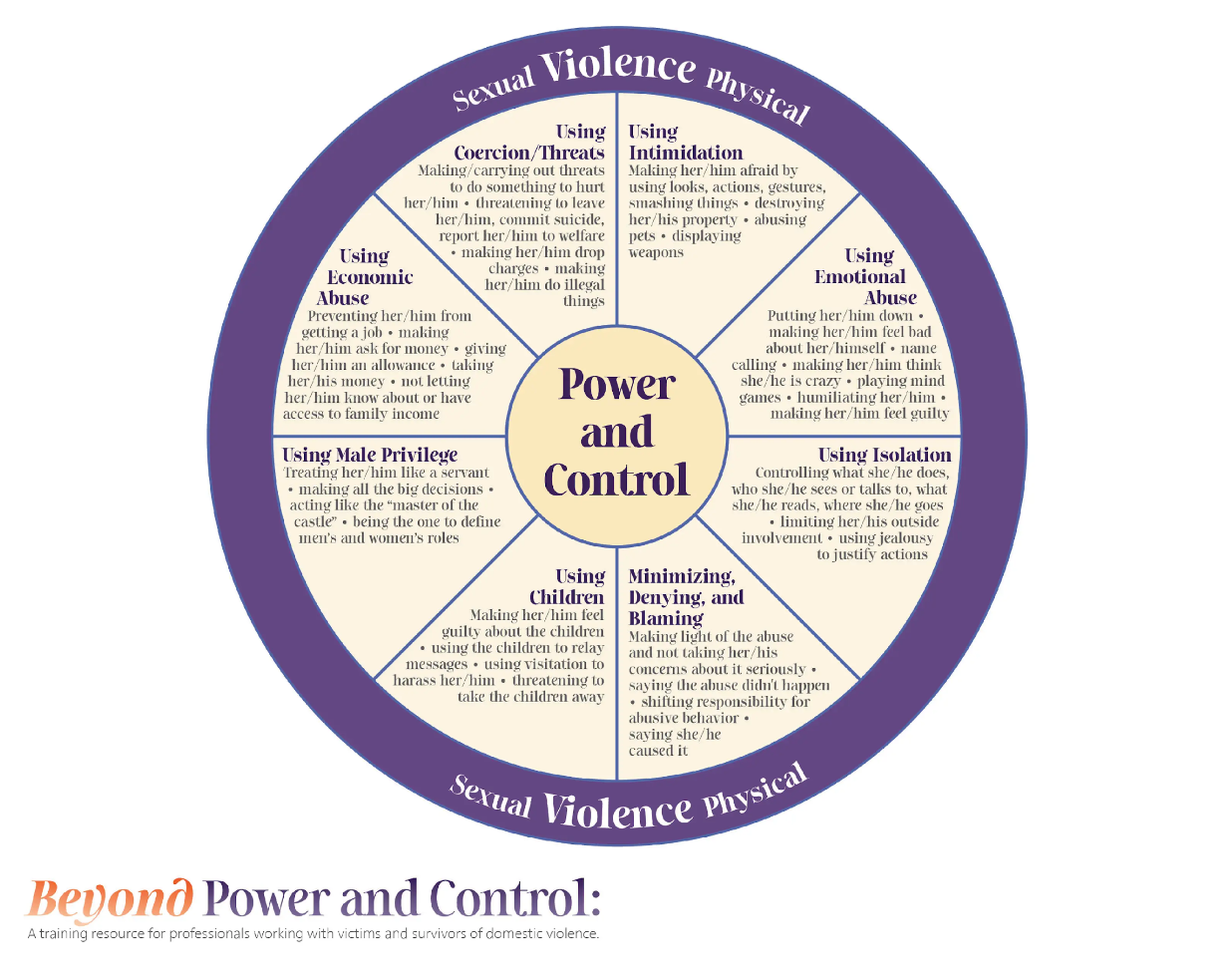
Figure 1 shows the Power and Control Wheel, which we won't cover extensively here, as you can find a detailed explanation in the resources section provided at the end. However, it's crucial to understand that physical and sexual violence within intimate relationships is often intertwined with various elements of coercive control. In essence, these forms of violence are underpinned by coercive control tactics. Without addressing these coercive control dynamics, it's challenging to fully grasp the dynamics of abuse in such relationships. Distinguishing between situational violence and domestic terrorism is important. Situational violence may involve isolated physical incidents, whereas domestic terrorism encompasses a broader spectrum of coercive control tactics, often without direct physical violence.
Figure 1. Power and control wheel. (Click here to enlarge this image.)
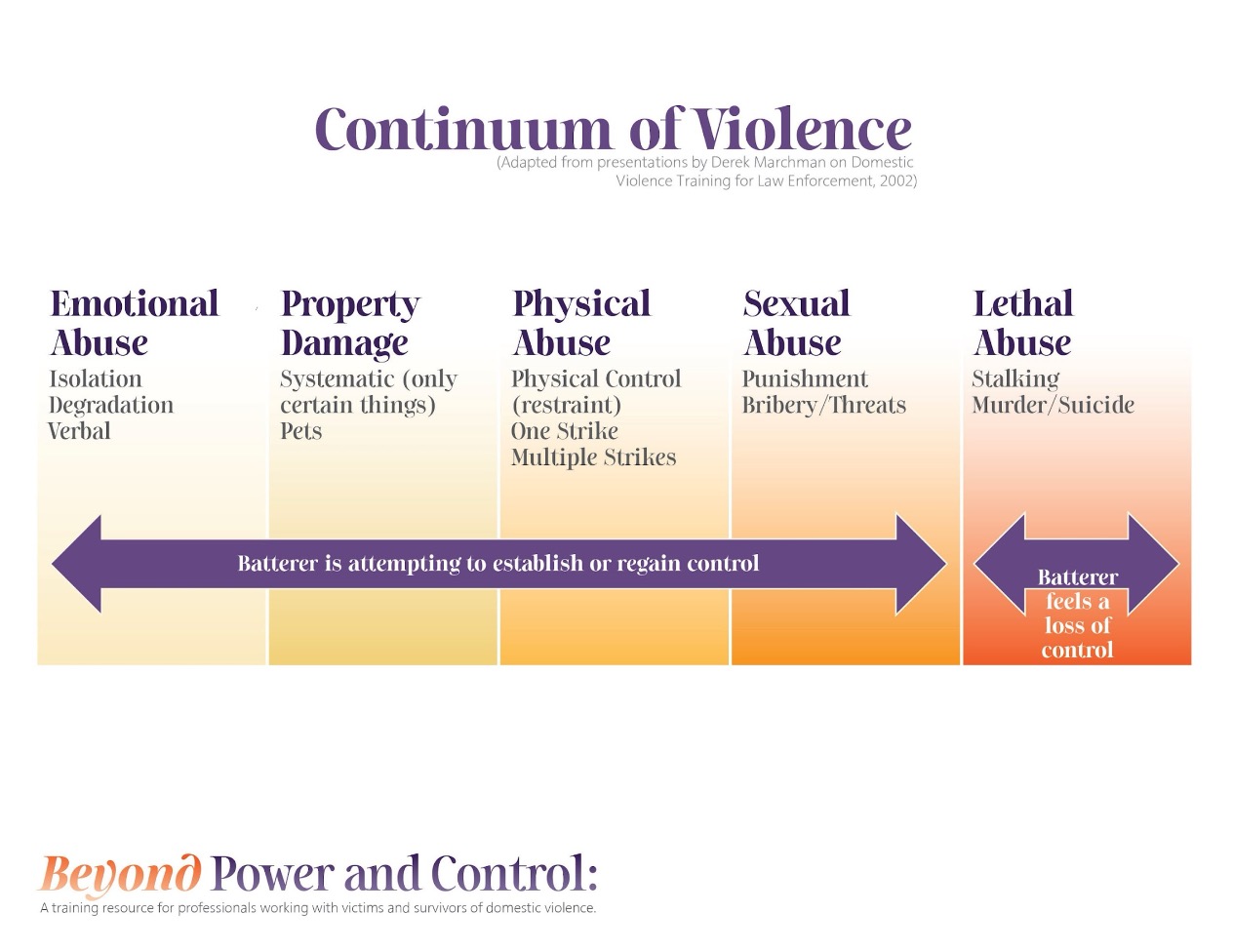
To illustrate some of the behaviors associated with coercive control, let's briefly touch on the continuum of violence, as seen in Figure 2. Perpetrators of abuse may escalate their tactics as they perceive a loss of control over their partner. This escalation can include increased physical, sexual, and even lethal forms of abuse. It's crucial to recognize that even in relationships without a history of physical violence, there's still a risk of lethality. Recent cases in the media highlight this unfortunate reality, where fatalities occurred despite no prior instances of physical abuse. As clinicians, it's imperative to adeptly assess for coercive control dynamics, as they serve as the primary indicator of potential escalation to lethal levels of abuse.
Figure 2. Continuum of violence. (Click here to enlarge this image.)
The Incident Model of Domestic Violence
Let's address the prevailing myth of the incident-based model in the context of how intimate partner violence is perceived and handled within our legal and judicial systems. Currently, many criminal courts, family courts, and child protection agencies operate under the premise of an incident-based model when addressing cases of domestic violence. However, this approach stands in stark contrast to our understanding of the complex dynamics inherent in intimate partner violence.
In criminal court proceedings, for instance, the focus tends to narrow solely on the specific incident of abuse that led to police involvement and subsequent arrest. The broader patterns of abuse leading up to that incident are often overlooked or deemed irrelevant. Similarly, in family court settings, if there's no formal conviction of domestic violence, judges may overlook available statutes designed to protect victims and survivors. This is symptomatic of the pervasive belief in the incident-based model, which oversimplifies the complexities of domestic violence dynamics.
Traditionally, the cycle of violence model has perpetuated this myth, emphasizing a cycle of tension, incident, and reconciliation. However, this framework fails to acknowledge the insidious nature of coercive control and its role in sustaining abusive relationships. In reality, the elements of coercive control—such as isolation, manipulation, and economic exploitation—are often more pervasive and damaging than individual incidents of physical violence.
The implications of adhering to an incident-based model extend beyond legal proceedings and into the realm of mental health treatment. Many survivors of intimate partner violence experience trauma that transcends singular incidents of abuse. The trauma is deeply intertwined with the erosion of autonomy and the systemic response to their experiences. Interactions with the legal system, including disbelief, reluctance to report, or fear of repercussions, often exacerbate this trauma, overshadowing the physical abuse itself.
In essence, the incident-based model fails to capture the full spectrum of abuse experienced by survivors of intimate partner violence. It is imperative that we shift towards a more comprehensive understanding of coercive control dynamics to better support survivors and address the systemic barriers they face in seeking justice and healing.
The Pattern-Based Model
To effect meaningful change in how we address intimate partner violence, it's imperative to shift from the entrenched incident-based model to a pattern-based approach. This paradigm shift is crucial across various professional spheres, whether you're a clinician, law enforcement officer, hospital staff member, or working in child protection. Rather than fixating solely on individual incidents, we must focus on identifying and understanding the patterns of coercive control that underpin abusive relationships.
Domestic violence doesn't suddenly materialize during a single incident—it often begins insidiously, sometimes even before the first date, particularly in the era of online dating. Elements of coercive control, such as manipulation and isolation, may manifest early in the relationship and escalate over time. By recognizing these non-physical forms of abuse as red flags, we can intervene before situations escalate to physical or sexual violence, potentially averting tragic outcomes such as homicide.
Indeed, the current rate of intimate partner homicides is alarmingly high. However, by shifting our collective focus to early intervention and prevention strategies rooted in understanding coercive control dynamics, we can reduce these devastating statistics. This shift requires a concerted effort to educate and raise awareness among professionals and the broader community about the insidious nature of intimate partner violence and the importance of identifying and addressing coercive control behaviors. By breaking free from the constraints of the incident-based model and embracing a pattern-based approach, we can work towards a future where fewer lives are lost to domestic violence.
Situational vs. Domestic Terrorism
When distinguishing between the incident-based and pattern-based models, particularly in contexts like couples therapy or child protection assessments, it's crucial to differentiate between situational abuse and domestic terrorism. Situational abuse typically stems from a deficit in conflict resolution skills or emotional intelligence, resulting in heated arguments or occasional physical altercations. While fear may be present, there's often a lack of pervasive patterns of control or autonomy deprivation within the relationship.
On the other hand, domestic terrorism, as conceptualized by Gottman and echoed in Sue Johnson's Emotionally Focused Therapy (EFT), involves systematic patterns of power and control throughout the relationship. This encompasses various forms of abuse, including financial coercion, emotional manipulation, gaslighting, and minimizing behaviors. Notably, perpetrators may employ "love bombing" tactics early in the relationship, presenting a false facade to align with their partner's values before gradually revealing their controlling nature after commitments are made.
Importantly, domestic terrorism or intimate partner violence is not mutual or bidirectional. Instead, it's characterized by unilateral control exerted by one partner over the other, often involving coercive control tactics aimed at depriving the victim of autonomy and agency within the relationship. By recognizing these distinctions, professionals can better assess and intervene in cases of intimate partner violence, tailoring interventions to address the underlying dynamics at play.
Assessments
As a clinician, your role in working with clients affected by intimate partner violence may vary, influencing the assessments you choose to utilize. Formal assessments can offer valuable insights into the dynamics of coercive control and the level of danger faced by survivors. Here are some assessments commonly used in this context:
- Danger Assessment: Widely utilized by advocacy agencies, the Danger Assessment is adept at gauging levels of danger and assessing elements of coercive control. It is a 20-question assessment that provides valuable information for safety planning and intervention strategies.
- Lethality Assessment: Primarily utilized by law enforcement, the Lethality Assessment focuses on assessing the risk of lethality, particularly regarding the presence of weapons or instances of strangulation. It's a crucial tool consisting of four questions for determining immediate safety concerns.
- DALE Assessment: While less commonly known, the DALE Assessment boasts higher validity and reliability rates than the Lethality Assessment. It is an 11-question assessment also utilized by law enforcement to assess the likelihood of homicide. It specifically targets elements of coercive control. However, its cost may deter widespread use.
- Coercion in Intimate Partner Relationship Scale: This assessment stands out as the sole instrument currently available that comprehensively measures various tactics of coercion (Dutton et al., 2007), including economic, sexual, emotional, and psychological coercion. It offers a holistic understanding of the dynamics at play in abusive relationships.
Each of these assessments serves a unique purpose and can inform tailored intervention strategies. However, it's essential to recognize the challenges associated with using formal assessments, including cost, accessibility, and limitations in capturing the full spectrum of coercive control tactics. As such, a combination of formal assessments, clinical judgment, and ongoing evaluation is often necessary to effectively support survivors of intimate partner violence.
Limitations of Formal Assessments
Using formal assessments with clients affected by intimate partner violence comes with several limitations that must be acknowledged. Firstly, safety concerns may hinder survivors from answering truthfully, particularly if they fear repercussions from their abuser. This underscores the importance of creating a safe and supportive environment for disclosure.
Additionally, the language used in formal assessments may not resonate with survivors' understanding of their experiences. For instance, terms like "narcissistic abuse" may or may not align with survivors' perceptions of their relationships. It's crucial to use language that reflects survivors' realities and validates their experiences, even if it diverges from traditional terminology associated with domestic violence.
Furthermore, many formal assessments primarily focus on physical abuse and may not adequately capture the full spectrum of coercive control tactics, such as emotional or financial abuse. This limited scope can overlook the nuanced dynamics of abusive relationships and hinder accurate assessment and intervention.
Moreover, formal assessments are often normed based on specific demographics, such as cisgender male offenders and cisgender female victims, and may not account for diverse experiences or contexts. This can lead to misinterpretation of survivors' responses and overlooking their situations' complexities.
In response to these limitations, it's essential for professionals to approach assessments with cultural humility, sensitivity, and a trauma-informed lens. This includes actively listening to survivors, validating their experiences, and considering the broader context in which abuse occurs. Supplementing formal assessments with open-ended questions and qualitative inquiry can provide a more comprehensive understanding of survivors' needs and experiences. Ultimately, the goal is to empower survivors to share their stories in a safe and supportive environment, facilitating effective intervention and support.
Behaviors of Coercive Control
When assessing for behaviors of coercive control, professionals should consider a range of factors that may indicate the presence of abuse. While this list is not exhaustive, it highlights key behaviors that warrant attention.
- Isolation
- Excessive monitoring
- Denying autonomy
- Gaslighting and minimization
- Economic abuse
- Reinforcing traditional gender roles
- Using children
- Controlling access to medical care
- Making all sexual relationship decisions
- Threatening to harm pets/children
- Post-separation abuse
Isolation is a significant red flag. Professionals should assess the level of isolation experienced by the survivor, probing when it began and how it manifested. Isolation tactics may include limiting contact with friends and family, controlling communication, or monitoring movements.
Excessive monitoring is another concerning behavior to watch for. Signs of excessive monitoring may include constant check-ins, GPS tracking, or surveillance. It's important to explore how monitoring behaviors started and the methods used, including technological means.
Denying autonomy can erode a survivor's sense of agency. Professionals should evaluate whether the survivor has autonomy over personal decisions, such as clothing choices, religious preferences, or hairstyle. Denial of autonomy can manifest in various aspects of life and contribute to feelings of powerlessness.
Gaslighting and minimization are manipulative tactics commonly employed by abusers. Gaslighting involves manipulating the survivor's perception of reality, while minimization downplays the seriousness of abusive behaviors. The extent of gaslighting and minimization should be carefully examined.
Economic abuse is a pervasive form of control. Professionals should investigate the dynamics of economic abuse, which may involve financial control, exploitation, or sabotage. Economic abuse can take various forms, including restricting access to funds, ruining credit, or coercing financial decisions.
Reinforcing traditional gender roles can perpetuate power imbalances. It's important to identify instances where the abuser reinforces traditional gender roles without mutual agreement or through coercion. This may involve imposing rigid expectations related to gender roles and responsibilities.
Using children to further abuse is a particularly concerning behavior. Professionals should pay attention to whether children are used as tools to perpetuate abuse, both during the relationship and after separation. This can include using children to manipulate or control the survivor or engaging in parental alienation tactics.
Controlling access to care is another significant indicator of abuse. Professionals should assess whether the abuser controls the survivor's access to medical care, sexual health decisions, or threatens harm to pets and children. These behaviors can further entrench power imbalances and inhibit the survivor's ability to seek help.
Post-separation abuse can continue even after separation. Professionals should recognize that coercive control can persist, with abusers using various tactics to maintain control over the survivor's life. This includes harassment, stalking, legal manipulation, and undermining efforts to establish independence.
By carefully evaluating these behaviors and their impact on the survivor, professionals can gain a deeper understanding of the dynamics of coercive control and tailor interventions to promote safety and autonomy.
Assessing as a Clinician
As a clinician, assessing for coercive control and domestic violence may involve a nuanced approach that extends beyond formal assessments. Whether or not to use formal assessments depends on various factors, such as the specific goals of the assessment and the context of the client's situation.
Formal assessments may be useful if the goal is to determine the presence of abuse claims, especially in situations where caseworkers are involved. These assessments can provide valuable insights that inform safety planning and intervention strategies.
Additionally, formal assessments may be beneficial for determining the scope of practice or suitability for working with a particular client. For example, couples therapists may utilize assessments like those in Gottman's work to assess for the presence of domestic violence or terrorism within the relationship.
However, it's essential to consider the limitations of formal assessments, particularly in cases where safety or truthfulness may be compromised. Survivors living with their abusive partners may be hesitant to answer questions truthfully for safety reasons, potentially impacting the validity of the assessment results.
In such cases, clinicians can supplement formal assessments with targeted questions during intake or initial sessions. These questions can help gauge the level of autonomy and decision-making within the relationship, providing valuable insights into the dynamics of coercive control. Here are some examples of questions for your initial sessions.
- How are decisions made in your relationship?
- Does it seem like you have lost relationships with friends and family over the last X number of years?
- Has your physical health changed in the last X number of years?
- How has your confidence level changed over the last X number of years?
I often inquire about the decision-making dynamics within the relationship, prompting clients to provide examples. This helps me gauge the level of autonomy they possess in their relationship. Follow-up questions are essential for further elucidating this aspect.
Another question I frequently pose relates to changes in the client's relationships with friends and family over time. In cases of abuse and coercive control, the answer often reveals significant distancing from loved ones. Follow-up questions delve into the specifics of these changes, exploring factors such as geographical relocation, jealousy, lack of support, or conflicts with the partner.
Assessing changes in physical health is another important aspect of my evaluation. Victims and survivors of intimate partner violence commonly experience significant physical health challenges. I probe for any shifts in health status, such as the onset of autoimmune conditions or unexplained pain.
Additionally, I inquire about changes in the client's confidence levels over time. Many survivors experience a decline in self-assurance, which can be indicative of the psychological impact of coercive control. Exploring these changes provides valuable insights into the client's well-being.
These questions serve as valuable tools for assessing the presence of coercive control within relationships. While I no longer engage in couples therapy, I used to incorporate these inquiries into couple sessions as well. I approach these questions with sensitivity, particularly when suspecting the presence of domestic violence, to ensure the client feels safe and supported.
Why Are They Coming To See You?
As you assess clients, it's crucial to understand their primary reason for seeking therapy. Even if my expertise lies in working with survivors of domestic violence, narcissistic abuse, and coercive control, clients may arrive with different presenting problems. They might have been referred to me by another therapist due to symptoms like severe anxiety, unexplained weight loss, or identity struggles. Therefore, it's essential to explore the underlying reasons for their visit.
Individual Work
- Is the presenting problem IPV/DV?
- Would they resonate with the term “domestic violence”
- Where are they in the healing process?
For instance, severe anxiety might be linked to living in a coercive control environment, leading to trauma, dysregulation, and possibly depression. Assessing their relationships is paramount in understanding their mental health landscape.
Rather than immediately labeling them as victims of domestic violence, it's more effective to discuss specific behaviors they're experiencing and ask questions in a non-judgmental manner. By examining patterns over time, we gradually introduce psycho-education about their experiences. This approach fosters understanding without imposing labels prematurely.
However, prompt safety planning becomes imperative if the client faces imminent danger due to high lethality risks.
Another crucial aspect of assessment is gauging where clients are in their healing journey. Are they still in the relationship, feeling trapped in a trauma bond? Or have they managed to leave but remain dependent? Some may be ready to delve into trauma work, indicating progress in their healing process. Understanding their current stage aids in tailoring interventions to their specific needs.
Couples Work
- Are they safe enough to be honest?
- Assessing between situational violence and domestic terrorism?
When conducting couples therapy, it's crucial to determine if the clients feel safe enough to be honest with each other. Additionally, it's essential to differentiate between situational violence and domestic terrorism, which encompasses coercive control and intimate partner violence (IPV). If one or both partners are experiencing domestic terrorism, it's contraindicated to proceed with couples therapy.
Therefore, it's vital for therapists working with couples to feel confident and comfortable in assessing for signs of domestic terrorism. This ensures the safety and well-being of both partners and facilitates appropriate interventions tailored to their specific needs.
Child Therapy
- Is it ethical to continue working with them?
Clients seeking therapy for their child raise important considerations, particularly regarding the potential impact of domestic violence and coercive control on the child's well-being. While it may not be definitive, it's highly probable that children are affected by such dynamics in the home, even if the parents have separated due to post-separation abuse.
In instances where children are brought in for therapy, such as play therapy, it's imperative to conduct thorough assessments for signs of domestic violence and coercive control. Despite the focus on child therapy, these assessments remain essential.
Given the complexity of the situation, therapists must carefully evaluate the ethical implications of continuing therapy with the family. This involves considering whether it's appropriate to proceed with therapy and if the therapeutic environment is conducive to the child's well-being. The importance of ongoing assessment and ethical decision-making cannot be overstated when providing therapy for children impacted by domestic violence and coercive control.
Safety Planning and Continued Assessment
Once you've completed the assessment, the next steps are crucial. If the risk level is relatively low, meaning there hasn't been physical abuse, weapon use, or strangulation, and the pattern isn't escalating, your approach will differ. You'll focus on safety planning, particularly around high-risk behaviors and any threats that have been identified, including the rapid cycling of abusive incidents.
Safety planning around court decisions is paramount for survivors navigating the family court system post-separation. The period following separation, especially the first year, carries the highest risk of lethality. This is also a critical time to address child safety, as child homicides often occur when court decisions oppose the perpetrator's wishes. Continuous assessment and active listening remain essential, even if the survivor has left the abusive situation years ago.
In the provided resources, downloadable safety plans and videos are available. One is tailored for those still residing in the home, while the other is designed for individuals who have left. Additionally, there's a resource dedicated to tech safety, addressing concerns about potential monitoring through devices like cars and computers. Given recent instances of invasive monitoring tactics, such as key loggers where a partner can see every single keystroke made on the computer, it's crucial to remain vigilant and provide support and resources as needed.
Assessment Over Time
Assessment over time is crucial, especially considering that as your client improves, particularly if they're still in the same environment, the lethality risk may rise. This stems from the dynamics of coercive control, where the abusive individual escalates their behavior to maintain dominance when they sense losing control. Even if there hasn't been physical violence yet, it doesn't guarantee safety, even after leaving the situation. The normalization of coercive behaviors often hampers early assessment efforts. Clients may downplay, excuse, or even conceal aspects of their experiences as a survival mechanism rooted in a lack of trust in themselves and others.
This process can be gradual, and therapists may find themselves grappling with self-doubt and frustration over what seems like slow progress. It's important to acknowledge that these cases often progress at a different pace and require patience and persistence. Despite any challenges, therapists should recognize their efforts and the inherent difficulty of addressing abuse within the therapeutic setting.
Aha Moments
Your "aha" moments in therapy often stem from maintaining a non-judgmental stance and fostering a safe space for your clients. Prioritizing safety and trust-building lays the groundwork for accurate assessment and effective intervention. Unless there are immediate threats of violence or harm, your primary focus should be on creating an environment where clients feel secure and supported. This foundation of safety enables them to engage in the therapeutic process and absorb the psychoeducation and insights you provide.
When discussing coercive control and domestic violence, it's essential to begin with specific behaviors rather than labeling their experiences outright. By exploring these behaviors and identifying patterns, you empower clients to recognize the dynamics in their relationships. Additionally, it's crucial to respect their autonomy throughout the therapeutic journey. Avoid replicating the power dynamics of the abuser by allowing clients to make their own choices and decisions about their lives.
Your role as a clinician is to help clients reclaim their sense of self, rediscover their values, and regain autonomy over their lives. By fostering a collaborative and empowering therapeutic environment, you support clients in their healing journey for themselves and their families.
Examples
Example 1
Here's an example to illustrate the importance of understanding coercive control, even in cases where physical violence isn't present.
Kate, “But he never hit me.”
- Late 40s, one child, graduate degree
- Married 12 years
- Attended same church
- Moving her away from family, friends, job, church
- Slow shift in preventing her from making financial decisions
- Indirect emotional abuse
- Feigning concern for mental health
- Spiritual abuse
- Abuse ramped up after separation
A client sought therapy feeling completely off balance and anxious, yet she didn't perceive herself as a victim of domestic violence because her partner never physically harmed her. Despite this perception, her therapist referred her to me, noting my specialization in working with domestic violence survivors. In our sessions, she revealed a complex story: married for 12 years with a child, she seemed to have a stable life until she became pregnant, and subtle shifts began.
Initially, it seemed like a reasonable decision—moving for better opportunities and climate—but gradually, she was isolated from family, friends, her job, and church. Financial autonomy slipped away, and emotional abuse insidiously crept in, particularly targeting her family of origin. Her partner feigned concern for her mental health but weaponized it against her. There was also significant spiritual abuse.
After deciding to leave, the abuse escalated post-separation. Legal battles became relentless, draining her financially and emotionally. The constant court appearances hindered her job search, trapping her in a cycle of control and manipulation.
This case underscores the need to recognize coercive control beyond physical violence. Despite the absence of overt abuse, the client endured a systematic erosion of her autonomy and well-being. Her reluctance to seek help initially highlights the pervasive myths surrounding domestic violence, emphasizing the importance of understanding and addressing coercive control in therapeutic practice.
Example 2
Here's a case study involving a couple, AJ and Sandy, who initially sought therapy for communication issues and postpartum support. Despite eight months of therapy, Sandy's anxiety symptoms worsened. When the therapist inquired about physical violence at home, both denied any occurrence.
The narrative shifted from the couple's issues to escalating concern for Sandy's mental health, leading to a referral to a psychiatrist. The clinician reported starting to "feel something was not right" and sought consultation, prompting a discussion on restructuring sessions to focus on couple dynamics and probing into decision-making, finances, and care for the child. As the therapist held AJ accountable and asked probing questions, the sessions became tense, eventually culminating in a physical altercation that hospitalized Sandy.
Remarkably, throughout their relationship, there had been no prior incidents of physical violence. This case underscores the importance of ongoing assessment, as subtle signs of coercive control may not be immediately apparent. Recognizing these dynamics early on could have prompted a referral to individual therapy for Sandy before attempting couples work, as it became evident that the relationship dynamics posed significant risks.
Coercive control's insidious nature often keeps it concealed, making it challenging to detect. Our preconceptions about domestic violence and coercive control can blind us to its presence. The relationships affected by these dynamics may appear normal on the surface, further complicating identification. Moreover, victims themselves may struggle to recognize the extent of their situation.
Wrapping It Up
In conclusion, it's imperative to transition away from an incident-based approach to addressing domestic violence and coercive control. This shift is crucial because relying solely on isolated incidents overlooks a significant portion of abuse, limiting our ability to prevent further harm and protect vulnerable individuals, including children. Embracing a pattern-based model enables us to intervene more effectively and mitigate the risk of lethality, physical violence, and the psychological impact on children.
While formal assessments have their limitations, they remain valuable tools in our efforts to address coercive control. However, it's essential to recognize that assessing coercive control is a nuanced process that requires time and trust to navigate successfully. This is particularly true in couples therapy, where establishing rapport and understanding the dynamics of the relationship are paramount. Communicating this need for time and patience upfront can help clients appreciate the complexity of the assessment process and foster a collaborative approach to addressing their concerns.
Resources
NetDoctor. (2020). Coercive control. https://www.netdoctor.co.uk/healthy-living/a26582123/coercive-control/
Psych Central. (2023). Coercive control. https://psychcentral.com/health/coercive-control#humiliation
Stalking Awareness Organization. (n.d.). Definition FAQs. Accessed on 4/1/2024. Retrieved from: https://www.stalkingawareness.org/definition-faqs/#1537978411858-2c051fd6-222b
Beyond Power and Control. (2024). Physical Safety Checklist. https://www.beyondpowerandcontrol.com/uploads/8/3/2/8/83280480/bpac_physicalsafetychecklist.pdf
New South Wales Government. (2015). Domestic Violence Safety Assessment Tool (DVSAT). http://www.domesticviolence.nsw.gov.au/__data/assets/file/0020/301178/DVSAT.pdf
Rising Beyond Power and Control. (2024). Resources. https://www.risingbeyondpc.com/resources.html
YouTube. (2023). [Is My Ex Tracking Me? Tips to Protect Yourself and Your Family]. https://www.youtube.com/watch?v=Ku07ZyBfDlU&t=2356s
Centers for Disease Control and Prevention. (2022). Fast Facts: Intimate Partner Violence. https://www.cdc.gov/violenceprevention/intimatepartnerviolence/fastfact.html
References
Crossman, K. A., Hardesty, J. L., & Raffaelli, M. (2016). “He could scare me without laying a hand on me”: Mothers’ experiences of nonviolent coercive control during marriage and after separation. Violence Against Women, 22(4), 454–473. https://doi.org/10.1177/1077801215604744
Dichter, M. E., Thomas, K. A., Crits-Christoph, P., Ogden, S. N., & Rhodes, K. V. (2018). Coercive control in intimate partner violence: Relationship with women's experience of violence, use of violence, and danger. Psychology of Violence, 8(5), 596-604. https://doi.org/10.1037/vio0000158
Johnson, M. P. (2008). A typology of domestic violence: Intimate terrorism, violent resistance, and situational couple violence. Northeastern University Press.
Jones, M. S. (2020). Exploring coercive control, PTSD, and the use of physical violence in the pre-prison heterosexual relationships of incarcerated women. Criminal Justice and Behavior, 47(10), 1299-1318. https://doi.org/10.1177/0093854820920661
Kennedy, A. C., Bybee, D., Mccauley, H. L., & Prock, K. A. (2018). Young women’s intimate partner violence victimization patterns across multiple relationships. Psychology of Women Quarterly, 42(4), 430–444. https://doi.org/10.1177/0361684318795880
Lohmann, S., Cowlishaw, S., Ney, L., O’Donnell, M., & Felmingham, K. (2024). The trauma and mental health impacts of coercive control: A systematic review and meta-analysis. Trauma, Violence, & Abuse, 25(1), 630-647.
Spearman, K. J., Hardesty, J. L., & Campbell, J. (2022). Post-separation abuse: A concept analysis. Journal of Advanced Nursing, 00, 1–22. https://doi.org/10.1111/jan.15310
Stark. (2007). Interpersonal violence. Coercive control: How men entrap women in personal life. In Interpersonal violence. Coercive control: How men entrap women in personal life (Editor). Oxford University Press.
Stark, E., & Hester, M. (2019). Coercive control: Update and review. Violence Against Women, 25(1), 81–104.
Yaxley, R., Norris, K., & Haines, J. (2017). Psychological assessment of intimate partner violence. Psychiatry, Psychology and Law, 25(2), 237-256. https://doi.org/10.1080/13218719.2017.1356211
Additional Current References
Please Note: The following resources have been included so members can view additional resources associated with this topic area. The presenter did not use these resources when creating this course.
Becker, P., Miller, S. L., & Iovanni, L. (2024). Pathways to resistance: Theorizing trauma and women’s use of force in intimate relationships. Violence Against Women, 1. https://doi.org/10.1177/10778012241233000
Cardenas, I., Graham, L. M., Sarmiento Mellinger, M., & Ting, L. (2024). Individuals who experience intimate partner violence and their engagement with the legal system: Critical considerations for agency and power. Journal of Health Care Law & Policy, 27(1), 113–144.
Juarros-Basterretxea, J., Fernández-Álvarez, N., Torres-Vallejos, J., & Herrero, J. (2024). Perceived reportability of intimate partner violence against women to the police and help-seeking: A national survey. Psychosocial Intervention, 33(1), 55–64. https://doi.org/10.5093/pi2024a3
Lohmann, S., Cowlishaw, S., Ney, L., O’Donnell, M., & Felmingham, K. (2024). The trauma and mental health impacts of coercive control: A systematic review and meta-analysis. Trauma, Violence & Abuse, 25(1), 630–647. https://doi.org/10.1177/15248380231162972
Peeren, S., McLindon, E., & Tarzia, L. (2024). “Counteract the gaslighting” – a thematic analysis of open-ended responses about what women survivors of intimate partner sexual violence need from service providers. BMC Women’s Health, 24(1), 1–11. https://doi.org/10.1186/s12905-024-02943-1
Cummin, S. (2024). Decoding coercive control: Advanced strategies for proficient domestic violence assessment. continued.com - Counseling, Article 55. Available at www.continued.com/counseling
Apr 15, 2024
1 CE CreditRelationship Violence and Research
Wind Goodfriend, PhD, MS, BA
This text-based course is an edited transcript of the webinar, Relationship Violence and Research, presented by Wind Goodfriend, PhD.
Learning Outcomes
After this course, participants will be able to:
- Compare and contrast different forms of relationship violence.
- Identify and explain several theories regarding the psychology of perpetrators and survivors of relationship violence.
- Describe steps toward escape from violent relationships and research on healing after relationship trauma.
Risks and Limitations
It is important to note that there are some limitations and risks, especially with a topic such as this one. For this course limitations or this webinar, most research focuses on heterosexual couples with male perpetrators and female victims and survivors. The research covered in this webinar is mostly from United States samples, so that is a limitation. Risks include: This course contains sensitive material, including physical and sexual violence, so take a break as needed and/or seek out resources for help if you have any adverse reactions.
Outline
What I would like to accomplish with you today is outlined as follows: We will start with an introduction to the topic. I would like to tell you a little bit about why I have chosen this area of research for my career and talk about why this is such an important topic. Then we are going to cover forms of relationship violence and how research has tried to describe relationship violence over the years. Then we will dive into the psychology of perpetrators. Why would someone do this to their romantic partner? Are there theories from psychology that can help explain the perpetrator's perspective or background? Then we will talk about the psychology of the victims or survivors, and when we get to that section, I'll make a note of the difference between the term victim and survivors and what that means. We will end with how people can escape from relationship violence and then a little bit on healing. There is a lot to cover today, and again, I encourage you to take a break if you need to. It is heavy material, but it is important for us to be talking about this not only in a research setting but in communities all over the world. It is equally important to discuss these problems and what can be done about them.
Introduction
I would like to start with this introduction. If we think about relationship violence, it is something that, in psychology specifically, we have only been able to study as a field for the past 40 years or so. I personally have been studying this topic for over 20 years. The reason that there was a delay in psychology addressing this issue is because it is such a personal topic, and the idea was we are not going to get people to be honest in studies about this. We are not even sure how often it happens. Maybe it is not our business to get involved in people's private affairs, and certainly, I can understand those concerns. But at the same time, as someone who is a social psychologist, someone who's interested in studying issues that we have in our home lives, and in our everyday interactions, relationship violence is something that we cannot simply ignore and hope it goes away.
It is something that is important for both basic and applied research. What I mean by that is, as a researcher, the basic research would be just understanding the phenomenon: Why is it happening? What are some theoretical models that we can use to understand it? But even more important will be the application, the applied research. What can we do with this information to actually prevent it from happening in the first place, ideally, or at least respond to it when it does happen? It is important across the board to be looking at the questions that we are covering in the next couple of hours together, as well as then thinking, okay, how can we apply this information to individual people in our lives, to individual clients, to individual students if you are an educator. Unfortunately, there will be people in all the contexts of our lives who are suffering from some form of relationship violence.
Regarding frequency, when we try to estimate the scope of this problem, it is difficult to understand exactly how big the problem is. Just one example of a statistic that we might be able to use is that the National Center for Victims of Crime (2018) estimated that 47% of people in the United States will experience some form of relationship abuse or violence or aggression in their lives. That is a significant number, basically half. Now, that number does include all forms of relationship violence, which is our next topic. This includes physical violence, sexual, emotional, and psychological. It includes the broad idea of what could count as relationship violence or aggression or abuse. That said, it is still a huge problem, in my opinion, and I assume the opinion of most people engaged in this webinar. One percent would be too high, right? We have to think about what we can be doing about this. Talking about it and understanding it are the first steps. I appreciate everyone who is here today and giving their time to this problem. One more thing about this is that the numbers of how often people are experiencing relationship violence is speculation at this point because many people rarely report these kinds of crimes to any kind of authority, or we might not be capturing them in our research. How often this is happening is still an empirical question. I will say it is happening too often and we can all likely agree on that. One time would be too often, in my opinion. It is a bit of background to help think about why is this such an important issue.
Forms of Violence
The next thing I would like to talk about is just forms of violence. I have already mentioned a bit of that now, but let us dig into that so we can understand more details about what this problem looks like. For years when people were first starting to look at this question from a psychological point of view, they were unsure where to start. The first questions that a lot of researchers asked are as follows: How often is this happening? What kinds of violence are out there? What do couples look like who experience this kind of thing? Basically, the questions focused on describing the problem. That led to the next questions: How are we going to do that research? How are we going to operationalize our variables? How are we going to define something like relationship abuse? Since these are abstract or subjective ideas, how are we going to measure that in studies? There were two approaches that early researchers used to try to understand and describe what relationship violence looks like in the United States.
The first approach was the archival data approach. Archival data in research is any data that was gathered for some other purpose, but we are now using that for research purposes to look at patterns or trends. Archival data related to relationship violence would be, for instance, "Who is calling the police in any given community for domestic violence incidents?" We can look at police reports, and we can look at hospitals where someone is coming in with a potential injury. Hopefully, the medical staff are asking questions to detect, "Did this happen because of relationship violence?" We can look at places like emergency shelters, which did exist when these questions were being asked in research. Questions such as: "Who is going to emergency shelters?" "How long are they staying?" "What are their plans after staying in the shelter?" "Are they planning on going back to the relationship or are they looking for a permanent exit from the relationship?" Using that approach, looking at these archival areas of data, led to a picture of relationship violence that matches many people's stereotypes about relationship violence. In other words, the picture looked like it was not all that common. When you look at the population of an entire town you wonder how many people are reporting this? It did not seem that frequent, although again, any frequency is bad. However, it did look as though the people who were experiencing it were experiencing very severe behaviors. Behaviors that were physically violent, leading to injury, and would require hospitalization. Overall, mostly high severity. Most of the data looked like it was in heterosexual couples with a male perpetrator and a female victim, which is what most people think of when they think of a typical relationship violence situation. At the same time, other researchers approached the question from a different perspective. This often came from criminal justice researchers who were administering, for example, national anonymous surveys of a wide variety of crimes. Relationship violence just happened to be one of the crimes on the survey. What they would do is get a list of people in a given city, randomly select people from that list, and then send them this survey. In the beginning, it was in the actual physical mail. You would receive this survey, and they would ask you, "Hey, do you mind filling this out, it will be anonymous." Some people did, some people did not. However, the surveys that they got back indicated a very different picture of what relationship violence looked like. From these national anonymous surveys, what we see is it is more frequent than we thought based on the archival data. It seems like people of any gender could be a perpetrator or a survivor or victim. I am going to try to avoid saying "both genders" because I am a Psychology and Gender Studies professor, and I believe there are more than two genders. We will say "all genders" are capable of perpetrating or being a survivor or a victim of relationship violence. In these national anonymous surveys, people would admit it is mutual. "I get into fights with my partner, and both of us can escalate to the kinds of things that might be considered aggression or violence or abuse." That is a very different picture from what we saw in the archival data.
All of that said, there were lots of debates going on in the psychology field, in the social work field, and in the criminal justice field on what are we even talking about here when we talk about the problem of relationship violence in a community. This led to many debates. There were people who were saying, "We should only look at heterosexual couples and male perpetrators" and "We only need shelters for women," for example. Other people were saying, "Well, that is leaving out a lot of people who say that they actually might need resources," but just imagine that you are the mayor of a town and you can only have so much money to throw at this problem. If I build a shelter for male victims, is that taking away a resource from a female victim? if there are statistically more female victims, would it not be better served to give my money to a larger population? These debates led to a lot of important pragmatic debates about how we can best address this problem and where our resources should go. This debate lasted for several years, and I will say that people eventually landed on the idea that all of these ideas and results are true. All of these versions of relationship violence are true. It is a bigger problem than just one type of issue. The data from the archives are correct, but so are the data from the national surveys.
Ultimately, this came to a head in the research world and in the academic world by a paper written by Michael Johnson. In 1995, Johnson wrote the first paper, then in 2007 wrote an update of his own ideas. Johnson says, "We need to acknowledge all of these forms of relationship violence and think about them as different problems that might need different kinds of resources or different kinds of solutions." What I want to do next is take you through these three kinds of relationship violence that Johnson has identified:
Situational Couple Violence
Intimate Terrorism
Violent Resistance
Situational Couple Violence
We will go through them one by one. We will start with situational couple violence. In his original paper, Johnson (1995) called this "Common Couple Violence." He changed the name of it in his later paper, but originally it was called "Common Couple Violence" because he was trying to make the point that this form of violence is actually more common than the stereotypical kind that we will talk about next. This common couple violence is the same as mutual violence that was identified in the national surveys where we have two people in a couple, and when they have a conflict, it escalates. Both people can do things that, from a psychological perspective, we would say are not healthy interactions or dynamics. For example, they might insult each other or they might push each other. But that said, while those behaviors are not healthy, they remain at a low level and are relatively stable. These behaviors are not intended to strike fear in the partner or control the partner as much as what we think of with that stereotype. He changed the name of it to situational couple violence because he explained it as violence as a result of the situation. maybe these people are not violent in any other context. It is the particular dynamics of this relationship that are causing this escalation to occur. It does seem to be relatively mutual. Any gender can be a perpetrator. Any gender can be a survivor or a victim. Johnson says, the people in this kind of relationship do not necessarily even identify it as problematic or something that would need to be reported or even maybe something that would need therapy because it is just how they fight. Again, from our perspective, we would not say that that is a healthy way to deal with your romantic partner, but from their perspective, it is a low level of severity, they do not necessarily identify it as abuse or aggression, and it is just how they fight. That is very different from this kind of stereotypical image of domestic violence that we think of, which he calls "intimate terrorism."
Intimate Terrorism
In Johnson's (1995, 2007) paper, he originally calls this "patriarchal terrorism" because he believes that this is far more common to happen with male perpetrators and female victims. He later revised this due to pushback from people who are saying that there are other kinds of gender dynamics. He now calls this "intimate terrorism," and I think this is a better name. The idea is that one person is the perpetrator, and one person is the victim or survivor. It is one-sided and no longer mutual. The intention of the perpetrator's behaviors is to terrorize their partner and/or to control their partner. We are going to talk about why that might be the case a little bit later today. The idea is that this includes more severe behaviors. It is very controlling, and it is very frightening. It is severe, and it is potentially very physical. It includes sexual violence, and it includes the psychological manipulation that we see portrayed in media. We perhaps know some people who are experiencing this or have experienced it. It is very frightening, and it is very, of course, unhealthy and inappropriate. This is the stereotypical relationship violence that we think of. Now, I mentioned that in this kind of couple we have physical violence, we also have sexual violence, and psychological or emotional violence. Something that we often refer to if you are working with people who might be current victims of this kind of abuse, is what we call the "Power and Control Wheel" (Pence & Paymar, 1993). This came out in 1993, and it was a tool that therapists or counselors or social workers could use to help their clients identify what kinds of violence they are experiencing. There is an update on this, see Øverlien et al. (2020). This is still a very common tool. Let me describe the Power and Control Wheel for you so that you can see what we are talking about here. The power and control wheel is depicted as a literal wheel. There is an outside, and then there are spokes or little pies, like a pie graph. The idea is that the outer part of this wheel, the outer rim, is the physical and sexual violence. The idea is that physical and sexual violence is so horrible to experience that it is trapping you, and it is the overall threat that you are always feeling. "I never know when my partner is going to use this physical or sexual violence against me." Within the wheel, these little pieces of pie or spokes are the different forms of psychological and emotional manipulation or abuse that your partner might be using on you.
Coercion and threats
Intimidation
Emotional abuse
Isolation
Manipulation of children
Economic abuse
Minimizing, denying, and blaming (“gaslighting”)
Male privilege
I will provide a few examples from this list to help illustrate the kinds of violence that someone might be experiencing. You can see things like "manipulation of children." That is going to be emotionally horrible for anyone if the perpetrator is trying to use the children against you. The perpetrator may say things like, "You know, boy, they [mommy or daddy] should have thought twice about what they did, shouldn't they? Don't you feel like they [mommy or daddy] are a bad person?" This is an attempt to get the kids to side with the perpetrator. They may also say things like, "If you ever tried to leave me, I would get custody of the children." These are examples of that manipulation of children. Another example is "economic abuse." Economic abuse would include, "I don't ever allow you to have access to cash," "You don't have a credit card," "I might not allow you to have a job so that you have no economic independence," or "You have no resources." If you do decide that you want to leave, you have no money, so you might not be able to get a job if you leave. You might not be able to establish your own household, and this form of manipulation is a way of keeping you here. It is a way of controlling you. You can imagine the different examples based on the names of the different pieces of this wheel. I encourage you to just do an online search for the Power and Control Wheel if you are interested in seeing more about this. You can see more examples and how it is used in settings like therapy or social work. When you think about the second form of violence that Johnson (1995, 2007) has identified, intimate terrorism, you can see how controlling one person is to another person in a relationship. I would like to mention a couple of updates to the Power and Control Wheel because there are several versions of this. One is that in the original Power and Control Wheel, one of the spokes is "using male privilege." It is the idea that if you are a heterosexual couple with a male perpetrator, he might say things like, "I'm the king of the castle," or "I'm the primary breadwinner, so I get to make all the decisions." That is a very traditional heteronormative type of relationship. If we wanted to update that, we might say using gender privilege. In LGBTQIA2S+ relationships, that might be something like threatening to "out" my partner against their will. You could imagine that this would have slightly different examples if you were not in a heterosexual male perpetrator type of relationship. There are also specific wheels for different kinds of populations, such as a specific Power and Control Wheel for college students. Here you can see things like, "My partner signs up for all the same classes that I do so that they can follow me around campus," or "My partner monopolizes my time, so I never have time to study," or "My partner won't let me sign up for clubs that I'm interested in because my partner's afraid that I'll make friends and have resources if they ever wanted to leave." It is interesting to think about the different forms of this kind of emotional manipulation that can happen in different kinds of relationships.
Key literature in this area includes Øverlien et al. (2020), Pence and Paymar (1993), and Stults et al. (2022).
Violent Resistance
The third form of violence that Johnson (1995, 2007) identified in his paper was "violent resistance," which is interesting from a criminal justice perspective or a law perspective because it is the idea that if you have actually been the target of this kind of violence for an extended period of time, sometimes people start to fight back, maybe even physically. There have been cases where someone who was a victim for several years ended up actually killing their partner. The legal question then becomes, does that count as self-defense? As you can imagine, it is controversial. Some juries would say "yes," and some juries would say "no." There are people who have committed the act of killing a perpetrator, and some of those people are in jail for murder or manslaughter, and some of those people were found not guilty. Now, this becomes even more nuanced as an interesting legal question, because for a while there was actually a mental health diagnosis that you could get if you were the survivor of relationship violence for several years. The lawyer could argue that you "snapped" after going through all of this for so long. They called it "battered women's syndrome." Here again, we have the traditional gender violence language here. The idea was that women who had been perpetrated against for years and years, killed their husbands and they could be found "not guilty" through an insanity defense or a crime of passion defense if they could claim that they had battered woman's syndrome. There were all these criteria for qualifying as basically having a mental illness that led you to kill your perpetrator. That seems to help at first because several women were found not guilty of killing their husbands through this battered women's syndrome defense. It ended up backfiring though, because if there were children involved, and I just was found mentally ill to avoid being convicted of murder, my children may be taken away from me because the courts would not want to send children to a woman who is mentally ill. This defense is not used anymore because of the backfire idea that it might lead you to have a mental illness diagnosis. There is a stigma that goes along with that and legal ramifications. It is interesting to think about the history of how our legal system has dealt with this issue and how that has changed from decade to decade depending on the political or cultural context.
Psychology of Perpetrators
All right, the next big topic is the psychology of perpetrators. From a research perspective, I find this topic fascinating and horrible, but the idea is when I think of a happy relationship, a happy romantic relationship, in my view, your partner is the one who should be the most supportive of you, the most loving toward you. In these cases of relationship violence, that's simply not the case. Often it's the person who's causing you the most psychological damage. We have to think about what kind of person is driven to these kinds of behaviors. There are lots of possible answers to that, so let's talk about that for a few minutes. We're going to cover three specific models that try to explain the psychology of perpetrators today. But one thing I want to make sure to point out is we often kind of vilify people who do these kinds of behaviors, and I absolutely understand that, I don't understand why people would do this. I find it horrible. I certainly blame people for doing these kinds of behaviors. At the same time, many perpetrators are actually survivors themselves. Many of them had childhood experiences where they either witnessed their parents in these kinds of relationships or they are survivors of child abuse. So we always have to remember, people are humans, right? They always need dignity and respect. It's interesting to think about why are people doing this, and the applied reason to ask that question is, could we have some form of therapy or treatment that would actually be able to solve this problem while still treating people with dignity, but holding them responsible for their choices, right? There are people who are survivors of child abuse, who are not perpetrators of relationship violence, right? We still need to hold people accountable for their behaviors.
The I3 Model
I want to talk about these three models that try to explain why are some people sometimes violent toward their partners. We're going to start with this first model. It's pronounced I Cubed. The I Cubed model comes from someone named Eli Finkel. He's a professor of psychology in Chicago. Finkel decided that he wanted to try to understand all the factors that might help us predict when is violence in a relationship more or less likely to occur. You can think about it almost like a mathematical model where it's sort of like algebra. If we have X, Y, and Z, can we predict the outcome? It's called I Cubed because Finkel identifies these three parts of any relationship situation that could help us predict whether violence is more or less likely.
The first one is called instigation. Instigation is the idea that at the moment that maybe there's a relationship fight, things are escalating, what is the perspective of the perpetrator? Are they thinking I'm jealous of my partner and I'm going to act in a way that sort of protects my partner from access to people who might potentially lead them astray? Have they, from my perspective, provoked me? I told them I like things a certain way, and they didn't do that, and so now I have to teach them a lesson, right, from the perpetrator's point of view. Instigation is what factors in that kind of immediate situation have made the violence more likely to occur? If you look at the original research, Fikel gives several other examples of this.
The second factor is called impedance, and that's the idea of sort of more long-term or distal factors that might be predicting relationship violence. It's things like, am I a survivor of violence myself? Did I experience this or witness this in childhood? But also my personality. Am I someone who's quick to anger? Am I someone who gets jealous very easily, just kind of as a person? Has a person, am I predisposed to violence? If the first one is sort of situational factors, the second one is more person factors, what about the people involved might make violence more or less likely to occur?
The third one kind of goes in the opposite direction. It's inhibition. Are there factors involved that might make the violence less likely to occur? This might be where things like therapy, and intervention, could be helpful. Is the perpetrator someone who maybe has been perpetrating, but they are now in anger management or counseling, or they're taking some sort of helpful medication, like an antidepressant medication where things have been cooled off or controlled more? There's research that argues that some of those things may be more or less effective. But the idea is are there any factors that might help the de-escalation of the situation? Are there factors that might help the perpetrator think about things from a different perspective?
Maybe try a different approach to this kind of conflict. Things like therapy, social work, any of those kinds of resources that we could provide a couple that might actually help de-escalate, prevent, or at least make things less severe. The idea is from this kind of big picture, what are factors that are contributing to the likelihood of relationship violence? This is a pretty interesting model, and it's led to lots of follow-up research studies looking at what are the different factors that matter, and how we could actually try to manipulate those factors to help any given couple.
Key literature in this area includes Finkel (2008, 2014) and Finkel and Hall (2018).
Pit Bulls and Cobras
The second model I want to discuss is one that my students always find fascinating because there's sort of a surprise ending. This research was done primarily by, you can see Jacobson and Gottman (1998). They were researchers in Seattle, Washington, and they were interested in just in general in relationship dynamics. They have a research lab that they called the Love Lab, and they weren't just studying abusive relationships, they were just studying all relationships. One of the things that they did in their research was they put up advertisements throughout Seattle saying, we're doing research on romantic couples, married couples. It's longitudinal, so this will take place over several years, and you'll get paid if you come in and participate in our study. They got a wide variety of couples to come into their lab. The research I want to describe to you for this purpose is people who kind of admitted in their intake surveys that there was some fairly severe violence in the couple. Both couple members agreed this is true. The couples that they had in their study, kind of narrowed it down. The research that I'll be describing to you today is all heterosexual couples with a male perpetrator and a female survivor or a victim. They asked them, after filling out these initial surveys, would you please get in a fight and let us watch? I find this procedure kind of fascinating because I always imagine if I brought my partner to a lab and I knew they were watching me fight, I imagine that I would, you know, be very kind and nurturing to my partner and say things like, you know, "Oh, that's a good point, let me consider that," but these couples did come in, and they got into fights, and they were not always very nice to each other in the lab. The fascinating thing about this procedure was they actually hooked the couple members up to a variety of physiological measures to see how their bodies would react while this fight was escalating, so it was things like, how quickly are you breathing, what's your heart rate doing? Do you have sweat on your palms? So galvanic skin response. A wide variety of these physiological measures, and they are looking at the results of these physiological measures while the fight is escalating, and then deescalating at the end, they made sure that would deescalate for ethical purposes. Their hypothesis was that people who are perpetrators of relationship violence would show steady increases in all of these physiological measures as the fight went on.
Essentially they would get more and more upset psychologically, but also physically, right? They're going to get angry, and they're going to start yelling, and their heart rate is going to go up, and they're going to start to sweat, and they're going to get red in the face, and that's what they were expecting. That hypothesis was confirmed for the majority of the men that they had in their lab. For 80% of the men, that's what happened. These physiological measures all shot up and kept going up while the fight was going on, so these men were yelling, getting red in the face, they were clearly showing anger. The metaphor that Jacobson and Gottman used for this particular type of perpetrator is pit bulls, now, I always have students in my classes who want to stop me. They're dog lovers, and they say, oh, pit bulls are stereotyped, and I agree with that. I love dogs too, but that's the term that they used in this study. I think it's very kind of a graphic term. It helps you understand immediately what they're talking about, right? Because if you're in front of an angry pit bull, you know it's angry, right? It's growling at you. The idea is that these men are clearly showing their anger, their frustration. When they did follow-up research with these men, they found that the triggers that made them the angriest were things like jealousy and fear of abandonment. That led to research on attachment theory, which is the idea that because of how you were raised, you might have sort of persistent low self-esteem.
You might always want validation from your relationships that you're worthy of love and attention. That seems to be a pattern in the majority of these men. It seemed like that was what caused the most frequent fights, and they would, they would clearly show their jealousy and anger. These relationships when they were followed over time were more likely to end in divorce because of these unhealthy dynamics. But I told you earlier that there was a sort of surprise ending to this research, and that's the part that I actually find the most psychologically fascinating, but also kind of chilling, is the what about the other 20% of men? What they found was that in 20% of the men in this study, as the fight started to escalate, their physiological measures showed that they were getting calmer. They would absolutely sort of relax. They would lean back in their chair, they might even smile a little bit. It's very frightening to imagine this happening. The metaphor that Jacobson and Gottman used for these men is the cobra because the idea is that the cobra sort of is very still, and then it'll strike at you in an almost unpredictable way. That makes it even scarier because you can't see it coming. It might even be a purposeful manipulation tactic of these men where they're trying to make it so that you can't predict so that they can constantly have you in a state of fear. I never know when this person's going to strike at me. These men tended to have more emotional and psychological abuse in their relationships in addition to physical and sexual abuse. They were definitely fitting into what we talked about earlier with that intimate terrorism kind of dynamic. But they were less likely to end in divorce as the relationships went on. Jacobson and Gottman said it's because their victims were much more afraid of what would happen if I tried to leave, their argument was, he might kill me basically. What was interesting though is that if you dive into their research, often the cobras would respond in an opposite way, which was basically like, well, good riddance, and they would immediately try to find someone else to replace you. It's a very different psychological perspective of these two different kinds of perpetrators and follow-up research has been done, some people have found the same pattern, and other people have failed to replicate what they found in their lab. But it's interesting just to sort of step back and think about what are the person's triggers. Why do they have those triggers? Once we've identified those, could we potentially do anything to intervene?
Key literature in this area includes Jacobson and Gottman (1998).
Personality Disorders
The last model that I think is interesting from psychology to try to understand the perpetrators, and again, there are more models that we could talk about today. This is just kind of a sampling of what I found the most important or interesting comes from a woman named Amy Holtzworth-Munroe. Her perspective was, are there mental illnesses that we could potentially use to diagnose perpetrators of relationship violence? That would be helpful because we could look at all the clinical and counseling research on these illnesses, and we could potentially get them inappropriate therapy or medications. Holtzworth-Munroe identified three different kinds of perpetrators and sort of affiliated each of those with different mental illness needs. You can see here that the first type is what she calls family only. Again, that's still bad. But the idea is that the people who are only violent in this context with this particular relationship, sometimes they don't necessarily qualify for an official mental illness or an official sort of clinical diagnosis. That tends to be less severe people. It maybe goes back to what we talked about earlier with Michael Johnson's model of maybe the common couple violence where it's low level, it doesn't seem to escalate, and maybe it doesn't include the terrorism and psychological abuse that we see in other couples. She said in that kind of situational violence, maybe there's not a mental illness diagnosis that's applicable. But she said in these other two forms of violence, maybe there is a mental illness diagnosis that we could use.
One is the idea of borderline personality disorder. I had a job for a couple of years in graduate school working at a mental hospital, a mental health facility, and I did encounter several patients there who were being treated for borderline personality disorder. The hallmarks of borderline are basically people who have a sort of emotional immaturity. They often want attention, they want validation. They'll often do things for that attention that we might consider unhealthy behaviors. Things like threatening self-harm to get attention and to get validation, tend to be emotionally volatile, as it says on the screen here on the slide, and impulsive. Holtzworth-Munroe has identified this personality disorder as one that might often go with being a perpetrator of relationship violence. The parallel there is probably the pit bulls that we talked about just a few minutes ago. It's people who very clearly show their emotions, and they have this kind of impulsive nature, this maybe emotionally volatile nature where they get upset very easily, they show that they're upset, and it's this kind of emotional rollercoaster.
Holtzworth-Munroe's third type of perpetrator is associated with antisocial personality disorder. This is the personality disorder that some people consider the most frightening, the most likely to be tied to criminals, and again, we're sort of stigmatizing people with disorders, and we're stigmatizing criminals. But the idea is that occasionally these two things will go together. Sometimes people who have extreme clinical levels of anti-social personality disorder will have a lack of empathy for other people and will have selfish behaviors. It's stereotypically tied to people who are maybe serial rapists or murderers or con artists. The idea is that they're very psychologically manipulative of other people in ways that will benefit them. This is probably more likely to be associated with the kind of person we talked about a few minutes ago who we labeled a cobra, right? They're actually going to have the outward appearance of being very calm. They're not necessarily going to show that they're upset because they don't have that lack of, or they don't have that empathy, and they appear to be very calm and collected on the surface, but they sometimes, because of that lack of empathy will be very abusive because it's basically I'll do whatever it takes to get what I want. What's interesting to think about the idea, is the big picture here is that there are lots of different kinds of perpetrators. They don't all fit into one stereotype. They don't all fit into one box. Because we have this variety, it means that resolving the problem of relationship violence is complicated because we can't just say there's one simple solution because every situation is going to be different. We have to kind of be creative and tenacious about the idea of doing this research and finding solutions that we can fit a particular issue or a particular person, because it is so complicated, not, there isn't one thing that will work for everyone.
Key literature in the area includes Holtzworth-Munroe and Stuart (1994) and Edhammer et al. (2022).
Psychology of Victims/Survivors
Let's talk about the psychology of victims and survivors, a very important thing to understand. I have a lot of important things to kind of keep in mind while we're talking about this issue. The most important thing is we're going to try to understand the perspective of people who are going through relationship violence. The most common error to make when we think about people who are experiencing this is to say, why don't they just leave, right? This is the most common question that people have if they maybe haven't experienced this before, if they don't know anyone who has experienced this, at least they're not aware of that, the experience of family or friends, why don't they just leave, right? Well, I wouldn't put up with that. I would just leave. That's a problematic question to ask because it's basically blaming the person who is the target of the crime, for the bad behavior. It's important to think about this research because it's not going to be a simple answer. There are reasons that people might not be able to leave right away. There are reasons that people might legitimately need to stay, just as one example, maybe they are trying to protect children who are involved in this family. We're not doing this research that we can blame people for their choices, right? Often people who are the victims or survivors of relationship violence have already taken their choices away. So a common thing that we try to remember if we're involved in any kind of intervention is we want to honor the dignity of all people, and they have the right to make their own choices. They have the right to decide what works for them. We want to avoid trying to be judgemental or ever-blaming someone who's going through this. That said, I also want to mention just how I'll talk about this research today.
One is it's important to think about the term victim versus the word survivor. There are a lot of advocates in the field, academic researchers, and people who are involved in the community who would say, we should never use the word victim when we're talking about people who have experienced relationship violence. The perspective there is that the word victim makes it seem like someone is helpless, it takes away their agency. It's not a very empowering word, whereas survivor is, it's honoring what you've gone through, it's saying, you know, you've gone through this, and you've come out the other end, it's a more empowering, more respectful word, and I absolutely agree with that. I am going to occasionally use the word victim here because I'm making the academic distinction between: Are you still experiencing it? You are in fact being victimized by your perpetrator. You are in fact being targeted by someone, and that is not your fault, just as if you were the victim of any other kind of crime. Then "survivor" is going to be used for people who have successfully gotten out of the relationship, right? It's just to kind of distinguish what phase of the relationship you are in right now. I also am going to be referring to several research studies in this part of the webinar on understanding the perspective of victims or survivors. Most frequently when I talk about victims or survivors, I'll use the word she for my pronoun, because most of this research is on heterosexual couples with male perpetrators and female victims or survivors. Most of the papers do say she when talking about the victim or survivor. Again, I want to emphasize that I believe that people of any gender could be anywhere in this relationship. So I just want to make sure to point out that I think a common mistake that people make in this field is that they forget about other kinds of victims or survivors. I personally know several men who have been the victims or survivors of relationship violence, both in gay relationships and from female perpetrators. I don't think that they get enough attention or resources. That's one thing I always like to point out just as a kind of caveat before we move forward.
The E3 Model
I want to say that a possible review that you might find interesting is a book that I published just a few months ago, so you can see that here Goodfriend and Simcock (2022), we propose a model called the E3 model. It's kind of paralleling what we saw before with the I Cubed model, but the E3 model is from the perpetrator of the person who's being targeted. It's called E3 because in this paper, it's sort of like a short book basically, or a long article. It's the idea that when you go through this as the target, there are three phases of psychological experience that you might have.
Phase one is what we call entrapment. This is a term that we got from previous research, and it's the idea that when you're first starting the relationship, it's probably not abusive or aggressive or violent on the first date. It's probably quite wonderful on the first date, and that's probably because your perpetrator is not going to, you know, show these behaviors right at the beginning. They might sort of slowly try to seduce you in thinking that they're going to treat you this nicely the entire time. Then slowly over time start to test your boundaries, start to show their behaviors, and see how you respond to those. It can be very manipulative, but that entrapment phase is when they're kind of trying to get you to commit to them, starting to test your boundaries. It's not probably going to be violent right at the beginning. That first phase is one that most people don't even realize they've gone through until maybe they get to phase two, which is where they've identified this relationship is not healthy, the dynamics are not what I deserve or what I expected. Now I get to the escape phase. We will talk about ways that people can successfully escape and barriers that they have to escape here in this webinar. The third phase is called what we call elevation. This is once you've gotten out of the relationship and you now need to heal from the trauma that you have experienced. Elevation refers to building back your self-esteem, building back your confidence, and trying to go through the posttraumatic growth that we'll talk about in a few minutes. Our model kind of honors all of those phases that survivors go through. We point out that the phases are not mutually exclusive. It's not like stairs on a step, steps on a staircase. It's not like I was here and now I'm here, and now I'm here. The idea is that you can move back and forth among these phases. There can be times when I leave for a little while, and then I go back to my partner for a little while, and that kind of back and forth actually very frequently happens multiple times before someone permanently leaves. I can feel like I'm making progress in therapy after I've left, I can feel like I've gotten some confidence back and then something that can happen that maybe triggers me and makes me feel like, oh, I haven't made as much progress as I thought I had.
It's important to honor this journey and to acknowledge it's going to be different for everyone. It depends on all of the factors that we've talked about, plus many more. It's interesting to just think about how challenging this process must be, and how brave, how courageous people are who go through this and to honor that journey. That's what the E3 model is all about. We also then talk about policies, and government support that is needed to help people get through all three of these phases. It's something that you might look into if you're interested in it, but it tries to have this comprehensive look, and it reviews a lot of the research that we're about to discuss.
Cycle of Violence
In addition to the E3 model that I just described today, we are now going to cover three additional models or theoretical frameworks to try to understand what the psychological experience is like of going through being the target of this kind of violence or abuse. Let's start with the oldest of these ideas, which is called the cycle of violence. The cycle of violence was originally suggested by a woman named Lenore Walker (1979, 1984). You can see this is a relatively old model, you know, by our standards, but it's still a very interesting model, and it still produces a lot of research studies. Walker was trying to understand sort of the dynamic of you being a victim or a target of this kind of relationship violence and the idea that it's probably not violent or abusive all the time. There are probably times when your partner is nice to you or you know, relatively calm or loving, and other times when they're not. She points out that it's not this kind of steady constant stream for most people. She actually identifies this cycle where an individual level, this could take just a few minutes, this could take a week to go through all three phases, but she says that there will be this kind of roller coaster or up and down dynamic in many couples. The idea is that maybe things are going fine for a while. Things seem calm, things are loving, and something happens that starts to build tension. We could go back to the I Cubed model and think about maybe there was something in the situation, maybe there was something going on with one of the people. They were reminded of a trauma from their childhood, whatever it was, set this in motion. The tension builds potentially very slowly, but the person who's going to be the target or a victim of the violence often starts to sense this, right? My partner is starting to act in a different way. They may be sort of starting to be meaner to me. I'm starting to feel this pressure build-up. Maybe I'm starting to sort of figuratively walk on eggshells, trying to not upset them further, but I can tell that this is headed in a bad direction, right, so this tension sort of builds. Then at some point, it will get to the second phase, which is the explosion phase, so the violence now comes out. That could be in any of the forms we've talked about, physical, sexual, emotional, financial, or any of those kinds of forms, but something explodes.
Now, Walker suggested that often from her perspective, from the research that she had done, there will be a third phase, which she called the contrition phase. She said, this is basically when the perpetrator realizes, okay, I'm going to get in trouble, or you might be thinking about leaving me, and now I have to switch back into management where I'm going to manipulate you to forgive me or to not leave. Or I'm going to try to maybe say it wasn't as big of a deal as you seem to think it was. There can be an apology, there can be promises that this won't happen again. I was just temporarily upset because of something at work, or I was drunk, and I didn't know what I was doing. There are often excuses made for the behavior. There might be an apology, but it's controversial, whether that apology is sincere. Some people would argue that's just another manipulation tactic, if you apologize, but then you keep doing it, is it an apology? Other people have argued, that maybe it is a sincere apology, but the person has not learned how to control their behaviors. They haven't learned how to de-escalate in other ways. But Walker's point generally was that the contrition phase is very positive from the victim's perspective, right? My partner is saying all the right things. My partner is making promises that this is not going to happen again. The idea is that things seem good during this phase. So maybe if I thought about leaving during the other two phases, this would sort of bring me back, and maybe I do love my partner, Walker even makes the point that this kind of positive behavior for my partner is not constant, because it's only occasional, she even sometimes talks about, I can maybe even get addicted to the idea that if I just wait long enough, I'll get my partner back, I'll get the person I love back. It's almost like an addiction in her terminology, the idea that that's what I live for, right? Yes, I know I'm going through this hard time, but soon I'll get the person I love back. It's interesting to think about how long these phases have to occur for people to make certain decisions about staying or leaving. What kinds of explosion might factor into someone's choices? It's just interesting to think about the idea that it's not a constant negative relationship probably for most people, right? It goes through these phases, and it's important to acknowledge that that's going to be a factor in all of these behaviors and perspectives of everyone involved.
Romantic Myths
Karen Rosen (1996) has done a lot of interesting qualitative research that my students enjoy. They always enjoy qualitative research more than quantitative research. But I also appreciate Rosen's research because she wants to honor individual voices, which is often what qualitative research has as a big advantage. Rosen has published several studies in which she has done in-depth interviews of people who are either still experiencing relationship violence or have gotten out of violent situations, and she asks them interview questions, which are very insightful. What I want to highlight today is questions about that entrapment phase or that seduction phase, and what about our culture or the messages that we've learned growing up about what love should look like, factors into our perceptions when relationship violence occurs? She's identified what she calls cultural myths that have contributed to the perspective of potential victims or survivors, so if you look at her research, she's identified more than the three examples that I have for you on the screen here. But this will just kind of give you a nice sampling of the type of research that she does. Most of the people that she interviews are young women. Some of them are still in high school, and some of them are a little bit older than those in their twenties. She identifies what she calls these cultural myths, which are, the idea that we grow up hearing fairy tales. You can see Cinderella, Beauty The Beast. It's possible that some of the messages in these fairy tales portray messages that romanticize behaviors that in real life might qualify as being manipulative or abusive. She asks her interviewees questions like, "What attracted you to this person?" Can you describe the first time that he did something that you thought maybe even looking back was not an appropriate response, or how did you respond when these kinds of abusive behaviors occurred? What was your perspective? How did your family react? I want to just talk about sort of these three examples. The first is what she calls the Cinderella effect. So you're probably familiar with the story, right? But just to put it in context here, the fairytale of Cinderella is that, when her father dies, she's living with her stepmother and her stepsisters, and they're basically abusing her. She meets this charming young man and basically marries him after one date, where they don't even talk to each other, they just dance.
The idea is what if that were real life? She says many people who are in relationship violence situations, many of them have experienced traumas in their childhood, and maybe they are not particularly happy with their current situation. They've been taught a Prince Charming can rescue you. All you have to do is find a man who will take you away from all of this. Often perpetrators know that we've been taught these messages and they say, "Well, all I have to do is portray myself as Prince Charming and sort of love bomb you and sweep you off your feet, and now you're in my clutches," so to speak. The idea is that people in her interviews said things like, you know, he put me on a pedestal. He treated me like a princess. I was in a bad situation. When he asked me to marry him after three dates, I thought it was very romantic. So I moved in with him, I married him, and I cut ties to everything that I had known in the past. But the issue there is you are now basically under his control, right? So you're living with this person, you have cut all of those ties, you've maybe sort of lost those bridges or those resources, and you maybe don't even necessarily know this person very well, right? Again, it's important to think about how the perpetrator might have done this on purpose, right? The perpetrator might have targeted you and manipulated you to be in the situation. She said, you know, several of the people she interviewed described this kind of situation where I thought I was getting out of a bad situation and going with Prince Charming, and then it ended up that he was just controlling me too. It's interesting to think about what messages are we sending young people in these kinds of fairy tales, and whether are we romanticizing maybe bad choices from the idea that you can expect another person to save you, and maybe it would be more empowering to teach young people, especially young girls, how to empower yourself, how to save yourself.
The second one is what she calls "the Romeo and Juliet phenomenon," and again, you're probably familiar with the Shakespeare story, but it's not a good story, right? Juliet was 13, and Romeo was 16 I think, they fell in love against their family's wishes, again, after seeing each other at one party. And then they said, "We're doing this all on our own," which ended up badly, right? They both died at the end, spoiler alert. The idea is that when she interviewed people, they would say, I was more attracted to this person because my family disapproved. That's why she picked this Romeo and Juliet metaphor or analogy. The idea is that it's very common in young adult years to sort of have that rebellious phase. If part of your rebellion is dating someone because your family disapproved or because they don't sort of fit into your culture, that's understandable sort of from a teenage perspective. I certainly did some of that myself. But the idea is that maybe there are reasons that your family disapproved. Maybe they saw things that you weren't able to see, maybe because they were manipulating you, right? And so again, just like in the real story of Romano and Juliet, maybe that's going to end badly.
The third one that I'm choosing to talk about today, and again, there are more examples of this in her original papers, is what she calls the "Beauty and the Beast phenomenon." Again, we're romanticizing in the original fairytale the idea that, so the beast captures the beauty, or Belle, and locks her up. It's because maybe he has this curse, and all he needs is true love to magically end this curse. If you are just patient enough, you can magically heal someone who is exhibiting all of these beastly behaviors. It justifies the beastly behaviors, especially if the perpetrator can say things like, I've gone through hard times, I am a survivor. Which again, might be true, but if they're not taking responsibility for their choices, the idea is that we're teaching people, you can fix someone basically, you can heal someone, and all they need is your patience and your love. If you wait long enough, they'll turn into a prince, and then they'll be so grateful that they'll treat you like a princess for the rest of your life. It's the idea that it teaches you to put up with these negative behaviors because it's like testing your love instead of saying, I don't deserve to be treated like that, I want someone who treats me with respect. It basically keeps people in these relationships longer than they deserve to be in because of this cultural messaging that if you loved someone, you would stay and try to heal them when it's not your responsibility to do that. It's interesting to think about these other cultural messages. We have other research talking about things like the myth of love at first sight or the myth of soulmates. That these myths do more harm than good, especially in terms of teaching people to maintain sort of the status quo of patriarchy or sexism that's often involved in this sort of heteronormative type of culture.
Cognitive Reframing
I also want to talk about a psychological phenomenon that I personally find fascinating. I'm a social psychologist, and the idea of cognitive dissonance comes from social psychology research. Just to back up a little bit, the idea of cognitive dissonance is that we like our world to make sense, if I have an attitude, I want my behavior to match that. If I have the attitude that voting is important, I should always make sure to vote, otherwise, I'm maybe a little bit of a hypocrite, right? The idea is if you are someone who says, relationship violence is bad, I would not stay in a violent relationship, and then I find myself in a violent relationship, that might cause me some cognitive dissonance, right? I might not feel comfortable with the fact that I'm going against the person I thought I was or the principles that I've said I have. I can resolve that cognitive dissonance by changing how I perceived the situation, I could leave the relationship if I have the resources to do that, which we'll talk about in a minute. Or I could change my perception of what's happening. I want to mention some research that I did. I published this in 2018 with one of my mentors from graduate school, her name is Jimena Arriaga. We were interested in the idea that there might be people currently victims of relationship violence, who cannot leave the relationship for one of the many pragmatic reasons that we'll talk about in a few minutes. Maybe they're protecting children, maybe they don't have any financial independence. Maybe they are a religious person, and they believe that the marriage vows that they took are religiously valid, right? They made a promise to God. There are lots of reasons that people might not feel like they can leave the relationship, at least maybe right now. If that's the case, then maybe if I psychologically change my perception of what's happening, in some ways it's a coping mechanism. It's a way for me to sort of put this on hold while maybe I gather the resources that I need, or I need to sort of process what's happening to me. It's the idea that people who are currently in the situation might not see things the way that an objective outsider person sees it because they have the psychological motivation to change their perception for some reason. This ties into why maybe from an outside perspective, maybe you have a friend or a family member who's in a violent relationship. It's very frustrating from our perspective because you think, you know, you're not seeing things the way that I'm seeing things, but maybe it's a coping mechanism for them. That's what we were interested in. In this particular study, we looked into the idea that if you're in love with someone, if you're committed to someone, if you for some reason have decided for some potentially valid reason, have decided that I am not ready to leave, at least right now, you might sort of change your perception to maybe make an excuse for what's happening so that it's not your perpetrator's fault, or you might shift the way that you perceive it. This comes from this cognitive dissonance research.
There's another theory in psychology called balance theory, which is the same idea that I need to my opinions and behavior so they all align. We've summarized those psychological theories with this phrase that we used called cognitive reframing, which is just my view of the world in a way that protects my needs at this given time. The way that we did this research was we went to a local shelter for emergency shelter for women, many of whom were at least temporarily getting out of violent situations, and we interviewed them, we asked them several questions. Two of those questions were: "Can you tell us the most violent incident that has ever happened in this relationship? Describe that for us." Then after they described that, we asked them, "Why did that happen?" We left it very open-ended, but I want to know what is your perspective on why this occurred. Then we looked for patterns in those answers that seemed like evidence of this kind of cognitive reframing. Maybe they're viewing it in a way that an objective outsider would not. We found four patterns or themes that were across multiple perspectives or multiple participants in our study. What we found was that several of the women that we interviewed, several of them had perspectives or explanations for what happened that we thought qualified for this kind of cognitive reframing. The first was blaming themselves for what happened. Again, as I mentioned before, it's never the victim's fault for what happens, right? The perpetrator should always take responsibility for what's happening. But if your perpetrator is telling you over and over again that "this is your fault," maybe on some level you incorporate that, maybe on some level that sinks in, and you start to believe the perpetrator that this is your fault. This is heartbreaking, of course, from our perspective, because we know it's not their fault, but it's possible that they start to think that, especially again if they're being manipulated by their perpetrator. In the original article, if you want to look it up, you'll see quotations from our interviews that illustrate these four different ways of reframing.
- It's me: Self-blame
- It's him: Uncontrollable personality (alcohol, PTSD, etc.)
- It's us: "For better or worse"
- It's the culture: Redefining violence
I'll just read a little piece of one of the quotations from our article here. This woman said, quote, "Maybe there was something else I could have done. There must be something that I'm doing wrong if he's hitting me or beating me up." It's just this idea, what am I doing wrong? I should have done something different, right? Again, that's never the case. You never deserve to get hit or beat up or any of the things that we've talked about. The second pattern that we noticed was what we called "uncontrollable personality." This was the idea that I was acknowledging that my partner is doing these things that are not okay, but I'm shifting the responsibility to something outside of my partner. I might say, my partner does this only because he's an alcoholic, and when he drinks, he can't control himself. If we could just get treatment for alcoholism, then this problem would go away. Another example is, "My partner has a mental health need - my partner has a disorder, and that's what's causing this issue." So again, if my partner could get treatment for that mental health need, then this other problem would go away. We had a couple of women who were married to military veterans, and they had a very interesting perspective that the abuse was a result of their partner's military service. They had maybe post-traumatic stress disorder. Interestingly, two of the women we interviewed said, I can't leave my partner because the reason he's doing this is because he's a veteran, and so leaving would be unpatriotic. It's such an interesting perspective that I had never considered before talking to these women, right? Again, it's a way to just highlight the idea that we need to honor their perspective and do what is going to feel good to them and not make decisions for them, right? We have to always understand their perspective.
The third thing that we noticed was what we called for better or worse, and again, this ties back to the idea that if you are a person of religious faith and you married someone, and you took vows that you considered to be sort of religious vows. You might believe "I cannot break those vows." That's also an interesting perspective that we have to think about how we can approach this particular individual with respect and dignity by honoring their perspective and meeting their needs and not just sort of making the decision for them.
The fourth one, I have another quote here for, and so this is what we call "redefining violence." So this was the idea that people would say, "I'm not in an abusive relationship. My partner's not abusing me, right? It's not violent." But what they had done is they had redefined abuse or violence in a way, so they did not fit that definition, right? If I define it in a way specifically so that I don't match that definition, then I can tell myself I'm not being abused. I'm not in a violent relationship, right? Because it doesn't fit this definition. Here's a quotation that I always find kind of heartbreaking, but it illustrates this point. We asked this woman, "Why did that happen to you?" Then a little bit later, "So do you feel like your partner is being violent toward you?" And here's what she said, "The only thing he's done is push, he threw a lamp stand at me, but it didn't hit me. He knows if he hits me, he'll get his gun permit taken away. He's never used his hands on me. He hit my daughter, he's thrown several things at me, he's kicked me, but that's it. I've been lucky with him not hitting me." It seems like she's defining violence in this very specific way, he has to hit me with a closed fist, and anything else doesn't qualify or doesn't count. Again, that's heartbreaking because she's experiencing this awfulness as is apparently her daughter. But if the perpetrator finds out that this is her definition, potentially he could use that against her. So it's another way that he could manipulate her. The general point here, which I'll emphasize one more time, is we have to honor what's going on in their mind and make sure that any resources, any interventions, are going to serve their needs and meet their perspective. It might take time, and it might take resources for that perspective to shift, but we can't put a perspective on someone. We have to try to understand where they're coming from.
Key literature in this area includes Goodfriend and Arriaga (2018).
Escape
Okay, we have two more things to discuss, and potentially they're some of the most important things to discuss, which is: How could people get out of these kinds of relationships? Then: How could people heal from these kinds of relationships? This is of course, our hope that we can offer these kinds of resources, whether it's friends and family, whether you're working in your community, whether you have clients or students who are in these kinds of relationships. Again, we're not going to be able to cover all of the possible options or resources or research on this from a psychological perspective today, but hopefully, this is a little bit of a sampler. Then you can look at the resources that I've provided at the end and that will again take you to additional resources as well. Just some things to think about, some ways to get started maybe today.
Psychological Steps
Going back to the same woman I mentioned earlier, Karen Rosen, Rosen in those same interviews, talked to people about what was your process of escape for the people who had gone from victim to survivor. You can see here that she talked about that escape process, and one of her important points was it's not something that can just happen easily, right? You can't just decide, "Oh, I think that this relationship is abusive, I'm going to leave now." That's just not realistic, often it takes a long period of time, and people might leave and go back multiple times. The psychological experience of deciding it's a time that I can leave or deciding, I'm going to label these things as abusive, is a step-by-step process. I find this paper interesting in that she describes these steps psychologically, that people can take, and she points out, that not every person will experience all of these steps, right? They don't necessarily go in this order, you won't necessarily experience all of these steps. You might move back and forth. But it's interesting to think about when you are talking to someone who you perceive might be a current victim, again, a student, a client, a friend, or a family member. It's interesting to think about whether you could identify what step they're in because that will help you to know what would be the most appropriate intervention at this step. Because maybe it's not saying, "Well, we need to get you out of the relationship right now." Maybe it's saying, "We just need to get you from step two to step three."
What are those steps? The first step that she describes is what she calls "seeds of doubt." This is almost on a subconscious or unconscious level, basically, where the person who's the target, the person who's the current victim might not even realize that they have a seed of doubt yet, but it's just a little tiny sort of hint of what might be coming in the future. This might be something that they see on TV. They might see someone who sees abusive behavior from the perpetrator in public and maybe frowns or asks, "Are you okay, right?" It can be anything that's these little small things, and they can be multiple at once. They can build up over time, and again, it's not necessarily that the person will consciously realize, I have a doubt. It's just sort of sitting there in the background, and even if they're not responding to that right now, maybe it will sort of germinate over time. Maybe that will change their perspective over time.
The second is what she calls turning points. This is when those seeds of doubt may move from the unconscious level to the conscious level, and you realize, "Oh, maybe I do have some doubts. Maybe this is not going to go away. Maybe this isn't something that was just a one-time thing." It's moving to this conscious realization that maybe the behaviors are not respectful, maybe the behaviors are not healthy. So I'm going to start to think about this a little bit more or name these things or realize from more of an objective perspective what's happening here. But even then, you're not jumping all the way to the end. She says the next step for many of the people she interviewed is what she called "objective reflections." Objective reflections are the idea that again, you're now seeing things almost like you're viewing yourself from a third perspective. In the past maybe you would have friends or family members or professionals say, "You know, that's not okay, what's happening?" You would sort of minimize it or disagree or say, well, you don't know the whole story, or you had to be there. Now you're actually starting to see things from that outside perspective, and you're starting to see more objectively maybe, okay, in the past, maybe I had these sort of frames or perspectives that were coping mechanisms that I needed at the time, but maybe now some of those are starting to lift. You are able to maybe relate more to what a friend or family member is telling you, or what a counselor or social worker is telling you about how you could potentially label what's happening to you and maybe start to think about moving on to the next step in the process here.
Number four is what she calls "self-reclaiming actions." I'm still in the relationship now, but I'm starting to label it. I'm starting to see that things are not necessarily healthy and I'm going to start building myself back up. If I've been the victim of this person for a long time, if they've been purposely manipulating me, lowering my self-esteem, cutting me down, insulting me, and having power over my choices, I might have lost my confidence and my empowerment and my agency. I might have given up hobbies that I previously loved. I might not have talked to friends who used to be my dear friends for years and years. Self-reclaiming actions are any of those steps, and they're not necessarily directly about the relationship, but they're about me, right? Things like I might start painting again. I might start reading novels again. I might wear something that my partner said that they don't like, maybe when they're not around, but it's just sort of my own joy that I'm bringing back to myself. It might be talking to a friend that I haven't talked to for a long time. It might also be things that are more directly tied to the relationship, so it might be things like imagining, "Okay if I were to leave, where would I sleep tonight? Do I have transportation? Do I have luggage? Can I start saving money in a place that my perpetrator does not have access to?" Even if it's just a little bit of change every once in a while. For example: "Any money that I consider my money that I have access to that cannot be taken away from me." This is a way to make them feel like they have a little bit of power back. There's an update on this that you can see in the slide here, which is the idea that often people who have been victimized have that very deep self-criticism and guilt and self-blame. That's an article about steps that people can overcome, that sort of internalization of what they've been told for years by their perpetrator.
The next step is what she calls "paradigm shifts." Paradigm shifts are important steps where it's like your entire perspective sort of clicks, and you do make the decision, I need to leave this relationship. You might not leave at that moment. It's just the decision that "Eventually I need to leave." It's more sort of an internal decision, and it might be framed in a variety of different ways. It might be, that "As soon as I save up X amount of money, I'm going to leave" or "I'm going to give my person one more chance. I'm saying very explicitly, if you do this one more time, I'm going to leave. I mean it this time." There could be a variety of different ways that this looks for different people, but it's this very conscious and sincere decision that "I will eventually leave this relationship at least if things don't change."
Then finally, Rosen identifies what she calls "the last straw event," which is the idea that something does inevitably happen for people who become survivors, where they do say, "Okay, I am now leaving." She describes that this is often when the violence is either so severe that "I feel like I might actually die if I don't leave" or another frequent example is "If the violence has been directed at me, that's different than when you now directed at my child. I am now leaving to protect my child" or "It's the first time that this has happened in front of my child and I don't want my child to have that exposure." Again, this is going to be different for different types of victims or survivors, but it's something that for them, was sort of the metaphorical straw that broke the camel's back, right? That's why it's called the last straw event. The idea is that all of these other steps that have been building up have given me the strength and the resources that I need to finally be able to feel like this is my choice, and I am in a place where I can now leave the situation. All of that said, I've been mentioning a few times today that we can't blame people for not leaving when we want them to leave, because there are lots of pragmatic reasons why people might not be able to leave right away.
Key literature in this area includes Rosen and Stith (1997).
Obstacles to Leaving
Kirkwood (1993) has an interesting paper, and I know that this seems a little bit old by our standards from 1993, but there is a lot of follow-up research that shows that what Kirkwood pointed out is still pretty true today. Kirkwood is establishing the idea that people need pragmatic resources in order to be able to have a safe way of leaving, so immediate things are finding housing. Finding housing was, according to Kirkwood's research, what the vast majority of survivors said was their most important and immediate need. "I need a place to sleep and live at least temporarily, right?" Housing was actually the number one priority for many of the people that Kirkwood discussed this with. After that, we have things like establishing economic independence and getting a job. "I might not have had a job for years. I don't have a resume, I don't have experience. I need an employer who will understand all of those things. I need to obtain medical aid and medical insurance so I can go get checked out. I might have sort of recurring chronic health issues as a result of being a victim. I might have, again, children for whom I'm trying to care and I need to be able to take them to the doctor." Those kinds of very pragmatic, immediate needs. Some people will want help from the legal system to get things like protection orders. Some people might want to sue for custody, right? Some people might want child support payments, alimony, or any of those kinds of issues. That kind of legal support is going to be very important. Then on a more psychological basis, resources to help me adjust to the change of life circumstances, right? Being able to go to the store and maybe my partner made all the decisions for me. Just trying to decide what kind of shampoo I want to buy, and what kind of deodorant I want to buy. In some ways, that can be very freeing, right? It can be very empowering to say, "I get to make these choices." Sometimes people find that very overwhelming. The idea that you're going to be experiencing a lot of emotions, some of them are going to be very positive, right? A feeling of achievement, a feeling of pride, a feeling of relief, but some of them will also be negative. Some dissociation, some numbness, some shock. Fear that my person, that my ex is coming after me, triggers in the environment. There's going to be a lot of psychological transition and making sure that people have the resources they need to process all of that in the healthiest way possible.
There's a paper that's a more recent paper that you can see here from Huerta (2022) that talks about all of these needs from the perspective that these are going to be more important for some kinds of people compared to others because of things like privilege or systemic oppression. If you're someone who comes from a population that has historically not had as much privilege, so if you're a person of color, if you're an immigrant or have any kind of stereotypes or stigma about immigrant status, if you're low socioeconomic status, any of those kinds of issues, that's going to provide even more barriers for you. So we need to especially think about resources for these populations that have been sort of systemically oppressed and make sure that we're providing resources to them, especially because they might not have the kind of resources if as more privileged people might have.
Key literature in this area includes Kirkwood (1993) and Huerta (2022).
Healing
Let's end on sort of a happier and more optimistic note. The goal is that all survivors will be able to experience this kind of healing at the end of their journey. There's a lot of research on this note that I did not choose to include in this presentation, research on the treatment of perpetrators. I will just point out at this point before we talk about the healing of survivors, there is a lot of research on how to best deal with perpetrators, again, this is a little bit of a political and academic debate. Some people believe that the best response to people who are perpetrators is to send them to prison. I can understand that perspective. There are some people who seem that they don't respond to any kind of treatment. There are some people who argue that if we have a prison system in place for perpetrators, it's sending the message that our culture does not find this behavior acceptable and that there are real consequences to this. It's basically instilling in the culture the idea that we will not tolerate domestic violence in any form. I agree with those messages. I think that we need to have this kind of authority figure in our culture saying these behaviors are not acceptable.
On the other hand, ideally, we are also helping people, and trying to resolve these situations so they don't continue again, the next time someone is in a relationship. Many perpetrators are survivors themselves. There is a lot of research on what might be effective treatments. There are things like anger management. The most common treatment for perpetrators is something that's called the Duluth model, as in Duluth, Minnesota. So that's kind of the feminist perspective model that we need to sort of treat someone holistically. There are a lot of group therapy sessions in the Duluth model. I'm not a clinical psychologist, so I don't want to get too detailed there because I don't have the experience of actually running one of those types of treatments. But I'll say that is probably the most common form of treatment in the United States as far as I'm aware. Several people tend to say that it can be effective, at least for certain types of perpetrators. But again, it depends on all those factors we talked about before. What kind of perpetrator are you, etc. I'll just mention a couple of those terms if you're interested in them, and invite you to look up that research on your own if you're interested. What I want to focus on again is the healing of the survivors and some interesting research on that experience. There's a lot of research on this, which is good. We need to be giving survivors our attention and give them as many resources as possible.
I've sort of chosen to go in threes today. We're going to talk about three areas of focus today for possible healing research with survivors of relationship violence, so that's going to be healing through storytelling, which is an approach that I've been involved with a little bit, post-traumatic growth, and then we will end on allyship. I do think we'll have time for a few questions at the end as well.
Healing Through Storytelling
The first is healing through storytelling. Telling your own story in your own voice can be very empowering and healing. I'll mention that there's a book by a researcher named Jamie Pennebaker, it's not on the list of resources, it's a little bit older now, but if you're interested, it's called "Opening Up." That research is about people from a wide variety of traumas, not just relationship violence, but Holocaust survivors, people who have gone through natural disasters, and any kind of trauma that you can think of. Pennebaker's research is about how often you don't talk about your trauma at all. You might feel a sense of shame about trauma. You might feel like, well, people don't want to listen to me complain. You might feel like I'll be able to work through it on my own, I don't need help. So often people never talk about what they've been through. Pennebaker's book is about how holding in your story and never sharing it can cause you a lot of damage, both psychologically and even physically. He shows that people have chronic health problems like high blood pressure, or potentially even issues such as cancer or hernias because you're holding in that trauma and you're not ever letting it out, so it's a physical burden almost. Again, the book "Opening Up," talks about he's got research where he brings people in and he asks them to tell their stories about traumas, and he then follows those people over time. The people who go through this experimental procedure of telling their story, especially if they're physically writing it down, often will have much better physical health afterward. Temporarily, their health might actually go down and get worse a little bit, because they're reliving the trauma. But long-term, getting it out leads to all sorts of benefits. I'll point you to that resource, but that has been translated into several therapeutic approaches that use storytelling in this kind of counseling environment to help people go through and process trauma. You can see here that narrative exposure therapy is just one example of that form of therapy, but there are lots of different kinds of therapies today that use this idea of storytelling. You can see that I mentioned just one example of a research-based article on why telling my narrative helps. This article pointed out three specific ways that sharing my story can help me heal from trauma.
The first is that by writing my story, telling it is okay, physically writing it like in a journal is even better according to research because it helps me slow down and I can maybe go back and edit if I want, if other things emerge, memories come up. But the idea is that by writing all that out or by sharing it verbally, I have to process it chronologically. I have to think about different events, what order did they occur in? I can take it maybe moment by moment, which helps it seem more accessible to me. If I just have memory and it's just this one big sort of ball of trauma, that can be intimidating for me to try to access. By telling my story, it makes it more accessible because I can just say, "What happened on this one day?" It makes it so that I can find that more approachable and take it in pieces and process each piece at a time. Again, it allows it to be accessible. That leads to me being able to have that awareness and insight instead of just sort of maybe being afraid or being intimidated to approach it at all because it's so massive. So I can talk, I have this insight into what happened, and how it affected other people. I can try to write my story from someone else's perspective to get that third-person idea of how other people saw what was happening to me. It's an effective way for me to process what happens to me in these more accessible pieces or less intimidating pieces.
Another important part of this is renewal and reconstruction. The idea that we go back to those self-reclaiming actions that we talked about before, so through this process, I can see times when I was brave, times that I decided I deserved better than this, times that I protected someone else, times that I stood up for myself. It's a way for me to honor my own experience. Instead of having that guilt and shame, to be proud of myself and to show ways that I am a survivor, ways that I have overcome challenges, and it helps me establish boundaries moving forward. I might be afraid to start a new relationship because I don't want to repeat what I've been through before. Now I can make sure that I establish healthy boundaries, that I can say very early on, I don't want you to tell me what to wear when we go out, right? That is not okay. It's this way of reclaiming that empowerment. It's a way of reclaiming my empowerment.
The last one here is transformation and meaning-making. The idea that I'm allowed to feel happy, I'm allowed to have pride in myself, that's okay. I encourage myself to feel proud of myself, I can say, "I'm awesome, I am smart, I am beautiful, I accomplish things, I'm a good mother, or I'm a good friend." Whatever it is that's meaningful to me. It's helping people find their joy again. That can be an important part of the end of the story. What is the end of the story? The idea that I can make the end of my own story. I'm the author of my own path. That ending can also be very powerful.
Key literature in this area includes D'Amore et al. (2018) and Volpe et al. (2017).
Post-Traumatic Growth
I also wanted to talk about something that you might already be familiar with. It's a very popular idea of post-traumatic growth. Just in case you're not already familiar with this, this idea of post-traumatic growth has been around now for about 30 years, and it's about the notion that people who go through traumas are certainly affected by those traumas, right? But it doesn't always have to be in a bad way. It's not saying "Yay, trauma," but rather that we can overcome those traumas and build on them in ways that show us how strong we are. It can renew our priorities and help us say, "I'm not going to take things for granted. I'm going to find my joy again." There's actually a survey by Tedeschi and Calhoun (1996) that can measure these different areas of post-traumatic growth. They've identified five specific ways that people who have come through traumas and are now on the other side can become even more powerful because they have gone through this and have seen their strength to get through it.
You can see here the five areas of growth that are identified:
- Relating to others
- New possibilities
- Personal strength
- Spiritual change
- Appreciation of life
I have the actual survey that they created, and I can read a couple of the items that they used to measure this just so you get an idea. This is available if you do an online search for it. It's a way to kind of measure someone's growth over time, so you could also do this longitudinally. You could have someone fill this out now, fill it out next month or maybe in six months or a year, and show them the change that they've gone through. I'll just go through a couple of these.
First off, we have "Relating to others." An example of an item on their scale that measures relating to others is things like, "I have more compassion for others," or "I put more effort into my relationships now."
"New possibilities." I think is an important one, having people be able to see all of these options that they have for their life, right? An example of an item on their scale for new possibilities is, "I have established a new path for my life," or "I'm more likely to try to change things that need changing." So, it's this idea that I feel in control, I have an internal locus of control, I can make decisions, and they matter.
The third one here is "Personal strength," which of course is going to be very important. Personal strength is about things like, "I have a greater feeling of self-reliance," or "I'm better able to accept the way that things work out." It's not saying everything always has to go my way because that's unrealistic, but it's the idea that I can sort of control the things that I can control and make peace with the things that I can't control.
Number four is "Spiritual change." This is going to be on an individual level depending on what the person's individual faith or philosophy is. But spiritual change for many people will be very important. Spiritual change items are things like, "I have a better understanding of spiritual matters." It's just that I've maybe gone through some doubt or some questions, and I've decided what is going to work for me.
The last one on here is "Appreciation of life." I think this is so important. The fifth factor here includes things like, "I have a greater appreciation for the value of my own life." I love that item because it's just saying "I matter, I'm important, I'm valuable, and I want other people to see that too." What are ways that I can make sure that I'm getting that validation in healthy ways? That I'm accomplishing my own dreams, my own goals. Post-traumatic growth is a good way to help people see that the effects of trauma don't only have to be bad things. They can help you realize your priorities or make you realize that you want to live life to the fullest.
Allyship
The last thing I'll talk about today before we get to some questions is the idea of allyship. Many people who are involved in research or community activism or therapy or social work or any kind of area of helping are people who have gone through something similar themselves, and they're now looking for ways to use what they went through to try to help other people. It's the idea that I can understand this perspective. I know what it's like to be judged. I know what it's like to go through this, and so I want to help other people have it a little bit easier than what I went through. We know that a lot of people who are survivors get involved somehow in trying to prevent domestic violence from happening or help responses be more educated or more sort of empathetic. That is a fantastic way for you to help your own healing journey. At the same time, it can be re-traumatizing because it can remind you of what you went through. You can sort of have that vicarious trauma with the people that you're helping. So sometimes this leads to burnout. There's an interesting article, for a qualitative study of people who are survivors who are now serving as advocates and sort of the pros and cons of working in this kind of field if you are a survivor yourself (Wood, 2017). Some of the challenges that people go through, such as setting boundaries and making sure that I'm not getting too personal with my clients or my students. That's a challenge for many people because they want to help so much, right? But you need to still create space for yourself to be able to go home at the end of the day. You need to be able to sort of set up your own self-care, but getting involved is a good way to continue that empowerment of healing.
Summary and Questions
I've created a list of some sort of frequently asked questions that I get from students here at the university. I teach a class on relationship violence, and I also often give lectures in the community or at conferences about this research. I've created a list of questions that I often get, and I'm happy that we have a few minutes for me to go over those with us, with you today. One is several people who are listening to this webinar are maybe educators. A common question I get is, "How can we talk about this in an educational setting without it being too much or maybe re-traumatizing people who are in the classroom?" It's important that whenever we're having conversations about this in public or with students, we're definitely going to be able to offer resources. So have a counselor on-site, if possible, have flyers for local resources, and anonymous national resources. That's always important. One of the ways that I like to talk about this issue in a way that is not ignoring it but is maybe a little bit more accessible to students is to show a movie in class that features some fictional relationship violence story, and then ask my students to analyze that movie based on the research that we've talked about in class. If you're looking for something like that, or if you just sort of want to go through that experience yourself of seeing these movies, some movies that I've used in class before: "Sleeping With The Enemy" is an early Julia Roberts movie that each shows things like intimate terrorism. That's an interesting film that my students usually respond very well to. There's a movie called "Enough," in which Jennifer Lopez actually physically fights back. It's interesting to think back to the very beginning of this webinar where we talked about the Michael Johnson kind of reactions. So that shows that sort of physical self-defense aspect of relationship violence. "Safe Haven" is based on a Nicholas Sparks book, so lots of students like that because it's maybe a little bit more modern. There's a film called "Till Death Do Us Part," which features an all-African-American cast. It's a nice way to show some diversity in the media that we're using in our classes. The last one that I sometimes use is called "Gaslight". In the power and control wheel that we talked about before, one of the psychological manipulation tactics is the idea of gaslighting your partner. People are using this term gaslight more and more, and it's the idea of someone trying to manipulate your perceptions of reality and saying, "Well, that's not what happened" or "You're blowing this out of proportion" or "You're exaggerating." That comes from a film, an old black and white film called "Gaslight," which was about a man who was trying to emotionally manipulate his wife to basically steal her money, and it came from literal lights in their house that were gas powered. He would go up into the attic, and he would manipulate the gas that was going in the lights into the entire house, and so while he was doing that, the lights in her room would dim, and he would come back into the room later, and she would say, "The lights were dimming what was going on?" He would say, "No, they weren't dimming. You're making that up, you must be crazy." So it's interesting to think about the historical perspectives on things like relationship violence. So you could have a conversation about how has our culture changed or has it? What kinds of psychological manipulation are important in addition to the more stereotypical physical types of abuse that we see?
I also often get a question from people about what we can be doing to educate people who are maybe not an academic audience about relationship violence. So I like to talk about a play called "Voices Of Hope," and it's free access to it if you are using it for educational purposes. It's only one hour long. It's manageable, and it is suggested to have no scenery. It features the stories of nine true survivors of relationship violence. It comes from research with qualitative research with real survivors, and it features a variety of different kinds of experiences. It includes both male and female voices. It includes people who have experienced adult relationship violence and child sexual abuse. It tries to show kind of a diversity of perspectives, and the play ends with all of them surviving and becoming empowered and healing, so it has sort of a happy ending, which makes it more accessible to audiences. The real reason that I like the idea of having a theatrical performance to highlight relationship violence is because people will go to that more, and it will maybe strike them emotionally in ways that are very different than saying, "Come to a lecture at the library about domestic violence." People don't want to do that, but they might go to a play. You could do it as a fundraiser for a local shelter. Now I'm educating the community, they're finding an emotional way to connect to the audience. We're honoring survivors, and potentially it's actually helping a local resource if we use it as a fundraiser. I encourage you to think about something like that. Again the name of this particular play is called "Voices Of Hope." You could email me if you want more information about how to access the play. But it's just one example of the sort of thing that you could do a little bit more creatively in the community to talk about the issue in ways that are not a traditional academic lecture that not everyone is excited about.
I mentioned earlier the treatment of perpetrators. I want to just highlight again, the idea that there's a lot of research on potential treatments for perpetrators. Some of them are things like traditional therapy, and some of them are things like anger management. There will also be some maybe pharmaceutical types of treatments, so there might be things like antidepressants, and anti-anxiety medications. The main point that I think I'll emphasize there is from a research perspective, there isn't any kind of one cure-all, of course, or would be using it, right? It's such a complicated issue. So many people involved in relationship violence from any kind of perspective, perpetrator, survivor, it's a lot of nuance. They've often gone through something themselves. So there is definitely more of a research need for effective treatment for perpetrators. If you're interested in the research aspect of this, I would emphasize that that's definitely a need that we have in the field, talking just about what we could do that's more effective, or maybe how we can modify treatment to be the most effective for the person involved.
One issue that I'll bring up that's important to communities is sometimes if someone is convicted of domestic violence or relationship abuse, there will be a fine. That in and of itself is controversial. Is a financial fine a good thing or a bad thing for the community? My perspective is often a fine is not great for the victim of relationship violence because that's taking money away from the family, right? That means you're also taking the money away from the victim if they're married if they share a bank account, now you're also fining the victim, right? That's punishing that person as well as the perpetrator. I've brought that up to many of my friends who are, you know, in criminal justice or involved in that aspect of the community and their perspective is the money from those fines goes to funding things like the emergency shelter. If we don't have those fines, we're now taking resources away from the community. That's an interesting perspective that I hadn't considered, and again, it just shows how nuanced and complicated this issue is. Everyone's going to have a personal perspective because we care about this issue, or because we have personal experience, or we have a family member. It's easy to get very emotional and to say, "You know, my perspective is the only correct perspective." But what I'll emphasize here is that anyone who's involved in trying to educate the community or provide resources or prevent this from happening or doing research on it, they're all contributing to helping this situation in some way, right? They all have a positive motivation, they all have a good perspective. So by fighting with each other, we're dividing, and we need to make sure that we're all allies, we're all in this together. We need to think of each other as one big team, and maybe we're coming at the problem from different perspectives, but we need everyone's perspective to get a full picture of what's needed and to make sure that we're solving this problem in the most comprehensive way. It's just a good example of how I need to remind myself of that sometimes too.
The last thing I'll mention is at the very beginning of this webinar, we talked about some limitations. One of the limitations was that this research is almost all from the United States, and also that most of this research is on heterosexual couples. I'll emphasize one more time that we need research that comes from other perspectives. There is more and more research on LGBTQIA2S+ community members and the resources that they need, the unique forms of potential manipulation or abuse that those kinds of partnerships can include, such as forced outing of a couple member, and the historical reality that people in that community don't necessarily want to rely on calling the police if they've been victimized by the police in the past or if they felt like the police don't have the training needed to help me or my relationship. We need more resources and more education and more research on that particular community, including male victims. Again, I'll say I have several family members who are men. They have been in physically abusive relationships with their wives, and when they've tried to seek out those resources, they've been told either this is just for women or they've been told we don't believe you, or, well, it couldn't have hurt that much, she's a girl, basically. I just want to emphasize something that's important to me is empathy for all survivors and victims, and trying to make sure that we're thinking about this as a comprehensive problem. This is a community problem. It's not just the particular victims or survivors or even perpetrators that we need to be helping. It's a community-level issue. If we think about that from this big picture, sort of macro perspective, even if you don't personally know someone that you think is involved in this kind of relationship, addressing this issue makes the entire community happier and healthier. This is an important issue.
I'm so glad that you've chosen to stick with me for the last two hours. I know sometimes it can be draining and hard to hear and hard to focus when we talk about issues that are so personal and so depressing in some ways. But it's so important that we don't stop talking about this, that we don't sort of bury our heads in the sand or look away or decide to think about something that's easier. Of course, we need to take breaks and have self-care, but we can't let this issue go away until we resolve it because it's affecting all of us. Even if you don't think it's affecting you personally, it probably is. You probably know someone who is experiencing this, and you just didn't realize it, and even on the community level, it's something that we need to think about the holistic nature of our community and the idea that our culture should emphasize respect and love in the healthiest way possible, and the idea that we should be thinking about our partnerships with this kind of trust and excitement that everyone deserves. If you have any questions other than the ones that I've talked about, you should be able to find me. I hope that everyone got what they wanted out of this, and I appreciate your time and attention. Thank you so much.
References
D’Amore, C., Martin, S. L., Wood, K., & Brooks, C. (2018). Themes of healing and posttraumatic growth in women survivors’ narratives of intimate partner violence. Journal of Interpersonal Violence, 36(5-6), 1-28. https://doi.org/10.1177/0886260518767909
Edhammer, H., Petersson, J. & Strand, S. J. (2022). Vulnerability factors of intimate partner violence among victims of partner only and generally violent perpetrators. Journal of Family Violence, [online], 1-11. https://doi.org/10.1007/s10896-022-00476-5
Finkel, E. J. (2008). Intimate partner violence perpetration: Insights from the science of self regulation. In J. P. Forgas & J. Fitness (Eds.), Social relationships: Cognitive, affective, and motivational processes (pp. 271-288). Psychology Press.
Finkel, E. J. (2014). The I3 model: Metatheory, theory, and evidence. Advances in Experimental Social Psychology, 49, 1-104. https://doi.org/10.1016/B978-0-12-800052-6.00001-9
Finkel, E. J., & Hall, A. N. (2018). The I3 model: A metatheoretical framework for understanding aggression. Current Opinion in Psychology, 19, 125-130. https://doi.org/10.1016/j.copsyc.2017.03.013
Goodfriend, W., & Arriaga, X. B. (2018). Cognitive reframing of intimate partner aggression: Social and contextual influences. International Journal of Environmental Research and Public Health, 15(11), 1-15. https://doi.org/10.3390/ijerph15112464
Goodfriend, W., & Simcock, P. (2022). Entrapment, escape, and elevation from relationship violence. Cambridge University Press.
Holtzworth-Munroe, A., & Stuart, G. L. (1994). Typologies of male batterers: Three subtypes and the differences among them. Psychological Bulletin, 116(3), 476-497. https://doi.org/10.1037/0033-2909.116.3.476
Huerta, B. (2022). Domestic violence advocates’ perceptions about barriers to help-seeking among minority victims (Doctoral dissertation, California State University, Fresno).
Jacobson, N., & Gottman, J. (1998). When men batter women: New insights into ending abusive relationships. Simon & Schuster.
Johnson, M. P. (1995). Patriarchal terrorism and common couple violence: Two forms of violence against women. Journal of Marriage and the Family, 57(2), 283-294. https://doi.org/10.2307/353683
Johnson, M. P. (2007). Domestic violence: The intersection of gender and control. In L. O’Toole, J. R. Schiffman, & M. L. K. Edwards (Eds.), Gender violence: Interdisciplinary perspectives (2nd ed.; pp. 257-268). New York University Press.
Kirkwood, C. (1993). Leaving abusive partners: From the scars of survival to the wisdom for change. Sage.
Naismith, I., Ripoll-Nuñez, K., & Henao, G. B. (2022). Depression, anxiety, and posttraumatic stress disorder following intimate partner violence: The role of self-criticism, guilt, and gender beliefs. Violence Against Women, [online], 1-21. https://doi.org/10.1177/10778012221142917
Øverlien, C., Hellevik, P. M., & Korkmaz, S. (2020). Young women’s experiences of intimate partner violence–narratives of control, terror, and resistance. Journal of Family Violence, 35(8), 803-814. https://doi.org/10.1007/s10896-019-00120-9
Pence, E., & Paymar, M. (1993). Education groups for men who batter: The Duluth model. Springer.
Rosen, K. (1996). The ties that bind women to violent premarital relationships. In D. D. Cahn & S. A. Lloyd (Eds.), Family violence from a communication perspective (pp. 151-176). Sage.
Rosen, K. H., & Stith, S. M. (1997). Surviving abusive dating relationships: Processes of leaving, healing, and moving on. In G. K. Kantor & J. L. Jasinski (Eds.), Out of the darkness: Contemporary perspectives on family violence (pp. 170-182). Sage.
Stults, C. B., Brandt, S. A., Hale, J. F., Rogers, N., Kreienberg, A. E., & Griffin, M. (2022). A qualitative study of intimate partner violence among young gay and bisexual men. Journal of Interpersonal Violence, 37(3-4), 1-37. https://doi.org/10.1177/0886260520936365
Tedeschi, R. G., & Calhoun, L. G. (1996). The Posttraumatic Growth Inventory: Measuring the positive legacy of trauma. Journal of Traumatic Stress, 9(3), 455-471. http://dx.doi.org/10.1002/jts.2490090305
Volpe, E. M., Quinn, C. R., Resch, K., Sommers, M. A., Wieling, E., & Cerulli, C. (2017). Narrative exposure therapy: A proposed model to address IPV-related PTSD in parenting and pregnant adolescents. Family Community Health, 40(3), 258-277. https://doi.org/10.1097/FCH.0000000000000072
Walker, L. E. (1979). Behind the closed doors of the middle-class wifebeater’s family. Contemporary Psychology, 24(5), 404-405. https://doi.org/10.1037/019018
Walker, L. E. (1984). Battered women, psychology, and public policy. American Psychologist, 39(10), 1178-1182. https://doi.org/10.1037/0003-066X.39.10.1178
Wood, L. (2017). “I look across from me and I see me”: Survivors as advocates in intimate partner violence agencies. Violence Against Women, 23(3), 309-329. https://doi.org/10.1177/1077801216641518
Citation
Goodfriend, W. (2023). Relationship violence and research. Continued.com - Social Work, Article 206. Available at www.continued.com-socialwork
Feb 6, 2023
2 CE CreditsSolution-Focused Interventions with Trauma Survivors
Kim Anderson, LCSW, PhD, MSSW
Editor’s note: This text-based course is a transcript of the webinar, Solution Focused Interventions with Trauma Survivors, presented by Kim Anderson, PhD, MSSW, LCSW.
Learning Outcomes
After this course, participants will be able to:
- Identify how trauma impacts the individual.
- Recognize how helping paradigms impact practice.
- Describe how to apply solution-focused strategies to effect change.
Introduction
The focus of today's presentation is solution-focused interventions. This has been quite popular and has become more mainstream within counseling, mental health, et cetera. However, it is often difficult as it is present-oriented. This lecture is about combining two frameworks of looking at solution-focused interventions with trauma theory.
Paradigms/Worldviews
- Paradigms/Worldviews are the underlying:
- explanations
- theories
- fundamental models or
- frames of reference
used to organize our observations and reasoning to make sense of the world. (Babbie & Benaquisto, 2002, p. 32)
- How does one’s paradigm impact one’s practice?
- Trauma-Informed—viewing survivors through the lens of trauma
- Empowerment, Solution-focused, Strengths-based-viewing survivors through the lens of strengths
We will begin by talking about paradigms/worldviews. These are the underlying ways that we view the world. These can be shaped by explanations, theories of human development, or in the social world fundamental models or frames of reference. We basically use this to organize our observations and reasoning to make sense of the world. For instance, I have a great nephew who is two years old. I gave him a miniature toolset. One of the tools is a hammer, and I showed him how to use the hammer with the tools. As he started to understand the connection, he started to take the hammer and hammer not only the nails but also me and everything around the room. This is how paradigms sometimes work. We use a paradigm and apply it to everything. We need to think about how to use paradigms to view the world and how to impact the world.
Let's now talk about a couple of different paradigms working with survivors of trauma. One of them is trauma-informed. This is very important in viewing the survivor and the pain and the suffering that they have endured. This is understanding their reactions and their worldview. Often, their worldview has been shaped by shattered assumptions. Shattered assumptions are that the world is safe, that you can trust people, and the people that you care about will not hurt you.
Another framework that we talk about particularly in social work is strengths-based practice. This is looking at and identifying people's strengths, assets, aspirations, skills, knowledge, et cetera. This is also understanding that people, regardless of the problems that they endure, have strengths. This goes along with some of our other theoretical frameworks, with a solution focus. Again, this is a way to not only look at individuals in the present but also to help them get beyond those shattered assumptions that occur due to trauma. With these shattered assumptions, they cannot make a change or achieve their goals or aspirations. Empowerment is not something that we give individuals. Instead, it is helping them once they connect with their strengths to feel empowered to make the changes they need or want in their life situations.
What is Trauma?
- Traumatic events impact a person’s sense of control, connection, and meaning.
- Feelings of intense fear, helplessness, loss of control, and the threat of annihilation.
- Disconnection: negatively impact systems of attachment and belief systems that give meaning to the human experience. (Loss of trust in themselves, in other people, and in a higher power.)
What is trauma? A lot of this presentation comes from some of the seminal work in trauma and recovery by Judith Herman. She states that traumatic events impact a person's sense of control, connection, and meaning. Essentially, people feel like they have no control and have a loss of connection with individuals due to trauma and betrayal. They also have intense feelings of fear, helplessness, loss of control, and for some, the threat of annihilation or death. That disconnection then negatively impacts our systems of attachment and belief systems that give us meaning to the human experience. If we cannot trust people, for instance, in family bonds the people that love us, then it makes it much more difficult to also extend such trust to other people. This may even be connections outside oneself like a higher power. Questions that someone may ask, "If I'm a good person, why did this happen to me?" Or, "If there is a God, why is there suffering in the world?"
Five Basic Needs Often Disrupted by Trauma
These basic needs are disrupted by trauma:
- Safety
- Trust
- Control
- Esteem
- Intimacy
There is a loss of both physical and emotional safety. There can be post-traumatic stress symptoms such as not feeling safe because of flashbacks. We do not want to say to somebody that they can trust us. This is something that needs to be earned. We would not expect people, whose trust has been betrayed, to automatically then trust us or to feel safe. That is up to us to show that that is possible. We talked about the loss of control earlier. This loss of control can impact counseling. It is important to give them control, but sometimes when we ask for them to make decisions, they often say, "I don't know." That is a pretty normal response because they are coming to you for information and advice. However, their worlds have been shattered. Thus, when we give people choices sometimes this can be overwhelming, particularly when they themselves had to make choices that were life or death for them or for someone else.
As far as esteem, they are impacted by shame and blame. These negative perceptions of self lead to helplessness and powerlessness. Their esteem is not only low, but it is also something that has such a significant impact on how they view the world. When we first meet with survivors to build trust, safety, and control, we do that by pointing out their strengths. However, this does not really fit with their worldview of themselves. They may say, "Well, that's not the way it is for me." We can respond, "All I want you to do is think about that that perhaps both could be true in the sense of how you see yourself. The strengths make-up who you are." You can also ask, "What don't you like?" And, intimacy, whether that is sexual, physical, or emotional, is often disrupted.
All of these basic needs work together and can test relationships. Survivors of trauma are often labeled manipulative. Thinking in this way can negatively impact the work we do. We need to be solution-focused and use an informed framework that is based on trauma.
Trauma-Informed Care
- A trauma-informed approach is based on the recognition that many behaviors and responses expressed by survivors and directly related to traumatic experiences.
- Traumatic reactions are Normal responses to Abnormal situations
Let's talk a little bit about trauma-informed care. A trauma-informed approach is very popular now. Trauma-informed care and trauma-informed frameworks go beyond the micro-level to also include the community. We see this happening on a larger scale, and it helps us to look at behaviors and responses expressed by survivors and how they are shaped by traumatic experiences. Traumatic reactions are normal even though they do not feel normal. The difficulty is that they try to use these same mechanisms where they are no longer under threat or are in a safe environment. Disassociation or separating someone from their feelings or experiences and the overwhelmingness related to that can be a good thing. However, to disassociate in a relationship with someone makes it difficult to build that intimacy. And, there are some reactions that we want to honor as that helps a person to strive and persevere. We might need to talk with them about modifying or adapting these reactions in situations that are no longer under threat.
- Basic understanding of trauma and how trauma impacts survivors
- Understanding trauma triggers and unique vulnerabilities of trauma survivors
- Designing services to acknowledge the impact of violence and trauma on people’s lives
Again, trauma-informed care is a basic understanding of trauma and how it impacts survivors. I think we have come a long way. Instead of labeling people as damaged or as incapable of knowing their situation, it is understanding that being victimized does not mean that you cannot make decisions about your life or change that life trajectory. This approach also helps us to understand trauma triggers and the unique vulnerabilities of trauma survivors. This is important when we start looking at survivors' ways of reacting rather than responding. Many triggers come from the senses as traumatic memories are encoded that way. For instance, a person can be disconnected from an image or event but then smelling alcohol can suddenly trigger a panic attack. This could be that when they were abused the person smelled like alcohol. And so, there are these unique vulnerabilities. We talk about how the body remembers. This is difficult for survivors as they feel that their bodies are betraying them or that there are things happening in their bodies that they do not understand.
With trauma-informed care, we want to design services to acknowledge the impact of violence and trauma on people's lives. We want to also understand those needs that are disrupted and the physiological aspects of how trauma can either shut someone down physically or make them hyper-alert or hyper-vigilant. They can have flashbacks, have difficulty remembering something, or have a hyper memory where they remember everything in every detail. There can also be a lack of feelings or emotions. They can have negative thoughts or feel numb. We want to help them to learn strategies and skills to manage these feelings to both survive and thrive.
Transforming Trauma
- “If you cannot get rid of the family skeleton, make it dance.” (George Bernard Shaw)
- “Extraordinary growth occurs when we cease to be ashamed or embarrassed by our hardships and no longer try to ward them off—but instead let ourselves experience them and be changed by them.” (Sanford, 1990)
As we look at the aspect of transforming trauma, one of the favorite quotes is from George Bernard Shaw, "If you cannot get rid of the family skeleton, make it dance." I think sometimes in trauma treatment, we want the trauma to go away. We cannot change what happened to people or change the trauma, but we can change the impact that has had with someone. We want to give survivors a choice on how much impact that family skeleton has on them and how to respond to it.
The second quote is by Sanford from a book called "Strong at the Broken Places." "Extraordinary growth occurs when we cease to be ashamed or embarrassed by our hardships and no longer try to ward them off--but instead let ourselves experienced them and be changed by them." Instead of avoiding the experiences and the effects of trauma, it is sitting with it, navigating one's way through it, and finding oneself. This is an integration of the past, present, and future.
Recovery
- Helping survivor connect with his/her power:
- Survivor’s self-determination in his/her recovery.
- Survivor has expertise in his/her life and has strengths that need to be supported. (This fits with feminist/empowerment, strengths-based, and trauma-informed care.)
When we are looking at recovery with survivors, we are helping survivors with self-determination in their recovery by giving people information. When someone says "What should I do," we can say, "Here are the choices, and here are the implications of those choices. What do you think would work for you?" Survivors have expertise in their own life, and they have strengths that need to be supported. I have been in this field for 30 years and never cease to be amazed at the strength, resolve, resourcefulness, and compassion in people who have been mistreated in ways that are inhumane. We can see how this might fit with many perspectives such as feminist empowerment, a strengths-based approach, and trauma-informed care.
The Strengths Perspective in Trauma Practice (Anderson, 2010)
- The strengths perspective emphasizes a helping framework that honors people’s abilities and potential for growth.
- Resilience and impairment are not necessarily opposites, but instead, appear to be different aspects of the overall experience of coping and adjustment.
- Standing alongside the entire range of debilitating effects of trauma, most survivors display a stunning capacity for survival and perseverance.
I wrote a book called "Enhancing Resilience "in Survivors of Family Violence." This book looks at an extended version of this presentation and how we take these paradigms and integrate a strengths perspective into a solution-focused trauma approach to assist survivors in their journey of healing. This strengths perspective emphasizes a helping framework that honors people's abilities and potential for growth. The key to this is that you have to believe that no matter what someone's circumstances are they have the ability to grow. I think that sometimes we get lost in diagnosing rather than seeing their strengths.
My mentor was Dennis Levy who was one of the key people that talked about the strengths perspective and trauma practice. He always said there should be a new DSM, and it should be the "diagnostic strengths manual." When we talk about the strengths perspective, we want to look at people's strengths first. Instead of asking people what is wrong with them, we want to start by asking them what their goals are and what is strong in them. Resilience and impairment are not necessarily opposites. I have studied resilience research and literature for most of my career. It started with looking at resilience, as either people have it or they don't, and how they face adversity and bounce back. I have found that many survivors are very resilient. However, it might not show up on standardized measures of self-esteem or coping, but they are extremely resilient to even show up and continue on with life, let alone taking steps towards changing that life. Most survivors display a stunning capacity for survival and perseverance. I have completed research with domestic violence survivors, and I often use a strategies index that is a standardized measure. "What did you do to survive and to protect yourself?" They often say "Nothing. I did whatever he said to me." Or, "I did whatever I needed to do to get it over with." Again, this is very powerful and impactful. I started digging deeper with questions like, "Did you ever hide the children? Did you ever, …” I found that within this sample of 38 women on average they used 22 different strategies to protect themselves or their children in the relationship.
Operating from a Strengths Perspective
- Assumptions:
- The worker’s role is to inquire, listen, and assist individuals in discovering, clarifying, and articulating their strengths.
- Survivors’ life stories provide numerous examples of strengths as they use their struggles with overcoming their adversity as a catalyst for growth and change.
- The worker can minimize the power imbalance inherent in the helping relationship by stressing the importance of the survivor’s understandings and wants.
- Survivors, whether they volunteer for services or are mandated, are always striving toward healing albeit encountering frustration, obstacles, and missteps along the way.
Anytime that people are faced with adversity, they are also working at fighting that adversity and resisting that in person. Our assumption is that the worker's role is to inquire, listen, and assist individuals in discovering and articulating their strengths. It is not up to us to tell them what their strengths are, but it is up to us to help them navigate their stories and to shine the light on those strengths. Survivor's life stories provide numerous examples of strengths that they used to overcome adversity as a catalyst for growth and change. Oftentimes, they do not give themselves the credit that they deserve in relation to those strengths. They do not recognize or give themselves credit for everything that they have done. The worker can minimize the power imbalance, but they cannot make the power imbalance go away. No matter what, if someone is coming to you for services, there is a power imbalance. It is inherent in the helping relationship. However, we can stress the importance of the survivor's understandings and wants.
As a caveat here, we do not want to say that we do not have the answers or that the answers are within them. Why come to somebody then if they are not going to assist you. It can be a pretty helpless feeling. When people ask, "Do you think I can change?", I say, "Yes. We will work together on that. You and I might not know right now what that looks like, but we will figure that out." This moves us into a solution-focused perspective. There is not only one solution but often many solutions. I have found in my work that any solutions I offer are not as good as the solutions that we work on together or that the survivor decides upon. Whether the survivor volunteers for services or is mandated, they are always striving towards healing. That does not mean, however, that they do not encounter frustration, obstacles, and missteps along the way.
Solution Focused Practice (O’Hanlon, 2019)
- Acknowledge distress.
- Focus on success.
- Solution or goal talk is necessary and it is independent of problem processes.
- Building on the problem when it is not a problem—exceptions
One of Bill O'Hanlon's books is, "Do Something Different." If something does not work, instead of doing it over and over again, let's look at doing something different. Solution-focused practice acknowledges the stress and validates the pain. It focuses on managing and impacting that distress. Solution or goal talk is necessary, and it is independent of problem processes. For instance, somebody could be struggling with depression, and from a problem-centered perspective, the thought would be for us to look at the root cause of depression and how it is impacting their lives. A goal might not be lessening the depression, but rather, asking them about how they would like their life to be instead. They might say, "I want to have friends." We then start at what it is they want to add to their lives rather than what they want to remove from their lives.
How Do We Build Solutions? (O’Hanlon, 2019)
- Joining With the Survivor
- Define what the survivor wants (rather than what he/she does not want).
- Focus on “doing” – What are the action steps the survivor needs to take?
One of the main things in solution-focused practice is identifying exceptions to the problem. How do we build solutions with the survivor? We talked about joining with a survivor. Joining means believing and collaborating with them to provide information when asked and provide support to help the survivor to navigate their way towards their goals. We define what they want rather than what they do not want. We start with what the problem is. And, as they describe it, we then ask, "What would you like to happen instead if depression was no longer a part of your life?"
There is also a focus on doing. This is a little bit different in solution-focused treatment because it does not really focus on feelings. This does not mean that you do not acknowledge feelings or validate people's pain. Believe me, they will let you know when you are not doing that. It is really looking at what they would do differently. What are the actions and steps they need to take? It is focused on the present. And, when it is looking at the past, it looks at when the problem was less of a problem. What was the person like in this situation? As we look at these aspects, then we can look at these assumptions.
Assumptions of a Solution-Focused Approach
- Small change is generative.
- Collaboration is possible.
- People are resourceful—are capable.
The belief system is that small change is generative. What that means is that it does not take a big grand gesture for change to occur. It can be something small that gets things moving. For instance, I worked with a client on the 12 step program. One of the steps is to do a personal inventory. This client said that she could not do it. When we were talking about it, I asked, "Do you have something to write with?" She said, "Oh yes, I have a notebook that I carry in my car but I have not used it in a long time." And, as we were talking about making one small change, I asked, "What do you want to do the next week?" She said, "I want to write in the book." This may seem like a small step, but that was a major step for this client. As she had not been able to do it for months, I did not think that in one week she would easily be able to do that. I suggested that she did not have to write but just open it. That was the step. It was concrete, specific, and it was in her control. When she came back the following week, she had written in it in the book. I think had we had the goal to write in the book, that may have been too overwhelming.
I do believe collaboration is possible even in mandated clients. When I am working with mandated clients, let's say for substance abuse issues, and they often say "I don't have a problem." I use this as an opportunity to say, "Oh, tell me more about that, I'd like to know when you know it's not a problem. Let me know when you're able to manage it." These interactions are even possible in court-ordered cases. "What has to change for you so that the judge will let you off?" "What do you need to do to be off of probation?
Lastly, people are resourceful and capable. I see that in everybody. Depending on our paradigms, we may not see things as resourceful when we see problems as opposed to the client being resourceful.
Building Solutions
- Assumptions:
- Focusing on solutions facilitates change in the desired direction.
- Exceptions to EVERY problem can be created.
- Change is happening all the time.
How do we build solutions? Focusing on solutions facilitates change in the desired direction. If we focus on solutions, then that will can help us to continue to focus on additional solutions, and that will pick up momentum. There are exceptions to every problem that can be created. For example, if you are stuck, you can talk with a supervisor or peers. There are solutions that we may not have figured it out yet.
The other aspect of this is that change is happening all the time. Even though people can have setbacks or they relapse, the relapse is never the same each time. Awareness is different, and there are things that have changed. Change is happening all the time. No one can abuse substances 24/7. There are these times when that is not happening. It may not look like change, but that generally is more of a problem with how we view the client and their work, as opposed to, whether we view them as changing or not. I often hear workers talk about resistant clients. I do not know that there are resistant clients from a solution-focused perspective. "Resistant workers" may not be doing what we want them to do, but this might mean that this does not fit in with their goals or that we are not listening to what it is that they feel is important.
Rules to Follow
- If it works don’t fix it! Stay out of the person’s way.
- If everything you are doing is not working, do something different (instead of “If at first, you don’t succeed try, try, again!”).
- Keep it simple.
If something works, do not fix it. Stay out of the person's way. And if everything you are doing is not working, do something different. I worked in child welfare for a long time. We would have court reports with the same kinds of recommendations. In fact, the clients who had been involved with the system more than once could tell you all about the individual counseling, group counseling, parent education, and substance abuse assessments. However, this was not working. We thought if we kept doing it or if it was a court order that somehow it would change instead of trying something different. Nothing is really simple when you try to make changes in life. If it was, more people would be able to do that. So, any step that a person takes, even if you fall on your face, you are falling forward and still making progress.
Modes of Cooperating
- Being supportive and future-oriented
- Supporting survivors who are barely coping: “How are you managing as much as you are?”
- “Yes, but” individual—advocate for the parts that are hurting or fearful
- Scaling (0-10)
Modes of cooperating include being supportive and future-oriented. Supporting survivors who are barely coping is important. "How are you managing as much as you are.?" There is also "the yes, but" individual. They are the folks that state, "I've tried that and it didn't work," or, "Yes, but I wouldn't be able to do that." A lot of this might be related to fear or from hurting. We want to advocate for that aspect of themselves that does want that change. Something that I find that has been helpful is looking at scaling. The scaling aspect of a problem looks at confidence or motivation. "On a scale from zero to 10, zero being you have no motivation to 10 being you're highly motivated, where do you fall?" When they say, "Four," I ask them, "Why not a two or three?" And then I ask them if they are a four, what would it take to go to a five? This is working in small steps. This is advocating for the parts of themselves that they want to move up that scale. This is also recognizing how far they have come. Wherever they start on the scale, we should ask about the next level. If zero, then we ask about a one.
Language Makes a Difference
- Instead of saying:
- “She’s a cutter."
- “He’s manipulative.”
- Say instead:
- “She cuts herself under stress. We haven’t figured out why yet.”
- “He’s usually indirect when asking for something.”
Language does make a difference. Instead of saying, "She is a cutter," we say, "She cuts herself under distress, and we haven't figured out why yet." Instead of He's manipulative," we say, "He's usually indirect when asking for something. We tend to use language as a way to put everything together and define the client to makes things more manageable. However, this approach does look at other aspects. It is only one side of the story. We do not do this in other parts of our lives. For example, I do not go around and introduce "my depressed friend Kathy." That may be an aspect of her, but that is not the main aspect and that is not how I define my relationship with her. We do not want to define others by their behavior either.
What Hurts and What Helps?
- WHAT HURTS?
- Interactions that are humiliating, harsh, impersonal, disrespectful, critical, demanding, judgmental
- WHAT HELPS?
- Interactions that express kindness, patience, reassurance, calm and acceptance and listening
- Frequent use of words like PLEASE and THANK YOU
What hurts and what helps in a relationship? Obviously, interactions that are humiliating, harsh, impersonal, disrespectful, critical, demanding, or judgmental are hurtful. We know what that is like in our own experiences, and that is not something we would want to promote in our relationships with survivors. However, sometimes, when we are not taking care of ourselves or perhaps we are suffering compassion fatigue, we might have interactions that are not necessarily hurtful but they are not helpful. In a genuine relationship, there are going to be ups and downs. I have found that when I acknowledged that and say, "I was distracted, and I wasn't listening as fully as I could have," that people are appreciative of that. We do not want to set it up that we have people taking care of us. If they pick up on something and ask me, I always say, "There is, however, I'm here for you. Thank you for asking." Interactions that express kindness, patience, reassurance, calm, acceptance, and listening are things that help. We need to use the words please and thank you frequently in our interactions with clients.
The Importance of our Attitudes and Beliefs
- WHAT HURTS?
- Asking questions that convey the idea that “there is something wrong with the person”
- Judgments and prejudices based on cultural ignorance
- Regarding a person’s difficulties only as symptoms of mental health, substance use or medical problem
- WHAT HELPS?
- Asking questions for the purpose of understanding what harmful events may contribute to current problems
- Understanding the role of culture in trauma response
- Recognizing that symptoms are often a person’s way of coping with trauma or are adaptations
It is also our attitudes and beliefs that can be seen as hurtful. If we ask questions that convey the idea that there is something wrong with the person, this can be harmful. Instead, we can ask questions about how events may have contributed to their current problems. We also may have judgments and prejudices when we work with clients that have been difficult. Based on past interactions, we may make judgments and or have prejudices of how they may act in the present. We may not understand their culture. We may also regard a person's difficulties only as symptoms of mental health rather than a person's way of coping or adapting to trauma.
Interacting with Survivors
- We begin to ask:
- "What happened to you?" rather than "What is wrong with you?"
- We have to ask:
- "What's strong in you" rather than "What's wrong?"
From a solution-focused approach, we begin to ask, "What happened to you?" rather than "What's wrong with you?" We also want to know what makes them strong rather than what is wrong.
Initiating Goals
- “I am very sorry to hear how things are going. Can you tell me what about this you would like to change or handle differently?”
- “I am sorry to hear how bad things have been going. Can you tell me what about this I can help you with?”
How do we start initiating goals? We want to make sure to not invalidate people's pain and where they are at. But, we can ask, "Tell me about what you would like to change or handle differently." We can also acknowledge their pain by stating, "I'm sorry to hear how bad things have been going. Can you tell me what I can help you with?"
Well-Defined Goals
- Stated in the positive—What will you be doing instead?
- Stated in a process form—How will you be doing this?
- In the here-and-now—As you leave here today, and are on track…
- As specific as possible—How specifically…
- In the individual's control—What will you be doing…
- In the individual’s language
This helps us then move into developing well-defined goals. Oftentimes the goals that we work on with clients are missing one of these qualities above. It is helpful to look at those goals and incorporate these elements. The goal needs to be stated in the positive, and asking, What will you be doing instead?" If somebody says I want to lose weight, we ask, What would you like to be doing instead?" They might say, "I want to eat healthier." That is positive, and it may be stated in a process of how they will be doing this. It is still more "a want." We could say, "If you're eating healthier, what would you be doing?"
We also need to make these goals in the here and now. We talked about we always look at each meeting as the last meeting. "As you leave here today, and you're on track, what would be the first step that you would take towards your goal? How specifically would you do that?" We may even talk about the time and the place. This is in the individual's control typically. Some may say, "I can't make a change until someone else makes the change." We can reply, "Let's say that they did make the change. How would you act differently?" And, "Is there any part of that that you could start doing now, regardless if that person changes?" We also need to use the individual's language when making the goals.
Problem Statement and Exceptions
- “When doesn’t the problem happen?”
- If they answer that the problem happens all the time then ask, “So when does the problem happen a little bit less?”
When a client first comes in, we ask about the problem. That is the paradigm that we have set up with problem-centered practice. However, what we are interested in more than how many times somebody is cutting is when they do not cut when they could have. What stops the problem? If they answer that the problem happens all the time, then we might ask, "When is a time when it has been a little bit less?
Exception Finding - Building on Strengths
- Who, what, where, when, and how of times when the problem was not a problem.
- Exceptions are praised and followed up on.
- “How did you do that?”
- “How did you get that to happen?”
- “How have you overcome problems in the past?”
We talked about exception finding to build on these strengths. When we do find exceptions of when someone's not hurting themselves, for instance, we want to know the details about that like who, what, where, when, and how. We want to really acknowledge those exceptions. We ask questions like, "How did you do that?" And, "How have you overcome problems in the past?" I like to use humor, and I do this so much, that often they know that I am going to ask, "How did you do that?" They will say, "I don't know how I did that," but they know that that is not going to stop the conversation. I might then add, "Let's say if you did know what might be some ideas or theories on how you did that?" I try to get them to think about how things do not just happen.
Externalizing the Problem
- Separate the person from the problem
- “the anger,” “the blame,” “the craving”
- “When are you able to stand up to the self-blame, so it doesn’t take a hold of you?”
Another way is to stand up to the problem which is separating the person from the issue. If they have anger, relentless blaming of themselves, or craving, we can talk about the problem and label what is. This is standing up to this unwanted visitor. You can ask as an example, When are you able to stand up to XYZ so that it doesn't take a hold of you?"
The Hypothetical Solution Frame
- Creating invitations into possibilities—thinking about how the future, as opposed to the past, can impact the present
- Focusing on how life will be different
- Focus on “doing” rather than “feeling”
- Miracle questions “So tell me about sometimes when this (the hypothetical solution) may be happening a little bit now.”
We can also go the route of thinking about hypothetical situations and creating invitations to possibilities. Thinking about the future as opposed to the past can impact the present. This is focusing on how life might be different, but I want to caution people with this because you do not want to act like it never happened. The client may have been sexually abused and suffer from anxiety. We are not saying that in a hypothetical solution you were never sexually abused, but we are saying hypothetically what would your life be like if you were no longer anxious. What would you be doing differently? This is not asking how you would feel differently. You might ask, "If you were no longer anxious, what would you do in the morning?" "How would you interact with others?" "How would you go about your day?" Then, there are miracle questions. "Tell me about some times when the anxiety is no longer a problem." I found this question to be quite impactful. Survivors are relieved to think about a life where the problems that brought them in for counseling no longer are there, and what that life would be like. Again, the miracle is not that we have changed the past. The miracle is that anxiety, depression, and self-blame no longer exist, and what would that look like for them.
If the Helper and Client/Survivor Are Not Progressing
- Who is the client?
- What is the client’s goal?
- Is the goal well-defined?
- Are you and the client looking for too much too fast?
- Maybe provide feedback to think about rather than doing.
- Maybe you and the client are in a negative pattern.
If the helper and the client are not progressing, there may be some other issues. Perhaps the client is really not the person that needs to change, but it might be somebody else in that system. Are we working on the client's goal? Is the goal well-defined? Maybe, you are trying to look at too much, too fast. Or, you are providing feedback to think about rather than doing. It could be that you and your client are in a negative pattern. You might be doing the same things over and over instead of determining that it is not working. Again, try something different.
Making an Action Plan for a Preferred Future
- What could you do in the near future that would be steps toward realizing your visions and dreams?
- What would you do as soon as you leave here?
- What would you do tonight?
- What feeling would you have in your body as you took those steps?
- What would you be thinking that would help you take those steps?
- What images or metaphors are helpful to you in taking these steps?
We want them to make an action plan, and these are questions that you can ask to help them to imagine a preferred future. Again, we are helping people look at the present, but then starting to steps towards their preferred future.
References
Finally, here are lists of our references.
Anderson, K. M. (2010). Enhancing resilience in survivors of family violence. New York: Springer Publishing Company. ISBN: 9780826111395
Anderson, K. M. (2011). Assessing strengths: Identifying acts of resistance to violence and oppression. In D. Saleebey (Ed). The Strengths Perspective in Social Work Practice, 6th edition (pp.182-202). Boston, MA: Pearson.
Anderson, K. M. (2019). Enhancing resilience in adult daughters of abused women. Social Work in Mental Health. DOI:10.1080/15332985.2019.1577789
Babbie, E., & Benaquisto, L. (2002). Fundamentals of social research (1st Canadian ed.). Scarborough, ON: Thompson Canada Limited.
Herman, J. (2019). Trauma and recovery: The aftermath of violence--from domestic abuse to political terror. Hachette Audio.
O'hanlon, B. (2019). Do one thing different: Ten simple ways to change your life. HarperCollins.
Renner, L. M., Driessen, M. C., & Lewis-Dmello, A. (2020). A Pilot Study Evaluation of a Parent Group for Survivors of Intimate Partner Violence. Journal of Family Violence, 35(2), 203–215. https://doi.org/10.1007/s10896-019-00118-3
Saleebey, D. (2011). Some basic ideas about the strengths perspective. Social work treatment: Interlocking theoretical approaches, 5, 477-4850.
Sanford, L. T. (1990). Strong at the broken places: Overcoming the trauma of childhood abuse. New York: Random House.
Schneider, F. D., Loveland Cook, C. A., Salas, J., Scherrer, J., Cleveland, I. N., & Burge, S. K. (2020). Childhood Trauma, Social Networks, and the Mental Health of Adult Survivors. Journal of Interpersonal Violence, 35(5/6), 1492– 1514. https://doi.org/10.1177/0886260517696855
There are a few articles in there for myself that I've authored in relationship to resilience strengths-based practice et cetera. And then we also have additional references here in this regard to strengths perspective, trauma theory, and solution-focused practice. I want to thank you for participating in this webinar, and we'll conclude, at this point, unless there are additional questions.
Questions
In thinking about some of the solution-focused interventions that you've discussed, what would you say the success rate is when these have been applied with survivors?
Solution-focused interventions have been highly successful because of the ownership that survivors take. It really is through this collaboration that they find the solutions that work best for them to achieve their goals. It also works well for the worker because oftentimes we feel like we are responsible for helping that person directly and accomplish their goals in a timely manner. If we can always think about ourselves as workers and that there are always solutions, we are going to be able to figure something out. This will also carry over to the client themselves. They begin asking themselves those same questions. "If I was to do something different, what would I do?" I've seen some significant changes in people as they start small and make those steps towards a solution. They then generate more and more towards their goals.
We talked a lot about traumatic experiences, especially as they relate to family violence, but would you say that these interventions can be applied to clients regardless of the traumatic experiences?
I have found that it can except in the area of grief and bereavement. It is not appropriate to think about solutions in this case. Clients need to process that grief. Eventually, they can get through the process and move to the day to day aspects of how they would like to change. But initially, this paradigm is not a good fit for people who have suffered a loss as it feels invalidating and rushed. With other situations of trauma, whether that is family violence or environmental crises like hurricanes, it is all about starting with Maslow's hierarchy of needs. We need to have safety and security first, and we need to provide the resources. From there, once the crisis has been addressed, we can start looking at the day to day and the future aspects of their lives.
Summary
Katrinna Matthews: Dr. Anderson thank you for addressing those questions for me. Also thank you so much for sharing your expertise with us. Trauma is prevalent among the clients the social workers serve, and having the ability to identify how trauma impacts the individual, recognizing how helping paradigms impact social work practice, and understanding how to apply solution-focused strategies to affect change is critical to social work practice, especially as social workers work from a strengths perspective to positively impact change in survivors of family violence. Please note that cultural competence is essential to our work as social workers, therefore we must be cognizant of the role of culture in diversity, and its impact on practice. For more information regarding culturally competent practice, please review the NASW resource Standards and Indicators for Cultural Competence in Social Work Practice. Again, thank you for joining us on social work at continued.com.
Citation
Anderson, K. (2020). Solution focused interventions with trauma survivors. continued.com/social-work, Article 15. Retrieved from http://continued.com/social-work
Apr 1, 2020
1 CE Credit